Showing posts with label Rape/Revenge. Show all posts

Monday, October 14, 2013

Last House on the Beach


Last House on the Beach
Original title:  La settima donna
Directed by: Franco Prosperi
Italy, 1978
Drama/Thriller, 86min


Franco Prosperi, no not the Mondo maverick, but the other Franco Prosperi, writer of such classic films as Jess Franco’s Mondo Canibale (White Cannibal Queen) 1980, Mario Bava’s La ragazza che sapeva troppo (The Evil Eye) 1963 and Ercole al centro della Terra (Hercules in the Haunted World) 1961 - which he co-directed with Bava, and director of low budget and exploitation films such as Un uomo dalla pelle dura (The Boxer) 1972 and this one, Last House on the Beach, serves up a decent home invasion rape revenge yarn with a solid set of actors like Ray Lovelock, Florinda Bolkan, Sherry Buchanan and Laura Trotter in the cast!
Basically, and vaguely, The Last House on the Beach is yet another take on Ingmar Bergman’s Jungfrukällan (The Virgin Spring) 1960, written by Ulla Isaksson. The same movie that inspired sardonic grit-fests like Wes Craven’s Last House on the Left, Aldo Lado’s L’ultimo treno della note (Night Train Murders) 1975 and Ruggero Deodato’s La casa sperduta nel parco (House on the Edge of the Park) 1980, and also this variant Franco Prosperi’s La settima Donna (Last House on the Beach).

Three bank robbers, under the lead of Aldo [Ray Lovelock], take to hiding in a summerhouse inhabited by Sister Christina [Florinda Bolkan] and half dozen young women. The men take the young woman hostage – after beating the maid to death with a hot iron.  Tension builds as the thugs start to rape and abuse the women one by one, eventually forcing Sister Christina to go against her faith, refuse to turn the other cheek and start to take revenge!
Romano Migliorini and Gianbattista Mussetto wrote a screenplay from the story by Ettore Sanzò. Ettore Sanzò had previously written screenplays to Aldo Lado’s Night Train Murders and Massimo Dallamano’s magnificent La polizia chiede auto (What have they done to Your Daughters) 1974, so Sanzó had been up the “young women in peril” street before. Despite being gritty, misogynistic and grim, the movie is still somewhat cheesy, possibly more due to the shoddy dubbing more than the actual performances or narrative.  But not all is lost, some effective passages of dialogue work in a timeframe that helps set a time limit and a tension builder in the shape of the returning buss that will arrive and pick up Sister Christina and the young women. In some ways it works as a reliever as we know help – or possible salvation – will be on the way, but when the Nuns at the convent call, without getting through, to tell them that the buss will be a da late, it works as a tension builder instead. Sister Christina is relying on keeping everyone safe until the buss arrives on the third day, but as this isn’t going to happen, tension builds to a boiling point… well kind of.
Characters are polarized; the male bank robbers are sinister, randy and somewhat dumb, whilst the girls are gentle, savvy and innocent– despite an early scene where they slip out of their tops whilst sunbathing, but quickly put them back on when Sister Christina approaches the pool area. This is simply Good versus Evil, with the exception of Lovelock who, in this mix, comes off as a dimensional character. (Which he isn’t really.)
Lovelock acts as something of a red herring, as he at times steps in to stop abuse, or help a girl out, but on the other hand provokes the two other kidnappers to go over the edge, holds a knife to Sister Christina and forces her to watch the other two thugs rape one of the young women. He also has a strange flirt with Margret [Luisa Maneri] who he bonds with and shows some form of affection for… but we all know that just below the surface it’s old school manipulation!
As all rape-revenge flicks, the main narrative is to push the god-fearing protagonist as far as possible until this character snaps and becomes a like worthy or equal force of antagonism towards the antagonists. In Last house on the Beach, a very symbolic act is used to show Sister Catherine's transition as she steps up and takes on the villains who have molested, terrorized, raped and murdered members of her young flock!
Early on you can hear a super weird Roxy Music sound-alike track “Place for the Landing” courtesy of Roberto Pregadio with Ray Lovelock blurting out vocals in his best Bryan Ferry imitation. But there’s a really neat title track with the great Edda Dell’Orso that adds the versatile mix of this movie. If nothing else, I take the great soundtrack with me from this film.
A lurid piece of trash that possibly becomes grittier as the groovy Roberto Pregadio soundtrack is blasted loud over almost every scene of violence and misogynist moments are depicted in surreal fashion mixing extreme close ups, victim point of view, and slow-motion whilst eerie dronish beats play over the sadistic acts. Last House on the Beach is rape revenge, home invasion cheapie done the book, worth the time, but not one that left an imprint in time.
Oh, and if anyone knows if there’s two or one Franco Prosperi, and if so, who made what, then please let me know. Personally I can’t decide if there actually where/are two or really just one. They both worked at the same time, in the same industry, in the same country in the same genre and at times on the same film it seems… Reading filmographies, their paths cross a few steps to close of each other on several occasions to be just coincidental. Right now, I’m leaning towards there being only one, as THIS Franco Prosperi supposedly edited Jacopetti & the other Prosperi’s Addio zio Tom (Goodbye Uncle Tom) 1971… it’s confusing, so anyone who actually KNOWS, you are more than welcome to let me know.


Sunday, October 07, 2012

Morituris


Morituris
Directed by: Raffaele Picchio
Italy, 2011
Horror, 83min
Distributed by: Njuta Films


At first I went “Oh bugger, don't tell me this is gonna be another found footage flick...” as the grainy super8 footage rolled over the screen. That’s until the chubby Uncle, whistling Grieg’s In the Hall of the Mountain King, takes little Martha into a secluded part of the forest, that is. But before he can lay his grubby paedophile hands on Little Martha, someone just off screen, dressed in a gladiator outfit slams his weapon into the sinister uncle, killing him, then Martha, then her mom, then her dad, then her brother… It’s suggestive and done in a rapid “found footage montage” style before the credits start rolling. The credits show images of roman gladiators fighting each other, but the longer the credits roll, the more grotesque the animated intro becomes. The credits tell the story of a band of rouge gladiators who roam the lands, raping women, murdering children and doing what ever the fuck they wanted until justice caught up with them. The entire five – ten minute segment played so far, is all something of a initial attack that will set the first half of the movie on a wild goose chase. But be patient, it will all fall into place later on.
Post credits and we are introduced to a bunch of kids driving down a dark off beat road. It’s obviously the new flesh and convention leads us to predict where this is going to go: Bunch of kids in the woods, the Gladiator geezer hunts them down one by one until there’s nobody left… BRAAAAAAP! Wrong! It’s an elaborate red herring that the initial attack has set up as the movie will first venture into some seriously dark territory before taking a sharp left turn into a new area, but more on that later.
The night before the bunch of lads picked up the two touristing women, who they now have sat in the back of their car. There’s some cheesy and ironic dialogue along the lines of “You guys are not like other Italian guys who only pick up tourists for sex. “ The destination is way deep into the woods, with the intention of going to a bad-ass rave, so booze and drugs are soon part of the picture. So far Morituris plays by the book as characters are established, some more empathic than others, and we get a pretty good idea of who’s who within the constellation. Viewers paying attention will see beyond the surface, and notice that something is of kilter, such as them being on their way to a rave, but listening to Charles Manson on the stereo. When the second act shifts into sadistic violent rape and torture, we are somewhat distraught due to the wrong impressions we have been given and the tremendous force of the assaults committed against he two women. Oh, and then there’s Jacques, still back in the city committing even viler acts against the prostitute he’s brought home. The text message correspondence between the two parties tells us that they have done this before, and in some fucked up way, it’s all a game of seeing whom can be the most eviler of the two camps. Warn the feminists; misogyny is back on the menu!
Once again it’s in place to quote author Jack Ketchum, “If I didn’t offend someone, then I wouldn’t be doing my job!” In my opinion this is one of the most important sentences ever said about the horror genre. Even in the vilest subgenres there’s sadly a repetition of tricks and gimmicks that unfortunately make them become convention. We need renewal, new approaches, fresh insanity and definitely original depravity thrown our way in our genre fare. If your movie fails to offend, then it, and you as a filmmaker are not doing your job. Morituris pushes limits and possibly goes to far in its random depravity – but that’s a good thing. Whichever way you look at it, Morituris is an intriguing movie, due to a sudden shift in genre. Justice is served, but in a way you never through possible until the big reveal of the third act.
The last ten years have seen a horror films take on a more profound nihilism than the movies that laid the foundation for European exploitation, horror and sleaze. Morituris is a stern slap in the face as it, as mentioned earlier, suddenly warps into a completely different genre. Where there was a chance that the ferocious rapes could have been avenged by anyone of the girls, Morituris stirs things up as it abruptly reveals the Gladiators from the opening segment to be zombies roaming the woodlands!  Mixing a Sadistic rape with zombies is a novelty I’ve not seen since Joe D’Amato dabbled in Zombies and Sex back in the late seventies. Dust off your chest plate, it’s killin’ time.
No Italian horror is worth its name without the over the top special effects we have grown accustomed to through the years. Morituris sports some great bloody moments courtesy of Maestro Sergio Stivaletti who delivers the goods in some splendid ways. Crucifixion, decapitation, impalement and on and on, the gooey moments are grand. I’m fascinated by the reactions it evokes in me. The gut cringing violence against the women serves as an antithesis of the mental, “give it to them”, chant the violence against the male counterparts generates. Although I do find the cruelty towards the men to be nothing compared to the acts performed against the women. I’d easily have seen them suffer more than what they did. Merciless rapists get off way to easy in horror these days.
So summing it up, getting something completely different from what I expected Morituris turns out to the most captivating movie to come out of Italy in a long time. The movie looks great, Daniele Poli’s cinematography with the RED is fantastic and brings the dark toned images of living legend Daniel Pearl to mind, and what is a movie without a great soundtrack. Mortiuris is an eclectic mix of Manson-ish acoustic guitar, brooding industrial sounds, guttural Death Metal and a brilliant medieval times tunes that evoke contemporary stuff such as Game of Thrones and Rome.
Morituris taps into everything I used to love about the gore, horror and sleaze of Old-school Italian genre. Violent sexploitation, Gothic horror and old school survival horror is summed up here, but with modern approach. Goddamn, this may well be one of the most provocative movies to come out of Italy in the last twenty years, and definitely a delightful step towards the magic of Italian horror of yesteryears! It would undeniably have put a smile on Lucio Fulci’s face!

Keep your eyes open for this one. In it’s own perverted way, it’s something really special, If Raffaele Picchio’s debut feature takes it’s audience on an grotesquely captivating rollercoaster of emotions like this, I can’t wait to see where he takes us next time.
 Soon available from NjutaFilms.


Saturday, April 21, 2012

Night Train Murders


Night Train Murders
Original Title: L’ultimo treno della notte
Directed by: Aldo Lado
Italy, 1975
Thriller, Rape/revenge, 94min

How could the late Ulla Isaksson ever have know that the script she based on a century old folksong, later directed by Ingmar Bergman as Jungfrukällan (The Virgin Spring) 1960, would end up being a prime source for exploitation films? Did she ever know? Did anyone ever inform her of this?

Wes Craven hit it off when he loosely based his Last House on the Left 1972 on the Isaksson script, and the ball was set in motion. Movies that sometimes where inspired by the plot, sometimes by the title such as Last House on Dead End Street, 1977, La settima donna (Last House on the Beach) 1978, to some extent Autostop rosso sangue (Hitch-Hike), 1977, and even Mario Bava’s Reazione a catena (Bay of Blood) was labled Last House on the Left, Part2 when it was finally released in the USA pooped up all over the place. Most of the films drew inspiration from the Craven movie and it’s spawn, and perhaps most famously Ruggero Deodato’s House at the Edge of the Park 1980. But already in 1975, Aldo Lado and Renato Izzo wrote a screenplay based on a story of Roberto Ifanascelli and Ettore Scanó (responsible for several similar stories) came up with Last Stop on the Night Train, also known as Night Train Murder.
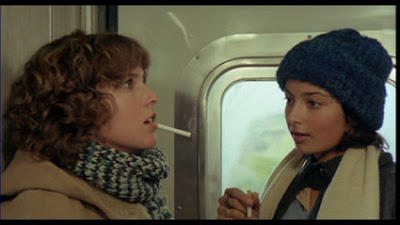
Laura Stradi [Marina Berti] and cousin Margaret Hoffenbach [Irene Miracle later to star in Dario Argento’s Inferno 1980] are on their way home for the holidays. The two girls take the train from Munich with Laura’s hometown in Italy as the final destination. But fate has other plans for them, and they never get there... On-board the train they encounter two brutish thugs; Blackie [Flavio Bucci also seen in Argento’s Suspiria 1977] and Curly [Gianfranco De Grassi] team up with the seedy blonde know only as “the lady” [Macha Mérli, best known for her performance as the psychic Helga Ullman in Argento’s Profondo Rosso (Deep Red) the same year, 1975] and set a series of sordid games in motion that lead up to the death of the two young women.  Following the deaths the three end up at the home of Professor Guilio Stradi [Enrico Maria Salerno – Inspector Morosini in Argento’s debut feature L’uccello dale piume di cristallo (The Bird with the Crystal Plumage) 1970] and his wife Lisa [Laura D’Angelo] who soon realize who they have encountered and take a violent revenge.

Night Train Murders could more or less be looked at as a chamber piece, as it mostly takes place in one location, apart from the last act. This startling thriller is simply fascinating from the opening titles with that dodgy vocal song, but more on that later, to the final shot. Because this is a well plotted, well-written and definitely surprising film.  The movie is like a jigsaw puzzle where each part interlocks with the next brining a larger image together. As I say, this is a well-plotted, well-written gem, and now I’ll tell you why!
Already during the opening titles the threat of Blackie [Bucci] and Curly [DeGrassi] is presented as they who run around Munich, stealing, roughing people up, and even robbing a drunk Santa of his few pennies before freeloading onto a train in the station. These guys, despite being stereotypical villains for Italian genre film of the time, are definitely trouble to count on for hell raising.

Six minutes in, the set up for a later twist is presented. The overprotective parents are presented through a series of phone calls to the maid who just put Laura [Berti] and Margaret [Miracle] on the train home, and Prof. Stradi [Salerno], who obviously spends his days saving the lives of people – on his way home to his wife, he stops in the corridor as he hears two colleagues talk about the unfortunate accident victim who’s life can’t be saved. The honourable Prof. Stradi hands his briefcase to the nurse and tells them to call his wife and tell her he’ll be late… a presentation of traits that later will collide, and become of importance to the story.
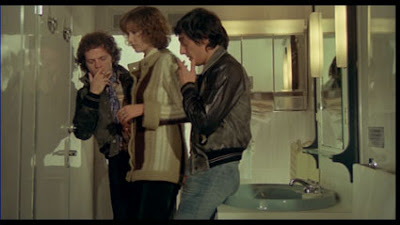
The introduction of “the Lady on the Train” [Mérli] is an interesting one. Only moments after she enters the full train carriage and giving off an aura of a sophisticated lady – later enhanced when she discusses politics with the famous politician she recognizes in the newspaper to be sitting across from her in the carriage - she accidentally drops her purse as the train shakes through an intersection. The only item that gives any form of identification of her person is seen after the contents spill out, is a sordid photograph of a group sex session. Alberto Galittini’s edits of the carriage passengers looks at Mérli is magnificent, as it taints every scene between Mérli and the co-passengers in that confined space from there on. It also indicates that the posh lady is not quite what she seems behind that strict facade. Also it’s no surprise that the scene is placed directly after the carriage of priests and bishop is presented. Contrasting the passengers in this way is a metaphor of heaven and hell, good and evil, and pretty soon this comes to ring disturbingly true.
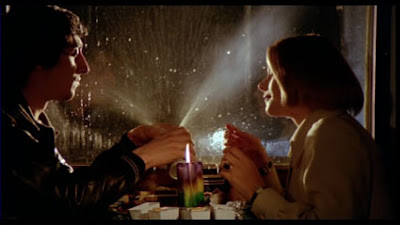
The girls are somewhat innocent kids, giddy to be away from school, smoking way to many cigarettes and exploring their sexuality – “Try leaning against the wall, you get a great feeling from all the vibration. Go on, try it!” Margaret says to Laura who answers “Yeah you are right. You think of everything.” This dialogue too is significant, as flirtation, forbidden pleasures and sexual tension is an important part of the set up.  The old saying curiosity killed the cat comes to mind.
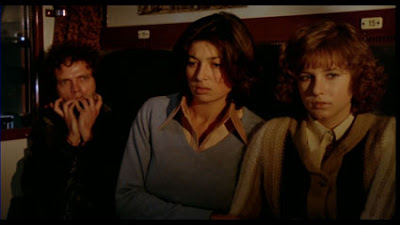
Margaret confides in Laura, her first and only sexual encounter, they pleasure themselves by the vibration of the train. Margret has a brief but daring flirt with the thugs in the train restroom, which leads to the Blackie forcing his way in with “The Lady” when she goes to the restroom, and the sexual tension between the two leads to them having intercourse… with, believe it or not, cutaways of the train entering tunnels and rail tracks. Again this is all presentation of character, Blackie is a ruthless predator who won’t take no for an answer, and with the photograph and fact that she’ll shag strange blokes in the train crapper, and we understand that “The Lady” is a lurid character.
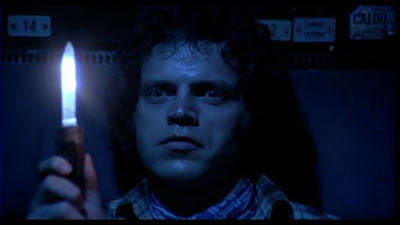
After changing trains, the girls are confronted by Curly and Blackie again, this time The Lady comforts them with the words that she won’t let them harm them. Now if they had stayed on the other train, the one filled with businessmen, politicians and the clergy, we may have believed her, but as soon as she says this, Lado takes us on a quick tour of this new train’s passenger. Prostitutes, Peeping Tom’s and Junkies… this is a completely different ride, as mentioned above, polarization is the game, and here it’s school bock example. In it’s finest form as the girls, held captive in the seedy night train, by Curly, Blackie and The Lady try to make a run for it, when Blackie beats Margaret… as she falls into the glass of the dark carriage door, editor Gallitti rapidly inserts shots of the light happy Christmas dinner taking place at their destination. Keep an eye open for Dalia di Lazzaro, from Andy Warhol’s Flesh for Frankenstein 1973, and Dario Argento’s Phenomena 1985 during this dinner party. Later Gallitti does the same when Margaret’s parents dance whilst their daughter is being raped.  As mentioned earlier, contrasts play a big part in this movie, and here’s it’s presented in it’s finest form.
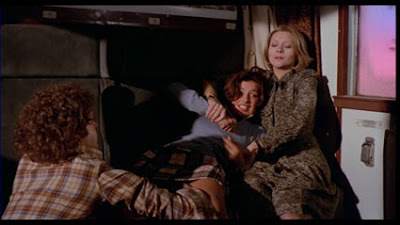
Within the dark confined space - superbly light and captured buy cinematographer Gábor Pogány who also shot Pink Floyd: Live at Pompei 1972 - tension builds, as Curly, Blackie and The Lady start off a series of sadistic games, sexually themed torments and rapes, that not only had the BBFC’s refuse to give the film a cinema certification in 1976, and landed the it on the list of banned video nasties back in 1983, but also arrives at a shocking climax leaving both the young girls dead. This hideous act propels us into the final act.
In accuracy with the original Isaksson source, the criminals arrive at the home of the victim’s parents, and as an audience we are now craving vengeance. It’s really not too complicated; once again we have an emotional recognition. We can’t experience what the girls or their parents do, but we want justice for the wring done to them.

This is where the subplot with the parent’s fading relationship and the new start this Christmas has brought hem, along with the previous establishment of their good character come into play. Blackie, Curly and The Lady, get off the train instead of the girls, The Lady with injuries obtained as Blackie beat her after the murders, is offered to come home to the ever gallant Prof. Stradi to have her wounds taken care of as his wife and he await the next train to arrive. Here the traits that where established early on come back into play, Stradi’s lack of to refuse tending to patients end up with him taking the trio of strangers home.
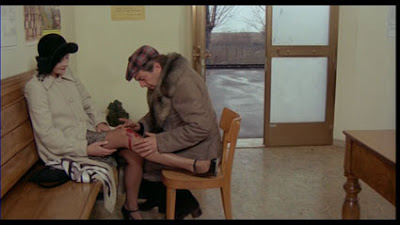
Then a streak of genius by the scriptwriters... a scene that earlier seemed to be random, falls into the jigsaw, making the fuller picture come into focus for the Stradi’s. During the opening of the movie we saw a scene where the maid who sends Lisa and Margaret to the train station on their trip home, calls Lisa, Laura’s mother, and warns her of the terrible turquoise neck scarf Lisa has bought for her father as a Christmas present. Curly steals this necktie as they toss the girls bodies and belongings off the train, and Mrs. Stradi quickly becomes suspicious of the strangers in her house. The frequent newsflashes on the radio finally reveal the identity of the two dead women found mutilated by the side of the railroad tracks, and Dr. finally snaps. To hell with moral, and common sense, emotions get the upper hand and he takes his vengeance on the thugs. The journey is complete, from respected, caring, kind-hearted man of society to cold-hearted avenger, outside the law. Just as in the Ulla Isaksson script, the question of how far would you go, what would you do, could you kill if you had the chance are posed. Harrowing questions that make the Bergman movie such a classic and poignant themes that ring true through the most of the imitations that came in it’s wake.
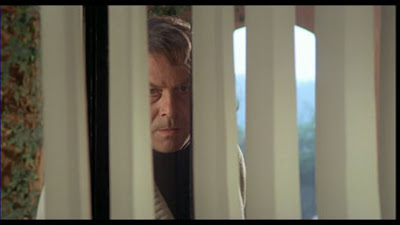
OK, so a few words on the soundtrack, because despite having something of a crap start with Demis Roussos garbing his way through “A Flower is All you need” – originally the theme song to a romantic themed animated film Il giro del mondo degli innamorati di peynet (Around the world of Love) from 1974 – Night Train Murders has a rather interesting soundtrack. Diegetic audio is of importance, as the sound of the train mainly plays as the movies soundtrack together with Morricone’s minimalistic score. But also non-diegetic audio is used to create effect. At times entire scenes off the train, inside the mansion of the Stradi’s are acted out without the correct audio. Instead we only hear the sound of the train rushing forth towards its destination.  It keeps a tension whilst showing us the contrasts, which I talked about earlier.

Harmonica is an important part of this soundtrack, as Curly frequently plays one. It also becomes an important signifier that the “Crazy Boys” also change trains when Lisa and Margaret do so at a border check earlier on. Certain that they alone in the new coach they have snuck into, they share a Spartan Christmas dinner of sandwiches and pop – kids once again – when they suddenly hear the warble of Curly’s harmonica. It’s a disturbing moment, as they react with honest fear… the crazy boys are there.

Night Train Murders still holds up, it’s a tight, tense and fairly sleazy piece that definitely is worth enjoying if you still haven’t seen it. A enthralling ride that takes some dark turns, and forces the audience to drop their morale and find their primitive being confined deep inside. Now available in it's uncut glory, with a new superior image, remastered in 1.85:1 and presented with crisp DolbyDigital 2.0 Mono from Shameless Screen Entertainment.


Thursday, April 12, 2012

The Hike

The Hike
Directed by: Rupert Bryan
Horror, 83min
UK, 2011


Spice Girls in Hell! Yeah, that’s the best description I can give you of The Hike. I dunno, but I just didn’t get into this flick at all, and it all felt like Spice Girls in Hell. A bunch of Sappy chicks go into the woods for a weekend hike, prove themselves to be complete stereotypes and fall victim of a band of geezers out for a weekend of mayhem.


Wham Bam. The Hike goes right in for the kill with it’s effective initial attack. An off-screen predator slaughters a bunch of unknown youths, we don’t really give a fuck, but it set’s the tone of the movie and establishes the killer in the woods… and because he stripped that last girl before tying her spread eagle to trees and roots in the forest floor, we know that he’s a pervy sadist too… but that’s about as good as it gets.

Quick titles and then a presentation of the gang of girls set on an adventurous weekend in the woods. Character traits are indicated and Kate’s [Zara Phythian] “the secret” is hinted. Their most successful friend, photo model Tori [Barbara Nedljakova], and her obnoxious boyfriend arrive on the scene in the last moment and makes an entrance to capture everyone’s attention. But Dean [Tamer Hassan], Tori’s huge rough boyfriend starts pushing Tori around, Kate steps in and takes him down – another reference to her time in the army.
So these tough Grrrls, fully capable of taking care of themselves get deep into the woods and bump into a bunch of typical adrenaline junkies. You know the kind and you probably hate them just as much as I do. Buffed, fit bastard urban adventurers, and the girls turn into moist crotched giggle buns, fully intent on getting it off with the boys. Or at least being cock teases. Surprise, surfukingprise when the lads turn out to be sadistic sex predators on their annual, let’s go rock climbing and rape-murder any unfortunate women that come along… Yes predicable as hell and the only person who you know will make it through is Kate, because she’s been in the army and it’s pointed out so blatantly over and over again that you know her repent rage, sadness and frustration over her deal boy friend is going to come back and motivate her to take revenge when push comes to shove.

There’s some really annoying and stupid dialogue at times, like when they talk about not having cell phone coverage, - what moron writes dialogue like that 2012? Break shit, loose shit, fucking run out of batteries, but don’t DON’T write no coverage dialogue. Oh I almost forgot the ridiculous dialogue where one girl freaks out over the “rest room” being out in the woods, Öh what part of Hike didn’t you get… Ok I can take that the photo model is supposed to be some sort of comic relief, but it’s still annoying.

The salvation of the movie is to be found in Kate. As said, the backstory of Kate is referenced several times, before she finally tells the girls what happened on that occasion they have been avoiding to talk about when she’s around. Sat round their camp she tells them how her partner was killed in action whilst they served time in the army together. And what better time to attack the girls! When Kate has opened up and exposed her vulnerability we empathize with her, and an attack at this point in time only helps create empathy for the characters. It almost works, and where you perhaps root for Kate to make it through and get the vengeance she’s entitled to, you just want the rest of the girls’’ dead.

The Hike get’s a two out of six. It was a clear disappointment although it had a promising set up and a decent idea going. Unfortunately it is devoured by convention, predictability and really shitty dialogue. In a nutshell it’s a cheap Rape-revenge knock off of Neil Marshall’s The Descent with a paper thin plot, shallow characters and crap dialogue – YOU DO NOT WRITE SCENES WHERE CELL COVERAGE CONVENIENTLY RUNS OUT AT A BAD TIME AND HAVE CHARACTERS TALK ABOUT THIS IN DIALOUGE. YOU DON’T!


Disney Star Wars and the Kiss of Life Trope... (Spoilers!)

Here’s a first… a Star Wars post here.  So, really should be doing something much more important, but whist watching my daily dose of t...