Showing posts with label Lucio Fulci. Show all posts

Sunday, March 17, 2013

Howlers of the Dock


Howlers of the Dock
Original title: Urlatori alla sbarra
Directed by: Lucio Fulci
Italy, 1960
Comedy/Drama/Music, 83min

It may seem odd that Lucio Fulci, the guy most of us associate with gruesome gothic shockers of the late seventies, early eighties – or lush thrillers and Gialli of the mid sixties, late seventies, started off as a director of comedies. It may seem even stranger that he started off with a string of musical comedies, showcasing young talent breaking out in song and dance at any given moment… or is it? Well not really, as the more you learn about Lucio Fulci, the more you learn to understand his versatility and perhaps foremost, appreciate the immense talent this true master of cinema held. For example, did you know that he only ventured into filmmaking as his girlfriend of time ditched, him making him take up film studies instead of medicine instead? Did you know that not only wrote and directed a bunch of fairly successful musical comedies for Italian pop star Adriano Celentano, but also wrote a couple of his most successful songs!
Let me put this into context for you. As a young man having left his initial passion of medicine behind and taken up studies at Centro Sperimentale di Cinematografia, Fulci graduated in 1948 and headed straight for work as an assistant in the world of cinema. Apart from assisting directors such as Max Ophüls, Marcel L’Herbier and his mentor Steno, Fulci frequently wrote art and film criticism for local papers. After a few years of working his way up, co-writing scripts, assisting second unit, shooting second unit for his mentor Steno, and comedian Totò, Lucio finally got the opportunity to direct his first feature, the comedic crime flick I ladri (The Thieves)1959. Using his connections within in the industry, he managed to get Totò to star in this debut film, and undoubtedly hoped for some of his popularity to rub off on the film, possibly generating a success similar to those earlier of Totò’s films… although this was not meant to happen. I ladri bombed and made no major imprint at all. Instead Lucio set sights on a new target audience, the youth of Italy, and what better way to captivate them but with rock’n’roll and rebellion!
The same year of the disastrous I ladri, Fulci set pen to paper, came up with a script, stepped behind the camera once again and directed Ragazzi del Juke Box (The Jukebox Kids), a light hearted comedy with loads of swinging tunes, upcoming musicians like Celentano, and hot young talent like Elke Sommer. Ragazzi del JukeBox also starred the song Il tuo bacio è come un rock, with lyrics written by the Fulci and performed in the film by Celenato, and also featured on his debut album of the same name. On that album Fulci co-wrote the tracks Blue Jeans Rock and Nikita Rock (Blue Jeans Rock featured in Howlers of the Dock). Fulci would later write yet another track for Celentano - 24 Mila Baci, which still to this day, turns up on summer compilations in Italy. Bet you didn’t know that did you? Pretty fucking cool right! Just more reasons to love the maestro.

Ragazzi del Juke-Box was a decent success for Fulci and led to him teaming up with the same co-writers and talent for a second spin at the musically oriented comedy. This time Urlatori alla sbarra (Howlers of the Dock).

Howlers on the Dock uses what is kind of a typical Fulci trait, a satirical approach to politics of the time. (If it wasn’t politics, it was religion) I with no doubt in mind consider this film, despite it’s light-hearted tone to be a satire, as the government try to change something that they can not control and fail miserably…
Howlers of the Dock, starts off with a board of executives demanding an investigation into how to stop and control the provocative Teddy Boys that are roaming the streets bringing a bad reputation to “The Blue Jeans Company”. Guessing that sales of Jeans will drop if associated with wild hoodlums, they try to ban the gangs and their music. After establishing what we could call the threat of the film – the banning of fun – Fulci brings on the bunch of swinging hepcats, or misfits if you will, through a bitchin’ party where both Adriano and Mina (another at the time upcoming artist) as they take turns singing a few tunes, whilst Gianni Di Venanzo’s camera circles the party showing us the who’s who of the gang. This opening sequence also introduces the peculiar – or genius – casting of Chet Baker! They sing, the dance, they goof around and do the shit that kids with a rebellious streak do.

The second main narrative focuses on a romantic tale between Guilia Giommarelli [Elke Sommer in one of her first starring roles] and Joe il Rosso [Joe Sentieri, who at the time was though of as the leading man, although in the wake of Celentano’s success to come, the film became a Celentano film and Sentieri secondary when it was reissued in later years].
With the "adults/government" trying to ban the rocking kids, Guilia, who’s father, not only is part of the board of executives seen earlier, but also a producer of a successful variety TV show on RAI, introduces him to the gang during a party thanks to Guilia. Her motif is obviously to help make her love interest Joe a star. Here's where that great Fulci irony comes into play. Following some daughterly manipulation she persuades him to give Joe a shot on his show – Adriano get’s one too – and hey presto. Joe is showcased too millions of viewers, although his song is a safe croonery one, and Adriano’s a shit kicking Elvis inspired number. The ban is shattered, the kids win and rock’n’roll is unleashed upon the nation - state fails again.  
The bands of friends are more or less a comic ensemble, one guy has a Marlon Brando fetish, one dresses as Davey Crocket, another two as cowboys. The women sing, dance and flash jazz hands en masse as everyone get’s at least one number during the course of the film. One spectacular number see’s the kids racing mopeds down the streets to a backdrop of projected city images, although the highlight in my opinion is the park make out session where Chet Baker sings and plays his trumpet in the way only he can.
There’s not really much of the Fulci we are familiar with here, apart from the irony and satirical approach to the theme. Howlers of the Dock is very much a nice and safe musical with all the trimmings. Bursting into song and dance, strutting spastic moves and catchy tunes in Italian may not be what the gore fans of Lucio Fulci want to watch. But it’s still a decent movie and if nothing else it’s a fun time capsule. This is Lucio Fulci’s version of a Cliff Richard film or a Jerry Lewis comedy. Adriano Celentano continued to have a successful career as a singer and as an actor in Italy. Apart from his collaborations with Fulci, he also held the lead in Dario Argento’s failed satirical period piece Le cinque giornate (The Five Days of Milan) 1973.
Personally  this movie is appealing to me is because of the fact that infamous bad boy of Jazz, Chet Baker, holds a part in the cast. His presence is commonly referred to as a cameo bit, but it’s much more than a cameo, he’s definitely a supporting cast member and is even credited in the titles – as Chet, the American. A few noteworthy facts/stories about Chet Baker's time in Italy are well worth sharing, such as the one that he was supposedly wasted on heroin throughout the production. Or that he was busted by the cops for heroin possession and spent a year in prison (most likely after the filming). During his time in Italy he also recorded several tracks together with the great Piero Umiliani! The film I Soliti Ignoti (Big Deal on Madonna Street) 1959 features the first appearance of their collaboration and it’s also the first Italian comedy to experiment with the use of Jazz on the score. 1961 saw the release of Smog, where Chet again is featured and is considered to be a highlight of Jazzbased soundtrack productions. Many of the tracks they made together would later surface on the albums Italian Movies, released in 1999 – something worth checking out if you dig Umiliani and/or Baker's music. Despite said to have been a wreck on set, Chet has a few small scenes where he’s present in more than a cameo appearance way, he interacts with cast, has a few lines and even manages to sing a song. Although the film primarily featured a score by Umiliani, Baker sings Umberto Bindi’s Arrividerci. This scene is also the one that closes Bruce Webber’s Chet Baker documentary Let’s Get Lost released in 1988.
Howlers of the Dock, the third ever feature film from the master of the macabre, Lucio Fulci, is quite a novel film. I like it for it’s harmless charm, silly comedy and rather catchy soundtrack. Never the less, the film and it’s theme of revolt and satire earned it a “E” rating from the Catholic Church and nobody under 14 was admitted into cinemas screening the film. Being a fan of Umiliani’s work and a huge admirer of Chet Baker, this is an essential Fulci film for me as it sees’ three very different creative forces melding. Three forces that all stand at their polarized corners in an assortment of ways, but still housing uncanny similarities.

I’ll leave you with the song Arrividerci as sung by Chet Baker in Lucio Fulci’s musical comedy Howlers of the Dock in 1960...


...and Adriano Celentano, always the goof, singing Blue Jean Rock (with Fulci lyrics) on some TV show in the eighties.


Friday, May 04, 2012

Don’t Torture a Duckling


Don’t Torture a Duckling
Original title: Non si sevizia un paperino
Directed by: Lucio Fulci
Thriller/horror, 1972
Italy, 98min
Distributed by: Shameless Films

I won’t start this with a rant on how Lucio Fulci made so much more than the classic video nasty’s he’s infamous for.  I’m quite convinced that anyone who really bears a passion for the works of the late master of genre, will already have ventured back past those seminal works and discovered the real masterpieces of suspense and thrill, hidden away in his back catalogue. If you haven’t seen the movie, I’d recommend that you first check it out before we get into this, as certain spoilers are featured in this text. If you know the movie, then buckle up and let’s go.
I’ve already covered some of the early pre-Gialli thrillers such as Una sull’altra (One on Top of the Other) 1969, Sette note in nero (The Psychic) 1977, and even a couple of the comedic works such as All’onorevole piaccino le donne (The Senator Prefers Woman) 1972, Il cav. Constante Nicosia demoniac, ovvero: Dracula in Brianza (Young Dracula) 1975, and even a few of the Spaghetti Westerns; Le colt cantarono le morte e fu… tempo du massacre (Massacre Time) 1966 and I quattro dell’apocalisse (Four of the Apocalypse) 1975. It’s time to take a look at the bookend movie of the early thriller trilogy, Non si sevizia un paperino (Don’t Torture a Ducking). On one of the greats from his early period, one of those movies where he was started to perfect the themes that would make him a god amongst fans of genre cinema in the years to come.
In a small rural village, someone is murdering young pre-adolescent boys. The Carabinieri are stood almost helpless as they have a hand full of suspects ranging from the village idiot, to the witch who roams the landside, to the shaman who taught her his magic. A curious journalist arrives in the village and together with a somewhat strange choice of companion, starts to poke around the case, coming to a shocking conclusion about the killer’s identity.
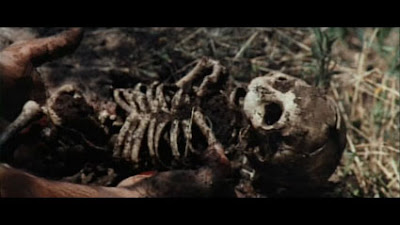
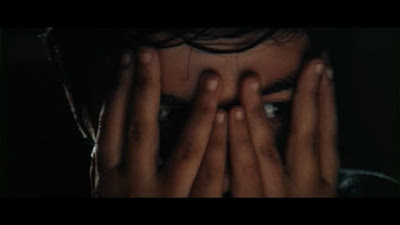
I often talk about setting tone as early as possible… Well try this on for size: a woman [Florinda Bolkan] claws at the dirt under a motorway overlay. Her thin soiled and bloodied fingers produce the skeleton of an infant from a shallow grave in the dirt. A young boy (Tonino) shoot’s a stone from his slingshot that upon impact crushes the small lizard he was aiming at whist he sits keeping lookout for a specific car to swoosh by. Editor Ornella Micheli (Fulci’s frequent editor before Vincenzo Tomassi made his entrance) rapidly establishes the small village with a series of fast edits to the diegetic sound of church bells ringing. We enter a church in mass, were two young boys  (Bruno and Michele) sneak out to share a gauloise under the same overlay we saw earlier. Tonino comes running towards them whilst screaming, “They’re here, they’re here” and the trio run off to a shack, where some blokes greet the two prostitutes who have exited their car. The women have  “tits like water melons” in the excited boys’ opinions – but the village idiot Giuseppe wrecks their intended session of sordid voyeurism. Instead they turn their attention on him and start verbally bullying him, as he too was planning to watch the two men shag the prostitutes. As they boys taunt Giuseppe, he screams that he will get they, he will get them…
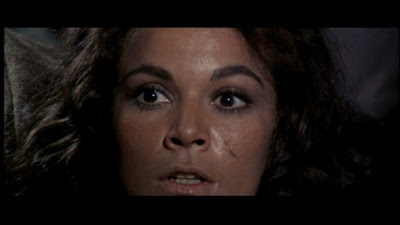
Potent stuff, and definitely an impressive couple of minutes which accompanied by Riz Ortolani’s short but harsh stinger cues, establishes a lot of stuff, which will come to play within the movies narrative later on. But be alert, those moments establish more than you could ever have guessed. The location is set, a small rural village, where the church is the centre of the town. The crazy woman – Florinda Bolkan’s is presented, and we understand that there’s a dark secret in her past. We learn that the kids are adolescent young men with a budding curiosity of the opposite sex. But they are still kids and can easily turn from their sexual curiosity to a taunting mob, which evokes fear in those they decide to single out. In the subtext we can assume that sex is something sacred and kept within the confinement of the family unit. This can be presumed as the village is most likely a stern follower of catholic values, and the men take their “imported” prostitutes to a shack outside of the village vicinity. But it’s not all presumptions, this is all true, and will give you a rush of insight upon the conclusion of the film.
If you know your Fulci, then you know that he enjoyed giving the church a kick in the ass on any given moment. My theory is that it's due to the tragic events in his personal life. I can’t really see a creative person being a devout follower of religion, when that religion takes away loved ones. Somewhere that bitterness has to vent, and I’m saying that the way Fulci aimed critique towards the clergy was one of them.
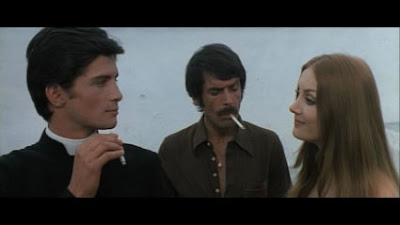
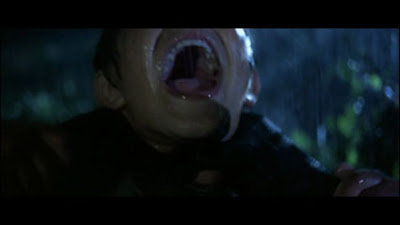
There’s a delightful irony that motivates the murders and definitely a provocative one in more than one way. The village priest, Don Avalone [Marc Porel], is the murderer of the piece, and it’s not only a stern poke at the church, but it also presents a delightful dilemma as one can in some strange way empathize with what Don Avalone is trying to do. In his complex state, his philosophy is to kill the yearning young lads as to protect them from committing sin, hence allowing them to enter heaven instead of the burning pits of hell. I’m a sucker for the moral twists of doing bad, for doing good, and Fulci nails this one on the head. Then he makes the priest – or the clergy in the larger picture – pay a most terrible and harrowing death as he has his face torn to pieces against the rock walls, before breaking every body in his bone when he smashes into the hard rock below. If there was one thing Fulci could do, it was provoke.
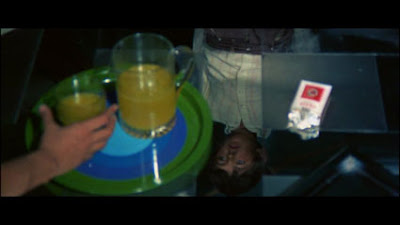
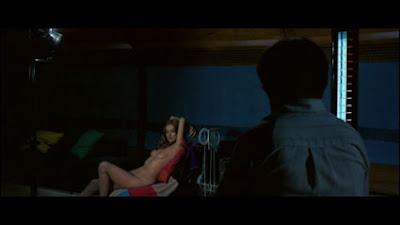
But perhaps the most provocative moment of the movie is found early on when Barbara Bouchet’s character Patrizia, who oddly enough rents a penthouse flat above the Spriano family, reveals herself as a paedophile! Now this isn’t a Feliniesque moment like the opening one, where the lads merely want to catch a glimpse of the prostitutes “tits like melons”. This is a raw, confrontational, full on flirtation where the fully naked Patrizia invites Michele to go to bed with her. If not for being saved by his mother who calls him back to the first floor. Patrizia, talk about a complex character, and it’s later revealed that she not only has an appetite for young boys, but she’s a recouping Junkie too…  Not that this was the first time Fulci, used paedophilia to provoke, it plays a vital part in the narrative of Beatrice Cenci 1969 too, where both Tomas Milian and Georges Wilson are part of the cast. Fulci, no stranger to getting in trouble with the law – i.e. the puppet dog incident following Una Lucertola con la pelle di donna (Lizard in a Woman’s Skin) 1971 – once again ended up facing another trial when the scene where the naked Bouchet takes to seducing Michele caused a stir. Always the one with an ace up his sleeve, Fulci presented the "little person" Don Semeraro (who almost thirty years later stared in Joe D’Amato’s The Hobgoblin) who had been the stand in for the child actor, and the case was dismissed.
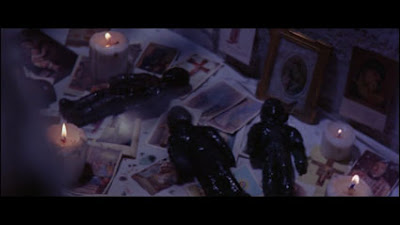
So how does this come together with the opening montage? Well basically Florinda Bolkan’s Macaria character is insane the whole time. Yes, she performs her voodoo-like ritual with the three dolls in the images of the three taunting kids – I told you they where trouble, and they disturbed the grave of her child, hence forcing her to move the dead baby from it’s resting place and have her perform her mumbo jumbo voodoo vengeance. But that’s merely a red herring to toss you off track, just as the trail of village idiot Giuseppe [Vito Passeri] is too. Barbara Bouchet is a red herring too, despite her wonderfully complex character. The church and the whole Catholic Church bit is all about Don Alberto’s modus operandi. Yes, there is a veil of Catholic values draped over the town, and to save the children from corruption – which we see they are on the way to being with the smoking and desire to peek at prostitutes, and possibly masturbate at the same time – Don Alberto saves their souls by murdering them. Then in the last moments of the movie, good Old Catholic guilt comes over him and he takes his own life… ironically as suicide damns the deceased to an eternity in purgatory.
There’s an interesting use of the off-screen space in Don't Torture a Duckling. At first several characters are isolated out  there, the killer, and at least two pairs of hands tampering with the voodoo dolls. The off-screen space had been a safe haven for murderers to lurk around in since Powell’s Peeping Tom and Hitchcock’s Psycho, both 1960, and a genre-defining trait when it came to the Giallo. What Fulci does is use it wisely; he keeps the characters in the off-screen space until he needs to reimburse them into the narrative. Such as when we need to introduce a second red herring, and Bolkan’s character finally comes into frame after tampering with the voodoo dolls off screen since the opening.
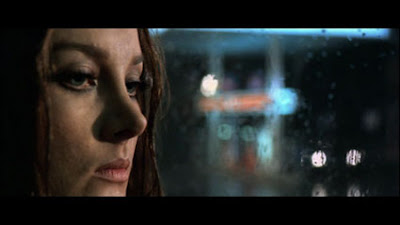
It’s said that Don’t Torture a Duckling was Lucio Fulci’s personal favorite amongst his films, well looking at the movie from a retrospective angle, it all rings true, in some way’s the movie is more a piece of Neorealism, with a smidgeon of thriller traits added. It’s definitely the Fulci movie that lies closest to Neorealism, and it is a fair interpretation, which possibly could explain why he was so fond of this little obscure gem. Considering that Neorealism is the big Italian contribution to film history, one can understand his fondness for the film.  With the knowledge that Don’t Torture a Duckling was Lucio’s favourite film, this could explain the reason why he later used several key moments –and beats - from this movie in his later more typical horror films.

Chains whipped against a tender frame of human flesh, creating deep gory gashes, which you all know and love from the “You ungodly warlock” opening of  …E tu vivrai nel terrore! L’alidià (The Beyond) 1981, when a band of villager’s once again take vigilante justice into their own hands. A face being smashing against side of mountain as character plumages to death and presents insightful inner dialogue at the same time, much like the opening visions that torment Jennifer O’Neil in The Psychic. Amusingly enough the film also features a first poke at Disney and primarily Donald Duck. A Donald Duck doll is decapitated and it’s torso dragged around. Originally Fulci wanted the movie to be titled Don’t torture Donald Duck, but when Disney protested, the title was changed. Exactly ten years later the killer of Lo squartore di New York (The New York Ripper) 1982 would disguise his voice and talk like Donald Duck, and Fulci finally got his poke at the cooperate suits of Disney Co.
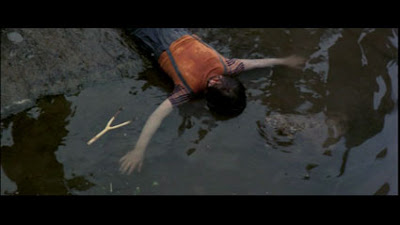
Don’t Torture a Duckling really is an “all comes together” flick in so many ways. Fulci has an amazing cast, several of which he’d worked previously or would work with again; Florinda Bolkan, Tomas Milian, Marc Porel and Georges Wilson. Not forgetting one-offers like Irene Papas, despite holding a rather small part, and Barbara Bouchet, who delivers a great performance here. Keeping that tight Fulci grip on those he enjoyed working with, the maestro delivers a movie with a water tight script, penned by Fulci, Gianfranco Clerici and Roberto Gianviti (who wrote a stunning twelve screenplays together with Fulci through the years), editing is superb and definitely amongst the best of the eighteen flicks Ornella Micheli cut for Lucio, and without saying, Sergio D’Offizi. Damn, the more I see of this man’s work the more it becomes a mystery to me why he never landed an international career like, say Vittorio Storaro. At least give the man an honorary award because, some stuff like Don’t Torture a Duckling and not forgetting the innovative “found footage” approach of Deodato’s Cannibal Holocaust 1980, is all D’Ofizzi. Someone give credit where it’s due!
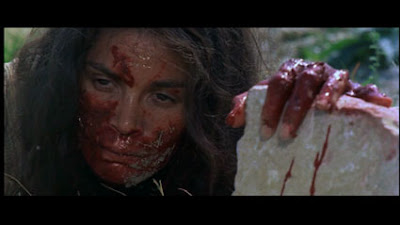
Riz Ortolani’s score, which is pretty tender at times, has a short moment that fan’s of the Cannibal Holocaust soundtrack will recognize. Not that it’s a complete tune or anything like that, but there’s a small build which Ortolani later used on Cannibal Holocaust and if you know that soundtrack you will find it. Following the violent beating of Florinda Bolkan one can hear the song Quei giorni insieme a te, performed by the domestically renown Ornella Vanoni. It’s a delicate piece written by Ortolani and Jaja Fiastri which definitely set’s a sentimental mood for Bolkan’s dying moment… but just wait for a moment, things are about to get kinda strange here. I’m more curious about the funky shit-kicker Crazy, here performed by Wess and the Airedales, the same funky ass shakers that played on stage in Umberto Lenzi’s Orgasmo 1969 and Paranoia 1970. The same version of Crazy (originally written by Armando Trovalioli), which is heard on the soundtrack to Dino Risi’s Vero Nudo 1969… Now take a guess who wrote the screenplay to Vero Nudo? Jaja Fiastri, the same who wrote Quei giorni insieme a te with Riz Ortolani. Just another reason why I love Italian genre, it’s all interwoven and connected to and fro for all eternity through captivating intertext.
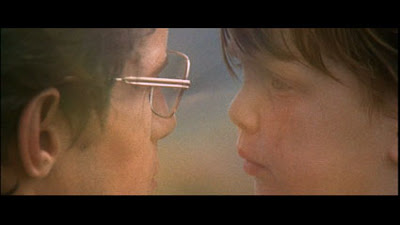
Unlike other releases, Shameless have given the movie a release with the original Italian soundtrack, and an optional English Dub. Now I do find that these movies are more fun with the English dub, but I also prefer to be able to watch them with the original language option. Thanks to Shameless, that’s now an alternative. If you watch one version of Lucio Fulci’s somewhat overlooked masterpiece Don’t Torture a Duckling, then make sure it’s the Shameless Films Version.

Friday, February 10, 2012

Friday's Fun with BluRay


Just as much as I hate that BluRay brings out the flaws in all my favorite movies, I love that BluRay brings out the details in all my favorite movies...

We where sat in the new cinema at the new office watching the new BluRay of George A. Romero's gritty climax to the original Dead trilogy, Day of the Dead 1985, when secrets that have been kept safe from the eye in previous versions - yeah think umpteenth version dupe, as that's how I first was introduced to this movie decades ago - where suddenly unleashed upon the bunch of us who'd gathered for our weekly dose of big screen carnage.

Day of the Dead is riddled with referents to previous installments in the Romero franchise and also several nod to other classic movies and horror related themes. There's the grand opening which sees Sara [Lori Cardille] have something of a recurrent nightmare. It not only set's the theme of pending doom, but it's also an obvious Roman Polanski's Repulsion 1965 homage. There's the nickname of Dr. Logan [Richard Liberty], Frankenstein - a contemporary spin on the creation of the modern Prometheus, as he tries to tap into the zombies primal "human behavior", and there's referrals to names from previous installments, and the obvious Stephen King's Salem's Lot nod.

But the minimal scene that caught my attention was the scene at the beginning of the movie - let's call it the ordinary world if you like - after the Repulsion prologue, where Lori and Miguel [Antoné DiLeo] are scouting the town for survivors, but merely awaken the horde...

After the crocodile crawls out of the bank, but before the iconic image of Dr. Tounge and the titles are up on screen, there's two shots of a zombie coming out of the Edison Theatre, and in the background of this wonderful high-defenition print from Arrow, you can make out two great posters on the outside of the theatre...

The images are posters for Lucio Fulci's Conquest 1983 and Enzo G. Castellari's I guerrieri del Bronx (1990: The Bronx Warriors) 1982. (There's a third poster hidden behind the door that seems to be shark related, but I'll leave the imagining up to you)

Now this may just seem to be random images which one may come to expect outside an old theatre... but these movies where movies that had a couple of years on their neck at the time Day of the Dead was shot. As far as I'm concerned I'm quite sure that this is a deliberate decision made by Romero - who's movies frequently hold nods to other films, filmmakers and writers that he appreciates - and his longtime collaborator production designer Cletus Anderson, art director Bruce Allan Miller and set designer Jan Pascale.

A great little secret, or perhaps homage, that's been hidden in generation loss and inferior quality since 1985, now finally sees the light of day!

Friday, December 23, 2011

Young Dracula

Young Dracula
Aka: Dracula in the Provinces
Original Title: Il cav. Costante Nicosia demoniac, ovvero: Dracula in Brianza
Directed By: Lucio Fulci
Italy, 1975
Comedy/Horror


I like to refer to it as the calm before the storm, the calm before second coming of Lucio Fulci. The movies he made after the impressive Gialli/thrillers, but before the magnificent grotesque movies that firmly placed him in horror mythos.

As you most likely know, Fulci started his career with comedies and dramas, so they are an important part in the fundament of what would come later on. With that I’m referring to the at times terrifyingly dark humour that is found in his films. Light dramas, saucy comedies, and fun fun fun is somewhat of a strange contradiction to the images and movies one associates The godfather of Gore with, but at the same time, if you weren’t making salty thrillers, westerns or horrors then it was the sexy comedy that the audiences in Italy wanted. Fulci was no stranger to making comedies; he even began his career as an assistant to the legendary Italian comedy director Steno, so comedies have an important place in his filmography. And before that second coming, Fulci directed some very interesting comedies that deserve to be rediscovered.

Young industrialist Costante Nicosia [Lando Buzzanca, who did a brilliant job as the politician with a bum-grabbing fetish in All'onorevole piacciono le donne (Nonostante le apparenze... e purché la nazione non lo sappia) (The Senator Likes Women) 1972, and his last leading role for Fulci] is the Toothpaste King. Despite being tremendously wealthy, the envy of town and married to beautiful wife, Mariú [Sylva Koscina], Costante is somewhat unhappy in his life as it is. His superstition has him convinced that he’s plagued with bad luck and watches carefully for all omens of evil forces. After insulting an old aunt at, a very gothic, dinner, Constanta takes off for a business trip to Romania.

In Romania, he goes to visit Count Dragulescu [John Steiner who’d starred in films for Fulci previously, and would go on to act in many classic genre pieces from here on] for a grand feast. After a series of comedic encounters and misunderstandings, Costante is binging champagne and making out with luscious women… only to wake up in the bed of Dragulescu. Upon his return to Italy, Costante is a changed man in more than one way. Convinced that night in the Romanian Count’s bed has turned him into a homosexual vampire, Constanta starts a transformative soul search that will take him on an unforgettable journey.

Getting into an Italian comedy from the seventies isn’t really as difficult as one would think. Fulci’s comedies are seldom straight forward slapstick routines, but more on the satirical side. Young Dracula goes for the jugular; the jokes sometimes racial, crude and chauvinistic, sometimes classic situation gags still do the job. Perhaps not as much tongue in cheek as something like The Senator Likes Women, Young Dracula has its moments where I almost feel as if Fulci is parodying the erotic comedy genre too. A specific scene where Costante confronts Mariú in the bath, should have been an obvious place for a saucy shot of nudity, instead Fulci uses it to present a gag about Costante‘s lust for blood. It’s also a vital scene for the shock ending that Fulci has prepared.

The main question is obviously does it work? Well yeah sure it works. It may not have the same natural appeal as the horror pieces do, but at the same time it’s a movie that mocks the genre and specifically the vampire niche. It does deliver quite a lot of laughs, there’s some nudity, and Buzzanca delivers a solid performance once again despite sporting a terrible Harry Reems moustache. I only mention that, as Christa Linder who’s to be seen in the movie would star against Reems the following year in his last adult film, Mac Ahlberg’s Bel Ami 1976. Young Dracula also features a tiny, but early appearance by very young Ilona Staller long before the days of being an Italian politician...

There’s no doubt about it, this is very much a Fulci movie. It’s riddled with typical Fulci surrealism. There’s a creepy atmosphere pre-dating David Lynch whilst an odd opera is held in a dining room at the hotel in Romania. A serious injury at the factory is shown in its gory glory. Costante has weird and frightening, but at the same time erotic nightmares. A slaughtered horses head is graphically on display, there’s an ungodly warlock [Ciccio Ingrassia] who holds an séance and one woman slits her wrist with a straight razor to feed Costante the blood of the proletariat. So yeah, this is Fulci-land indeed.
There’s a wonderful confusion to be found in Lando’s Costante character arc, on several occasions I find myself thinking of Robert Bierman’s Vampire’s Kiss 1988 and Margheritti/Morrissey’s Blood for Dracula 1974, the year before Young Dracula, which also is an alternative title to the Udo Kier, Joe Dallasandro vehicle. It’s a decent character arc that he has through the movie. After all he goes from superstitious, frustrated man to calm and relaxed, with a few bumps along the way.

Every approach to his wife, she’s got some excuse to avoid being intimate. This obviously results in a couple of skits and laughs in the early half of the flick when establishing Costante's sexual frustration of never being allowed to get cosy. Lines like “Don’t mess my make up, don’t tear my dress, don’t mess my hair… then you complain that a man picks up a hooker once in a while…” establish a clear image of this love sick man longing for some closeness. Although he’d probably never approach a whore, it’s still this yearning that makes him fall for the Vampires
erotic seduction later in Eastern Europe. Another important plot device presented in the first half is Costante's superstitious mind frame. He points out that he’s cursed with bad luck, freaks out when seeing a black cat cross the road, get’s hysterical when he accidently breaks a mirror in his wife’s room, and even tosses salt over the shoulder of the airplane pilots for good luck when he travels to Romania. Just like the sexual frustration, the superstitious side of Costante goes away with his transformation. Even the dog Gestapo that barks and snarls at him every time he arrives at his office block, runs and hides after Costante’s trip to Romania.

There’s a gay undercurrent to be found. At first Costante is avoidant of the male vampire in the castle despite several approaches, Costante backs away, almost repulsed. After almost fainting in the showers of his basketball team, he goes to a doctor pulling the old classic “ a friend of mine…” only to come up with the answer that he’s probably becoming a homosexual! When the doctor encourages Costante to go straight to his mistress to find out if a woman can still arouse him or if he actually was “deflowered” in Romania. But whilst chasing her across a field she trips and cuts her knee… Costante cant resist when being requested to sucking the bloody wound to save his mistress from blood poisoning, and in a metaphorical way, his vampire virginity is taken. Moments later she slaps him hard in the face because of the “love bites” on his neck. Despite the serious topic, Fulci quickly returns to the gags, after all this is a comedy.

The movie is high on production value and sees most of the familiar names that I associate with the really great Fulci movies. Frequent collaborator on early Fulci movies, editor Ornella Micheli is on-board, and does a wonderful job of it too. Sergio Salvati who shot almost all of the great classic Fulci movies brings a familiar look to the movie, and some scenes – even though being comedic – would easily fit into the horror canon.

The screenplay – written by amongst others Pupi Avati, Mario Amendola and Bruno Corbucci does what it should, there are some genuine laughs in there, and Fulci obviously brought his surreal grotesque to the table considering certain moments of the movie mentioned above.

But why is this a lost movie, still only available on shoddy bootlegs sourced from that even rarer Greek VHS? It’s odd, as Young Dracula easy could compete with the other comedies released so far. Perhaps the movie was forgotten by time, as Fulci himself never really appreciated the movie. A shame as it’s certainly got a lot going for it, and a restored version should be of interest for fans. Considering that I maniaci 1964, The Senator Likes Women 1972, La Pretora 1976, all received this treatment – not to mention those titles released in Italy - there’s no reason why Young Dracula shouldn’t. I’m keeping my fingers crossed because this one is an entertaining, and interesting movie considering that this is the Fulci comedies that plays closest to the sphere we all associate his name with - the horror genre.

Polish up on your Italian and enjoy, this would never have happened in the days of VHS.

Disney Star Wars and the Kiss of Life Trope... (Spoilers!)

Here’s a first… a Star Wars post here.  So, really should be doing something much more important, but whist watching my daily dose of t...