Showing posts with label Edda Dell'Orso. Show all posts

Monday, October 14, 2013

Last House on the Beach


Last House on the Beach
Original title:  La settima donna
Directed by: Franco Prosperi
Italy, 1978
Drama/Thriller, 86min


Franco Prosperi, no not the Mondo maverick, but the other Franco Prosperi, writer of such classic films as Jess Franco’s Mondo Canibale (White Cannibal Queen) 1980, Mario Bava’s La ragazza che sapeva troppo (The Evil Eye) 1963 and Ercole al centro della Terra (Hercules in the Haunted World) 1961 - which he co-directed with Bava, and director of low budget and exploitation films such as Un uomo dalla pelle dura (The Boxer) 1972 and this one, Last House on the Beach, serves up a decent home invasion rape revenge yarn with a solid set of actors like Ray Lovelock, Florinda Bolkan, Sherry Buchanan and Laura Trotter in the cast!
Basically, and vaguely, The Last House on the Beach is yet another take on Ingmar Bergman’s Jungfrukällan (The Virgin Spring) 1960, written by Ulla Isaksson. The same movie that inspired sardonic grit-fests like Wes Craven’s Last House on the Left, Aldo Lado’s L’ultimo treno della note (Night Train Murders) 1975 and Ruggero Deodato’s La casa sperduta nel parco (House on the Edge of the Park) 1980, and also this variant Franco Prosperi’s La settima Donna (Last House on the Beach).

Three bank robbers, under the lead of Aldo [Ray Lovelock], take to hiding in a summerhouse inhabited by Sister Christina [Florinda Bolkan] and half dozen young women. The men take the young woman hostage – after beating the maid to death with a hot iron.  Tension builds as the thugs start to rape and abuse the women one by one, eventually forcing Sister Christina to go against her faith, refuse to turn the other cheek and start to take revenge!
Romano Migliorini and Gianbattista Mussetto wrote a screenplay from the story by Ettore Sanzò. Ettore Sanzò had previously written screenplays to Aldo Lado’s Night Train Murders and Massimo Dallamano’s magnificent La polizia chiede auto (What have they done to Your Daughters) 1974, so Sanzó had been up the “young women in peril” street before. Despite being gritty, misogynistic and grim, the movie is still somewhat cheesy, possibly more due to the shoddy dubbing more than the actual performances or narrative.  But not all is lost, some effective passages of dialogue work in a timeframe that helps set a time limit and a tension builder in the shape of the returning buss that will arrive and pick up Sister Christina and the young women. In some ways it works as a reliever as we know help – or possible salvation – will be on the way, but when the Nuns at the convent call, without getting through, to tell them that the buss will be a da late, it works as a tension builder instead. Sister Christina is relying on keeping everyone safe until the buss arrives on the third day, but as this isn’t going to happen, tension builds to a boiling point… well kind of.
Characters are polarized; the male bank robbers are sinister, randy and somewhat dumb, whilst the girls are gentle, savvy and innocent– despite an early scene where they slip out of their tops whilst sunbathing, but quickly put them back on when Sister Christina approaches the pool area. This is simply Good versus Evil, with the exception of Lovelock who, in this mix, comes off as a dimensional character. (Which he isn’t really.)
Lovelock acts as something of a red herring, as he at times steps in to stop abuse, or help a girl out, but on the other hand provokes the two other kidnappers to go over the edge, holds a knife to Sister Christina and forces her to watch the other two thugs rape one of the young women. He also has a strange flirt with Margret [Luisa Maneri] who he bonds with and shows some form of affection for… but we all know that just below the surface it’s old school manipulation!
As all rape-revenge flicks, the main narrative is to push the god-fearing protagonist as far as possible until this character snaps and becomes a like worthy or equal force of antagonism towards the antagonists. In Last house on the Beach, a very symbolic act is used to show Sister Catherine's transition as she steps up and takes on the villains who have molested, terrorized, raped and murdered members of her young flock!
Early on you can hear a super weird Roxy Music sound-alike track “Place for the Landing” courtesy of Roberto Pregadio with Ray Lovelock blurting out vocals in his best Bryan Ferry imitation. But there’s a really neat title track with the great Edda Dell’Orso that adds the versatile mix of this movie. If nothing else, I take the great soundtrack with me from this film.
A lurid piece of trash that possibly becomes grittier as the groovy Roberto Pregadio soundtrack is blasted loud over almost every scene of violence and misogynist moments are depicted in surreal fashion mixing extreme close ups, victim point of view, and slow-motion whilst eerie dronish beats play over the sadistic acts. Last House on the Beach is rape revenge, home invasion cheapie done the book, worth the time, but not one that left an imprint in time.
Oh, and if anyone knows if there’s two or one Franco Prosperi, and if so, who made what, then please let me know. Personally I can’t decide if there actually where/are two or really just one. They both worked at the same time, in the same industry, in the same country in the same genre and at times on the same film it seems… Reading filmographies, their paths cross a few steps to close of each other on several occasions to be just coincidental. Right now, I’m leaning towards there being only one, as THIS Franco Prosperi supposedly edited Jacopetti & the other Prosperi’s Addio zio Tom (Goodbye Uncle Tom) 1971… it’s confusing, so anyone who actually KNOWS, you are more than welcome to let me know.


Wednesday, February 10, 2010

Human Cobras


Human Cobras
Original Title: L’uomo più velenoso del cobra
Directed by: Bitto Albertini
Italy / Spain, 1971
Thriller / Mystery, 95min
Distributed by: Mya Entertainment


Bitto Albertini [born Adalberto Albertini - directing here under his Albert J. Walkner pseudonym] is not a name that one finds in my quick list of genre theatre fix too often, I’ve never really been a fan of his work, and find his movies pretty boring. In my book there aren’t too many title’s that pop out and catch my attention at all, and the ones I have seen, didn’t really make an impression as I when researching him realized that I have and had seen several of his other works.

His sequel/cash in on Luigi Cozzi’s Star Crash 1978, the rather vague Giochi erotici nella 3a galassia (Erotic Games in the Third Galaxy – A.k.a. Star Crash 2) 1981 is a disappointment compared to the campy original, his Mondo movies made at the end of his career as a director Naked and Cruel 1984, and Naked and Cruel2 1985, are quite dull and made ten years to late, as many of the areas had already been covered in previous Mondo entries bring nothing new with them.

I feel that it’s fair to say that Albertini’s claim to fame is for snatching up the success of Just Jaekin’s Emmanuelle 1974, and putting that unique Italian spin on it and making a star out of Laura Gemser, with the film Black Emanuelle 1975. Hence giving Joe D’Amato a star and source to exploit and return to over and over again for the next decade.


But that’s not where we are going to go today, as the movie that actually made me go Hmmm… what else has this guy made? is as far away from the odder genres as one can go. The movie Human Cobras is, even though in some aspects is kind of tricky to pigeonhole, only a good old action-mystery plot movie. It would be easy to claim that it’s a rather tepid Giallo, which many other reviewers have, but that would be unfair, as it really isn’t a Giallo at all. It is simply a mystery thriller that uses some vague Gialli traits along the way.

Any non-domestic movie that starts with shots of my hometown Stockholm, is going to get my attention at least for a few minutes, and Human Cobras starts with a great montage of leading man Tony Garden [George Ardisson] jumping into an old Volvo 242 and zooming around the city’s views only to skid to a halt and fight a masked man who stops him in the middle of nowhere – or Riddarholmen if you know your Stockholm geography. This sets up Tony as a man on the run, and his girlfriend getting worked up, asking him; “Do you think it was them?” brings us to the understanding that something has gone down previously which is forcing him to stay in hiding. A knock on the door delivers both a short sequence of suspense and the enticing incident – Tony’s brother Johnny has been murdered and he tells his girlfriend that he has to go back… These first five minutes are suggestive, and work like a charm to lure the audience in. It continues in the same vibe as Tony dreams about the past during his flight back to New York. We learn from his dream, that there’s a woman somewhere along the line that he still loves – no it’s not the one he just left behind, but another woman he’s left previously – and that he was in some sort of trouble that lead to a contract being put out on him. Luckily for Tony the guy with the contract can’t kill Tony when he holds him in his sights and tells Tony to get the heck out of the country, get out or I’ll have to kill you. So with the plot firmly established, Tony the gangster who once took to hiding abroad has returned to the place he once was banished from to avenge his brother’s death, the movie gets cracking.

Tony smokes, shoves, shuffles and punches his way through a series of thugs and gangsters in his quest to find his brother Johnny’s killer. He also meets up with Johnny’s girlfriend Leslie [Erika Blanc –from Mario Bava’s Kill Baby Kill 1966, Emilio Miraglia's The Night Evelyn Came Out of the Grave 1971 and Jean Brismeé's The Devil’s Nightmare 1971] who turns out to be the woman from Tony’s airborne dream. She also tells Tony what happened on the evening that Johnny got killed, giving Ardisson a chance to play the role of Johnny too. Eventually Tony comes face to face with Archie, who once held the contract on his life, and starts understanding that the murder of Johnny may not have been an action towards Tony, but something much more sinister…

What was Johnny actually up to? The leads take Tony on yet another flight, this time to Kenya, where Johnny’s business partner George MacGreeves [Alberto de MendozaLucio Fulci’s Lizard in a Woman’s Skin, Sergio Martino’s The Strange Vice of Mrs Wardh, and Case of the Scorpions Tail - all 1971 - what a great year for Gialli!] obviously becomes Tony’s prime suspect. In Nairobi, he encounters Clara [Janine ReynaudJess Franco’s Succubus 1968, Sadist Erotica 1969 and Kiss Me, Monster 1969, not to forget… Sergio Martino’s Case of the Scorpions Tail 1971] Johnny’s girl away from home, and also starts to become more and more paranoid that the tail that followed him from Stockholm to New York also is on his heels in Africa. But being as close as he is to his main suspect, George, that’s the lead that Tony must follow up to the very end where a series of ominous plot twists actually make it a time worthy investment.

It’s also in this later half where the Gialli traits are introduced as there is a suspicious person [Fernando Hilbeck – who also played Guthrie the tramp zombie in Jorge Grau’s Let Sleeping Corpses Lie 1974, and Pedro Almovodar’s Pepi, Luci, Bom 1980] constantly following the footsteps of Tony. Who is this guy? Is it one of he hit men still out to nail Tony and collect the contract payment? Is it Johnny’s killer? Just who is he – and what does he want? And to add to the mystery, he also makes some Gialli like phone calls where he breaths heavily down the receiver and kills his victims with a straight razor. Then there’s the grand finale, an ending that definitely makes one think of many great Gialli endings, but as mentioned, these are only traits used and it doesn’t make the movie a Giallo. Albertini also sneaks in some goth-spook moves too during the latter half as Leslie thinks she’s seeing Johnny walking the grounds outside the African mansion, but nobody ever called this movie a ghost story did they.

I found myself thinking of Mike Hodges’ Get Carter 1971 on many occasions, and that’s not too strange either, as the initial premise; The gangster brother going back to “the forbidden zone” to investigate and avenge the murder of his brother is the exact plot of Get Carter.

After my down putting of Albertini in the opening of this bit, I feel that I may have to go back on my word there, as I actually enjoyed Human Cobras. Sure it has it’s flaws, and there are some issues with the movie that take some of the impact away, but putting it in context of the genre movies of the time, it’s a watchable movie and grows the longer you stay with it. Now this may be thanks to the script by Eduardo Manzanos Borchero and Ernesto Gastaldi, who together and each separately wrote scripts for some of the best genre pieces to come out of Italy and Spain during the seventies and eighties. Producer Luciano Martino also receives writing credit on the movie, but I still feel that it’s the teamwork of Gastaldi and Borchero that make this one stand out. Obviously it’s nowhere near their Gialli masterpieces like Sergio Martino’s The Strange Vice of Mrs. Wardh, or Case of the Scorpions Tail, but I have already pointed out that the movie isn’t a Giallo, but a murder mystery flick.


Also a movie with a Stelivo Cipriani score to its name will add an extra attraction to it for my liking. I’m a huge fan of Cipriani’s work and frequently play his music as I work, write or simply feel like winding down. Cipriani’s pieces heard in Human Cobras is somewhat of a mixed bag, some music may have been, and probably was, written for the movie, but many others are painfully familiar, there’s a track that has the exact same bass line as Blue Oyster Cult’s Don’t Fear the Reaper which wasn’t to be released for another five years to come, and I’m certain there’s a track from Riccardo Freda’s The Iguana With a Tongue of Fire 1971 in there too. But most surprisingly is that there’s two tracks off Cipriani’s soundtrack to Piero Schivazappa’s Femina RidensSophisticated Shake and Femina Ridens (Versione Cantata) from the movie. Which by the way also features the magnificent Edda Dell’Orso’s voice talents too. Which innovatively enough is played on the radio as Tony takes a postcoital shower and Clara meets her death at the hands of the killer.


I’m glad that I gave the movie a shot, especially with my aversion towards Albertini in mind, because while I thought it would be a great movie to nod in and out of n the couch, it caught me off guard me by being an entertaining little piece, that engaged me, lured me in and had me thinking in the wrong lines on a few occasions. Something that doesn’t happen all to often, but gives a kick when it does.

On the down side, I can’t really understand why the team at Mya Entertainment gave it such a shoddy release? With the excellent NoShame and some of the Mya Releases in mind, this one is in real poor shape. The rather tacky print which unfortunately after the almost aspect ratio credit sequence moves in to a hideous full frame version making some scenes look ludicrous really hurts the movie. I hope that this isn’t a standard that Mya aim to continue with, as it gives me a feeling that they might be focusing more on releasing semi rare titles instead of releasing state of the art releases that will, and are becoming collectors items.

Image:
1.33:1 Full frame

Audio:
Dolby Digital Mono, Italian Dialogue with optional English subtitles

Extras:
This is where the lack of extras becomes painfully apparent. There’s not even a trailer for the film.

Tuesday, December 01, 2009

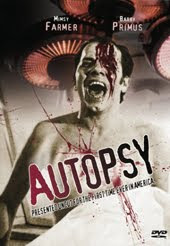
Autopsy


Autopsy
Original Title: Macchie solari
Directed by: Armando Crispini
Italy, 1975
Giallo/Thriller, 100min
Distributed by: Blue Underground.


After revisiting this title, I have to confess that I got quite surprised by it. I didn’t remember it as freaky and surreal as it indeed is. I recall seeing it years ago when I was a young lad exploring all the bizarre titles I could lay my grubby little hands on, especially the ones with words like Blood, Death and especially Autopsy in the title. Titles designed to jump out and appeal to a young cineaste on search for his next fix of carnage, which is what lead me into the amazing world of EuroHorror.

Even though Autopsy may not be the most violent or blood drenched little oddity you may think from the title, it is a really entertaining and fascinating movie that works out of the Giallo mould. It’s fair to say that it’s one of those Gialli that expand the boundaries of the genre and treats its audience to a wild ride indeed.

The movie jump starts with a series of violent suicides, nekid' woman slits her wrists, old geezer stuffs head in bag and jumps in river, a father takes a machine gun to the heart after killing his kids, all provoked by the intense heat wave hammering down on Rome. Crash cut to a bunch of American tourists having problems understanding the piazza vendors, a young redhead helps them with the explanation that she too is American. She hails a cab and just as she gets in, a man climbs in with her and bursting into tears she falls into his arms. Right now this little scene is a mere parenthesis, but in good old Gialli style it’s of importance will be revealed before the film is over. The meat wagon driving the corpses elegantly leads us to the morgue where medical student Simona [Mimsy Farmer from Dario Argento’s Four Flies on Grey Velvet 1971, Francesco Barilli’s The Perfume of a Lady in Black 1974, Lucio Fulci’s The Black Cat 1981 to name a few], is currently working.
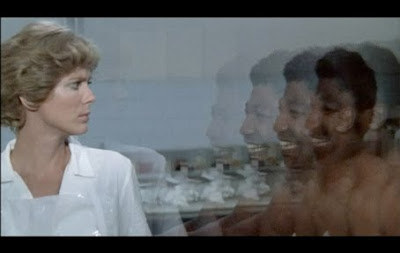
Following a presentation of Simona’s character through a sequence shot almost in documentary type realism of corpse gutting and intestine removals, the long work and heat causes Simone to start hallucinating while she is working in the morgue. And she sees some amazing stuff, like a corpse winking at her, corpses get up and dance, and even two corpses making, out only to end up shagging on the floor (on a conveniently placed rug of course) – Now there’s one way to work in some gratuitous nudity for your audience if there ever was one.

After a baleful practical joke conducted by her boyfriend Edgar [the always a blast, Ray Lovelock from Jorge Grau’s Let Sleeping Corpses Lie 1974, Umberto Lenzi’s The Oasis of Fear 1971, and Lucio Fulci’s Murder Rock 1984] and Ivo [Ernesto Colli who you get bonus points for if you spot him in Sergio Martino’s Torso 1973] her sleazy colleague, Simone is driven home by the laughing, taunting Edgar who tries his best to get in her pants before she climbs out of the car. But Simone rejects him and says that there will be none of that until she’s finished her thesis.

In the comfort of her flat, decorated with photographs of dead, mutilated bodies all over the place, she starts going over her work, and we learn that Simone’s thesis is a study on the differences between real suicides set against murders staged as suicides, sounds like a bizarre study, but this is Giallo territory and it will all make sense eventually… we hope. There’s a sudden knock on the door in the middle of the night, and in comes Betty [Gaby Wagner] who wants to borrow an envelope (another sub plot plant) and then claims to be renting the flat above Simona's – a flat hat belongs to Simona's father… …a man Nancy says she doesn’t know. After she leaves Nancy takes a walk and is pretty soon pursued by the headlights of a car. The car stops and Nancy, with a sigh of relief says, ”Oh it’s you again” and walks towards the car… Hmmm once again a delicate sub plot is planted, and we are given our first hint at the culprit of the movie. It all makes sense in a while.

The following morning Simone and her colleagues gather round the latest ”suicide corpse” that was found in a deckchair on the beach with a gun in hand, and ponder over the question whom she can be… Simone’s sleazy colleague Ivo obviously cops a feel as he washes the dead female body in preparation for his rebuilding of her disfigured face. Simone goes for a lunch with her father Gianni [Massimo Serato who you may recognize as the evil warden from the recently deceased Rino Di Silvestro’s Women in Cell Block 7 1973, Giulio Berruti’s The Killer Nun 1978 and Antonio Bido’s The Bloodstained Shadow 1978], during their lunch poppa Guilin reveals that he’s met a woman whom he plans to marry, but his girlfriend seems to have missed their appointment. Simone feels faint and leaves the restaurant only to run into Giuliio’s ex, Daniela [Angela Goodwin] an artist preparing her next exhibition in the death museum. Daniela’s red hair gives Simona a premonition of who the dead girl might be and returns to the corpse in the morgue with a red haired wig. Just as Simona solves the mystery girl’s identity Father Lennox [Barry Primus] makes his entrance claiming that the dead woman is his sister, and that there is no way possible that she would have killed herself.
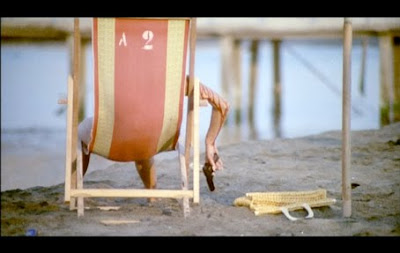
That’s just the first twenty minutes of Armando Crispino’s Autopsy. He’s introduced all the main players, their traits, and solved the initial mystery only to spark further mystery that drives the movie forth from here and introduced a gallery of interesting suspects that might be responsible for the death of Betty, and I’m totally drawn in.

It’s a wonderful little piece that brings a lot to the screen with it, double identities, mysterious books found in flooded libraries, suspicious characters and side winding plots that will throw you off track over and over again, There is quite little of the customary killing sprees of a masked murderer here, most murders take place off screen or with the killer completely out of sight, but never the less, it’s the mystery plot of who’s who that makes this movie such a treat.
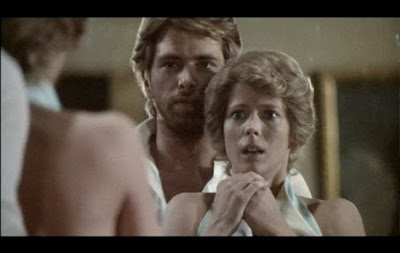
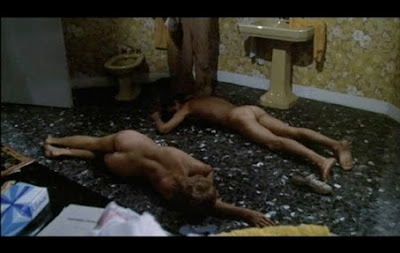
There’s also a great sub plot with Simona rejecting her boyfriend Edgar, displaying a cold sexual repression that reminds me of Catherine Deneuve in Roman Polanski’s Repulsion 1965, but at the same time she lusts for and falls in love with Father Lennox, a man she can’t have due to his faith which complicates things. But then at the same time, Father Lennox beats the crap out of Simona’s landlord during one of his nightly stakeouts screaming ”I’ll Kill You, I’ll Fucking Kill You!” so it’s doubtful that this man of the cloth is true to his vows. There’s also a fantastic scene where the killer tries to arrange a dual suicide with Simona and Father Lennox after drugging them and leaving them in a bathroom slowly filling with gas. It’s a very exciting and suspense full little scene, and familiarity with the genre will let you know that you never know who is going to get it next, so the killer has a fair chance of killing off the leading lady.
Eventually there’s a wonderful climax that will have you gasping, as the killer ignorant of his past deeds goes about his regular routines and is finally confronted by the only person who know the truth of what has been going on, and that little scene at the beginning with the redhead and the man in the cab, the envelope that Nancy asks for, the mysterious car driver who Nancy recognizes, there all small details that will make sense. I love it when gaily wrap things up and small bit’s that at first seem incoherent and almost like filler scenes drop into their place in the story and you get that rush of insight. It’s one of the small perks of watching movies in this fantastic genre that make it all worthwhile.
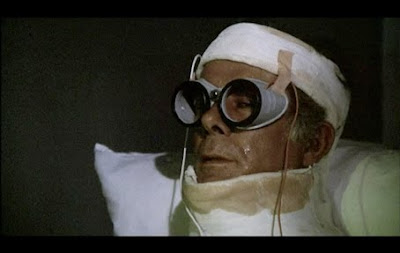
Something that I find recurrent in Gialli, apart from clothing supplied by the major fashion houses, and constant fraternisation with the art world, there’s a recurrent display of the cutting edge technology. Be it enormous seventies computers that take up a whole wall, or gigantic matrix printers technology keeps making itself apparent in the genre. Here there’s a bizarre machine that is supposed to help one of the characters, now totally paralysed, to speak with the police and give them a clue to who the killer may be. It’s an enormous machine, that looks more like an instrument of torture than anything else, but more petite and functioning versions are actually used today by people in paralysis. So even how ridiculous the scene may seem today, there is a fascinating foresight in there. Sort of like when you watch classic Star Trek and see their “future tech” which we all have in our households and everyday life today.
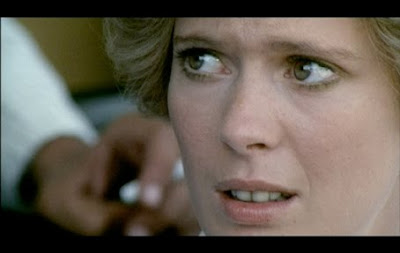
Farmer does what is expected of her, she wanders from scene to scene with a puzzled, almost lost look on her face and gives a grad performance as the confused Simone. Once again Lovelock, get’s to play the chauvinistic, misogynist part that he plays so wonderfully. He’s self centred, filthy rich and truly a disturbing character, all he wants’ is to have fun, shoot his photographs and get his rocks off with Simone. He repeatedly tries to get it on with Simone, to varied results, but it is a primal urge hat he can’t resist. Edgar even gives it a shot when he get’s Simona home and after her colleague tries to rape her, Edgar coldly says – ”Well you can’t blame the guy for trying” and sticks his hand up her dress. Sinister and misogynist to the very end. But also Primus gives a decent performance here, even though he made no more Gialli after this one, but disappeared into US TV serial bit parts. But in Crispino’s Autopsy it’s possible that he was given some great direction, as he makes an impression that many other one off Yankee’s in Italian genre pieces didn’t.

Editor Daniele Alabiso [Ruggero Deodato’s Last Cannibal World 1977, Phantom of Death 1988, and Umberto Lenzi’s Nightmare City 1980] does a wonderful job with the movie. The timing is impeccable, and right on cue. Also he takes a few wild transitions into play to add to the delicate weave. Just keep an eye out for the sequence when Simona’s father is introduced, as he intercuts Massimo Serato swimming towards something, Ivo is remodelling the face of the female corpse, Serato swimming, the corpse with Simona watching on in puzzlement, Serato swimming up to a pair of female feet, the completed corpse being photographed, Serato revealing that the feet belong to Simona standing by the pool greeting her father – Serato. It’s a wonderful part and there’s that great short thread of mystery spinning off the larger – the unknown female corpse – which soon will be integrated with the shorter thread and lead to the solution of the larger sub plot. Great stuff that has the movie stands out over many other Gialli.
Finally there’s Ennio Morricone’s marvellous score. It’s a fascinating and eclectic score filled with both electronic minimalism, and full-feathered orchestral parts. Gentle flutes, brooding synthesizers mix in a catchy but disturbing blend. The use of the electronic harpsichord played heavily brings an added dimension to the score, as it’s a rather delicate instrument played violently. Also Morricone uses his long time collaborator Edda Dell'Orso on the soundtrack, which makes it even more interesting as she’s something of a female Mike Patton of the sixties and seventies. A tremendously talented singer she also explored alternative vocal performances, styles and ranges (like Patton) in many great Italian genre pieces; Morricone’s great scores for Mario Bava’s Danger Diabolik 1968, Dario Argento’s The Bird With the Crystal Plumage 1970, Aldo Lado’s Who Saw Her Die? 1972 (With those great child quires) and Massimo Dallamano’s What Have you Done To Solange? 1972, to give you a few highlights of her amazing talent. For Autopsy she supplies vocal performances ranging from sensual groaning to heavy breathing to death rattles, which makes the soundtrack one of Morricone’s better dark horror works. Definitely a soundtrack worth picking up if you are into that kind of thing.


Image:
1.85:1 – Anamorphic 16x9

Audio:
English and Italian Dialogue in Dolby Digital Mono

Extras:
Very scarce, but there’s the US theatrical trailer and an international trailer for the movie under the name The Victim.

Disney Star Wars and the Kiss of Life Trope... (Spoilers!)

Here’s a first… a Star Wars post here.  So, really should be doing something much more important, but whist watching my daily dose of t...