Showing posts with label Goblin. Show all posts

Thursday, January 06, 2011

The Other Hell


The Other Hell
Original Title: L’altro inferno
Directed by: Bruno Mattei
Italy, 1981
Horror/Mystery, 88Min
Distributed by: Shriek Show

I’ve really not seen enough Bruno Mattei movies in my time and wish I'd get round to seeing more. But for some reason it’s only a handful of eighties flicks that I keep returning to over the years. It’s hard not to enjoy a movie like Virus - L'inferno dei morte viventi (Hell of the Living Dead) 1981, or Rats - Notte di terrore (Rats - Night of Terror) 1984. There’s a mesmerising eighties Italian low budget charm to those movies that I simply can’t resist. Trashy, dodgy and kind of corny, but that’s just the way I like them, and especially the ones penned by Mattei and long time collaborator Claudio Fragasso, because you know you are in for a treat when those two got together. Using one of his many pseudonyms, this time Stephen Oblowsky, Mattei serves up a rather intriguing, movie set in a nunnery starring Franca Stoppi, Carlo De Mejo and a score by progressive rockers Goblin.

Opening with a rather strange montage of a nun wandering the dark corridors of the catacombs searching for Sister Assunta, The Other Hell, establishing not only sister Assunta [Paola Montenero] but also Mother Vincenza [Franca Stoppi] and Boris, the gardener [Franco Garofalo – who you may recall from Mattei’s Hell of the Living Dead where he gave a show stopping performance as the psychotic Zantoro], both important characters, as we will see later. Then it gets into setting up the theme of the flick, when Sister Assunta conducts a savage autopsy and violently defiles the corpse of a dead nun whilst claiming that the genitals are the door to evil. After the glowing red eyes of a demon mesmerize Assunta, she goes insane and stabs her assistant to death! Father Inardo [Andrea Aureli] arrives to investigate the strange string of murders and deaths that have plagued the nunnery, and obviously peculiar shit starts to happen all staying true to demonic activity formula. Bibles burst into fire, lights explode and owls fly in slow motion – giving Mattei an opportunity to use some stock footage. Moments later an unfortunate sister is possessed and bleeds to death from her stigmata whist Father Inardo preaches the love of the lord.

Then the investigation plot takes off, and investigation plot with a dash of Nunsplotiation horror elements. Father Valerio [Carlo De Mejo], an obvious sceptic to demonic possession and believes strong in science. A fascinating conflict of interests for a priest to have and stuff that gives splendid dimension to Father Valerio. And it makes for a fascinating conflict between Father Valerio and Mother Vincenza when he arrives at the nunnery so see that she is profoundly convinced that the Devil is behind the all the deaths, whilst he is convinced they are murders.

The Other Hell is something of an odd little movie. A mystery murder piece with horror traits at the core – I’m a bit hesitant to actually call it a Nunsplotiation flick, because there’s practically no nudity or any sexual romps with Satan on screen at any time, and nothing ever really feels exploitative in any way. Which may seem somewhat strange considering the movies that Mattei made in the sexploitation field and the assemblies of stuff like Jess Franco’s 99 Women 1969 that he over saw. Although Mattei has said that he wasn’t interested in making that kind of movie with The Other Hell, but a straightforward mystery horror, which he also continued to claim enjoying the best.

There’s also an apparent influence of Dario Argento’s Suspiria 1977 and Inferno 1980 especially if you take a look at how the movie looks in it’s lighting and certain camera angles. There’s a lot of heavy lighting with reds, blues and greens and a lot of cheap laboratory/alchemy props in the foreground of many shots. Those movies have undoubtedly been an influence. And that may be a good thing as the movie is very entertaining and never really get’s too far out, and god knows there’s been some far out silly imitators of those two movies in their time. Instead it stays close to the mystic investigation plot and there are some really impressive scenes – like a full burning body suit, the strange masked woman in the attic, and the shocking reveal at the end.

The mystery at the core of the story is an interesting one and does have a decent surprise to it when it all comes to the surface. The mystery of the masked woman is revealed and the reason for the murders in the convent is understandable. They are motivated by a terrible act in the past – and that back-story is one of the best things with The Other Hell, I won’t bust it for you here, just in case you haven’t seen The Other Hell. But it’s a brilliant beat, because when you think about it its just mind blowing – especially if you take into mind the “horrific” opening and what Sister Assunta proposes there. In her opinion, children are the fruit of Satan and should be aborted before the womb is torn out!

Although The Other Hell at times is very tedious with a fair amount of filler scenes – just how many times can nuns run up and down staircases – but it’s still deep with atmosphere and does actually have one of the best stories and final twists penned by Fragasso. An ending that stays true to the usual downbeat climaxes I find seem to conclude the handful of Mattei/Fragasso movies that I’ve seen.

Carlo De Mejo is fantastic in The Other Hell; he feels as if he’s just walked right off Fulci’s City of the Living Dead 1980, into this one with a quick stop at wardrobe. And Franca Stoppi, although nowhere as outlandish as she is in Joe D’Amato’s Buio Omega 1979 makes a fabulous mother superior with a dark past and haunting secrets behind that stern façade.

The Goblin score doesn’t really do much for the movie. Once again it’s a reusing of previous tracks, this time mostly lifted from D’Amato’s Buio Omega, much like on Hell of the Living Dead. For editor Liliana Serra, who had previously worked on several Alfonso Brescia movies and was an assistant editor on a couple or Mario Bava flicks, The Other Hell was her final movie.
All in all, The Other Hell is a decent Mattei/Fragasso vehicle that entertains, entices and almost hits the most of the right spots. Don’t go there if you want randy nuns drinking she communion wine and having it off with old Nick, but if you want a lighter take on something like mix of Argento’s Suspiria, Inferno and say Norman Jewison’s Agnes of God 1985, then this is the ticket for you! It's gradually becoming a personal favourite of mine through the years.


Image:
1.85:1 Aspect Ratio

Audio:
Dolby Digital 2.0, English Dialogue, no subtitles.

Extras:
Interviews with the late Bruno Mattei and Carlo De Mejo. Trailers for other Shreik Show releases.


Wednesday, June 30, 2010

Il ritorno del Goblin


You guys do know that Goblin have reformed don't ya!


Just check this amazo-fest out. Recorded live in Rome just this past May...


Mike Barona's Paura Productions is putting them on the road in the US, and I hope that he brings them to Stockholm because that would fucking rock! I think we need to find good old Mr. Dimle and tell him what band to book for a blow out gig in the near future.

Keep an eye on their soon to open web page for more info.

Saturday, April 10, 2010

Hell of the Living Dead


Hell of the Living Dead
Original Title: Virus – l’inferno dei morti viventi
Aka: Zombie Creping Flesh

Directed by: Bruno Mattei (as Vincent Dawn)
Italy/Spain, 1980
Horror/Zombies, 101min
Distributed by: Anchor Bay


You can not, not like Bruno Mattei. With a numerous amount of movies to his name – or rather, not to his name, as he almost never directed a movie under his real name – the guy got his fingers in the jam jar of almost every possibly genre, and no matter how much he used to get slammed by the critics, some of the low budget movies he left us with are still terribly entertaining movies.

Starting out in his twenties as an assistant at his fathers film editing studio, the step to becoming a film editor was a logic one, and after spending almost a decade of slicing and splicing supposedly more than a hundred movies for the likes of Sergio Sollima, Roberto Bianci Montero and Nick Nostro – even a few for Jess Franco (the rougher cut of 99 Women 1969 and Count Dracula 1970). Shifting between editing and directing he made his debut with the drama Armida, il dramma di una sposa 1970, then returned to he edit bay to assemble movies like Ferdinando Merighi’s The French Sex Murders 1972, and Joe D’Amato’s Eve Nera (Black Cobra) before his career really took off with the Nazisplotiation flicks S.S. Girls (Cassa privata per le SS) and S.S. Extermination Love Camp (KZ9 – Lager di Sterminio) both 1977. From there on it was like a run away train stopping at sexploitation, women in prison, sci-fi post apocalypse, zombie armageddon, all in porn, nunsploitation, spaghetti western and some Mondo and monster shark stations along the way. You name it and Mattei had been there in one-way or another.

Always the storyteller – and that’s without any evaluation of his work, it speaks for itself – Mattei made a return to the fantastic world of low budget cinema, and went right for the hearts of fans with pieces that mirror some of his most favoured seventies and eighties classics –the beloved W.I.P., Sexploitation, Zombies and Cannibals genres. Leaving a string of fifteen straight to Video productions, most of them shot in the Philippines with small crews and a handful of actors Mattei stayed true to his roots as a storyteller and even though he stared death in the eye – he continued to complete his final movie – Zombie: The Beginning (Zombi: La creazione) 2007.

It’s difficult to name your favourite Bruno Mattei movies, as he was such a versatile maker of genre pieces, there’s almost no genre that is left untouched in his wide output, although any fan of Italian zombie/post apocalypse fare will tell you that Hell of the Living Dead and the animal monster rampage piece Rats – notti di terrore (Rats : Night of Terror) 1984 are among those that are required, and repeated viewings.

Hell of the Living Dead is a perfect example of the how Bruno Mattei crafted the most of his more known pieces, how he constantly either relied on predecessors as influence, or blatantly just ripped them off – not that this is a bad thing, as certain of his movies have more recognition than the originals. Hell of the Living Dead is an obvious cash in on George A. Romero’s Dawn of the Dead 1978, and the success of Lucio Fulci’s Zombi 2, the movie freely uses themes and scenes reminiscent of the two movies, and if that wasn’t enough the film also uses a catalogue music by Italian progressive rockers Goblin – who also supplied the score to Dario Argento’s European cut of Romero’s Dawn of the Dead titled Zombi in Italy, but more on that later - and a whole load of stock footage from Barbet Schroeder’s La vallée (The Valley) 1972, Ferbus, Garny & Zéno’s Des Mortes (Of the Dead) and several others sources which at sometimes helps the narrative and at others is just plain confusing.

In all simplicity Hell of the Living Dead opens on shots of a remote chemical laboratory, slash, factory where life is chugging along as normal. A series of routine checks are being made to document the safety of the plant… and needless to say that’s when the shit starts hitting the fan. Two technicians bitching about chicks and how much they hate their job are the unfortunate first victims of a rabid rat and a sinister looking green cloud that sets the zombie plague in motion.
A band of elite commandos (Lt. Mike London - José Gras, Vincent - Selan Karay, Osborne - Joseph Luís Fonoll and the magnificent Franco Garofalo as the insane Zantoro) are after taking out a band of kidnappers – possibly inspired by the SAS storming of the Iranian Embassy siege in London that same year– sent out on their next mission, to reach the HOPE centre and find out what the heck is going on. On route they pick up the minute TV team consisting of reporter Lia Rousseau [Margit Evelyn Newton] and cameraman Max [Gabriel Renom] who just witnessed their travelling companions being guzzled down by the zombies. The commandos arrive just in the nick of time and don’t thing twice about putting a few slugs though the heads of the zombies – not even the seven year old zombie kid – that’s just how friggin' hard they are.
The mismatched group make their way through New Guinea stopping off at a village –giving Newton an opportunity to get her kit off and walk amongst the natives’ naked- where they yet again fight their way out of an attacking zombie horde. Keep an eye open for sudden background continuity errors and you’ll now know that those are the scenes of extra gore that Fragasso shot along with the added ending back in Italy after the Spanish shoot wrapped. Slowly but surely they make their way cross the country diminishing in numbers during each encounter with the living dead until they reach the HOPE centre and the very bleak and shocking climax hit’s us hard in the face.

Based off an idea by Spaniard José Maria Cunillés and later fleshed out by Mattei and his regular working partner, Claudio Fragasso (and his wife Rosella Drudi) the movie takes to comment on the problem-solution of overpopulation which at the time in the late seventies and early eighties was a major topic of discussion – just like global warming is today. Although this one has the scornful Italian twist to it, as the HOPE centre are not actually looking for a way to help the overpopulation, but rather eradicate it… Taking the production to Spain – as it was a Spanish-Italian coproduction – the movie was shot in just five weeks. As the Spanish producers for some reason didn’t want Mattei to use one of his common pseudonyms, the demanded that he come up with something new, and that’s how the name Vincent Dawn was created.

I find it somewhat unfair that Fragasso and Mattei get so much slack for being crap directors making crap movies – in Hell of the Living Dead they actually take some time to set up the hardened elite team as they bust into the US Embassy and without further ado take out all the terrorists. The movie could definitely have started off right in New Guinea with the attack at the mission house, but instead we get this little starting stretch that establishes the characters, which I in some ways interpret as an attempt at setting up the rough traits of the commando characters. That tight shit kicking sequence is all there to establish the ruthlessness of the commandos, that pretty soon will be set in contrast to the moderate approach to things that Lia and Max take in the situation they find themselves in. This also establishes a great rift in character between Lia/Max and the Commandos’ that brings certain driving force to the narrative.
At first it may seem as a random action sequence, but it’s really a neat little thread concerning the HOPE centre – yeah that one that we saw in the opening sequence – as the activists/terrorists know about the cynical experiments that HOPE are performing, and that their research is more of an extermination plan than a real solution to the overpopulation problem. There will be several referrals to this theme throughout the movie.

There’s also a little love story if you like that is brooding underneath the surface, and that’s the one between one of the commando’s and Lia – it’s not the most elaborate relationship, but there are feelings there and it does bring some hope to he narrative… if you never have seen an Italian genre piece before that is. Regular fans know that shit goes down hard in the world of Italian exploitation flicks, and nothing is sacred there. Perhaps this is why we opt for the cheaper remakes on successful stories – we want to avoid mainstream conventions and predictability. But it still goes to show that Fragasso and Mattei weren’t simple hacks that just tossed stuff at the screen, but actually did have some modus operandi that they where after. Even though they may have lost it behind corny dialogue, cheap acting and completely random stock footage along the way. Just how many times can you scream and squiggle your eyebrows around when you see a zombie eating your mates? Well that's a beer drinking game if there ever was one, so now you have anew use for Mattei's Hell of the Living Dead!

Finally let’s just take a quick listen to that soundtrack which at the start of the movie is shoved in our faces through a huge Goblin logo. So now you think that you are going to enjoy a great score by the great Goblin – which you certainly do – but it’s mainly stacks lifted off other movies under the direction of Gianni Dell’Orso. Obviously they had “obtained “ rights to the Goblin catalogue and helped themselves to a few of Goblins previous scores to other movies. If you know your Goblin you will recognise the scores from Dario Argento’s Italian edit of Dawn of the Dead, “Quiet Drops” from Joe D’Amato’s Buio Omega, and Luigi Cozzi’s Alien Contamination. It can be distracting at times, but then again those scores are fantastic and they get the job done in Mattei’s sardonic first entry into the Italian zombie chunk blower genre.

Hell of the Living Dead is a definitive must for all fans of Italian Exploitation fare. Without a doubt one of Mattei’s finest moments – mordant, aggressive and a shit load of fun – what more could you ask for.


Image:
Widescreen 1.85:1

Audio:
Dolby Digital Mono, English dubbed dialouge

Extras:
Hell Rats of the Living Dead – an interview with the late Bruno Mattei, the theatrical trailer and a gallery of posters and stills.

Monday, January 04, 2010

Beyond The Darkness


Beyond The Darkness
Original Title: Buio Omega
Directed by: Joe D’Amato
Italy, 1979
Horror, 94 min
Distributed by: Shriek Show

This movie is one sick little puppy. Dealing with cannibalism, voodoo, necrophilia, torture, perverse relationships and violent death, it’s no wonder that it’s one of Joe D’Amato’s most popular movies.

Joe D’Amato, birth name Aristide Massacessi started out as a cinematographer shooting second unit and assistant director work from the late sixties until the early seventies on movies like Alberto De Martino’s Scenes from a Murder and Massimo Dallamano's What Have They Done To Solange? 1972.
When he did direct his first features they where a fist full of Spaghetti Westerns, Go Away! Trinity Has Arrived in Eldorado (Scansati… a Trinità arriva Eldorade); God is My Colt (La colt era il suo Dio), A Bounty Killer for Trinity (Un Bounty killer a Trinità) all in 1972. It was also in 1972 that he directed and shot the movie The Last Decameron (Sollazzevoli storie di mogli gaudeneti e mariti penitenti – Decameron nº 69). The film, which blends comedy and erotic situations in a very Italian Sex Comedy manner is obviously inspired by Pier Pasolini’s Award Winning Il Decameron 1971, and shows the beginning of the traits D’Amato would find himself most comfortable directing, sleazy sexploitation flicks. But that comes later.
1973 Saw D’Amato under his birth name directing the surreal horror/thriller Death Smiles at A Murder starring Klaus Kinski and Eva Aulin in leading roles. The movie was an almost like a contemporary Gothic film using themes of incest, necrophilia, murder and sexuality; all themes that D’Amato frequently used in his horror films. As D’Amato chose to direct the arty flick under his real name, Aristide Massaccesi, a title he usually didn’t use for directing credits but for his cinematography as this was what he took most pride in, it's probably fair to say that he was satisfied with the results

D’Amato continued to crank out movies in a varied range of genres, but not until 1975 would he tackle the franchise for which he would forever be associated with, the sexploitation classics that make up the Emanuelle series.

Eventually we’ll get round to Emanuelle, and the living legend of Laura Gemser, but we will save for a later day, as today I’m looking at D’Amato’s entries into the horror realm.

Being so strongly connected to the sexploitation genre, there are certain ingredients one would presume to find in a D’Amato film, sure he did experiment and blend Sexploitation with Horror in several films, ones like Erotic Nights of the Living Dead 1980, Porno Holocaust 1981 to name a few, give you a gist of what the movies are about - the titles say it all. But when he focused on pure horror he gave it all he had, the films Beyond Darkness 1979, Anthropophagus: The Beast 1980 and Absurd 1981 are all cherished entries into the dark underbelly of Italian Horror. No holds are barred as D’Amato brings on the sinister antagonists, buckets of blood and gore and stunning special effects – if you’ve seen the movies you know exactly what I’m talking about.
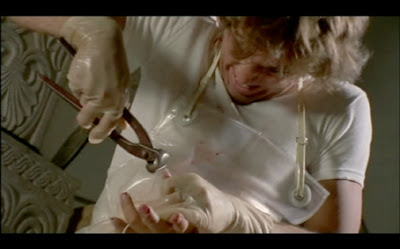
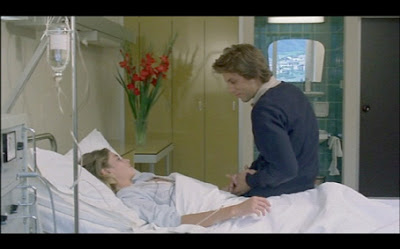
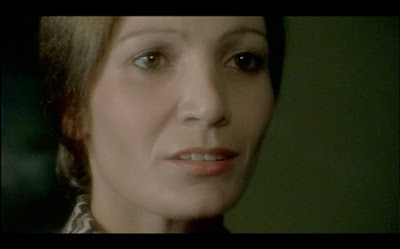
Beyond The Darkness is a trippy movie to say the least, Kieran Canter plays Frank Wyker a young man who after his parents died inherited their huge mansion where he now lives and conducts his taxidermy on a professional level that would have Norman Bates envious. Frank’s girlfriend Anna Völkl [Cinzia Monreale – who is painstakingly skinny in this movie, and looks so much hotter these days. Monreale who you may remember from Lucio Fulci’s The Beyond 1981, where she plays the blind Emily and House of Clocks 1989 and later in Dario Argento’s The Stendhal Syndrome 1996] is in the hospital on some sort of life support machine, still Frank and Anna have a love like any other between them. Frank lives in his huge house with the maid Iris [Franca Stoppi – who went on to star in several of Bruno Mattei’s Nunsplotitation and Women in Prison flicks] with whom he has a very strange relationship. She probably took care of him after his parents died and was more than likely his nanny as a child, because the first scene she and Frank share, she comforts him after Anna passes away by breast feeding him!
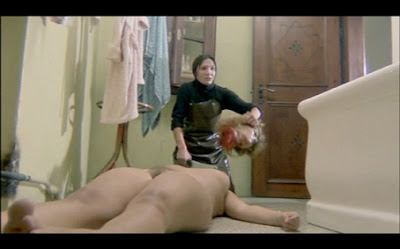
The sinister Iris is in many way’s the main antagonist of the film, as she is the one who has with the aid of witch put a voodoo curse on Anna to start with as she want’s to claim Frank, or is it his wealth and mansion for herself.

After Anna’s death, Frank starts going insane. With the assistance of Iris he steals her corpse the night after the funeral, and D’Amato neatly plants Anna’s twin sister Elena, also played by Monreale into the plot. He embalms Anna, removes her internal organs, and takes a healthy bite out of one, let’s say her uterus to make it even kinkier dresses her and lays her in his bed. Anna’s now a mummy that he now can love for all eternity.
Now things could be all hunky dory from here on, but no, this is a horror flick and shit has to break down any time now. Which it does, on his way back from the morgue with the body of Anna, before the above mentioned autopsy, mummification scenes, he get’s a flat tire, allowing a dumb hitchhiker, Jan [Lucia D’Elia], to get in his van, needless to say after the suspenseful threat of exposure during the ride home, the nosey, doped up hitcher stumbles upon Frank as he lays the final touches to Anna’s corpse. Needless to say the hitcher meets a violent death, as Frank will let nothing come between him and Anna. He beats her, pulls out her fingernails, and finally strangling her.
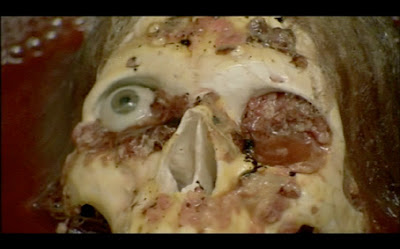
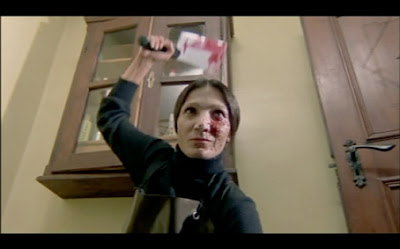
What makes this such a splendid little sequence is that it’s all intercut by Ornella Micheli’s, the preparations of Anna's body and the hippie hitcher sneaking around build suspense that is exhilarating, because you know that the hitcher is going go catch Frank at work and the shit is going to hit the fan, which it does. Once again Iris proves her dedication to Frank, or is it her underlying agenda to take over the mansion, and helps him dispose of Jan the hippie hitcher’s corpse in a gruelling fashion. She coldly chops the body up into disposable pieces and chucks them in a bath filled with acid. It’s one of the most fiendish scenes of the film and will stay with you for a long time. The special effects are astonishing and really freaky, it’s amazing what you can do with a few pounds of pig, a plastic skull and bubble bath. But it works and is a great sequence.
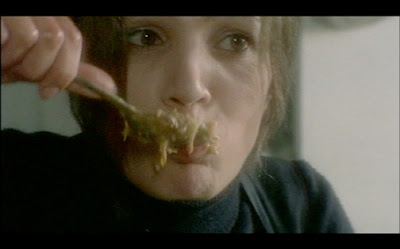
D’Amato also gives us a small, but effective release after the grim scenes when Iris serves Frank dinner, a beef casserole, and as he moves his camera close to the mouth of Iris sloppily chewing on the food intercut with the hideous remains of Jan, Frank runs to the sink and throws his guts up. Excellent timing for a laugh as the plot thickens and the Mr Kale, who works for the mortician and funeral parlour that buried Anna, and who also saw Frank inject that initial dose of formaldehyde into the corpse, starts to look into Franks activities. A young jogger [Anna Cardini] becomes Frank’s outlet for all that dammed up sexual frustration, but obviously he can’t restrain himself and pulling back the covers revealing the embalmed Anna next to them in the bed, he quickly murders the screaming young woman by tearing out her throat with his teeth. That’s when Iris makes her move, if she is to help the now multiple murderer Frank, she wants’ something in return, she wants Frank to marry her!
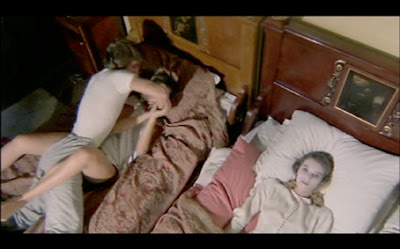
The movie gets into it’s last half hour and grows even more surreal as the detectives try to search the house while the joggers body burns in the taxidermy studio’s furnace, then again an opportunity for laughter as Iris family of freaks gather to celebrate the couple soon to be joined in holy matrimony. Mr. Kale takes yet another sneak around the house again and this time to his shock, finds Anna, who for reasons untold is hidden in a closet. The end is nigh, as an external partner now knows Frank’s dark secret.
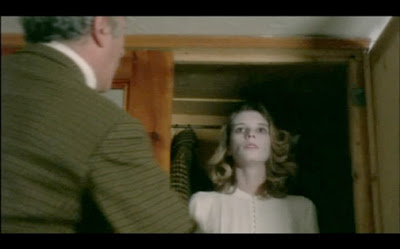
As Beyond The Darkness revs up to it’s climax, Frank once again picks up a strange girl, this time at a disco, only to be interrupted by a sudden surprise visit from Anna’s twin sister Elena! Frank desperately begs Iris to keep Elena in the house, (as he only sees her as Anna alive and kicking), while he gets rid of disco girl – who actually takes the time to drive home... But Iris has finally had enough of Franks abuse and non-response to her love and life long affection and decides that Frank will have none of the Völkl girls. The grand finale is splendid, gory and vigorous as several subplots come into their culmination, and then when you think it’s all over there’s an excellent little twist concerning Mr Kale and Elena.
Beyond The Darkness is a great movie; gory, kinky and surreal in a way that only D’Amato could deliver it. His cinematography leaves nothing to complain about, he knows what he wants from his compositions and that’s what we get. Ornella Micheli’s editing is perfect once again, and then there’s that excellent soundtrack by Goblin, that constantly keeps the movie moving along with their progressive rhythms. Also it’s where you’ll find the track Quiet Drops that Prog Super group Morte Macabre covered on their magnificent soundtrack alum Symphonic Holocaust. As said, Beyond The Darkness, although not as violent and aggressive as Anthropophagus: The Beast or Absurd is possibly Joe D’Amato’s finest hour as a horror director. It comes with my warmest recommendation!


Image:
1.85:1 Aspect Ratio remastered for 16x9

Audio:
Dolby Digital 2.0 Stereo, English Dub Dialogue

Extras:
Trailers for Massimo Dallamano’s What Have They Done To Solange? 1972, Ruggero Deodato’s House on the Edge of the Park 1980, Umberto Lenzi’s Seven Bloodstained Orchids 1972, and the original Beyond the Darkness trailer. A booklet with articles on D’Amato, Goblin and Beyond The Darkness, Interview/commentary with Art Director Donatella Donati, and a neat little session with Cinzia Monreale who looks better than ever as Mike Baronas and Kit Garvin interview her.

Disney Star Wars and the Kiss of Life Trope... (Spoilers!)

Here’s a first… a Star Wars post here.  So, really should be doing something much more important, but whist watching my daily dose of t...