Directed by: Sergio Corbucci
Spaghetti Western, 1966
Italy, 88 min.
Distributed by: Atlantic Film.
Story:
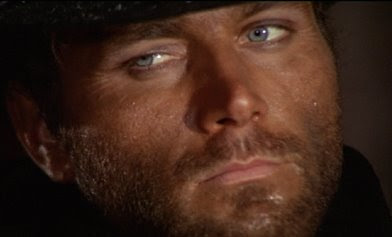
Django walks slowly through the dry barren desert dragging a coffin behind him. He first rescues a young woman, Maria, from the claws of two opposing gangs, Major Jackson’s red hooded hoodlums and the Mexican bandits, splicing him in-between the two enemy camps. He claims to be their to avenge the only person he ever loved and sets out on a one man rampage killing all of Major Jackson’s gang but soon proves to have further motives, namely to swipe the gold from Fort Charriba with the help of the opposing Mexican bandits. Gambling high Django goes up against two separate gangs, wedging himself in between the two rival parts in his quest to achieve his two goals, vengeance and money.
Me:
Probably one of the most known Spaghetti Westerns outside of Leone’s fistful of genre classics, Sergio Corbucci’s Django sure makes it’s mark and there’s a very obvious reason that it made an impact full impression back in 1966 when it was released on the big screens and later on when the wonderful world of home entertainment exploded and video tapes hit the shelves of rental stores allover Europe.
Banned when it first hit screens outside of Italy (both cinema and domestically on VHS) due to the sadistic violence and nihilistic tone that the movie holds it’s fair to see why audiences wanting to push further into the genre beyond the Eastwood/Leone westerns start out by tracking down Corbucci’s milestone Spaghetti Western. And even though it has some flaws that distract from the all round experience the movie is a milestone in the aspect that it generated almost thirty, follow-ups and copycat movies.
 Corbucci had previously directed four Spaghetti Westerns, nowhere near the brilliance of Django, but like them it was inspired by the dark anti-hero take of Akira Kurosawa’s Yojimbo from 1961, (just like Leone’s Fistful of Dollars the year after) and was an important addition to the army of Italian Spaghetti Westernsthat in cold blood blew the old school American westerns out of the saloon and into the mud outside.
 Then there’s the violence and the flip-flopping of characters that make the Italian genre cinema so much more attractive than most of the boring old tricks that other non-European countries where shipping out at the same time. In Django the gore hounds get what they want (although don’t go there today expecting a blood fest, but put in the correct time frame and it’s gore galore, sit like this wasn't happening in other Westerns!) almost fifty hoodlums are torn apart by extensive gunfire from the Gattling gun Django pulls out of the coffin he’s been dragging with him allover the place, prostitutes fist fight in the mud, a preacher gets his ear sliced of and then force fed it, and then there’s the extensive beating that Django takes. And we’re not talking about a few punches to the face and gut here, no first Mexican bandit General Hugo Rodriguez has his right hand man smash the butt of his rifle into Django’s hands some twenty times, then the entire band of Mexicans ride their horses over the mangled digits that Django so skillfully uses to quickly shoot his enemies down. And what good is a gunslinger that can’t use his trigger finger?
 A few years ago (when it was released on DVD by Criterion in 2000) I revisited Perry Henzell’s 1972 excellent Jamaican crime flick The Harder They Come, which features the machinegun massacre of Django in a key scene, and as I hadn’t seen Django since years ago I was surprised that the infamous Gattling gun scene was already over and done with before the movie hit the halftime mark, I was convinced that this scene was the grand finale, but nope. Midpoint, or possibly point of no return, as Django wipes out the entire gang that rides with Major Jackson [Eduardo Fajardo], letting only him flee for he hills.
 How do you possibly escalate a move after that ecstatic crescendo of death and violence? Well Corbucci moves to new ground and shifts from the classic “Revenge/Vengeance” plot to the “Greed/Money” plot that he and his brother Bruno Corbucci explored in many of their great scripts. Money and greed is almost always the single driving force of all characters in a Corbucci Western. Django befriends, or rather is reunited with his old jail buddy General Hugo Rodriguez, (played by Jóse Bódalo who also just like Eduardo Fajardo and Gino Pernice starred in Corbucci’s Compañeros against Franco Nero four years later) and as they celebrate the victory over Major Jackson’s band Django suggests the plan to raid Fort Charriba and share the gold held there. Stealing from the Fort and hefty heists are a Corbucci trait too, as it is recurrent in several of his Westerns. With the money from the heist, the Mexicans would have enough money to buy nine more Gatling guns that Django claims to be available. And with these the bandits could return to Mexico as heroes with massive firepower on their side. So even here the motif of greed is important.
General Rodriguez can now return home to Mexico a powerful man that will hold a valuable position. His greed drives him into the plan. Needless to say there’s a second twist and Django goes a step further and his greed makes him attempt to double-cross the General and swipe the gold for himself… which brings the first of two main plots full circle the damned bridge over the quicksand, the same where Django saved Maria’s [silently portrayed by Loredana Nusicak] life at the start of the movie, the one that leads on to freedom and the future, Django says to Maria during the opening that he’s not ready to cross the bridge yet, and now that he’s facing it once again it becomes his downfall. The coffin containing the gold slips from the wagon and plummets into the quicksand. Despite Django’s desperate attempts to salvage it he fails, Maria is gunned down by the Mexicans and only due to previously having saved General Rodriguez in prison (yet another unexplored subplot if you ask me) Django gets to keep his life, but only barely and not with his fast gun hands intact. But you can’t keep a good man down, and if he can’t escape his past through hue wealth, he better redeem it in the way he originally set out to do; Vengeance. Needless to say the last part of the movie builds towards the final shootout with Major Jackson and the few remains of his once terrorizing gang, and even though it isn’t as formulated and stylized as later Spaghetti Westerns with their low angles, deep focus, cross cut with extreme close-ups of eyes, fingers and the inedible waiting for the shots to come, because that’s what differs the finale of Italian Westerns over American ones. Where the US movies focus on the actual shootout (i.e. Ford, Houston, Peckinpah) the Italians focus on the mood an atmosphere just before the shots ring out giving us those wonderful moments of cinematic glory. The shootings are over in a few seconds, the villains, or in some cases the heroes are dead, but that moment of pre-death still lingers on emotionally. A Corbucci-esque metaphor for life, it can be slow, tedious and disregarded, but taken from us in the blink of an eye.
 I have read several analysis of Django that claim that there are no sub-plots to this magnificent movie, but I tend to disagree and claim that there definitely are subplots to be found, and these are what make main plots click into each other, even if the subplots are not closed. The story of Maria, which is left uncommented, (apart from the information that she used to be the whore of Major Jackson, went over to the Mexicans and then fled from them too, leaving her in the troublesome state she’s in at the start of the movie. There’s the dark “Love story” between Maria and Django. Yes it is there. After he saves her she offers herself to him in the safety of the brothel, and he isn’t late in responding, even if Corbucci chooses to let this happen behind closed doors. This is also what allows Django to tell the story of his dark past later on when he tells Maria that he once knew love and will never know love like that again. And don’t forget that Maria follows him as he makes off with the gold, saving his life before her own is put in jeopardy on the bridge. There’s the “revenge” story that Django unfolds during his visit to the cemetery, and the untold story behind what happened all those years ago. There’s the entire subplot of The Mexican Band of Bandits vs. Major Jackson and his troops, which Django uses in his quest for both his goals, swipe the gold and take his revenge. So to say that there are no subplots is pretty far fetched I feel.
A further directorial trait I love about Sergio Corbucci is his Fellini-esque ugliness that is found in almost everything, the sets really look shitty and abandoned, the prostitutes are butt-ugly, the violence is always way exaggerated, and there’s always a morbid fascination for death and the grotesque in his films. This exemplified in the finale out where Django chews the trigger guard off his pistol (probably wrecking what’s left of his teeth in the process) and uses a cross in the cemetery to wedge his gun in between before slamming his mangled hands on the cock and trigger in the final shootout.
 On the down side, I feel that Django perhaps is not the masterpiece that it’s hailed as, as it certainly has its flaws and I feel that Corbucci made some better Westerns after this one, but the main letdown of the movie has to be the terribly poor dubbing and dialogue. Sure, being a fan of Italian movies, I’m all for dubbing and sound overlays, it’s all part of the charm when it comes to Italian genre cinema. Silly voices, awkward grammar, and faulty dialogue, and we all know about the 300 page scripts actors where getting, and just by own decisions slicing away dialogue from, hence creating some of he most memorable Western characters ever…, but it all comes together neatly and with discretion in the majority of cases. But Django unfortunately feels as nobody ever really took the time to look through the dialogue, and then when it was overdubbed it was laid down very sloppy and often out of sync with the actors. Which is a shame, then there’s the soundtrack. Right off the bat, I’m not a big fan of Luis Enriquez Bacalov’s score for this movie at all. Sure there is a damned good push in that title track, DJANGOOOO! With its powerful chorus and all, and god knows it was copied over and over again by others, but the score to the rest of the film just gets me annoyed. Just like the sound dubbing I get a very determined feeling that nobody really gave a damn about this important part. I’m sure that Sergio Corbucci was involved, but to what extent is questionable, as he did script and direct three/four other movies during the same year. Where was Nick Alexander when we really needed him?
Anyhow, Django, a masterpiece or not is a defining moment for Spaghetti Western history, and it makes an impression still today, and is a very enjoyable movie with a great early (not first, contrary to common belief) leading role from Franco Nero as the classic anti hero Django.
Image:
Anamorphic Widescreen 16x9 [original proportion 1.85:1]
Audio:
English Dolby Digital 2.0. Stereo. Swedish, Finnish, Danish and Norwegian subtitles optional
Extras:
So lame that it’s hardly worth calling them extras, but there’s a very weak poster and artwork galley, and a complete waste of space “cast and crew” text that is really just the credits all over again. Unfortunately this Atlantic release is a real shitty print, the colors dip at time to time and there is a lot of damage to the print, but it was a cheap one I found in a box during holiday, and just looking at the Franco Nero as Django artwork on the front of the box made me decide I needed to see Django ASAP. In retrospect I should have waited and ordered the far more superior Blue Underground edition instead.
Spaghetti Western, 1966
Italy, 88 min.
Distributed by: Atlantic Film.
Story:
Django walks slowly through the dry barren desert dragging a coffin behind him. He first rescues a young woman, Maria, from the claws of two opposing gangs, Major Jackson’s red hooded hoodlums and the Mexican bandits, splicing him in-between the two enemy camps. He claims to be their to avenge the only person he ever loved and sets out on a one man rampage killing all of Major Jackson’s gang but soon proves to have further motives, namely to swipe the gold from Fort Charriba with the help of the opposing Mexican bandits. Gambling high Django goes up against two separate gangs, wedging himself in between the two rival parts in his quest to achieve his two goals, vengeance and money.
Me:
Probably one of the most known Spaghetti Westerns outside of Leone’s fistful of genre classics, Sergio Corbucci’s Django sure makes it’s mark and there’s a very obvious reason that it made an impact full impression back in 1966 when it was released on the big screens and later on when the wonderful world of home entertainment exploded and video tapes hit the shelves of rental stores allover Europe.
Banned when it first hit screens outside of Italy (both cinema and domestically on VHS) due to the sadistic violence and nihilistic tone that the movie holds it’s fair to see why audiences wanting to push further into the genre beyond the Eastwood/Leone westerns start out by tracking down Corbucci’s milestone Spaghetti Western. And even though it has some flaws that distract from the all round experience the movie is a milestone in the aspect that it generated almost thirty, follow-ups and copycat movies.
General Rodriguez can now return home to Mexico a powerful man that will hold a valuable position. His greed drives him into the plan. Needless to say there’s a second twist and Django goes a step further and his greed makes him attempt to double-cross the General and swipe the gold for himself… which brings the first of two main plots full circle the damned bridge over the quicksand, the same where Django saved Maria’s [silently portrayed by Loredana Nusicak] life at the start of the movie, the one that leads on to freedom and the future, Django says to Maria during the opening that he’s not ready to cross the bridge yet, and now that he’s facing it once again it becomes his downfall. The coffin containing the gold slips from the wagon and plummets into the quicksand. Despite Django’s desperate attempts to salvage it he fails, Maria is gunned down by the Mexicans and only due to previously having saved General Rodriguez in prison (yet another unexplored subplot if you ask me) Django gets to keep his life, but only barely and not with his fast gun hands intact. But you can’t keep a good man down, and if he can’t escape his past through hue wealth, he better redeem it in the way he originally set out to do; Vengeance. Needless to say the last part of the movie builds towards the final shootout with Major Jackson and the few remains of his once terrorizing gang, and even though it isn’t as formulated and stylized as later Spaghetti Westerns with their low angles, deep focus, cross cut with extreme close-ups of eyes, fingers and the inedible waiting for the shots to come, because that’s what differs the finale of Italian Westerns over American ones. Where the US movies focus on the actual shootout (i.e. Ford, Houston, Peckinpah) the Italians focus on the mood an atmosphere just before the shots ring out giving us those wonderful moments of cinematic glory. The shootings are over in a few seconds, the villains, or in some cases the heroes are dead, but that moment of pre-death still lingers on emotionally. A Corbucci-esque metaphor for life, it can be slow, tedious and disregarded, but taken from us in the blink of an eye.
A further directorial trait I love about Sergio Corbucci is his Fellini-esque ugliness that is found in almost everything, the sets really look shitty and abandoned, the prostitutes are butt-ugly, the violence is always way exaggerated, and there’s always a morbid fascination for death and the grotesque in his films. This exemplified in the finale out where Django chews the trigger guard off his pistol (probably wrecking what’s left of his teeth in the process) and uses a cross in the cemetery to wedge his gun in between before slamming his mangled hands on the cock and trigger in the final shootout.
Anyhow, Django, a masterpiece or not is a defining moment for Spaghetti Western history, and it makes an impression still today, and is a very enjoyable movie with a great early (not first, contrary to common belief) leading role from Franco Nero as the classic anti hero Django.
Image:
Anamorphic Widescreen 16x9 [original proportion 1.85:1]
Audio:
English Dolby Digital 2.0. Stereo. Swedish, Finnish, Danish and Norwegian subtitles optional
Extras:
So lame that it’s hardly worth calling them extras, but there’s a very weak poster and artwork galley, and a complete waste of space “cast and crew” text that is really just the credits all over again. Unfortunately this Atlantic release is a real shitty print, the colors dip at time to time and there is a lot of damage to the print, but it was a cheap one I found in a box during holiday, and just looking at the Franco Nero as Django artwork on the front of the box made me decide I needed to see Django ASAP. In retrospect I should have waited and ordered the far more superior Blue Underground edition instead.