Showing posts with label Yoshihiro Nishimura. Show all posts

Thursday, November 24, 2011

Underwater Love

Underwater Love.
Original title: Onna no kappa
Directed by: Shinji Imaoka
Japan/Germany, 2011
Drama/Comedy/Musical/Pinku, 87min


You can stop with the Hentai jokes as of now. From here on it’s all Kappa! The Japanese water spirit, renown for being malicious troublemakers, with a bag of tricks ranging from breaking wind, peeking up women’s skirts, pulling kids into the water, rape and drowning people. Keep a cucumber handy as they are addicted to the vegetable, and tossing it in its direction could be what gives you the extra minute to escape the claws of the Kappa.

You may have seen him before in woodprints of the Edo period, or as the lurky turtle monster in Kimiyoshi Yasuda’s and Yoshiyuki Kuroda’s Yokai movies of the late 60’s, possibly even in Takashi Mike’s Yôkai daisenô (The Great Yokai War) 2005 … but you have never seen him like this. Stop what you are doing and come meet Kappa… you won’t regret it.

Middle aged Asuka [Sawa Masaki – who starred in Barbet Schroder’s, to date, last movie, Inju, la bête dans l’ombre (Inju: The Beast in the Shadow) 2008 based on a Rampo Edogawa novel] works at a fish processing plant. She’s got a pretty straightforward life, and her imminent future seems to be clearly staked out for her. Pretty soon she’s going to marry Hajime [Mutsuo Yoshioka – star of several Imaoka Pinku's], who runs the factory she works at and is something of a jerk. One day whilst rescuing a fish that has miraculously survived into the plant, she encounters a Kappa at the nearby harbour. Although Kappa waves at her, she tries to ignore it, even though she’s delighted by the fact that she’s seen a real live Kappa. But Kappa want’s more than a wave, he wants to talk to Asuka, and has a very determined agenda. Confronting her as she’s about to leave, Kappa reveals that he used to be her school friend Tetsuya Aoki [Yoshirô Umezawa] who after dying in a drowning accident several years ago, was reborn as a kappa… Asuka takes him home and stores him in the washing machine, where he - staying true to legend – waters his bare scalp to keep from dehydrating. But it’s not an easy ride, and despite having a fun time with Kappa, Asuka’s moral dilemma lies in the fact that she’s engaged and planning her wedding to Hajima. Kappa is rejected, and like a love sick teenager – which Tetsuya indeed was before his untimely demise – he takes comfort on the arms of Reiko [Ai Narita] starts to show an interest in him, Asuka soon get’s jealous and realises what she’s about to miss out on. Finally one last subplot is put into play. Kappa – Tetsuya – being a spirit figure, knows that Asuka is going to die soon, and the reason for him returning to the human realm is that he want’s to save her.

Part fantasy, part comedy, part musical – with music and songs written by French/German pop duo Stereo Total, part Pinku… yes turtle boy get’s his mojo workin’ too, Underwater Love is one hell of a funny and weird movie. It never really get’s too explicit, too surreal or too far-fetched. Imaoka commonly brings a comedic tone to his movies, and Underwater Love is no exception. This is why the sudden breaking out in song – much like Takashi Miike’s Katakuri-ke no kôfuku (The Happiness of the Katakuris) 2001 – the dopey characters, and semi impressive special effects – courtesy of Taiga Ishino who’s worked with Yoshihiro Nishimura and the J-Gore gangsters on several of their flicks. But at the same time the almost naïve make-up and prosthetics of Kappa work for the movie
Shinji Imaoka has been a solid name on the later years Pinku scene. He recently, 2009, directed a remake of Junchirô Tanizaki’s short story Hakujitsumu (Day-Dream). A movie that previously was adapted and directed by Pinku legend Tetsuji Takechi twice. First in a Wizard of Oz-ish style where the wraparound was in Black and White with colour dream segments in 1964, and again in 1981 in a more graphic and daring take. If you do not know the story then let me just mention that it’s about a visit to the dentists that takes on epic proportions concerning bondage, vampirism and surreal dreams with a powerful triangular love story at the core. Definitely a movie worth seeking out if you like bizarre and kinky Japanese movies – they are certainly amongst my favourites in the Pinku genre.

But back to Imaoka, who is considered part of the “Seven Lucky Gods of Pink” circle, and like most of the people working in Japanese genre cinema spent several years working for one mentor. Imaoka’s mentor was the great Hisayasu Satō, which makes him an interesting name in my book. But where Satō holds a more voyeuristic and rough approach to the pink themes, Imaoka tends to take the themes lighter, coming at the genre with a more comedic angle where the sex scenes not necessarily are the main focus. He may have alienated a lot of Pinku viewers with his restrained approach, but he’s gained a lot of acclaim from critics and even won the Best Director Award at the Pink Grand Prix. One can see why critics would favour them, as Imaoka’s movies frequently have a serious emotional theme from which his movies build off. It’s not rare to find characters stuck in the rut of convenience and every day routine whilst yearning for something else that they at one point in time gave up on.

Which brings me to the main theme of Underwater Love. Because it’s no surprise to see how the characters interlock with each other when you know that it is a reoccurring Imaoka trait. Asuka may seem happy in her current state, but she isn’t… which we will understand as the movie plays out. Tetsuya – Kappa that is – comes to the human realm with a longing for Asuka. He’s been in love with her since he was a young man, but never proclaimed his love. In death, reborn as Kappa he has a second chance.

Let’s talk about character development, and mainly because I’m excited by the chance to talk about character development in a movie like this. Tetsuya, a shy young man in life, comes back and offer’s his reborn state as a sacrifice to save a woman (Asuka) who never responded to his silent love all those years ago. In his final moments of the movie, he even bargains with a god of death, and when he finally reaches climax – metaphorically and actually in the movie, his arc ends. Asuka is comfortable with her nine to five grind, jerky husband to be and doesn’t really make much noise. Although by the end of the movie, she will have entered deep into the sacred forest, inserted the magic anal pearl into her rectum, fought and defeated a god of death and engaged in necrophilia. A young man afraid to speak up and proclaim his love evolves into a strong personality staking his life to save his love. A woman so passive that’s she content with a lesser everything evolves into a strong warrior wrestling gods and fighting for something better. Impressive character arcs to say the least, and beyond the goofiness of the comedy, singing and Pinku, a fascinating tale of development as they progress from one side of the spectrum to the other.

Then there’s the issue of cinematography… If I throw movies like Wong-Kar Wei’s Days of Being Wild 1990, Ashes of Time 1994, Happy Together 1997, In the Mood for Love 2002, 2046 2004, Yimou Zhang’s Hero 2002, Gus Van Sant’s Paranoid Park 2007 – all of them award winners for the cinematography – at you, then back that up with titles like, John Favreau’s Made 2001, Pen-Ek Rantarauang‘s Last Life in the Universe 2003, the Fruit Chan/Chan-wook Park/Takashi Miike horror anthology Three… Extremes 2004, M. Night Shyamalan’s The Lady in the Water 2006, Jim Jarmusch’s The Limits of Control 2009 – all of them movies know and favoured for their stunning visual imagery, well then you wouldn’t even think of sticking a Japanese Pinku, comedy, love story in there would you. But you can. All of them where lensed by the magnificent Christopher Doyle - the praised Australian cinematographer who has brought some of the most beautiful movies to the big screen over the last three decades. If not for anything else, you need to see this movie for its cinematography

Shot in a mere five days – in no way unique for Pinku - the flaws of tight budget and stressed production schedule shows despite some fantastic cinematography. But a movie concerning a lovesick fantasy figure searching for a sacred anal pearl so that he can trick the god of death, doesn’t really need high production values, as that one line alone more or less motivates the reason why you need to watch Underwater Love.

This is an instant classic, a hilarious blast with a sensitive story at the core. It’s a movie that kicks those Ninja Turtles back into the sewer where they belong and leaves us with a new icon of fantastic cinema –Kappa! I officially challenge you to the Kappa dance, which will start as of now.


Friday, June 11, 2010

Samurai Princess


Samurai Princess
Original Title: Samurai purinsesu: Gedô-hime
Directed by: Kengo Kaji
Japan, 2009
Splatter/Chanbara/Sci-Fi, 82min
Distributed by: Njuta Films

...and on the topic of splatter movies, there’s no hesitation at mind when I say that the Japanese are rightfully making an impressive claim to the throne of innovative splatter flick makers. Some of the stuff that is coming out in Japan and finding it’s way across the ocean thanks to enthusiastic distributors is absolutely fabulous. It certainly does ooze with that same aura of a over energetic kid jumping up and down waving it’s hand, screaming look at me, look at me, and they certainly are fun.
Being a fan of both Higuchinsky’s amazing Uzumaki 2000 and Yoshihiro Nishimura’s Tokyo Gore Police 2008 – which both saw Kengo Kaji involved with their writing process, I obviously was curious of what he would have come up for his first theatrical feature with when I initially heard of Samurai Princess. Also the fact that he was teaming up with Nishimura again, this time with Nishimura producing and supervising the special effects obviously saturated the movie with a certain attraction.

In a quick fix let’s say that the movie is all about a young woman - the only survivor after bandits rape and murder twelve schoolgirls - get’s the chance to be reborn as a Cyborg and take revenge on the band of killers. And that’s the starting point for a violent and entropic journey that will leave a river of mutilated corpses and rivers of blood in its trail.

What at first may seem like a pretty shallow and simple story is somewhat evolved take and ironic gaze upon the age-old legend of Frankenstein. You can’t play God and create life without paying the ultimate price. It’s when the realisation that the person giving Samurai Princess [AV starlet Aino Kishi] her chance to avenge her friends – even if it is reanimated as Cyborg with a stern operative programme – the enigmatic scientist Insanity, is at the same time responsible for unleashing the gang of foul murderers roaming the lands that the ironic twist becomes apparent. And in the quest to take out the people responsible for murdering and raping her eleven friends, the path leads right up to Insanity.

Samurai Princess may be pretty low on story and packed with glorious ultra violence, but at some point I feel that these movies in many ways are linked to those great movies that spawned that brilliant series of female avenger movies. Movies like Shunya Itô’s Female Convict movies [1972-1973] and Toshiya Fujita’s Lady Snowblood [1973-1974] films starring Meiko Kaji and obviously come to mind. Nothing is as empathetic as a gorgeous young woman out for vengeance. And taking the best of Japanese cinema I find the mix of old style feudal Chanbara and modern cyberpunk sci-fi to work like a charm.

There’s also an aura of Edogawa Rampo seeping throughout the movie – everyone is disfigured in one way or another, not to mention modified to their Cyborg states which are almost never the beautiful glossy Cyborg that we are used to, but slimy, grotesque and disfigured modifications – which definitely brings a Ero guro style to the movie.

God knows that mixing genre’s sometimes can go terribly wrong, but in Samurai Princess it works pretty well, and it’s a pretty interesting approach to set futuristic cyberpunk elements inside an obvious feudal state complete with Shogunate laws and Buddhist philosophy. In a way it is reminiscent of some of the more innovative scenes from Takashi Miike’s misunderstood IZO 2004, or may very well be looked upon as a wild mix of Ridley Scott’s Blade Runner 1982, Yukio Noda’s phenomenal Zeroka no onna: Akai wappa (Zero Woman: Red Handcuffs) 1974, and Ryûhei Kitamura’s breakthrough Versus 2000. And you can’t get into this movie without thinking of Tetsuro Takeuchi’s Wild Zero 2000 as Samurai Princess partner on the journey, Moonray [Dai Mizuno] has a very interesting weapon of choice, an electric guitar that can summon up whirlwinds of lethal riffs.

So yeah, it’s not a movie made to impress with it’s immaculate screenwriting or fascinating plot if that’s what you are after, but then you shouldn’t be on this blog either, but in the library reading some book without illustrations that discusses the theoretical aspects of off-screen framing in the works of Yasujiro Ozu. Which is a fascinating discussion in it's own right, but not something that’s going to be taking place here any day soon. Instead what you get is almost an hour and a half of hilarious in-your-face gore fest that takes the ball and runs with it.

Samurai Princess may have some technical flaws – I can never really get used to movies shot on Digital Video as I’ll always be a sucker for the old grain of celluloid, but then again it does give the filmmakers unlimited possibilities to fuck around with digital effects in post even when restrained by a tight budget. And that’s exactly what Kengo Kaji and Yoshihiro Nishimura have done with Samurai Princess, you get used to the crispy video look, the effects sweep you away and the magic of moviemaking is simply fantastic. Mixing prosthetics with CG is fine by me if it’s done in the right way. Breast Missiles, Chainsaw legs, scissor feet, fountains of blood, entail Kusari-gama, screwed up mutants you name it and you get it.

Certainly in the same style of Tokyo Gore Police or even Noburo Iguchi's Kataude mashin gâru (The Machine Girl), Samurai Princess gets the job done. It’s a blast of a little movie, and to top things off Kaji makes the most of his adult video star Aino Kishi and works some nudity into the movie by letting her have a little erotic fantasy about Moonbeam in a scene that should have earned the movie the under title Do Androids Dream of Naked Action Heroes.

All hail Japanese Extreme Cinema as these guys are rushing ahead when it comes to taking classic narratives and using them in a new inventive fashion. Long live the new blood!


Image:
1.85:5 Anamorphic Widescreen.

Audio:
Dolby Digital 5.1, Japanese audio, Swedish, Norwegian, Danish and Finnish Subtitles are optional.

Extras:
Original Trailer, a twenty minute Making of featurette and trailers for other movies released by Njuta Films.


Kengo Kaji’s Samurai Princess hits the Scandinavian DVD shelves at the end of June thanks to the enthusiastic boys and girls at Njuta Films.

Sunday, May 09, 2010

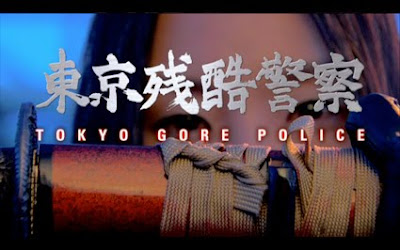
Tokyo Gore Police


Tokyo Gore Police
Original Title: Tôkyô zankoku keisatsu
Directed by: Yoshihiro Nishimura
Japan, 2008
Sci-Fi/Horror, 110 min
Distributed by: Njuta Films

Kick-ass over the top supers stylized Japanese gore. I’ll tell you right now, that it doesn’t get any better than this. The wave of neo-cyber/splatter punk directors that are on the scene right now are definitely making sure that everyone interested in alternative cinema is directing their eyes at a hard stare back on Japan.

The movies that have been coming out of Japan these last years since J-horror tripped up in it’s own matted web of wet hair and pale chicks is completely outrageous. They are among the most fascinating stuff that one can watch if your after a quick fix of gore drenched entertainment with outrageous special effects. It’s wonderfully sinister, gory to the max, and is very reminiscent of the great gore wave of the eighties.
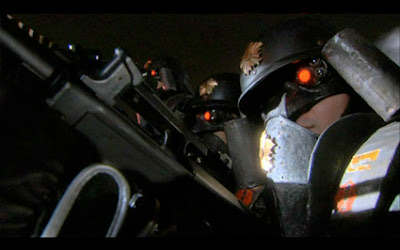
There’s something terrifically aesthetic about the way that Japanese directors portray their extremely stylish violence, since the ban on cinematic swordplay was lifted in the 50’s. Yes, in the post WW2 occupation of Japan the U.S. Censors imposed a ban on “nationalistic” movies hence forcing age old genres into obscurity. Well until they came back with a blood spraying vengeance a few years later. Directors and movies like Akira Kurosawa, Hiroshi Inagaki and Kenji Misui’s post war jidai-geki chanbaras, the great kaidan films of Nobou Nakagawa, Kaneto Shindô and Masaki Koboyashi, the gritty sixties and seventies pop crime flicks of Toshiya Fujita, Koji Fukasaku, Seijun Suzuki, Kenji Misumi and Shunya Ito, the new wave of Shinya Tsukamoto, Sogo Ishii, Takashi Kitano the revival of kaidan with the likes of Hideo Nakata, Kiyoshi Kurosawa, Shion Sono, and Takashii Miike and even still relatively unknown directors like Sakichi Satô, Gen Sekiguchi and Higuchinsky all have it in common. Their movies are perfected works of stunning visuals and amazing style. One could easily freeze frame at any one point and there is a breath taking image on screen… this is one of the reasons why I constantly find myself being drawn back to Japanese cinema over and over again. They pack a punch, spray the red, and always look fantastic.

Tapping into the likes of Sogo Ishii and Shinya Tsukamoto’s cyber punk of the last decade, and the ferocity of Takashi Miike’s no holds barred action flicks; Tokyo Gore Police is set in a dystopian future world where the law has been privatized. There is no compromising with crime – it’s a disease and the Tokyo Police Corporation show no mercy. Young star cop Ruka [Eihi Shiina – star of Takashi Miike’s Ôdishon (Audition) 1999] is drawn into a nightmare world where strange scientist [Itsuji Itao] has created a killer organism, from concentrated serial killer DNA. He places the genetically engineered keys into people, and once these keys are in place they are transformed into Engineers – deadly killers set on bringing the downfall of mankind.
But taking out the engineer’s is a more complicated task than just sending in the cops, as for each wound an engineer sustains a new lethal weapon from the wound. This is a brilliant idea and brings some really amazing scenes to the movie – the alligator woman is easily amongst one of the most impressive creatures ever to be put on scene.

At the same time Ruka has serious issues stemming from her childhood – she was grimly traumatised when she saw her cop father shot at point blank in the head during a demonstration – this incident has Ruka taking her angst out on her self through self mutilation. But it’s also an angst that she shares with the lead protagonist The Scientist as their pasts are linked in several ways.

When the scientist starts killing victims as well – apart from creating new engineers – the police force lead by Tokyo Police Chief [Yukihide Benny] demands that the engineers be stopped at all costs when they start finding the scientists victims – drained from blood and cut up into parts left in cardboard boxes. Ruka is obviously set on the case and goes after the Scientist, but the closer she get’s the more she learns that they share similar backgrounds. After fighting the Scientist in the subway, and actually being defeated, the Scientist encourages Ruka to “remember it all” and then inserts a key into her… Ruka faces some real issues now when she, the top cop, also is infected and doomed to become an engineer!
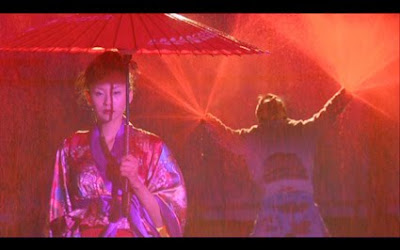
After fellow police officer is lured into a set up – which features the outlandish bordello and modified prostitutes, one which becomes the fantastic alligator woman - and turned into a diabolic engineer too, the Police Chief declares war on the engineer’s and Ruka – now with a foot in each camp has some shocking revelations ahead of her.

If you just want a taste of this film, then simply watch the opening sequence. I guarantee that it will shock you, seduce you and draw you right in. It’s packs a punch in the face opening like no other movie has for ages. And after setting up this fabulous tone, the movie starts exploring it’s narrative. There’s a great back-story that unravels throughout the movie and new information is put forth for each step closer to finding the lead engineer –Key man [Itsuji Itao]. Once he’s found, Ruka’s character has to revaluate her life as much of what she has previously thought to be one thing turns out to be a complete different one. There’s a wonderful complexity to the characters that really makes a difference. There are no simply good or bad characters, as they all hold both sides of the spectrum. Bad guys have very reasonable reasons for their actions and in some ways are acting in the name of good, and the same goes for the good guys who also are conducting foul deeds even if it’s in the name of good. It’s interesting and brings a density to the movie above the traditional linear narrative and classic archetypes.

Design wise there’s a lot of great things going on here. Police cars are modified old SAAB’s with shrines attached to the top, the usual mixture of new and old Japanese style is found as the cops all have a kind of neo-samurai clothing, the schoolgirl outfits and geisha outfits are all there too. Clubbers sport some fantastic outfits obviously inspired by LeighBowery and the modified girls will blow your mind. Especially the police chief’s pet Dog Girl [Cay Izumi] who later has razor sharp swords attached to her stumps becoming an almost gazelle like combatant.

Yoshihiro Nishimura has been on the scene for a few years – he’s already directed a bunch of movies of his own, but he’s primarily been working on special effects on some of the most impressive movies to come out of Japan since the J-Horror wave. If you’ve seen any of Shion Sono’s splendid movies this past decade, then you’ve seen the stuff that Nishimura comes up with.
There’s a great Blade Runner (Ridley Scott 1982), RoboCop (Paul Vehoeven 1987), Neo-Chanbara - CyberPunk vibe to the movie and the hilarious TV commercials that blurt onto screen – just like Starship Troopers (Paul Verhoeven 1997) are great. The Wii like appliance is outstanding and will have you laughing your ass off. These short ironic infomercials where directed by Yūdai Yamaguchi and Noboru Iguchi. Iguchi who also directed the fantastic Kataude mashin gâru (The Machine Girl) 2008 on which Yohshihiro Nishimura provided special effects. It was also on that same production that Nishimura was approached with the request to make another movie. Looking back at his 1995 debut feature Genkai jinkô keisü (Anatomia Extinction) he decided that it would make a perfect source and together with Kengo Kaji (who also worked on Higuchinsky’s amazing live action adaptation of Junji Ito’s Uzumaki 2000) on the screenplay to Tokyo Gore Police. I would love to find out how long they spent on pre-production, as the shoot itself supposedly only took Two weeks!
Nishimura still stays close to working the special effect on many of the movies within the Japanese gore horror genre, and has gone on to direct a few more films in a similar vain as Tokyo Gore PoliceKyûketsu Shôjo tai Shôjo Frankura (Vampire Girl vs. Frankenstein Girl) 2009 and Sentô shôjo: hi no tekkamen desetsu (Mutant Girls Squad) currently in post-production. Hopefully he’ll soon get back to the Gore Police with the sequel that is promised at the end of Tokyo Gore Police, as I’ll definitely be up for that one.

Tokyo Gore Police is a great movie, its extremely violent, grotesquely funny, has a great narrative and some outrageous designs that make it a fantastic piece of Japanese cinema. It’s a definitive must see movie that you need to check out as soon as possible if you haven’t seen it already because there’s a valid reason that this movie won the Best Asian Film award at the 2008 FantAsia Film Festival. It simply rocks supreme.

Image:
Widescreen

Audio:
Dolby Digital Stereo, Japanese dialogue, optional Swedish, Norwegian, Danish or Finnish subtitles.

Extras:
The making of Tokyo Gore Police, footage from the Japanese premiere, Interviews with Yoshihiro Nishimura and Eihi Shiina, theatrical trailer and trailers for other Njuta Film releases.

Here's the trailer and a selection of those fantastic infomercials.


Disney Star Wars and the Kiss of Life Trope... (Spoilers!)

Here’s a first… a Star Wars post here.  So, really should be doing something much more important, but whist watching my daily dose of t...