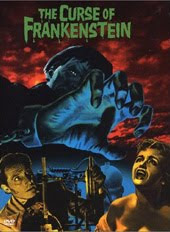
The Curse of Frankenstein
Directed by: Terrence Fisher
UK, 1957
Horror, 82min
Distributed by: Sandrews Metronome/Warner Bros.
It’s close to midnight, the kids are asleep, the wife has just gone too bed. Perfect time for a relaxing stretch out on the settee with a cup of tea and a top notch Hammer film that I know will within the span of ninety minutes have me happily drifting in and out of sleep as the plot squirms forth on the TV screen. As Wallace and Gromit love their cheese, I love me a Hammer film every now and again. I always have, I always will, as they are an important part of my fascination for the horror genre, and where one of the definitive starting points in my life long passion for low budget movies.
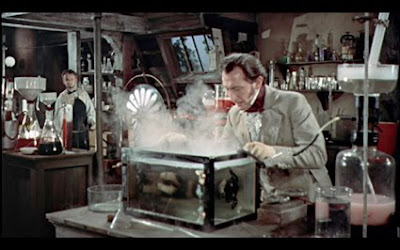
But the 1957 classic The Curse of Frankenstein, a film I’ve been returning to over and over a gain ever now and then since seeing it on the telly as a kid, still fascinates me in many ways, and challenges me to keep awake, as I want to see the movie come full circle. And on the way there will be cold blooded murder, grave-robbery, decapitations, Peter Cushing, Christopher Lee and James Bernard’s wonderful score.
I’m going to be bold here and suggest that Terrence Fisher's 1957 Hammer Horror The Curse of Frankenstein is where the first gentle streaks of exploitative blood and violence where put on screen. Sure there had been movies what showed scenes of horror gone before, but this is where they first hit the audience in full colour, and only there for speculative effect. It should be pointed out that the Japanese Chanbara shouldn’t be looked at as splatter flicks, as they are a completely different genre. Sure the blood does spray all over the place, but it does so outside of the horror themed area – well not until Nobuo Nakagawa and others like him started putting the Kaidan plays of Kabuki on celluloid at least.

So all that humbug that H.G. Lewis was the godfather of the gore movie, and John McCarty’s eighties document Splatter Movies on the genre, can all be laid to rest. The yanks didn’t create splatter and gore, they simply made the claim that they did. Frequent readers will know that I previously have argued that the slasher genre of the late seventies and early eighties would not have been if not for the low budget Gialli and horror flicks out of Europe and neither do I feel that the gore films of the mid sixties would have arrived if not for pioneering studios like Hammer and their little series of groundbreaking flicks. And while I’m at it, those H.G. Lewis films weren’t especially good back then and they certainly haven’t aged well as their naivety and campiness mean nothing anymore, and really didn’t back then either.
Instead I claim that splatter/gore, call it what ever you will has it’s roots in the late Fifties Hammer films.
There must have been a shitload of surprised faces as Bray studios when fifty three year old Terrence Fisher, and his thirty year old screenwriter Jimmy Sangster realised that their venture into classic horror ground with the spice of Eastmancolour and blood became an unexpected box office hit not only in the UK, but also a global success as far away as the US and Japan. A worldwide phenomenon that would spawn several remakes of the Universal horror’s in a spanking new packaging, and kept the Hammer studios running for almost two decades to come.
You know the story - it’s the classic Frankenstein tale by Mary Shelly with a Hammer spin on it. And here’s the quick fix if you haven’t seen it: After a short bookend opening where a worn out and shattered Baron Frankenstein [Peter Cushing] sit’s in his prison cell awaiting execution, he tells his tale to the priest that has come to save him. The flashback movie begins…
The young Baron Victor Frankenstein and his tutor of many years Paul Krempe [Robert Urquart] perform a series of experiments, and after bringing a dead pup back to life, they see how they can revolutionise the world of medicine… but in two completely different ways. This lays out the fundamental rift between the two men and it’s also the conflict that will separate the two friends indefinitely. Victor goes about building his beast to Krempe’s despair, who demands that he stop this terrible experiment. Finally after a freak lightning storm the monster is awoken! The cameras rushes forth to a harrowing close up of the snarling scarred beast [Christopher Lee] and James Bernard’s score goes all in.

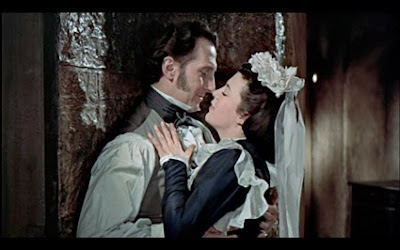
Despite the genius of creating life, Victor is unable to keep the beast captive and it obviously escapes only to kills off a blind man and his son. It’s done off screen but with James Whale’s 1931 classic in reference you know what happens. The beast is recaptured and strung up in the lab once again. Frankenstein has an affair – even if only suggested in a brief snog, the sort of scenes Cushing loathed doing, but being the damned fine actor that he was, he did exactly what the part required from him. What a trooper. – with this maid Justine [Valerie Gaunt, who would return to the screen with Lee, Cushing and Fisher the following year in Dracula 1958 also based on a Sangster script.] and when his cousin Elisabeth [Hazel Court] whom he has been acting as guardian for, arrives at his house with the intent of marrying him, there’s a conflict that Frankie Boy solves by luring Justine into the room housing the monster he’s created. Some splendid editing and suggestive images of the off screen killing where to become Hammer Horror trademarks, and also the cynicism of their main antagonists. When Justine’s screams fades off the soundtrack there is a hard cut into a breakfast scene where Frankenstein coldly asks Elisabeth to pass him the marmalade. It’s a cold-hearted testament to the Barons lack of affection for stuff outside of his research and his dedication to his scientific abomination.
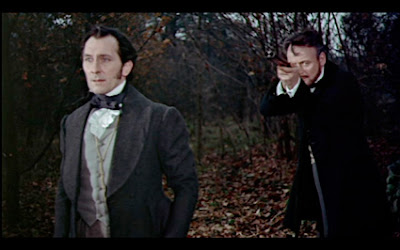
The rift between Krempe and Frankenstein grows throughout the movie, and after the final confrontation, where Frankenstein is forced to kill his creation to save Elisabeth; the game grinds to a halt. Back in the prison cell, the priest is appalled by Victors’ tale, and in a sinister twist Kempe makes a final entrance. Victor begs Krempe to tell the priest of the monster he created, so that Frankenstein can be acquitted from the charge of killing Justine… but Krempe denies knowing anything of any monster, and as he leaves the prison with Elisabeth on his arm, Frankenstein is walked off to the guillotine.
Definitely among one of the finest Hammer Movies, The Curse of Frankenstein is a real gem for many reasons. It’s the first Colour version of Frankenstein, the first time Peter Cushing and Christopher Lee where together in a horror movie, and the first of many fantastic screenplays that Jimmy Sangster would write for Hammer. And last but not least, it's still a damned good movie!
Where American movies had been running with the themes of a world gone wild due to the side effects of Nuclear power with their many giant monster movies - THEM 1954, The Giant Gila Monster 1959 and so on, or guzzling on communist paranoia films – Invasion of the Body Snatchers 1956 etc, the chilling dreadfulness of The Curse of Frankenstein was a fresh wave of Gothic Horror. A wave that soon would sweep over the globe and make Hammer studios forever associated with period piece horror.
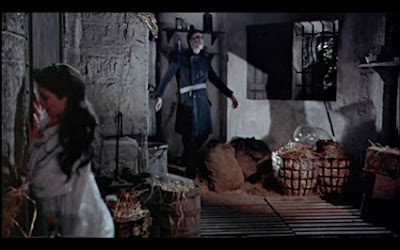
Also the movie brought with it a fresh vain of dark cynicism previously not found in horror pieces. As in The Curse of Frankenstein, you have a leading character sentenced to death. Sure he’s been breaking the laws by playing god for the last eighty minutes and guzzling down jam sandwiches after killing his mistress, but the “good guy” Krempe turns on him in the last minute and not only sends him off to his death with a lie, but he also steals his wife to be. I still find it as fascinating that Sangster chooses this disturbing twist at the end of the movie, and it’s a frequent returning trait of his, positive characters going against their character in the last moment. But perhaps this is what makes his scripts so interesting, he dared to challenge the norm and character arcs that he built thought out the movie.
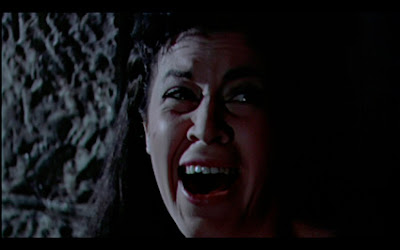
Now that claim that this is one of the first movies to use gory violence for speculative effect may seem somewhat odd, as there are not really too many scenes of carnage in the film compared to films in the same niche that followed. But keep in mind that the audience had not seen these sorts of images – Cushing wiping off a fair amount of blood on his apron after decapitating the initial corpse, severed hands, cold and bloody being unwrapped, Christopher Lee’s monster makeup, all pale, bloated and riddled with oozing bloody scars enhanced by a furious push forth zoom the first time he’s exposed, and then there’s that shot gun blast to the head of the monster which at the time must have been astonishing for the audience. Cushing races his hand to his forehead as blood pours between his fingers. Sure with today’s standards there are scarier things on the shows that my kids watch, but back in 1957 this was met with outrage! The censors slapped an “X” on the film, and with that controversial rating, the kids of the time just lapped it up. Hence the success of Hammer, movies that still today has a passionate and affectionate legion of fans that spend time in the company of these fantastic movies.
Fast-forward fifty years and these movies are now released with the PG certificate, and nobody would ever believe that they where groundbreaking pieces of cinema that it indeed where.
Image:
1.85:1 – Anamorphic 16x9
Audio:
English Dialogue, French or German Dub available, and subtitles in every possible language imaginable.
Extras:
Pretty lame edition, it’s only got the Theatrical Trailer and a cast and crew test loop. Hopefully the revitalised Hammer as part of Entertainment mogul Jan de Mol will start re-releaseing their movies with a full deluxe extras and the whole shebang.