Showing posts with label watchmen. Show all posts

Sunday, March 8, 2009

Watchmen Weekend Wrap-Up: Captain Atom and Nightshade

Welcome back, Groove-ophiles! Today we're gonna take one last look at the Groovy Age characters that served as the inspiration for Alan Moore and Dave Gibbons' Watchmen! For our grand finale, we'll focus on Captain Atom (transformed in Watchmen to Dr. Manhattan) and Nightshade (Watchmen's Silk Spectre). Remember,
= and
= . Got it? And away we go!

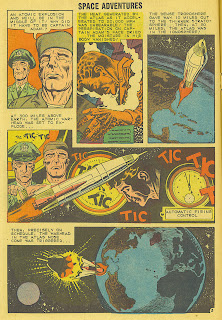
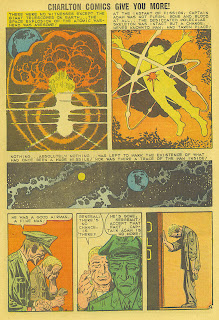
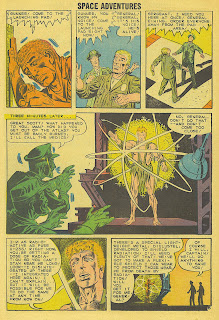
Captain Atom first appeared in Charlton's Space Adventures #33 (December 1959). The first super-hero co-created by artist Steve Ditko (along with writer Joe Gill), Captain Atom looked to be Charlton's answer to DC's Superman and Green Lantern. Ditko and Gill actually produced one of my all-time favorite origin stories in that fateful issue. Let's take a little peek, shall we?

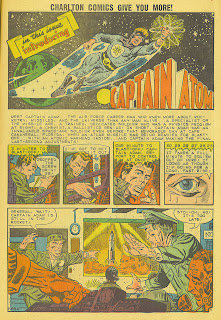
(Man, whoever colored the interior story must've been asleep when they told 'im about Cap's red and gold togs, y'think?)

Ditko's inspired art, along with Gill's taught and tense scripts made this strip a stand-out. The good Captain appeared issues 33-40 and 42 (December 1959-March 1961, May 1961) of Space Adventures before disappearing. In March 1965, Charlton began reprinting Captain Atom's exploits in Strange Suspense Stories, beginning with issue #75. The reprints lasted until Strange Suspense Stories' final issue #77 (July 1965). This time, however, Captain Atom didn't disappear. In September, 1965, Captain Atom #78 (picking up the numbering from SSS) hit the stands with brand new stories and art. Co-creators Gill and Ditko returned to their creation (aided and abetted by the wonderful inks of Roke Mastroserio), this time with the freedom to spin more fabulous tales than their previous 5 to 9 page format had allowed.

Changes began with Captain Atom #82 (July 1966). The cover gave us two new characters in the Captain Atom universe; a new villain called the Ghost and a new heroine by the name of Nightshade. Looking at the first page, we had a new writer by the name of David Kaler, as well.

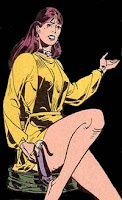
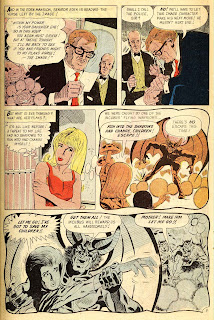
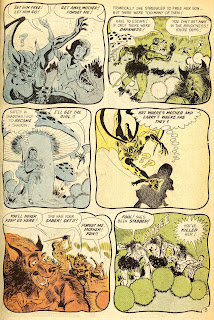
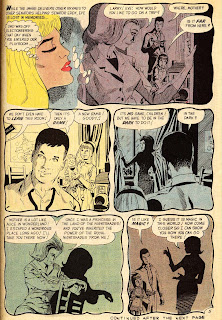
Nightshade was the daughter of a U.S. Senator and his extra-dimensional wife who learned she had the power to become a living, two-dimensional shadow. A pretty cool power, and coupling it with martial arts abilities made her quite a formidable opponent. She teamed with Captain Atom for a few issues, seeming to develop a bit of a romantic bond with our hero. Then in CA issues 87-89, Kaler teamed with artist supreme Jim Aparo on Nightshade's solo back-up strip and filled in the details of Nightshade's origin. Here are some highlights from that classic tale...


Steve Ditko gave Captain Atom a sleeker, "more modern" look with issue #84 (November 1966). Some fans flipped for it, others were reaching for a barf bag. Personally, Young Groove kinda dug it! Take a look and decide for yourself, Groove-ophile!

When Captain Atom ended with issue #89 (September 1967), both the Captain and Nightshade disappeared from the comics racks, seemingly for good. But weird things happen in comicbook land, don'tcha know? In 1977, Modern Comics, an imprint of Charlton Comics, began reprinting vintage Charlton comics in toto (but with new ads). Among those reprinted were three key issues of Captain Atom, #s 83-85. Then in 1978, Charlton reprinted the Captain Atom stories that had appeared in the original Space Adventures (the same ones that had been reprinted in Strange Suspense Stories) in their new Space Adventures title (issues 9-12 , February-October 1978). But wait, there's more! In February 1982, fan writer/artist Dan Reed created a brand new Captain Atom story for Charlton's Showcase-style title, Charlton Bullseye (#7). Captain Atom, Nightshade, and other Charlton Action Heroes appeared in two comics published by Americomics (Americomics #1, cover-dated April 1983 and Americomics Special #1 cover-dated August 1983).

From there, it was on to DC where the Captain and his pals would not only inspire Watchmen, but gain new lives (and sometimes, as in Captain Atom's case, new identities) in their own DC titles.

Whew! I hope you enjoyed this Watchmen Weekend, Groove-ophiles! We'll be back to our regularly scheduled Diversions on the morrow! Til then, be cool, baby!

Saturday, March 7, 2009

Watchmen Weekend Continues with Blue Beetle and Peter Cannon, Thunderbolt

Welcome back to Ol' Groove's Watchmen Weekend party, Groove-ophiles! Yesterday we took a look at the Question, Alan Moore and Dave Gibbon's template for Rorschach, and Peacemaker, who inspired the Comedian. Today we're gonna get down with the ever-lovin' Blue Beetle and Peter Cannon, Thunderbolt! If you're keeping score, Blue Beetle begat Nite-Owl and Thunderbolt morphed into Ozymandias. Or, for you visual learners:
= and
= . Got it? Good!

Blue Beetle has a long and checkered history in comicdom. Created early in the Golden Age (1939 to be exact!), BB has appeared in comics under no fewer than five different publishers and enjoyed nearly as many secret identities and costumes. The Groovy Age Blue Beetle, the one published by Charlton (and later Americomics and DC) and created by Steve Ditko is the one we're focusing on today. It was this version, sporting one of the all-time greatest superhero costumes, that led Moore and Gibbons to create Nite-Owl. Ditko's Blue Beetle was not only an awesome character, visually, but just doggone cool all the way around. In his secret identity of Ted Kord, BB was an inventor and industrialist a la Tony Stark. He created all kinds of far-out gadgets, not the least of which was his high-tech, beetle-shaped aircraft lovingly referred to as "Bug". He first appeared as a back-up in Captain Atom #83 (August 1966) and fandom immediately took him to their hearts. Check out this snippet from his debut by Ditko with scripting by Gary Friedrich...

Blue Beetle is on the prowl in his "Bug" when he hears gunshots coming from the City Bank. Wasting no time, he's on the scene and ready to bust heads!


BB drops the bad guys off at police headquarters, thus ending his first outing as a costumed crimefighter. Short and sweet, but all-in-all not a bad intro!

Ditko wisely kept his Blue Beetle mysteriously tied to the original, and you know how us comicbook fans love our mysterious pasts and ties to Golden Age continuity. Between the mysterious back story, costume, gadgets, and fun characterization BB should'a been a huge, huge hit. Charlton had faith in BB, faith enough to give him his own mag with its own first issue (something rare for Charlton) beginning in March, 1967. They even created a house ad trumpeting BB's comic.

The Blue Beetle's mag lasted a mere five issues. The tardiness of its final issue made it seem to have held on a bit longer than the other members of Charlton's Action Heroes line, but it finally bit the dust in August, 1968. Ted Kord went on to become a cult favorite and starred in a very successful DC mag in the 1980s. Sadly, DC recently killed him and replaced him with yet another Blue Beetle. Hopefully they'll fix that one of these days...

Peter Cannon...Thunderbolt was created by Peter A. Morisi (a Golden Age comicbook artist who went on to become a policeman who moonlighted as a comicbook artist, compelling him to sign his name as P.A.M. so as to hide his cartooning career from his superiors). PC...T was inspired by the Golden Age Daredevil, to whom Morisi had tried, unsuccessfully, to attain the rights, hence the very similar costume designs. Morisi also pinched the origin of another Golden Age character, Bill Everett's Amazing Man, for Thunderbolt's origin (AA's origin was also homaged by Roy Thomas and Gil Kane when they did Iron Fist, but you knew that already...). So, while not wholly original, Peter Cannon...Thunderbolt was still a great deal of fun. Morisi's beautiful art was a throwback to the great days of the Golden Age, his stories were globe-trotting romps in the tradition of Terry and the Pirates, and PC...T enjoyed an 11 issue run (Peter Cannon...Thunderbolt #1, October 1966; Peter Cannon...Thunderbolt #s 51-60, December/January 1966-August 1967). Here's a partial look at PC...T's origin from Peter Cannon...Thunderbolt #1!

Told ya it was fun stuff! Be back tomorrow for our grand finale starring Captain Atom and Nightshade! Pax!

Friday, March 6, 2009

Watchmen Weekend Begins with The Question and Peacemaker

What it is, Groove-ophiles! I know what you're thinking--what has Watchmen got to to with the Groovy Age? The comics came out in the 80s, the movie's coming out now--what's Ol' Groove up to? Never fear! You know I've always got an angle, don'tcha? Y'see, we know the Watchmen movie was inspired by the Watchmen comic which was inspired by a premise Alan Moore cooked up for Charlton's Action Heroes when DC got the rights to 'em as a "gift" for former Charlton editor, then DC editor Dick Giordano, right? Well if ya didn't ya do now! So how does that tie into the Groovy Age? Well, as I often point out, the Groovy Age started in 1967. Guess what Charlton was publishing in 1967?
Which led to this in 1986...

Which led to this in 2009.

Now, if you're like me (even just a little) you're gonna go see Watchmen sometime this weekend. Win or lose, good or bad, we're gonna see it! So why not mix a little today in with our yesterday? And just to keep things interesting, you can look at today's post as a double-dose of Famous First Fridays, 'cause Ol' Groove is layin' the first appearances of both the Question (Rorschach's inspiration) and Peacemaker (who became Watchmen's Comedian) on ya!
=

and = , dig it? Here we go!

The Question made his debut as the back-up feature in the first issue of Charlton's revamped Blue Beetle comic (March 1967). Created by Steve Ditko under the editorship of Dick Giordano, the Question quickly became a comicboook cult fave. In the Question, Ditko created a hero who saw the world as he, himself, saw it: in black and white. Good is good, evil is evil, and there are no gray colors. The Question was relentless in his quest for the truth and for right as no other comicbook hero before him, and inspired many who came after him (well, inspired them to be relentless, especially when the "grim and gritty" trend kicked in). In his other identity, the Question was Vic Sage, a "hard-hitting TV reporter" who also relentlessly sought the truth, the whole truth, and nothing but the truth. The Question existed to find the answers that Vic Sage could not find. Deep stuff, man, but even Li'l Groove could dig where Ditko was coming from with all of this. In fact, discovering the Question as a child might've made him even easier to understand! Ditko came up with a very cool and innovative look for the Question, hearkening back to the grand old crime-fighters of the Golden Age like the Spirit and the Sandman. But it was that mask, that featureless, faceless face mask that really ramped up the awesome factor. Check it our for yourself...

While Syd Starr is making his speech, the police are busy busting up a gambling ring led by a self-proclaimed "three time loser" named Lou Dicer. Dicer shoots and wounds a policeman (the Comics Code still ruled in '67, baby!), making good his escape. Sage takes to the airwaves with the story of Dicer's crimes. It's then we see Sage is not the Question's version of Clark Kent. Sage begins to, well, preach to his audience about how the average citizen who participates in any type of gambling is helping keep Dicer and his ilk in business. Of course, the public doesn't like to hear that crime is their fault , and the folks who run Sage's TV station, except for station president Sam Starr, see him as a troublemaker. "We have to remain neutral. Just report the facts..." one of his superiors says. Not if you're a hero in a Steve Ditko story, baby! Especially not if you're the Question!

Naturally, after a beating like that, Dicer's men talk. The Question heads directly for Dicer's place where he overhears the crook talking to to his mysterious partner. Deciding it would be more productive to let Dicer lead him to the mysterious partner, the Question shadows Dicer to the pre-arranged meeting place, but not before he phones the police to fill them in on what's about to go down...

How's that for an original twist? It's not the Question who takes Dicer down and uncovers the identity of his partner, but the police! Why? Because the Question had faith in the men in blue that they could get the job done--so much faith that he was there with a live camera crew to film the whole episode for his news show.

The Question appeared in all five issues of Blue Beetle, plus in the legendary one-shot issue of Mysterious Suspense (July 1968). All were plotted and drawn by Ditko, all were scripted by D.C. Glanzman (who's identity is still debated to this day--Dave Glanzman, Sam Glanzman's brother? Sam Glanzman himself? And how much re-writing did Ditko do?) except for the untitled story in BB #4, which was scripted by the great Steve Skeates under his pen name of Warren Savin.

Peacemaker also began his comicbook career as a back-up strip. He first appeared in Fightin' 5 #40 (August 1966--yeah, he first appeared before the Groovy Age actually started, but his mag ran through 1967--let your hair down and have some fun, man!), written and drawn by Joe Gill and Pat Boyette. Another sort of oddball hero, the Peacemaker was actually a pacifist envoy to the Geneva Arms Conference by the name of Christopher Smith. Smith we learn became the Peacemaker because he was a "...man who loves peace...so much so, that he is willing to fight for it!" It says so right there on the splash page...

As the story begins, Smith is mulling over his mission. He has learned that a warmonger named Emil Bork is stirring up border wars in South America. Thing is, Smith is on Bork's mind, too. Bork is in Geneva and has arranged a very unpleasant welcome for our peace-loving envoy...

Bork, hiding in plain sight as an advisor, meets Smith later that evening at an embassy function. The two men play cat and mouse with each other, in a James Bondian battle of wit and words. Smith knows Bork has the authorities duped. That means he must take matters into his own hands as...aw, you guessed it!

Of course that wasn't the end of the Peacemaker, and he did finally defeat Bork in the next issue of Fightin' 5. Peacemaker then graduated to his own comic, which ran five issues (December 1966-August 1967).

Before I go, I have to thank Dave Olbrich for naming the ol' Diversions blog as his Fanatic Blog of the Month for March! Dave's Funnybook Fantatic is a joy to read and a class act, as well. Ya know Dave has great taste, so if you're not reading it, read it!

Tomorrow, BLUE BEETLE and THUNDERBOLT! Be here!


LinkWithin

Blog Widget by LinkWithin
Special thanks to Mike's Amazing World of Comics and Grand Comics Database for being such fantastic resources for covers, dates, creator info, etc. Thou art treasures true!


Note to "The Man": All images are presumed copyright by the respective copyright holders and are presented here as fair use under applicable laws, man! If you hold the copyright to a work I've posted and would like me to remove it, just drop me an e-mail and it's gone, baby, gone.


All other commentary and insanity copyright GroovyAge, Ltd.

As for the rest of ya, the purpose of this blog is to (re)introduce you to the great comics of the 1970s. If you like what you see, do what I do--go to a comics shop, bookstore, e-Bay or whatever and BUY YOUR OWN!