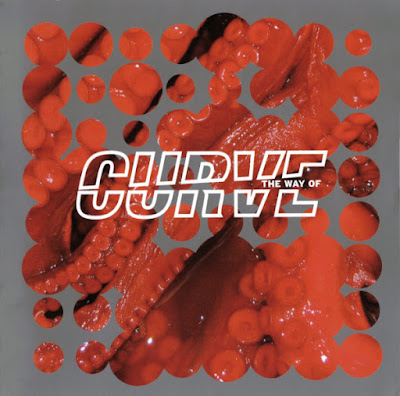
Curve thrived on contradictions. They were at their sexiest when they were at their ugliest; they were at their most cathartic when they were at their most claustrophobic; they were at their sleekest when they were at their most layered. Curve were also, in a roundabout and involuntary way, considerate: had they been more concerned with melodies and a little less so with textures, Garbage wouldn't have been necessary -- in turn, that later band's members would have less money in the bank. Curve's blurred textures, created in part by guitars subjected to a battery of effects, led to frequent classification as shoegaze, but their sound -- reliant on pounding/driving/pulsing rhythms generated by both machines and humans -- put you in a chokehold, not a daze. There were steady torrents of vroom and oomph, and Toni Halliday's confrontational lyrics and vocals were more likely to pierce through the din than melt into the background. They were certainly dark and yet were hardly goth; they were set up like a rock band but were essentially a dance band. The Way of Curve is the most representative of the band not for its set of wise selections, but for the fact that it's as difficult to classify as the band itself. It lands somewhere between a beginning and an end, not quite a proper beginner's guide while falling short of being a gap plugger for those seeking all the elusive B-sides. The first disc, covering the band's first A-side through its most recent recordings, does include many of the best moments, but a few essential tracks are neglected in favor of too much later, lesser material. (Right around the major-label comeback single, 1997's "Chinese Burn," it became evident that the musical climate had finally caught up with them.) "Pink Girl With the Blues," a low-key, independent-label comeback single from 1996, is one of the most significant inclusions, since many longtime fans have gone years without ever hearing it. Storming and seething, it rightfully belongs on this first disc, pitting Throbbing Gristle/Moroder-like percolations against a kinetic, snarling flurry of guitars. The second disc rifles through B-sides and obscurities, beginning with "On the Wheel." That song is Curve's own "Erotic City" -- meaning it's a B-side that many justifiably regard as the band's apex -- and you don't have to actually see The Doom Generation to know that the scene in which the song is used must be the best one in any Gregg Araki-directed film. There are negligible choices made with the remainder of this second disc as well, the greatest miscue being the favoring of the Aphex Twin mix of "Falling Free" over the far superior original. Even with these flaws, The Way of Curve provides plenty for any form of fan.
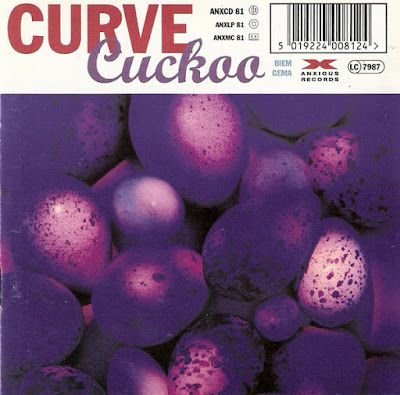
The duo of Toni Halliday and Dean Garcia (with help from three others) gave us the refinement of the deeds they started before. This 1993 release garnered them the press and acclaim they deserved, and although it would be five years before their next release, they left the masses with a lasting impression.
The lead-off "Missing Link" burns by with the loudest number they had done up to that point. Using the loudness as a driving force instead of an accompanying factor, it's a refreshing blast of energy. An illustration of the opposite end of the noise spectrum is "Left of Mother" with its acoustic base and Halliday's airy vocals spilling into the tracks. "Unreadable Communication" showcases a different train of thought with its electronic intro and main body, only heightened with moments of the Curve grind. These are the extremes, and Cuckoo is the crystallization of previous works.
Following the blitz of "Missing Link," "Crystal" finds the band back in the mode of power through coloring and groove. The color of noise is used splendidly in the chorus, adding to the tone of the lyrics. "All Of One" leads off with Halliday's floating lyrics before plunging into a guitar driven choruses. Additional flourishes of guitar throughout add depth and teeth to the composition. The "Curve style" is used to great effect in "Turkey Crossing" with its simple bass groove and ultra-dirty guitar phrases accompanied by Halliday's seductive vocal. Lyrics like "I'm finished with you/please be finished with me" are only embellished by layered guitars adding musical weight to the lines. Flood's prowess at the board only helps "Men Are From Mars, Women Are From Venus" pound a groove into your head, only to have the salt of dirty guitar added into your wound. It's grind and melody join two things that at times seem to be in conflict, just like the objects of the title. Curve was one of the top purveyors of "shoe-gazing" pop, and Cuckoo demonstrates why. This is an essential album to the genre.
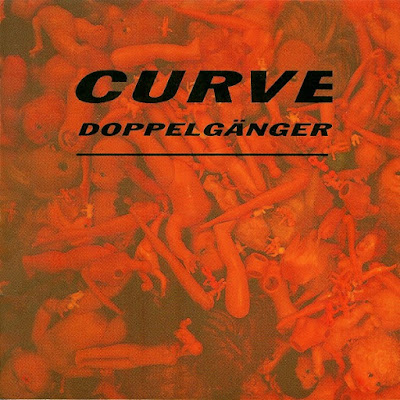
Following a series of single and EP releases that had found chart success in the U.K. and indie credibility in the States, the British band Curve released their full-length debut Doppelganger on Dave Stewart's Anxious label. Led by lead singer Toni Halliday and guitarist Dean Garcia, both of whom had toured with Robert Plant, Curve enlisted production help from Flood for this record. Roaming the same sonic landscape as My Bloody Valentine, Doppelganger features the breathy, dreamy vocals of Halliday over top layers of throbbing guitar, dense keyboards, and sledgehammer drumming to create formidable aural textures. At times meandering and unrelenting, tracks like "Already Yours" and "Wish You Dead" are stellar workouts full of rhythm and attitude. The few slower numbers are a nice change of pace with the best results on "Fait Accompli" and the quiet, almost dirge-like "Sandpit," where the less dense instrumentation allows Halliday's vocals to become the focal point. At times menacing and dark and other times more playful, Doppelganger is a bracing listening experience that earned Curve well-deserved attention on both sides of the Atlantic.