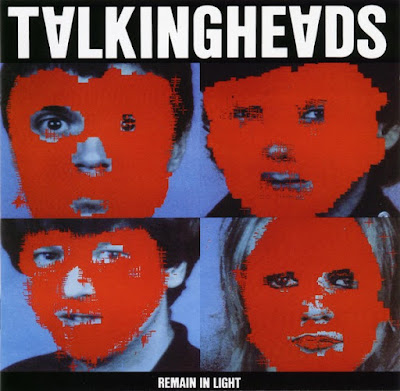
The musical transition that seemed to have just begun with Fear of Music came to fruition on Talking Heads' fourth album, Remain in Light. "I Zimbra" and "Life During Wartime" from the earlier album served as the blueprints for a disc on which the group explored African polyrhythms on a series of driving groove tracks, over which David Byrne chanted and sang his typically disconnected lyrics. Remain in Light had more words than any previous Heads record, but they counted for less than ever in the sweep of the music. The album's single, "Once in a Lifetime," flopped upon release, but over the years it became an audience favorite due to a striking video, its inclusion in the band's 1984 concert film Stop Making Sense, and its second single release (in the live version) because of its use in the 1986 movie Down and Out in Beverly Hills, when it became a minor chart entry. Byrne sounded typically uncomfortable in the verses ("And you may find yourself in a beautiful house, with a beautiful wife/And you may ask yourself, well, how did I get here?"), which were undercut by the reassuring chorus ("Letting the days go by"). Even without a single, Remain in Light was a hit, indicating that Talking Heads were connecting with an audience ready to follow their musical evolution, and the album was so inventive and influential, it was no wonder. As it turned out, however, it marked the end of one aspect of the group's development and was their last new music for three years.
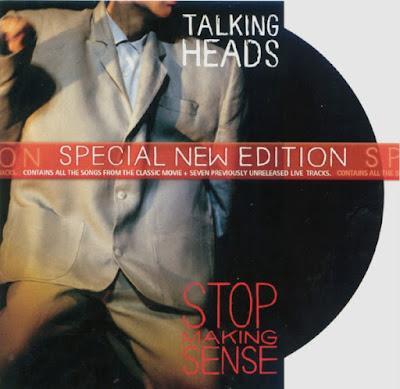
It starts with audience noise, David Byrne scrolls out and utters immortal opening lines.
“Hi.
I’ve got a tape I wanna play you.”
A basic electronic drum pattern starts up, there’s a sharply strummed acoustic guitar and then the bare-bones live version of “Psycho Killer” blows the studio original clean out of the water. Just a drum machine, Byrne’s voice and an acoustic guitar. You already know that this is going to be one of the greatest live albums in the history of popular music.
For the next song Tina Weymouth turns up on stage and they produce a stunning version of “Heaven”. For “Thank You For Sending Me An Angel” Chris Franz appears behind the drum kit and things are really starting to take shape now. “Found A Job” finds Jerry Harrison appear next to Byrne to add anther guitar and the original Talking Heads quartet is in place, playing their angular art rock and winning the audience over hand over fist. But it doesn’t stop there, as all manner of backing singers, synth players, percussionists and funky rhythm guitar players take to the stage one after the other, until by the time we get to “Burning Down The House” we get the funkiest punk band that ever walked the earth.
Lets get one thing straight now, Stop Making Sense may very well be the best live album ever recorded, it’s certainly one of the best sounding, as its production picks up every polyrhythm, every guitar lick, everyone of Byrne’s vocal ticks. The majority of the sixteen tracks here are superior to their studio counterparts and given that Talking Heads were no slouches in the studio, that’s one hell of an achievement. Favourite numbers? Everyone has their own, but for me “Slippery People”, “This Must Be The Place (Naive Melody)” and “Take Me To The River” are three that jump out at me every time (particularly that drum crack and vocal yelp near the end of “Slippery People” which sounds as if it’s going to blow your speaker out if you play it too loud). Only one track doesn’t quite measure up to the studio original and that’s the evergreen “Once In A Lifetime”, but the original version is so close to my heart that I doubt any other recording of it will ever measure up and the live version here is very, very good indeed. Of course no review of Stop Making Sense is complete without a reference to Byrne’s big suit worn during the storming “Girlfriend Is Better”. You can practically hear it expanding.
On this expanded version you also get “Genius Of Love” played by the Tom Tom Club (on this occasion the entire Talking Heads line up except David Byrne), while Byrne takes the opportunity for a well-deserved breather. While some would argue that has no place on a Talking Heads release, I would argue until my last breath that it should remain, if only to hear Chris Franz yelling “Jaammmeesss Broowwwwnnn!!! Jaammmeesss Broowwwwnnn!!!”. It’s just one of many utterly brilliant moments on this album.
This is one of the few occasions where a live album is an act’s definitive release. It starts with the most basic of rhythms and a sparse tune and it ends with some of the most complex polyrhythms in my music collection. It doesn’t really get much better than this.