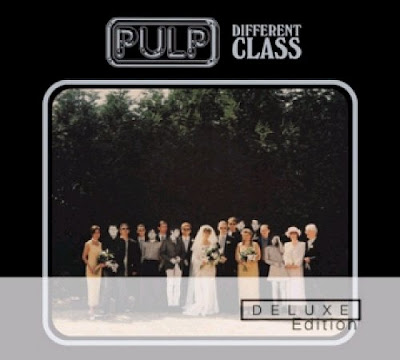
Universal UK reissued the three key '90s Pulp albums as double-disc deluxe editions in 2006. Thankfully, the deluxe edition of Pulp's 1995 masterpiece Different Class is not just a recycling of Second Class, the collection of B-sides that appeared as a bonus disc in a repackaging of the album in 1996. That's partially due to the fact that Second Class drew heavily from His 'n' Hers-era B-sides, which now appropriately appear on the concurrently released His 'n' Hers deluxe edition, so this 11-track collection of non-LP material and rarities feels quite different than the 1996 bonus disc. Completists should also be aware that this disc does not contain all the B-sides from the Different Class singles, but that's because the singles carried B-sides that were largely consisted of alternate mixes; a "Vocoda Mix" of "Common People" shows up here, but there are plenty of mixes that didn't carry over here, only two of which may be missed by collectors: an alternate, extended "Live Bed Show" and a 7" single mix of "Disco 2000," which is considerably different than the album mix thanks to added organ, synths, harmonies, and, yes, a prominent disco beat. These may be missed by certain trainspotters, but all the crucial non-LP material from the Different Class era is here, all worthy of the classic album they supported. There's the cutting, wickedly funny teacher-student sex tale "PTA"; there's "Mile End," their contribution to the Trainspotting soundtrack, a nimble evocation of slum living that's far catchier than its subject should be; there's "Whiskey in the Jar," a surprisingly sinewy cover of the Thin Lizzy version of the Irish anthem that was given to the Childline charity album; then, there's the heartbreaking "Ansaphone," a B-side for "Disco 2000" that's presented here in a slightly different demo version. "Ansaphone" is grouped together with four demos of unheard songs from the sessions, all very strong. For starters, there's "Paula," whose light, skipping music camouflages the cynicism of the friends-with-benefits celebration of the lyrics. It's followed by the tremendous "Catcliffe Shakedown," a six-minute epic that may be driven by a slightly dorky beat (which Jarvis Cocker calls "frankly ridiculous" in his great liner notes, which also feature full lyrics for all songs on these two discs), but it gains strength from its gangly rhythms, and it's distinguished by a great Jarvis lyric that, by his own admission, resembles "I Spy," but where that contained a barely veiled menace, this is pure riotous satire of a nasty down-class small town ("why not try our delicious lager-styled drink?"). The sleek, svelte "We Can Dance Again" pales a bit in comparison to this deliberately cinematic gem, but it's a great piece of knowing retro-disco, as is the fantastic "Don't Lose It," which is sensual and urgent in equal measures. Rounding out the rest of the deluxe edition is their transcendent version of "Common People" that closed their triumphant last-minute headlining slot at the 1995 Glastonbury Festival and Nick Cave's inspired "Pub Rock Version" of "Disco 2000," which sees its first release here. With the possible exception of the "Vocoda Mix," which finds a threadbare idea stretched a little too far, this is all great music, a fitting companion to a classic album, and makes this a truly deluxe deluxe edition.

There’s a telling moment that comes near the end of This is Hardcore’s lead single “Help the Aged”. After building the bridge towards a climax, the song approaches the moment Jarvis Cocker is clearly supposed to hit the songs big note and send the whole song rocketing into the last chorus. Instead he chops the word to bits, “Your se-se-se-se-se-se-se-sellooooh!” he cries, and single handedly destroys the song’s momentum and sends it limping into the final chorus. The moment is emblematic of This is Hardcore, which is not commercial suicide but commercial sabotage. Cocker spends the duration of the album limiting his commercial appeal as much as possible in order to regress from the epic success of Different Class back to a cult following. “You’re gunna like it, but not a lot,” Cocker sings to his pop audience on opener “The Fear”. While This is Hardcore is far more challenging than its predecessor it’s just as rewarding, a harrowing look at what happens when the cameras cut off and the stars go home alone.
Jarvis Cocker spent Christmas 1996 alone at the Paramount Hotel in New York. Cocaine had ripped through the Britpop scene and Cocker wasn’t exempt as rumors began to fly about his supposed heroin usage. By this point, Pulp wasn’t the same band they were a few years ago. Russell Senior left upon Cocker’s return from New York, explaining “it wasn’t creatively rewarding to be in Pulp anymore.” When This is Hardcore was released in March 1998 it was heralded as commercial suicide and sold a small fraction what its predecessor did with only one of its singles making the top 10.
Listening to it now, this sounds intentional. This is Hardcore obscures it’s pop thrills, but they are there, they just aren’t half as obvious as they were on Different Class. Perhaps the most difficult thing about This is Hardcore is it’s deeply sad, not the kind of sadness that comes with a few missteps, but a lifetime of them. On the brutally sad album highlight “A Little Soul” Cocker sings from the role of a failed father begging his son not to turn out like he did. “I've got no wisdom that I want to pass on/Just don't hang round here, no, I'm telling you son/You don't want to know me.” Perversely enough, its also one of the albums catchiest songs. “TV Movie” begins with Cocker comparing his new bachlor life with to “a movie made for TV/bad dialogue, bad acting, no interest” and climaxes with Cocker hitting his own version of rock bottom, “I know it must be bad 'cos sitting here right now/all I know is I can't even think/I can't even think of anything clever to say.”
Nobody sounds more aware of Britpop’s dissolution than Jarvis Cocker. Closer “The Day After the Revolution” seems to be explicitly about the end of the whole circus. “Perfection is over/the rave is over/Sheffield is over/the fear is over/guilt is over,” he lists before going on to declare that everything is done for, “Men are over/Women are over/Cholesterol is over/Tapers are over/Irony is over/Bye bye.” Commercial suicide maybe but considering that the only two bands to make it out of Britpop with their legacies intact (You should know what the other is by now… okay it’s Blur) both made albums anticipating this it sounds like a canny move of self preservation. It’s not that Jarvis Cocker couldn’t have made another rip roaring pop record, he didn’t want to. Consider “Sylvia”, it contains the album’s only true go for broke chorus, everything building to a triumphant(ish) shout of “I can't help you but I know things are gonna get better!” This would have fit well on the singles charts but it wasn’t released as a single at all. Cocker’s willful receding from the spotlight is even more evident when looking at the singles that were released, songs about the inevitability of death, a fathers shame, the exaustion of the party life, and hardcore pornography.
Man, I thought Different Class was well produced. This is Hardcore is such a willful rejection of Britpop that even the mixing is a direct response to Britpop’s paper thin treble squall, and it sounds amazing. Every instrument on This is Hardcore has been given a massive amount of space and the bass is a beast of its own. Nowhere is the sound of This is Hardcore more evident than on its bewildering title track. The immediately jarring percussion speaks volumes, the horns even more so; by the time the piano comes in I’ve been transported far away from here to a place of pure delightful evil. Meanwhile, Cocker’s pitch perfect vocal performance seems hell-bent on communicating one thing, sex with Jarvis Cocker is terrifying. “It seems I saw you in some teenage wet dream/I like your get up if you know what I mean,” he leers, “Oh this is Hardcore/this is me on top of you/And I can't believe that it took me this long.” Naturally, it was the album’s second single. But while many would consider its peak position of 12 as a disappointment, I see a song with no chorus about passionless sex breaking the top 20. Sounds like a triumph to me.
But it’s a lyric from “Help the Aged” that perfectly encapsulates the state of British music in 1998. As Britpop began producing diminishing returns, it’s minor acts like Kula Shakur and Menswear rapidly sliding down the charts, and the nation’s music industry continuing to cling to the idea that all was well, nothing sounded quite as ominously true as “In the meantime we try, try to forget that nothing lasts forever.”