
Nothing Has Changed is a bit of a cheeky title for a career retrospective from an artist who is known as a chameleon, and this triple-disc compilation has other tricks up its sleeve. Chief among these is sequencing the SuperDeluxe 59-track set in reverse chronological order, so it opens with the brand-new, jazz-inflected "Sue (Or in a Season of Crime)" and concludes with David Bowie's debut single, "Liza Jane." On paper, this seems a bit like a stunt, but in actuality it's a sly way to revisit and recontextualize a career that has been compiled many, many times before. Previously, there have been single discs, double discs, and triple-disc boxes, but the largest of these was Sound + Vision, a box released in 1989, and the most recent was 2002's The Best of Bowie, which featured slightly different track listings in different territories but generally stopped in the late '90s. The two-CD version of Nothing Has Changed resembles this 2002 set -- there are absences, notably "John, I'm Only Dancing," "Diamond Dogs," and "TVC15," but they're not noticed among the parade of standards -- but it's easily overshadowed by the triple-disc SuperDeluxe set. This version of Nothing Has Changed touches upon nearly every phrase of Bowie's career, bypassing Tin Machine but finding space for early pre-"Space Oddity" singles that often don't make Bowie's comps, and naturally it samples from his fine Y2K records, plus his 2013 comeback The Next Day. This expansiveness alone would be noteworthy, but when it's combined with the reverse sequencing the compilation forces listeners to reconsider an artist whose legacy seemed so set in stone it appropriately was enshrined in museums. Obvious high-water marks are undersold -- there's not as much Ziggy as usual, nor as much Berlin -- so other eras can also enter the canon, whether it's the assured maturity of the new millennium or the appealing juvenilia of the '60s. The end result is something unexpected: a compilation that makes us hear an artist we know well in a whole new way.

VH1's sadly short-lived series Storytellers was ideal for an old charmer like David Bowie, giving him an intimate platform to spin stories both old and new. When he appeared on the show on August 23, 1999, he was a few months away from releasing Hours..., an album where he comfortably came to terms with his past, so it fits that he's looking back fondly here, telling stories about the Mannish Boys and Iggy Pop, sliding the new tunes "Thursday's Child" and "Seven" in between "Life on Mars?" and "Drive-In Saturday," plus "Can't Help Thinking About Me," a single he released with the Lower Third in 1965. These are all good, relaxed, unplugged readings, but the chief attraction of VH1 Storytellers is, appropriately enough, those stories Bowie tells, as they not only offer a glimpse into the creation of these songs, they do what great stories should do: they entertain. [VH1 Storytellers is available as a CD/DVD package, with the CD containing a mere eight songs and the DVD containing a full program of 12 tunes, adding "Always Crashing in the Same Car" and Tin Machine's "I Can't Read" into the mix.]
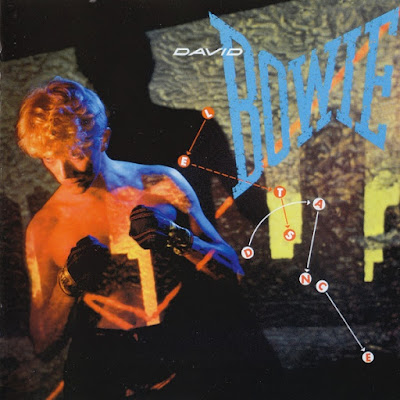
Bowie teams up with Nile Rogers ex of Chic and creates one of the ultimate commercial albums of the entire 1980s. With ultra-contemporary and impressive production for the day, with Nile Rogers seemingly given a mission by the Bowie team to pack as many hooks into each song as he could. It's a shame that the album fails to maintain its momentum throughout, but with three massive blockbusters to open, that's hardly surprising. 'Modern Love', 'China Girl' and the title track all became worldwide bestsellers and 'Lets Dance' moved David Bowie firmly into rocks mainstream, a position that even with Ziggy, he'd never quite occupied before. Long-term fans bemoaned the lack of strangeness contained on 'Let's Dance' and wanted to keep Bowie out-there and obtuse. He won a legion of new fans. Many listeners were just pleased to have a decent entertaining album to listen to. 'Let's Dance' certainly doesn't really merit any deep analysis at any rate. It is what it is. Nile used classic arranging and production tricks when faced with a song such as 'China Girl'. Eg, you better make sure the music appropriately evokes the songs lryic and title. Similarly, with a song such as 'Let's Dance', you better make sure you can dance to it! Besides the music and contributions of musicians such as Stevie Ray Vaughan on stellar guitar, 'Let's Dance' contains some fine Bowie vocals throughout, his voice deeper than during his seventies days and really reaching fine heights during the fine and entertaining 'Cat People', for example. Still, back to those three stellar singles. 'China Girl' may well have been previously given by Bowie to Iggy Pop to record, yet this version adds all those shiny Nile Rodgers moments such as an utterly distinctive and suitably chinese sounding opening riff. 'Modern Love' has fabulous jerky and bendy sounding guitar to open before proceeding with pounding drums that continue pretty much throughout the song. Trumpets decorate the chorus, and there you are. Another hit!
All of the singles from this album sported expensive and appropriately 80s videos which were almost as memorable as the songs themselves