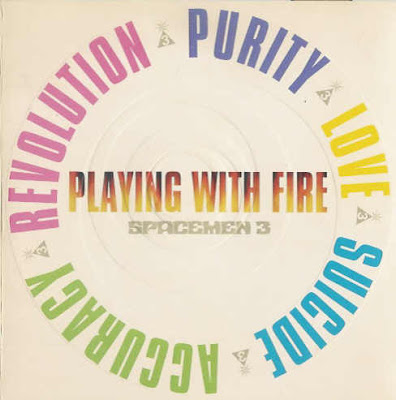
Appropriately preceded by the mind-melting crunch of the "Revolution" single, Playing With Fire proved to be the end of Spacemen 3 as a functioning band, but in truly spectacular fashion. Exploring both the depths of serene, agog beauty and sheer tape-shredding chaos, Playing With Fire pushed the extremes of The Perfect Prescription to an even further edge. It's little surprise that Pierce and Sonic couldn't find themselves properly working together after it, but even less that hordes of bands to follow would rank Playing With Fire as the equal (or better) of psychedelia's '60s and '70s forebears. Sonic himself is quoted in one reissue's liner notes as feeling the album "was the refining point of a lot of my theories on minimalism being maximalism" -- as apt a description as any. One of his songs, "How Does It Feel?," sums it up by using a series of notes echoing off into the distance, again and again. With future Spiritualized bassist Will Carruthers in place of Baines, the trio (and uncredited drummer) created glazed, liquid songs with subtle arrangements and sheer reveling in aural joys. Flange is everywhere, as is echo, full dynamic stereo mixes and more, a feast of sound. When aiming toward a gentler, hushed sound, most notably on Pierce's compositions, the incorporation of gospel power filtered through the band's own perspective results in wonders, as heard on "Come Down Softly to My Soul" and the album closing "Lord Can You Hear Me?" As for the louder end of things, besides the awesome "Revolution" itself, a slow burn blast that just keeps getting more and more obsessive and frenetic as it goes, Sonic calling for a release of energy in a mere five seconds, the other complete freak-out is "Suicide." An instrumental tribute to the New York synth pioneers, Spacemen 3 keep the minimalism and up the feedback with astonishing results. Initial re-pressings of the album in the mid-'90s included tracks from the Revolution and Threebie singles. [An elaborate reissue in 1999 included a full, extra disc of demos and rarities, including covers of the Perfect Disaster's "Girl on Fire" and the Troggs' "Anyway That You Want Me" -- eventually Spiritualized's first single.]
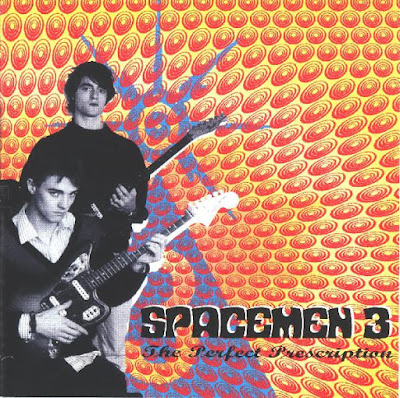
Drawing together some earlier material and a slew of new songs, Spacemen 3 tied everything together on the brilliant Perfect Prescription, the clear point of departure from tribute to psych inspirations and finding its own unique voice. Planned as a concept album, Perfect Prescription works where so many other similar efforts failed due to the strength of the individual songs, as well as the smart focus of the concept in question -- a vision of a drug trip from inception to its blasted conclusion, highs and lows fully intact. The bookending of the album makes that much clear -- "Take Me to the Other Side" is a brash, exultant charge into the joys of the experience, a sharp, tight performance. "Call the Doctor," meanwhile, is a pretty-but-wounded conclusion, husky singing and a drowsy mood detailing the final collapse. The many highlights in between beginning and end are so striking that the album is practically a best-of in all but name. Sonic's eventual work with Spectrum and E.A.R. gets clearly signaled via the majestic reprise of the Transparent Radiation single, here introduced by the swirling flange of an edited "Ecstasy Symphony," also originally from that release. Sonic's breathless delivery of the Red Krayola classic, combined with the elegant arrangement, is a marvel to hear. "Walkin' With Jesus," meanwhile, is practically the birth of Spiritualized, the much different earlier takes now become a reflective combination of acoustic guitar, two-note keyboard lines, and Pierce's yearning, aching desire. The intentionally nasty flip to that is the storming charge of "Things'll Never Be the Same," a call to arms (or injecting something into them) that's as disturbing as it is energetic, the compressed, violent rage of feedback and rhythmic charge a gripping listen. Guest performers from the Jazz Butcher family tree, including Alex Green on sax, help expand the record's sonic range even further. Further reissues include a rotating series of bonus tracks from contemporary singles.
Recurring is really a Spacemen 3 album in name only. Once the 90's had rolled around, Sonic Boom and Jason Pierce's relationship had become so acrimonious that the two wouldn't even enter the studio together. In fact, I don't think they both appear on any of the album's tracks. Thus, we get sort of a weird double EP with Boom's tracks on side one and Pierce's tracks on side two. Even the backing is different as Boom uses some friends and a few folk that would follow him on to his next project, Spectrum. Pierce's backing is in fact the first line-up of Spiritualized. I guess Spacemen 3 simply had a contract to finish. Let's look at this as two separate collections. I thought Sonic Boom supplied the better tracks on Playing With Fire (although only by a hair or two), but he sounds positively wasted here. Tracks like the opening "Big City," "I Love You," and "Why Couldn't I See" include some lame automated-sounding backing and a half baked 'Madchester' influence. Unfortunately, that influence comes through like a second-rate Inspirial Carpets. To add insult to injury, his vocals are a big cut below previous performances and he comes across as drug-addled bored rather than surreal and altered. With some different arranging and performances, these would've been a lot better. Maybe that's where Boom needed Pierce. I can't really say that for "Just To See You Smile," which appears in a vocal and instrumental version. Actually, it's a fine song with great production, but it was also a fine song with great production on Playing With Fire, where it was called "Honey" and sounded EXACTLY THE SAME. Fortunately for this album, Pierce came in with his game face on. His tracks with the soon-to-be Spiritualized take the gospel vibe of Pierce's Playing With Fire tracks and amp up the production and dreaminess. With Boom out of the picture, Pierce goes for an airy, atmospheric drone rather than Spacemen 3's previous pulsing drone (not that there's anything wrong with a pulsing drone). Blessed with some great organic performances, this side of the album seriously contrasts with side a's badly programmed beats. The tracks on this side are uniformly great and serve as the not-so-missing link between Spacemen 3 and Spiritualized. If you're new to this album, it would probably be in your best interest to skip to track 8 in case you have trouble stomaching Boom's songs. Or you might try the Mudhoney cover of "When Tomorrow Hits" on track 7 which harkens back to the Sound Of Confusion-era style. Mr. Boom manages to come through ok on that one.