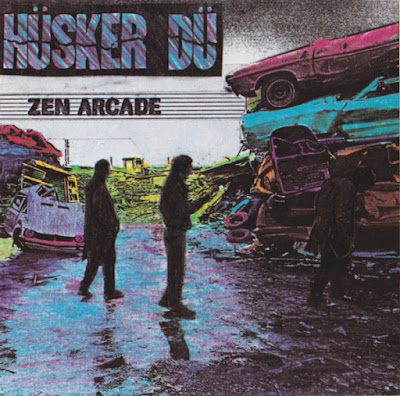
In many ways, it's impossible to overestimate the impact of Hüsker Dü's Zen Arcade on the American rock underground in the '80s. It's the record that exploded the limits of hardcore and what it could achieve. Hüsker Dü broke all of the rules with Zen Arcade. First and foremost, it's a sprawling concept album, even if the concept isn't immediately clear or comprehensible. More important are the individual songs. Both Bob Mould and Grant Hart abandoned the strict "fast, hard, loud" rules of hardcore punk with their songs for Zen Arcade. Without turning down the volume, Hüsker Dü try everything -- pop songs, tape experiments, acoustic songs, pianos, noisy psychedelia. Hüsker Dü willed themselves to make such a sprawling record -- as the liner notes state, the album was recorded and mixed within 85 hours and consists almost entirely of first takes. That reckless, ridiculously single-minded approach does result in some weak moments -- the sound is thin and the instrumentals drag on a bit too long -- but it's also the key to the success of Zen Arcade. Hüsker Dü sound phenomenally strong and possessed, as if they could do anything. The sonic experimentation is bolstered by Mould and Hart's increased sense of songcraft. Neither writer is afraid to let his pop influences show on Zen Arcade, which gives the songs -- from the unrestrained rage of "Something I Learned Today" and the bitter, acoustic "Never Talking to You Again" to the eerie "Pink Turns to Blue" and anthemic "Turn On the News" -- their weight. It's music that is informed by hardcore punk and indie rock ideals without being limited by them

For New Day Rising, the follow-up to their breakthrough double-album Zen Arcade, Hüsker Dü replaced concept with conciseness, concentrating on individual songs delivered as scalding post-hardcore pop. New Day Rising is not only a more vicious and relentless record than Zen Arcade, it's more melodic. Bob Mould and Grant Hart have written tightly crafted, melodic pop songs that don't compromise Hüsker's volcanic, unchecked power. Mould and Hart's songs owe a great deal to '60s pop, as the verses and choruses ebb and flow with immediately catchy hooks. Occasionally, the razor-thin production and waves of noise mean that it takes a little bit of effort to pick out the melodies, but more often the furious noise and melodies fuse together to create an overwhelming sonic force. It's possible to hear the rivalry between Mould and Hart on the album itself -- each song is like a game of one-upmanship, as Mould responds to "The Girl Who Lives on Heaven Hill" with "Celebrated Summer." Neither songwriter slips -- both turn in songs that are catchy, clever, and alternately wracked with pain or teeming with humor. New Day Rising is a positively cathartic record and ranks as Hüsker Dü's most sustained moment of pure power.

Candy Apple Grey from 1986 marks Hüsker Dü's "sellout" to the big nasty major label Warner Bros. So, naturally, this album is supposed to be a terrible album. Well... sorry to disappoint you guys, but it ain't. It really ain't. Do you know how bands like Nirvana and Soundgarden ever could wind up at respectively Geffen and A&M? Because of this very album here. This album album proves that it is possible for a punk band to go from the diy indie ethics of releasing the albums yourself, or on small indie labels - to a huge major label, without making a fool out of yourself! Actually, in quite a few's opinion - they do the exact opposite! You'll find emocore fans stating Zen Arcade as Hüsker Dü's best album. You'll find hardcore fans stating Everything Falls Apart as their best album. As for the "rest" - it's New Day Rising, Flip Your Wig and perhaps most commonly - Candy Apple Grey that matters.
Candy Apple Grey is without a doubt the most radio-friendly album to derive from Hüsker Dü. That sentence alone might just be enough to make some of the hardcore fans' stomachs turn. But have no fear, it's only a temporarily stomach-turn. Once you've put the record on the gramophone - you'll find that: "Hey! This ain't altogether that bad!". No, it isn't. It's actually quite impressing, I must say. It begins with you getting pushed into a wail. Then punched in the face by a tremendous force, that is Bob Mould's distinct way of playing the guitar.
And then it explodes. For a trio, they sound huge. And the sound is broader than ever. It's all still there. the basics I mean; there's still the thumpy drums being played slightly behind the beat, the malicious basslines that cooperate perfectly with the trashing guitar-riffs.
But there's something more to it, this time. It's broader and more melodic, than ever. It's sort of a total change of genre. It's a transition from hardcore/emocore to what is later to be known as alternative rock.
It sounds as frenetic, as passionate and as upset as ever... but it's also introverted, cold, and at times toned-down. There's even an acoustic guitar in the picture, as well as a piano. The songs "No Promise Have I Made", "Hardly Getting Over It" and "Too Far Down" are particularly... blue. And cold. And just downright sad. The acoustic guitar and piano makes a welcome change of sound, from the upbeat tracks on the record, who - by the way, are catchier and more passionate than ever.
There is some very strong songwriting present on this record. Bob Mould and Grant Hart both outdo themselves.
The lyrics on this album is concerned with everything from breaking up in "Don't Want to Know If You Are Lonely", to trying to sell ice cream in a theater (I have no idea if that's a metaphor, and in which case - what it's supposed to mean) in "Eiffel Tower High". In general it's all kind of blue and melancholic. But still damn catchy. You'll have yourself singing along to both "I Don't Know for Sure" and "Sorry Somehow" by the end of the tracks.
The production is also better, now that they're on Warner Bros. But it all sounds a little dirty, and not as commercialized as one would expect. Who's produced this album? None other than Bob Mould and Grant Hart themselves. So this is still diy and indie, up to a certain point. They're still in full artistic control, thanks to Warner Bros. who put their money where their mouth was - supporting a band they're not very likely to make any money on, but is admired in the musical industry. And for that I really respect Warner Bros. for being a label that is more engaged in MUSIC than in MONEY. This "full artistic control" contract is considered being a model for future alternative rock acts that signed with major labels (e.g. Sonic Youth and Soul Asylum).
All in all, this is a great album. With a lot of amazing tracks. Maybe especially "Don't Want to Know If You Are Lonely" - the album's natural highlight. It's probably the most catchy Hüsker Dü song ever. If not the best Hüsker Dü song ever. Such an amazing track.
But with that being said, no tracks are really skipable.
They're all actually surprisingly good. You know, for a major label act.