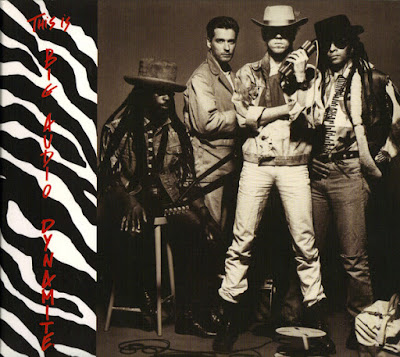
Elbowed out of the Clash, Mick Jones responded forcefully with Big Audio Dynamite, a modernist audio-terrorist outfit whose 1985 debut, This Is Big Audio Dynamite, seemed all the more futuristic when compared to Joe Strummer’s reductionist retro rejiggering of the Clash on Cut the Crap. Strummer may have been intent on shedding every experimental element of the Clash’s prime, but Jones, in collaboration with longtime friend filmmaker Don Letts, picked up where Sandinista! left off, anchoring BAD in dance and rap, building the group’s debut on layers of samples and drum machines. As is often the case, what was once forward-looking seems inextricably tied to its time in retrospect and the clanking electro rhythms, Sergio Leone samples, chicken-scratch guitars, bleating synths, and six-minute songs of This Is Big Audio Dynamite evoke 1985 in a way few other records do. Nevertheless, BAD’s boldness remains impressive, even visionary, pointing toward the cut-n-paste masterpieces of the late ‘80s and early ‘90s, and since Jones did not abandon his innate gift for hooks -- if anything, he found ways to create rhythmic hooks as well as melodic ones -- it’s quite accessible for an album that is, at its core, avant-rock. [Legacy’s 2010 double-disc expansion of This Is Big Audio Dynamite remasters the original eight-track LP and adds a second 12-track CD. Befitting BAD’s futuristic dance bent, almost all of these are 12" remixes of the album’s singles -- “Medicine Show,” “E=MC2,” and “The Bottom Line” -- including no less than four previously unreleased mixes -- and there’s also the outtake “Electric Vandal,” plus the B-sides “Albert Einstein Meets the Human Beatbox” and “This is Big Audio Dynamite,” with every last one of these 12 songs extending the modernist sampledelia of the album proper.]
Culling together tracks chosen from a decade's (and seven albums') worth of material, Planet BAD serves as a focused, well-chosen compilation of Mick Jones' post-Clash outfit. Although neither as critically or commercially successful as the Clash, Big Audio Dynamite's blend of rock and dance music, with a generous dose of samples, was a fixture on college radio in the mid- to late '80s with tracks like "E=MC2," "The Bottom Line," and "C'mon Every Beatbox" (all included here). The band even managed to make a foray onto the U.S. Top 40 charts in 1992 with the infectious "Rush." With his place already secure in rock annals, Jones' work with BAD was much more lighthearted, but it cannily anticipated the influence electronics and technology would have on music. it's also undeniable that the band was a more interesting venture than it was sometimes given credit.
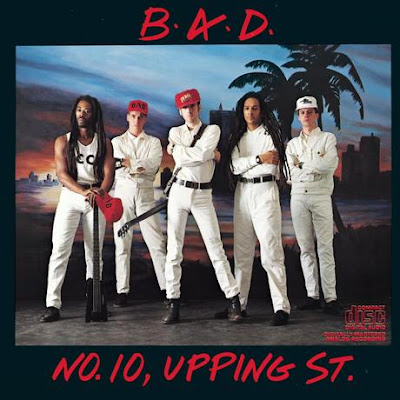
NO. 10, UPPING ST. (a pun on 10 Downing St., the residence and office of the Prime Minister of the United Kingdom), is the second album by Big Audio Dynamite, led by former Clash guitarist and songwriter Mick Jones. It was released in 1986. Perhaps the most notable aspect of the album is the pairing of Jones and his former Clash partner, Joe Strummer, who co-wrote five songs (one of them being the immigrant tale of "Beyond the Pale") and co-produced the entire album.
Mick Jones virtually re-invented himself with Big Audio Dynamite. While he maintained some of the bristling punk energy of his former band, Jones turned a keen eye to the future. He began better sculpting his songs, draping them with sampled beats, movie dialogue, dense textures, found sounds, dance rhythms and elements of hip-hop more completely and effectively than those on the first record. The resulting sophomore effort in no small way upped the ante and broadly expanded on debut''s formula. Jones'' use of samples - check the Eddie Cochranesque "C''mon Every Beatbox," replete with James Brown''s electrifying squawks or the disturbing yet strangely humorous contract-killing fiasco in "Dial a Hitman." As the 1980''s progressed, Jones visionary tapestry of rock, techno, and dance served as a creative high-water mark and inspiration for the next generation of rappers, DJs, and rockers looking to expand their musical palettes.
"C''mon Every Beatbox" and "V. Thirteen" made the U.K. singles chart. "Badrock City," added to the album after its initial release, made the U.S. R&B singles chart.