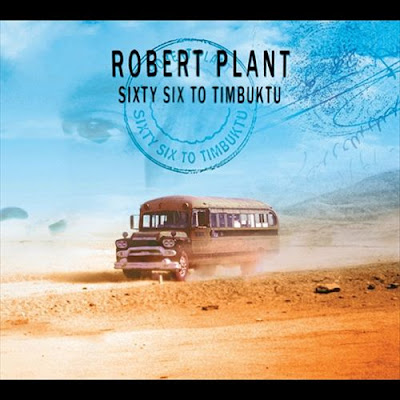
Sixty Six to Timbuktu has to be the icing on the cake for Robert Plant. After Led Zeppelin issued its second live album as well as a spectacular DVD in 2003, his career retrospective outside of the band is the new archetype for how they should be compiled. Containing two discs and 35 cuts, the set is divided with distinction. Disc one contains 16 tracks that cover Plant's post-Zep recording career via cuts from his eight solo albums. Along with the obvious weight of his former band's presence on cuts like "Tall Cool One," "Promised Land," and "Tie Dye on the Highway," there is also the flowering of the influence that Moroccan music in particular and Eastern music in general would have on him in readings of Tim Hardin's "If I Were a Carpenter," Jesse Colin Young's "Darkness, Darkness," and his own "29 Palms." There is also a healthy interest in technology being opened up on cuts from Pictures at Eleven and Now & Zen. The sequencing is creative, and the way one track seemingly foreshadows another is rather uncanny. But it is on disc two where the real treasures lie, and they are treasures. Of the 19 selections included, five are pre-Led Zeppelin. And these are no mere dead-dog files. Plant was revealing himself to be a jack-of-all-subgenres master: he drops a burning rendition of the Young Rascals' "You'd Better Run" circa 1966, and a wailing version of Billy Roberts' "Hey Joe" (recorded in 1967 and rivaling the emotional wallop of Jimi Hendrix's version recorded that same year). There's also the proto-blues moan and groan of "Operator" with British blues god Alexis Korner from 1968, which foreshadows the following year when he would join Zep. But Plant was not all raw raunch & roll. On Stephen Stills' "For What It's Worth," he lays out a paisley hippie sincerity that is downright stirring. And on "Our Song," he takes the example of crooners like Dion and sings a love song, so pure and true it might have come from screen rushes of American Graffiti. These tracks are worth their weight in gold for the integrity in their performances and their rough edges.
At first, Fate of Nations seems so light and airy that it slips away through the layers of acoustic guitars, violins, and keyboards. Upon further listenings, more textures appear, and the album gains a calm sense of tension and reflectiveness. It's also Robert Plant's most personal record ever; he addresses the death of his son in the beautiful "I Believe." Simultaneously, Fate of Nations is a political album -- "Great Spirit" and "Network News" are two of the most socially conscious songs Plant has ever written. Yet, the album is never heavy-handed and doesn't fall into sermonizing or sentimentality. Plant has always had a folkie heart; on Fate of Nations, he wears it on his sleeve. [The 2007 edition features five bonus tracks highlighted by acoustic versions of "Great Spirit" and Dark Moon," along with a demo version of "Rollercoaster".]
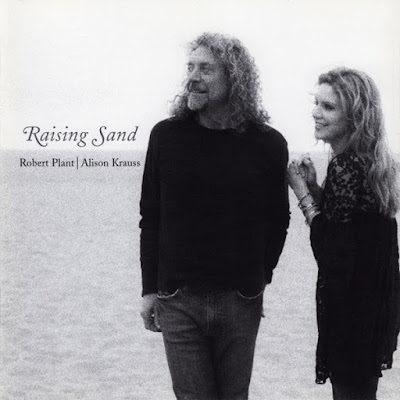
You don’t have to be a fan of the country, blues or folk genres to appreciate the heartbreaking brilliance of this inspired collaboration.
Robert Plant and Alison Krauss? Sounds like one of the most unlikely collaborations in contemporary music since Nick Cave gave Kylie a call. Yet the pairing of the Led Zeppelin rocker with the gorgeous young Union Station singer – under the sonic supervision of the legendary T Bone Burnett – has proved to be just as inspired a move.
Recorded in Nashville and Los Angeles, Raising Sand features the two singers doing cover versions of lesser-known material from various country, R&B and folk songwriters. The songs they’ve chosen may not be very famous, but their writers sure are – Townes Van Zandt, Tom Waits, Doc Watson, the Everly Brothers, Gene Clark, etc.
Mixing country, blues and folk rock, the mood throughout is dreamlike, ominous and ethereal. At times, it’s downright spooky, like something you’d hear on the Twin Peaks soundtrack.
Not that there was ever really any doubt, but Plant and Krauss – singing both solo and in harmonies on songs well out of their respective comfort zones – prove themselves to be amazingly versatile vocalists. Plant has never sounded so wounded and vulnerable as he does on their slow take on Gene Clark’s ‘Polly Come Home’.
A couple of foot-stomping honky-tonk moments aside, for the most part the music is slow, sublime and intimate – incisively crafted by, amongst others, multi-instrumentalist Mike Seeger, guitarists Norman Blake and Marc Ribot, bassist Dennis Crouch and drummer Jay Bellerose. Burnett himself plays six-string guitar on a couple of tracks, while Krauss’s fiddle also gets some welcome workouts.
While there are obvious standouts – Krauss’s wonderful take on Sam Philip’s ‘Sister Rosetta Goes Before Us’, Plant’s revealingly melancholic reinterpretation of his own ‘Please Read The Letter’ – there really isn’t a dud among the thirteen songs here.
You don’t have to be a fan of the country, blues or folk genres to appreciate the heartbreaking brilliance of this inspired collaboration. Raising Sand is easily one of the best albums of 2007.