In the simplest terms, The Great Escape is the flip side of Parklife. Where Blur's breakthrough album was a celebration of the working class, drawing on British pop from the '60s and reaching through the '80s, The Great Escape concentrates on the suburbs, featuring a cast of characters all trying to cope with the numbing pressures of modern life. Consequently, it's darker than Parklife, even if the melancholia is hidden underneath the crisp production and catchy melodies. Even the bright, infectious numbers on The Great Escape have gloomy subtexts, whether it's the disillusioned millionaire of "Country House" and the sycophant of "Charmless Man" or the bleak loneliness of "Globe Alone" and "Entertain Me." Naturally, the slower numbers are even more despairing, with the acoustic "Best Days," the lush, sweeping strings of "The Universal," and the stark, moving electronic ballad "Yuko & Hiro" ranking as the most affecting work Blur have ever recorded. However, none of this makes The Great Escape a burden or a difficult album. The music bristles with invention throughout, as Blur delve deeper into experimentation with synthesizers, horns, and strings; guitarist Graham Coxon twists out unusual chords and lead lines, and Damon Albarn spits out unexpected lyrical couplets filled with wit and venomous intelligence in each song. But Blur's most remarkable accomplishment is that they can reference the past -- the Scott Walker homage of "The Universal," the Terry Hall/Fun Boy Three cop on "Top Man," the skittish, XTC-flavored pop of "It Could Be You," and Albarn's devotion to Ray Davies -- while still moving forward, creating a vibrant, invigorating record.
[EMI's deluxe 2012 double-disc expansion of The Great Escape contains the 1995 album on the first disc and a host of B-sides and rarities on the second. Among Blur's British Trilogy, The Great Escape often gets slighted but this era generated the band's greatest B-sides, likely due to the confluence of the band being in its commercial prime and the industry's dictate to release multi-part CD singles for every single pulled from the record. And so we have "One Born Every Minute," "The Ultranol," and "No Monsters in Me," outtakes from The Great Escape that could have fit easily within the record itself ("Ultranol" itself is the sunny flip of "The Universal"). There are a couple of alternates -- a remix of "Entertain Me," a French version of "To the End" -- along with a suite of songs culled from their triumphant 1995 gig at Mile End. And then there are five flips that illustrate how not all was well beneath the glided surface: "The Man Who Left Himself," "Tame," "Ludwig," "The Horrors," "A Song," and "St. Louis" are woozy, unnerving returns to Barrett-styled psychedelia and tentative stabs at lo-fi that point the way to the sounds of 1997's Blur.]
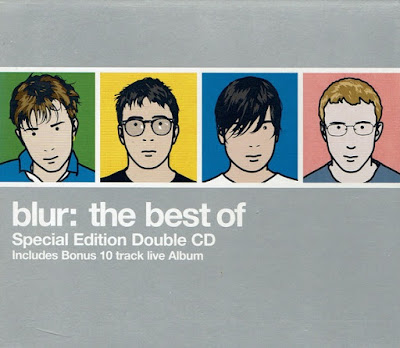
It's boring to point out omissions on hits compilations, especially when a collection is as generous as the 18-track The Best of Blur, but let's do it anyway. The Best of Blur largely bypasses the group's key album, Modern Life Is Rubbish, the record that invented Brit-pop, skewing in favor of the self-consciously "experimental" 13, which, for all of its attributes, wasn't a singles album. Plus, the group continues to punish the British record-buying public by not including the brilliant "Pop Scene" (to beat a dead horse, the single that invented Brit-pop), since nobody bought it at the time. So, without "Pop Scene," "Chemical World," or "Sunday Sunday," a crucial chapter of Blur's history is missing from The Best of Blur -- the chapter where they essentially became Blur. It's to their immense credit that the album doesn't feel like it's missing anything, since these singles (plus one album track) are dazzling on their own. Of course, the trick is that the record isn't assembled chronologically. Instead, it flows like a set list, complete with the set closer "This Is a Low" followed by a two-song encore that ends with the new song (the good, not great, "Music Is My Radar"), which not only gives it a momentum of its own, but draws attention to the songs themselves. And "dazzling" isn't hyperbole -- based on these 18 songs, Blur aren't just the best pop band of the '90s, with greater range and depth than their peers; they rank among the best pop bands of all time. The Best of Blur illustrates that, even as it misses some of their best moments -- omissions that prevent it from being the flat-out classic it should be. Even so, it's pretty damn terrific, particularly for the unconverted.
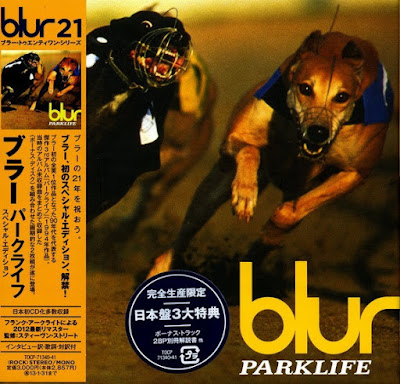
Modern Life Is Rubbish established Blur as the heir to the archly British pop of the Kinks, the Small Faces, and the Jam, but its follow-up, Parklife, revealed the depth of that transformation. Relying more heavily on Ray Davies' seriocomic social commentary, as well as new wave, Parklife runs through the entire history of post-British Invasion Brit-pop in the course of 16 songs, touching on psychedelia, synth pop, disco, punk, and music hall along the way. Damon Albarn intended these songs to form a sketch of British life in the mid-'90s, and it's startling how close he came to his goal; not only did the bouncy, disco-fied "Girls & Boys" and singalong chant "Parklife" become anthems in the U.K., but they inaugurated a new era of Brit-pop and lad culture, where British youth celebrated their country and traditions. The legions of jangly, melodic bands that followed in the wake of Parklife revealed how much more complex Blur's vision was. Not only was their music precisely detailed -- sound effects and brilliant guitar lines pop up all over the record -- but the melodies elegantly interwove with the chords, as in the graceful, heartbreaking "Badhead." Surprisingly, Albarn, for all of his cold, dispassionate wit, demonstrates compassion that gives these songs three dimensions, as on the pathos-laden "End of a Century," the melancholy Walker Brothers tribute "To the End," and the swirling, epic closer, "This Is a Low." For all of its celebration of tradition, Parklife is a thoroughly modern record in that it bends genres and is self-referential (the mod anthem of the title track is voiced by none other than Phil Daniels, the star of Quadrophenia). And, by tying the past and the present together, Blur articulated the mid-'90s Zeitgeist and produced an epoch-defining record.
[EMI's deluxe 2012 double-disc expansion of Parklife contains the 1994 album on the first disc and a host of B-sides and rarities on the second. Parklife is where Blur hit their stride and this is evident even throughout the B-sides collected here. Sure, there are songs that are proud throwaways -- Graham Coxon's spiteful, boozy pisstake "Red Necks" and Alex James' tweaked twee "Alex's Song" -- but there are also moments of shivering beauty, as in the Ziggy Stardust homage "Peter Panic," the gleefully nasty disco "People in Europe," and the barbed pop of "Threadneedle Street." To these B-sides acoustic versions of "Jubilee" (a song that does not easily lend itself to such an arrangement), "Parklife," and "End of a Century" are added, rounding out a generous and entertaining bonus disc.]