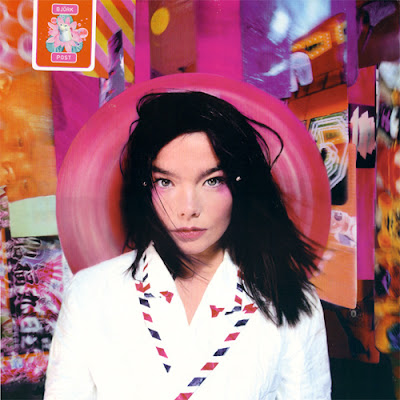
After Debut's success, the pressure was on Björk to surpass that album's creative, tantalizing electronic pop. She more than delivered with 1995's Post; from the menacing, industrial-tinged opener, "Army of Me," it's clear that this album is not simply Debut redux. The songs' production and arrangements -- especially those of the epic, modern fairy tale "Isobel" -- all aim for, and accomplish, more. Post also features Debut producer Nellee Hooper, 808 State's Graham Massey, Howie B, and Tricky, who help Björk incorporate a spectrum of electronic and orchestral styles into songs like "Hyperballad," which sounds like a love song penned by Aphex Twin. Meanwhile, the bristling beats on the volatile, sensual "Enjoy" and the fragile, weightless ballad "Possibly Maybe" nod to trip-hop without being overwhelmed by it. As on Debut, Björk finds new ways of expressing timeworn emotions like love, lust, and yearning in abstractly precise lyrics like "Since you went away/I'm wearing lipstick again/I suck my tongue in remembrance of you," from "Possibly Maybe." But Post's emotional peaks and valleys are more extreme than Debut's. "I Miss You"'s exuberance is so animated, it makes perfect sense that Ren & Stimpy's John Kricfalusi directed the song's video. Likewise, "It's Oh So Quiet" -- which eventually led to Björk's award-winning turn as Selma in Dancer in the Dark -- is so cartoonishly vibrant, it could have been arranged by Warner Bros. musical director Carl Stalling. Yet Björk sounds equally comfortable with an understated string section on "You've Been Flirting Again." "Headphones" ends the album on an experimental, hypnotic note, layering Björk's vocals over and over till they circle each other atop a bubbling, minimal beat. The work of a constantly changing artist, Post proves that as Björk moves toward more ambitious, complex music, she always surpasses herself.
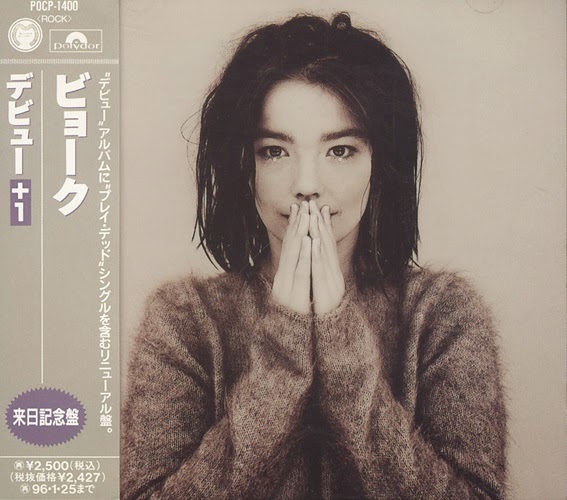
“Rock and Roll is so passé, so yesterday. Pop music is more important than art”, said Bjork on the release of “Debut” in 1993. Undoubtedly her view was provocative, but for all the quirky, cute innocence she outwardly portrayed there was, and still is a knowing determination to make music that has an expressive purpose that binds both experimentalism and popular musical culture seamlessly. She would insist that “Debut” was merely a stepping stone to greater things, an opportunity to develop her skills as a solo artist and establish a style and content distinctly different to that of The Sugarcubes. Her modest views belie the value of this collection, and for many fans this remains her greatest achievement, showcasing an unerring ability to successfully marry a vast array of styles including pop, dance, electronic, house, jazz and trip-hop. The glue that holds such ambitious intentions is Bjork’s skilful song writing, mainly themed around a joyous celebration of love, and of course her unique vocal style which swoops effortlessly through octaves somewhere between a screaming banshee, a distant melodious mantra from an uncharted heaven and a young child, fresh and untainted by the ills of this world. “Debut” owes much to the cast list of contributors, all cleverly selected by Bjork. Soul II Soul’s Nellee Hooper brings the polished dance rhythms and co writing credits for five of the songs. Veteran jazz musician Corky Hale adds a beautifully understated Harp accompaniment to the Van Heusen/Burke penned classic, “Like Someone In Love”. The gentle bossa nova rhythms of “Aeroplane” and the starkly mysterious “Anchor Song” are both enlivened by jazz saxophonist Oliver Lake. The album would host a staggering four hit singles (five if one includes the tagged on David Arnold produced “Play Dead”), helped in no small part by some of the most innovative promotional videos ever seen. Of the singles, “Human Behaviour” stands out as one of Bjork’s most memorable recordings. The slowed down four to the floor house rhythm with bass drums beating out a jungle call overlaid with a vocal track that dynamically displays the singer’s range as she takes the perspective of an animal studying the human emotion. “Big Time Sensuality” and “Violently Happy” are far more than disposable dance numbers, as the singer adds a rare warmth to the mechanized rhythms, taking the songs way beyond the dancefloor. “Venus As A Boy” is the sweetest of odd love songs, combining a chilled reggae pace with a keyboard/vibraphone melody that skips around Bjork’s vocal line with the simple whimsy of a child’s rhyme. The heartfelt yearning of “Come To Me” is supported by a serenely spacious arrangement that includes an exotic eastern backing with added tabla and sub continental string effects. Bjork would distance herself from the success of “Debut”, almost dismissively stating "It's hard to judge yourself but I don't think [the early albums are] my best. Debut was the album that went the highest up there in terms of what is 'Bjork music'. But I think that the persona I created, which was entirely accidental, is better captured on the later albums." Without appearing confrontational, this album is as important, dynamic and enjoyable as any of her later recordings. Few female artists have produced albums as challenging as Bjork and this sets the agenda.