Unauthorised item in the bagging area
Showing posts with label jon savage. Show all posts

Saturday, 17 February 2024

V.A. Saturday

Jon Savage is a writer who fully deserves the status legendary attached to his name- since the early days of punk he chronicled the music and the subculture, a  writer and journalist who knows his stuff and who cares. His Sex Pistols book England's Dreaming is probably the definitive account of account of UK and US punk and his oral history of Joy Division, This Searing Light, The Sun And Everything Else,is the best account of that band's trajectory and story bar none. He has had for many years a sideline as a Various Artists album compiler, including some VA albums that have had repeat plays round here over the years: Fame- Jon Savage's Secret History Of Post Punk 1978- 1981 and 1966 Jon Savage's The Year The Decade Exploded are both Bagging Area favourites and his recent one, Do You Have The Force? Jon Savage's Alternate History Of Electronica 1978- 1982, is a genre busting, futuristic compilation that finds proto- electronica in Throbbing Gristle, Soft Machine, UFO, PiL and The Flying Lizards among others. 

In 2015 Caroline True Records released Perfect Motion: Jon Savage's Secret History Of Second Wave Psychedelia, 1988- 1993, a treasure trove of the period across four sides of vinyl, a snapshot of guitar bands, pop acts and dance music that to Jon, was what the title suggested- a new wave of psychedelia. Jon found it in Shack, The High and The Stone Roses (for this release the head spinning track Full Fathom Five, Elephant Stone played backwards, named after a Jackson Pollock painting), he found it in Deee- Lite, Pet Shop Boys, 808 State and Joi, he found it in Saint Etienne and Electronic and he found it in 'the scene's resident genius', Andrew Weatherall (Clock Factory by Sabres Of Paradise, Andrew's remix of Sly And Lovechild and his production on Screamadelica, in this case Slip Inside This House, Primal Scream's cover of a first wave of US psychedelia band, The Thirteenth Floor Elevators).

Full Fathom Five

Jon takes some delight I think in stretching the boundaries of the genre he's compiling, in finding what he's looking for places some people wouldn't. His latest compilation for Caroline True Records, out at the end of last year, is titled Jon Savage's Ambient 90s, a concept and compilation that's very up my street. True to form Jon stretches the definition of ambient so far it almost snaps the fabric of music to pieces, but it all makes sense too. In 1992 Jon started sending articles to Jockey Slut, fired up by the new music being made- 'a new way of looking at the world, a new language', he said at the time. Jockey Slut were more than happy to publish 2000 words on the importance of Aphex Twin by the man who saw Joy Division at the PSV. 

On Ambient 90s he compiles tracks by William Orbit, Aphex Twin, Underworld (Blueski from Second Toughest In The Infants, three minutes of Karl Hyde's blues guitar looped and distorted), Sandoz (Richard Kirk from Cabaret Voltaire), React To Rhythm's Intoxication (a huge progressive house track with a vocal sample whispering, 'this works almost instantly', a track so rhythmic and thumpy it can't be really called ambient but let's go with it), U-Ziq and several others. It closes with this by Biosphere, a 1994 release by a Norwegian artist on a Belgian label that starts out with background noise and acoustic guitar and floats away on ambient waves, synths and washes of sound ebbing and flowing as the acoustic guitar keeps time. 

En- Trance

Friday, 12 August 2022

Temple Head And Filthy

Bob Stanley and Pete Wiggs have a very good sideline outside Saint Etienne, putting together themed compilation albums for Ace Records. Often these mine the rich seams of the 60s and 70s, unearthing forgotten album tracks and B-sides. Their most recent album is Fell From the Sun, a selection of 98BPM tracks from the summer of 1990 where the dance music revolution slowed down and a floaty, chilled out, modern psychedelia came in, records for the sunrise. 

Many of the songs on the album (double vinyl, single CD)  have been posted at this blog before- Primal Scream's Higher Than the Sun (produced and remixed by The Orb), Sheer Taft's Cascades, Saint Etienne's B-side Speedwell, One Dove's Fallen, BBG's Snappiness, the Jon and Vangelis/ Martin Luther King inspired Spiritual High by Moodswings, the Apocalypse Now! sampling Never Get Out Of The Boat by The Aloof and The Grid's Floatation. You'd be correct in seeing the hands, or the spirit, of Andrew Weatherall all over this compilation- Loaded was one of the records that kicked it off. There are quite a few I've never posted (one below and also Soul Family Sensation's I Don't Even Know If I Should Call You Baby, which is odd as I love it and was sure I'd written about it at some point). There are lesser known songs from Massonix, Elis Curry, History and Q- Tee and Critical Rhythm. It's a lovely snapshot of a time and a place (Britain in the summer of 1990), perfectly chiming with this period of hot and sunny weather we've been having. The sleeve photos and Bob's notes are spot on too, as you'd expect.

This is one of the songs on Fell From The Sun that I can't believe I've never posted here, Temple Head by Transglobal Underground. All the summer of 1990 elements are present- a unifiying, coming together 'Na na na/ Na na na' chant, that 98 BPM chuggy rhythm, loved up pianos and a 'watch the skies' vocal sample (from the film The Thing From Another World). The group signed to DeConstruction who re- released Temple Head on 12" the following year. 

Temple Head (Pacific Mix)

Fell From The Sun goes very well with another compilation covering the same period put together by Jon Savage and released in 2015, a double vinyl album called Perfect Motion- A Secret History Of Second Wave Psychedelia. Savage also saw it as a new (or neo) psychedelia and pulled together his snapshot of the 1988- 1993 period, a time when dance artists, guitar bands and pop groups with new technology and new drugs made music that seemed to promise endless possibility. Jon's compilation also has Saint Etienne (with Q-Tee, on their B-side Filthy) and Primal Scream (Slip Inside This House, itself a cover of freaked out 1960s psychedelia) and fellow guitar travellers Shack, Northside, The High and The Stone Roses (with one of their head-spinning backwards tracks, Full Fathom Five) alongside Deee- Lite, a Pet Shop Boys B-side, Weatherall's remix of Sly And Lovechild and his group Sabres Of Paradise's Clock Factory, rave from 808 State, DHS and Joi and DNA's remix of Electronic's Get The Message. A slightly wider ranging selection than Bob and Pete's but the two compilations sit side by side very well, two halves of the same pill.

Filthy was the B-side to the 1991 re- release of Saint Etienne's first single, their cover of Neil Young's Only Love Can Break Your Heart, a genuine lost classic. Riding in on a, yep, filthy bassline and a swamp rock guitar solo sampled from Afrique, South London rapper Q- Tee delivers a scene stealing vocal, rapping and singing. 'This is not a media hype', she drops huskily before the xylophone solo comes in. 

Filthy

Wednesday, 5 January 2022

Use Hearing Protection

On Monday I got to the Museum Of Science And Industry to see an exhibition which has been open since the start of June and which I finally got to on its final day- Use Hearing Protection, a version of the Factory records story. Manchester has been drowning in its own nostalgia for many years now but this exhibition was excellent all the same and really skewered the period when Factory first started, those early years in the late 1970s and early 1980s. Looking at the flickering film footage playing with OMD's Electricity on the banks of tv screens at the entrance to the exhibition was like looking at another world and also the city I remember as a kid- derelict buildings, the Arndale Centre, dirty orange buses. There was an introduction to the main players- Wilson, Hannett, Saville, Gretton, Erasmus, Granada TV, Situationism- and the teardrop guitar Ian Curtis plays in the Love Will Tear Us Apart video.

There were many posters from the time, many loaned by Rob Gretton's family and Tony Wilson's family. These ones stand out, designed by writer Jon Savage, advertising gigs by Durutti Column at the Lesser Free Trade Hall and a Joy Division gig with support from A Certain Ratio and Section 25 (which would set you back £1.25). 


The central room was an exhibition of all the items that make up Fac 1-to Fac 50 in the Factory catalogue- not just singles and albums (though they were all there with sleeve proofs and sketches) but the posters (Fac 1, Fac 15, Fac 26), the menstrual egg timer (Fac 8), the film scripts, the Factory notepaper (Fac 7), the badges (Fac 21) and much more. The major releases, Unknown Pleasures, Closer, Love Will Tear Us Apart, Still and Movement, were accompanied by extras- film clips and interviews and pieces of Martin Hannett's studio equipment. There was an appreciation of the somewhat unsung role women played in the early years of Factory- Ann Quigley, Lesley Gilbert, Linder, New Order's Gillian Gilbert and Lindsay Reade. 

In the room next door (see picture at the top of this post) there was a wall of floor to ceiling screens with nine different live performances projected, starting with Joy Division and ending with New Order. In between this start and end point were some lesser known Factory acts such as The Names and Section 25 and the totally bewitching clip of The Durutti Column playing Sketch For Dawn in a park in Finland in 1981 (later released as part of a Factory video, Fact 56). 


The next room had photographs of Manchester during the period, to put some historical and social context around what was going on at Palatine Road, The Russell Club and The Hacienda. Photos of the Hulme Crescents, the multi- racial crowd enjoying themselves at a Rock Against Racism concert in Alexandra Park, grainy shots of footbridges and people, children playing on bombsites, a post- industrial city on the verge of something even if no- one can really see it at the time. On the way out you could walk through a mock up of the edge of the Hacienda's dancefloor- the future it suggests, the way out, Manchester's rebirth as a modern city begins here. 

There are so many single releases in the first 50 Fac numbers that are from the fringes of the culture, pieces of minor brilliance that Factory's team saw something special in and put out in beautifully designed sleeves that set out to make a statement (and for Gretton, Wilson and Saville to subvert as well). ACR's All Night Party. OMD's Electricity. ESG's You're No Good. X-O- Dus' English Black Boys. The Distractions' Time Goes By So Slow. Section 25's Girls Don't Count. Crispy Ambulances' Unsightly And Serene. Stockholm Monsters' Fairy Tales. And this one, a long time favourite of mine, a one off single by a group of teenagers from Blackpool called Tunnelvision. They'd split up by the time a second single was suggested, leaving one sole 7" single as their legacy- a doomy, sombre, rough- edged slice of post- punk beauty called Watching The Hydroplanes. 

Watching The Hydroplanes

Friday, 8 May 2020

We Have Brandy And Half Corona


I wrote this, went back to it, re-wrote it, nearly deleted it and then went back to it again and decided to go with it.

Today is a bank holiday in the UK. The traditional May Day bank holiday that should have been on Monday moved to today- not that it matters very much at the moment, almost everyday's the same anyway. Today's bank holiday celebrates the 75th anniversary of Victory in Europe, the defeat of the Nazis and the end of the Second World War in Europe. This day will be celebrated by some with bunting and socially distant street parties and cosy 1940s vibes, speeches by Churchill and a general sense of national satisfaction. It is a Daily Mail, Tory Party, Brexit, picture postcard version of 1945- cheerful British crowds, Spitfires, the King and Queen waving from the balcony, cucumber sandwiches. I'm uncomfortable with it because it is based on a number of lies and distortions.

The Blitz brought untold suffering to the people of Britain. Two million houses destroyed, 32, 000 people killed and 87, 000 seriously injured by bombs. Cities were flattened. When it began there was no real plan at central or local government level for how to deal with bombing or its aftermath. When the first air raids wiped out whole streets, the local authorities had to invent a response. Clearing bomb sites, digging out survivors and bodies, providing medical care and shelter. Blackout, evacuation, fire wardens and so on were all put in place. Whole families and entire streets were lost. There's a memorial in Stretford cemetery, just up the road from here, to the residents of Lime Road where multiple houses were flattened by a bomber returning from delivering it's load to Trafford Park. The wall records the names of fifty people and 'seventeen unidentified persons' who were killed in their beds at Christmas 1940, in some cases every member of a family. The trauma that these raids brought is generally overshadowed by the so- called Spirit of the Blitz. Counselling didn't exist. Dealing with PTSD wasn't a priority. People buried didn't talk about it. Even at the time the Spirit of the Blitz was a myth, a propaganda campaign conducted by Lord Beaverbrook, the Daily Express newspaper owner brought into the National Government, to keep spirits up and help win the war. Crime increased during the Blitz. The black market flourished. The King and Queen were booed and jeered  by ordinary Londoners when they visited the East End. Evacuees were often resented by communities and many were treated badly. Public air raid shelters were not widely used, they were often cheaply built, water logged and had a reputation for collapsing. Many people, the poor in the cities, had little or no access to shelters anyway. All in it together?
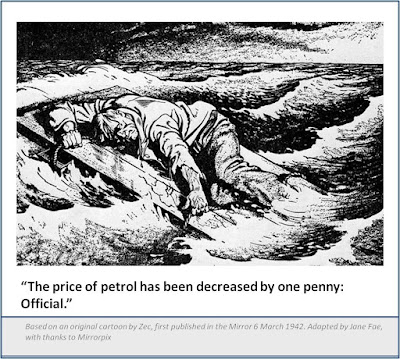

Newspapers that supported left wing parties were banned under wartime legislation. Churchill wanted to extended the ban to include the Daily Mirror when it published a cartoon critical of his policies in 1942 (above). Under Beaverbrook the newspapers staged photographs of milkmen delivering the daily pint over the wreckage of a bombing raid to keep spirits up. They'd already had to spin the defeat at Dunkirk into a victory. The war was almost lost before it began, 350, 000 troops retreating from the oncoming German army and trapped between them and the sea. This is not to deny the bravery of the men involved but the Dunkirk myth is one of the biggest propaganda spins the British media has ever created. This isn't to say that keeping spirits up and raising morale aren't an important job during wartime but the lie has become the truth, officially repeated and that's the version of the war that is being celebrated today.

During the war some members of the government began to plan for afterwards and there was a growing view that things had to change. The poverty of the 1930s, unemployment, children going hungry, slum housing, no security, were all seen as the old way. There was talk of a new world, of doing away with the old guard and getting it right. Win the war and then win the peace. People started to talk of a welfare state and Sir William Beveridge was asked to write a report. He said that Britain could afford a welfare state and had to afford it, for the national good. Churchill was against it and he began to be seen as the man for the war but not the man for the peace. The British people agreed, removing him from office at the first post- war general election. Ernest Bevin, the trade union leader who was brought into the Wartime Cabinet and in charge of the Ministry of Labour, argued strongly for a welfare state and for post- war security for all, the idea that poverty should be eradicated and that government and the people had a duty to build a fairer society. After all, what was the suffering for, if not this? This has been successively undermined from the 1970s onwards by the right wing press and right wing politicians, with repeated stories of benefit cheats, dependency culture and dole dossers, a concerted campaign to forget that the welfare state was a reaction to the absolute poverty of the 1920s and 1930s and a commonly held desire to provide security for people who had none, who could not afford to visit a doctor, who died because they could not afford medicines, who went hungry when they had no work. The Daily Mail and the Tories who want us to celebrate V.E. Day are the same who want to undermine and override the Second World War's most long lasting social impact in this country. The causes of the welfare state- war, poverty, inequality, injustice- are ignored in favour of sentimental flag waving and a notion of togetherness. The real togetherness, if it existed, was the sense among politicians and people in 1945 that when Hitler was defeated there had to be fundamental changes in the way the UK and society were organised and the way it treated people. In this new world there was no place for Winston Churchill who was against it anyway. Our current PM's hero is Winston Churchill. The talk is that he wants to loosen the lockdown, get the economy going again, and that he will announce this on Sunday- backed up by the flag waving Tory press. Many feel that this is too soon. If Johnson sees this as his Churchill moment he may find that a resulting second wave of Covid infections becomes the equivalent of the V2 flying rockets that destroyed neighbourhoods in London 1944 and 1945.

The V.E. Day celebrations also add to the idea of British exceptionalism, that 'we' won the war. Yes, the Battle of Britain was a significant moment, Hitler's plan to invade Britain postponed, but it was his decision to invade the Soviet Union that the war hinges on militarily. The Russian people fought street by street, house by house, cellar by cellar. Russian women served at the fontline. They lost 20 million people as a result. The Red Army, the defence of Stalingrad, the horrors of the Eastern Front and the advance towards Berlin turned the tide of the war. In the west the D- Day landings started to squeeze the Nazis out of France. U.S. soldiers make up two thirds of the 10, 000 casualties from the landings. None of this is adequately represented by the Spitfires, sandwiches and bunting portrayal of V.E. Day.

The newspapers and politicians who want us to celebrate this parochial, one eyed view of the past are the same ones who want to take us out of Europe, who want us to prioritise business over human lives by lifting the lockdown and who want to turn back the clock to a land that never existed. Jon Savage tweeted a comment earlier this week and it's something that I've felt for some time. Jon's Tweet reads-

'Have suddenly focussed on the fact that the usual May Day holiday on Monday has been moved by this shower of shit government to next Friday for VE Day: this country has been totally infantilised. GET OVER THE FUCKING SECOND WORLD WAR'

And who can disagree?

Actually loads of people would disagree I'm sure.

Anyway, that's my take. I'll inevitably end up feeling like the V.E. Day Grinch when the genuine sense of community down our road that has been fostered during lockdown becomes a socially distanced street party later on today, people drinking and waving flags in their front gardens and there's some communal Vera Lynn and Churchill broadcasts.


Here are some London Irish trad- folk punks singing a song in 1988 about the serious business of public holidays in Almeria.


Fiesta

Thursday, 13 June 2019

This Searing Light


I have recently read Jon Savage's book about Joy Division- This Searing Light, The Sun And Everything Else: Joy Division: The Oral History. When I first heard about it I wasn't sure an oral history, constructed from interviews old and new, was what I wanted from a Joy Division book by Jon Savage, one of the best writers of his generation. What I wanted was Jon's writing, his thoughts and words, his insights. But within pages of starting the book I was realised I was wrong- the selection of quotes from interviews, the perspectives of the participants and eye witnesses, is exactly the way the story of Joy Division should be told. Some of the excerpts and quotes are familiar, from the Joy Division documentary from 2007, from interviews and articles I've read elsewhere. Some are taken from reviews and contemporary music press accounts. Some are new. The genius of Jon's assemblage of the quotes is in the constant forward momentum of the story, told from within the band and from outside it, and the way he manages to make time shift. Clearly we all know the ending and some of the passages are from interviews with Sumner, Hook and Morris talking now about then, but despite them having the benefit of hindsight the book has a real immediacy, as if events are unfolding in front of your eyes. The shifting focus from one person to another, with interviews conducted at different points between 1978 and 2018, is really well done. The final few chapters, hurtling into 1980 and Ian's increasing issues with his epilepsy and the side effects of the medication, the ongoing situation with Ian, Deborah Curtis and Annik Honore and the sense within the group that they should stop and give Ian a rest- while at the same time they're making Transmission, Atmosphere, Dead Souls, Closer and Love Will Tear Us Apart- is brilliantly portrayed, heartrendingly so as the whirlpool sucks Ian further into it, and the loss of control by all involved. If you have any interest in the Joy Division story or the music they made, I can't recommend it enough.

Fittingly, for a group so defined by the graphic presentation of the art and the beauty of Peter Saville's work, it is a superbly put together book too, from the shiny reflective cover with the book title in the font used for Closer and grainy band photo, to the selection of gig shots and posters. There are a pair of quotes placed at the end of two of the chapters that are genuinely breathtaking, that make you stop, turn back a few pages and read again, so that the quote comes at you once more- one is from Tony Wilson, that gives the book its title (you should buy it, read it and enjoy that moment yourself). The other is from Annik Honore where she says 'They made [the music] very naturally... and that's why it was so good, because they were not self-conscious about it. I think it was coming from deep within them... it was spontaneous, it was not calculated, you know, not artificial; they had the light, the spirit.' For a group that lasted only a couple of years and wrote and recorded no more than eighty songs, that had an enormous impact on those around them and in their audience at the time- Annik's quote goes some way toward explaining their particular brilliance.

In 1978, before Factory existed, Joy Division got some studio time from RCA (who had an office in Manchester at the time). The session didn't go very well and they almost walked out. It was suggested that they record a cover of version of N.F. Porter's northern soul classic Keep On Keeping On. Hooky says they could never do covers, they never turned out well, they couldn't work out the parts, but in this case they kept the guitar riff which became Interzone. It would be one of the ten songs that became Unknown Pleasures, recorded in Stockport's Strawberry Studios with Martin Hannett in 1979. Hooky and Bernard hated Unknown Pleasures. Hannett took away their aggressive, punky live sound and made it something else, something with space and atmosphere and a doomy sense of things going wrong. Everyone else loved it. The rest, as they always say, is history.

Keep On Keeping On

Interzone