Showing posts with label Dan O'Bannon. Show all posts
Showing posts with label Dan O'Bannon. Show all posts
Wednesday, December 30, 2009
Requiescant in Pace 2009: Part 2
Jane Randolph
David Carradine
Clayton "Sweater Zombie" Hill
Vic Mizzy (composer)
Edward Woodward
Dan O'Bannon (director, screenwriter)
Saturday, December 19, 2009
Friday, December 18, 2009
Dan O'Bannon 1946-2009
"A writer can't scare a reader unless that writer scares himself or herself first. So, you can't excite anyone in the audience unless you're excited writing the script! You're taking yourself for a ride before you take the audience for a ride!"
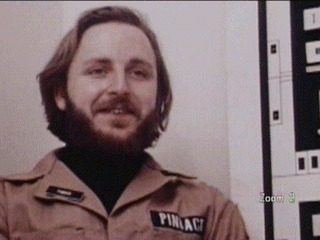 If you're not instantly familiar with the name Dan O'Bannon, you should be. This is the man who wrote Alien--not just a great sci-fi/horror film, but the sci-fi/horror film. This is the man who wrote and directed The Return of the Living Dead, not just a great horror comedy, but the horror comedy. The same man is responsible for both of these absolutely pivotal movies/franchises. Oh yeah, and he also wrote the scripts for Lifeforce and Total Recall, just in case his resume needed a little extra boosting.
And now, the man who did all those things is no longer with us, having passed away last night after a short illness at the sadly young age of 63.
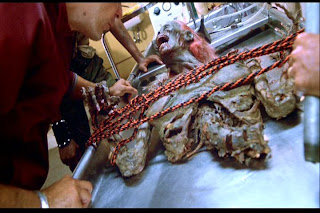 From a personal perspective, I can tell you that were it not for ROTLD, I very well might not be the horror fanatic I am today. As a kid, I already had a solid grounding in Universal and Hammer, but it was O'Bannon's brilliant zombie comedy that put me over the top as an obsessed lifelong fan of the macabre. Without Dan O'Bannon, there might very well have been no Vault of Horror. Less than a fraction of a drop in the bucket in the grand scheme of things, to be sure--but I thank him for that.
O'Bannon had a somewhat sparse career, but what he chose to be associated with over the years is so impressive. Definitely a case of quality over quantity. He went to USC with none other than John Carpenter, collaborating with him on both of their debuts, the sci-fi comedy Dark Star (1974). He was on board for the earliest days of George Lucas' Industrial Light & Magic--you know those computer-generated Death Star blueprints, and the stop-motion game pieces Chewie & R2 use in Star Wars? Yeah, he worked on that.
He was also a writer of science fiction and horror in print as well as film, contributing occasionally to the landmark illustrated magazine Heavy Metal. In fact, two of his stories were adapted in the 1981 Heavy Metal movie, including the one about zombie pilots in World War II (figures!). In the '70s, he was attached as a writer to one of the most legendary cinematic missed opportunities, Alejandro Jodorowsky's adaptation of Dune. Although the project never happened, it did acquaint O'Bannon with H.R. Giger, the man who would design the title character of his most famous script.
 What came out of the failed Dune for O'Bannon was the chance to script what would become Ridley Scott's masterpiece, Alien. So I guess we can't be too disappointed. You don't need me to tell you what a brilliant screenplay O'Bannon crafted for that picture, one whose influence continues to be felt to this day. He took the established haunted house/slasher motifs, and bonded them to a sci-fi template in a way no one had before. The closest prior comparison might be Forbidden Planet, but that was obviously pre-slasher. In the wake of Star Wars, he showed us the darker, grimmer side of sci-fi.
 Nor do you need me to tell you what a minor miracle he pulled off with ROTLD. A movie called The Return of the Living Dead, based on a half-cocked attempt by John Russo to capitalize on the cult popularity of his previous work with George Romero, had no right whatsoever to be any good at all. Yet once O'Bannon took over, in his one great directorial turn, he transformed it into what I can say in all confidence is a terrific piece of film-making, justly revered among genre fans, but worth a look for any lover of film. It's a solid piece of work that gets better every time I watch it. Hell, it was so good it totally overshadowed Romero's own Day of the Dead, which came out at the same time!
So I'll be remembering Dan O'Bannon today, one of the key people who made me the fan I am. I hope you will, too.
And now, the man who did all those things is no longer with us, having passed away last night after a short illness at the sadly young age of 63.
O'Bannon had a somewhat sparse career, but what he chose to be associated with over the years is so impressive. Definitely a case of quality over quantity. He went to USC with none other than John Carpenter, collaborating with him on both of their debuts, the sci-fi comedy Dark Star (1974). He was on board for the earliest days of George Lucas' Industrial Light & Magic--you know those computer-generated Death Star blueprints, and the stop-motion game pieces Chewie & R2 use in Star Wars? Yeah, he worked on that.
He was also a writer of science fiction and horror in print as well as film, contributing occasionally to the landmark illustrated magazine Heavy Metal. In fact, two of his stories were adapted in the 1981 Heavy Metal movie, including the one about zombie pilots in World War II (figures!). In the '70s, he was attached as a writer to one of the most legendary cinematic missed opportunities, Alejandro Jodorowsky's adaptation of Dune. Although the project never happened, it did acquaint O'Bannon with H.R. Giger, the man who would design the title character of his most famous script.
So I'll be remembering Dan O'Bannon today, one of the key people who made me the fan I am. I hope you will, too.
Monday, April 28, 2008
No More Room in Hell: 40 Years of the Modern Zombie Movie, Part 2
George Romero's 1968 masterpiece Night of the Living Dead is rightfully credited with inventing the modern zombie genre. Yet it was the sequel to that film--released a full decade later--that effectively branded that genre into the collective consciousness of popular culture, ensuring that it was no fly-by-night niche but a category that was here to stay, much like vampires, werewolves and mummies before it.
Dawn of the Dead led to a veritable explosion of zombie movies, thanks to the ways in which it took the elements introduced in Night to a level virtually unseen in horror up to that point. In the 1970s, horror was all about the explicit, rather than the implied. And Dawn delivered explicit in buckets--audiences witnessed the flesh of victims being bitten; the heads of ghouls blown apart by shotgun fire; bodies being torn to pieces by hordes of the undead. And all in brightly lit full-color.
The picture was also a major evolutionary step forward both stylistically and thematically. Romero was able to create an overwhelming sense of impending dread and realism--this was a vision of the entire world literally falling apart. At the same time, he was able to deal with issues of race, gender and consumerism in bolder, more direct ways. Add a dose of black humor, and you have the ultimate horror epic.
Although released without the all-important MPAA rating, Dawn of the Dead managed to become a cult underground sensation. And its success opened the floodgates for a seemingly limitless flow of horror movies that dealt with the walking dead.
Among the first was Lucio Fulci, whose dubiously titled Zombi 2 (1979) was unofficially marketed as a sequel to Dawn of the Dead (known in Europe as Zombi). Set on a Carribean island, the film harkens back in some respects to the more traditional voodoo-style of much earlier zombie films. Yet it is also decidedly a product of the Romero renaissance, focusing as it does on graphic depictions of rotting corpses and their flesh-eating frenzies. Yet there is something even more sinister at work in Fulci's flick--with no trace of humor in sight, it's a straight-ahead gorefest of unprecedented proportions. Unrelenting in its horror, the film seems to seek mainly to revolt the viewer as much as possible.
Fulci's later zombie trilogy continued his explorations into the utter bleakness of zombie horror. Hailed by some for being stylistically and technically superior to Zombi 2, City of the Living Dead (1980), The Beyond (1981) and House by the Cemetery (1981) were also less directly influenced by Romero. Here, Fulci struck out on more of an original path, tieing the zombie mythos to that of H.P. Lovecraft, and intertwining the zombie apocalypse with the apocalypse presented in the New Testament Book of Revelations.
The violence depicted in these movies was of a type never before seen in the history of cinema. Many have pointed to Italy's pervasive Roman Catholicism as the source for this zombie obsession. Specifically, in the Italian mindset, the living dead represent the ultimate horror, the most unspeakable blasphemy, because their existence refutes the sanctity of the human soul and is a perversion of the fundamental Christian belief in the resurrection of the body.
But Italy wasn't the only place where cinematic ghouls were flourishing. Some of George Romero's American compatriots were paying attention, as well. This was evidenced by films like John Carpenter's The Fog, released a year after Dawn of the Dead. Building on Romero's notions of social commentary, The Fog reinforced the idea that these movies could contain messages beyond the depiction of gore.
One of the ways in which zombie films managed to survive the 1980s despite the oversaturation was by adding healthy doses of what helped the entire horror genre survive the decade as well: comedy. Perhaps in no other era was the horror comedy so prevalent, and within this particular niche it earned an especially memorable name: splatstick.
Almost an instant classic, Re-Animator was based on the work of Lovecraft, and the satirical manner in which it dealt with the subject matter of bringing life to corpses made it the "anti-Frankenstein". Although its undead were not of the flesh-eating variety, Re-Animator was a more than worthy addition to the genre.
Return of the Living Dead's zombies were not of the flesh-eating variety either--no, they preferred brains. In fact, it was this film which directly led to the inextricable link between zombies and brain-eating that continues to persist in pop culture to this day. Originally envisioned as an unofficial sequel to Night of the Living Dead, O'Bannon chose instead, out of deference to the master, to take the proceedings in a more humorous direction. The result was a film which is regarded as one of the finest horror comedies ever made.
Ironically, ROTLD would go head-to-head with the long-awaited third chapter in Romero's series, 1985's Day of the Dead. Panned at the time by critics and rejected by fans, the film failed at the box office, its serious tone and depressing social message no match for the frivolity and punk rock mentality of O'Bannon's film. Also, budgetary constraints and creative disputes had caused the film to be significantly less than what Romero had originally intended it to be.
Once again, Romero had managed to reinvent the cinematic category he invented. But after Day of the Dead, several issues would cause the director to walk away from the world of the living dead. The genre would be forced to go on without him--and during a time when horror films in general would be suffering their lowest nadir in decades.
To Be Continued...
Subscribe to:
Posts (Atom)