Athletic muscleman Mario Guaita aka Mario Ausonia (1881-1956) was an Italian actor, director, producer and scriptwriter in the silent era. He had his international breakthrough with Spartaco (1913) and became a star in the Italian Forzuto genre. In the early 1920s, he moved to Marseille where he made a few films and ran a cinema.

French postcard by Les Cinématographes Méric. Mario Ausonia (Mario Guaita) in the French silent film La course à l'amour/Love On The Run (Paul Barlatier, Charles Keppens, 1924).
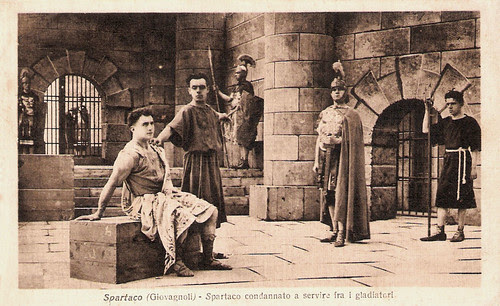
Italian postcard bt V. Uff. Ref. St., Terni, no. 4227. Photo: Pasquali Film, Torino. Publicity still for Spartaco – Il gladiatore della Tracia/Spartacus (1913). Caption: Spartaco condamnato a servire fra i gladiatori (Spartacus condemned to serve among the gladiators).

Spanish collectors card by Reclam Films, Mallorca, no. 5 of 6. Photo: Pasquali Film. Suzanne De Labroy and Mario Ausonia in Salambò (Domenico Gaido, 1914), a very free adaptation from Gustave Flaubert's classic novel. The picture shows Matho and Salambò in his tent.

French postcard by Cinématographes Méric. Mario Ausonia (Mario Guaita) in the French silent film Mes p'tits/Le calvaire d’un saltimbanque/My Little Ones (Paul Barlatier, Charles Keppens, 1923). The film evolves in the circus and fairground milieu and was scripted by Ausonia's wife Renée Deliot aka de Liot.
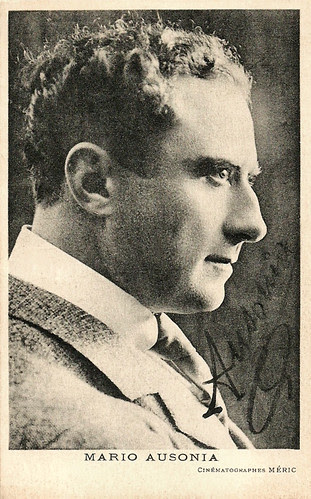
French postcard by Cinématographes Méric.
Mario Ausonia was born Mario Guaita in Milan, Italy in 1881, into a well-to-do family of Lombardy. He left his studies of medicine and dedicated himself to athletics and vaudeville. As a member of the Trio Ausonia, ‘Gladiators of the Twentieth Century’, he did tableaux vivants of famous paintings and sculptures. The trio knew triumphant successes, not only in Italy but all over Europe.
In 1912 he reportedly switched to cinema. Aldo Bernardini and Vittorio Martinelli write in their book, 'Il cinema muto italiano, Voll. III' that Mario Guaita played his first supporting role in Sui gradini del trono/On The Steps Of The Throne (Ubaldo Maria Del Colle, 1912), at the Pasquali company of Turin. However, we recently the copy of the film in the Desmet collection of Eye Netherlands Filmmuseum and Ausonia is really not in film. It mus have been a mistake of the noted film historians or Ausonia's role was cut from the film afterwards. Probably his first supporting part was L’ultimo convegno/Under Suspicion (Giovanni Enrico Vidali, 1913). Then Ausoniua had a major role in La zia di Carlo/Charley’s Aunt (Umberto Paradisi, 1913), an adaptation of the cross-dressing farce 'Charley’s Aunt'.
His real and international breakthrough came with the epic film Spartaco – Il gladiatore della Tracia/Spartacus (1914), a prestigious production by Pasquali and directed by Enrico Vidali, who directed him in L’ultimo convegno. The Italian film journal Vita Cinematografica praised Guaita for ‘the plastic beauty of his appearance, the attraction and at the same time the power and swiftness of his perfect body, his penetrating glance, and his perfect acting.’ In American publicity, he was described as ‘a celebrated Italian wrestler and fine actor, whose physique and finely chiselled face make him an extraordinary prototype [sic!] of the ancient gladiator.’ Actually, in Spartaco the camera is often focusing on Ausonia’s naked upper body, his muscular arms and his stern look into the camera. The film was strongly based on the novel by Raffaello Giovagnoli on Spartacus, but where the hero dies on the battlefield in the novel, Ausonia’s Spartacus reconciles with Crassus and marries his daughter. So romantic love conquers political conflict. Spartaco (1913) presents Ausonio as a strongman of the cinema, a 'Forzuto'. Audiences could see him bending prison bars, just like Bartolomeo Pagano would do a year later in his role as Maciste in Cabiria (Giovanni Pastrone, 1914).
After a minor part in Il posto vuoto/The Empty Place (Giuseppe Giusti, 1914), Ausonia played the lead in Il principino saltimbanco/The Prince Acrobat (Giovanni Enrico Vidali, 1915), about a kidnapped little prince who becomes an acrobat. While the press mocked the audience’s tears over the melodrama, it praised Guaita’s restrained acting. Pasquali also exploited the success of Spartaco by having Ausonia perform in another epic, Salammbo/Salambo, A $100,000 Spectacle (Domenico Gaido, 1915), with Suzanne De Labroy in the title role, and Ausonia as Matho. The film was made in coproduction with George Kleine, the biggest importer of Italian films in the US at the time. Ausonia then acted in other films at the Gloria company, such as Il romanzo di un atleta/The Romance Of An Athlete (Vittorio Rossi-Pianelli, 1915), Un dramma tra le belve/A Drama Among The Beasts (Amleto Palermi, 1915), Il più forte/The Strongest (Guido Di Nardo, 1915), Il mistero dell’educanda di Sant-Bon/The Mystery Of The Education Of Saint-Bon (Guido Di Nardo, 1915-1916), and Un grande drama in un piccolo cuore/A Great Drama In A Small Heart (Guido Di Nardo, 1916).
During the First World War, Guaita-Ausonia served in the army but obtained several leaves to play film parts. Leaving Gloria, he shifted to the Jupiter company of Turin to act opposite Diana Karenne in the drama Il marchio/The Mark (Armand Puget, 1916). The press praised the mise-en-scene and cinematography of the film but disliked Karenne. Then he moved on to another Torinese company, Phoenix, where Ausonia starred in the adventure film Panther (Gero Zambuto, 1916) opposite Zambuto’s wife Claudia Zambuto. In 1917 Mario Ausonia played in just one film, Vittime/Victim (Giuseppe Pinto, 1917), produced by Jupiter. He made no films in 1918.
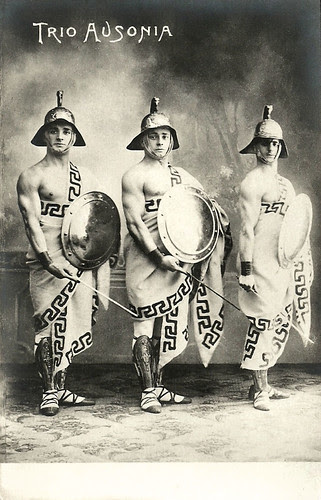
French postcard. Mario Ausonia is in the middle.
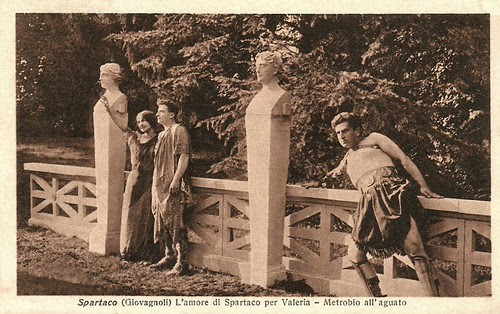
Italian postcard bt V. Uff. Ref. St., Terni, no. 4224. Photo: Pasquali Film, Torino. Publicity still for Spartaco – Il gladiatore della Tracia/Spartacus (1913). Caption: L'amore di Spartaco per Valeria - Metrobio all'agguato (The Love of Spartaco for Valeria - Metrobio plots a trap).
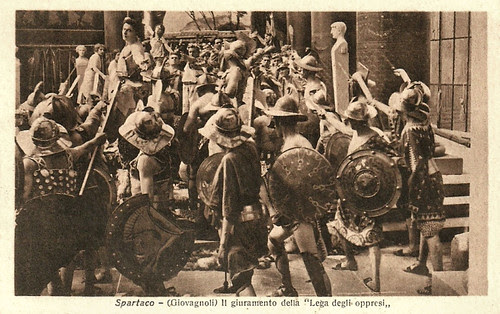
Italian postcard bt V. Uff. Ref. St., Terni, no. 4232. Photo: Pasquali Film, Torino. Publicity still for Spartaco – Il gladiatore della Tracia/Spartacus (1913). Caption: Il giuramento della Lega degli oppresi (The Oath of the League of the oppressed). The gladiators swear loyalty to Spartacus (Mario Ausonia).
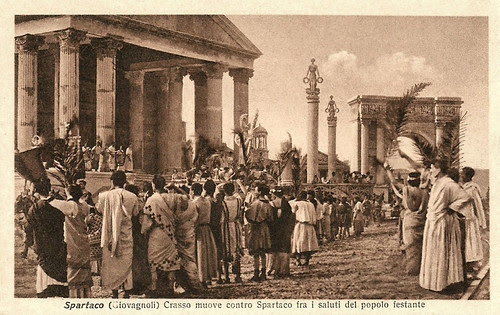
Italian postcard bt V. Uff. Ref. St., Terni, no. 4226. Photo: Pasquali Film, Torino. Publicity still for Spartaco – Il gladiatore della Tracia/Spartacus (1913). Caption: Crasso muove contro Spartaco fra i saluti del popolo festante (Crassus moves against Spartacus amongst the celebrating people). Eventually Spartacus will beat Crassus (Enrico Bracci).

Spanish collectors card by Reclam Films, Mallorca, no. 6 of 6. Photo: Pasquali Film. Mario Ausonia in Salambò (Domenico Gaido, 1914). This card shows the capture of Matho. Left on the horse we see Hamilcar, with a Greek-like helmet. On the right horse is Narr Havas.

Italian postcard by Società Italiana Eclair. Photo: Eclair. Mario Ausonia on crutches in Il principino saltimbanco/The Prince Acrobat (Giovanni Enrico Vidali, 1915). Caption: Grandioso Dramma in cinque parti (Grand Drama in five parts). The man right of Ausonia is director Giovanni Enrico Vidali himself who also acted in the film, while the the two on the left could be Emilia Vidali and Carlo Vidali.
At Films A. De Giglio in Turin, Marco Guaita, by now known as Mario Ausonia, obtained his greatest successes. Films such as La cintura delle amazzoni/The Belt Of The Amazons (Mario Guaita, 1920) and Atlas (Mario Guaita, 1920) had vast diffusion and obtained positive responses all over. In 1919, Ausonia relaunched himself in L’atleta fantasma/The Ghost Athlete (Raimondo Scotti, 1919) about a bland society man who leads a Zorro- or Batman-like double life as a masked athlete – exactly the kind of man his fiancée dreams about. He stops two antiquarians from robbing a precious jewel from a museum, by posing as the statue of the Dying Athlete, which then becomes alive during the robbery. He kicks the thieves out, but they hire a gang to steal the jewel again and to kidnap the fiancée. The whole film constantly plays with Guaita’s physique and powers, from the opening images showing the man with and without clothes to when the fiancée mockingly asks whether he wouldn’t like to be like the statue in the museum.
After this film, Ausonia did a whole series of films at De Giglio directed by himself and often with Elsa Zara as his female partner. The series started with Lotte di giganti/Battles Of The Giants (Mario Guaita, 1919), about a Duke who wants to refresh his offspring, so he needs a modern Hercules as the man for his daughter. In the two-part film Atlas, he is a European child raised by Indians. One day other Europeans are captured, Atlas’s European roots come back and he flees with them. Back in Europe, he discovers the mystery which destroyed his family and marries Kate. Next followed La cintura delle Amazzoni, a modern adventure film which had little to do with one of the works of Hercules, the two-part La mascotte di Sparta/The Mascot of Sparta (Mario Guaita, 1921), and the Honoré de Balzac adaptation Sotto i ponti di Parigi/Under The Bridges Of Paris (Mario Guaita, 1920), which was well received by both press and audiences.
In Frisson/Thrill (Mario Guaita, 1922) he tries to extort money from his aunts to buy a theatre. La nave dei milliardi/Ship Of Billions (Mario Guaita, 1922) doubled much of the plot of Atlas and probably used parts of the other film in flashbacks, while in Il pescatore di perle (Mario Guaita, 1922) Ausonia models for a statue of a wave and afterwards ends up in an island, which afterwards proves to be very close to the coastline. In Gli spettri della fattoria/The Ghosts Of The Farm (Mario Guaita, 1923), shot in the mountains of Northern Italy, he is a new country doctor who discovers a former, Spanish girlfriend resides there. She pretends there are ghosts on a farm, to mask the shady business of her husband and herself. Ausonia’s reckless acrobatic tours astounded audiences. To avoid suspension of his work he also used a fixed understudy, an extra and an athlete called Franco.
When the crisis hit Italian cinema in the early 1920s, Ausonia moved to France, where he founded in Marseille the Société Cinématographe Ausonia. According to cinematographer Luigi Fiorio who worked with him in France, ‘it was his wife, the little attractive Mrs. Felicie, who wrote the scripts and collaborated in the direction of the films. She was a very good woman who patiently supported the caprices of her husband. We worked in a little studio in the outskirts of Marseille, very badly equipped and of no importance.’ In Marseille, Ausonia made the films Dans les mansardes de Paris/In The Attics Of Paris (1924) and L’emeraude de la folie/The Emerald Of Madness (Mario Guaita, Luigi Fiorio, 1925). He also acted in Mes petits/My Little Ones (Pierre Barlatier, Charles Keppens, 1923) and in La course à l’amour/Love On The Run (Pierre Barlatier, Charles Keppens, 1924). Both films starred Edouard Mathé and Gina Relly and were made at the Marseille-based Lauréa Films company.
Mario Ausonia shot his last film in Turin, the Western La donna carnefice nel paese dell'oro/The Woman Hangman In The Land Of Gold (Mario Guaita, 1926), an adaptation of a novel by Arnaldo Cipolla. Then, Ausonia left the film world and established himself in Marseille, where he opened a small cinema at the Pointe-Rouge in the periphery of the city. He stopped to do this in 1947 when he retired. ‘Calm, slow in his gestures, rosy, fresh, smiling, with an eternal cigarette on his lips, dressed with sportive elegance’, scriptwriter Giovanni Drovetti remembered him. Mario Guaita alias Mario Ausonia died in Marseille in 1956. He was married to Emilia Amoroso, and after she died, he remarried with Renée Felicie Deliot.

French postcard by Cinématographes Méric. Mario Ausonia in Mes p'tits/Le Calvaire d'une saltimbanque/My Little Ones (Paul Barlatier, Charles Keppens, 1923). The woman in the middle could be Jane (Jeanne) Rollette.

French postcard by Cinématographes Méric. Mario Ausonia in Mes p'tits/Le Calvaire d'une saltimbanque/My Little Ones (Paul Barlatier and Charles Keppens, 1923).

French postcard by Cinématographes Méric. Gina Relly, Edouard Mathé and Mario Ausonia in La course à l'amour/Love On The Run (Charles Keppens, Paul Barlatier, 1924).

French postcard by Les Cinématographes Méric. Mario Ausonia in La course à l'amour/Love On The Run (Paul Barlatier, Charles Keppens, 1924).

French postcard by Les Cinématographes Méric. Mario Ausonia (Mario Guaita) and Gina Relly in the French silent film La course à l'amour/Love On The Run (Paul Barlatier, Charles Keppens, 1924).

French postcard by Editions Filma.
Sources: Ivo Blom (Catalogue Il Cinema Ritrovato 2013), Ivo Blom (), Vittorio Martinelli (Maciste & Co - Italian), Thomas Späth and Margit Tröhler (Spartacus – Männermuskeln, Heldenbilder, oder: die Befreiung der Moral’, in Antike im Kino - page now defunct), Ciné-Ressources (French) and IMDb. Ivo Blom also wrote two other articles on Mario Ausonia: ‘The Beauty of the Forzuti: Irresistible Male Bodies On and Off Screen’, in: Marina Dahlquist, Doron Galili, Jan Olsson, Valentine Robert eds., Corporeality in Early Cinema: Viscera, Skin, and Physical Form; and with Micaela Veronesi he published‘Muscoli e cervello. I film di Mario Guaita Ausonia tra avventura e crime story/Muscles and Brains: the Films of Mario Ausonia between Adventure and Crime’, in: Luca Mazzei and Paola Valentini eds., Giallo italiano: crime movie / occulto / conspiracy theory / gothic in Bianco e Nero, no. 587, 2017.
This post was last updated on 19 July 2024.
French postcard by Les Cinématographes Méric. Mario Ausonia (Mario Guaita) in the French silent film La course à l'amour/Love On The Run (Paul Barlatier, Charles Keppens, 1924).
Italian postcard bt V. Uff. Ref. St., Terni, no. 4227. Photo: Pasquali Film, Torino. Publicity still for Spartaco – Il gladiatore della Tracia/Spartacus (1913). Caption: Spartaco condamnato a servire fra i gladiatori (Spartacus condemned to serve among the gladiators).
Spanish collectors card by Reclam Films, Mallorca, no. 5 of 6. Photo: Pasquali Film. Suzanne De Labroy and Mario Ausonia in Salambò (Domenico Gaido, 1914), a very free adaptation from Gustave Flaubert's classic novel. The picture shows Matho and Salambò in his tent.
French postcard by Cinématographes Méric. Mario Ausonia (Mario Guaita) in the French silent film Mes p'tits/Le calvaire d’un saltimbanque/My Little Ones (Paul Barlatier, Charles Keppens, 1923). The film evolves in the circus and fairground milieu and was scripted by Ausonia's wife Renée Deliot aka de Liot.
French postcard by Cinématographes Méric.
Perfect body
Mario Ausonia was born Mario Guaita in Milan, Italy in 1881, into a well-to-do family of Lombardy. He left his studies of medicine and dedicated himself to athletics and vaudeville. As a member of the Trio Ausonia, ‘Gladiators of the Twentieth Century’, he did tableaux vivants of famous paintings and sculptures. The trio knew triumphant successes, not only in Italy but all over Europe.
In 1912 he reportedly switched to cinema. Aldo Bernardini and Vittorio Martinelli write in their book, 'Il cinema muto italiano, Voll. III' that Mario Guaita played his first supporting role in Sui gradini del trono/On The Steps Of The Throne (Ubaldo Maria Del Colle, 1912), at the Pasquali company of Turin. However, we recently the copy of the film in the Desmet collection of Eye Netherlands Filmmuseum and Ausonia is really not in film. It mus have been a mistake of the noted film historians or Ausonia's role was cut from the film afterwards. Probably his first supporting part was L’ultimo convegno/Under Suspicion (Giovanni Enrico Vidali, 1913). Then Ausoniua had a major role in La zia di Carlo/Charley’s Aunt (Umberto Paradisi, 1913), an adaptation of the cross-dressing farce 'Charley’s Aunt'.
His real and international breakthrough came with the epic film Spartaco – Il gladiatore della Tracia/Spartacus (1914), a prestigious production by Pasquali and directed by Enrico Vidali, who directed him in L’ultimo convegno. The Italian film journal Vita Cinematografica praised Guaita for ‘the plastic beauty of his appearance, the attraction and at the same time the power and swiftness of his perfect body, his penetrating glance, and his perfect acting.’ In American publicity, he was described as ‘a celebrated Italian wrestler and fine actor, whose physique and finely chiselled face make him an extraordinary prototype [sic!] of the ancient gladiator.’ Actually, in Spartaco the camera is often focusing on Ausonia’s naked upper body, his muscular arms and his stern look into the camera. The film was strongly based on the novel by Raffaello Giovagnoli on Spartacus, but where the hero dies on the battlefield in the novel, Ausonia’s Spartacus reconciles with Crassus and marries his daughter. So romantic love conquers political conflict. Spartaco (1913) presents Ausonio as a strongman of the cinema, a 'Forzuto'. Audiences could see him bending prison bars, just like Bartolomeo Pagano would do a year later in his role as Maciste in Cabiria (Giovanni Pastrone, 1914).
After a minor part in Il posto vuoto/The Empty Place (Giuseppe Giusti, 1914), Ausonia played the lead in Il principino saltimbanco/The Prince Acrobat (Giovanni Enrico Vidali, 1915), about a kidnapped little prince who becomes an acrobat. While the press mocked the audience’s tears over the melodrama, it praised Guaita’s restrained acting. Pasquali also exploited the success of Spartaco by having Ausonia perform in another epic, Salammbo/Salambo, A $100,000 Spectacle (Domenico Gaido, 1915), with Suzanne De Labroy in the title role, and Ausonia as Matho. The film was made in coproduction with George Kleine, the biggest importer of Italian films in the US at the time. Ausonia then acted in other films at the Gloria company, such as Il romanzo di un atleta/The Romance Of An Athlete (Vittorio Rossi-Pianelli, 1915), Un dramma tra le belve/A Drama Among The Beasts (Amleto Palermi, 1915), Il più forte/The Strongest (Guido Di Nardo, 1915), Il mistero dell’educanda di Sant-Bon/The Mystery Of The Education Of Saint-Bon (Guido Di Nardo, 1915-1916), and Un grande drama in un piccolo cuore/A Great Drama In A Small Heart (Guido Di Nardo, 1916).
During the First World War, Guaita-Ausonia served in the army but obtained several leaves to play film parts. Leaving Gloria, he shifted to the Jupiter company of Turin to act opposite Diana Karenne in the drama Il marchio/The Mark (Armand Puget, 1916). The press praised the mise-en-scene and cinematography of the film but disliked Karenne. Then he moved on to another Torinese company, Phoenix, where Ausonia starred in the adventure film Panther (Gero Zambuto, 1916) opposite Zambuto’s wife Claudia Zambuto. In 1917 Mario Ausonia played in just one film, Vittime/Victim (Giuseppe Pinto, 1917), produced by Jupiter. He made no films in 1918.
French postcard. Mario Ausonia is in the middle.
Italian postcard bt V. Uff. Ref. St., Terni, no. 4224. Photo: Pasquali Film, Torino. Publicity still for Spartaco – Il gladiatore della Tracia/Spartacus (1913). Caption: L'amore di Spartaco per Valeria - Metrobio all'agguato (The Love of Spartaco for Valeria - Metrobio plots a trap).
Italian postcard bt V. Uff. Ref. St., Terni, no. 4232. Photo: Pasquali Film, Torino. Publicity still for Spartaco – Il gladiatore della Tracia/Spartacus (1913). Caption: Il giuramento della Lega degli oppresi (The Oath of the League of the oppressed). The gladiators swear loyalty to Spartacus (Mario Ausonia).
Italian postcard bt V. Uff. Ref. St., Terni, no. 4226. Photo: Pasquali Film, Torino. Publicity still for Spartaco – Il gladiatore della Tracia/Spartacus (1913). Caption: Crasso muove contro Spartaco fra i saluti del popolo festante (Crassus moves against Spartacus amongst the celebrating people). Eventually Spartacus will beat Crassus (Enrico Bracci).
Spanish collectors card by Reclam Films, Mallorca, no. 6 of 6. Photo: Pasquali Film. Mario Ausonia in Salambò (Domenico Gaido, 1914). This card shows the capture of Matho. Left on the horse we see Hamilcar, with a Greek-like helmet. On the right horse is Narr Havas.
Italian postcard by Società Italiana Eclair. Photo: Eclair. Mario Ausonia on crutches in Il principino saltimbanco/The Prince Acrobat (Giovanni Enrico Vidali, 1915). Caption: Grandioso Dramma in cinque parti (Grand Drama in five parts). The man right of Ausonia is director Giovanni Enrico Vidali himself who also acted in the film, while the the two on the left could be Emilia Vidali and Carlo Vidali.
A modern Hercules
At Films A. De Giglio in Turin, Marco Guaita, by now known as Mario Ausonia, obtained his greatest successes. Films such as La cintura delle amazzoni/The Belt Of The Amazons (Mario Guaita, 1920) and Atlas (Mario Guaita, 1920) had vast diffusion and obtained positive responses all over. In 1919, Ausonia relaunched himself in L’atleta fantasma/The Ghost Athlete (Raimondo Scotti, 1919) about a bland society man who leads a Zorro- or Batman-like double life as a masked athlete – exactly the kind of man his fiancée dreams about. He stops two antiquarians from robbing a precious jewel from a museum, by posing as the statue of the Dying Athlete, which then becomes alive during the robbery. He kicks the thieves out, but they hire a gang to steal the jewel again and to kidnap the fiancée. The whole film constantly plays with Guaita’s physique and powers, from the opening images showing the man with and without clothes to when the fiancée mockingly asks whether he wouldn’t like to be like the statue in the museum.
After this film, Ausonia did a whole series of films at De Giglio directed by himself and often with Elsa Zara as his female partner. The series started with Lotte di giganti/Battles Of The Giants (Mario Guaita, 1919), about a Duke who wants to refresh his offspring, so he needs a modern Hercules as the man for his daughter. In the two-part film Atlas, he is a European child raised by Indians. One day other Europeans are captured, Atlas’s European roots come back and he flees with them. Back in Europe, he discovers the mystery which destroyed his family and marries Kate. Next followed La cintura delle Amazzoni, a modern adventure film which had little to do with one of the works of Hercules, the two-part La mascotte di Sparta/The Mascot of Sparta (Mario Guaita, 1921), and the Honoré de Balzac adaptation Sotto i ponti di Parigi/Under The Bridges Of Paris (Mario Guaita, 1920), which was well received by both press and audiences.
In Frisson/Thrill (Mario Guaita, 1922) he tries to extort money from his aunts to buy a theatre. La nave dei milliardi/Ship Of Billions (Mario Guaita, 1922) doubled much of the plot of Atlas and probably used parts of the other film in flashbacks, while in Il pescatore di perle (Mario Guaita, 1922) Ausonia models for a statue of a wave and afterwards ends up in an island, which afterwards proves to be very close to the coastline. In Gli spettri della fattoria/The Ghosts Of The Farm (Mario Guaita, 1923), shot in the mountains of Northern Italy, he is a new country doctor who discovers a former, Spanish girlfriend resides there. She pretends there are ghosts on a farm, to mask the shady business of her husband and herself. Ausonia’s reckless acrobatic tours astounded audiences. To avoid suspension of his work he also used a fixed understudy, an extra and an athlete called Franco.
When the crisis hit Italian cinema in the early 1920s, Ausonia moved to France, where he founded in Marseille the Société Cinématographe Ausonia. According to cinematographer Luigi Fiorio who worked with him in France, ‘it was his wife, the little attractive Mrs. Felicie, who wrote the scripts and collaborated in the direction of the films. She was a very good woman who patiently supported the caprices of her husband. We worked in a little studio in the outskirts of Marseille, very badly equipped and of no importance.’ In Marseille, Ausonia made the films Dans les mansardes de Paris/In The Attics Of Paris (1924) and L’emeraude de la folie/The Emerald Of Madness (Mario Guaita, Luigi Fiorio, 1925). He also acted in Mes petits/My Little Ones (Pierre Barlatier, Charles Keppens, 1923) and in La course à l’amour/Love On The Run (Pierre Barlatier, Charles Keppens, 1924). Both films starred Edouard Mathé and Gina Relly and were made at the Marseille-based Lauréa Films company.
Mario Ausonia shot his last film in Turin, the Western La donna carnefice nel paese dell'oro/The Woman Hangman In The Land Of Gold (Mario Guaita, 1926), an adaptation of a novel by Arnaldo Cipolla. Then, Ausonia left the film world and established himself in Marseille, where he opened a small cinema at the Pointe-Rouge in the periphery of the city. He stopped to do this in 1947 when he retired. ‘Calm, slow in his gestures, rosy, fresh, smiling, with an eternal cigarette on his lips, dressed with sportive elegance’, scriptwriter Giovanni Drovetti remembered him. Mario Guaita alias Mario Ausonia died in Marseille in 1956. He was married to Emilia Amoroso, and after she died, he remarried with Renée Felicie Deliot.
French postcard by Cinématographes Méric. Mario Ausonia in Mes p'tits/Le Calvaire d'une saltimbanque/My Little Ones (Paul Barlatier, Charles Keppens, 1923). The woman in the middle could be Jane (Jeanne) Rollette.
French postcard by Cinématographes Méric. Mario Ausonia in Mes p'tits/Le Calvaire d'une saltimbanque/My Little Ones (Paul Barlatier and Charles Keppens, 1923).
French postcard by Cinématographes Méric. Gina Relly, Edouard Mathé and Mario Ausonia in La course à l'amour/Love On The Run (Charles Keppens, Paul Barlatier, 1924).
French postcard by Les Cinématographes Méric. Mario Ausonia in La course à l'amour/Love On The Run (Paul Barlatier, Charles Keppens, 1924).
French postcard by Les Cinématographes Méric. Mario Ausonia (Mario Guaita) and Gina Relly in the French silent film La course à l'amour/Love On The Run (Paul Barlatier, Charles Keppens, 1924).
French postcard by Editions Filma.
Sources: Ivo Blom (Catalogue Il Cinema Ritrovato 2013), Ivo Blom (), Vittorio Martinelli (Maciste & Co - Italian), Thomas Späth and Margit Tröhler (Spartacus – Männermuskeln, Heldenbilder, oder: die Befreiung der Moral’, in Antike im Kino - page now defunct), Ciné-Ressources (French) and IMDb. Ivo Blom also wrote two other articles on Mario Ausonia: ‘The Beauty of the Forzuti: Irresistible Male Bodies On and Off Screen’, in: Marina Dahlquist, Doron Galili, Jan Olsson, Valentine Robert eds., Corporeality in Early Cinema: Viscera, Skin, and Physical Form; and with Micaela Veronesi he published‘Muscoli e cervello. I film di Mario Guaita Ausonia tra avventura e crime story/Muscles and Brains: the Films of Mario Ausonia between Adventure and Crime’, in: Luca Mazzei and Paola Valentini eds., Giallo italiano: crime movie / occulto / conspiracy theory / gothic in Bianco e Nero, no. 587, 2017.
This post was last updated on 19 July 2024.