On 26 November 20204, German film actress Karin Baal (1940-2024) passed away. She has appeared in over 90 films since 1956. Baal started as a teenage rebel in the cult film Die Halbstarken (1956) and became one of the brightest stars of the Wirtschaftswunder cinema. She was 84.

Austrian postcard by Lichtbild-Vertrieb Paula Weizmann, Wien, no. F 7. Photo: Interwest / Union-Film / Haenchen. Publicity still for Die Halbstarken/Teenage Wolfpack (Georg Tressler, 1956) with Horst Buchholz.

German postcard by Universum-Film Aktiengesellschaft (Ufa), Berlin-Tempelhof, no. CK 190. Retail price: 30 Pfg. Photo: Klaus Collignon / Ufa.

German postcard by Universum-Film Aktiengesellschaft (Ufa), Berlin-Tempelhof, no. CK 291. Retail price: 30 Pfg. Photo: Joe Niczky / Ufa.

German postcard by Universum-Film Aktiengesellschaft (Ufa), Berlin-Tempelhof, no. CK 334. Photo: Klaus Collignon / Ufa.

German postcard by Universum-Film Aktiengesellschaft (Ufa), Berlin-Tempelhof, no. CK 392. Retail price: 30 Pfg. Photo: Georg Michalke / Ufa.
Karin Baal was born as Karin Blauermel in Berlin, Germany, in 1940. Her mother was a seamstress. She and her brother grew up under difficult social conditions without a father and living with their grandmother. After finishing secondary school, she attended a school for fashion design.
In 1956, she learned that a young actress was sought for the film Die Halbstarken/The Hooligans (Georg Tressler, 1956), which embodied the so-called Zeitgeist. Without any acting training, the 16-year-old Baal was chosen out of 700 applicants to play the main female role opposite Horst Buchholz. She also got a three-year actor training contract. Filmportal.de: “In Georg Tressler's film, Baal made a convincing performance as the 15-year old Sissy Bohl, who – with her self-confidence and aplomb – is superior to the boys and in the end does not shy away from taking up arms.”
From then on she was cast in roles as a blonde rebel. She played a supporting role as a prostitute in Das Mädchen Rosemarie/The Girl Rosemarie (Rolf Thiele, 1958), a film adaptation of the scandalous life and death of the prostitute Rosemarie Nitribitt (Nadja Tiller).
She played another ‘loose girl’ in Arzt ohne Gewissen/Doctor Without Scruples (Falk Harnack, 1959), she was a teenage delinquent in Der Jugendrichter/The Judge and the Sinner (Paul Verhoeven, 1959) opposite Heinz Rühmann, and she seduced the father (Rudolf Prack) of her friend in Die junge Sünderin/The Young Sinner (Rudolf Jugert, 1960).
In 1959 she finished her acting training and had her first stage roles in München (Munich). From then on, she regularly appeared on stage. In 1959, she married boyfriend and fellow actor from Die Halbstarken, Karl Heinz Gaffkus, with whom she has a son, Thomas. They divorced two years later, and Baal married in 1962 with actor Helmuth Lohner. In 1967 their daughter Therese Lohner was born, who became an actress too.

German autograph card by Labphoto. Photo: Inter-West Film / Union Film. Karin Baal in Die Halbstarken/The Hooligans (Georg Tressler, 1956).

German postcard by Kolibri-Verlag, Minden/Westf., no. 2096. Photo: Interwest / Union. Publicity still for Die Halbstarken (1956).

German postcard by Kolibri-Verlag, Minden/Westf. Photo: Interwest / Union / Haenchen. Publicity still for Die Halbstarken (1956).

German postcard by Kolibri-Verlag, Minden/Westf., no. 2329. Photo: Interwest / Union / Haenchen. Publicity still for Die Halbstarken/The Hooligans (Georg Tressler, 1956) with Horst Buchholz.

German postcard by WS-Druck, Wanne-Eickel. Photo: Interwest / Union / Haenchen. Publicity still for Die Halbstarken/The Hooligans (Georg Tressler, 1956) with Horst Buchholz.

German postcard by Kolibri-Verlag, Minden/Westf., no. 2507. Photo: DFH / Lilo. Publicity still for Der müde Theodor/Tired Theodore (Géza von Cziffra, 1957) with Albert Rueprecht.
In 1961 Karin Baal was awarded the Silver Bambi award and the prize of the German Film Critics for Best Young Actress. In the 1960s she appeared in several Edgar Wallace thrillers, including Die Toten Augen von London/The Dark Eyes of London (Alfred Vohrer, 1961) with Joachim Fuchsberger, and Der Hund von Blackwood Castle/The Hound of Blackwood Castle (Alfred Vohrer, 1967).
Her parts as the threatened blonde innocence in these thrillers were a break from the independent characters she had played in the 1950s. In 1966 she was again awarded, this time with the Golden Camera by the magazine Hörzu. She incidentally appeared in international films, such as the thriller Hannibal Brooks (Michael Winner, 1969) starring Oliver Reed.
From the 1970s on, Baal was offered fewer film roles and focused on television. She often guest-starred in such Krimi series as Der Kommissar/The Commissioner (1975), Tatort (1979 and 1990), Derrick (1980 and 1981), Die Männer vom K3/The Men from K3 (1987 and 1991), Ein Fall für Zwei/A Case for Two (1990 and 1995), Der Alte/The Old Man (1990), Marleneken (1990), Doppelter Einsatz/Double Down (1994), Rosa Roth (1995) and Polizeiruf 110/Police 110 (1996).
On TV she also played leading roles in the six-part series Ein Jahr ohne Sonntag/A Year Without Sundays (1970) opposite Götz George, and in the 13-part TV series Wenn Engel reisen/When Angels Travel (Uwe Friessner, 1993). She also worked in popular family TV shows like Liebling Kreuzberg (1985), Schwarzwaldklinik/Black Forest Clinic (1985), and Praxis Bülowbogen/Practice Bülowbogen (1990).
In Ula Stöckl's Erikas Leidenschaften/Erika's Passions (1976), a two-person film with Vera Tschechowa, Baal's role starts out as a 'little woman' but becomes more and more confident in the course of the film. In Desperado City (Vadim Glowna, 1980), Baal played a cab driver and was able to show her former strength once more as part of the personality of an elderly woman.

German postcard by Kolibri-Verlag G.m.b.H., Minden/Westf, no. 914. Photo: Weidenbaum.

German postcard by Universum-Film Aktiengesellschaft (Ufa), Berlin-Tempelhof, no. FK 3567. Retail price: 25 Pfg. Photo: Wesel / Arion Film.
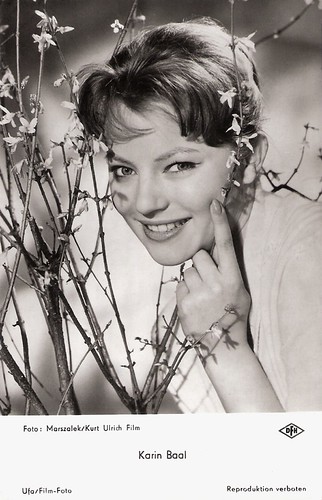
German postcard by Universum-Film Aktiengesellschaft (Ufa), Berlin-Tempelhof, no. 4489. Retail price: 25 Pfg. Photo: Mrszalek / Kurt Ulrich-Film/DFH. Publicity still for So angelt man keinen Mann/That's No Way to Land a Man (Hans Deppe, 1959).

German postcard by Kolibri-Verlag, Minden/Westf., no. 626. Photo: Kurt Ulrich-Film / Dt. Film Hansa (DFH) / Marszalek. Publicity still for So angelt man keinen Mann/That's No Way to Land a Man (Hans Deppe, 1959).

Dutch postcard by Gebr. Spanjersberg N.V., Rotterdam no. 1324. Photo: Weisse / Ufa.

German postcard by Filmbilder-Vertrieb Ernst Freihoff, Essen no. 616. Photo: Erwin Schneider.
Karin Baal collaborated three times with filmmaker Rainer Werner Fassbinder. She played Franz Biberkopf’s (Günther Lamprecht) sister-in-law in the monumental TV series Berlin Alexanderplatz (Rainer Werner Fassbinder, 1979), a resistance fighter in Lili Marleen (Rainer Werner Fassbinder, 1980) and Barbara Sukowa’s mother in Lola (Rainer Werner Fassbinder, 1981).
Other prominent film roles were her parts in Reinhard Hauff‘s Der Mann auf der Mauer/The Man at the Wall (1982), and Margarethe von Trotta‘s Rosa Luxemburg (1986) starring Barbara Sukowa. Highlights of her theatre work were the plays 'Die verlorene Ehre der Katharina Blum' (The Lost Honour of Katharina Blum, 1977) based on the novel by Heinrich Böll, 'Geschlossene Gesellschaft' (No Exit, 1986) based on Jean-Paul Sartre’s 'Huis Clos', and 'Mord um Mitternacht' (Murder at Midnight, 1986) based on the thriller by Francis Durbridge.
Baal divorced from Helmut Lohner in 1977. Her third husband was actor Volker Eckstein, who died of cancer in 1993. His death rushed her into a severe personal crisis for seven years. Alcohol problems and break-downs damaged her career. In 2006 she made her stage comeback with the play '8 Frauen' (8 Women) in which she appeared opposite her daughter, Therese Lohner. At the same time, she was honoured with a retrospective at the Düsseldorf Film Museum. In 2000 she married the 30-years-younger Kurdish actor Cevdet Çelik, from whom she lived separately since 2004.
Among her later films were Der Tunnel/The Tunnel (Roland Suso Richter, 2001) with Sebastian Koch, based on a true story about a group of East Berliners escaping to the West, and the drama Sieben Tage Sonntag/Seven Days Sunday (Niels Laupert, 2006) of two bored 16-year-old boys who murder an innocent human being.
Her final film was Vergiss nie, dass ich Dich Liebe/Remember I'll Always Love You (Carlo Rola, 2011). In 2012, she published her memoir 'Ungezähmt – Mein Leben' (Untamed - My Life). Karin Baal died on 26 November 2024 in Berlin, at the age of 84.

German postcard by Kolibri-Verlag, Minden/Westf, no. 1898. Photo: Rapid / Gloria / Guzman. Publicity still for Zwischen Schanghai und St. Pauli/Voyage to Danger (Roberto Bianchi Montero, Wolfgang Schleif, 1962).

German postcard by Rüdel-Verlag, Hamburg. Photo: Virginia Schmidt.
Scene from Die Halbstarken (1956). Source: Susiedarling69 (YouTube).
Trailer for Lola (1981). Source: RialtoFilm (YouTube).
Sources: Stephanie D’heil (Steffi-line - German), Filmportal (German), Stiftung Haus der Geschichte der Bundesrepublik Deutschland (German), Prisma.de (German), Wikipedia (German) and IMDb.
Austrian postcard by Lichtbild-Vertrieb Paula Weizmann, Wien, no. F 7. Photo: Interwest / Union-Film / Haenchen. Publicity still for Die Halbstarken/Teenage Wolfpack (Georg Tressler, 1956) with Horst Buchholz.
German postcard by Universum-Film Aktiengesellschaft (Ufa), Berlin-Tempelhof, no. CK 190. Retail price: 30 Pfg. Photo: Klaus Collignon / Ufa.
German postcard by Universum-Film Aktiengesellschaft (Ufa), Berlin-Tempelhof, no. CK 291. Retail price: 30 Pfg. Photo: Joe Niczky / Ufa.
German postcard by Universum-Film Aktiengesellschaft (Ufa), Berlin-Tempelhof, no. CK 334. Photo: Klaus Collignon / Ufa.
German postcard by Universum-Film Aktiengesellschaft (Ufa), Berlin-Tempelhof, no. CK 392. Retail price: 30 Pfg. Photo: Georg Michalke / Ufa.
Zeitgeist
Karin Baal was born as Karin Blauermel in Berlin, Germany, in 1940. Her mother was a seamstress. She and her brother grew up under difficult social conditions without a father and living with their grandmother. After finishing secondary school, she attended a school for fashion design.
In 1956, she learned that a young actress was sought for the film Die Halbstarken/The Hooligans (Georg Tressler, 1956), which embodied the so-called Zeitgeist. Without any acting training, the 16-year-old Baal was chosen out of 700 applicants to play the main female role opposite Horst Buchholz. She also got a three-year actor training contract. Filmportal.de: “In Georg Tressler's film, Baal made a convincing performance as the 15-year old Sissy Bohl, who – with her self-confidence and aplomb – is superior to the boys and in the end does not shy away from taking up arms.”
From then on she was cast in roles as a blonde rebel. She played a supporting role as a prostitute in Das Mädchen Rosemarie/The Girl Rosemarie (Rolf Thiele, 1958), a film adaptation of the scandalous life and death of the prostitute Rosemarie Nitribitt (Nadja Tiller).
She played another ‘loose girl’ in Arzt ohne Gewissen/Doctor Without Scruples (Falk Harnack, 1959), she was a teenage delinquent in Der Jugendrichter/The Judge and the Sinner (Paul Verhoeven, 1959) opposite Heinz Rühmann, and she seduced the father (Rudolf Prack) of her friend in Die junge Sünderin/The Young Sinner (Rudolf Jugert, 1960).
In 1959 she finished her acting training and had her first stage roles in München (Munich). From then on, she regularly appeared on stage. In 1959, she married boyfriend and fellow actor from Die Halbstarken, Karl Heinz Gaffkus, with whom she has a son, Thomas. They divorced two years later, and Baal married in 1962 with actor Helmuth Lohner. In 1967 their daughter Therese Lohner was born, who became an actress too.
German autograph card by Labphoto. Photo: Inter-West Film / Union Film. Karin Baal in Die Halbstarken/The Hooligans (Georg Tressler, 1956).
German postcard by Kolibri-Verlag, Minden/Westf., no. 2096. Photo: Interwest / Union. Publicity still for Die Halbstarken (1956).
German postcard by Kolibri-Verlag, Minden/Westf. Photo: Interwest / Union / Haenchen. Publicity still for Die Halbstarken (1956).
German postcard by Kolibri-Verlag, Minden/Westf., no. 2329. Photo: Interwest / Union / Haenchen. Publicity still for Die Halbstarken/The Hooligans (Georg Tressler, 1956) with Horst Buchholz.
German postcard by WS-Druck, Wanne-Eickel. Photo: Interwest / Union / Haenchen. Publicity still for Die Halbstarken/The Hooligans (Georg Tressler, 1956) with Horst Buchholz.
German postcard by Kolibri-Verlag, Minden/Westf., no. 2507. Photo: DFH / Lilo. Publicity still for Der müde Theodor/Tired Theodore (Géza von Cziffra, 1957) with Albert Rueprecht.
Threatened blonde innocence
In 1961 Karin Baal was awarded the Silver Bambi award and the prize of the German Film Critics for Best Young Actress. In the 1960s she appeared in several Edgar Wallace thrillers, including Die Toten Augen von London/The Dark Eyes of London (Alfred Vohrer, 1961) with Joachim Fuchsberger, and Der Hund von Blackwood Castle/The Hound of Blackwood Castle (Alfred Vohrer, 1967).
Her parts as the threatened blonde innocence in these thrillers were a break from the independent characters she had played in the 1950s. In 1966 she was again awarded, this time with the Golden Camera by the magazine Hörzu. She incidentally appeared in international films, such as the thriller Hannibal Brooks (Michael Winner, 1969) starring Oliver Reed.
From the 1970s on, Baal was offered fewer film roles and focused on television. She often guest-starred in such Krimi series as Der Kommissar/The Commissioner (1975), Tatort (1979 and 1990), Derrick (1980 and 1981), Die Männer vom K3/The Men from K3 (1987 and 1991), Ein Fall für Zwei/A Case for Two (1990 and 1995), Der Alte/The Old Man (1990), Marleneken (1990), Doppelter Einsatz/Double Down (1994), Rosa Roth (1995) and Polizeiruf 110/Police 110 (1996).
On TV she also played leading roles in the six-part series Ein Jahr ohne Sonntag/A Year Without Sundays (1970) opposite Götz George, and in the 13-part TV series Wenn Engel reisen/When Angels Travel (Uwe Friessner, 1993). She also worked in popular family TV shows like Liebling Kreuzberg (1985), Schwarzwaldklinik/Black Forest Clinic (1985), and Praxis Bülowbogen/Practice Bülowbogen (1990).
In Ula Stöckl's Erikas Leidenschaften/Erika's Passions (1976), a two-person film with Vera Tschechowa, Baal's role starts out as a 'little woman' but becomes more and more confident in the course of the film. In Desperado City (Vadim Glowna, 1980), Baal played a cab driver and was able to show her former strength once more as part of the personality of an elderly woman.
German postcard by Kolibri-Verlag G.m.b.H., Minden/Westf, no. 914. Photo: Weidenbaum.
German postcard by Universum-Film Aktiengesellschaft (Ufa), Berlin-Tempelhof, no. FK 3567. Retail price: 25 Pfg. Photo: Wesel / Arion Film.
German postcard by Universum-Film Aktiengesellschaft (Ufa), Berlin-Tempelhof, no. 4489. Retail price: 25 Pfg. Photo: Mrszalek / Kurt Ulrich-Film/DFH. Publicity still for So angelt man keinen Mann/That's No Way to Land a Man (Hans Deppe, 1959).
German postcard by Kolibri-Verlag, Minden/Westf., no. 626. Photo: Kurt Ulrich-Film / Dt. Film Hansa (DFH) / Marszalek. Publicity still for So angelt man keinen Mann/That's No Way to Land a Man (Hans Deppe, 1959).
Dutch postcard by Gebr. Spanjersberg N.V., Rotterdam no. 1324. Photo: Weisse / Ufa.
German postcard by Filmbilder-Vertrieb Ernst Freihoff, Essen no. 616. Photo: Erwin Schneider.
Alcohol problems and break-downs
Karin Baal collaborated three times with filmmaker Rainer Werner Fassbinder. She played Franz Biberkopf’s (Günther Lamprecht) sister-in-law in the monumental TV series Berlin Alexanderplatz (Rainer Werner Fassbinder, 1979), a resistance fighter in Lili Marleen (Rainer Werner Fassbinder, 1980) and Barbara Sukowa’s mother in Lola (Rainer Werner Fassbinder, 1981).
Other prominent film roles were her parts in Reinhard Hauff‘s Der Mann auf der Mauer/The Man at the Wall (1982), and Margarethe von Trotta‘s Rosa Luxemburg (1986) starring Barbara Sukowa. Highlights of her theatre work were the plays 'Die verlorene Ehre der Katharina Blum' (The Lost Honour of Katharina Blum, 1977) based on the novel by Heinrich Böll, 'Geschlossene Gesellschaft' (No Exit, 1986) based on Jean-Paul Sartre’s 'Huis Clos', and 'Mord um Mitternacht' (Murder at Midnight, 1986) based on the thriller by Francis Durbridge.
Baal divorced from Helmut Lohner in 1977. Her third husband was actor Volker Eckstein, who died of cancer in 1993. His death rushed her into a severe personal crisis for seven years. Alcohol problems and break-downs damaged her career. In 2006 she made her stage comeback with the play '8 Frauen' (8 Women) in which she appeared opposite her daughter, Therese Lohner. At the same time, she was honoured with a retrospective at the Düsseldorf Film Museum. In 2000 she married the 30-years-younger Kurdish actor Cevdet Çelik, from whom she lived separately since 2004.
Among her later films were Der Tunnel/The Tunnel (Roland Suso Richter, 2001) with Sebastian Koch, based on a true story about a group of East Berliners escaping to the West, and the drama Sieben Tage Sonntag/Seven Days Sunday (Niels Laupert, 2006) of two bored 16-year-old boys who murder an innocent human being.
Her final film was Vergiss nie, dass ich Dich Liebe/Remember I'll Always Love You (Carlo Rola, 2011). In 2012, she published her memoir 'Ungezähmt – Mein Leben' (Untamed - My Life). Karin Baal died on 26 November 2024 in Berlin, at the age of 84.
German postcard by Kolibri-Verlag, Minden/Westf, no. 1898. Photo: Rapid / Gloria / Guzman. Publicity still for Zwischen Schanghai und St. Pauli/Voyage to Danger (Roberto Bianchi Montero, Wolfgang Schleif, 1962).
German postcard by Rüdel-Verlag, Hamburg. Photo: Virginia Schmidt.
Scene from Die Halbstarken (1956). Source: Susiedarling69 (YouTube).
Trailer for Lola (1981). Source: RialtoFilm (YouTube).
Sources: Stephanie D’heil (Steffi-line - German), Filmportal (German), Stiftung Haus der Geschichte der Bundesrepublik Deutschland (German), Prisma.de (German), Wikipedia (German) and IMDb.