On the 2nd Day of Christmas, a post on the Italian silent film Christus/Christ (1916). This Cines production directed by count Giulio Antamoro and filmed in Palestine and Egypt was a worldwide success. Alberto Pasquali played Jesus and Leda Gys played Mary.

French postcard by Les Films Primior, Paris. Photo: Cines. Publicity still for Christus (Giulio Antamoro, 1916). Translation of the caption: 'The Flight to Egypt: Get up, take your child and his mother, fly to Egypt and stay there until I warn you.'

French postcard by Les Films Primior, Paris. Photo: Cines. Publicity still for Christus (Giulio Antamoro, 1916). Caption: 'The Sky over Egypt. At the entrance of Memphis, in Old Cairo, the Well of Matarea saves the menaced life of Jesus.'
In 1915-1916, so right in the middle of the First World War, Italian director Count Giulio Cesare Antamoro went to Palestine and Egypt, on behalf of the film company Cines. He went there with a crew and an impressive cast to film Christ (1916).
Earlier, the Kalem production From the Manger to the Cross (Sidney Olcott, 1912) had faithfully reproduced the sketches by James Tissot, drawn on location in Egypt and Palestine.
Antamoro wanted to film the life of Christ on location. His Christus (1916) became a worldwide success, because of the quotations from famous artworks such as Fra Angelico's 'Annunciation', Leonardo da Vinci's 'Last Supper' and Michelangelo's 'Pietà', but also because of the location shots.
The press drew a direct relationship between the authenticity of Giulio Antamoro's film and that of the earlier sketches by James Tissot.
Even more than in the Kalem production, the Cines crew exploited the monuments and scenery in Egypt for the film, bending the Biblical tales to make it more spectacular.

French postcard by Les Films Primior, Paris. Photo: Cines. Publicity still for Christus (Giulio Antamoro, 1916). Caption: 'In Nazareth, surrounded by the Holy Virgin and Joseph, Jesus grows up in wisdom, in grace and in age, before God and before mankind.' On the right, Leda Gys plays the Holy Virgin.

French postcard by Les Films Primior, Paris. Photo: Cines. Alberto Pasquali as Jesus in Christus (Giulio Antamoro, 1916). Caption: 'The world is dying, oppressed, degraded and in despair, Jesus, says, but God is there who guards.'
Arriving in Egypt after their Flight from Jerusalem, the Holy Family passes the pyramids of Gizeh and the famous Sphinx in Christ (1916).
We notice Mary in Memphis under Cairo, where she receives food and drinks after the Flight to Egypt. Afterwards, we see the Holy Family near a row of sphinxes at Karnak.
Later in the film, when Jesus has grown up, he reflects on the decay of the world. Director Giulio Antamoro then shows Jesus (Alberto Pasquali) walking through the majestic ruins of Luxor.
There is no Biblical reason for this scene, but Giulio Antamoro thus combines literal decay with spiritual decay. Besides, in 1915-1916 there were more ancient buildings in Egypt than in Palestine to exploit, and thus Antamoro used Egypt's monumentality.
For the average cinema visitor in Europe during the First World War, the vision of ancient ruins must have created associations with the modern ruins in Northern France and Belgium, daily visible in cinema newsreels.
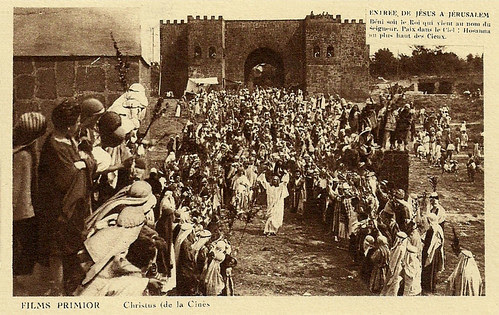
French postcard by Films Primior, Paris. Photo: Cines. Publicity still for Christus (Giulio Antamoro, 1916). Entry of Christ into Jerusalem. On Palm Sunday, the Sunday before Easter, Christians celebrate Christ's triumphant entry into Jerusalem.
French postcard by Les Films Primior, Paris. Photo: Cines. Publicity still for Christus (Giulio Antamoro, 1916). Translation of the caption: 'The Flight to Egypt: Get up, take your child and his mother, fly to Egypt and stay there until I warn you.'
French postcard by Les Films Primior, Paris. Photo: Cines. Publicity still for Christus (Giulio Antamoro, 1916). Caption: 'The Sky over Egypt. At the entrance of Memphis, in Old Cairo, the Well of Matarea saves the menaced life of Jesus.'
Shot on location
In 1915-1916, so right in the middle of the First World War, Italian director Count Giulio Cesare Antamoro went to Palestine and Egypt, on behalf of the film company Cines. He went there with a crew and an impressive cast to film Christ (1916).
Earlier, the Kalem production From the Manger to the Cross (Sidney Olcott, 1912) had faithfully reproduced the sketches by James Tissot, drawn on location in Egypt and Palestine.
Antamoro wanted to film the life of Christ on location. His Christus (1916) became a worldwide success, because of the quotations from famous artworks such as Fra Angelico's 'Annunciation', Leonardo da Vinci's 'Last Supper' and Michelangelo's 'Pietà', but also because of the location shots.
The press drew a direct relationship between the authenticity of Giulio Antamoro's film and that of the earlier sketches by James Tissot.
Even more than in the Kalem production, the Cines crew exploited the monuments and scenery in Egypt for the film, bending the Biblical tales to make it more spectacular.
French postcard by Les Films Primior, Paris. Photo: Cines. Publicity still for Christus (Giulio Antamoro, 1916). Caption: 'In Nazareth, surrounded by the Holy Virgin and Joseph, Jesus grows up in wisdom, in grace and in age, before God and before mankind.' On the right, Leda Gys plays the Holy Virgin.
French postcard by Les Films Primior, Paris. Photo: Cines. Alberto Pasquali as Jesus in Christus (Giulio Antamoro, 1916). Caption: 'The world is dying, oppressed, degraded and in despair, Jesus, says, but God is there who guards.'
The holy family
Arriving in Egypt after their Flight from Jerusalem, the Holy Family passes the pyramids of Gizeh and the famous Sphinx in Christ (1916).
We notice Mary in Memphis under Cairo, where she receives food and drinks after the Flight to Egypt. Afterwards, we see the Holy Family near a row of sphinxes at Karnak.
Later in the film, when Jesus has grown up, he reflects on the decay of the world. Director Giulio Antamoro then shows Jesus (Alberto Pasquali) walking through the majestic ruins of Luxor.
There is no Biblical reason for this scene, but Giulio Antamoro thus combines literal decay with spiritual decay. Besides, in 1915-1916 there were more ancient buildings in Egypt than in Palestine to exploit, and thus Antamoro used Egypt's monumentality.
For the average cinema visitor in Europe during the First World War, the vision of ancient ruins must have created associations with the modern ruins in Northern France and Belgium, daily visible in cinema newsreels.
French postcard by Films Primior, Paris. Photo: Cines. Publicity still for Christus (Giulio Antamoro, 1916). Entry of Christ into Jerusalem. On Palm Sunday, the Sunday before Easter, Christians celebrate Christ's triumphant entry into Jerusalem.
French postcard by Films Primior, Paris. Photo: Cines. Publicity still for Christus (Giulio Antamoro, 1916). Christ (Alberto Pasquali) agonising in the gardens of Gethsemane.
Additional shooting
The leading roles in Christus (1916) were acted by Alberto Pasquali (Christ), Leda Gys (Mary), Amleto Novelli (Pilate), and Augusto Mastripietri (Judas), while Renato Visca played the young Jesus.
When additional shooting was necessary in 1916, Enrico Guazzoni, the director of Quo Vadis? (1912), Marcantonio e Cleopatra (1913) and Cajus Julius Caesar (1914), was in charge, while Antamoro wasn't available anymore.
Janiss Garza at AllMovie reviewed the result as: "static, pretentious and dated (yes, even for 1917 (sic)). In addition, the titles - at least in the English version - were long and wordy, which was anathema to moviegoers of the 'teens."
However, Christus (1916) was an international success. A tagline read: "Greatest screen success Europe has known is acclaimed with new honours in America." Two other films with the same title were released in 1914 and 1919 but both are missing now.
Cines' Christus was eventually restored by producer Goffredo Lombardo, the founder of Titanus and the son of Leda Gys. The restored film was shown at the 2000 Venice Film Festival.
French postcard by Les Films Primior, Paris. Christ towards Mount Calvary and the Crucifixion. While Simon of Cyrene is carrying the cross, Jesus (Alberto Pasquali) meets his mother Mary (Leda Gys) and Mary Magdalene (Aurelia Cattaneo), on the way to Mount Calvary. Translation of the caption: 'The Calvary: Jesus meets his mother Mary and Mary Magdalene. Turning towards the other women, he speaks: Don't weep for me, daughters of Jerusalem, but for you and your children.'
French postcard by Films Primior, Paris. Christ's Crucifixion on Mount Calvary. Translation of the caption: 'Father, forgive them, for they know not what they do.'
French postcard by Films Primior, Paris. The Pietà with Jesus (Alberto Pasquali) and Mary (Leda Gys). Translation of the caption: 'The descent of the cross. See if there is any sorrow like mine.'
Sources: Janiss Garza (AllMovie - page now defunct), Mario Gauci (IMDb - page now defunct) and IMDb.