Austrian actor O.W. Fischer (1915–2004) was one of one of the most popular and highest-paid actors in the German-language cinema of the 1950s. 'Europe's Answer to Cary Grant' played the lead in dozens of light romantic comedies, Heimatfilms and historical pieces. But unlike countrymen Curd Jürgens, Maria Schell, Horst Buchholz and Romy Schneider, he never made it internationally.

German postcard by Film-Foto-Verlag, no. A 3763/1, 1941-1944. Photo: Wien Film / Hämmerer.

German postcard by Rüdel-Verlag, Hamburg-Bergedorf, no. 493. Photo: Rhombus / Herzog / Bayer. Publicity still for Cuba Cabana (Fritz Peter Buch, 1952).

German postcard by FBZ, no. 493. Photo: Europa / Fama / Meteor-Film. Publicity still for Das letzte Rezept/Desires (Rolf Hansen, 1952).

German postcard by Rüdel-Verlag, Hamburg-Bergedorf, no. 808. Photo: Intercontinental-Film / Deutsche London Film / Lilo. Publicity still for Eine Liebesgeschichte/A Love Story (Rudolf Jugert, 1954).

Austrian postcard by Kellner-Postkarten, Wien, no. 1464. Photo: CIFA / Prisma / FCC. Publicity still for II bacio del sole/Don Vesuvio/The Kiss of the Sun (Siro Marcellini, 1958).

German postcard by BILD-Zeitung. Photo: J. Arthur Rank Film Publicity still for Die Schwarze Lorelei/Whirlpool (Lewis Allen, 1959). Caption: Best Regards from the beautiful Lorelei.
Otto Wilhelm Fischer was born in the small town of Klosterneuburg near Vienna, Austria-Hungary (now Austria) in 1915. He was the son of an Austrian government legal adviser, Franz Karl Fischer, and his wife Maria Fischer-Schoerg.
After German and art studies at the University of Vienna he went in 1936 to the Max-Reinhardt-Seminar for acting classes. He began his stage career later that year at the Theater in der Josefstadt as Fritz in Arthur Schnitzler's Liebelei (Flirtation). He also appeared on the stages of the Münchner Kammerspiele and the Deutsche Volkstheater and became a popular star in both German and Austrian plays.
Soon he made the leap to the German cinema and played small roles. His first appearance in Burgtheater/Vienna Burgtheater (Willi Forst, 1936) led to 40 other films such as Anton, der Letzte/Anthony the Last (E.W. Emo, 1939), and Meine Tochter lebt in Wien/My Daughter Lives in Vienna (E.W. Emo, 1940) with Elfriede Datzig and Hans Moser.
In 1942 he married Czech actress Anna Usell, and the couple stayed together untill her death in 1985. From 1945 to 1952 he was an ensemble member at the famous Vienna Burgtheater, where he had success with dramatic parts in plays by Arthur Schnitzler and Henrik Ibsen.

German postcard by Universum-Film Aktiengesellschaft (Ufa), Berlin-Tempelhof, no. FK 2013. Photo: dpa / Göbel.

German postcard by Ufa, Berlin-Tempelhof, no. FK 3332. Retail price: 25 Pfg. Photo: Theo Huster / Allianz Film.

German postcard by Ufa, Berlin-Tempelhof, no. FK 3919. Photo: Filipp / Roxy-Film / NF.

German postcard by Ufa, Berlin-Tempelhof, no. FK 4206. Retail price: 25 Pfg. Photo: Bavaria Film. Publicity still for Und nichts als die Wahrheit/And Nothing But The Truth (Franz Peter Wirth, 1958).

German postcard by Ufa, Berlin-Tempelhof, no. FK 4275. Photo: Ufa / Kurt Ulrich / Roth. Publicity still for Peter Voss, der Milionendieb/Peter Voss, the Millions Thief (Wolfgang Becker, 1958).
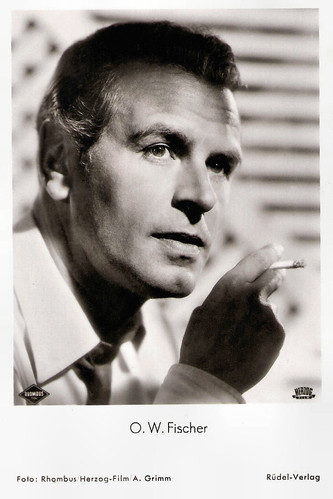
German postcard by F.J. Rüdel, Filmpostkartenverlag, Hamburg-Bergedorf, no. 369. Photo: Rhombus / Herzog Film / Arthur Grimm.
In 1950, after 21 films, O.W. Fischer got his first leading role, in Erzherzog Johanns grosse Liebe/Archduke Johann's Great Love (Hans Schott-Schöbinger, 1951). Many leading roles followed.
Known as 'Europe's answer to Cary Grant', he specialized in romantic roles starring alongside Maria Holst, Marte Harell, Liselotte Pulver, Winnie Markus, or Ruth Leuwerik. These films include Märchen vom Glück/Kiss Me Casanova (Arthur De Glahs, 1949), Heidelberger Romanze/Heidelberg Romance (Paul Verhoeven, 1951), Tausend rote Rosen blüh'n/Thousand Red Roses (Alfred Braun, 1952), and Ein Herz spielt falsch/A Heart's Foul Play (Rudolf Jugert, 1953).
With the simpering blonde Maria Schell he formed ‘Das Traumpaar’(The Dream Couple). They made made seven films together, such as Bis wir uns wiedersehn/Till We meet Again (Gustav Ucicky, 1952), Der Traumende Mund/Dreaming Lips (Josef von Báky, 1953), Solange Du da bist/As Long as You're Near Me (Harald Braun, 1953), and Tagebuch einer Verliebten/The Diary of a Married Woman (Josef von Báky, 1953).
He often worked with the Hungarian emigré director Josef von Baky, whose reputation had been established with The Adventures Of Baron Munchhausen, made for the Nazi propaganda chief Josef Goebbels in 1943.
Fischer also starred in the title role of a classic of the German cinema, Ludwig II (Helmut Käutner, 1955). Most of these productions were financially successful and he became one of the two highest paid actors in Germany. (Curd Jürgens was the other one).

German promotion card by Lux.
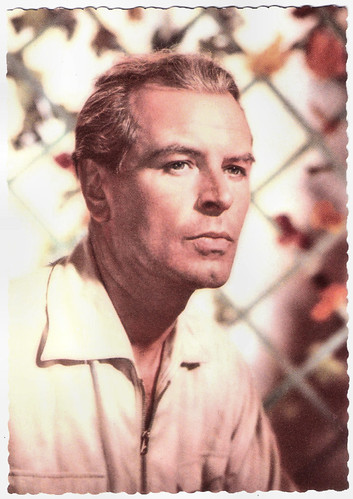
German postcard by Universum-Film Aktiengesellschaft (Ufa), Berlin-Tempelhof, no. CK-30. Photo: Arthur Grimm / Ufa.

German postcard by ISV, no. H 38.

With Maria Schell. German postcard by WS-Druck, Wanne-Eickel, no. F 44. Photo: Klaus Collignon.

East-German collector's card by Progress, no. 11/18/211, 1955.
O.W. Fischer occasionally assisted on directorial chores during the 1950s. In 1955, he directed and starred in Hanussen (O.W. Fischer, Georg Marischka, 1955), a film detailing the life of Erik Jan Hanussen a.k.a. the Devil's Prophet, a well-known psychic who collaborated with the Nazis. While the film is considered highly romanticized, Wikipedia states that it assisted historians and biographers in uncovering previously unknown facts.
In 1956 he directed and starred opposite Anouk Aimée in Ich suche Dich/I Am Looking For You (O.W. Fischer, 1956), based on a play by A.J. Cronin. In 1956 Universal Studios signed Fischer to star with June Allyson in a remake of My Man Godfrey (Henry Koster, 1957), but his Hollywood break ended before it began: when Fischer reportedly lost his memory during filming, he was replaced by David Niven. Other sources say that differences with director Henry Koster and Universal Studios eventually cost him his contract.
So Fischer returned to Europe, where he acted in films like Peter Voss, der Millionendieb/Peter Voss, Thief of Millions (Wolfgang Becker, 1958) and Menschen im Hotel/Grand Hotel (Gottfried Reinhardt, 1959) with Michèle Morgan.
In the 1960s O.W. Fischer and his wife Anna moved to Vernate, Switzerland. He kept appearing on television and in the theatre. His last film was Komm, süßer Tod/Love Birds (Mario Caiano, 1969) with Claudine Auger and Christine Kaufmann.
In the late 1970s, he retired from acting to concentrate on linguistics and philosophy, on which he lectured and published a number of books. O.W. Fischer died in 2004 in Lugano, Switzerland, of kidney failure. He was 88.

German collector's card. Photo: Roxy-Gloria-Wesel.

German postcard by WS-Druck, Wanne-Eickel, no. 350. Photo: Archiv Filmpress Zürich.

West-German card. Photo: Urmich. Maria Schell and O.W. Fischer.
Clip from Anton, der Letzte/Anthony the Last (E.W. Emo, 1939) with Elfriede Datzig. Source: BD130 (YouTube).
Scene with Maria Schell from Solange Du da bist/As Long as You're Near Me (Harald Braun, 1953). Source: Yamsala (YouTube).
O.W. Fischer as Ludwig II. von Bayern in Ludwig II (Helmut Käutner, 1955). Source: Hevenu (YouTube).
German trailer for Menschen im Hotel/Grand Hotel (Gottfried Reinhardt, 1959). Source: Ascotdrei3333 (YouTube).
Sources: Ronald Bergan (The Guardian), Stephanie D'heil (Steffi-line, German), Sandra Brennan (AllMovie), Wikipedia, and IMDb.
This post was last updated on 20 March 2024.
German postcard by Film-Foto-Verlag, no. A 3763/1, 1941-1944. Photo: Wien Film / Hämmerer.
German postcard by Rüdel-Verlag, Hamburg-Bergedorf, no. 493. Photo: Rhombus / Herzog / Bayer. Publicity still for Cuba Cabana (Fritz Peter Buch, 1952).
German postcard by FBZ, no. 493. Photo: Europa / Fama / Meteor-Film. Publicity still for Das letzte Rezept/Desires (Rolf Hansen, 1952).
German postcard by Rüdel-Verlag, Hamburg-Bergedorf, no. 808. Photo: Intercontinental-Film / Deutsche London Film / Lilo. Publicity still for Eine Liebesgeschichte/A Love Story (Rudolf Jugert, 1954).
Austrian postcard by Kellner-Postkarten, Wien, no. 1464. Photo: CIFA / Prisma / FCC. Publicity still for II bacio del sole/Don Vesuvio/The Kiss of the Sun (Siro Marcellini, 1958).
German postcard by BILD-Zeitung. Photo: J. Arthur Rank Film Publicity still for Die Schwarze Lorelei/Whirlpool (Lewis Allen, 1959). Caption: Best Regards from the beautiful Lorelei.
Burgtheater
Otto Wilhelm Fischer was born in the small town of Klosterneuburg near Vienna, Austria-Hungary (now Austria) in 1915. He was the son of an Austrian government legal adviser, Franz Karl Fischer, and his wife Maria Fischer-Schoerg.
After German and art studies at the University of Vienna he went in 1936 to the Max-Reinhardt-Seminar for acting classes. He began his stage career later that year at the Theater in der Josefstadt as Fritz in Arthur Schnitzler's Liebelei (Flirtation). He also appeared on the stages of the Münchner Kammerspiele and the Deutsche Volkstheater and became a popular star in both German and Austrian plays.
Soon he made the leap to the German cinema and played small roles. His first appearance in Burgtheater/Vienna Burgtheater (Willi Forst, 1936) led to 40 other films such as Anton, der Letzte/Anthony the Last (E.W. Emo, 1939), and Meine Tochter lebt in Wien/My Daughter Lives in Vienna (E.W. Emo, 1940) with Elfriede Datzig and Hans Moser.
In 1942 he married Czech actress Anna Usell, and the couple stayed together untill her death in 1985. From 1945 to 1952 he was an ensemble member at the famous Vienna Burgtheater, where he had success with dramatic parts in plays by Arthur Schnitzler and Henrik Ibsen.
German postcard by Universum-Film Aktiengesellschaft (Ufa), Berlin-Tempelhof, no. FK 2013. Photo: dpa / Göbel.
German postcard by Ufa, Berlin-Tempelhof, no. FK 3332. Retail price: 25 Pfg. Photo: Theo Huster / Allianz Film.
German postcard by Ufa, Berlin-Tempelhof, no. FK 3919. Photo: Filipp / Roxy-Film / NF.
German postcard by Ufa, Berlin-Tempelhof, no. FK 4206. Retail price: 25 Pfg. Photo: Bavaria Film. Publicity still for Und nichts als die Wahrheit/And Nothing But The Truth (Franz Peter Wirth, 1958).
German postcard by Ufa, Berlin-Tempelhof, no. FK 4275. Photo: Ufa / Kurt Ulrich / Roth. Publicity still for Peter Voss, der Milionendieb/Peter Voss, the Millions Thief (Wolfgang Becker, 1958).
German postcard by F.J. Rüdel, Filmpostkartenverlag, Hamburg-Bergedorf, no. 369. Photo: Rhombus / Herzog Film / Arthur Grimm.
The Dream Couple
In 1950, after 21 films, O.W. Fischer got his first leading role, in Erzherzog Johanns grosse Liebe/Archduke Johann's Great Love (Hans Schott-Schöbinger, 1951). Many leading roles followed.
Known as 'Europe's answer to Cary Grant', he specialized in romantic roles starring alongside Maria Holst, Marte Harell, Liselotte Pulver, Winnie Markus, or Ruth Leuwerik. These films include Märchen vom Glück/Kiss Me Casanova (Arthur De Glahs, 1949), Heidelberger Romanze/Heidelberg Romance (Paul Verhoeven, 1951), Tausend rote Rosen blüh'n/Thousand Red Roses (Alfred Braun, 1952), and Ein Herz spielt falsch/A Heart's Foul Play (Rudolf Jugert, 1953).
With the simpering blonde Maria Schell he formed ‘Das Traumpaar’(The Dream Couple). They made made seven films together, such as Bis wir uns wiedersehn/Till We meet Again (Gustav Ucicky, 1952), Der Traumende Mund/Dreaming Lips (Josef von Báky, 1953), Solange Du da bist/As Long as You're Near Me (Harald Braun, 1953), and Tagebuch einer Verliebten/The Diary of a Married Woman (Josef von Báky, 1953).
He often worked with the Hungarian emigré director Josef von Baky, whose reputation had been established with The Adventures Of Baron Munchhausen, made for the Nazi propaganda chief Josef Goebbels in 1943.
Fischer also starred in the title role of a classic of the German cinema, Ludwig II (Helmut Käutner, 1955). Most of these productions were financially successful and he became one of the two highest paid actors in Germany. (Curd Jürgens was the other one).
German promotion card by Lux.
German postcard by Universum-Film Aktiengesellschaft (Ufa), Berlin-Tempelhof, no. CK-30. Photo: Arthur Grimm / Ufa.
German postcard by ISV, no. H 38.
With Maria Schell. German postcard by WS-Druck, Wanne-Eickel, no. F 44. Photo: Klaus Collignon.
East-German collector's card by Progress, no. 11/18/211, 1955.
The Devil's Prophet
O.W. Fischer occasionally assisted on directorial chores during the 1950s. In 1955, he directed and starred in Hanussen (O.W. Fischer, Georg Marischka, 1955), a film detailing the life of Erik Jan Hanussen a.k.a. the Devil's Prophet, a well-known psychic who collaborated with the Nazis. While the film is considered highly romanticized, Wikipedia states that it assisted historians and biographers in uncovering previously unknown facts.
In 1956 he directed and starred opposite Anouk Aimée in Ich suche Dich/I Am Looking For You (O.W. Fischer, 1956), based on a play by A.J. Cronin. In 1956 Universal Studios signed Fischer to star with June Allyson in a remake of My Man Godfrey (Henry Koster, 1957), but his Hollywood break ended before it began: when Fischer reportedly lost his memory during filming, he was replaced by David Niven. Other sources say that differences with director Henry Koster and Universal Studios eventually cost him his contract.
So Fischer returned to Europe, where he acted in films like Peter Voss, der Millionendieb/Peter Voss, Thief of Millions (Wolfgang Becker, 1958) and Menschen im Hotel/Grand Hotel (Gottfried Reinhardt, 1959) with Michèle Morgan.
In the 1960s O.W. Fischer and his wife Anna moved to Vernate, Switzerland. He kept appearing on television and in the theatre. His last film was Komm, süßer Tod/Love Birds (Mario Caiano, 1969) with Claudine Auger and Christine Kaufmann.
In the late 1970s, he retired from acting to concentrate on linguistics and philosophy, on which he lectured and published a number of books. O.W. Fischer died in 2004 in Lugano, Switzerland, of kidney failure. He was 88.
German collector's card. Photo: Roxy-Gloria-Wesel.
German postcard by WS-Druck, Wanne-Eickel, no. 350. Photo: Archiv Filmpress Zürich.
West-German card. Photo: Urmich. Maria Schell and O.W. Fischer.
Clip from Anton, der Letzte/Anthony the Last (E.W. Emo, 1939) with Elfriede Datzig. Source: BD130 (YouTube).
Scene with Maria Schell from Solange Du da bist/As Long as You're Near Me (Harald Braun, 1953). Source: Yamsala (YouTube).
O.W. Fischer as Ludwig II. von Bayern in Ludwig II (Helmut Käutner, 1955). Source: Hevenu (YouTube).
German trailer for Menschen im Hotel/Grand Hotel (Gottfried Reinhardt, 1959). Source: Ascotdrei3333 (YouTube).
Sources: Ronald Bergan (The Guardian), Stephanie D'heil (Steffi-line, German), Sandra Brennan (AllMovie), Wikipedia, and IMDb.
This post was last updated on 20 March 2024.