American soprano opera singer and film actress Geraldine Farrar (1882-1967) was noted for her glamorous beauty, acting ability, and the timbre of her voice. Barely 20, she was already the toast of Berlin. Later at the Met in New York, she had a large following among young women, nicknamed ‘Gerry-flappers’. Farrar also starred in over a dozen silent films from 1915 to 1920. She was married to and co-starred with Dutch matinee idol Lou Tellegen.

German postcard by G.G. & Co., no. 2419.

German postcard by Photochemie, Berlin, no. 251. Photo: Zander und Labisch. Geraldine Farrar as Angela in 'Le Domino Noir' (1905).

French postcard.

German postcard by PH, no. 4116/1. Geraldine Farrar as Marguerite in Charles Gounod's opera Faust.

Swedish postcard by Förlag Nordisk Konst, Stockholm, no. 936. Photo: Skandinavisk Film-Central, Stockholm.
Alice Geraldine Farrar was born in Melrose, Massachusetts, in 1882. She was the daughter of baseball player Sidney Farrar, and his wife, Henrietta Barnes. At 5 she began studying music in Boston and by 14 was giving recitals. Later she studied voice with the American soprano Emma Thursby in New York City, in Paris, and finally with the Italian baritone Francesco Graziani in Berlin.
In 1901, Farrar created a sensation at the Berlin Hofoper with her debut as Marguerite in Charles Gounod's 'Faust'. She remained with the company for three years, while she continued her studies with legendary Wagnerian soprano Lilli Lehmann. Farrar appeared in the title roles of Ambroise Thomas' 'Mignon' and Jules Massenet's 'Manon', as well as Juliette in Charles Gounod's 'Roméo et Juliette'.
Her admirers in Berlin included Crown Prince Wilhelm of Germany, with whom she is believed to have had a relationship beginning in 1903. This Berlin period was interspersed with three seasons with the Monte Carlo Opera. Highlights were Pietro Mascagni's 'Amica' (1905), and Giuseppe Verdi's 'Rigoletto' (1906) in which she appeared with Enrico Caruso. That year, she debuted at the New York Metropolitan Opera in 'Romeo et Juliette' (1906). The success placed her on a plateau with Caruso as a box-office magnet. The next year, she got raves for her performance as Cio-Cio-San in the Metropolitan premiere of Giacomo Puccini's 'Madama Butterfly' in 1907.
Farrar remained a company member until her retirement in 1922, singing 29 roles there in 672 performances. She developed a large following, especially among New York's young female opera-goers, known as Gerry-flappers. Farrar created the title roles in Puccini's 'Suor Angelica' (1918), Umberto Giordano's 'Madame Sans-Gêne' (1915), as well as the Goosegirl in Engelbert Humperdinck's 'Königskinder' (1910), for which Farrar trained her own flock of geese. According to a New York Tribune review of the first performance, "at the close of the opera, Miss Farrar caused 'much amusement' by appearing before the curtain with a live goose under her arm."
Her biographer Elizabeth Nash adds: “Unlike most of the famous bel canto singers of the past who sacrificed dramatic action to tonal perfection, she was more interested in the emotional than in the purely lyrical aspects of her roles.”

German postcard by K.V.i.B., Dess, no. 1016.

German postcard by K.V.i.B. 12. Dess., no. 4017.

Vintage postcard, no. 58. Photo: Geraldine Farrar as Elsa in Lohengrin. Collection: Didier Hanson.

German postcard by G.G. & Co., no. 2414. Photo: publicity still for Mignon. Collection: Didier Hanson.

French postcard. Editor unknown. Postcard sent in 1907. Geraldine Farrar in the opera Mignon.

French postcard.
Geraldine Farrar recorded extensively for the Victor Talking Machine Company and was often featured prominently in that firm's advertisements. She was one of the first performers to make a radio broadcast, in a 1907 publicity event singing over Lee De Forest's experimental AM radio transmitter in New York City.
She also starred in more than a dozen silent films from 1915 to 1920, filmed between opera seasons. Farrar debuted with the title role in Cecil B. De Mille's Carmen (1915), based on the novella Carmen by Prosper Mérimée. For her role as the seductive gipsy girl, she was extensively praised. For her performance, she came in fourth in the 1916 Screen Masterpiece contest held by Motion Picture Magazine, ahead of any other actress. DeMille directed her next in the silent romantic drama Temptation (Cecil B. DeMille, 1915), also with Theodore Roberts, and in the drama Maria Rosa (Cecil B. DeMille, 1916) with Wallace Reid.
Another notable screen role was as Joan of Arc in Joan the Woman (1917). This was Cecil DeMille's first historical drama. The screenplay is based on Friedrich Schiller's 1801 play 'Die Jungfrau von Orleans' (The Maid of Orleans). She next played the daughter of an Aztec king in the silent romance The Woman God Forgot (Cecil B. DeMille, 1917). In the film, she falls in love with a Spanish captain (Wallace Reid) whose army has come to convert the Aztecs to Christianity. Her last film for Paramount Pictures was the romance The Devil-Stone (Cecil B. DeMille, 1917), again with Wallace Reid. The film had sequences filmed in the Handschiegl Color Process, but only two of six reels are known to survive.
For Goldwyn Pictures, she appeared in such films as The Turn of the Wheel (Reginald Barker, 1918) with Herbert Rawlinson and Percy Marmont, the Western The Hell Cat (Reginald Barker, 1918), Shadows (Reginald Barker, 1918) and the melodrama The Stronger Vow (Reginald Barker, 1919), the latter three with Milton Sills. All four films are considered lost.
She co-starred with her husband Lou Tellegen in the dramas The World and Its Woman (Frank Lloyd, 1919), Flame of the Desert (Reginald Barker, 1919), and The Woman and the Puppet (Reginald Barker, 1920). Her final film was the silent drama The Riddle: Woman (Edward José, 1920), in which her co-star was Montagu Love.

Spanish card by La Novela Semanal Cinematográfica, no. 109.

French postcard by Etoile, Paris, no. 195. Photo: Reutlinger.

German postcard by GG Cie, no. 5050. Geraldine Farrar as Madam Butterfly.

German postcard by Verlag Herm. Leiser, Berlin, no. 6530. Photo: H. Manuel. Geraldine Farrar in the opera 'Tosca'.

French postcard. Publicity for Vins Désiles. Photo SIP, Boyer. G. Farrar de l'Opéra Impéraile de Berlin. Caption: J'ai plaisir à recommander l'excellent Vin Désiles (I enjoy recommending the excellent Vin Désiles).
Geraldine Farrar had a seven-year love affair with the Italian conductor Arturo Toscanini. It was rumoured that she gave him an ultimatum to choose either her or his wife and children in Italy. It resulted in Toscanini's abrupt resignation as principal conductor of the Metropolitan Opera in 1915. Farrar was close friends with the star tenor Enrico Caruso and there has been speculation that they too had a love affair, but no conclusive evidence has surfaced.
In 1916, she married Dutch film actor Lou Tellegen. Their marriage was the source of considerable scandal, and it ended, as a result of her husband's numerous affairs, in a messy and very public divorce in 1923. The circumstances of the divorce were brought again to public recollection by Tellegen's bizarre 1934 suicide in Hollywood. When told of her ex-husband's death, she replied "Why should that interest me?"
Farrar retired from opera in 1922 at the age of 40. Her final performance was as Ruggero Leoncavallo's Zazà. By this stage, her voice was in premature decline due to overwork. Farrar quickly transitioned into concert recitals and was signed within several weeks of announcing her opera retirement to an appearance at Hershey Park on Memorial Day 1922.
She continued to make recordings and give recitals throughout the 1920s and was briefly the intermission commentator for the Metropolitan Opera radio broadcasts during the 1934–1935 season. Her rather bizarre autobiography, Such Sweet Compulsion (1938), was written in alternating chapters purporting to be her own words and those of her mother, with Mrs. Farrar rather floridly recounting her daughter's many accomplishments.
In 1967, Geraldine Farrar died in Ridgefield, Connecticut of heart disease aged 85, and was buried in Kensico Cemetery in Valhalla, New York. She had no children. Dutch author Susan Smit published an excellent biographical novel about Farrar and her great love Lou Tellegen, 'De eerste vrouw' (The First Woman).

Swedish postcard by AE (Axel Eliassons Konstförlag, Stockholm), no. 2513-3.

Swedish postcard by AE (Axel Eliassons Konstförlag, Stockholm), no. 2513-5. The swan may refer to the opera 'Lohengrin' by Richard Wagner.

German postcard G.G. & Co., no. 478/4. Photo: Gerlach.

German postcard G.G. & Co., no. 579/5. Photo: Gerlach.

Swedish postcard by Förlag Nordisk Konst, Stockholm, no. 938. Photo: Skandinavisk Film-Central, Stockholm.
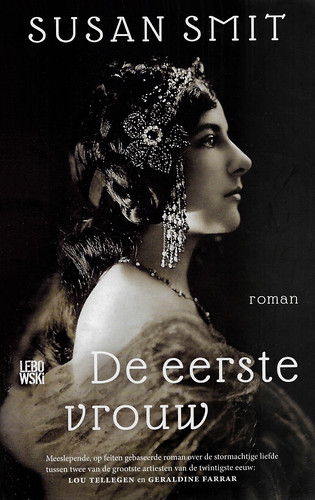
Book cover for Susan Smit, 'De eerste vrouw' (2016). Publisher: Lebowski.
Sources: Andrea Suhm-Binder (Cantabile subito), Bob Hufford (Find A Grave), Wikipedia and IMDb.
This post was last updated on 2 March 2024.
German postcard by G.G. & Co., no. 2419.
German postcard by Photochemie, Berlin, no. 251. Photo: Zander und Labisch. Geraldine Farrar as Angela in 'Le Domino Noir' (1905).
French postcard.
German postcard by PH, no. 4116/1. Geraldine Farrar as Marguerite in Charles Gounod's opera Faust.
Swedish postcard by Förlag Nordisk Konst, Stockholm, no. 936. Photo: Skandinavisk Film-Central, Stockholm.
Gerry-flappers
Alice Geraldine Farrar was born in Melrose, Massachusetts, in 1882. She was the daughter of baseball player Sidney Farrar, and his wife, Henrietta Barnes. At 5 she began studying music in Boston and by 14 was giving recitals. Later she studied voice with the American soprano Emma Thursby in New York City, in Paris, and finally with the Italian baritone Francesco Graziani in Berlin.
In 1901, Farrar created a sensation at the Berlin Hofoper with her debut as Marguerite in Charles Gounod's 'Faust'. She remained with the company for three years, while she continued her studies with legendary Wagnerian soprano Lilli Lehmann. Farrar appeared in the title roles of Ambroise Thomas' 'Mignon' and Jules Massenet's 'Manon', as well as Juliette in Charles Gounod's 'Roméo et Juliette'.
Her admirers in Berlin included Crown Prince Wilhelm of Germany, with whom she is believed to have had a relationship beginning in 1903. This Berlin period was interspersed with three seasons with the Monte Carlo Opera. Highlights were Pietro Mascagni's 'Amica' (1905), and Giuseppe Verdi's 'Rigoletto' (1906) in which she appeared with Enrico Caruso. That year, she debuted at the New York Metropolitan Opera in 'Romeo et Juliette' (1906). The success placed her on a plateau with Caruso as a box-office magnet. The next year, she got raves for her performance as Cio-Cio-San in the Metropolitan premiere of Giacomo Puccini's 'Madama Butterfly' in 1907.
Farrar remained a company member until her retirement in 1922, singing 29 roles there in 672 performances. She developed a large following, especially among New York's young female opera-goers, known as Gerry-flappers. Farrar created the title roles in Puccini's 'Suor Angelica' (1918), Umberto Giordano's 'Madame Sans-Gêne' (1915), as well as the Goosegirl in Engelbert Humperdinck's 'Königskinder' (1910), for which Farrar trained her own flock of geese. According to a New York Tribune review of the first performance, "at the close of the opera, Miss Farrar caused 'much amusement' by appearing before the curtain with a live goose under her arm."
Her biographer Elizabeth Nash adds: “Unlike most of the famous bel canto singers of the past who sacrificed dramatic action to tonal perfection, she was more interested in the emotional than in the purely lyrical aspects of her roles.”
German postcard by K.V.i.B., Dess, no. 1016.
German postcard by K.V.i.B. 12. Dess., no. 4017.
Vintage postcard, no. 58. Photo: Geraldine Farrar as Elsa in Lohengrin. Collection: Didier Hanson.
German postcard by G.G. & Co., no. 2414. Photo: publicity still for Mignon. Collection: Didier Hanson.
French postcard. Editor unknown. Postcard sent in 1907. Geraldine Farrar in the opera Mignon.
French postcard.
Cecil B. De Mille
Geraldine Farrar recorded extensively for the Victor Talking Machine Company and was often featured prominently in that firm's advertisements. She was one of the first performers to make a radio broadcast, in a 1907 publicity event singing over Lee De Forest's experimental AM radio transmitter in New York City.
She also starred in more than a dozen silent films from 1915 to 1920, filmed between opera seasons. Farrar debuted with the title role in Cecil B. De Mille's Carmen (1915), based on the novella Carmen by Prosper Mérimée. For her role as the seductive gipsy girl, she was extensively praised. For her performance, she came in fourth in the 1916 Screen Masterpiece contest held by Motion Picture Magazine, ahead of any other actress. DeMille directed her next in the silent romantic drama Temptation (Cecil B. DeMille, 1915), also with Theodore Roberts, and in the drama Maria Rosa (Cecil B. DeMille, 1916) with Wallace Reid.
Another notable screen role was as Joan of Arc in Joan the Woman (1917). This was Cecil DeMille's first historical drama. The screenplay is based on Friedrich Schiller's 1801 play 'Die Jungfrau von Orleans' (The Maid of Orleans). She next played the daughter of an Aztec king in the silent romance The Woman God Forgot (Cecil B. DeMille, 1917). In the film, she falls in love with a Spanish captain (Wallace Reid) whose army has come to convert the Aztecs to Christianity. Her last film for Paramount Pictures was the romance The Devil-Stone (Cecil B. DeMille, 1917), again with Wallace Reid. The film had sequences filmed in the Handschiegl Color Process, but only two of six reels are known to survive.
For Goldwyn Pictures, she appeared in such films as The Turn of the Wheel (Reginald Barker, 1918) with Herbert Rawlinson and Percy Marmont, the Western The Hell Cat (Reginald Barker, 1918), Shadows (Reginald Barker, 1918) and the melodrama The Stronger Vow (Reginald Barker, 1919), the latter three with Milton Sills. All four films are considered lost.
She co-starred with her husband Lou Tellegen in the dramas The World and Its Woman (Frank Lloyd, 1919), Flame of the Desert (Reginald Barker, 1919), and The Woman and the Puppet (Reginald Barker, 1920). Her final film was the silent drama The Riddle: Woman (Edward José, 1920), in which her co-star was Montagu Love.
Spanish card by La Novela Semanal Cinematográfica, no. 109.
French postcard by Etoile, Paris, no. 195. Photo: Reutlinger.
German postcard by GG Cie, no. 5050. Geraldine Farrar as Madam Butterfly.
German postcard by Verlag Herm. Leiser, Berlin, no. 6530. Photo: H. Manuel. Geraldine Farrar in the opera 'Tosca'.
French postcard. Publicity for Vins Désiles. Photo SIP, Boyer. G. Farrar de l'Opéra Impéraile de Berlin. Caption: J'ai plaisir à recommander l'excellent Vin Désiles (I enjoy recommending the excellent Vin Désiles).
A messy and very public divorce
Geraldine Farrar had a seven-year love affair with the Italian conductor Arturo Toscanini. It was rumoured that she gave him an ultimatum to choose either her or his wife and children in Italy. It resulted in Toscanini's abrupt resignation as principal conductor of the Metropolitan Opera in 1915. Farrar was close friends with the star tenor Enrico Caruso and there has been speculation that they too had a love affair, but no conclusive evidence has surfaced.
In 1916, she married Dutch film actor Lou Tellegen. Their marriage was the source of considerable scandal, and it ended, as a result of her husband's numerous affairs, in a messy and very public divorce in 1923. The circumstances of the divorce were brought again to public recollection by Tellegen's bizarre 1934 suicide in Hollywood. When told of her ex-husband's death, she replied "Why should that interest me?"
Farrar retired from opera in 1922 at the age of 40. Her final performance was as Ruggero Leoncavallo's Zazà. By this stage, her voice was in premature decline due to overwork. Farrar quickly transitioned into concert recitals and was signed within several weeks of announcing her opera retirement to an appearance at Hershey Park on Memorial Day 1922.
She continued to make recordings and give recitals throughout the 1920s and was briefly the intermission commentator for the Metropolitan Opera radio broadcasts during the 1934–1935 season. Her rather bizarre autobiography, Such Sweet Compulsion (1938), was written in alternating chapters purporting to be her own words and those of her mother, with Mrs. Farrar rather floridly recounting her daughter's many accomplishments.
In 1967, Geraldine Farrar died in Ridgefield, Connecticut of heart disease aged 85, and was buried in Kensico Cemetery in Valhalla, New York. She had no children. Dutch author Susan Smit published an excellent biographical novel about Farrar and her great love Lou Tellegen, 'De eerste vrouw' (The First Woman).
Swedish postcard by AE (Axel Eliassons Konstförlag, Stockholm), no. 2513-3.
Swedish postcard by AE (Axel Eliassons Konstförlag, Stockholm), no. 2513-5. The swan may refer to the opera 'Lohengrin' by Richard Wagner.
German postcard G.G. & Co., no. 478/4. Photo: Gerlach.
German postcard G.G. & Co., no. 579/5. Photo: Gerlach.
Swedish postcard by Förlag Nordisk Konst, Stockholm, no. 938. Photo: Skandinavisk Film-Central, Stockholm.
Book cover for Susan Smit, 'De eerste vrouw' (2016). Publisher: Lebowski.
Sources: Andrea Suhm-Binder (Cantabile subito), Bob Hufford (Find A Grave), Wikipedia and IMDb.
This post was last updated on 2 March 2024.