German actor Bruno Kastner (1890-1932) was one of the most beloved stars of the 1910s and 1920s. His parts as the elegant and charming dandy made him a heartthrob of the German silent cinema.

German postcard by Ross Verlag, no. 434/2, 1919-1924. Photo: Heinz Rosenberger, Berlin.

German postcard by Rotophot in the Film Sterne series, no. 181/4. Photo: Becker & Maass, Berlin.

German postcard by Rotophot, no. 220/1. Photo: Becker & Maass, Berlin. With Ida Wüst.

German postcard by Ross Verlag, Berlin.

German postcard by Ross Verlag, Berlin, no. 436/2, 1919-1924. Photo: A. Eberth, Berlin.
Bruno Richard Otto Kastner was born in Forst, Lausitz, Germany, in 1890. He was the son of a collector. After grammar school, Kastner went to the army, but he was expelled after only 17 days. He then took acting classes from the actor Paul Biensfeldt in Berlin and was engaged by the Stadttheater Harburg. From 1911 to 1921 he worked as a choir singer and actor at the Meinhard-und Bernauer-Bühnen in Berlin.
After the start of the First World War, the unfit-for-service Kastner had his breakthrough in the cinema, while most of the other actors were serving at the front. In 1914 he was discovered by the Danish director Urban Gad, who gave him a part in the film Engelein/Little Angel (Urban Gad, 1914), and the sequel Engeleins Hochzeit/The Marriage of Little Angel (Urban Gad, 1916) next to Asta Nielsen.
He also appeared opposite the other German diva, Henny Porten in Das Schicksal der Gabriele Stark/The Destiny of Gabriele Stark (Rudolf Biebrach, 1915). Kastner, young, handsome and equipped with a winning smile, became a heartthrob, who received laundry baskets full of love letters from his female admirers.
He was the partner and female lust object in the series of stars like Dorrit Weixler (Dorrits Eheglück/Dorrit’s marital Bliss (Paul Otto, 1916)), Lotte Neumann (Die Bettlerin von St. Marien/The Beggar-woman of St. Marien (Alfred Halm, 1916) and Mia May (Hilde Warren und der Tod/Hilde Warren and Death (Joe May, 1917) written by Fritz Lang).
The male public gave Bruno less flattering names as 'Kleiderbügel' (clothes hanger) and had lively discussions in journals and film magazines about Kastner.

German postcard by Rotophot in the Film Sterne series, no. 516/2. Photo: May-Film. Mia May and Bruno Kastner in Ein Lichtstrahl im Dunkel/A Ray of Light in the Dark (Joe May, 1917).

German postcard by Rotophot in the Film Sterne series, no. 516/8. Photo: May-Film / Becker & Maass. Mia May and Bruno Kastner in Der Schwarze Chauffeur/The Black Chauffeur (Joe May, 1917).

German postcard by Verlag Ross, no. 590. Photo: Ring-Film. Bruno Kastner and Hanni Weisse in the German silent film Zwischen zwei Welten/Between two worlds (Adolf Gärtner, 1919). The first card of a series of four. The portrait in the back is a classic one of Karl Marx.

German postcard by Ross Verlag, no. 607/1. Photo: Ring-Film. Bruno Kastner and Ria Jende in the German silent film Die goldene Lüge (Erik Lund, 1919).

German postcard by Ross Verlag, no. 618/3. Photo: Ring-Film. Bruno Kastner and Hanne Brinkmann in the German silent film Artistentreue/Faithful to the Species (Erik Lund, 1919).

German postcard by Ross Verlag, no. 622/4. Photo: Ring-Film. Bruno Kastner in the German silent film Das Herz des Casanova/The Heart of Casanova (Erik Lund, 1919).

German postcard by Ross Verlag, no. 65/1. Photo: Aafa-Film. Mady Christians and Bruno Kastner in Die geschiedene Frau/The Divorcée (Victor Janson, 1926).
Bruno Kastner also appeared with Alwin Neuß in detective films like the Joe Deebs series (Die Hochzeit im Excentricclub/Wedding in the Eccentric Club (Joe May, 1917) again written by Fritz Lang).
All his films were money-spinners. In 1918 he married actress Ida Wüst, with whom he played in films and also wrote screenplays.
From 1918 on he worked for the Ring-Film GmbH often under the direction of Erik Lund (pseudonym for producer and director Manfred Liebenau) in such films as Nur ein Diener/Just an Attendant (Erik Lund, 1919) written by Kastner and Wüst.
In 1921 he was chosen as the best (in fact most popular) actor in Germany - he was even ahead of Harry Liedtke and Max Landa.
The following year he started his own film company, which produced films like Masken Fallen/When the Mask Falls (Erik Lund, 1922) and Die Lüge eines Sommers/The Lie of a Summer (Erik Lund, 1922).

German postcard by Rotophot in the Film Sterne series, no. 138/3, 1916-1919. Photo: Becker & Maass, Berlin.

German postcard by Rotophot in the Film Sterne series, no. 181/2. Photo: Becker & Maass, Berlin.

German postcard by Rotophot in the Film Sterne Series, no. 190/4. Photo: Becker & Maass, Berlin.

German postcard by Rotophot in the Film Sterne series, no. 191/1, 1916-1919. Photo: Becker & Maass, Berlin.

German postcard by Rotophot in the Film Sterne series, no. 191/2, 1916-1919. Photo: Becker & Maass, Berlin.
In 1924 Bruno Kastner had a serious accident with his motorcycle in Lugano and he had to take a break for one year. The accident left him depressed. The accident caused him to be not a man any longer, literally.
He was able to continue his film career, and appeared in Der Mann, der sich verkaufte/The man Who Sold Himself (Hans Steinhoff, 1925) with Vivian Gibson, Die vom anderen Ufer/Those of the Other Side of the River (Arthur Bergen, 1926), Die Brüder Schellenberg/The Schellenberg Brothers (Karl Grune, 1926) with Conrad Veidt, and Wehe, wenn sie losgelassen/Woe, when they let go (Carl Froelich, 1926) with Henny Porten.
In the mid-1920s his star started to fall. His last important roles were Du Stollst Nicht Stehlen/The Love Commandment (Victor Janson, 1928) with Lilian Harvey, the biography Luther (Hans Kyser, 1928) and Angst/Fear (Hans Steinhoff, 1928) with Gustav Fröhlich.
Kastner had a stammering problem and the sound film made it hard for him to keep his fans. He made two sound films, Das Land des Lächelns/The Land of Smiles (Max Reichmann, 1930) with Richard Tauber, and Tingel-Tangel (Jaap Speyer, 1930) with Ernst Verebes, but these roles were no successes. He had become too old for the part of the young and charming dandy and Bon vivant.
In 1932 Bruno Kastner committed suicide by hanging himself in his hotel room in Bad Kreuznach, Germany, only 42 years old. He was married to Ida Wüst from 1918 to 1927.
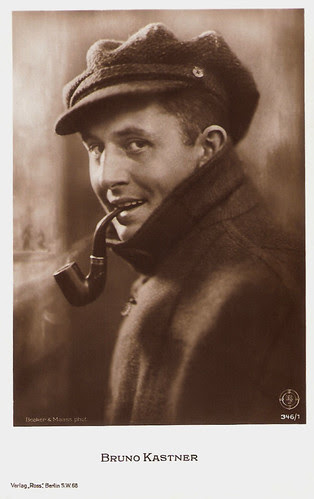
German postcard by Ross Verlag, no. 346/1, 1919-1924. Photo: Becker & Maass / RF.

German postcard by Ross Verlag, no. 921/3, 1925-1926. Photo: Becker & Maass.

German postcard by Ross Verlag, no. 1356/2, 1927-1928. Photo: Atelier Hanni Schwarz.

German postcard by Ross Verlag, no. 3163/1, 1928-1929. Photo: Hanni Schwarz, Berlin.

German postcard by Ross Verlag, no. 3124/1, 1928-1929. Photo: Aafa Film.
Sources: Thomas Staedeli (Cyranos), Filmportal (German), Wikipedia (German), and IMDb.
This post was last updated on 6 December 2024.
German postcard by Ross Verlag, no. 434/2, 1919-1924. Photo: Heinz Rosenberger, Berlin.
German postcard by Rotophot in the Film Sterne series, no. 181/4. Photo: Becker & Maass, Berlin.
German postcard by Rotophot, no. 220/1. Photo: Becker & Maass, Berlin. With Ida Wüst.
German postcard by Ross Verlag, Berlin.
German postcard by Ross Verlag, Berlin, no. 436/2, 1919-1924. Photo: A. Eberth, Berlin.
Equipped with a winning smile
Bruno Richard Otto Kastner was born in Forst, Lausitz, Germany, in 1890. He was the son of a collector. After grammar school, Kastner went to the army, but he was expelled after only 17 days. He then took acting classes from the actor Paul Biensfeldt in Berlin and was engaged by the Stadttheater Harburg. From 1911 to 1921 he worked as a choir singer and actor at the Meinhard-und Bernauer-Bühnen in Berlin.
After the start of the First World War, the unfit-for-service Kastner had his breakthrough in the cinema, while most of the other actors were serving at the front. In 1914 he was discovered by the Danish director Urban Gad, who gave him a part in the film Engelein/Little Angel (Urban Gad, 1914), and the sequel Engeleins Hochzeit/The Marriage of Little Angel (Urban Gad, 1916) next to Asta Nielsen.
He also appeared opposite the other German diva, Henny Porten in Das Schicksal der Gabriele Stark/The Destiny of Gabriele Stark (Rudolf Biebrach, 1915). Kastner, young, handsome and equipped with a winning smile, became a heartthrob, who received laundry baskets full of love letters from his female admirers.
He was the partner and female lust object in the series of stars like Dorrit Weixler (Dorrits Eheglück/Dorrit’s marital Bliss (Paul Otto, 1916)), Lotte Neumann (Die Bettlerin von St. Marien/The Beggar-woman of St. Marien (Alfred Halm, 1916) and Mia May (Hilde Warren und der Tod/Hilde Warren and Death (Joe May, 1917) written by Fritz Lang).
The male public gave Bruno less flattering names as 'Kleiderbügel' (clothes hanger) and had lively discussions in journals and film magazines about Kastner.
German postcard by Rotophot in the Film Sterne series, no. 516/2. Photo: May-Film. Mia May and Bruno Kastner in Ein Lichtstrahl im Dunkel/A Ray of Light in the Dark (Joe May, 1917).
German postcard by Rotophot in the Film Sterne series, no. 516/8. Photo: May-Film / Becker & Maass. Mia May and Bruno Kastner in Der Schwarze Chauffeur/The Black Chauffeur (Joe May, 1917).
German postcard by Verlag Ross, no. 590. Photo: Ring-Film. Bruno Kastner and Hanni Weisse in the German silent film Zwischen zwei Welten/Between two worlds (Adolf Gärtner, 1919). The first card of a series of four. The portrait in the back is a classic one of Karl Marx.
German postcard by Ross Verlag, no. 607/1. Photo: Ring-Film. Bruno Kastner and Ria Jende in the German silent film Die goldene Lüge (Erik Lund, 1919).
German postcard by Ross Verlag, no. 618/3. Photo: Ring-Film. Bruno Kastner and Hanne Brinkmann in the German silent film Artistentreue/Faithful to the Species (Erik Lund, 1919).
German postcard by Ross Verlag, no. 622/4. Photo: Ring-Film. Bruno Kastner in the German silent film Das Herz des Casanova/The Heart of Casanova (Erik Lund, 1919).
German postcard by Ross Verlag, no. 65/1. Photo: Aafa-Film. Mady Christians and Bruno Kastner in Die geschiedene Frau/The Divorcée (Victor Janson, 1926).
Money spinners
Bruno Kastner also appeared with Alwin Neuß in detective films like the Joe Deebs series (Die Hochzeit im Excentricclub/Wedding in the Eccentric Club (Joe May, 1917) again written by Fritz Lang).
All his films were money-spinners. In 1918 he married actress Ida Wüst, with whom he played in films and also wrote screenplays.
From 1918 on he worked for the Ring-Film GmbH often under the direction of Erik Lund (pseudonym for producer and director Manfred Liebenau) in such films as Nur ein Diener/Just an Attendant (Erik Lund, 1919) written by Kastner and Wüst.
In 1921 he was chosen as the best (in fact most popular) actor in Germany - he was even ahead of Harry Liedtke and Max Landa.
The following year he started his own film company, which produced films like Masken Fallen/When the Mask Falls (Erik Lund, 1922) and Die Lüge eines Sommers/The Lie of a Summer (Erik Lund, 1922).
German postcard by Rotophot in the Film Sterne series, no. 138/3, 1916-1919. Photo: Becker & Maass, Berlin.
German postcard by Rotophot in the Film Sterne series, no. 181/2. Photo: Becker & Maass, Berlin.
German postcard by Rotophot in the Film Sterne Series, no. 190/4. Photo: Becker & Maass, Berlin.
German postcard by Rotophot in the Film Sterne series, no. 191/1, 1916-1919. Photo: Becker & Maass, Berlin.
German postcard by Rotophot in the Film Sterne series, no. 191/2, 1916-1919. Photo: Becker & Maass, Berlin.
Fallen star
In 1924 Bruno Kastner had a serious accident with his motorcycle in Lugano and he had to take a break for one year. The accident left him depressed. The accident caused him to be not a man any longer, literally.
He was able to continue his film career, and appeared in Der Mann, der sich verkaufte/The man Who Sold Himself (Hans Steinhoff, 1925) with Vivian Gibson, Die vom anderen Ufer/Those of the Other Side of the River (Arthur Bergen, 1926), Die Brüder Schellenberg/The Schellenberg Brothers (Karl Grune, 1926) with Conrad Veidt, and Wehe, wenn sie losgelassen/Woe, when they let go (Carl Froelich, 1926) with Henny Porten.
In the mid-1920s his star started to fall. His last important roles were Du Stollst Nicht Stehlen/The Love Commandment (Victor Janson, 1928) with Lilian Harvey, the biography Luther (Hans Kyser, 1928) and Angst/Fear (Hans Steinhoff, 1928) with Gustav Fröhlich.
Kastner had a stammering problem and the sound film made it hard for him to keep his fans. He made two sound films, Das Land des Lächelns/The Land of Smiles (Max Reichmann, 1930) with Richard Tauber, and Tingel-Tangel (Jaap Speyer, 1930) with Ernst Verebes, but these roles were no successes. He had become too old for the part of the young and charming dandy and Bon vivant.
In 1932 Bruno Kastner committed suicide by hanging himself in his hotel room in Bad Kreuznach, Germany, only 42 years old. He was married to Ida Wüst from 1918 to 1927.
German postcard by Ross Verlag, no. 346/1, 1919-1924. Photo: Becker & Maass / RF.
German postcard by Ross Verlag, no. 921/3, 1925-1926. Photo: Becker & Maass.
German postcard by Ross Verlag, no. 1356/2, 1927-1928. Photo: Atelier Hanni Schwarz.
German postcard by Ross Verlag, no. 3163/1, 1928-1929. Photo: Hanni Schwarz, Berlin.
German postcard by Ross Verlag, no. 3124/1, 1928-1929. Photo: Aafa Film.
Sources: Thomas Staedeli (Cyranos), Filmportal (German), Wikipedia (German), and IMDb.
This post was last updated on 6 December 2024.