Today is the start of the Netherlands Silent Film Festival (11-14 January) in Eindhoven. We're gonna watch the sensual comedy Forbidden Paradise (1924) directed by Ernst Lubitsch (1892-1947). The German-American actor, screenwriter, producer and film director started his career in the silent cinema of the Weimar Republic. During the 1920s, his urbane comedies of manners made him Hollywood's most elegant and sophisticated director. His films were promoted as having 'the Lubitsch touch', due to his wit and style.

German postcard by Ross Verlag, no. 415/1, 1919-1924. Photo: Rembrandt.

German postcard by Verlag Hermann Leiser, Berlin-Wilm., no. 1926. Photo: Fritz Richard. Collection: Didier Hanson.

German postcard by Photochemie, no. K. 1743. Photo: Alex Binder, Paris. Collection: Marlene Pilaete.

German postcard by Ross Verlag, Berlin, no. 581/4, 1919-1924. Photo: B.B.B. Collection: Didier Hanson. Ernst Lubitsch with Douglas Fairbanks, Charlie Chaplin and Mary Pickford.

German postcard by Ross Verlag, no. 581/5, 1919-1924. Photo: B.B.B. Collection: Didier Hanson. Ernst Lubitsch with Charlie Chaplin, Mary Pickford and Douglas Fairbanks.

German postcard by Ross Verlag, no. 7376/1, 1932-1933. Photo: Paramount. Ernst Lubitsch with Harold Lloyd.
Ernst Lubitsch was born in Berlin, Germany, in 1892. He was the son of Anna (née Lindenstaedt) and Simon Lubitsch, a prosperous tailor. His family was Ashkenazi Jewish, his father was born in Grodno and his mother came from Wriezen (Oder), outside Berlin. Ernst was drawn to the stage while participating in plays staged by the Sophien Gymnasium, his Berlin high school, which he quit at 16.
To satisfy both his own urge to act and his father's desire that he take over the family business, he began leading a double life, working as a bookkeeper at his father's store by day and appearing in cabarets and music halls by night. By 1911, he was a member of Max Reinhardt's renowned Deutsches Theater, where he quickly advanced from bit parts to character leads. To supplement his income, Lubitsch took a job in 1912 as an apprentice and general-purpose handyman at Berlin's Bioscope film studios and learned silent film acting.
Lubitsch made his film debut in Die ideale Gattin/The Ideal Wife (Hanns Heinz Ewers, Marc Henry, 1913) with Lyda Salmanova. The comedy Die Firma heiratet/The Firm Weds (Carl Wilhelm, 1913) with Albert Paulig, and its sequel Der Stolz der Firma/The Pride of the Firm (Carl Wilhelm, 1914) turned him into a popular comedian. Till 1920, he acted in approximately thirty films. Lubitsch appeared in a series of very successful film comedies as a character named Meyer in which he emphasised ethnic Jewish humour, including Meyer auf der Alm (?, 1913), and Meyer Als Soldat/Meyer as Soldier (?, 1914).
In 1914 he began to write and direct his own films. His first film as a director was Fräulein Seifenschaum/Miss Soapsuds (1914) and he established his reputation as a director, writer, producer and comedian with the foundation of the Malu-Film company, together with the actor Ernst Matráy.
He made his mark as a serious director with the drama Die Augen der Mumie Ma/The Eyes of the Mummy (Ernst Lubitsch, 1918), starring Pola Negri. He gradually abandoned acting to concentrate on directing and his last film appearance was opposite Pola Negri and Paul Wegener in the drama Sumurun (Ernst Lubitsch, 1920).

With Ossi Oswalda. German postcard by Ross Verlag, Berlin, no. 337/1, 1919-1924. Photo: Zander & Labisch.

German postcard by Photochemie, no. K. 1983. Photo: Union Film. Publicity still for Der Blusen-König (Ernst Lubitsch, 1917). Collection: Didier Hanson.

German postcard by Photochemie, Berlin, no. K. 1999. Photo: Union Film. Ossi Oswalda and Hermann Thimig in the Ossi's Tagebuch (Ernst Lubitsch, 1917).

German postcard by Ross Verlag, no. 614/1. Photo: Union. Asta Nielsen and Alfred Abel in Rausch/Intoxication (Ernst Lubitsch, 1919).

Henny Porten as Anna Boleyn in Anna Boleyn (1920). German postcard by Ross Verlag, Berlin, no. 645/3, 1919-1924. Photo: Union Film.

German postcard by Ross Verlag, no. 581/2, 1919-1924. Photo: B.B.B. Collection: Didier Hanson. Ernst Lubitsch with Mary Pickford.

German postcard by Ross Verlag, no. 1523/3, 1927-1928. Photo: Parufamet. Pola Negri in Forbidden Paradise (Ernst Lubitsch, 1924).
As a director, Ernst Lubitsch alternated between escapist comedies and large-scale historical dramas, enjoying great international success with both. A triumph was Die Austernprinzessin/The Oyster Princess (Ernst Lubitsch, 1919), featuring Ossi Oswalda, a sparkling satire caricaturing American manners.
Ephraim Katz in The Film Encyclopedia: "For the first time he demonstrated the subtle humour and the virtuoso visual wit that would in time become known as 'the Lubitsch Touch'. The style was characterised by a parsimonious compression of ideas and situations into single shots or brief scenes that provided an ironic key to the characters and to the meaning of the entire film."
His reputation as a grand master of world cinema reached a new peak after the release of his spectacles Madame DuBarry/Passion (Ernst Lubitsch, 1919) with Pola Negri, and Anna Boleyn/Deception (Ernst Lubitsch, 1920) starring Henny Porten and Emil Jannings.
Both of these films found American distributorship by early 1921. Madame Du Barry and Anna Boleyn, along with his Carmen/Gypsy Blood (Ernst Lubitsch, 1921) were selected by The New York Times on its list of the 15 most important movies of 1921.
With glowing reviews under his belt, and American money flowing his way, Lubitsch formed his own production company and made the high-budget spectacular Das Weib des Pharao/The Loves of Pharaoh (Ernst Lubitsch, 1921). In 1922, he married Helene Kraus. They divorced in 1931.

German postcard by Photochemie, Berlin, no. K. 2008. Photo: Union-Film. Publicity still for Wenn vier dasselbe tun/When Four Do the Same (Ernst Lubitsch, 1917), starring Ossi Oswalda as the girl, Fritz Schulz (here on the left) as her lover, and Emil Jannings as her father (here on the right).

German postcard by Photochemie, Berlin, no. K. 2012. Photo: Union Film. Publicity still for Prinz Sami/Prince Sami (Ernst Lubitsch, 1918). Collection: Didier Hanson.

German postcard by Photochemie, Berlin, no. K. 2835. Photo: publicity still for Die Augen der Mumie Ma/The Eyes of the Mummy (Ernst Lubitsch, 1918) with Pola Negri. Collection: Didier Hanson.

German postcard by Ross Verlag, Berlin, no. 611/2. Photo: Union / Ufa. Publicity still for Die Austernprinzessin/The Oyster Princess (Ernst Lubitsch, 1919) with Victor Janson.

German postcard by Ross Verlag, no. 627/6. Photo: Union Film. Publicity still of Reinhold Schünzel and Pola Negri in Madame DuBarry (Ernst Lubitsch, 1919). After the death of King Louis XV (Emil Jannings), his minister Choiseul (Schünzel) chases DuBarry (Negri) from the Royal palace.
Ernst Lubitsch's success in Europe brought him to the shores of America to promote Das Weib des Pharao/The Loves of Pharaoh (1922) and he got acquainted with the thriving US film industry. Lubitsch returned briefly to Germany but soon left for good for Hollywood.
He was contracted by Mary Pickford, who wanted him to direct her in Dorothy Vernon of Haddon Hall. Upon arrival, he rejected the project and instead, he directed her in Rosita (1923). The director and star clashed during its filming. While the result was deemed a failure from her point of view, it was a critical and commercial success. It ended up as the only project that they made together.
A free agent after just one American film, Lubitsch was signed to a remarkable three-year, six-picture contract by Warner Brothers that guaranteed the director his choice of both cast and crew and full editing control over the final cut. Settling in America, Lubitsch established his reputation for sophisticated comedy with such stylish films as The Marriage Circle (1924), Lady Windermere's Fan (1925), and So This Is Paris (1926).
Ephraim Katz: "Lubitsch grasped the American psychology with an amazing accuracy and focused his satire on two main themes - sex and money. With characteristic laconic wit, he depicted sex as a frivolous pastime, a sophisticated game moneyed people play to occupy their hours of leisure. To be safe, he set his plots against foreign backgrounds - Paris, Vienna, Budapest - or some mythical land, but the implication was clearly American and audiences rarely failed to recognize themselves or their friends, their manners, their foibles, their weaknesses."
But his films were only marginally profitable for Warner Brothers, and Lubitsch's contract was eventually dissolved by mutual consent, with MGM-Paramount buying out the remainder. His first film for MGM, The Student Prince in Old Heidelberg (1927) with Ramon Novarro, was well-regarded but also lost money.

German postcard by Ross Verlag, Berlin, no. 635/5, 1919-1924. Photo: Union. Publicity still for Die Puppe/The Doll (Ernst Lubitsch, 1919) with Ossi Oswalda and Hermann Thimig.
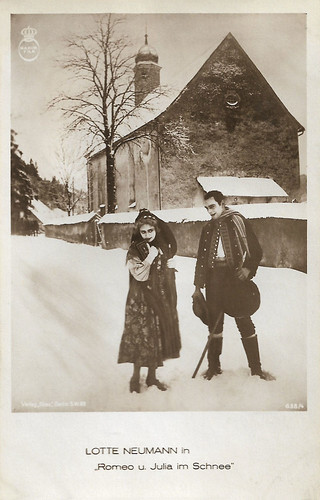
German postcard by Ross Verlag, no. 636/4. Photo: Maxim Film. Publicity still for Romeo und Julia im Schnee/Romeo and Juliet in the Snow (Ernst Lubitsch, 1920), with Lotte Neumann (Julia) and Gustav von Wangenheim (Romeo Montekugerl).

German postcard by Ross Verlag, no. 636/1. Photo: Maxim Film. Lotte Neumann in the comedy Romeo und Julia im Schnee/Romeo and Juliet in the Snow (Ernst Lubitsch, 1920). The man on the left dressed as an antique hero could be Julius Falkenstein as Paris. The others are from left to right Jakob Tiedtke (Herr Capulethofer), Marga Köhler (his wife), Lotte Neumann (Julia) and Gustav von Wangenheim (Romeo Montekugerl).

German postcard by Ross Verlag no. 639/5. Photo: Messter-Film. Publicity still for Kohlhiesels Töchter/Kohlhiesel's Daughters (Ernst Lubitsch, 1920) with Emil Jannings and Henny Porten.

German postcard by Ross Verlag, no. 645/8. Photo: Union Film. Henny Porten in Anna Boleyn/Deception (Ernst Lubitsch, 1920).

German postcard by Ross Verlag, Berlin, no. 760/5. Photo: Alex Binder. Publicity still for Die Bergkatze/Wildcat (Ernst Lubitsch, 1921) with Pola Negri.

German postcard by Ross Verlag, Berlin, no. 832/1, 1919-1924. Union Film. Publicity still for Sumurun (Ernst Lubitsch, 1920) with Jenny Hasselqvist aka Jenny Hasselquist.
Ernst Lubitsch seized upon the advent of talkies to direct musicals. With his first sound film, The Love Parade (1929), starring Maurice Chevalier and Jeanette MacDonald, Lubitsch hit his stride as a maker of worldly musical comedies and earned himself another Oscar nomination.
While most of Lubitsch's silent films had been made for Warner Bros., most of his early sound pictures were for Paramount. The Love Parade (1929), Monte Carlo (1930), and The Smiling Lieutenant (1931) were hailed by critics as masterpieces of the newly emerging musical genre. Lubitsch served on the faculty of the University of Southern California for a time.
His next film was a romantic comedy, written with Samson Raphaelson, Trouble in Paradise (1932). The cynical comedy was popular both with critics and with audiences. But it was a project that could only have been made before the enforcement of the Production Code, and after 1935, Trouble in Paradise was withdrawn from circulation. It was not seen again until 1968.
Ernst Lubitsch continued to specialise in comedy, whether with music, as in MGM's opulent The Merry Widow (1934) and Paramount's One Hour with You (1932), or without, as in Design for Living (1933). He made only one other dramatic film, the anti-war film Broken Lullaby/The Man I Killed (1932).
In 1935, he was appointed Paramount's production manager, thus becoming the only major Hollywood director to run a large studio. But Lubitsch had trouble delegating authority, which was a problem when he was overseeing sixty different films. He was fired after a year on the job and returned to full-time moviemaking.

German postcard by Ross Verlag, no. 838/1. Photo: Terra Film A.G., Berlin. Mary Pickford in Rosita (Ernst Lubitsch, 1923).

Italian postcard, no. 134. Photo: Films Paramount, Roma. Pola Negri in Forbidden Paradise (Ernst Lubitsch, 1924), launched in Italy as La Czarina.

Ramon Novarro and Norma Shearer. German postcard by Ross Verlag, no. 98/6. Photo: Metro-Goldwyn-Mayer. Publicity still for The Student Prince in Old Heidelberg (Ernst Lubitsch, 1927).

German postcard by Ross Verlag, no. 98/9. Photo: Metro-Goldwyn-Mayer. Ramon Novarro in The Student Prince in Old Heidelberg (Ernst Lubitsch, 1927).

French postcard by A.N. [Noyer], Paris, no. 397. Photo: Paramount. Emil Jannings in The Patriot (Ernst Lubitsch, 1928).

German postcard by Ross Verlag, no. 4030/1, 1929-1930. Photo: United Artists. Camilla Horn and John Barrymore in Eternal Love (Ernst Lubitsch, 1929).

French postcard by Cinémagazine Edition, Paris, no. 794. Photo: Paramount. Publicity still for The Love Parade (Ernst Lubitsch, 1929) with Maurice Chevalier and Jeanette MacDonald.

Dutch-Belgian promotion card for Cacao Van Houten, no. 11 and 12. Printed by N.V. Ned Reclamefabriek. This card was part of a series of promo cards for a quiz by Van Houten Chocolate. The public had to go to stores to guess which film star was in the photo in the shop window. There were 24 photos. At the right, we recognised (with the help of a former owner of the card Jack Buchanan and Jeanette MacDonald in Monte Carlo (Ernst Lubitsch, 1930). But who are the actors in the other picture? Name also the title of the film and the production company. In the past you could win a Philips Radio... (*)

Maurice Chevalier and Miriam Hopkins. German postcard by Ross Verlag, no. 5976/1, 1931-1932. Photo: Paramount. Publicity still for The Smiling Lieutenant (Ernst Lubitsch, 1931).
In 1935 he married his second wife, British actress Vivian Gaye. They had one daughter, Nicola Lubitsch in 1938. In 1936, he became a naturalised US citizen. Lubitsch moved to MGM and directed Greta Garbo in Ninotchka (1939). The famously serious actress' laughing scene in this satirical comedy was heavily promoted by studio publicists with the tagline "Garbo Laughs!"
In 1940, Lubitsch directed The Shop Around the Corner, an artful comedy of cross purposes. The film reunited Lubitsch with his Merry Widow screenwriter Raphaelson and starred James Stewart and Margaret Sullavan as a pair of bickering co-workers in Budapest, each unaware that the other is their secret romantic correspondent.
Lubitsch went independent to direct That Uncertain Feeling (1941, a remake of his 1925 film Kiss Me Again), and the dark anti-Nazi farce To Be or Not to Be (1942). William McPeak at IMDb on To Be or Not to Be (1942): "a biting satire of Nazi tyranny that also poked fun at Lubitsch's own theater roots with the problems and bickering - but also the triumph - of a somewhat raggedy acting troupe in Warsaw during the Nazi occupation. Jack Benny's perfect deadpan humor worked well with the zany vivaciousness of Carole Lombard, and a cast of veteran character actors from both Hollywood and Lubitsch's native Germany provided all the chemistry needed to make this a classic comedy, as well as a fierce statement against the perpetrators of war."
A heart condition curtailed his activity, and he spent much of his time in supervisory capacities. His next film, Heaven Can Wait (1943) was another Raphaelson collaboration. Then, Lubitsch worked with Edwin Justus Mayer on the scripting process of A Royal Scandal (1945), a remake of Lubitsch's silent film A Forbidden Paradise. The script was written and prepared under Lubitsch, and he was the original director of this film and directed the rehearsals. He became ill during the shooting, so he hired Otto Preminger, another disciple of Max Reinhardt's Viennese theatre work, to do the rest of the shooting.
After A Royal Scandal, Lubitsch regained his health, and directed Cluny Brown (1946), with Charles Boyer and Jennifer Jones. In 1947, he was awarded a Special Academy Award. Ernst Lubitsch died later that year in Hollywood of a heart attack, his sixth. He was 55. His last film, That Lady in Ermine (1948) with Betty Grable, was completed by Otto Preminger and released posthumously.

German postcard by Ross Verlag, no. 6732/1, 1931-1932. Photo: Paramount. Publicity still for One Hour with You (Ernst Lubitsch, 1932) with Roland Young, Genevieve Tobin, Jeanette MacDonald, and Maurice Chevalier.

French postcard by Europe, no. 73. Photo: Paramount. Maurice Chevalier and Lily Damita in Une heure près de toi (George Cukor, Ernst Lubitsch, 1932), the French language version of One Hour With You.

Dutch postcard by M. Bonnist & Zonen, Amsterdam, no. B 480. Photo: Paramount. Herbert Marshall and Marlene Dietrich in Angel (Ernst Lubitsch, 1937). Collection: Marlene Pilaete.

German postcard by Ross Verlag, no. 1606/2, 1937-1938. Photo: Paramount. Publicity still for Bluebeard's Eighth Wife (Ernst Lubitsch, 1938) with Claudette Colbert.

Belgian collector's card by Kwatta, no. C 181. Photo: MGM. Publicity still for Ninotschka (Ernst Lubitsch, 1939) with Greta Garbo and Melvyn Douglas.

Belgian postcard by Les Editions d'Art L.A.B., Bruxelles, no. 2009. Photo: Metro-Goldwyn-Mayer. Margaret Sullavan and James Stewart in The Shop Around the Corner (Ernst Lubitsch, 1940). The French title was Rendez-vous.

Spanish postcard by C.M.B., no. 59. Photo: 20th Century Fox. Jennifer Jones in Cluny Brown (Ernst Lubitsch, 1946). Collection: Marlene Pilaete.
Meyer aus Berlin/Meyer from Berlin (Ernst Lubitsch, 1919). Source: Bob Toomey (YouTube).

French postcard in the Entr'acte series by Éditions Asphodèle. Mâcon, no. 003/9 Photo: Ernst Lubitschand Maurice Chevalier at the set of The Love Parade (Ernst Lubitsch, 1929). Caption: Director Ernst Lubitsch and Maurice Chevalier in the shadow of the cameras, during the shooting of the first talking operetta on the screen.
Sources: Ephraim Katz (The Film Encyclopedia), William McPeak (IMDb), Wikipedia and IMDb.
(*) Marlene Pilaete solved the puzzle: "The other actors on the card printed by N.V. Ned Reklamefabriek are Betty Compson and George Bancroft in the Paramount movie The Docks of New York. Could you please ask Van Houten to send me the Philips radio?" No problem at all, Marlene.
German postcard by Ross Verlag, no. 415/1, 1919-1924. Photo: Rembrandt.
German postcard by Verlag Hermann Leiser, Berlin-Wilm., no. 1926. Photo: Fritz Richard. Collection: Didier Hanson.
German postcard by Photochemie, no. K. 1743. Photo: Alex Binder, Paris. Collection: Marlene Pilaete.
German postcard by Ross Verlag, Berlin, no. 581/4, 1919-1924. Photo: B.B.B. Collection: Didier Hanson. Ernst Lubitsch with Douglas Fairbanks, Charlie Chaplin and Mary Pickford.
German postcard by Ross Verlag, no. 581/5, 1919-1924. Photo: B.B.B. Collection: Didier Hanson. Ernst Lubitsch with Charlie Chaplin, Mary Pickford and Douglas Fairbanks.
German postcard by Ross Verlag, no. 7376/1, 1932-1933. Photo: Paramount. Ernst Lubitsch with Harold Lloyd.
Ethnic Jewish humour
Ernst Lubitsch was born in Berlin, Germany, in 1892. He was the son of Anna (née Lindenstaedt) and Simon Lubitsch, a prosperous tailor. His family was Ashkenazi Jewish, his father was born in Grodno and his mother came from Wriezen (Oder), outside Berlin. Ernst was drawn to the stage while participating in plays staged by the Sophien Gymnasium, his Berlin high school, which he quit at 16.
To satisfy both his own urge to act and his father's desire that he take over the family business, he began leading a double life, working as a bookkeeper at his father's store by day and appearing in cabarets and music halls by night. By 1911, he was a member of Max Reinhardt's renowned Deutsches Theater, where he quickly advanced from bit parts to character leads. To supplement his income, Lubitsch took a job in 1912 as an apprentice and general-purpose handyman at Berlin's Bioscope film studios and learned silent film acting.
Lubitsch made his film debut in Die ideale Gattin/The Ideal Wife (Hanns Heinz Ewers, Marc Henry, 1913) with Lyda Salmanova. The comedy Die Firma heiratet/The Firm Weds (Carl Wilhelm, 1913) with Albert Paulig, and its sequel Der Stolz der Firma/The Pride of the Firm (Carl Wilhelm, 1914) turned him into a popular comedian. Till 1920, he acted in approximately thirty films. Lubitsch appeared in a series of very successful film comedies as a character named Meyer in which he emphasised ethnic Jewish humour, including Meyer auf der Alm (?, 1913), and Meyer Als Soldat/Meyer as Soldier (?, 1914).
In 1914 he began to write and direct his own films. His first film as a director was Fräulein Seifenschaum/Miss Soapsuds (1914) and he established his reputation as a director, writer, producer and comedian with the foundation of the Malu-Film company, together with the actor Ernst Matráy.
He made his mark as a serious director with the drama Die Augen der Mumie Ma/The Eyes of the Mummy (Ernst Lubitsch, 1918), starring Pola Negri. He gradually abandoned acting to concentrate on directing and his last film appearance was opposite Pola Negri and Paul Wegener in the drama Sumurun (Ernst Lubitsch, 1920).
With Ossi Oswalda. German postcard by Ross Verlag, Berlin, no. 337/1, 1919-1924. Photo: Zander & Labisch.
German postcard by Photochemie, no. K. 1983. Photo: Union Film. Publicity still for Der Blusen-König (Ernst Lubitsch, 1917). Collection: Didier Hanson.
German postcard by Photochemie, Berlin, no. K. 1999. Photo: Union Film. Ossi Oswalda and Hermann Thimig in the Ossi's Tagebuch (Ernst Lubitsch, 1917).
German postcard by Ross Verlag, no. 614/1. Photo: Union. Asta Nielsen and Alfred Abel in Rausch/Intoxication (Ernst Lubitsch, 1919).
Henny Porten as Anna Boleyn in Anna Boleyn (1920). German postcard by Ross Verlag, Berlin, no. 645/3, 1919-1924. Photo: Union Film.
German postcard by Ross Verlag, no. 581/2, 1919-1924. Photo: B.B.B. Collection: Didier Hanson. Ernst Lubitsch with Mary Pickford.
German postcard by Ross Verlag, no. 1523/3, 1927-1928. Photo: Parufamet. Pola Negri in Forbidden Paradise (Ernst Lubitsch, 1924).
Grand Master
As a director, Ernst Lubitsch alternated between escapist comedies and large-scale historical dramas, enjoying great international success with both. A triumph was Die Austernprinzessin/The Oyster Princess (Ernst Lubitsch, 1919), featuring Ossi Oswalda, a sparkling satire caricaturing American manners.
Ephraim Katz in The Film Encyclopedia: "For the first time he demonstrated the subtle humour and the virtuoso visual wit that would in time become known as 'the Lubitsch Touch'. The style was characterised by a parsimonious compression of ideas and situations into single shots or brief scenes that provided an ironic key to the characters and to the meaning of the entire film."
His reputation as a grand master of world cinema reached a new peak after the release of his spectacles Madame DuBarry/Passion (Ernst Lubitsch, 1919) with Pola Negri, and Anna Boleyn/Deception (Ernst Lubitsch, 1920) starring Henny Porten and Emil Jannings.
Both of these films found American distributorship by early 1921. Madame Du Barry and Anna Boleyn, along with his Carmen/Gypsy Blood (Ernst Lubitsch, 1921) were selected by The New York Times on its list of the 15 most important movies of 1921.
With glowing reviews under his belt, and American money flowing his way, Lubitsch formed his own production company and made the high-budget spectacular Das Weib des Pharao/The Loves of Pharaoh (Ernst Lubitsch, 1921). In 1922, he married Helene Kraus. They divorced in 1931.
German postcard by Photochemie, Berlin, no. K. 2008. Photo: Union-Film. Publicity still for Wenn vier dasselbe tun/When Four Do the Same (Ernst Lubitsch, 1917), starring Ossi Oswalda as the girl, Fritz Schulz (here on the left) as her lover, and Emil Jannings as her father (here on the right).
German postcard by Photochemie, Berlin, no. K. 2012. Photo: Union Film. Publicity still for Prinz Sami/Prince Sami (Ernst Lubitsch, 1918). Collection: Didier Hanson.
German postcard by Photochemie, Berlin, no. K. 2835. Photo: publicity still for Die Augen der Mumie Ma/The Eyes of the Mummy (Ernst Lubitsch, 1918) with Pola Negri. Collection: Didier Hanson.
German postcard by Ross Verlag, Berlin, no. 611/2. Photo: Union / Ufa. Publicity still for Die Austernprinzessin/The Oyster Princess (Ernst Lubitsch, 1919) with Victor Janson.
German postcard by Ross Verlag, no. 627/6. Photo: Union Film. Publicity still of Reinhold Schünzel and Pola Negri in Madame DuBarry (Ernst Lubitsch, 1919). After the death of King Louis XV (Emil Jannings), his minister Choiseul (Schünzel) chases DuBarry (Negri) from the Royal palace.
Hollywood
Ernst Lubitsch's success in Europe brought him to the shores of America to promote Das Weib des Pharao/The Loves of Pharaoh (1922) and he got acquainted with the thriving US film industry. Lubitsch returned briefly to Germany but soon left for good for Hollywood.
He was contracted by Mary Pickford, who wanted him to direct her in Dorothy Vernon of Haddon Hall. Upon arrival, he rejected the project and instead, he directed her in Rosita (1923). The director and star clashed during its filming. While the result was deemed a failure from her point of view, it was a critical and commercial success. It ended up as the only project that they made together.
A free agent after just one American film, Lubitsch was signed to a remarkable three-year, six-picture contract by Warner Brothers that guaranteed the director his choice of both cast and crew and full editing control over the final cut. Settling in America, Lubitsch established his reputation for sophisticated comedy with such stylish films as The Marriage Circle (1924), Lady Windermere's Fan (1925), and So This Is Paris (1926).
Ephraim Katz: "Lubitsch grasped the American psychology with an amazing accuracy and focused his satire on two main themes - sex and money. With characteristic laconic wit, he depicted sex as a frivolous pastime, a sophisticated game moneyed people play to occupy their hours of leisure. To be safe, he set his plots against foreign backgrounds - Paris, Vienna, Budapest - or some mythical land, but the implication was clearly American and audiences rarely failed to recognize themselves or their friends, their manners, their foibles, their weaknesses."
But his films were only marginally profitable for Warner Brothers, and Lubitsch's contract was eventually dissolved by mutual consent, with MGM-Paramount buying out the remainder. His first film for MGM, The Student Prince in Old Heidelberg (1927) with Ramon Novarro, was well-regarded but also lost money.
German postcard by Ross Verlag, Berlin, no. 635/5, 1919-1924. Photo: Union. Publicity still for Die Puppe/The Doll (Ernst Lubitsch, 1919) with Ossi Oswalda and Hermann Thimig.
German postcard by Ross Verlag, no. 636/4. Photo: Maxim Film. Publicity still for Romeo und Julia im Schnee/Romeo and Juliet in the Snow (Ernst Lubitsch, 1920), with Lotte Neumann (Julia) and Gustav von Wangenheim (Romeo Montekugerl).
German postcard by Ross Verlag, no. 636/1. Photo: Maxim Film. Lotte Neumann in the comedy Romeo und Julia im Schnee/Romeo and Juliet in the Snow (Ernst Lubitsch, 1920). The man on the left dressed as an antique hero could be Julius Falkenstein as Paris. The others are from left to right Jakob Tiedtke (Herr Capulethofer), Marga Köhler (his wife), Lotte Neumann (Julia) and Gustav von Wangenheim (Romeo Montekugerl).
German postcard by Ross Verlag no. 639/5. Photo: Messter-Film. Publicity still for Kohlhiesels Töchter/Kohlhiesel's Daughters (Ernst Lubitsch, 1920) with Emil Jannings and Henny Porten.
German postcard by Ross Verlag, no. 645/8. Photo: Union Film. Henny Porten in Anna Boleyn/Deception (Ernst Lubitsch, 1920).
German postcard by Ross Verlag, Berlin, no. 760/5. Photo: Alex Binder. Publicity still for Die Bergkatze/Wildcat (Ernst Lubitsch, 1921) with Pola Negri.
German postcard by Ross Verlag, Berlin, no. 832/1, 1919-1924. Union Film. Publicity still for Sumurun (Ernst Lubitsch, 1920) with Jenny Hasselqvist aka Jenny Hasselquist.
Musicals
Ernst Lubitsch seized upon the advent of talkies to direct musicals. With his first sound film, The Love Parade (1929), starring Maurice Chevalier and Jeanette MacDonald, Lubitsch hit his stride as a maker of worldly musical comedies and earned himself another Oscar nomination.
While most of Lubitsch's silent films had been made for Warner Bros., most of his early sound pictures were for Paramount. The Love Parade (1929), Monte Carlo (1930), and The Smiling Lieutenant (1931) were hailed by critics as masterpieces of the newly emerging musical genre. Lubitsch served on the faculty of the University of Southern California for a time.
His next film was a romantic comedy, written with Samson Raphaelson, Trouble in Paradise (1932). The cynical comedy was popular both with critics and with audiences. But it was a project that could only have been made before the enforcement of the Production Code, and after 1935, Trouble in Paradise was withdrawn from circulation. It was not seen again until 1968.
Ernst Lubitsch continued to specialise in comedy, whether with music, as in MGM's opulent The Merry Widow (1934) and Paramount's One Hour with You (1932), or without, as in Design for Living (1933). He made only one other dramatic film, the anti-war film Broken Lullaby/The Man I Killed (1932).
In 1935, he was appointed Paramount's production manager, thus becoming the only major Hollywood director to run a large studio. But Lubitsch had trouble delegating authority, which was a problem when he was overseeing sixty different films. He was fired after a year on the job and returned to full-time moviemaking.
German postcard by Ross Verlag, no. 838/1. Photo: Terra Film A.G., Berlin. Mary Pickford in Rosita (Ernst Lubitsch, 1923).
Italian postcard, no. 134. Photo: Films Paramount, Roma. Pola Negri in Forbidden Paradise (Ernst Lubitsch, 1924), launched in Italy as La Czarina.
Ramon Novarro and Norma Shearer. German postcard by Ross Verlag, no. 98/6. Photo: Metro-Goldwyn-Mayer. Publicity still for The Student Prince in Old Heidelberg (Ernst Lubitsch, 1927).
German postcard by Ross Verlag, no. 98/9. Photo: Metro-Goldwyn-Mayer. Ramon Novarro in The Student Prince in Old Heidelberg (Ernst Lubitsch, 1927).
French postcard by A.N. [Noyer], Paris, no. 397. Photo: Paramount. Emil Jannings in The Patriot (Ernst Lubitsch, 1928).
German postcard by Ross Verlag, no. 4030/1, 1929-1930. Photo: United Artists. Camilla Horn and John Barrymore in Eternal Love (Ernst Lubitsch, 1929).
French postcard by Cinémagazine Edition, Paris, no. 794. Photo: Paramount. Publicity still for The Love Parade (Ernst Lubitsch, 1929) with Maurice Chevalier and Jeanette MacDonald.
Dutch-Belgian promotion card for Cacao Van Houten, no. 11 and 12. Printed by N.V. Ned Reclamefabriek. This card was part of a series of promo cards for a quiz by Van Houten Chocolate. The public had to go to stores to guess which film star was in the photo in the shop window. There were 24 photos. At the right, we recognised (with the help of a former owner of the card Jack Buchanan and Jeanette MacDonald in Monte Carlo (Ernst Lubitsch, 1930). But who are the actors in the other picture? Name also the title of the film and the production company. In the past you could win a Philips Radio... (*)
Maurice Chevalier and Miriam Hopkins. German postcard by Ross Verlag, no. 5976/1, 1931-1932. Photo: Paramount. Publicity still for The Smiling Lieutenant (Ernst Lubitsch, 1931).
Garbo laughs!
In 1935 he married his second wife, British actress Vivian Gaye. They had one daughter, Nicola Lubitsch in 1938. In 1936, he became a naturalised US citizen. Lubitsch moved to MGM and directed Greta Garbo in Ninotchka (1939). The famously serious actress' laughing scene in this satirical comedy was heavily promoted by studio publicists with the tagline "Garbo Laughs!"
In 1940, Lubitsch directed The Shop Around the Corner, an artful comedy of cross purposes. The film reunited Lubitsch with his Merry Widow screenwriter Raphaelson and starred James Stewart and Margaret Sullavan as a pair of bickering co-workers in Budapest, each unaware that the other is their secret romantic correspondent.
Lubitsch went independent to direct That Uncertain Feeling (1941, a remake of his 1925 film Kiss Me Again), and the dark anti-Nazi farce To Be or Not to Be (1942). William McPeak at IMDb on To Be or Not to Be (1942): "a biting satire of Nazi tyranny that also poked fun at Lubitsch's own theater roots with the problems and bickering - but also the triumph - of a somewhat raggedy acting troupe in Warsaw during the Nazi occupation. Jack Benny's perfect deadpan humor worked well with the zany vivaciousness of Carole Lombard, and a cast of veteran character actors from both Hollywood and Lubitsch's native Germany provided all the chemistry needed to make this a classic comedy, as well as a fierce statement against the perpetrators of war."
A heart condition curtailed his activity, and he spent much of his time in supervisory capacities. His next film, Heaven Can Wait (1943) was another Raphaelson collaboration. Then, Lubitsch worked with Edwin Justus Mayer on the scripting process of A Royal Scandal (1945), a remake of Lubitsch's silent film A Forbidden Paradise. The script was written and prepared under Lubitsch, and he was the original director of this film and directed the rehearsals. He became ill during the shooting, so he hired Otto Preminger, another disciple of Max Reinhardt's Viennese theatre work, to do the rest of the shooting.
After A Royal Scandal, Lubitsch regained his health, and directed Cluny Brown (1946), with Charles Boyer and Jennifer Jones. In 1947, he was awarded a Special Academy Award. Ernst Lubitsch died later that year in Hollywood of a heart attack, his sixth. He was 55. His last film, That Lady in Ermine (1948) with Betty Grable, was completed by Otto Preminger and released posthumously.
German postcard by Ross Verlag, no. 6732/1, 1931-1932. Photo: Paramount. Publicity still for One Hour with You (Ernst Lubitsch, 1932) with Roland Young, Genevieve Tobin, Jeanette MacDonald, and Maurice Chevalier.
French postcard by Europe, no. 73. Photo: Paramount. Maurice Chevalier and Lily Damita in Une heure près de toi (George Cukor, Ernst Lubitsch, 1932), the French language version of One Hour With You.
Dutch postcard by M. Bonnist & Zonen, Amsterdam, no. B 480. Photo: Paramount. Herbert Marshall and Marlene Dietrich in Angel (Ernst Lubitsch, 1937). Collection: Marlene Pilaete.
German postcard by Ross Verlag, no. 1606/2, 1937-1938. Photo: Paramount. Publicity still for Bluebeard's Eighth Wife (Ernst Lubitsch, 1938) with Claudette Colbert.
Belgian collector's card by Kwatta, no. C 181. Photo: MGM. Publicity still for Ninotschka (Ernst Lubitsch, 1939) with Greta Garbo and Melvyn Douglas.
Belgian postcard by Les Editions d'Art L.A.B., Bruxelles, no. 2009. Photo: Metro-Goldwyn-Mayer. Margaret Sullavan and James Stewart in The Shop Around the Corner (Ernst Lubitsch, 1940). The French title was Rendez-vous.
Spanish postcard by C.M.B., no. 59. Photo: 20th Century Fox. Jennifer Jones in Cluny Brown (Ernst Lubitsch, 1946). Collection: Marlene Pilaete.
Meyer aus Berlin/Meyer from Berlin (Ernst Lubitsch, 1919). Source: Bob Toomey (YouTube).
French postcard in the Entr'acte series by Éditions Asphodèle. Mâcon, no. 003/9 Photo: Ernst Lubitschand Maurice Chevalier at the set of The Love Parade (Ernst Lubitsch, 1929). Caption: Director Ernst Lubitsch and Maurice Chevalier in the shadow of the cameras, during the shooting of the first talking operetta on the screen.
Sources: Ephraim Katz (The Film Encyclopedia), William McPeak (IMDb), Wikipedia and IMDb.
(*) Marlene Pilaete solved the puzzle: "The other actors on the card printed by N.V. Ned Reklamefabriek are Betty Compson and George Bancroft in the Paramount movie The Docks of New York. Could you please ask Van Houten to send me the Philips radio?" No problem at all, Marlene.