Conrad Veidt (1893–1943) was the 'most highly strung and romantically handsome of the German expressionist actors'. From 1916 until his death, he appeared in over 100 films, including such classics as Das Kabinett des Doktor Caligari (1920) as the sleep-walking killer Cesare, and Casablanca (1942) as Nazi Major Heinrich Strasser. He played in the 'first gay film', Anders als die Andern (1919) and his starring role in The Man Who Laughs (1928) was the inspiration for Batman's greatest enemy, The Joker.

German postcard by Ross Verlag, Berlin, no. 1426/2, 1927-1928. Photo: Vaida M. Pál, Budapest.

German postcard by Ross Verlag, no. 272/1, 1919-1924. Photo: Becker & Maass, Berlin.

German postcard by Ross Verlag, Berlin, no. 564/1, 1919-1924. Photo: R Film. Publicity still for
Lady Hamilton (Richard Oswald, 1921).

German postcard by Ross Verlag, Berlin, no. 564/3, 1919-1924. Photo: Conrad Veidt Film. Publicity still for
Paganini (Heinz Goldberg, 1923).
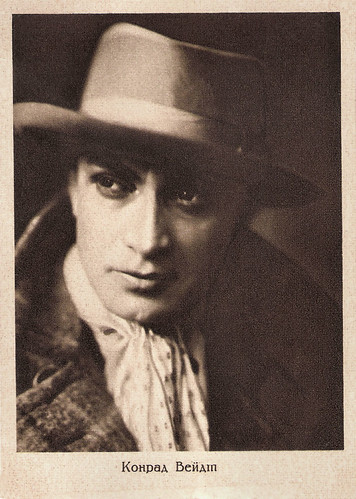
Russian postcard, no. 6, 1928.
A creature from Poe's nightmares
Hans Walter Conrad Veidt was born in 1893, in Potsdam, Germany. He attended the Sophiengymnasium (a secondary school) in the Schoeneberg district of Berlin, and graduated without a diploma in 1912.
Veidt received his basic acting training and stage experience from
Max Reinhardt, and appeared at the age of 20 — just before World War I — at Reinhardt's Deutsches Theater in Berlin. In 1914, he met actress
Lucie Mannheim, with whom he began a relationship.
Later in the year he was drafted into the German Army during World War I. In 1915, Veidt was sent to the Eastern Front as a noncommissioned officer and took part in the Battle of Warsaw. He contracted jaundice and pneumonia, and had to be evacuated to a hospital on the Baltic Sea.
While recuperating, he received a letter from
Lucie Mannheim informing him that she had found work at a front theatre. Intrigued, Veidt applied for the theatre as well. As his condition had not improved, the army allowed him to join the theatre so that he could entertain the troops. It was also during this time that his relationship with Mannheim ended. In late 1916, he was reexamined by the Army and deemed unfit for service; he was given a full discharge in January 1917. Veidt then returned to Berlin to pursue his acting career.
Director
Richard Oswald encouraged him to go into films. He was seen in such silent films as
Der Weg des Todes/The Road of Death (Robert Reinert, 1917) with
Maria Carmi,
Furcht/Fear (Robert Wiene, 1917),
Das Tagebuch einer Verlorenen/The Diary of a Lost Woman (Richard Oswald, 1918) with
Erna Morena,
Opium (Robert Reinert, 1919) with
Werner Krauss, and as Lucifer in
Satanas/Satan (F.W. Murnau, 1920) starring
Fritz Kortner.
The anonymous biographer at
Lenin Imports writes: "Veidt was the most highly strung and romantically handsome of German expressionist actors. He was a creature from Poe's nightmares - tall, gaunt, glowing with a mixture of illness and ecstatic anxiety. Amid so many overweight actors, Veidt was an attenuated, hypersensitive figure, the aesthete or artist tormented by dark forces and driven to violence. His movements were deliberately slowed and prolonged".

German postcard by Ross Verlag, Berlin, no. 272/4, 1919-1924. Photo: Becker & Maass.

German postcard by Ross Verlag, no. 539/1. Photo: May Film. Conrad Veidt as the proud and cruel Maharajah of Eschnapur in the two-part monumental film
Das indische Grabmal/The Indian Tomb (Joe May, 1921-1922).

German postcard. Photo: Richard Oswald Film. Perhaps a publicity still for
Lucrezia Borgia (Richard Oswald, 1922).

German postcard by Ross Verlag, Berlin, no. 674/5. Photo: Krabbe. Publicity still for
Carlos und Elisabeth/Carlos and Elisabeth (Richard Oswald, 1924) with
Dagny Servaes.

German postcard by Ross Verlag, Berlin, no. 933/1, 1925-1926. Publicity still for
Das Wachsfigurenkabinett/Waxworks (Leo Birinsky, Paul Leni, 1924).

German postcard by Ross Verlag, no. 934/1, 1925-1926. Conrad Veidt starring in the Franco-German coproduction
Le Comte Kostia/ Graf Kostja (Jacques Robert, 1925).

German postcard by Ross Verlag, no. 1561/2, 1927-1928. Photo: ?
Caligari
With his impressive height, handsomely gaunt face, high cheekbones and wide, thin-lipped mouth, Conrad Veidt seemed a natural to play sinister, tortured roles. To many silent film fans, he is primarily known for his Cesare, the sleep-walking killer in
Das Kabinett des Doktor Caligari/The Cabinet of Dr. Caligari (Robert Wiene, 1920). His first close-up of Cesare was riveting: a pale face and harrowed eyes, awakened from sleep. Unforgettable was also the rhythmic, boldly diagonal way he crept along a wall to kidnap
Lil Dagover. Cesare became one of the most influential performances in the history of the fantasy and horror film.
Veidt did a brave appearance in
Magnus Hirschfeld's pioneering homosexual rights film
Anders als die Andern/Different from the Others (Richard Oswald, 1919). It is credited as being the first gay film: it argued for reform of the harsh German laws regarding homosexuality. The film had a very short run in Germany before being pulled, and people who attended it were, according to the reviewer on
IMDb, harassed.
Veidt then worked in the full range of the German cinema: the Jekyll and Hyde film
Der Januskopf/The Two-Faced Man (F. W. Murnau, 1920) with
Béla Lugosi, the exotic adventure epic
Das Indische Grabmal/The Indian Tomb (Joe May, 1921) starring
Olaf Fønss and
Mia May, the melodrama
Der Gang in die Nacht/Journey Into the Night (F.W. Murnau, 1921), the historic film
Danton (Dmitri Buchowetzki, 1922) starring
Emil Jannings, and the drama
Die Brüder Schellenberg/The Brothers Schellenberg (Karl Grune, 1926).
He starred in three classic horror films, in
Das Wachsfigurenkabinett/The Three Wax Works (Paul Leni, Leo Birinsky, 1924) as Ivan the Terrible, in
Orlacs Hände/The Hands of Orlac (Robert Wiene, 1924) as Orlac, and in
Der Student von Prag/The Student of Prague (Henrik Galeen, 1926) as the student and his doppelganger. In addition he directed also films himself, including
Wahnsinn/Madness (1919) with
Reinhold Schünzel, and
Die Nacht auf Goldenhall/The Night at Goldenhall (1920) with his then-wife
Gussy Holl.

German postcard by Ross Verlag, no. 1682/2, 1927-1928. Conrad Veidt preparing for his first trip to the United States. Caption: his most precious luggage item. The child is his daughter,
Viola Veidt.

German postcard by Ross Verlag, no. 1682/3, 1927-1928. Conrad Veidt and his wife
Felicitas Radke preparing for his first trip to the United States. Caption:"Do you think, Conny, one can wear such a coat in Hollywood?"

German postcard by Ross Verlag, Berlin, no. 1719/1, 1927-1928. Photo: Arthur Ziehm, Berlin. Publicity still for
Kreuzzug des Weibes/The Wife's Crusade (Martin Berger, 1926) with
Harry Liedtke.

German postcard by Ross Verlag, Berlin, no. 1670/1, 1927-1928. Photo: United Artists. Publicity still for
The Beloved Rogue (Alan Crosland, 1927).

German postcard by Ross Verlag, Berlin, no. 1670/2, 1927-1928. Photo: United Artists. Publicity still for
The Beloved Rogue (Alan Crosland, 1927). Conrad Veidt plays a cruel and superstitious French king Louis XI.

German postcard by Ross Verlag, no. 1692/1, 1927-1928. Photo: Sokal Film. Publicity still for
Der Student von Prag/The Student of Prague (Henrik Galeen, 1926).

German postcard by Ross Verlag, no. 105/1. Photo: Universal Pictures Corp. Publicity still for
The Man Who Laughs (Paul Leni, 1928) with
Mary Philbin.
The Joker
Conrad Veidt worked briefly in Sweden –
Ingmarsarvet/The Ingmar Inheritance (Gustaf Molander, 1925) with
Lars Hanson, and in Italy - the
Luigi Pirandello adaptation
Enrico I/The Flight in the Night (Amleto Palermi, 1926).
Then he took up an offer to play Louis XI to
John Barrymore's Francois Villon in
The Beloved Rogue (Alan Crosland, 1927). Veidt stayed in Hollywood for
A Man's Past (George Melford, 1927), and
The Last Performance (Paul Fejos, 1927).
In
The Man Who Laughs (Paul Leni, 1928) he played a disfigured circus performer, one of his most sublime performances. His grotesque grin was achieved with a prosthesis. Comic book artist and
Batman creator
Bob Kane, writer
Bill Finger and artist
Jerry Robinson used stills of Veidt in
The Man Who Laughs as inspiration for the iconic supervillain The Joker.
Back in Germany, Veidt made Germany's first talking picture
Das Land ohne Frauen/The Land Without Women (Carmine Gallone, 1929) about Australia in the days when the search for gold fused together men of all nations. His beautiful speaking voice consolidated his star position.
He was cast as Count Metternich in the immensely popular operetta
Der Kongress Tanzt (Erik Charell, 1931) with
Lilian Harvey, both in the original and in the English-language version,
The Congress Dances (Erik Charell, 1931).
He also appeared oppposite
Elza Temary in
Rasputin (Adolph Trotz, 1932) as the legendary mystic who ruled the czarist court in its last years, as the czarina hoped he could heal her son's haemophilia. In 1916 Rasputin was murdered by a number of aristocrats, but not before predicting the downfall of the regime.

German postcard by Ross Verlag, no. 135/2, 1929-1933. Photo: Lichtenstein / Gottschalk-Tonfilm. Publicity still for
Rasputin (Adolph Trotz, 1931) with
Elza Temary.

German postcard by Ross Verlag, Berlin, no. 3919/1, 1928-1929. Photo: Roman Freulich.

German postcard by Ross Verlag, Berlin, no. 943/2, 1925-1926. Photo: Alex Binder.

German postcard by Ross Verlag, Berlin, no. 943/5, 1925-1926. Photo: Alex Binder.

German postcard by Ross Verlag, Berlin, no. 4200/2, 1929-1930. Photo: Alex Binder, Berlin.

German postcard by Ross Verlag, no. 131/7. Photo: Ufa. Still with Conrad Veidt (Count Metternich) and
Lil Dagover (Countess) in
Der Kongress tanzt/The Congress dances (Erik Charell, 1931).
The Wandering Jew
Conrad Veidt then moved to England for the thriller
Express Rome (Walter Forde, 1932) and
The Wandering Jew (Maurice Elvey, 1933), the fantasy of the Jew who cursed Christ and found himself stuck on earth till the Second Coming.
Back in Germany he was in
F.P.I. Antwortet Nicht/F. P. 1 Doesn't Answer (Karl Hartl, 1933). Veidt sang the title song
Where the Lighthouse Shines Across the Bay. It was a flop at the time, but became a hit in the United Kingdom in 1980. BBC presenter
Terry Wogan had played it as a request on his breakfast show and was flooded afterwards with letters asking for a repeat.
Veidt fervently opposed the Nazi regime. His activities came under the scrutiny of the
Gestapo, and a decision was made to assassinate him. Veidt found out about the plot, and managed to escape Germany in 1933 a week after marrying a half-Jewish woman,
Illona Prager. He was married twice before, and reportedly he was bisexual. He was first married to actress
Gussy Holl (1919-1922) and in 1923 he married
Felicitas Radke, a woman from an aristocratic German family. They divorced in 1932. Their daughter,
Viola Veidt, was born in 1925.
Her father settled in the United Kingdom and continued making films. In England, Veidt played in
Jew Suss (Lothar Mendes, 1934), a satire of Nazi anti-Semitism, based on the novel by
Lion Feuchtwanger. Although it was not a success with audiences, it did succeed in angering Nazi propaganda minister
Josef Goebbels who banned all of Veidt's films from Germany.
Veidt became a British citizen in 1938. His most interesting British pictures were two films directed by
Michael Powell and
Emeric Pressburger,
The Spy in Black (1939) and
Contraband (1940). When the war started, producer
Alexander Korda shipped Veidt to the United States to play the Vizier in
The Thief of Baghdad (Michael Powell, Tim Whelan, Ludwig Berger, 1940)
TCM notes that Veidt added "immeasurably to his role as the demonic magician and grand vizier Jaffar. He spent his last years playing Germans in such Hollywood films as
Escape (Mervyn Le Roy, 1940) - in which he and
Norma Shearer made a dynamic pair as a German general and his American mistress,
A Woman's Face (George Cukor, 1941) as the lover and onetime partner in crime of
Joan Crawford, and
Nazi Agent (Jules Dassin, 1942) - in which he had a dual role as a Nazi and as the Nazi's twin brother.
But he is best known for playing the Nazi Major Heinrich Strasser in
Casablanca (Michael Curtiz, 1942) opposite
Humphrey Bogart. When Britain went to war, Veidt gave most of his estate to the war effort. He also donated a large portion of the salary from each of his films to the British war relief, as well - he was the highest paid actor in
Casablanca.
His last film was
Above Suspicion (Richard Thorpe, 1943), in which he played an Austrian undercover agent.
In 1943, Conrad Veidt suddenly died of a heart attack during a game of golf in Los Angeles. He was playing with
Arthur Field of MGM and his personal physician,
Dr. Bergman, who pronounced him dead at the scene. His death at just 50 was possibly a result of his heavy smoking. Because he had been blacklisted in Nazi Germany, there was no official announcement there of his death. His ex-wife, Felicitas, and daughter Viola, in Switzerland, heard about it on the radio.

German postcard by Ross Verlag, Berlin, no. 7621/2, 1932-1933. Photo: Ufa. Publicity still for
Ich und die Kaiserin/The Empress and I (Friedrich Hollaender, 1933)

Vintage postcard. Photo: Paramount.

British postcard in the Picturegoer Series, London, no. 1365. Photo: British National. Publicity still for
Contraband (Michael Powell, Emeric Pressburger, 1940).

British postcard by Real Photograph, no. 167. Photo: Gaumont-British Pictures.

Dutch postcard, no. 142. Photo: Universal.

British postcard by De Reszke Cigarettes, no. 33. Photo: Gaumont-British. Publicity still for
Jew Süss (Lothar Mendes, 1934).
DVD Trailer of
Orlacs Hände/The Hands of Orlac (Robert Wiene, 1924). Source: Kino International (YouTube).
Conrad Veidt sings
There's a lighthouse shines across the bay (1933). Source: Allanh53 (YouTube).
Sources:
Peter Jacobs (Gay For Today),
Roger Manvell (Film Reference),
Hal Erickson (AllMovie),
Doug Sederberg (IMDb),
Lenin Imports,
Filmportal.de (German),
Wikipedia, and
IMDb.