Showing posts with label Leda Gys. Show all posts

26 December 2024

Christus (1916)

On the 2nd Day of Christmas, a post on the Italian silent film Christus/Christ (1916). This Cines production directed by count Giulio Antamoro and filmed in Palestine and Egypt was a worldwide success. Alberto Pasquali played Jesus and Leda Gys played Mary.

Christus (1916)  Flight to Egypt
French postcard by Les Films Primior, Paris. Photo: Cines. Publicity still for Christus (Giulio Antamoro, 1916). Translation of the caption: 'The Flight to Egypt: Get up, take your child and his mother, fly to Egypt and stay there until I warn you.'

Christus (1916) Holy Family in Egypt
French postcard by Les Films Primior, Paris. Photo: Cines. Publicity still for Christus (Giulio Antamoro, 1916). Caption: 'The Sky over Egypt. At the entrance of Memphis, in Old Cairo, the Well of Matarea saves the menaced life of Jesus.'

Shot on location


In 1915-1916, so right in the middle of the First World War, Italian director Count Giulio Cesare Antamoro went to Palestine and Egypt, on behalf of the film company Cines. He went there with a crew and an impressive cast to film Christ (1916).

Earlier, the Kalem production From the Manger to the Cross (Sidney Olcott, 1912) had faithfully reproduced the sketches by James Tissot, drawn on location in Egypt and Palestine.

Antamoro wanted to film the life of Christ on location. His Christus (1916) became a worldwide success, because of the quotations from famous artworks such as Fra Angelico's 'Annunciation', Leonardo da Vinci's 'Last Supper' and Michelangelo's 'Pietà', but also because of the location shots.

The press drew a direct relationship between the authenticity of Giulio Antamoro's film and that of the earlier sketches by James Tissot.

Even more than in the Kalem production, the Cines crew exploited the monuments and scenery in Egypt for the film, bending the Biblical tales to make it more spectacular.

Christus (1916) Youth in Nazareth
French postcard by Les Films Primior, Paris. Photo: Cines. Publicity still for Christus (Giulio Antamoro, 1916). Caption: 'In Nazareth, surrounded by the Holy Virgin and Joseph, Jesus grows up in wisdom, in grace and in age, before God and before mankind.' On the right, Leda Gys plays the Holy Virgin.

Christus (1916) Jesus among the ruins of the world (Luxor, Egypt)
French postcard by Les Films Primior, Paris. Photo: Cines. Alberto Pasquali as Jesus in Christus (Giulio Antamoro, 1916). Caption: 'The world is dying, oppressed, degraded and in despair, Jesus, says, but God is there who guards.'

The holy family


Arriving in Egypt after their Flight from Jerusalem, the Holy Family passes the pyramids of Gizeh and the famous Sphinx in Christ (1916).

We notice Mary in Memphis under Cairo, where she receives food and drinks after the Flight to Egypt. Afterwards, we see the Holy Family near a row of sphinxes at Karnak.

Later in the film, when Jesus has grown up, he reflects on the decay of the world. Director Giulio Antamoro then shows Jesus (Alberto Pasquali) walking through the majestic ruins of Luxor.

There is no Biblical reason for this scene, but Giulio Antamoro thus combines literal decay with spiritual decay. Besides, in 1915-1916 there were more ancient buildings in Egypt than in Palestine to exploit, and thus Antamoro used Egypt's monumentality.

For the average cinema visitor in Europe during the First World War, the vision of ancient ruins must have created associations with the modern ruins in Northern France and Belgium, daily visible in cinema newsreels.
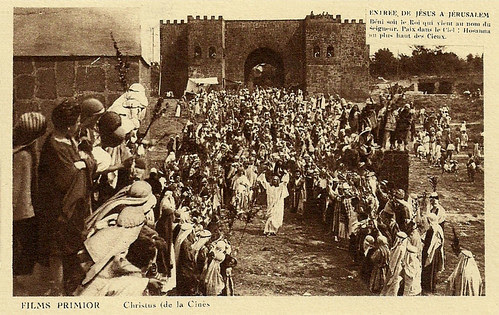
Christus (1916) Entry of Christ into Jerusalem
French postcard by Films Primior, Paris. Photo: Cines. Publicity still for Christus (Giulio Antamoro, 1916). Entry of Christ into Jerusalem. On Palm Sunday, the Sunday before Easter, Christians celebrate Christ's triumphant entry into Jerusalem.

Christus (1916) Getsemane
French postcard by Films Primior, Paris. Photo: Cines. Publicity still for Christus (Giulio Antamoro, 1916). Christ (Alberto Pasquali) agonising in the gardens of Gethsemane.

Additional shooting


The leading roles in Christus (1916) were acted by Alberto Pasquali (Christ), Leda Gys (Mary), Amleto Novelli (Pilate), and Augusto Mastripietri (Judas), while Renato Visca played the young Jesus.

When additional shooting was necessary in 1916, Enrico Guazzoni, the director of Quo Vadis? (1912), Marcantonio e Cleopatra (1913) and Cajus Julius Caesar (1914), was in charge, while Antamoro wasn't available anymore.

Janiss Garza at AllMovie reviewed the result as: "static, pretentious and dated (yes, even for 1917 (sic)). In addition, the titles - at least in the English version - were long and wordy, which was anathema to moviegoers of the 'teens."

However, Christus (1916) was an international success. A tagline read: "Greatest screen success Europe has known is acclaimed with new honours in America." Two other films with the same title were released in 1914 and 1919 but both are missing now.

Cines' Christus was eventually restored by producer Goffredo Lombardo, the founder of Titanus and the son of Leda Gys. The restored film was shown at the 2000 Venice Film Festival.

Christus (1916) towards Mount Calvary and the Crucifixion
French postcard by Les Films Primior, Paris. Christ towards Mount Calvary and the Crucifixion. While Simon of Cyrene is carrying the cross, Jesus (Alberto Pasquali) meets his mother Mary (Leda Gys) and Mary Magdalene (Aurelia Cattaneo), on the way to Mount Calvary. Translation of the caption: 'The Calvary: Jesus meets his mother Mary and Mary Magdalene. Turning towards the other women, he speaks: Don't weep for me, daughters of Jerusalem, but for you and your children.'

Christus (1916) Calvary
French postcard by Films Primior, Paris. Christ's Crucifixion on Mount Calvary. Translation of the caption: 'Father, forgive them, for they know not what they do.'

Christus (1916) Pietà
French postcard by Films Primior, Paris. The Pietà with Jesus (Alberto Pasquali) and Mary (Leda Gys). Translation of the caption: 'The descent of the cross. See if there is any sorrow like mine.'

Sources: Janiss Garza (AllMovie - page now defunct), Mario Gauci (IMDb - page now defunct) and IMDb.

09 May 2022

Leda Gys

Versatile actress Leda Gys (1892-1957) was the only Italian diva who never played vamp roles and the only one whose career lasted until the advent of sound films. She starred in some 80 dramas, comedies, action thrillers and even westerns of the Italian and Spanish silent cinema. Her claim to fame came with the film Christus (1916), shot in Egypt and Palestine, where Gys performed the Madonna.

Leda Gys
Italian postcard by Ed. A. Traldi, Milano (Milan), no. 722.

Leda Gys
Italian postcard by Ed. A. Traldi, Milano, no. 711.

Leda Gys
Italian postcard by Ed. G. Vettori, Bologna, no. 303.

Leda Gys
Italian postcard by Edit. Soc. Anon. It. Bettini, Roma, no. 112. Photo: Riccardo Bettini.

Leda Gys
Italian postcard by Edit. Soc. Anon. It. Bettini, Roma, no. 113. Photo: Riccardo Bettini.

Leda Gys
Italian postcard by Edit. Soc. Anon. It. Bettini, Roma, no. 201. Photo: Riccardo Bettini.


Leda Gys
Italian postcard by Edit. Soc. Anon. It. Bettini, Roma, no. 237. Photo: Riccardo Bettini.

Leda Gys
Italian postcard by Edit. Soc. Anon. It. Bettini, Roma, no. 238. Photo: Riccardo Bettini.

Madonna


Leda Gys was born as Giselda Ilardi in Roma (Rome), Italy, in 1892.

Her lover, the Roman poet Carlo Alberto Trilussa introduced young Giselda to the Cines film studios in 1912. He also gave her her artist's name Leda Gys, by anagrammatising her Christian name, Giselda. Her film debut was the short silent Cines drama Fior d'amore e fior di morte/Flower of Love and Flower of Death (1912) with Amleto Novelli.

Gys quickly rose to leads in films like L'histoire d'un Pierrot/Pierrot the Prodigal (Baldassarre Negroni, 1914) with Francesca Bertini, L'amazzone mascherata/The Masked Amazon (Baldassarre Negroni, 1914) again with Bertini and with Emilio Ghione, La marcia nuziale/The Wedding March (Carmine Gallone, 1915) with Lyda Borelli, Maschera di mistero/Mask of Mystery (Mario Caserini, 1915) and La morta del lago/A Fatal Fascination (Enrico Guazzoni, 1915) with Pina Menichelli.

Italian-American film historian Angela Dalle Vacche writes in the Encyclopedia Of Early Cinema: "Working for both Cines and its branch Celio, between 1913 and 1914, she sharpened her skills in some two dozen short—or medium-length films directed by Enrico Guazzoni and others.

It was then that Gys began to develop a personal screen type based on American stars, combining the girl-next-door innocence of Mary Pickford and the suffering pathos of Lilian Gish."

Leda Gys
Vintage postcard, printed in Italy but with English text. Gys's name is misspelled.

Leda Gys
Vintage postcard, no. 523A, sent by mail from Belgium to the Netherlands in 1928.

Leda Gys
Vintage Italian postcard.

Leda Gys
Italian postcard by Ed. A. Traldi, Milano, no. 564.

Leda Gys
Italian postcard by Ed. Romeo Biagi, Bologna, no. 652.

Leda Gys
Italian postcard by Ed. Vettori, Bologna, no. 402 bis. Photo: Foto Pinto, Roma.

Leda Gys
German postcard by Verlag Hermann Leiser, Berlin, no. 5652.

Neapolitan dramas and comedies


The versatile Leda Gys appeared in all kinds of genres: drama, comedy, action thrillers and even westerns. Often she played the pathetic roles of the romantic and innocent young woman, victim of loose mothers, unfaithful husbands, adventurers etc.

Her claim to fame came with Christus/Christ (Giulio Antamoro, 1916), a religious epic shot in Egypt and Palestine. Gys performed the Madonna and Alberto Pasquali appeared as Jesus Christ.

Various films in Spain followed, such as Flor de otoño/Autumn Flowers (Mario Caserini, 1916) with Maria Caserini, which led to the belief afterwards that she was a Spanish actress.

From the late 1910s on, Gys performed in Neapolitan dramas and comedies, produced by the Neapolitan producer and Gys' husband Gustavo Lombardo. Lombardo was inspired by American cinema and transposed the American modern style to Italian cinema, thus mixing Gys's characters with sentiment or wit.

These films like I figli di nessuno/Nobody's Children (Ubaldo Maria del Colle, 1921) and Napoli è una canzone/Naples Is A Song (Eugenio Perego, 1927), appealed to Italian emigrants in North and South America thanks to their shots of Naples and surroundings, their references to Neapolitan regional theatre and their intertitles in Neapolitan dialect.

Leda Gys and Mario Bonard in La pantomima della morte (1915)
French postcard, no. 7467. Photo: publicity still for La pantomima della morte/The pantomime of death (Mario Caserini, 1915) with Mario Bonnard. Collection: Didier Hanson.

Leda Gys and Mario Bonnard in La pantomima della morte
Italian postcard by Ed. A. Traldi, Milano. Leda Gys and Mario Bonnard in the Italian silent film La pantomima della morte (Mario Caserini, 1915).

Christus (1916) Pietà
French postcard by J. Mayer, graveur, Paris. Photo: Films Primior, Paris. The Pietà with Jesus (Alberto Pasquali) and Mary (Leda Gys), from the silent epic Christus (Giulio Antamoro, 1916).

Leda Gys in Amica (1916)
Spanish cromo (collectors card) by Chocolate Pi, Barcelona, card 9. Photo: Distr. J. Pich, Barcelona / Cines. Scene from the film Amica (Enrico Guazzoni, 1916), starring Leda Gys, here with what seems to be Augusto Poggioli.

Leda Gys in Fernanda (1917)
Spanish postcard by Chocolate Salas Sabadell. Leda Gys in the silent Italian film Fernanda (Gustavo Serena, 1917), based on Victorien Sardou's play.

Leda Gys
Italian postcard. Leda Gys as protagonist of the film Treno di lusso (Mario Bonnard, 1917).

Leda Gys in La Bohème
Italian postcard by G.B. Falci, Milano, no. 300. Photo: Leda Gys as Mimì in La Bohème (Amleto Palermi, 1917).

Diva Dolorosa


Throughout the 1920s Leda Gys did light-hearted romantic comedies directed by Eugenio Perego.

She also worked in France, where she made Esclave/Slave (Georges Monca, Rose Pansini, 1922) with the young Charles Boyer.

In 1929 she appeared in her last films, the Titanus productions Mi chiamano Mimì Rondine/Rondine (Eugenio Perego, 1929) with Adele Farulli, and La signorina Chicchiricchì/Miss Chicchiricchì (Eugenio Perego, 1929) with Silvio Orsini.

Just before the advent of the sound film, she withdrew from the cinema to take care of her son, Goffredo Lombardo. In the post-war years, Goffredo would be the producer of Titanus Film, the company founded by his father Gustavo Lombardo in 1908.

Leda Gys died in Rome in 1957. She was 65. In 1999, Gys was one of the divas of the silent Italian cinema, who was featured by Peter Delpeut in his beautiful compilation film Diva Dolorosa.

Leda Gys in Quando si ama (1917)
Spanish cromo (collectors card) by Chocolate Pi, Barcelona, card 5 of 6. Photo: Cosmpoli Film Leda Gys in Quando si ama (Giuseppe De Liguoro, 1917). The film was released in Spain as Cuando el amor se muere.

Leda Gys in Mia moglie si è fidanzata (1921)
Italian postcard by G.B. Falci Editore, Milano, no. 309. Photo: publicity still for Mia moglie si è fidanzata/My wife got engaged (Gero Zambuto, 1921).

Silvio Orsini and Leda Gys in Santareilina (1923)
Italian postcard by G.B. Falci, Milano, no. 303. Photo: publicity still for Santarellina (Eugenio Perego, 1923) with Silvio Orsini.

Leda Gys in Santarellina
Italian postcard by G.B. Falci, Milano, no. 322. Photo: Leda Gys in Santarellina (Eugenio Perego, 1923).

Leda Gys and Silvio Orsini
Italian postcard by S.A. Stef. Pittaluga. G.B. Falci, Milano, no. 592. Leda Gys and Silvio Orsini acted in 10 films together, between 1921 and 1929. While most of their films were produced by Lombardo Film, such as Napule... e niente cchiù (Eugenio Perego, 1928), only one film was produced by Pittaluga: I 28 giorni di Claretta (Eugenio Perego, 1927).

Leda Gys
Italian postcard by Ed. A. Traldi, Milano, no. 956.

Leda Gys
American postcard imported by Peter Caruggi & Brothers.


Histoire d'un Pierrot (Baldassarre Negroni, 1913). Source: Enrico Giacovelli (YouTube).


Clip from Diva Dolorosa (1999). Source: TheStat01 (YouTube). The clip is without Leda Gys.

Sources: Vittorio Martinelli (Le dive del silenzio), Angela Dalle Vacche (Encyclopedia Of Early Cinema), Wikipedia (Italian) and IMDb.

This post was last updated on 22 July 2024.

27 April 2022

Fernanda (1917)

Italian film diva Leda Gys (1892-1957) starred in ca. 60 dramas, comedies, action thrillers, and even Westerns of the Italian and Spanish silent cinema. In 1917, she starred in the silent Italian film Fernanda, directed by Gustavo Serena and based on a play by Victorien Sardou. Ivo Blom found two, incomplete series of Spanish collectors cards for the film. Both series were once supplements in chocolate boxes of two different manufacturers

Leda Gys in Fernanda
Spanish collectors card by Chocolate Imperiale, Barcelona, series of 6 cromos, no. 1. Leda Gys in Fernanda (Gustavo Serena, 1917).

Leda Gys in Fernanda
Spanish collectors card by Chocolate Imperiale, Barcelona, series of 6 cromos, no. 3. Leda Gys in Fernanda (Gustavo Serena, 1917). Here we see Fernanda and her mother (Olga Vannelli).

Leda Gys in Fernanda
Spanish collectors card by Chocolate Imperiale, Barcelona, series of 6 cromos, no. 4. Leda Gys in Fernanda (Gustavo Serena, 1917).

Leda Gys in Fernanda
Spanish collectors card by Chocolate Imperiale, Barcelona, series of 6 cromos, no. 5. Leda Gys, Gustavo Serena and Olga Benetti in Fernanda (Gustavo Serena, 1917).

Leda Gys in Fernanda
Spanish collectors card by Chocolate Imperiale, Barcelona, series of 6 cromos, no. 6. Leda Gys, Gustavo Serena and Olga Benetti in Fernanda (Gustavo Serena, 1917). The woman with the veil is Olga Benetti, left in the back Orlando Ricci as Roqueville.

Growing up in an illegal gambling house


Fernanda's father kills himself when he goes bankrupt. Her mother (Olga Vannelli) fights poverty and in order to save her daughter, she accepts to run an illegal gambling house. In this milieu young Fernanda (Leda Gys) grows up to be an attractive young girl. The bandit Roqueville (Orlando Ricci) lusts for her but when rejected by Fernanda, he denounces her mother who is arrested.

Left alone, Fernanda is promised by Roqueville that her mother will be freed once Fernanda accepts to marry him. She tries to commit suicide by throwing herself before a car, but she is saved by the ones in the car, the lawyer Giorgio Pomeral (Gustavo Serena) and his cousin, the widowed marchioness Clotilde (Olga Benetti). The terrible experience has matured Fernanda.

The marquis d'Arcis (Alfredo de Antoni), who is about to marry Clotilde, falls in love with Fernanda and wants to marry her. The dumped Clotilde takes revenge by intercepting a written confession of Fernanda to her future husband about her past. She thus reveals after the wedding the past of Fernanda. The husband throws his newlywed young wife out of the house, thinking she is a slut. In the end, the marquis knows to pardon his wife because when the letter resurfaces, he is assured that the purity and honesty of his wife have never been tainted.

Fernanda had its premiere in Rome on 16 February 1917. While the Turinese Rivista cinematografica thought Gys should better stick to comedy, instead Tito Alacevich, for the Neapolitan journal Film considered her performance and that of the others well done and to the point. He also praised the vivacity and the cinematography but missed the couleur locale of Paris and the Parisians; veracity, in short. Fernanda was internationally well distributed all over Europe.

Leda Gys in Fernanda
Spanish collectors card by Chocolate Salas-Sabadell, series of 6 cards, no. 3. Leda Gys in Fernanda (Gustavo Serena, 1917). This is probably the moment Fernanda's mother (Olga Vannelli) is arrested by the police.

Leda Gys in Fernanda
Spanish collectors card by Chocolate Salas-Sabadell, series of 6 cards, no. 4. Leda Gys in Fernanda (Gustavo Serena, 1917). The characters standing left must be Olga Vannelli (Fernanda's mother) and Orlando Ricco (Roqueville), one notices the gambling table in the back.

Leda Gys
Spanish collectors card by Chocolate Salas-Sabadell, series of 6 cards, no. 6. Leda Gys in Fernanda (Gustavo Serena, 1917).

Source: Vittorio Martinelli (Il cinema muto italiano) and IMDb.