Florin Piersic (1936) is one of the most renowned Romanian film actors and a monster sacré of the National Theatre in Bucharest. During the Ceauşescu era he appeared in more than forty films, in which he often depicted heroic, masculine characters. More recently, he played in a popular soap opera.

Romanian postcard by Casa Filmului Acin.
Born in a Cinema
Florin Piersic (Romanian pronunciation: [floˈrin ˈpjersik] was born in a cinema in Cluj, Romania in 1936. His parents were seeing a film, when the contractions started. His family left Cluj when it was ceded to Hungary in 1940, and moved to Cernauti after the city's occupation by Romania the following year. There, his father Ștefan Piersic was appointed to the role of chief municipal veterinary. Later they returned home, and Florin graduated from the High School for Boys No. 3 in Cluj. In Bucharest he attended the Institute of Theater and Cinematographic Art (IATC, now UNATC), where he graduated in 1957. He made his film debut in the French-Romanian co-production Ciulinii Bărăganului/The Thistles of the Bărăgan (1958, Louis Daquin, Gheorghe Vitanidis), starring Nuta Charlea. The film was nominated for the Golden Palm award at the 1958 Cannes Film Festival. Soon followed another film part in the fairy-tale O poveste ca-n basme/The Princess in Love (1959, Ion Popescu-Gopo) and in 1959, Piersic joined the regular cast of the Romanian National Theater. His first role was as Richard in The Devil's Disciple, but he proved to directors that he could play anything.

Romanian postcard by Casa Filmului Acin.
A Dialogue-free Film
Another international success for Florin Piersic was the spy-film S-a furat o bombă/A Bomb Was Stolen (1961, Ion Popescu-Gopo), with Emil Botta. The dialogue-free film was entered into the 1962 Cannes Film Festival. The fantasy film De-aș fi... Harap Alb/The White Moor (1965, Ion Popescu-Gopo) was entered into the 4th Moscow International Film Festival where Popescu-Gopo won the award for Best Director. In West-Germany Piersic played in the historical drama Kampf um Rom I/The Last Roman (1968, Robert Siodmak), about Justinian's (Orson Welles) attempts to repel barbarian incursions and reclaim those parts of the empire already lost. The star cast also included Laurence Harvey and Sylva Koscina. Another historical epic was Columna/The Column (1968, Mircea Drăgan). This Romanian production also had an international cast, a.o. Richard Johnson and Antonella Lualdi. Another Romanian historical production was Mihai Viteazul/Michael the Brave (1970, Sergiu Nicolaescu), about Mihai Viteazu (Amza Pellea), the famous prince who united the three provinces: Transalpine Vallachia, Transylvania and Moldavia, into the country of Romania, at the end of the 16th century (1599-1601) against the opposition of the Ottoman and Austrian Empires. The film was released in 1970 in Romania, and worldwide by Columbia Pictures as The Last Crusade.

East-German postcard by CEB Progress Filmvertrieb, Berlin, no. 190/71, 1971. Retail price:0,20 M. Photo: publicity still for Haiducii lui Saptecai/The Outlaws of Captain Anghel (1970, Dinu Cocea).

Romanian postcard by Casa Filmului Acin. Photo: Florin Piersic in his role as Margelatul.
Greatest Romanian #51
Another highlight in Florin Piersic’s career is Drumul oaselor/Bone Road(1982, Dorus Nastase) with Marga Barbu. In this adventure film he played Margelatul, a criminal who helps the resistance in 1849 Romania. The huge success of the film lead to several sequels and the Romanian site Cinemania calls Margelatul one of the most beloved characters of the Romanian cinema. Piersic also appeared in the surreal fantasy Ramasagul (1984, Ion Popescu-Gopo) with Iurie Darie. After that the Romanian cinema went into decay. Piersic continued to perform in numerous productions of the Romanian National Theater until his retirement in 1989. He married thrice: to stage actress Tatiana Iekel (1962 - 1974), with whom he has a son, actor-director Florin Piersic Jr.; to the popular Hungarian actress Anna Széles (1975 – 1985), the mother of another son, Daniel Piersic; and since 1993, he is married to Anna Török. He made a come-back in the cinema in two films directed by his son Florin Jr., Eminescu versus Eminem (2005, Florin Piersic Jr.) and Fix Alert (2005, Florin Piersic Jr.). On TV he appeared in the popular soap opera Lacrimi de iubire/Tears of Love (2005–2006 ). Initially he was cast for a guest appearance in two episodes, but the ratings of these episodes were so good that the producers decided to create a new role for him. In 2006, he was voted to the 51st place on the 100 greatest Romanians list. At 2008 he became an honorary citizen of Oradea. The following year, Florin Piersic was bestowed with the lifetime achievement award at the Transylvania International Film Festival. In 2011, the cinema Republic in Cluj was renamed Cinema Florin Piersic.

With Anna Szeles. Romanian postcard by Casa Filmului Acin, no. 33 150.
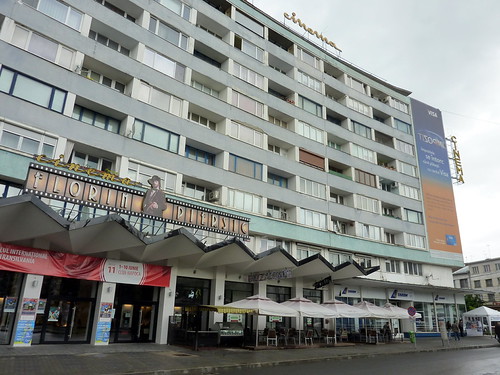
Cinema Florin Piersic in Cluj, Romania.
Sources: Immircea Alexandru (IMDb), Cinemagia (Romanian), Wikipedia (English and Romanian), and IMDb.
Romanian postcard by Casa Filmului Acin.
Born in a Cinema
Florin Piersic (Romanian pronunciation: [floˈrin ˈpjersik] was born in a cinema in Cluj, Romania in 1936. His parents were seeing a film, when the contractions started. His family left Cluj when it was ceded to Hungary in 1940, and moved to Cernauti after the city's occupation by Romania the following year. There, his father Ștefan Piersic was appointed to the role of chief municipal veterinary. Later they returned home, and Florin graduated from the High School for Boys No. 3 in Cluj. In Bucharest he attended the Institute of Theater and Cinematographic Art (IATC, now UNATC), where he graduated in 1957. He made his film debut in the French-Romanian co-production Ciulinii Bărăganului/The Thistles of the Bărăgan (1958, Louis Daquin, Gheorghe Vitanidis), starring Nuta Charlea. The film was nominated for the Golden Palm award at the 1958 Cannes Film Festival. Soon followed another film part in the fairy-tale O poveste ca-n basme/The Princess in Love (1959, Ion Popescu-Gopo) and in 1959, Piersic joined the regular cast of the Romanian National Theater. His first role was as Richard in The Devil's Disciple, but he proved to directors that he could play anything.
Romanian postcard by Casa Filmului Acin.
A Dialogue-free Film
Another international success for Florin Piersic was the spy-film S-a furat o bombă/A Bomb Was Stolen (1961, Ion Popescu-Gopo), with Emil Botta. The dialogue-free film was entered into the 1962 Cannes Film Festival. The fantasy film De-aș fi... Harap Alb/The White Moor (1965, Ion Popescu-Gopo) was entered into the 4th Moscow International Film Festival where Popescu-Gopo won the award for Best Director. In West-Germany Piersic played in the historical drama Kampf um Rom I/The Last Roman (1968, Robert Siodmak), about Justinian's (Orson Welles) attempts to repel barbarian incursions and reclaim those parts of the empire already lost. The star cast also included Laurence Harvey and Sylva Koscina. Another historical epic was Columna/The Column (1968, Mircea Drăgan). This Romanian production also had an international cast, a.o. Richard Johnson and Antonella Lualdi. Another Romanian historical production was Mihai Viteazul/Michael the Brave (1970, Sergiu Nicolaescu), about Mihai Viteazu (Amza Pellea), the famous prince who united the three provinces: Transalpine Vallachia, Transylvania and Moldavia, into the country of Romania, at the end of the 16th century (1599-1601) against the opposition of the Ottoman and Austrian Empires. The film was released in 1970 in Romania, and worldwide by Columbia Pictures as The Last Crusade.
East-German postcard by CEB Progress Filmvertrieb, Berlin, no. 190/71, 1971. Retail price:0,20 M. Photo: publicity still for Haiducii lui Saptecai/The Outlaws of Captain Anghel (1970, Dinu Cocea).
Romanian postcard by Casa Filmului Acin. Photo: Florin Piersic in his role as Margelatul.
Greatest Romanian #51
Another highlight in Florin Piersic’s career is Drumul oaselor/Bone Road(1982, Dorus Nastase) with Marga Barbu. In this adventure film he played Margelatul, a criminal who helps the resistance in 1849 Romania. The huge success of the film lead to several sequels and the Romanian site Cinemania calls Margelatul one of the most beloved characters of the Romanian cinema. Piersic also appeared in the surreal fantasy Ramasagul (1984, Ion Popescu-Gopo) with Iurie Darie. After that the Romanian cinema went into decay. Piersic continued to perform in numerous productions of the Romanian National Theater until his retirement in 1989. He married thrice: to stage actress Tatiana Iekel (1962 - 1974), with whom he has a son, actor-director Florin Piersic Jr.; to the popular Hungarian actress Anna Széles (1975 – 1985), the mother of another son, Daniel Piersic; and since 1993, he is married to Anna Török. He made a come-back in the cinema in two films directed by his son Florin Jr., Eminescu versus Eminem (2005, Florin Piersic Jr.) and Fix Alert (2005, Florin Piersic Jr.). On TV he appeared in the popular soap opera Lacrimi de iubire/Tears of Love (2005–2006 ). Initially he was cast for a guest appearance in two episodes, but the ratings of these episodes were so good that the producers decided to create a new role for him. In 2006, he was voted to the 51st place on the 100 greatest Romanians list. At 2008 he became an honorary citizen of Oradea. The following year, Florin Piersic was bestowed with the lifetime achievement award at the Transylvania International Film Festival. In 2011, the cinema Republic in Cluj was renamed Cinema Florin Piersic.
With Anna Szeles. Romanian postcard by Casa Filmului Acin, no. 33 150.
Cinema Florin Piersic in Cluj, Romania.
Sources: Immircea Alexandru (IMDb), Cinemagia (Romanian), Wikipedia (English and Romanian), and IMDb.