Showing posts with label Gösta Ekman. Show all posts

18 November 2024

Familjens traditioner (1920)

Gösta Ekman and Mary Johnson starred in the silent Swedish tragicomedy Familjens traditioner/Family Traditions (1920). The film was directed by Rune Carlsten for Svensk Filmindustri (SF) and was distributed by Skandiafilm. Familjens traditioner was shot at the Skandia studio at Långängen in Stockholm with exteriors from the Råbelöv estate in Skåne and Ludvika by Raoul Reynols. Axel Eliassons Konstförlag published this series of postcards.

Mary Johnson and Gösta Ekman in Familjens traditioner (1920)
Swedish postcard by Axel Eliassons Konstförlag, no. 185. Photo: Skandiafilm. Gösta Ekman and Mary Johnson in Familjens traditioner (Rune Carlsten, 1920).

John Ekman and Tora Teje in Familjens traditioner (1920)
Swedish postcard by Axel Eliassons Konstförlag, no. 186. Photo: Skandiafilm. John Ekman and Tora Teje in Familjens traditioner (Rune Carlsten, 1920).

Borrowing money from a stranger


Familjens traditioner/Family Traditions (Rune Carlsten, 1920) is based on Einar Fröberg's play 'Disciplin' (Discipline), which premiered at Dramaten, the Royal Dramatic Theatre in Stockholm, in 1911. The film scenario was written by Sam Ask and director Rune Carlsten.

The young Baron Robert of Valla (Sven Bergvall) falls in love with his distant relative Helga (Tora Teje) on a motorbike ride. They marry.

However, Helga feels unappreciated and is kept in her place by old Aunt Frederique (Hilda Castegren) and others. It is not until the death of her father-in-law, the old Baron Stenklo (Hjalmar Selander), and Robert's appointment as lord of the manor that she begins to breathe again. She throws herself into a whirl of pleasures.

Her husband does not give her much pleasure and neglects her. Helga is courted by the owner of the estate, Sixten Borgman (John Ekman), an upstart who, on a visit to the races, persuades her to make a bet: he lends her money and she writes a receipt.

Helga loses the money, and at the ball that follows, the landowner takes the opportunity to betray her. Through the mediation of the scheming Aunt Frederique, the story comes to Robert's attention and he takes great offence at Helga's borrowing money from a stranger. After this, the marriage becomes very cold, and Helga's life becomes even more desolate than before.

Mary Johnson and Gösta Ekman in Familjens traditioner (1920)
Swedish postcard by Axel Eliassons Konstförlag, no. 189. Photo: Skandiafilm. Gösta Ekman and Mary Johnson in Familjens traditioner (Rune Carlsten, 1920).

Mary Johnson and Gösta Ekman in Familjens traditioner (1920)
Swedish postcard by Axel Eliassons Konstförlag, no. 190. Photo: Skandiafilm. Gösta Ekman and Mary Johnson in Familjens traditioner (Rune Carlsten, 1920).

The daring intervention of the house's faithful servant


Robert's younger brother, Ernst (Gösta Ekman), has long had a crush on Helga and is now indignant at the way she is treated by her husband. At the same time, Ernst is very enamoured with the sweet daughter of the provost, Inga Lidner (Mary Johnson).

When the Stenklo family visits Provost Lidner for crayfish fishing, a series of dramatic events occur. Ernst and Inga fall out. Robert behaves rudely towards Helga. Helga seeks comfort from Ernst.

A forest fire breaks out on the estate and Robert has to go out and lead the extinguishing work. When Robert returns home at night and seeks out his wife to apologise, he finds his brother hiding in her sleeping alcove.

The situation is about to lead to the deepest misfortune when the house's faithful servant, old Bergqvist (Carl Browallius), dares to intervene. He overheard Helga talking to Ernst through the door, explaining that she loved her husband and could never betray him. Bergqvist also reminds Robert of his promise to his father: to always support his brother.

After this settlement, all is well again on the estate. The family traditions are cherished as before, but no longer as a heavy duty but in love.

Tora Teje and Gösta Ekman in Familjens traditloner 1920)
Swedish postcard by Axel Eliassons Konstförlag, no. 191. Photo: Skandiafilm. Gösta Ekman and Tora Teje in Familjens traditioner (Rune Carlsten, 1920).

Mary Johnson and Gösta Ekman in Familjens traditioner (1920)
Swedish postcard by Axel Eliassons Konstförlag, no. 192. Photo: Skandiafilm. Gösta Ekman and Mary Johnson in Familjens traditioner (Rune Carlsten, 1920), here also with Sven Bergvall and Carl Browallius, mentioned here as Brovallius.

Sources: The Swedish Film Database, Wikipedia (Swedish) and IMDb.

02 October 2023

Gösta Ekman

Gösta Ekman (1890-1938) was the first real star of the Swedish theatre. His boyish good looks attracted both sexes, helping to create a massive cult following, and elevating him to the status of a living legend. Combined with a beautiful voice, and a powerful stage and screen presence, Ekman was able to captivate his audiences.

Pauline Brunius in Thora van Deken
Swedish postcard by Verlag Nordisk Konst, Stockholm, no. 1095/9. Photo: Skandia Film. Publicity still for Thora van Deken/A Mother's Fight (John W. Brunius, 1920) with Oscar Johansson, Pauline Brunius, Gösta Ekman and Jessie Wessel.

Gösta Ekman and Jenny Hasselqvist in Vem dömer
Swedish postcard by Axel Eliassons Konstförlag, Stockholm, no. 304. Photo: Skandia Film. Gösta Ekman and Jenny Hasselquist in the Swedish silent drama Vem dömer/Love's Crucible (Victor Sjöström, 1922).

Gösta Ekman in Faust
German postcard by Ross Verlag, no. 62/5. Photo: Ufa. Publicity still for Faust (Friedrich Wilhelm Murnau, 1926).

Gösta Ekman in Klovnen (1926)
German postcard by Ross Verlag, no. 1623/1, 1927-1928. Photo: Nordisk. Publicity still for Klovnen/The Clown (A.W. Sandberg, 1926).

Gösta Ekman
German postcard by Ross Verlag, no. 3746/2, 1928-1929. Photo: Terra Film. Gösta Ekman in the German silent film Revolutionshochzeit/The Last Night (A.W. Sandberg, 1928).

Master of disguise


Gösta Ekman was born as Frans Gösta Viktor Ekman in Stockholm in 1890. He first entered the stage as an extra in 1906 but made his professional stage debut in the renowned Selander Company in 1911.

During his short life, he enjoyed a prolific stage career, becoming a star of the Swedish theatre. He won acclaim for his classic portrayals, such as Lionel in Friedrich Schiller’s 'Maid of Orleans' (1914), Claudio in 'Much Ado About Nothing' (1916), and Romeo in 'Romeo and Juliet' (1919).

Known as a self-taught master of disguise with theatre make-up and costumes, Gösta Ekman was equally convincing as a farmer's son, an 18th-century middle-aged aristocrat, or an 80-year-old lunatic. Furthermore, he played in comedies, tragedies, dramas, and operettas. As a result, it was believed that he was capable of being convincing in all genres and as all types of characters.

At different times, he also ran and supervised several private theatres in Stockholm, including the Oscarsteatern, the Vasateatern, and the Konserthusteatern. He was also head of the Gothenburg City Theatre in the 1930s.

At the Vasateatern, which he ran from 1931 to 1935, he both directed and played the lead in several plays, while also producing a large number of productions. As a result, his time at the Vasateatern is considered to be the peak of his stage career.

Gösta Ekman
Swedish postcard by Axel Eliassons Konstförlag, Stockholm, no. 413, mailed in 1916. Photo: Uno Falkengren, Göteborg.

Gösta Ekman in Magdalena Rudenschöld
Swedish postcard by Axel Eliassons Konstförlag, Stockholm, no. 44. Photo: Hofatelier Jaeger, 1917.

Gösta Ekman
Swedish postcard by Axel Eliassons Konstförlag, Stockholm, no. 21. Photo: Uno Falkengren, Nordiska Kompaniet, 1918.

Gösta Ekman
Swedish postcard, no. 903. Photo: Goodwin, 1918.

Gösta Ekman
Swedish postcard by Förlag Nordisk Konst, Stockholm, no. 1188. Photo: Ferd. Flodin, Stockholm. Written on the back: 1922.
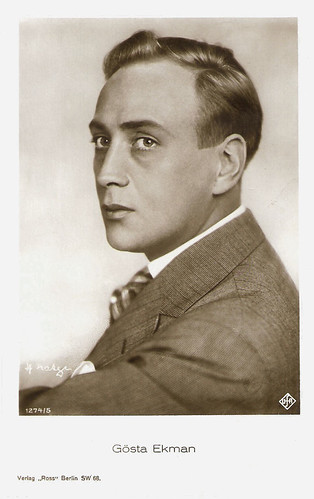
Gösta Ekman
German postcard by Ross Verlag, no. 1274/5, 1927-1928. Photo: H. Natge / Ufa.

Gösta Ekman
Austrian postcard by Iris-Verlag, no. 5355. Photo: Pan-Film A.G.

Gösta Ekman
German postcard by Ross Verlag, no. 4034/2, 1929-1930. Photo: Aafa Film.

The clown


Gösta Ekman started to appear in films at the dawn of the Swedish film industry and played an important role in its development.

One of his first film roles was in Victor Sjöström's experimental film Trädgårdsmästaren/The Broken Springrose (Victor Sjöström, 1912).

He also appeared in Den Okända/The Unknown Woman (Mauritz Stiller, 1913), Vem dömer/Love's Crucible (Victor Sjöström, 1922), and Karl XII/Charles XII (John W. Brunius, 1924-1925) made in two parts.

Ekman also starred in Nordisk Studio's most lucrative release of the 1920s, Klovnen/The Clown (1926), directed and co-written by A.W. Sandberg. This was a remake of a 1917 film with the same title, also written and directed by Sandberg.

Later, Gösta Ekman also played the lead in the first Swedish sound film, För hennes skull/For Her Sake (Paul Merzbach, 1930).

Jenny Hasselquist, Ivan Hedqvist, Tore Svennberg and Gösta Ekman in Vem dömer
Swedish postcard by Axel Eliassons Konstforlag, no. 305. Photo: Skandia Film. Jenny Hasselquist, Ivan Hedqvist, Tore Svennberg and Gösta Ekman in Vem dömer/Love's Crucible (Victor Sjöström, 1922). The film is a Renaissance drama where a young woman named Ursula (Hasselquist), who is in love with Bertram, the son (Ekman) of the mayor (Svenberg), is accused of having poisoned her older husband, the sculptor Master Anton (Hedqvist). She has to prove her virginity through a fire test. The film's title reads: Who judges? NB. Nils Asther had a small part in this film. He is the man just left of Hasselquist.

Gösta Ekman in Karl XII
Romanian postcard. Photo: Monopol Gloria-Film. Gösta Ekman as the elder Swedish king Charles XII in the prestigious Swedish period piece Karl XII (John W. Brunius, 1925). Caption: The famous fight at Bender aka Tighina [a city in Moldova] in the film Karl XII.

Gösta Ekman and Karina Bell in Klovnen (1926)
Austrian postcard by Iris Verlag, no. 949. Photo: Nordisk Film / Lux Film Verleih. Publicity still for Klovnen/The Clown (A.W. Sandberg, 1926) with Karina Bell.

Diomira Jacobini and Gösta Ekman in Revolutionsbryllup
Danish postcard by Alex. Vincent's Kunstforlag, Eneret, no. 253. Photo: publicity still for Revolutionshochzeit/Revolutionsbryllup/The Last Night (A.W. Sandberg, 1928) with Diomira Jacobini.

Gösta Ekman
German postcard by Ross Verlag, no. 3746/1, 1928-1929. Photo: Terra Film. Publicity still for Revolutionshochzeit/Revolutionsbryllup/The Last Night (A.W. Sandberg, 1928).

The King


Gösta Ekman starred in two films that would gain international recognition. In F.W. Murnau's silent film classic Faust (Friedrich Wilhelm Murnau, 1926), he played the title character opposite Emil Jannings as Mephisto.

And in the original version of Intermezzo (Gustaf Molander, 1936), where he played a world-famous violinist opposite Ingrid Bergman in her breakout role.

Ekman and Bergman had already acted opposite each other in Swedenhielms/Swedenhielms Family (Gustaf Molander, 1935). They share a couple of wonderful scenes together as their characters have a heart-to-heart conversation on life and love, which are among the most memorable moments in the film.

His best on-screen credit is his double role in the comedy Kungen kommer/The King Is Coming (Ragnar Hyltén-Cavallius, 1936), where Ekman masterfully plays first the king and then also the king's look-a-like; an actor who is hired by members of the Royal Court to impersonate His Majesty at a private party. Naturally, the real king later arrives at the party causing several confusions and comic mix-ups.

Ekman co-directed himself in the film En Perfekt gentleman/A Perfect Gentleman (Vilhelm Bryde, 1927), in which he also starred opposite exotic star La Jana.


Gösta Ekman, Emil Jannings and Hanna Ralph in Faust (1926)
German postcard by Ross Verlag, no. 62/1. Photo: Parufamet. Publicity still for Faust (1926) with Hanna Ralph and Emil Jannings.
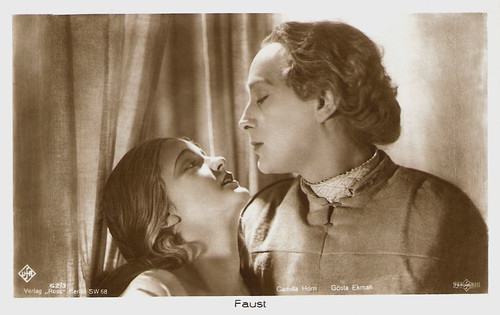
Gösta Ekman and Camilla Horn in Faust
German postcard by Ross Verlag, no. 62/3. Photo: Parufamet. Publicity still for Faust (1926) with Camilla Horn.
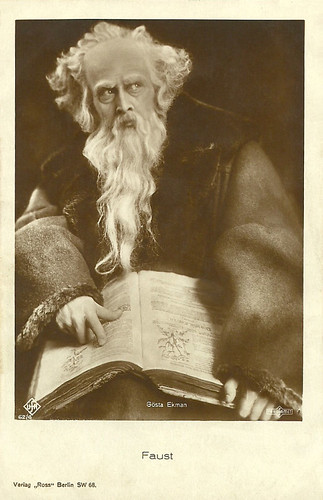
Gösta Ekman, Faust
German postcard by Ross Verlag, no. 62/6. Photo: ParUfaMet / Ufa. Gösta Ekman in Faust (1926). Collection: Didier Hanson.

Camilla Horn and Gösta Ekman in Faust (1926)
German postcard by Ross Verlag, no. 66/5. Photo: Ufa. Publicity still for Faust (1926) with Camilla Horn.

Gösta Ekman, Camilla Horn, Faust
German postcard by Ross Verlag, no. 66/6. Photo: Ufa. Publicity still for Faust (1926) with Camilla Horn.

Cocaine


Early on, Gösta Ekman was labelled as a workaholic, sacrificing himself for his art and for his love of the theatre. Later, as his fame increased, his workload increased likewise.

During the day, he would rehearse and direct plays. In the evening, he played leading roles in stage plays. Later at night, he would film. This busy schedule left him with relatively little free time. Furthermore, the free time he did have was spent carrying out his duties as the administrative director of the theatres he ran.

In 1926, while filming Faust in Berlin, he was introduced to cocaine by two Scandinavians, who told him that the drug would help him to cope better with his work schedule. Sadly, this began a long-term drug addiction that slowly deteriorated his health and eventually caused his death 12 years later at the age of 47.

In 1914, Gösta Ekman had married Greta Sundström. Their son Hasse Ekman became one of Sweden's most successful film directors in the 1940s and early 1950s. Gösta Ekman's grandson, Gösta Ekman Jr., was one of Sweden's finest actors. He passed away in 2017.

Gosta Ekman in Karl XII
German postcard with Romanian imprint by Ross Verlag, no. 1274/3. Photo: H. Natger. Caption: Gösta Ekman in the great film Karl XII (John W. Brunius, 1925). Wikipedia mentions that the film 'because of its long-running time of nearly six hours, it was released in two separate parts. The film depicts the life of Charles XII of Sweden (1682-1718) who oversaw the expansion of the Swedish Empire until its defeat at the Battle of Poltava. It was the most expensive production in Swedish history when it was made, and inspired a string of large budget Swedish historical films.'

Gösta Ekman
German postcard by Ross Verlag, no. 4462/1, 1929-1930. Photo: Jaeger (?).

Gösta Ekman
Austrian postcard by Iris Verlag, no. 968. Photo: Nordisk Film / Lux Film Verleih.

Gösta Ekman
German postcard by Ross Verlag, Berlin, no. 8050/1, 1933-1934. Photo: Svensk Filmindustri(e).


DVD trailer for Faust (1926). Source: Kino International (YouTube).


Scene from Klovnen/The Clown (1926). Source: Vintagezelle (YouTube).

Sources: Wikipedia, Encyclopaedia Britannica, and IMDb.

This post was last updated on 11 February 2024.

17 August 2023

Revolutionshochzeit (1928)

EFSP's co-editor Ivo Blom is in Germany, where he visits the Bonn Stumfilmtage. Tonight he attends the screening of Revolutionshochzeit/The Last Night (1929), a revolutionary drama which shows the sophistication with which a "mere entertainment film" could be made in the late 1920s. The stage play, 'Revolutionsbryllup', on which the film is based, by the famous Danish writer Sophus Michaëlis, had previously been filmed four times in Denmark and Germany. This last silent film adaptation is a masterstroke of international cooperation: a Danish director, A.W. Sandberg, staged a Danish play with French content on behalf of a German production company. The small ensemble consisted of the Swede Gösta Eckman, the Italian Diomira Jacobini, the Austrian Fritz Kortner, the German Walter Rilla and the Dane Karina Bell. And the 35mm print that is shown in Bonn comes from the Danish Film Institute in Copenhagen.

Diomira Jacobini and Gösta Ekman in Revolutionsbryllup
Danish postcard by Alex. Vincent's Kunstforlag, Eneret, no. 253. Photo: Diomira Jacobini and Gösta Ekman in Revolutionshochzeit/ The Last Night (A.W. Sandberg, 1927).

Diomira Jacobini and Gösta Ekman in Revolutionsbryllup (1928)
Danish postcard by Alex. Vincent's Kunstforlag, Eneret, no. 254. Photo: publicity still for Revolutionshochzeit/The Last Night (A.W. Sandberg, 1928). This was a German-Danish dramatisation of Sophus Michaëlis' play 'Revolutionsbryllup' (Revolutionary Wedding) and produced by Terra-Filmkunst. This card shows left Gösta Ekman and Karina Bell and in the back Fritz Kortner as the Jacobine Monteloup, and right Diomira Jacobini whose character, the aristocratic Alaine, has changed clothes with her maid Leontine (Karina Bell) to get a pass to leave Paris.

Paris in 1793, in the midst of the French Revolution


Revolutionshochzeit/Revolution Wedding (A.W. Sandberg, 1928) evolves in Paris in 1793, in the midst of the French Revolution. To fulfil her late father's last wish, the Comtesse Alaine de l'Estelle has become engaged to the noble Erneste de Tressailles.

Alaine de l’Estelle (Diomira Jacobini) and her maid Leontine (Karina Bell) try to flee Paris. Alaine is expected by her fiance, Ernest de Tresailles (Walter Rilla), at the castle of Trionville.

Erneste is fighting as a so-called émigré officer in the Austrian army against the Republicans. When Erneste is stationed near Alaine's castle of Trionville, he visits her in order to marry quickly. But that's when a Republican army led by the cold-hearted citizen-commissar Jacobine Monteloup (Fritz Kortner) invades the chateau and arrests Erneste.

As an émigré officer and enemy of the people, he is sentenced to death. In order to save Erneste, Alaine asks the good-natured Republican lieutenant Marc-Arron (Gösta Ekman) for help. He is a member of the Jacobines, who right after the marriage of Ernest and Alaine occupy Trionville.

For the love of Alaine, Marc tries to help Ernest and, consequently, is arrested and executed.

Gösta Ekman in Revolutionsbryllup/ Revolutionshochzeit
German postcard by Ross Verlag, no. 3746/1, 1928-1929. Photo: Terra Film. Gösta Ekman in the Revolutionshochzeit/Revolution Wedding (A.W. Sandberg, 1928).

Gösta Ekman in Revolutionshochzeit (1928)
German postcard by Ross Verlag, no. 3746/2, 1928-1929. Photo: Terra Film. Gösta Ekman in the Revolutionshochzeit/Revolution Wedding (A.W. Sandberg, 1928).

A still enjoyable film full of excitement


Revolutionshochzeit/Revolution Wedding (A.W. Sandberg, 1928) is an adaptation by Norbert Falk and Robert Liebmann of the 1906 play of the same name by Sophus Michaelis and was produced by the Berlin company Terra-Film AG. Filming took place in the Terra Glass House and the surrounding area of Paris.

After passing through the Reich film censors, who gave the film the rating "Volksbildend" (educating the people), it premiered in Berlin (Mozartsaal) on 3 October 1928. In the following weeks, it was shown in other European countries, and later worldwide.

Revolutionshochzeit/Revolution Wedding was described by contemporary critics as a "top work", a "great film" and a "great revolutionary film". In particular, the courage of the tragic ending and the performance of Gösta Ekman and the direction of Anders Wilhelm Sandberg were praised.

Hans Wollenberg in Lichtbild-Bühne, no. 239, 4.10.1928: A. W. Sandberg, the Danish director, not only proves to be a master of the magnificent, splendidly moving and animated mass scenes but rather, above the outer unfolding, devotes all his love to the inner human core and thus to the actual play scenes with the finest feeling for the unravelling of the human heart, makes his directorial achievement an artistic deed. One must realise the unusual tasks that this demanding subject confronted the director with in order to appreciate the rich and great art of interpretation to which it owes its realisation as a silent film.

Revolutionshochzeit/Revolution Wedding was popular with the public, but after the film had been shown in cinemas, it fell into oblivion. It took till 2010 for a print from Moscow to emerge at the film archive of Toulouse, which was sent to the Filmmuseum Potsdam, where it was restored and re-premiered in March 2011. It was considered then to have an overdose of pathos and heroism, but it is also an enjoyable film full of excitement.

Karina Bell in Revolutionsbryllup (1928)
German postcard by Ross Verlag, no. 3747/1, 1928-1929. Photo: Terra Film. Karina Bell in Revolutionshochzeit/The Last Night (A.W. Sandberg, 1928).

Diomira Jacobini in Revolutionshochzeit (1928)
German postcard by Ross Verlag, no. 3748/1, 1928-1929. Source: Terra-Film. Diomira Jacobini in Revolutionshochzeit/The Last Night (A.W. Sandberg, 1928).

Sources: Bonn Stumfilmtage (German), Wikipedia (German) and IMDb.

11 May 2022

Bomben (1920)

Boyish good-looking Gösta Ekman and Karin Molander were the stars of the Swedish silent comedy Bomben/Sunshine and Shadow (Rune Carlsten, 1920). Skandia Film produced the film and the film was shot in the summer of 1919 in the Skandia studio in Långängen, the Claestorp estate in Södermanland, Sigtuna, Vaxholm, Stockholm and on the Jönköping-Gripenberg railway. Axel Eliassons Konstförlag published a series of delicious postcards of the film.

Karin Molander in Bomben (1920)
Swedish postcard by Axel Eliassons Konstförlag, Stockholm, no. 158. Photo: Skandia Film. Karin Molander as Elsa and Sam Ask as Bredberg in Bomben (Rune Carlsten, 1920). Caption: The "bomb" has exploded.

Gösta Ekman in Bomben
Swedish postcard by Axel Eliassons Konstförlag, Stockholm, no. 159. Photo: Skandia Film. Gösta Ekman in Bomben (Rune Carlsten, 1920). Caption: As farmer apprentice.

Karin Molander in Bomben (1920)
Swedish postcard by Axel Eliassons Konstförlag, Stockholm, no. 160. Photo: Skandia Film. Karin Molander as Elsa Wendel and Hilda Castegren as Mrs. Bredberg, her godmother, in Bomben (Rune Carlsten, 1920). Caption: That's what you look like when you've won one of the most beautiful estates in the kingdom!

Gösta Ekman in Bomben (1920)
Swedish postcard by Axel Eliassons Konstförlag, Stockholm, no. 161. Photo: Skandia Film. Gösta Ekman as Ture and Josua Bengtsson as Petterson in Bomben (Rune Carlsten, 1920). Caption: A proven sacrifice of reconciliation.

The effects of a drinking tour


Young landlord and agricultural pupil, baron Ture von Örnefeldt (Gösta Ekman), celebrates his official day of maturity with a big party at the city hotel in Lillköping. Afterward, he accompanies his new friend, the clerk Lars Morin (Ragnar Arvedson), on a drinking tour, but as Ture in his excitement annoys the city's police, Morin inflicts in order not to lose his reputation.

When Ture later in the night tries to attract Morin's attention by throwing a stone through his window, he thinks the stone killed an elderly gentleman. In fact, the harmful effects have been minimal. The stone accidentally came in through a wrong window and ended up at a birthday party for chief accountant Bredberg from Lillköping (Sam Ask). Bredberg fainted with pure horror, his face going white, causing Ture to think he had murdered the man.

The next day, Bredberg accompanies his goddaughter Elsa Wendel (Karin Molander) to the train. Elsa has just received the estate Cronoholm from an uncle, who, however, stipulated in the testament that his heir needs to marry Lt. Gabriel Trane (Vilhelm Bryde), or pay 250,000 Swedish crowns to him. On the same train, Ture is heading away from the neighborhood of his evil.

He meets on the train an old acquaintance from the agricultural school, where he is actually a student. This Josias Svensson (Hugo Tranberg) has been employed as an inspector at Cronoholm and is now about to take up his job. Ture fools his friend to go abroad and wears his inspector's identity. As an inspector of Elsa Werner's estate, Ture becomes in love with his employer, and even she thinks well of him.

However, she sees no opportunity to take on her the expenses of a quarter of a million to avoid marrying the unsympathetic lieutenant Trane. When, furthermore, it fits her to believe that the inspector is bound elsewhere, she decides to announce her engagement with Gabriel Trane. Among the guests at the engagement party, though, there is also chief accountant Bredberg.

Ture finally understands that he is by no means a murderer and therefore he no longer needs to maintain his false identity. The lieutenant's intrigue is revealed, the engagement is broken off, and Elsa and Ture get each other. Since Ture is rich enough to pay the 250,000, the testament is no longer a barrier, and Lieutenant Trane can retreat with sufficient resources to entertain his mistress, actress Bojan Jensen (Lilian Rössel).

The British Film Institute has an incomplete print of Bomben/Sunshine and Shadow (Rune Carlsten, 1920) of 516 ft (157 m.). The Swedish Film Institute only has a few seconds of the film. A complete copy of the film never resurfaced.

Gösta Ekman and Karin Molander in Bomben (1920)
Swedish postcard by Axel Eliassons Konstförlag, Stockholm, no. 162. Photo: Skandia Film. Gösta Ekman and Karin Molander in Bomben (Rune Carlsten, 1920). Caption: Happily united.

Karin Molander and Vilhelm Bryde in Bomben (1920)
Swedish postcard by Axel Eliassons Konstförlag, Stockholm, no. 163. Photo: Skandia Film. Vilhelm Bryde and Karin Molander in Bomben (Rune Carlsten, 1920). Caption: Miss Elsa gives away her hand in despair.

Gösta Ekman and Karin Molander in Bomben (1920)
Swedish postcard by Axel Eliassons Konstförlag, Stockholm, no. 164. Photo: Skandia Film. Gösta Ekman and Karin Molander in Bomben (Rune Carlsten, 1920). Caption: The estate manager and the inspector check the accounts.

Karin Molander in Bomben
Swedish postcard by Axel Eliassons Konstförlag, Stockholm, no. 166. Photo: Skandia Film. Karin Molander in Bomben (Rune Carlsten, 1920). Caption: Elsa Vendel's first morning amidst her own possessions.

Sources: The Swedish Film Database, Wikipedia (Swedish) and IMDb.

18 May 2021

Vem Dömer (1922)

The Swedish silent film Vem dömer/Love's Crucible (1922) was a Skandia Film production directed by the great Viktor Sjöström. The film is a Renaissance drama where a young woman named Ursula (Jenny Hasselqvist), who is in love with Bertram (Gösta Ekman), the son of the mayor (Tore Svenberg), is accused of having poisoned her older husband, the sculptor Master Anton (Ivan Hedqvist). She has to prove her virginity through a fire test. The literal translation of the film's title reads: Who judges?

Jenny Hasselqvist and Gösta Ekman in Vem dömer (1922)
Swedish postcard by Axel Eliassons Konstförlag, Stockholm, no. 299. Photo: Skandia Film, Stockholm. Jenny Hasselqvist and Gösta Ekman in Vem dömer/Love's Crucible (Victor Sjöström, 1922).

Jenny Hasselqvist and Gösta Ekman in Vem dömer (1922)
Swedish postcard by Axel Eliassons Konstförlag, Stockholm, no. 300. Photo: Skandia Film, Stockholm. Jenny Hasselqvist and Gösta Ekman in Vem dömer/Love's Crucible (Victor Sjöström, 1922).


Jenny Hasselqvist in Vem dömer, Skandiafilm, Axel Eliasson 301
Swedish postcard by Axel Eliassons Konstförlag, Stockholm, no. 301. Photo: Skandia Film, Stockholm. Jenny Hasselqvist and Ivan Hedqvist in Vem dömer/Love's Crucible (Victor Sjöström, 1922).

A film of extraordinary visual beauty


Vem dömer/Love's Crucible (1922) was Victor Sjöström’s follow up to Körkarlen/The Phantom Carriage (Victor Sjöström, 1921). The lavish production premiered on New Year’s Day in 1922 accompanied by the Red Kvarn Orchestra and a publicity campaign including an illustrated book of Hjalmar Bergman’s story. Paul Joyce at his blog Ithankyou: "Sjöström co-wrote the screenplay and whilst this tale of illicit period romance may appear atypical it has much in common with its predecessor and the director’s earlier work."

The story of Vem dömer/Love's Crucible (1922) takes place in the Catholic south and is shot largely on (vast) studio sets, so it lacks the location shooting and Nordic settings of Sjöström’s more famous works. However, a connection to how nature takes an active part and interferes with the plot of several more famous 'Golden Age' films can be found in how the use of fire – one of the classical elements of nature – is essential to the film’s conclusion. Just as characters in Terje Vigen/A Man There Was (Victor Sjöström, 1917) and Berg-Ejvind och hans hustru/The Outlaw and His Wife (Victor Sjöström, 1918) must endure extremes in order to survive, so must Jenny Hasselqvist’s Ursula overcome not just a physical test but also a moral one: she has to judge herself.

Contemporary reviewers criticised Vem dömer/Love's Crucible for being "artificial" and "lacking in soul", and these complaints were repeated by some later historians of the Swedish silent cinema. The film’s critical and commercial failure was readily linked to its supposed lack of specifically Swedish authenticity and heart, the Italianate, distinctly Catholic milieu obscuring the many continuities with earlier successes. While the weeping crucifixes and Christ-visions of this film are just as much realisations of the characters’ legend-filled world-view as the peasant paradise of Ingmarssönerna/The Sons of Ingmar (Victor Sjöström, 1919) and the death-cart of Körkarlen/The Phantom Carriage (Victor Sjöström, 1921), they may have sparked the uneasy suspicion in some critics that they were meant to preach rather than portray a superstitious religiosity.

In 1969, a duplicate negative of Vem dömer/Love's Crucible was made by the Svenska Filminstitutet from a nitrate positive source. A viewing print was struck from this negative the same year. In 2017, this print was presented at the Pordenone Silent Film Festival, Le Giornate del Cinema Muto. The musical accompaniment in the Verdi Theatre in Pordenone was by Neil Brand and Frank Bockius. Valerio Greco made a series of photos of the event.

In the festival catalog, Magnus Rosborn and Casper Tybjerg wrote: "A film of extraordinary visual beauty, Love’s Crucible has never held the canonical status of Sjöström’s better-known films, despite being known as a film that brought his directorial skills to Hollywood’s attention, leading to his American career two years later, and also despite the similar way it presents an unsparing, psychologically profound examination of marital hatred, guilt, and atonement wrapped inside an atmosphere of legend, old tales, and supernatural visitation. (...)

The evident artistry of the film – every shot is exactingly composed – goes against the myth of Sjöström as an instinctive artist, a rough-hewn naïf similar to the good-hearted peasants he sometimes played on screen. With its sumptuous renaissance setting, its vast sets, and its exquisitely crafted visuals, realized through the efforts of master cinematographer Julius Jaenzon, Love’s Crucible is a self-consciously masterful display of cinematic art and technique."

Jenny Hasselqvist and Ivan Hedqvist in Vem dömer (1922)
Swedish postcard by Axel Eliassons Konstförlag, Stockholm, no. 303. Photo: Skandia Film, Stockholm. Jenny Hasselqvist and Ivan Hedqvist in Vem dömer/Love's Crucible (Victor Sjöström, 1922).

Gösta Ekman and Jenny Hasselqvist in Vem dömer
Swedish postcard by Axel Eliassons Konstförlag, Stockholm, no. 304. Photo: Skandia Film, Stockholm. Jenny Hasselqvist and Gösta Ekman in Vem dömer/Love's Crucible (Victor Sjöström, 1922).

Jenny Hasselqvist, Ivan Hedqvist, Tore Svennberg and Gösta Ekman in Vem dömer (1922)
Swedish postcard by Axel Eliassons Konstförlag, Stockholm, no. 305. Photo: Skandia Film, Stockholm. Jenny Hasselqvist, Ivan Hedqvist, Tore Svennberg and Gösta Ekman in Vem dömer/Love's Crucible (Victor Sjöström, 1922). Nils Asther had a small part in this film. On this postcard, he is the man just left of Hasselquist.

Sources: Magnus Rosborn and Casper Tybjerg (Le Giornate del Cinema Muto); Paul Joyce (ithankyouarthur), IMDb, and Wikipedia (Italian).