Striking, sophisticated Suzanne Grandais (1893-1920) was the most beautiful and refined actress of the French silent cinema. Her nickname was 'the French Mary Pickford' because of her angel face and blond hair. Grandais died when she was only 27.

Vintage postcard. Collection: Didier Hanson.

French postcard.

Spanish postcard.

British postcard by K Ltd.

French postcard by Editions Cinémagazine, no. 25. Photo: Reutlinger.

Possibly a French postcard, but the editor is unknown.
Suzanne Grandais was born Suzanne Gueudret in Paris, France in 1893. At the age of 15, she already started to work as a dancer. Her first stage appearance was in Le Château Des Loufoques (The Castle of Loufoques) by Benjamin Rabier at the Théâtre de Cluny.
After a tour through South America, she played some parts in short silent films for the Lux and Eclair companies. Then she was discovered by pioneer director Louis Feuillade who hired her for Gaumont. Wikipedia (English) however suggests it was director Leonce Perret who discovered her at the Moulin Rouge.
From 1911 to 1913, Grandais made some 45 films for Gaumont, mostly short comedies and dramas. First she appeared in Feuillade's series Scènes de la vie telle qu'elle est/Life As It Is. In his Encyclopedia of Early Cinema, Richard Abel writes that these films were marked by her 'sober, restrained acting'.
Later Grandais often played Léonce Perret's wife or temptress in the Léonce series, elegant comedies starring and directed by Perret. She also appeared in such feature-length adventure melodramas as Le Mystère des roches de Kador/The Mystery of the Rocks of Kador (Léonce Perret, 1912).
In 1913-1914, Grandais switched to the German Dekage company (Deutsche Kinematograph Gesellschaft), for which she did another 18 films, directed by Marcel Robert and Charles Decroix. Then she founded her own film company with Raoul d'Archy, Les Films Suzanne Grandais.

Italian postcard by G. Vettori, Bologna, no. 83.

Spanish collectors card by Amatller Marca Luna chocolate, series 3, no. 10. Photo: Eclipse. Suzanne Grandais, Jane Danjou and Marcel Marquet in Midinettes (René Hervil, Louis Mercanton, 1917).

Spanish collectors card by Amatller Marca Luna chocolate, series 3, no. 11. Photo: Eclipse. Suzanne Grandais and Anthony Gildès in Midinettes (René Hervil, Louis Mercanton, 1917).

Spanish postcard by Amatller Marca Luna, series 6, no. 3. Photo: Eclipse. Suzanne Grandais in Lorena (Georges Tréville, 1918).

Spanish postcard by Amatller Marca Luna, series 6, no. 10. Photo: Eclipse. Suzanne Grandais and Jean Aymé in Lorena (Georges Tréville, 1918).

German postcard by Verleih Hermann Leiser, no. 7872. Photo: Willinger.
During the First World War, Suzanne Grandais also worked at Eclipse. The drama Suzanne (René Hervil, Louis Mercanton, 1916) was a major international success and turned Grandais into a star. French women started to notice that she always wore the latest fashions.
The great film critic Louis Delluc compared her to American serial queen Pearl White in the journal Paris-Midi in 1918. In 2005, Richard Abel called her 'arguably the most popular French actress of the early 1910s': "Grandais was equally adept at playing subtly pathetic figures, deceptive partners in crime, or witty wives who deftly outsmarted their husbands".
On Saturday 28 August 1920, Suzanne Grandais was killed while making the film serial L'Essor/The Rise (Charles Burguet, 1921) in the Alsace. She was only 27 when she died in a car crash between Sézanne and Coulommiers. Cameraman Marcel Ruette was also killed. Director Charles Burguet and his wife were in the back of the same car, but both survived. The accident happened during the shooting of the film, and the ending of the film had to be changed.
In 2009, Gallimard published a book on Grandais Un amour sans paroles (A Love Without Words), written by Didier Blonde. The author mentioned that he could see only one film of her. Most of Suzanne Grandais' more than 60 films are considered lost. But there's good news for him: several of her films have been saved by Eye Filmmuseum in Amsterdam.
Most of these films are short comedies and dramas, often directed by Léonce Perret, from her early years at Gaumont. These include Graziella la Gitane/Graziella the Gypsy (Léonce Perret, 1912), Le homard/Lobsters: All Styles (Léonce Perret, 1913), and L'obsession du souvenir/The Obsession of a Souvenir (1913). The films are preserved with beautiful tinted and stencil-colored colours. Eye also owns some feature films with Suzanne Grandais such as Le mystère des Roches de Kador/The Mystery of the Rocks of Kador (Léonce Perret, 1912).

French postcard. Photo: Phocea Films. Suzanne Grandais in Méa Culpa (Georges Champavert, 1919).

French postcard. Photo: Phocéa Film. Suzanne Grandais in the tile role of Simplette (René Hervil, 1919).

French postcard. Photo: Phocéa Film. Suzanne Grandais in Simplette (René Hervil, 1919).

French postcard by Phocéa-Film, no. 13. Photo: Phocéa-Film. Suzanne Grandais and Henry Roussel in Gosse de riche/Rich Kid (Charles Burguet, 1920).

French postcard. Photo: Phocéa-Film. Suzanne Grandais in Gosse de riche/Rich Kid (Charles Burguet, 1920).
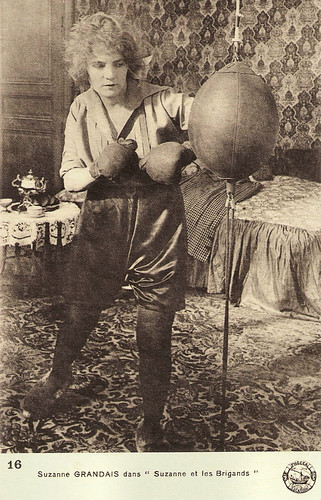
French postcard by Phocéa-Film, no. 16. Photo: Phocéa-Film. Suzanne Grandais in Suzanne et les Brigands/Suzanne and the Brigands (Charles Burguet, 1920).

French postcard. Photo: Sciarabin, Strasbourg / Phocea Films. Suzanne Grandais in L'essor/The Rise (Charles Burguet, 1920), 1st episode.

French postcard by Phocea-Films. This card was made for the 10th (and final) episode of the serial L'Essor/The Rise (Charles Burguet, 1921). Photo: Sciarabin, Strasbourg.
Sources: Richard Abel (Encyclopedia of Early Cinema), Alberto Blanco (Find A Grave), Gallimard (French), Wikipedia (French and English), and IMDb.
This post was last updated on 6 July 2024.
Vintage postcard. Collection: Didier Hanson.
French postcard.
Spanish postcard.
British postcard by K Ltd.
French postcard by Editions Cinémagazine, no. 25. Photo: Reutlinger.
Possibly a French postcard, but the editor is unknown.
Louis Feuillade
Suzanne Grandais was born Suzanne Gueudret in Paris, France in 1893. At the age of 15, she already started to work as a dancer. Her first stage appearance was in Le Château Des Loufoques (The Castle of Loufoques) by Benjamin Rabier at the Théâtre de Cluny.
After a tour through South America, she played some parts in short silent films for the Lux and Eclair companies. Then she was discovered by pioneer director Louis Feuillade who hired her for Gaumont. Wikipedia (English) however suggests it was director Leonce Perret who discovered her at the Moulin Rouge.
From 1911 to 1913, Grandais made some 45 films for Gaumont, mostly short comedies and dramas. First she appeared in Feuillade's series Scènes de la vie telle qu'elle est/Life As It Is. In his Encyclopedia of Early Cinema, Richard Abel writes that these films were marked by her 'sober, restrained acting'.
Later Grandais often played Léonce Perret's wife or temptress in the Léonce series, elegant comedies starring and directed by Perret. She also appeared in such feature-length adventure melodramas as Le Mystère des roches de Kador/The Mystery of the Rocks of Kador (Léonce Perret, 1912).
In 1913-1914, Grandais switched to the German Dekage company (Deutsche Kinematograph Gesellschaft), for which she did another 18 films, directed by Marcel Robert and Charles Decroix. Then she founded her own film company with Raoul d'Archy, Les Films Suzanne Grandais.
Italian postcard by G. Vettori, Bologna, no. 83.
Spanish collectors card by Amatller Marca Luna chocolate, series 3, no. 10. Photo: Eclipse. Suzanne Grandais, Jane Danjou and Marcel Marquet in Midinettes (René Hervil, Louis Mercanton, 1917).
Spanish collectors card by Amatller Marca Luna chocolate, series 3, no. 11. Photo: Eclipse. Suzanne Grandais and Anthony Gildès in Midinettes (René Hervil, Louis Mercanton, 1917).
Spanish postcard by Amatller Marca Luna, series 6, no. 3. Photo: Eclipse. Suzanne Grandais in Lorena (Georges Tréville, 1918).
Spanish postcard by Amatller Marca Luna, series 6, no. 10. Photo: Eclipse. Suzanne Grandais and Jean Aymé in Lorena (Georges Tréville, 1918).
German postcard by Verleih Hermann Leiser, no. 7872. Photo: Willinger.
Car crash
During the First World War, Suzanne Grandais also worked at Eclipse. The drama Suzanne (René Hervil, Louis Mercanton, 1916) was a major international success and turned Grandais into a star. French women started to notice that she always wore the latest fashions.
The great film critic Louis Delluc compared her to American serial queen Pearl White in the journal Paris-Midi in 1918. In 2005, Richard Abel called her 'arguably the most popular French actress of the early 1910s': "Grandais was equally adept at playing subtly pathetic figures, deceptive partners in crime, or witty wives who deftly outsmarted their husbands".
On Saturday 28 August 1920, Suzanne Grandais was killed while making the film serial L'Essor/The Rise (Charles Burguet, 1921) in the Alsace. She was only 27 when she died in a car crash between Sézanne and Coulommiers. Cameraman Marcel Ruette was also killed. Director Charles Burguet and his wife were in the back of the same car, but both survived. The accident happened during the shooting of the film, and the ending of the film had to be changed.
In 2009, Gallimard published a book on Grandais Un amour sans paroles (A Love Without Words), written by Didier Blonde. The author mentioned that he could see only one film of her. Most of Suzanne Grandais' more than 60 films are considered lost. But there's good news for him: several of her films have been saved by Eye Filmmuseum in Amsterdam.
Most of these films are short comedies and dramas, often directed by Léonce Perret, from her early years at Gaumont. These include Graziella la Gitane/Graziella the Gypsy (Léonce Perret, 1912), Le homard/Lobsters: All Styles (Léonce Perret, 1913), and L'obsession du souvenir/The Obsession of a Souvenir (1913). The films are preserved with beautiful tinted and stencil-colored colours. Eye also owns some feature films with Suzanne Grandais such as Le mystère des Roches de Kador/The Mystery of the Rocks of Kador (Léonce Perret, 1912).
French postcard. Photo: Phocea Films. Suzanne Grandais in Méa Culpa (Georges Champavert, 1919).
French postcard. Photo: Phocéa Film. Suzanne Grandais in the tile role of Simplette (René Hervil, 1919).
French postcard. Photo: Phocéa Film. Suzanne Grandais in Simplette (René Hervil, 1919).
French postcard by Phocéa-Film, no. 13. Photo: Phocéa-Film. Suzanne Grandais and Henry Roussel in Gosse de riche/Rich Kid (Charles Burguet, 1920).
French postcard. Photo: Phocéa-Film. Suzanne Grandais in Gosse de riche/Rich Kid (Charles Burguet, 1920).
French postcard by Phocéa-Film, no. 16. Photo: Phocéa-Film. Suzanne Grandais in Suzanne et les Brigands/Suzanne and the Brigands (Charles Burguet, 1920).
French postcard. Photo: Sciarabin, Strasbourg / Phocea Films. Suzanne Grandais in L'essor/The Rise (Charles Burguet, 1920), 1st episode.
French postcard by Phocea-Films. This card was made for the 10th (and final) episode of the serial L'Essor/The Rise (Charles Burguet, 1921). Photo: Sciarabin, Strasbourg.
Sources: Richard Abel (Encyclopedia of Early Cinema), Alberto Blanco (Find A Grave), Gallimard (French), Wikipedia (French and English), and IMDb.
This post was last updated on 6 July 2024.