Showing posts with label Barbara Crampton. Show all posts

Monday, 4 December 2023

Lovecraft on Film Appendum:
The Evil Clergyman
(Charles Band, 1987 / 2012)

As anyone familiar with his work will be aware, H.P. Lovecraft’s ‘The Evil Clergyman’ is a brief, half-formed fragment, obviously written in haste, perhaps extrapolated from a bad dream, and presumably never intended for publication in its extant form. Nonetheless, it saw print several years after Lovecraft’s death, in the April 1939 edition of ‘Weird Tales’, and - rather irksomely - it has formed part of his accepted canon ever since, seemingly more by accident than design.

As such, it seems appropriate that the story’s movie adaptation should take the form of an orphaned, 28 minute short, originally intended for inclusion in a 1988 Empire Pictures anthology flick named ‘Pulse Pounders’ which never saw the light of a projector at the time, remaining unreleased due to (it says here) circumstances arising from the company’s bankruptcy.

Furthermore, it appears that the original film elements for ‘The Evil Clergyman’ were subsequently misplaced or destroyed, leaving the footage presumed lost until, a quarter century later, Charlie Band found a VHS work print knocking about in his attic and smelled a quick buck to be made.

A bit of a clean up, a new credits sequence and a newly commissioned score from brother Richard later, and ‘The Evil Clergyman’ finally premiered, streaming on Band’s Full Moon Features website, in 2012.

I’m unfamiliar with the back story re: how exactly those film elements ended up disappearing, but I can only assume it must have been the result of some terrible and unprecedented freak accident, as any other explanation would frankly beggar belief given the breadth of talent involved in creating this segment, and the relatively lavish budget obviously invested in this thing.

With the exception of an AWOL Stuart Gordon in fact, ‘..Clergyman’ is effectively a ‘Reanimator’  reunion, with Dennis Paoli providing the script, photography by Mac Ahlberg, effects by John Carl Buechler, and a cast comprising Barbara Crampton, Jeffrey Combs and David Gale, with the ever wonderful David Warner (R.I.P.) thrown in for good measure.

In the grand tradition of Poe/Lovecraft adaptations through the ages, the film’s narrative has pretty much nothing in common with the supposed source story whatsoever. Instead, Paoli’s script sees Crampton taking centre stage, playing a woman returning to the attic chamber of a medieval castle which she had previously shared with her lover (Combs), a lapsed priest and alleged black magician who has recently taken his own life, prompting her to flee and leave the room vacant.

This ill-stared chamber is apparently still up for rent from the castle’s acid-tongued landlady (Una Brandon-Jones) however, and, once ensconced within it (ostensibly to “collect her things,” although the room looks bare), Crampton begins to experience a series of increasingly hair-raising manifestations related to her deceased partner, and reflective of the unholy depredations the pair apparently got up to prior to Combs’ decision to sling a noose slung over the high beams, and depart this mortal coil… temporarily, at least.

Along the way, Warner pops up as the revenant spirit of another dead priest, who pops up to warn Crampton of the error of her ways, whilst Gale is in full effect as Combs’ familiar, a chittering, man-faced rat-thing straight out of ‘Dreams in the Witch House’.

And... it actually all works really well. Paoli’s story is weird, memorable and unnerving, leaving plenty to the imagination, whilst the production design and performances are excellent.

Though she’s not really called upon to do much more than act terrified, confused and distraught here, Crampton achieves this quite brilliantly. Always a good few rungs up the ladder from yr average ‘80s ‘scream queen’, the sheer intensity scruff of the neck and drags us through this compressed ghost train ride of a viewing experience very effectively.

By contrast, we get a relatively low-key turn from Combs, but there is still a hell of a lot to enjoy in his sleazily sinister presence. His introductory “hi” at the moment his character first takes on corporeal form is a delight in itself, and the spectral love scenes he shares with Crampton take on an appropriately fevered quality, drawing us further into the odd story being told here.

Warner meanwhile seems a bit surplus to requirements here in terms of the narrative, but it’s great to have him along for the ride, and he’s clearly having a fine time regardless. In the midst of a seemingly endless series of rent-a-villain / mad scientist roles at this point in his career, the old boy knows exactly how to pitch a high-handed spectral priest, managing to deliver lines like “I’m a bishop, from Canterbury, sent to expel your lover from our church” entirely straight, without eliciting laughs from the peanut gallery.

As for the long-suffering David Gale meanwhile, one shudders to imagine the indignities he must have been subjected to in the process of realising Buechler’s man-faced rat effects - an inspired mixture of puppetry and facial prosthetics which is actually extremely effective, allowing Gale’s face and voice remain present, even when seemingly attached to a repulsive, ankle-high critter capering about on the castle floor.

Essentially functioning as a foul-mouthed, perpetually enraged manifestation of the Combs character’s id, Gale manages to deliver a memorable performance under what we might reasonably assuming were challenging circumstances; his spittle-flecked delivery of words like “WHORE” and “SLUT” in particular are imbued with an old world, puritan gusto which I very much enjoyed.

Shot, inevitably, amid the imposing environs of the swanky Italian castle which Charles Band inexplicably ended up owning in the late ‘80s (also see: ‘The Pit and the Pendulum’ (1991), ‘Castle Freak’ (1995)), ‘..Clergyman’ benefits greatly from the location’s in-built atmosphere, adopting an almost abstract / fairy tale-like vibe which slips further into delirium as Crampton’s visions take told, and the world outside her lofty chamber effectively ceases to exist.

Moodily lit by Ahlberg in a none-more-80s manner, with deep shadows and shocks of blue-tinged moon light drifting in across the ancient brick-work, this is certainly one of the more accomplished efforts I’ve seen bearing Charles Band’s name as director. As is often the case, it’s perhaps questionable to what extent creative decisions here were actually taken by Band, but for what it’s worth, everything here is very solidly done. (I particularly liked the striking use of vertiginous high and low angles, reflecting the constant presence of both the swinging noose above, and the skittering rat-thing below.)

Even Richard Band’s retrospectively recorded orchestral score goes over gangbusters, really classing up this murky VHS-sourced work-print, much like his similarly bombastic/melodic work on Gordon’s ‘80s films, hovering just on the precipice of Elfman-esque parody, but never quite taking the plunge, or overpowering the action on-screen.

Given how strong this short is overall, it’s easy to see why a few elements ended up being recycled in other productions during the years in which the material shot for ‘Pulse Pounders’ remained unreleased.

Most notably, the effects used to create the human-faced rat creature were repurposed pretty much in their entirety for the creation of Brown Jenkin in Gordon’s 2005 TV adaptation of Lovecraft’s ‘Dreams in the Witch House’, whilst the “erotically charged predatory haunting” conceit of Paoli’s script also strongly reminded me of another Gordon-adjacent film, Danny Draven’s 2002 ‘Deathbed’ (not to be confused with the late George Barry’s outsider masterpiece of the same name), an interesting obscurity, also shot by Ahlberg and executive produced by Band, which saw release on DVD under the rather niche banner of “Stuart Gordon presents…”. (Were there any other entries in that series, I wonder? I don’t recall ever seeing any...)

In summary then, ‘The Evil Clergyman’ stands as something of an unexpected minor miracle for fans of the Empire/Full Moon/Stuart Gordon milieu. Alongside this year’s Suitable Flesh, it offers encouraging proof that the spirit of Gordon’s Lovecraft movies could live on and flourish, even in circumstances in which the man himself was unable to call the shots. Well worth making a small amount of time for if (as is understandable) it passed you by upon its belated release in 2012.

Friday, 17 November 2023

Lovecraft on Film:
Suitable Flesh
(Joe Lynch, 2023)

“..the place of utter blasphemy, the unholy pit where the black realm begins and the watcher guards the gate… I saw a shaggoth - it changed shape… I can’t stand it… I won’t stand it… I’ll kill her if she ever sends me there again…” 

- H.P. Lovecraft, ‘The Thing On The Doorstep’

Though it was apparently drafted as early as 1933, ‘The Thing On The Doorstep’ was actually the last of H.P. Lovecraft’s story to see publication during the author’s lifetime, appearing two months before his death, in the January 1937 issue of ‘Weird Tales’.

Employing a relatively direct and unadorned prose style, ‘..Doorstep’ opens not with, say, a dense and baroque description of the stunted trees growing around some rarely used pike off the road in the depths of the Miskatonic valley, but instead with a concise sentence more deliberately designed to draw in the casual pulp magazine reader. (“It is true that I have sent six bullets through the head of my best friend, and yet I hope to show by this statement that I am not his murderer.”)

This has led some to speculate that this tale, chronicling decadent writer Edward Pickman Derby’s enslavement and bodily possession by his sinister wife Asenath, may have been concocted with a greater degree of commercial consideration than was usually the case with HPL’s work - possibly reflecting the occasional necessity of actually earning a buck or two from the coffers of his long-suffering editors. Perhaps as a result, it is rarely cited as a favourite by Lovecraft’s more ardent devotees, and remains a bit of an outlier within his canon of core ‘Cthulhu Mythos’ tales.

Nonetheless, I’ve always found it surprising that ‘Thing on the Doorstep’ hasn’t more frequently drawn the attention of those seeking to adapt the Lovecraft’s work for the screen, given that it features the only significant female character in the entirety of his fiction (well, sort of), and that the essence its core body transference plot-line remains pretty cinema-friendly, requiring no on-screen realisation of unearthly locales or sanity-shaking monstrosities.

And verily, the drought of ‘..Doorstep’ adaptations has finally come to an end in grand style this year, as some familiar faces have teamed up with some less familiar ones to bring us ‘Suitable Flesh’ - an acknowledged tribute to / continuation of the legacy of Lovecraftian cinema created by the late Stuart Gordon, and a far from unworthy one, if I’m any judge.

Birthed from a project which was apparently in the early stages of development when Gordon passed away in 2020, ‘..Flesh’ has subsequently been brought to fruition by producer/star Barbara Crampton and director Joe Lynch, and the resulting film benefits greatly from a classically well turned out script by Dennis Paoli (who, for the uninitiated amongst us, wrote all of Gordon’s Lovecraft adaptations).

Dragging the core conceit of Lovecraft’s tale into the 21st century by means of gender-switching both the narrator and the best friend character who forms the subject of the narration, Paoli has succeeded in whittling the story down into a highly effective, tightly-plotted modern horror movie (just as he did with Reanimator and From Beyond all those years ago), adding additional interest to the narrative by considerably complicating the nature of Dr Elizabeth Derby’s relationship to the unlikely sexual partner who drags her into a hellish predicament of body-switching black magickal terror.

Played by Heather Graham, Dr Derby was formerly an Arkham-based psychoanalyst, but when we meet her here, she is a resident in the dingy padded cell which Miskatonic Medical School have conveniently kept upstairs since the days of Dean Halsey’s incarceration.

Elizabeth’s friend and professional mentor, Dr Daniella Upton (Crampton), boldly steps through the bolted door, intent on subjecting her latest patient to a good ol’ “let’s go through it one more time” talking cure. And so, after Derby has obsessively reiterated her insistence that the corpse of one Asa Waite - a badly mutilated teenage boy currently residing downstairs in the morgue - be cremated immediately, we shift straight into Film Noir-approved flashback mode, taking us back to the day when awkward and inarticulate goth kid Asa (played by Judah Lewis) first burst unannounced through the door of Elizabeth’s private practice office, pleading for help, claiming he was being pursued and persecuted by his father, before suddenly undergoing a sudden, alarming shift in personality.

Patterned more after a thriller or noir than a gothic horror, Paoli’s script renders the assorted twists which follow with a precision that any ‘40s RKO or Columbia screenwriter would have been proud of, threading a wealth of verbal tics and visual motifs (a concentration on hands, the details of the various characters’ smoking habits, etc) through the narrative to help us glide through this potentially confusing yarn in smooth, exposition-free fashion, whilst allowing all the knotty inter-personal relationships to pay off just the way they should come the inevitable, bloody conclusion.

For Lovecraft fans approaching a ‘..Doorstep’ adaptation, the natural fear is that the generous dose of yogsothothery HPL gifted us with on paper could easily be jettisoned, allowing the central body-swap gimmick to be presented as a more easily digestible (and cheaper) science fiction conceit.

As such, I’m glad to report that ‘Suitable Flesh’ keeps at least a bit of Mythos mayhem in the mix, allowing Asa’s father (or at least, the malevolent entity inhabiting him) to remain a black magician and disciple of the Great Old Ones. In fact, his portrayal (by Bruce Davison, when in his ‘original’ body) as a foul-mouthed, narcissistic, lecherous old bastard  proves one of the movie’s highlights - both surprising and genuinely menacing.

(Could Davison’s character perhaps be read as a reflection of the evil wrought upon contemporary American culture by certain other predatory, self-obsessed baby boomers… or is that maybe a stretch too far, do you think?)

That aside though, we’ve still inevitably lost a lot in the transition to the screen. With the constraints of low budget filmmaking being what they are, you’ll be unsurprised to hear that there are no unspeakable rites in unhallowed caverns beneath the Maine woods to be enjoyed here, no - ahem - “shaggoths”, no hints of nameless cults sniffing around the Derby/Waites’ doors, and - sadly - no remnant of the original story’s Innsmouth angle (which effectively makes it a sequel of sorts to ‘The Shadow Over Innsmouth’).

There are some remaining hints that ‘..Flesh’s script may at one point have retained this connection (eg, some references to Elizabeth’s husband (Jonathan Schaech) catching and cooking fish, and the couple’s use of ocean footage when they're making love), but, unlike the rest of Paoli’s script, these little winks to the Lovecraft-literate viewer never really pay off.

As a result, we lose probably the single nastiest idea from Lovecraft’s story (that of the elderly sorcerer Ephraim Waite fathering his “weak-willed, half-human girl child” purely in order to take possession of her body, leaving her spirit screaming mad in the attic in his mouldering carcass), along with that persistant sense of a wider occult conspiracy which permeates Lovecraft’s mythos tales.

Making up for these absences however, ‘Suitable Flesh’ does give us, well… a hell of a lot of sex, to not put too fine a point on it.

Crowbarring sex and perverse eroticism into Lovecraft’s universe was already of course a key element of all of Paoli and Gordon’s collaborations, but even in the BDSM-drenched ‘From Beyond’, the beast-with-two-backs was never previously foregrounded to quite the extent it is here, as the development of ‘Suitable Flesh’s plot is increasingly driven forward through the multifarious couplings of of the bodies of the four primary characters, together which whichever combinations of the four (or five?) primary intelligences are ‘inhabiting’ them at any given point, as the body-swappin’ ritual initiated by the entity possessing Ephraim Waite becomes wilder and more instantaneous as things progress.

As some commentators have already noted, many of the sex scenes here have a bit of a ‘skinemax’ / cable TV vibe to them, and not necessarily in a good way, as tastefully shot, nudity-free kinky/vanilla encounters remain the order of the day, in spite of the outlandish circumstances surrounding them, making ‘Suitable Flesh’ perhaps the world’s first example of a fully-fledged Lovecraftian erotic thriller. (Fifty Shades of Great Old One, anyone? I’ll get my coat…) (1)

Moving away from such pastel-hued sweatiness however, the climactic body transfer / seduction scene between Heather Graham and Judah Lewis in the study of Waite house proves rather more disquieting - probably the closest ‘Suitable Flesh’ gets to the trademark moments of transgression which Gordon brought to nearly all his films, as the teenaged Asa - inhabited by the spirit formerly residing in his father - uses telepathic ooga-booga to force himself upon Elizabeth Derby, as the corpse of the old man - soon to be decapitated and flambéed - lays dead on the carpet behind them.

It’s a great, show-stopping scene all round, but, the curious disjuncture between ‘erotic thriller’ and ‘cosmic horror’ can still be felt here to some extent, in the sense that, whilst all this was going on, I kept finding myself wishing they’d give it a rest and check out those oh-so-tempting sorcerer’s bookshelves behind them instead. I mean, softcore sex films are ten a penny, but how often do you get a chance to have a good poke around in ‘Unaussprechlichen Kulten’, y’knowwhatImean?

(Admittedly, we do get a pretty good look at Waite’s ‘Necronomicon’ here, but sadly I fear the prop the design team came up with looks a bit naff. Bit of a niche gripe to put it mildly, but I do sometimes wish people could move past the look of the book as defined by ‘The Evil Dead’ and try a different approach…)

Anyway, ‘Suitable Flesh’s closing act, full of gory chaos in Miskatonic Medical School, functions as pure fan service for the ‘Reanimator’ / ‘From Beyond’ crowd... but I’m entirely fine with that, I must say. I especially enjoyed the little in-joke about the security guard sitting outside the morgue being the son of the guy who fulfilled the same function on ‘Reanimator’ , and as mentioned, I’m glad the hospital kept the padded cell upstairs, just for old time’s sake.

As always, Crampton is cool as ice here, and the male members of the cast (Lewis, Davison, Schaech) are all excellent, but really - in acting terms, this movie belongs to Heather Graham. I mean, I must confess, I’ve not exactly been following her career much over the past few decades, but I don’t recall seeing her in a role this full-on, since... I dunno, ‘Boogie Nights’, perhaps? She delivers a totally fearless, multi-faceted and appropriately unhinged performance here anyway, chewing up and spitting out some challenging material with ease, so - respect is due.

Could this be the start of a new career trajectory for her I wonder, joining Nick Cage as a former A-lister battling it out every couple of months in the realm of crazy, mid-budget horror movies? Here’s hoping.

Moving on to Joe Lynch’s direction meanwhile, it would be all too easy to say, “Stuart Gordon could have done this better”, but that would be an unfair comparison. Gordon, after all, was a much-loved horror director with a consistently strong body of work behind him, whereas, at the point I sat down to watch ‘Suitable Flesh’, Lynch was just... some guy, as far as I was concerned.

If I were feeling critical, I could take issue with a few bits of sub-par production design, a few goofy transitions (one ‘ceiling fan wipe’ in particular raised a few unintentional laughs in the cinema), the aforementioned blandness afflicting some of the sex scenes, and a reliance on the kind of modern effects (pointless gliding camera moves, rumbling “woosh/BANG!” sound design timed to the cutting, etc) which one would imagine Gordon, as a filmmaker of an older generation, would possibly not have embraced.

But, these are minor criticisms, and thankfully the film built up such a weight of good feeling elsewhere that I certainly wasn’t feeling critical when I left the screening. Lynch stepped into some big shoes by taking this project on and making it happen, and by-and-large he’s done pretty damn well with it. Good for him.

If not exactly a mind-blowing, game-changing triumph by any stretch of the imagination, ‘Suitable Flesh’ is solid, whether viewed as a more-than-decent 21st century horror film, a really weird-ass erotic thriller, or a noteworthy new addition to the tangled canon of Lovecraftian cinema. Perhaps most importantly though, it’s also a worthy continuation of the cinematic world Stuart Gordon created across his lifetime, and proof positive that that spirit can be still be taken forward, even though he’s no longer with us. Well done everybody. Any chance of another one, do you think..?

--

(1) In view of this, it was no surprise to hear director Joe Lynch popping up on the always entertaining The Movies That Made Me podcast last month, discussing his long-standing and unrepentant love for the erotic thriller genre.

Wednesday, 15 July 2020

Lovecraft on Film:
From Beyond

(Stuart Gordon, 1986)


I.

“That Crawford Tillinghast should ever have studied science and philosophy was a mistake. These things should be left to the frigid and impersonal investigator, for they offer two equally tragic alternatives to the man of feeling and action; despair if he fail in his quest, and terrors unutterable and unimaginable if he succeed.”
- H. P. Lovecraft, ‘From Beyond’ (1920)

“It ate him. It bit - off - his - head... like a gingerbread man!”
- Crawford Tillinghast (Jeffrey Combs), ‘From Beyond’ (1986)

After the surprise success of 1985’s ‘Reanimator’, a follow up was inevitable. Rather than embarking upon a direct sequel however (producer Brian Yuzna would later fill that gap in the market), director Stuart Gordon seems to have envisioned a thematically linked series of H.P. Lovecraft adaptations – presumably mirroring the pattern set by the Corman/AIP Poe cycle of the 1960s, which exerted a strong influence on Gordon’s work in the horror genre throughout his career.

Gordon’s initial proposal apparently involved adapting ‘The Shadow Over Innsmouth’ (written 1931, published 1936), one of the most conventionally structured and comparatively action-packed of Lovecraft’s Cthulhu mythos tales, but Empire Pictures boss and executive producer Charles Band put the nix on that idea.

Band was reportedly of the opinion that rampaging fish people wouldn’t make for good box office (whatever could have given him that idea?), but to give him his due, perhaps he was also concerned about the budgetary implications and/or the story’s rather icky racial/miscegenation sub-text. Either way, Gordon had to wait nearly fifteen years to realise his ‘..Innsmouth’ project, completing his quartet of Lovecraft films with ‘Dagon’ in 2001.

Back in the mid ‘80s though, Gordon, Yuzna and screenwriter Dennis Paoli instead went back to the drawing board and worked up a script based upon ‘From Beyond’, a short but perfectly formed Lovecraft tale which comprised part of the author’s first burst of literary creativity at the dawn of the 1920s, although again, it was inexplicably overlooked for publication until 1934, when he deigned to dig it out of his archives for the June issue of a small press publication named ‘The Fantasy Fan’. (1)

Weighing in at barely 3,000 words, ‘From Beyond’ is an important but oft-overlooked entry in Lovecraft’s oeuvre, arguably marking the earliest point at which the morass of imagery and ideas which we’re now inclined the throw together under the umbrella adjective “Lovecraftian” first began to coalesce – and, if you’ll forgive me a brief digression, it is an important story for me personally too.

When I first became aware of Lovecraft’s work as a teenager, some circumstance now lost to history prevented me from getting hold of the essential third volume of the then-standard Grafton / Harper Collins paperback anthology series, which contained the bulk of the core Cthulhu mythos stories. Instead, I had to make do for a while with volume # 2 (‘Dagon and Other Macabre Tales’), largely comprised of the earlier Dunsay/Poe-inspired tales and assorted other odds and ends.

Coming to these tales as a fan of reality-bending science fiction seeking gruesome new thrills, ethereal, pulp-poetic fragments like ‘The Tomb’ and ‘The White Ship’ initially left me rather non-plussed, but ‘From Beyond’ really grabbed me. I recall re-reading it multiple times, thinking, “ok, I get it now – this guy was really on to something”.

The June 1934 edition of ‘The Fantasy Fan’ – see footnote for further info.

Essentially, the story explores the notion that electrical waves keyed to certain frequencies can serve to activate “..unrecognised sense-organs that exist in us as atrophied or rudimentary vestiges”, expanding the range of human perception to allow us a glimpse of parallel layers of being which overlap with our day-to-day reality, causing us to realise that shapeless monsters float through the air around us in an incessant, seething throng. A simple idea, yet such a horribly compelling one.

Prefiguring the ‘multiverse’ theories first proposed by Schrödinger in the 1950s, whilst also touching upon weird, quasi-medieval notions of monads, ‘humours’ and other such unseen guff lurking within the firmament, ‘From Beyond’ finds Lovecraft tapping into the uniquely uncanny eldritch sweet spot midway between science and demonology which would go on to inform all of his best subsequent work.

In fact, ‘From Beyond’s mad scientist character, the splendidly named Crawford Tillinghast, squares that particular magick circle almost immediately, pushing his scientific fervour to the point where it impinges upon the realm of spirituality, as his ranting (which comprises a fairly hefty proportion of the text) begins to echo the kind of rhetoric espoused by advocates of the LSD experience and other such new age psychonauts over forty years later;

“‘Our means of receiving impressions are absurdly few, and our notions of surrounding objects infinitely narrow. We see things only as we are constructed to see them, and can gain no idea of their absolute nature. With five feeble senses we pretend to comprehend the boundlessly complex cosmos, yet other beings with a wider, stronger, or different range of senses might not only see very differently the things we see, but might see and study whole worlds of matter, energy, and life which lie close at hand yet can never be detected with the senses we have.’”

The manner in which Lovecraft manages to pull these high-falutin’ notions back into the horror genre is pretty inspired (“We shall see that at which dogs howl in the dark, and that at which cats prick up their ears after midnight”), and the inevitable revelation that “we are able to be *seen* as well as to see” provides the perfect hook upon which to hang the grisly denouement of this extraordinarily effective little story. (“Remember we’re dealing with a hideous world in which we are practically helpless,” Tillinghast reminds our unnamed narrator. “Keep still!”)


Initially likened to polyps or jellyfish, the “semi-fluid” things glimpsed by our narrator whilst under the influence of Tillinghast’s whirring electrical machine are soon revealed to be merely an appetiser on the story’s full menu of cosmic terrors, as the increasingly hysterical scientist begins to insist that he has “drawn down daemons from the stars”, leaving him hunted by “things that devour and dissolve”;

“‘My pets are not pretty, for they come out of places where aesthetic standards are— very different. Disintegration is quite painless, I assure you—but I want you to see them. I almost saw them, but I knew how to stop. You are not curious? I always knew you were no scientist!’”

Factor into this the story’s rich, Edwardian atmosphere of clanking, electrical machinery powered by “huge chemical batteries”, and the more conventional candle-lit, barely glimpsed horrors of the “..the ancient, lonely house set back from Benevolent Street” in which Tillinghast has been reduced to “..a shivering gargoyle” over the course of ten weeks of solitude, and you’ve got one hell of a potent little pulp yarn here. A pure, concentrated dose of head-fuckery for eager young minds, ‘From Beyond’ stands as one of most efficient summations of his strange art that HPL ever produced.

All of which presumably helps explain why the ‘Reanimator’ gang picked this story out as a good prospect for their next film, but, as you might well have imagined, bringing something like this to the screen was not without its challenges, to put it mildly.


II.

“Suddenly I myself became possessed of a kind of augmented sight. Over and above the luminous and shadowy chaos arose a picture which, though vague, held the elements of consistency and permanence. It was indeed somewhat familiar, for the unusual part was superimposed upon the usual terrestrial scene much as a cinema view may be thrown upon the painted curtain of a theatre.”
- H. P. Lovecraft, ‘From Beyond’ (1920)

Surprisingly, the chief issue faced by Gordon, Paoli and Yuzna in working up their script for ‘From Beyond’ was not the obvious difficulty of translating Lovecraft’s wild, inter-dimensional visions into a form which can be assembled by special effects technicians and stuck in front of a camera - but rather the more prosaic issue of the fact the source material is so narratively slight.

Boil it down to crude, storytelling terms in fact, and for all of ‘From Beyond’s mind-bending ideas and heady, delirious prose, in terms of earthbound cause and effect there’s not much going on here besides “man visits friend in creepy house, sees unspeakable stuff, goes mad”. An interesting, masculine take on the minimalist “girl gets scared in old house” formula which animated so many ‘60s gothic horror films, perhaps - but a difficult one to try to stretch out to ninety minutes.

In trying to work around this, the writers hit upon the same solution utilised so effectively by Richard Matheson in his scripts for the ‘60s Poe movies (specifically, ‘The Pit & The Pendulum’ (1961) and ‘The Raven’ (1963)) – namely, using up the entire source story during the pre-credits prologue, then just spending the rest of the run time riffing wildly off the loose thematic threads of the original tale, figuring out an entirely new story along the way. (2)

To reverse their achievement and cut a long story short though, let’s just say that the Gordon/Paoli/Yuzna adaptation of (or perhaps more correctly, ‘extrapolation from…’) ‘From Beyond’ is really quite the thing - an overpowering, hugely enjoyable and exuberantly tasteless horror film whose tone of barely controlled hysteria makes it difficult to fully digest on first viewing – or indeed to reduce to an easy capsule summation even on the fourth or fifth go-round.

In spite of its singularity and strength of vision however, I’ve always come away from the film feeling that something was slightly amiss – perhaps simply as a result of the fact that it sidesteps the essential idea which I found so compelling in Lovecraft’s story.


Here, the “thousand sleeping senses” of which HPL waxes lyrical are boiled down to mere stimulation of the pineal gland, which can't help but strike me as at least a bit reductionist, whilst the film’s idea of allowing said gland to physically change and expand, eventually bursting through the forehead of Crawford Tillinghast (Jeffrey Combs), causing him to spend the final act of the movie as an albino zombie - sucking out victims brains through their eye-sockets no less - feels like an all too obvious attempt to inject some crowd-pleasing, ‘Reanimator’-style medical gore into proceedings. (Having said that however, the horror fan in me of course can’t claim that Combs’ blood-drenched rampage through the wards of Arkham General Hospital is anything less than a joy to behold.)

Though somewhat updated to include flashing banks of both computer and valve-driven equipment, ‘From Beyond’s impressive attic laboratory set, built around the fluorescent, glowing tuning forks and central Van de Graaff generator-like sphere of the all important “resonator”, retains the spirit of that described by Lovecraft. At the same time though, I’ve always found the film as a whole to be curiously over-lit, notably lacking in the kind of shadow and decay stipulated by the story’s quasi-gothic atmospherics.

Even as sickly, over-saturated shades of red, green and purple play havoc over the screen once the effect of the resonator takes hold, we’re in a considerably more earthy – more fleshy - realm here than that described by HPL’s narrator, who likens Tillighast’s unnaturally hued attic to “..some vast and incredible temple of long-dead gods; some vague edifice of innumerable black stone columns reaching up from a floor of damp slabs to a cloudy height beyond the range of my vision.” (3)

In truth though, this change in visual emphasis is entirely appropriate to the new direction in which the film’s script takes the material. For all its gothic bells and whistles, Lovecraft’s story is essentially a coldly scientific nightmare. The denizens of his hidden layer of reality remain those we might encounter under a microscope – polyps, protozoa, and stranger, more unknowable alien life-forms.

After treating us to the sight of a few toothy, conga eel/hookworm-like beasties and spectral jellyfish though, the film largely jettisons the ‘parallel dimensions’ concept (or at least, fails to communicate it very clearly). Instead, it chooses to populate its unseen realm with something a great deal more recognisable to the experience of most human beings, even if, according to most accounts, it would have had Lovecraft himself reaching for the smelling salts.

To not put too fine a point on it, the new order of reality which is revealed when that naughty, bulbous pineal gland is vibrated just so in Gordon’s movie is full of nothing but SEX.


III.

DR KATHERINE MCMICHAELS: Don't you understand? This is the greatest discovery since van Leeuwenhoek first looked through a microscope and saw an amoeba.
BUBBA BROWNLEE: Yeah, but he wasn't down there *with* the amoebas!
- ‘From Beyond’ (1986)

Of course, bringing an element of, ahem, feminine allure into screen versions of Lovecraft’s pointedly sexless tales wasn’t exactly a new innovation at this point. Until John Carpenter made the case for men-only horror with his tangentially Lovecraftian ‘The Thing’ in 1982, keeping a pretty girl or two on hand to be frightened and imperilled (if not actually slaughtered) was considered the key commercial imperative of all horror cinema, for better or for worse, and filmmakers tackling material derived from Lovecraft were happy to follow convention.

Given that mid 20th century horror cinema could be seen to represent the most misogynistic corner of the most chauvinistic of creative industries, it is perhaps no surprise that when it ran headfirst into the fear-driven psycho-sexual dynamics bubbling away beneath the surface of Lovecraft’s fiction, the results were… less than progressive, shall we say, with the female characters conveniently parachuted into HPL-derived plotlines being largely defined in terms of violence, helplessness and victimhood, even more-so than we would normally have expected within genre product of this era.

Although such a scenario never actually occurred in Lovecraft’s writing, the recurrent idea of a damsel in distress being tied down on a stone slab and sacrificed to the Great Old Ones goes all the way back to The Haunted Palace in 1963, and by the end of the decade, things were taken considerably further, with Dean Stockwell’s icky, somewhat Mansonite ritual rape of the drugged Sandra Dee in The Dunwich Horror (1970) - a scene which finds its natural successor in the even more delirious sexual assault perpetrated upon Barbara Crampton in what soon became by far the most notorious scene in Re-animator.

None of these films though had the wherewithal to fuse sex and horror in anything like the manner attempted by ‘From Beyond’.

In the most significant change the Paoli/Gordon/Yuzna team made to ‘From Beyond’s source story, Crawford Tillinghast is essentially downgraded here from his central ‘mad genius’ role, instead assuming the function of a mere traumatised assistant and witness to events, pitched somewhere between the unnamed narrator of Lovecraft’s tale and the obligatory cringing hunchback of the Universal-derived Frankenstein movie tradition.

The latter in particular seems an apt comparison, given that primary responsibility for the film’s mad science maleficence falls instead upon the shoulders of a newly created character, Dr Edward Pretorius (Ted Sorel) - the name presumably borrowed from another camp-skirting, taboo-shattering horror sequel, James Whale’s ‘Bride of Frankenstein’ (1935).

Much like the character so memorably portrayed by Ernest Thesiger in Whale’s film (though of a more aggressively heterosexual inclination, to put it mildly), our Dr Pretorius here is an imperious sadist who seems to relish the opportunity of using science to tear down conventional limits of taste and decency, colouring the nature of his scientific breakthroughs with his own egomaniacal obsessions.


More than merely making folks horny, the pineal stimulation process perfected by Pretorius seems to accelerate the human libido like some crazed horror movie variant on Wilhelm Reich’s Orgone therapy, causing all living matter within range of the ‘resonator’ to eventually fuse into a kind of polymorphous perversion of undifferentiated flesh, held under the thrall of a dominant, alpha male will (that of Pretorius himself in this case, needless to say).

By raising the idea of jaded thrill seekers being being driven insane and/or propelled beyond bodily restrictions by sheer sensation, ‘From Beyond’ jettisons the austere cosmicism of Lovecraft, touching instead upon a mixed up set of ideas stretching all way back to the aesthetic extremism of J.K. Huysmans’ ‘Against Nature’ (1884), or perhaps even to antiquarian mutterings of Roman decadence which inspired it, whilst the story’s sub/dom, battle of wills element brings us back, somewhat inevitably, to that inadvertent progenitor of so many of sex-horror’s most compelling cinematic manifestations, De Sade himself.

Closer to home meanwhile, the predatory/devouring aspect of ‘From Beyond’s take on supernatural sexual hysteria directly pre-empts Clive Barker’s ‘Hellraiser’ (which hit big the following year), whilst its startlingly lurid body horror, together with Dr Pretorius’s post-human advocacy for the idea of the spirit unleashed from the limitations of the body, also puts the film on a similar trajectory to the shape-shifting, pan-sexual hallucinations of William S. Burroughs, or the treacherous world of David Cronenberg’s ‘Videodrome’ (1983).

Heady stuff indeed for a low budget horror flick, even if the film, perhaps wisely, works these ideas through not so much with actual human bodies, but via one of the most grotesquely chaotic parades of over-sized latex abominations that had ever been seen on screen up to this point, with the hardship that Sorel in particular must have experienced in the make-up chair frankly defying belief. (Always a keen proponent of the ‘crazed latex overload’ approach to horror, producer Yuzna would take these ideas to even further extremes in his own directorial debut ‘Society’ in 1989.)

With hyper-sensual sadist Dr Pretorius thus established as the film’s Big Bad, ‘From Beyond’s most inspired departure from horror movie convention has Barbara Crampton’s Dr Katherine McMichaels, rather than the top-billed Combs, emerge as the story’s prime motivator and central ‘doomed protagonist’ figure, creating in the process the most complex and interesting female character Lovecraftian cinema has seen before or since.


IV.

“‘You see them? You see them? You see the things that float and flop about you and through you every moment of your life? You see the creatures that form what men call the pure air and the blue sky? Have I not succeeded in breaking down the barrier; have I not shown you worlds that no other living men have seen?’”
- H. P. Lovecraft, ‘From Beyond’ (1920)

As ridiculous as it might sound, even today it’s extremely unusual to find a horror film in the gothic lineage in which the character inhabiting what we might call the ‘Vincent Price role’ – the domineering, morally ambiguous central figure who changes over the course of the story, becoming fascinated and/or possessed by the forces of evil – is a woman, but that’s essentially what Gordon & co give us here.
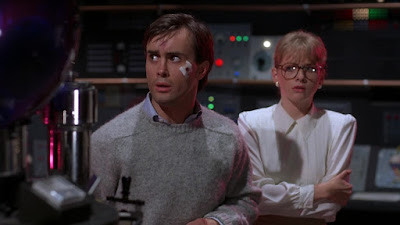
Although Jeffrey Combs provides a pretty much definitive reading of the nervous, weak-willed Lovecraftian protagonist here (it is difficult to read HPL’s description of Tillinghast’s “..high and unnatural, though always pedantic, voice” without recalling Combs’ unique line readings), he nonetheless seems aware that he is essentially a supporting character – a victim rather than instigator of events – this time around, despite his top billing on the poster, and he steps back accordingly. No match for the force of Pretorius’s malevolent sexual energy, Tillinghast essentially exits prior to the film’s final act, transformed into a mindless, albino monster before he meets his sorry fate.
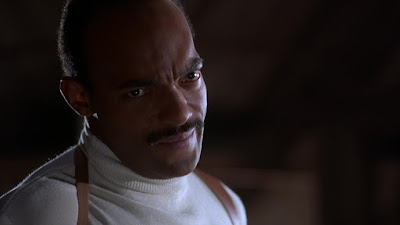
As for Ken Foree’s turn as good-natured cop ‘Bubba’ Brownlee meanwhile, he seems to have wandered in from another film entirely (perhaps taking a wrong turn on his way to audition for a pre-‘Lethal Weapon’ buddy-cop movie?), with his light-hearted banter and comedic appetite feel absurdly out of place in the Lovecraftian universe. It’s always nice to see Foree (whom you’ll recall from Romero’s ‘Dawn of the Dead’ (1977)) getting a good role, and it’s impossible not to be charmed by his shtick - but nonetheless, Bubba’s materialist attitude and steadfast refusal to countenance the ‘other’ clearly indicate that he is no fit protagonist for this story. Indeed, his former football pro libido counts for little in the relentlessly hetero eyes of Pretorius, whose shapeless minions proceed to eat him at the first convenient opportunity.


It is Barbara Crampton’s Dr Katherine McMichaels therefore who lives on to battle ‘From Beyond’s inter-dimensional overlord, experiencing by far the most well developed arc doled out to any of this film’s characters in the process, with her earth-bound transformations between different female pulp archetypes in a way mirroring the trans-dimensional shape-shifting of Pretorius himself.

Crampton’s solid performance in ‘Re-animator’ gave us some hints that she was more than just yr average ‘80s ‘scream queen’ (or rather, more than just a somewhat competent actress who was willing to go all the way re: the singular demands of that film’s finale), but with ‘From Beyond’, the filmmakers really gave her a chance to step up and turn the tables on genre expectation, essentially taking centre stage amid the libidinous, latex excesses of the movie’s hyper-sexualised take on cosmic horror, and the results are pretty wonderful.

A radical psychiatrist who, we are told, disapproves of locking up schizophrenics, Dr McMichaels is initially introduced to us her through her antagonistic relationship with the more authoritarian Dr Bloch (Carolyn Purdy-Gordon), who accuses her younger colleague of exploiting rather than rehabilitating her patients, using them as guinea pigs for her research as they are presumably allowed to run free to indulge their most destructive whims.
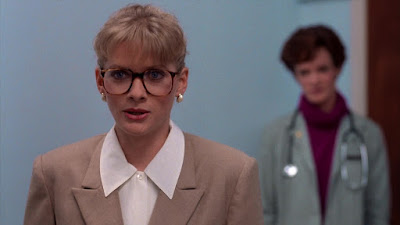
Be that as it may (and to be honest, the script is clearly just using these argument to set the stage for the mayhem which will occur once Dr McMichaels is assigned custody of the incarcerated Tillinghast, rather than attempting make any grander point about contemporary psychiatry), Crampton presents an almost comically buttoned up and repressed figure during these early scenes, complete with tightly bunned hair, woollen overcoat and oversized glasses. Even here though, she already manages to inject a hint of submerged kinkiness into her performance, failing to hide her obvious excitement when Tillinghast, confined to his asylum cell, begins to tell her of the work he and Pretorius carried out.

Once our gang are back at the Pretorius house, ostensibly in an attempt to help Tillinghast by repeating the experiments which led to his collapse, Crampton gradually dials up the more sensual aspect of her character, as her prim mannerisms and fusty exterior begin to feel more and more like some kind of perverse dress-up, as the true scale and freakery of Pretorius’s activities (both earthbound and supernatural) become increasingly clear to the good doctor.

It’s almost a relief therefore when, in classic camp / fairy tale fashion, Crampton lets her blonde locks down and dons the obligatory frilly nightie in preparation for bed time, allowing things to get really charged as she knowingly takes on the role of the timorous gothic heroine, practically role-playing it for Pretorious’s unseen spirit as she takes that same nocturnal walk toward the cursed attic that thousands have trod before her. Approaching, and indeed fondling, the rather phallic edifice of the resonator, she uses it to summon her learned lover from beyond as if it were some tribal fetish object, prompting a traumatic, slimy encounter with Sorel’s by now thoroughly inhuman patriarch, apparently magnifying both her attraction and repulsion to the heavily sexualised Other.
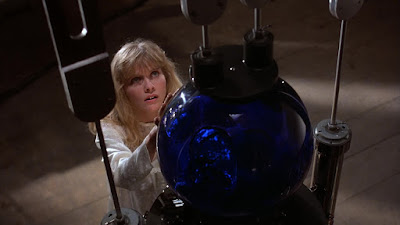
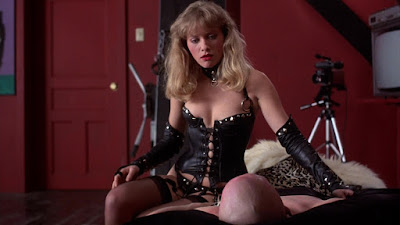
By the time Katherine has transformed herself, via the contents Pretorius’s on-site sex dungeon, into a kind of mind-blown, insatiable dominatrix, we’re heading into pretty uncomfortable territory here, as the warped hues of the film’s lighting and garish sleaziness of its interior décor becoming increasingly nauseous.

Following a delirious special effects showcase which sees Foree (in startling tight red y-fronts) and Combs (in a Miskatonic Uni t-shirt) battling a decidedly vaginal (yet also kinda phallic) giant worm in the infernal, flooded basement, Gordon leads us on helplessly toward the trademark, “this is going considerably further than I expected” / envelope-pushing type scene which he likes to include in each of his horror movies – which in this case involves Crampton, in full black leather fetish get-up, mounting the bruised and unresponsive body of Combs, who has been reduced to a hairless, shuddering albino after being swallowed and spat out by the suggestive, spectral worm. (And honestly, they wonder why the MPAA had some issues!)

If we can reclaim our jaws from the floor whilst all this is going on, we may again wish to award the filmmakers a gold star for defying expectation by casting Crampton as the aggressor here, and concede that ‘From Beyond’s weird detournement of the kind of titillation which hetero-male horror fans tend to consider their birth-right is in many ways quite admirable (for it is here that the dark mystery of the sex-horror ideal truly resides, cf: Cronenberg’s ‘Shivers’ or Franco’s Lorna the Exorcist). By this point in proceedings in fact, things have become infused with such a miasma of sickness – of, for want of a better word, grossness - that we can’t help but be to some extent relieved when Foree intrudes upon the scene, pulling us back to reality with a dose of good ol’ fashioned restraint and self-respect and/or slut-shaming reinforcement of patriarchal values [delete according to taste].

In terms of the moral schema through which the film’s script deals with all of these inter-dimensional sexual shenanigans, submission to one’s desires is framed as triumph of pure ego over collective human responsibility. Satisfaction, under the terms imposed here by the predatory Pretorius, can only be achieved through the destruction of another soul. When Foree’s character tries to snap Katherine out of her new persona as a kind of sleazoid, brain-washed nymphomaniac, there is more than just mere puritanism at work. Bubba, as an archetypical down-to-earth realist, realises that the kind of idealistic quest for mindless sensation embodied by Pretorius can lead only to destruction – first of the bodies and souls of others, and ultimately or oneself.

Trying to extrapolate some kind of real world analogue from all this, it occurs to me that proponents of sado-masochism and/or so-called polyamorous relationships might well be inclined to take offence at ‘From Beyond’s approach to sexual ethics, but, I’ll leave that battle for them to fight, should they wish to. Instead, I’ll merely state that, in terms of a horror movie, the conflict which rages within our characters between all-consuming ego rampage and the inter-personal respect for the bodily and cerebral identities of others, works very well.

Whether or not ‘From Beyond’ ultimately works as a film however, will largely be a matter of personal taste. Even if the production veers dangerously close to outright cheesiness in places, I’ve certainly grown to love it over the years, largely thanks to the excellent set of performances delivered by the cast (another Gordon trademark) and the astounding special effects work (that basement worm battle is really a thing to behold).

Many viewers though will doubtless find the excesses of the movie’s visuals and ideas difficult to process, and, whatever fans may have had in mind for a follow up to ‘Re-animator’ back in 1986, some lunatic fusion of ‘The Rocky Horror Picture Show’ and ‘The Thing’ on an Empire Pictures budget was probably not it. Though the film has amassed a considerable cult following over the years, the initial reaction of audiences and critics was far from kind, with the response of many leaving theatres probably best summed up by one of the more memorable lines uttered by Combs’ Tillighast; “That… will be quite enough of that.”

Though Brian Yuzna proceeded to follow this particular strain of latex insanity even further in the aforementioned ‘Society’, he soon retreated to the comparatively safer ground of ‘Bride of Re-animator’, and ‘From Beyond’ meanwhile seems to have led to a decade long hiatus in Gordon and Paoli’s Lovecraftian adventures, as the director transitioned straight into a series of considerably more audience-friendly (or perhaps more to the point, producer-friendly) ventures, beginning with the thoroughly wholesome ‘Dolls’ (1987). Thus, ‘From Beyond’ is left to stand on its own merits as a kind of fascinating historical aberration. All of the film’s principal creatives and cast members would go on to make good horror films after this, and all of them would return to Lovecraft in some form or another, but none of them ever again attempted anything quite this unconventional and tonally extreme.

----


(1) Published between 1933 and 1935, ‘The Fantasy Fan’ was founded by an Elizabeth, NJ based teenager named Charles D. Hornig. Although its circulation remained minimal (subscribers numbered around 60, and the print run never exceeded 300 copies), ‘The Fantasy Fan’ is remembered an an important title within the earl ‘weird fiction’ community, publishing work by Lovecraft, Howard, Derleth and Bloch, as well as correspondence from HPL, Clark Ashton Smith and Forrest J. Ackerman. Surprisingly given their rarity and fragility, extant copies begin at a not unreasonable $150 at Abebooks. Further info via Wikipedia.

(2) In fact, there are numerous parallels between ‘From Beyond’ and Corman’s ‘The Pit & The Pendulum’ in particular. Both are the second movies in a series, coming hot on the heels of an initial big success, and both make a point of pushing the envelope far further than their respective predecessor, incorporating uncomfortable sexual content with a concentration on torture and/or S&M. Both have a rather unhinged, hysterical tone and encourage a dreamlike sense of shifting, uncertain realities, and on some level they also tell similar tales of a younger character losing his/her identity to the fleshy, sensual obsessions of an absent patriarchal figure. Both films even make extensive use of red in their colour schemes, for goodness sake. Coincidence? Quite possibly, but just putting the idea out there.

(3)Interestingly, both the extreme colour scheme used in ‘From Beyond’ and the discussion of ultra-violet light in Lovecraft’s original story seem to mirror the approach to visualising ‘impossible’ colours utilised by Richard Stanley in his recent adaptation of ‘The Color Out of Space’. As both films make clear, MAGENTA is clearly the colour of cosmic horror.

Monday, 20 December 2010

#19
Re-animator
(Stuart Gordon, 1985)


“..and what would the note say, Dan? ‘Cat dead, details later’?”

In this country as least, it is safe to say that Bruce Robinson’s script for his film “Withnail & I” has permeated the social lexicon to such a degree that quotations from such may be employed, sparingly and in appropriate circumstances, without fear of embarrassment or misunderstanding. Try as I might, I can’t shake the irrational urge to try to employ Dennis Paoli’s script to Stuart Gordon’s “Re-animator” to similar effect, however ill-judged and ineffectual I know such an effort would be. The film’s dialogue, and more particularly the cast’s delivery of it, carries I think a sense of the same timeless, blackened wit as Robinson’s script, but alas, at the end of the day I suppose modern life simply doesn’t provide enough opportunities to bust out with “you’re not even a second rate scientist”, or “don’t expect it to tango, it’s got a broken back”. Modern life’s loss. If I were some obnoxious jock medical student, or an obnoxious horror convention attendee, we’d be having a gas with this stuff I’m sure. But as it is, I’d at least like to think that “Re-animator”s lack of conversational universality doesn’t in any way diminish the film’s winningly twisted charm.

Only last month, I was wasting space here talking here about Stuart Gordon’s background in theatre, and the corresponding importance his best films place upon tight scripting, memorable characters and strong performances – well, obviously “Re-animator” is the prime example. Not only was it the first film Gordon made after leaving his theatrical career behind, but allegedly he was pretty much forced to resign in disgrace from the Organic Theater company which he had helped found in Chicago, such was the collective disgust of his colleagues at the idea of their director trying to make some dough via a low budget horror film. I don’t know whether or not aforementioned snooty colleagues actually went to see “Re-animator”, but the joke’s on them if they did, as the considerable success Gordon’s film has achieved is driven as much by a hard-won sense of theatrical craftsmanship as it is by nasty ideas and eye-popping gore effects.

Think about it: you’ve got a cast that’s essentially limited to five characters, their personalities and relationship to each other all carefully established and ready to kick off. You’ve got a witty, fast-moving, dialogue-driven script, two or three simple, unspectacular locations, and five really good actors. Dynamite. “Re-animator” could have worked brilliantly on stage, and the old fashioned solidity of it’s execution as a movie is doubly refreshing in the midst of a genre that so often cruises by on visceral thrills, visual weirdness, wafer-thin characters and sloppy, illogical story-telling. Of course, stage plays rarely feature shovel decapitations, intestinal strangulation and mutilated undead cats, which at heart probably has a lot to do with why I’m not writing my ’25 favourite plays’ here, but so, er, yeah – “Re-animator” is win-win on that score really.

Above all, the success of the film is in the characters and the cast, and how many ‘80s horror movies can you really say that about? I’m assuming you’ve probably seen it, so I don’t have to tell you that Jeffrey Combs is the stuff of legend, that David Gale as Dr. Hill is one of the all time great villains, that Bruce Abbot and Barbara Crampton manage to invest their traditionally dull “normal” roles (always the anchors that drag down a good gothic or Frankenstein movie) with a rare degree of depth and likeability. It says a lot that I made it cheerfully through both of Bruce Yuzna’s objectively-quite-poor sequels and thoroughly enjoyed them, such was my happiness at seeing Herbert West and Dan Cain and Dr. Hill back in action, getting up to further necrotic mischief.

Like I say, you’ve probably seen “Re-animator”. You probably don’t need me to tell you how great it is, how perfectly pitched Gordon’s mixture of black humour and genuinely disturbing nastiness is, how well paced the film is, and how, unlike the sequels, it knows exactly where to stop, and never spoils the brew by letting things boil over into silliness. It is the modest little horror movie that does *everything* right, and it is heartening that its killer rep as a fan favourite reflects that. “Who’d believe a talking head? Get a job in a sideshow!” Ha, ha, yeah… it’s all in the way he tells ‘em I think.

Tuesday, 16 November 2010

Castle Freak
(Stuart Gordon, 1995)


“Castle Freak” is the kind of movie only a card-carrying horror fan could love. Comprised of material that breaks down as about one third cruel and depressing, one third stupid and cheap, with a final third of intelligent and well-executed gothic tragedy creeping in around the edges, it will take a… sympathetic viewer to find time to appreciate the latter aspect.

I didn’t much enjoy “Castle Freak” whilst I was actually watching it. My main memory is of finding it a grim and disappointing effort from a creative team whose work I usually enjoy, and of waiting for the damn thing to end so I could do something fun. But the more I think about it, the more vague my reasons for disliking the film become, and the more it begins to stand out in my memory as a pretty decent piece of work, all things considered.


Throughout his career as a horror director, Stuart Gordon has specialised in mixing humour and absurdity with a streak of utter, black-hearted nastiness, usually to great effect. From the the rampant sexual dysfunction of “From Beyond” to the bit where that poor guy gets skinned alive in “Dagon”, his movies seem to thrive on a genuinely unsavoury undercurrent, manifesting itself in at least one sequence in each film that will have even jaded horror-freaks pausing to think “jesus… that was pretty intense”, before returning to the comfort zone of likeable characters, goofy situations and chaotic special effects showcases.

Despite the corny name and the fan-pleasing potential of reuniting Gordon with his “Reanimator”/”From Beyond” team of scriptwriter Dennis Paoli and stars Jeffrey Combs and Barbara Crampton, “Castle Freak” sees this darker aspect of the director’s work taking precedence, as he drops the comedy altogether, instead taking his best shot at an straight-faced, emotionally gruelling horror story, with, well… let’s say mixed results.


Not that “Castle Freak” is an unremitting gorefest or a journey into nihilistic oblivion or anything like that. It’s just sort of, well, miserable really – a film full of deeply unhappy people who would probably be having a pretty bad time of it even if they weren’t being stalked by a once-I-was-human monster whose tale of life-long woe puts them all in the shade. I guess I went in expecting a more light-hearted gothic castle caper, and as such the whole experience left me kinda bummed out.

Things are scarcely helped by the fact the film has a squalid, low rent sort of feel to it – not necessarily a bad thing for a horror movie, but rather a shame for a gothic yarn such as this, which could have been rendered a lot more palatable with the addition of a some of the grand, velvety production design that’s seen us (or seen me, at least) happily through dozens of similarly tragedy-heavy ‘60s Euro-horrors. Financed as an Italian co-production by Charles Band’s Full Moon Productions for straight-to-video release at the nadir of the horror genre’s pre-Scream commercial slump in the mid-‘90s, “Castle Freak” is, needless to say, a fairly plain looking affair, shot predominantly on location in a somewhat drab-looking Italian castle, with cinematography leaning a little toward the TV movie end of things.

(Actually, I shouldn’t call the castle “drab-looking” – I’m sure in real life it’s a smashing old castle, and there are lots of good architectural shots and nifty decorative bits and bobs on display. But in one of those odd cows-don’t-look-like-cows-on-screen type dysfunctions, the way it is filmed here makes the whole place seem a lot less atmospheric than the set-bound castles of a good ‘60s gothic horror.)


An original story cobbled together from echoes of Lovecraft’s “The Outsider”, Derleth’s “The Shuttered Room” and subsequent generations of ‘deformed relative in the attic’ tales with just a hint of “Don’t Look Now” and “Phantom of the Opera” mythos sprinkled in for flavour, “Castle Freak” begins with a lengthy pre-credits sequence introducing us to an old crone who lives in a dusty old castle, alone but for her deformed son. She keeps him chained up in a basement dungeon, subjecting him to sadistic daily beatings with a fearsome-looking medieval cat-o’-nine-tails. Delightful. So what happens when Old Crone eventually kicks the bucket..?

“Boy, who’da thought we’d inherit an old Italian castle?”, grins John Reilly (Combs), as he, his wife Susan (Crampton) and their blind daughter Rebecca (Jessica Dollarhide) are shown to the door by a craven estate agent. Any mainstream viewers will be forgiven for rolling their eyes and giving up right there, but Paoli’s script is at pains (actual, proper pains) to try to shoehorn an extra depth into this rather ponderous creepy castle/meet the monster scenario, investing our American family with a rather harrowing back story that provides the weight of the film’s emotional narrative.


Gradually, we’re filled in on the fact that until recently John and Susan had two children, both of whom were fully-sighted. Then there was a car crash, caused by Dad, who was driving drunk. Ouch. Now John is off the sauce, and trying his best to stay positive and keep the family together as they deal with their grief, but Rebecca is struggling to adapt to a life of blindness, and Susan hasn’t forgiven him by a long shot. Awkward.

So, will John’s new Italian inheritance, and the story of the lonely old widow whose only son “died” in eerily similar circumstances forty years ago help rekindle the family’s relationship, or drive them further over the edge into an abyss of guilt, madness and recrimination? What do you think?


I think it’s interesting to see Jeffrey Combs in a straight role for once. Deprived of his trademark mad scientist tics he makes for a pretty convincing tormented father figure, with his slow descent into guilt-wracked collapse standing up reasonably well to the high standards set for such roles by Donald Sutherland in “Don’t Look Now” or Sam Neill in Zulawski’s “Possession”. Crampton too is a fine and versatile actress, and, as ever, it’s a shame she’s never really been given a shot at movie stardom, beyond the eternal sex symbol status conferred upon her by pervy horror fans of a certain stripe off the back of her memorable turns in “Reanimator” and “From Beyond”. Jessica Dollarhide is, um, I dunno, perfectly acceptable as ‘timid mid-teenage daughter’ I guess, and I don’t know how much acting Jonathan Fuller gets to throw around beneath his grisly full-body make-up job in the role of Giorgio the monster, but either way, he certainly makes for an appropriately frightening and upsetting screen presence.


As befits his background in theatre, good acting and engaging characters have always been central to the success of Stuart Gordon’s films, and everyone in the cast of “Castle Freak” gives a solid, no nonsense performance appropriate to the solid, no nonsense melodrama of Paoli’s script. The overall vibe is akin to that of, say, a committed amateur theatre group working with a harrowing, personal play written by a well-regarded local journalist, and, if perhaps not quite Oscar-worthy, I’ll certainly go out on a limb and say the acting chops on display here are likely to be a damn sight better than anything else put out by Full Moon Productions in 1995.


It is a shame then that for all the film’s laudable attempts to stand alone as a serious drama, the pathos of the tale is undercut by frequent descents into the realm of abject, straight-to-video stupidity – the kind of things you could easily shrug off in a goofier, more fast-moving movie, but that here function a pie to the face of viewers who were just starting to shakily accept “Castle Freak” as a pretty-good-effort-all-things-considered.

In short order, we’re expected to believe that, having been helplessly chained up for decades, the, er, ‘freak’ suddenly wakes up one morning and thinks up a way to escape. Then, when free, this emaciated, deformed fellow, who has never enjoyed the benefits of exercise, sunlight or a decent diet, is apparently capable of near super-human feats of strength and agility. He can evade detection and move around silently as a ninja assassin, in spite of the fact he staggers around with an exaggerated limp, wheezes and groans like an injured bloodhound and is dragging a heavy iron chain around attached to his wrist. The editing in one sequence – which sees the monster practically disappear into thin air, running out of the door of the daughter’s bedroom seconds before her awakened parents run in – is particularly woeful. Subsequently, we see John investigating the creature’s dungeon in search of intruders in the castle, and completely failing to notice either the remains of a recently eviscerated cat in the corner, or, presumably, the telltale signs that some poor dude has been living in there for the past few decades.


Later on, the film takes a somewhat sleazy turn, when Gordon and Paoli suddenly realise they’ve written a horror movie without any sex or easily killable characters, and rope in Raffaella Offidani as a prostitute who John drags back to the castle after a grief-fuelled drunken relapse, and who subsequently finds herself wandering around aimlessly, falling prey to the monster in predictably grisly fashion. As the film’s one go-for-broke gore/sleaze sequence, Offidani’s demise is as horrific as any gore-hounds in the audience could wish for, executed with a streak of sheer nastiness in keeping with the film’s uncomfortable, downbeat tone. What bothered me about this sequence though wasn’t the gratuitous sexualised violence (hey, you watch horror, sometimes you get horror) so much as the fact that the poor lady’s prolonged, bloodcurdling screams were presented as being inaudible the castle’s other occupants, who are separated from the violence only be a flimsy door and a few staircases.


I’m not usually one to make a big deal out logical flaws in low budget horror films (if you want fucking logic, go watch CSI or something), but when a movie like this is trying to build tension and emotional engagement via a small cast stuck in a single location, the flow of cause & effect and the realism of the film-world need to be kept tight, and these goof-ups have a pretty debilitating effect on “Castle Freak”s overall impact, suggesting haste, inconsistency or just plain laziness on the part of the filmmakers. It’s as if one faction of the production team was yelling “fuck it, it’s just a monster movie, who cares”, while the others were striving to make a fairly serious movie. Either of those approaches is just fine, but when they get fouled up together the results are rarely a good time for anyone.


Despite all this though, there’s something itch-you-can’t-scratch compelling about “Castle Freak”s tale of grief and abuse and pointless misery; something about this f-ed up loser of a monster that lives on in the memory after viewing.

Whilst Giorgio’s desire to chain women up in his lair and slobber on them is somewhat less than congenial, Paoli’s script is careful to ensure that each time the monster actually turns violent, it is only because he has been threatened or attacked by one of the other characters. And if he gets a bit carried away in his bloody retaliation and seems to take a sadistic thrill in all the biting and choking and scratching, well, er, yeah, that doesn’t look so good really. But c’mon, give the guy a break – how would you feel if you’d been chained in a darkened basement for forty years and beaten into unconsciousness every day by your crazed mother? (Ok, don’t think to hard about answering that, I’m being rhetorical here for chrissake.)


Various plot elements seem to be converging on the idea of transforming the monster into a sympathetic, misunderstood figure ala Karloff’s Frankenstein monster or Lon Chaney’s Hunchback, but none of it really comes together as would classically be expected. Rebecca’s blindness would seem to be setting the scene for a bond to develop between her and the monster, whose repellent ugliness she cannot see. But as it turns out, she gets the idea pretty quickly from all his slobbering and groping and wants to get away from, and preferably kill, the horrible fucker as soon as possible, as an all-American non-mystical innocent girl rightly should.

Similarly, John’s identification of Giorgio with his dead son, and the shared weight of a parent’s responsibility for destroying their own child, is a big theme throughout the movie, from the moment when John none-too-subtly gazes up at a mural of Cronus devouring his young, to when he weeps over a photograph of the Countess’s “dead” son, and starts to mistake the presence of the monster for the ghost of his own child. As John begins to crack up and act more irresponsibly, implicitly doing further damage to his family in the process, a deeper identification between man and monster seems inevitable, especially when, in the film’s most queasily disturbing moment, Giorgio sets about his attack on the prostitute by mimicking the actions he earlier observed John performing with her. At this point, things seem to be leading towards a moment of pretty dark catharsis for our male lead, but here again, things don’t follow through. When John becomes aware of the monster’s existence, he pulls himself together and sets out to whack it and achieve a happy(ish) ending, weird guilt-tripping temporarily put aside.


You could blame inconsistencies in the script for the failure of these themes to tie themselves up properly, but I’d prefer to think that our eventual view of the monster was deliberately left ambiguous - after all, it is his own grotesque and selfish behaviour that denies him the audience sympathy his sad state deserves. Like the Merrye family in “Spider Baby”, you can shed tears for him all you like, but he’ll still likely gouge yr eye out and eat it, and it is difficult to imagine any future for such a problematic, atavistic creature in our own world, beyond a merciful demise. As a result, Giorgio is a truer and more complex take on what it means to be a ‘monster’ than the amoral killing machines or sentimental tragic figures more commonly encountered in horror cinema.

“Castle Freak” will likely go down in history as shoddy and profoundly unenjoyable film in which a slobbering monster bites a hooker’s tit off. On one level that’s a perfectly accurate summation, and I’ll admit it’s never exactly going to be a good choice for inviting yr pals round and getting the beers in. But at least you and I, my horror-weblog-reading type friend, can perhaps put a few moments aside this winter to appreciate the many finer points of this odd and unsavoury little movie.