Has the output of a commercial film studio ever matched the sheer level of NO RULES anarchy exhibited by Japan’s Toei studios during the early 1970s? Well, I can’t say for certain, and of course Toei were still producing plenty of relatively ‘normal’ genre pictures to sit alongside their more outré efforts through this period, but nonetheless - the more examples I see of the kind of high-octane, good taste-eviscerating madness that seemed to rule the roost at the studio during these years, the more I’m inclined to think that, for better or worse, there was *something* pretty unique going on behind the scenes.
God only knows what was transpiring on a management level at Toei during this period. If anyone has seen fit to discuss the matter in English, I’m unaware of their efforts, but we can at least speculate some, based on the knowledge that Toei had always been something of an
enfant terrible amongst the Japanese film studios, having been established during the period of reconstruction that immediately followed WWII, and bank-rolled largely via the corporate/construction money that accompanied it.
Unashamed b-movie bruisers right from the outset, Toei were free of the sense of dignity and respectability that sometimes dragged down the older studios in the post-war marketplace, and from the mid-‘50s onwards, they locked into a relentless production schedule of action-focused samurai and crime films that allowed them to swiftly gain ground on their more venerable competitors, providing exhibitors with competitive deals on pre-packaged, audience-pleasing double bills that by the dawn of the ‘60s had secured them a position as one of the biggest players in the domestic film industry.
(1)

With this kind of underdog, low-brow history, I guess it stands to reason that when cinema attendance began to fall sharply in the ‘70s, and with the remaining audience skewed heavily towards itinerant single men and those too poor to afford TV sets, company policy at Toei would naturally have been to try to push the sex and violence quota of their product several steps further than their competitors, whilst upping the pace of on-screen action as much as possible. And verily, this is exactly what they proceeded to do. AND THEN SOME, as anyone who has seen even the smallest fragment of their post-1968 output will testify.
Which is all well and good, but still, I think it only goes some way toward explaining the sheer madness that seems to characterise much of Toei’s output in this era. Could it be that the films in question were perhaps just the progeny of one or two rogue producers, giving their film-makers a “what the hell, go nuts” blank slate, just to help keep product rolling..? If so, I suppose it figures that when your roster of creatives includes deviants and innovators on the level of Shinyo Ito, Teruo Ishii, Kinji Fukasaku and Norifumi Suzuki - all buoyed up by the knowledge that at least some of their wilder outings turned out to be huge hits – sparks are inevitably going to fly. With this in mind, perhaps the writing was simply on the wall as the studio ploughed on toward the accumulation of what now seems like one of the world’s greatest stockpiles of totally crazed exploitation films.

Beyond all that though, Toei’s daily bread always came from straight-up yakuza films. In fact they pretty much dominated the genre from the ‘60s onwards, releasing vast quantities of formulaic product and setting the agenda for all of the genre’s periodic reinventions. Chris D.’s recently published ‘Gun & Sword: An Encyclopaedia of Japanese Gangster Films, 1955-1980’ (see footnote 1 and then
BUY IT) lists details of over 300 Toei yakuza films, and in all likelihood they probably made many more. In fact they made so many of the damn things that the various other genres they dabbled in (pop culture-inclined ‘youth’ flicks and Sukeban/Pinky Violence of course, plus sexploitation, comedy, martial arts, horror, etc.) often seem like mere spin-offs from the endless grind of the yakuza machine.
But just as yakuza material tended to drift across almost by osmosis into other genres, so the pop art surrealism, weird sex and goofball humour seen in the studio’s more unglued productions also sometimes filtered back into the yakuza titles… or at least, I think that’s probably the best way for us to go about making sense of a movie like ‘Yakuza Cop: The Assassin’, whose none-more-generic yakuza title actually masks an all-over-the-map, genre-defying freakout, wantonly mixing elements of Bond-style action/adventure, screwball comedy, crime movie badassery and youth movie energy into a bewilderingly ridiculous, endlessly enjoyable brew that has little to do with any variation on the yakuza formula, but that surely
does provide an exemplary demonstration of the kind of craziness Toei were capable of unleashing at the dawn of the ‘70s.
In the aforementioned ‘Gun & Sword’ (I did remind you to buy a copy, right?), Chris D. is actually pretty scathing about the ‘Yakuza Cop’ movies, describing the first entry in the series as
“..an eminently forgettable timewaster”, and dismissing this one as being
“Not so much directed as slapped together from what looks like nearly unsupervised footage”, concluding that it is
“..fun in a very light-hearted, non-discriminating way. Don’t go in expecting high quality and you may be able to enjoy it.”(2)
To which I say: c’mon Chris, really..? I mean, I get where you’re coming from I suppose, and I know you’re primarily about the serious, well-made yakuza films and all that but - *MAY* be able to enjoy it? To be honest, I’d question the sanity of a ‘70s b-movie fan who failed to enjoy this one. I mean, I know from your write-ups on the sukeban films and so on that you’ve got a keen appreciation for mindless mayhem too, so could you really find so little to appreciate in this... this
wondrous motion picture, this film in which…. well, I think the best way for us to proceed is with a brief synopsis, don’t you?
So: ‘Yakuza Cop: The Assassin’ opens with the sight of ubiquitous character player Ryôhei Uchida, greasy-haired and cackling in an immaculate white suit, kipper tie and jauntily angled hat, boarding a brightly painted bus belonging to a Hindu dance troupe at an airport carpark. Cutting open the skin of a bongo drum, he finds what he came for – a massive quantity of weed – and the requisite suitcase full of cash changes hands. But wait! Sirens! Apparently a small army of cops are on their way to intercept Uchida! What’s he gonna do?
Well it turns out that what he’s gonna do is run around in a panic for a few minutes, until he is unexpectedly rescued by Sonny Chiba, resplendent in a full-on black leather pimp suit and Meijo Kaji floppy vengeance hat, who screeches to a halt beside him in a bright red dune buggy! “Hop in,” says Chiba, and the requisite enka/funk-fuelled credits sequence plays out against the duo’s tyre-screeching escape from the fuzz, as they leave the cops literally eating their dust.
(3)
And what can you possibly say to a movie that begins like that? Not much, beyond a happy combination of “I have no idea why this is happening” and “but please continue, it’s amazing!” that is engendered by only the very best action/exploitation films, and that continues to predominate through the majority of ‘Yakuza Cop’s run time.


When we re-join Chiba and Uchida, they’re busy doing what any of us would do having just staged a daring escape from police custody whilst in possession of a large quantity of illegal drugs: namely, goofing about on a street corner in the same flamboyant outfits they wore during the getaway, exchanging banter with an itinerant fortune-teller and preparing to cement their new friendship by heading to the nearest bar to get drunk. You see, it turns out the pair didn’t actually know each other prior to their escape. But if it occurs to Uchida to wonder exactly WHY Chiba came out of nowhere to stage such an unlikely rescue, well… quick ,move along there, viewer! You’re thinking too hard, when there’s random mayhem to be enjoyed!

Entering the film’s requisite subterranean psychedelic nightspot (‘Club Queen Bee’), complete with a Group Sounds outfit called The Scorpions wailing away on-stage, our heroes are immediately assailed by the sight of a Japanese woman being man-handled by a bunch of neckless, Gomer Pyle lookalike American GIs. Clearly this kind of crap won’t stand, and our guys are just about to go into action when the club’s bouncer intervenes ahead of them. A thoroughly gigantic individual, this turns out to be none other than legendary wrestler
Giant Baba, making a brief but memorable cameo appearance.
“You son uva bitch!,” yells one of the Americans, charging forward with a red Gretsch guitar raised above his head(!), before Baba hurls him across the room with such force that he and his buddies are apparently thrown completely out of the movie. With national pride safely reasserted, Chiba and Uchida proceed to pal around with Giant Baba for a few seconds, proclaiming him “the strongest Japanese [they’ve] ever known” and dutifully doing the old ‘bone-crunching handshake’ routine, before he too exits the movie and our heroes move on to the club’s next room, a casino, where some serious yakuza business is going down.

As Uchida is busy introducing Chiba to his gang boss though, disaster strikes in the form of, uh… ninjas!? Well, sort of. Four masked assassins drop from the ceiling wielding pistols and open fire, allowing Chiba the chance to take a hit that conveniently saves the boss’s life, and also to unleash a few licks of the jaw-dropping karate that make him an international star a few years after this film. It’s all to no avail though, as the assailants disappear as quickly as they arrived. Where could they have gone..? Well let’s just say that The Scorpions are piling into their tour van a little bit quicker than might be expected…

And so things go on. If I’ve recounted these opening scenes in exacting detail, it’s simply to give you a feel of the head-spinning velocity that characterises these Toei films – the relentless piling up of incident upon incident, strung together with only the slightest thread of narrative glue, with speed-freak editing and crash zooms barely giving you a chance to catch your breath before the next batch of carnage unfolds. It’s insane, and I love it.

Actually, it’s just as well ‘Yakuza Cop’ takes this kind of non-stop, event-packed approach, because when we do finally get stuck into the central plot-line, it’s pretty dull stuff to be honest. Obviously Chiba is an undercover cop, and obviously he’s busy playing out another variation on the old Yojimbo / Fistful of Dollars formula, ingratiating himself with both sides in a gang conflict and turning them against each other until he’s the last man standing, with only the fraternal bond he develops with Uchida serving to twang his conscience a little along the way.
And so things might have played out if this were a standard Yakuza film, but thankfully director Noda and his collaborators seem keen to do everything in their power to distract us from this fairly hum-drum tale, diverting our attention toward all manner of largely irrelevant shenanigans at every opportunity.
Take for instance the almost surreal romantic interludes wherein Chiba and Uchida visit the latter’s sister, a dewy-eyed young thing who appears to be single-handedly running an orphanage for a generic crowd of happy, cheering children in an idyllic rural setting.
(4) A hilariously over-extended sequence shows Chiba and the sister getting to know each other by riding horses through verdant meadows, with so much Vaseline on the lens we can barely see what’s going on. Meanwhile, they leave Uchida in charge of the kids, which scarcely seems a good idea. (One suspects that this whole sub-plot only exists so that Chiba can show off his riding skills and squeeze in his rousing rendition of a romantic ballad, but it’s all pretty funny regardless – weird ‘Sound of Music’ vibes with a ramshackle looking Alpine farmhouse in the background and everything.)
This all provides something of a contrast to the scene later in the movie where Chiba follows a lascivious bar girl / yakuza operative to a wild marijuana party, where we get to see Japan’s leading action hero ‘tripping out’ on the demon weed, complete with all the wild lighting, fish-eyed semi-nudity and fuzz guitar freakout jive you could hope for.


And, making up most of the time when that kinda stuff isn’t happening, we get a veritable avalanche of light-hearted action set pieces that seem peculiarly reminiscent (in tone, if not necessarily in quality of execution) of the kind of stuff Jackie Chan would go on to perfect a decade or two later.
Highlights here are plentiful, taking in blink-and-you’ll-miss it spoofs of everything from Golgo 13 to Thunderball to The Dirty Dozen, a guy who looks like Bunta Sugawara but isn’t putting in a winningly melodramatic turn as a crippled, drunken assassin, and – my personal favourite – frequent appearances by a lead goon who looks like he’s going all-out to win the Japanese Charles Bronson lookalike contest. (I thought this might have just been an accidental happenstance, until Chiba greets him with a line that the subtitles translate for us as “be punctual, you fake Charles Bronson!”)
Frankly, Chiba’s wardrobe alone was enough to keep me entertained through the moments of dull yakuza plotting that punctuate the film’s middle half hour (aside from his aforementioned Sasori outfit, the various-shades-of-green and swirl pattern tie ensemble he’s rocking just prior to the conclusion is astonishingly cool), but thankfully those moments are rare indeed.
I mean, I don’t think I’ve even told you yet about the bit where Chiba chases a crossbow-wielding assassin through an abandoned funfair, complete with randomly placed trampolines and a potentially lethal cups and saucers ride. Or the bit where he gets the ass burned off his trousers after careering around in a burning jeep. Or how about Uchida and his mute sidekick rampaging through a coastal yakuza hideaway in a leopard-skin painted military assault vehicle with a sack full of dynamite..? Man, I was cheering like a football fan at the cup final through that shit. I guess that would have just about done most movies for their action-packed finale, but ‘Yakuza Cop’ carries on to give us random backflipping female kung-fu assassins in black & gold ‘bumblebee’ style outfits, speed boats chases, helicopter stunts, smoke bombs… holy cow, do I ever love this movie.


Well, anyway - you get the idea. Presumably you’re already sold by this point, or have stopped reading. So let’s move on.
One thing that’s notable about ‘Yakuza Cop’ compared to most other Japanese genre films of this period is the complete lack of any nasty sleaze or sexploitation elements. Throughout, the film has an earnestly good-natured, upbeat feel to it to match Chiba’s mugging and Uchida’s slovenly grin. Hell, give or take the marijuana party and the occasional gangster massacre, the movie is practically family friendly – a nigh-on inexplicable occurrence within the context of Toei’s usual MO, but I for one don’t think that makes it any less enjoyable. (Indeed, it’s nice to have one of these kinda films that can be screened in mixed company without the need to issue a warning / apology in advance.)
Such an approach becomes even more surprising though given that we last encountered Yukio Noda on this blog via the singularly vicious
Zero Woman: Red Handcuffs, a film that sits at completely the other end of Toei’s tonal spectrum. Insofar as I can tell, Noda remains a fairly undistinguished figure within Japanese b-film lore, a workaday type director with relatively few IMDB credits to his name
,(5) but if we can draw any comparison at all between these two examples of his work beside their relentless mayhem, it’s probably an ability to identify the core essence of a film’s appeal (psychopathic abuse in the case of ‘Red Handcuffs’, zany humour in ‘The Assassin’) and to go about as far with it as he possibly can with it before the metaphorical engine splutters to a halt.

And whilst Noda isn’t exactly the smoothest of directors, I can’t help but think that Chris D.’s above-quoted dismissal of his work here as “near unsupervised footage” is a little harsh. Sure, it’s all pretty rough n’ ready, with scenes thrown together seemingly at random, and at least some material apparently shot on the fly with little in the way of finesse or preparation. But that, I think, is very much in keeping with the spirit of a film like this one, in which sheer velocity is valued above all things, and in which any undue application of care, forethought or, heaven forbid, rational thought is liable only to succeed in sabotaging the unstoppable forward momentum.
Plus, amid all the chaos, individual sequences here are often quite well handled, I think. Noda certainly never loses the audience’s attention, that’s for sure, and, in keeping with the majority of Toei product, the cinematography remains accomplished enough to make most low budget American filmmakers weep with envy. The numerous action scenes, though knowingly absurd, are often pretty great too, at times exhibiting some imaginative framing and editing, staggering levels of destruction and above-average stunt-work and fight choreography. (Chiba himself can presumably take responsibility for some of the latter - he was in the process of establishing his famed Japan Action Club at around this time, and many of ‘Yakuza Cop’s action scenes become blatant showcases for his acrobatic prowess… not that there’s anything wrong with that.)
Furthermore, Noda also seems here to be tapping into a vein of self-aware pop art surrealism that to some extent places ‘Yakuza Cop’ within the lineage established by Japanese cult cinema godhead Seijun Suzuki, as presumably filtered through the ‘70s-exploito lens of disciples like
Yasuharu Hasebe and
Toshiya Fujita. (The police briefing room scenes, where the cops have life-size cut-outs of the criminals they’re tracing propped up against the wall, seem a very Seijun-like touch, for example.)
In fact, at a push you could easily see ‘Yakuza Cop’ forming a perfect bridge between the brash spectacle of those latter-day Nikkatsu youth/action movies and the even more unhinged, comic book stylings of Noda’s more notorious Toei contemporary,
Norifumi Suzuki - a man whose formidable Non-Shit Giving this film definitely seems to emulate, if in somewhat less explicit form.
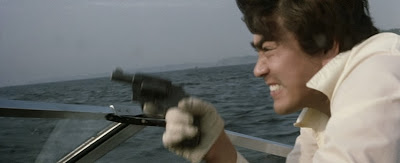
We’ve already noted ’Yakuza Cop’s tendency to lurch momentarily into spoof territory, but I think the legacy of the anarchic post-modernism borne of the aforementioned influences can be seen most prominently in the deliberate ludicrousness of the film’s action scenes. A form of humour that I’ve actually noticed popping up in a wide variety of Japanese films - from Kazuhiko Hasegawa’s Leonard Schrader scripted ‘The Man Who Stole The Sun’ (1979) through to Takashi Miike’s ‘Deadly Outlaw: Rekka’ (2002) - this technique reaches its apex In ’Yakuza Cop’ during the finale, in which we see Chiba in close pursuit of a boat full of heavily-armed yakuza, first in a speed-boat, and subsequently dangling from a rope suspended from a helicopter. Throughout this, our hero appears to
dodge the solid wall of machine gun fire aimed at him at near point blank range, only falling when a well-aimed pistol shot cuts through his rope!
Seeking to pre-empt the viewer’s automatic “that’s the most ridiculous thing I’ve seen in my life!” response to such poorly staged or implausible goings-on, the approach used here functions by throwing caution to the wind and simply making the events portrayed on-screen so outrageously stupid that, rather than calling foul, the viewer is instead inspired simply to laugh with the filmmakers in a spirit of happy disbelief - a playful wrong-footing of audience expectation that didn’t become common in Hollywood cinema until… when? Andy Sidaris movies? ‘True Lies’? I dunno.
In conclusion, I don’t want to pump up expectation for this movie too high – god knows, it’s certainly no masterpiece, and it’s certainly not going to change anyone’s life any time soon. But: it is a blast, and sometimes that’s exactly what you need – pure, mindless entertainment, presented with an idiot grin and an energy level akin to a runaway train. A perfect Saturday night party double bill filler, ready mixed to warm up the palette, ready for, say, ‘Stunt Rock’ or ‘Ninja III: The Domination’ or ’Lady Terminator’, or some other truly world class example of mind-boggling action movie nonsense… but with just a touch of cinematic elegance and sly intelligence slipped in there too for an added kick. Perfect.
(1) Prior to this, the convention in the Japanese film industry had been to mix A and B pictures from different studios, so Toei’s ability to provide BOTH halves of the bill at a bargain rate understandably put the rest of the industry into a bit of a spin. Thanks by the way to Chris D.’s utterly invaluable ‘Gun & Sword: An Encyclopaedia of Japanese Gangster Films, 1955-1980’ for all this Toei background.
(2) Pp. 373-374 in the book. There were four films made, of which this was the second. Or at least, I’m pretty sure it is -very similar titles, cast & crew credits and plot synopses of the first two films don’t help much with aiding identification, and discrepancies between the entries in ‘Gun & Sword’, the films’ pages on IMDB and the subtitled credits on the film itself muddy the waters further, but yeah, I’m pretty sure this is the second one, also known as ‘Yakuza Cop: Marijuana Gang’. The third and fourth films by the way were ‘Yakuza Cop: Poison Gas Terror’ and ‘Yakuza Cop: No Epitaphs For Us’ (both 1971), which I mention simply because they have cool names.
(3) I’m assuming it’s Chiba himself singing the theme song incidentally, as is standard practice for Japanese popular movies, and a right, throaty, gravelly job he makes of it too.
(4) I’m afraid I can’t match up the IMDB cast list well enough with character names stated in the film to really be sure who plays who in the supporting cast, so I thought I thought it best just to leave out acting credits from the majority of this review, rather than randomly guessing. So apologies to the woman who played the sister, and to Fake Charles Bronson for that matter.
(5) Noda went on to direct several other Chiba vehicles later in the ‘70s, and it’s strange to note that several of the cinematic in-jokes seen in ‘Yakuza Cop’ seem to act as odd ‘future echoes’ of moments in his subsequent career; the brief spoof of Golgo 13 prefigures his directorship of a live action version of that franchise in 1977, whilst the appearance of Japanese Charles Bronson seems to anticipate the utterly bizarre sounding US/Japanese kung fu flick ‘Bronson Lee’, which he helmed in 1975. Coincidence..? To avoid the distraction of further thought on the issue, I’m going to go with “yes”.