This review forms part of this week’s tribute to the work of Yaphet Kotto – many thanks to Seth at Lost Video Archive for putting in the organisational work and for picking such a good subject! See the bottom of this post for a complete list of weblogs taking part.
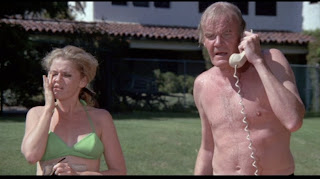
Beverley Hills used car salesman Bill Lennik (Andrew Duggan) begins "Bone" as a post-counter-culture whipping boy. A personification of square, capitalist values, he is already seething with hatred as undesirable elements seek to ‘invade’ his all-American home, whether in the form of a rat in his swimming pool filter, “that damned Jap gardener”, or a poor Asian cleaning lady gesturing forlornly outside the front gates. Bill is materialistic, intolerant, frustrated by everything – a recognisable ‘type’, ready to be flattened by our hip, young New American filmmakers.
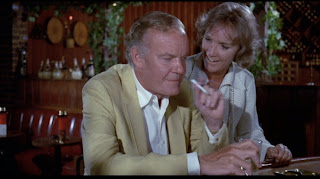
Have we ever stopped to wonder though, how deep this character’s dedication to his allotted role in the forthcoming drama really goes? How would we feel if, say, we left him midway through a nail-biting race against time to save his wife and home from the privations of psychotic criminal… and when we return, he’s knocking back scotch in a dubious-looking singles bar, exchanging surrealistic banter with an alcoholic widow who claims her husband was murdered by a sinister cabal of dentists subjecting him to excessive levels of x-ray radiation?
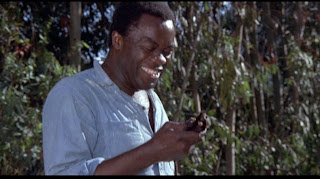
back at the scene of the crime meanwhile, how do we feel when our vicious face of black, urban crime (Yaphet Kotto as the titular ‘Bone’) drops his façade of implacable menace, accepts a drink from wouldbe victim Bernadette (Joyce Van Patten), and reluctantly admits that he just plain doesn’t have the
where-with-all to carry out the threats he made to her husband and go through all the raping and throat-slitting yet again. (“This is a rotten day for both of us” he snaps as he dutifully tears her clothes off.)
To go into a movie with simple, genre-based expectations and see them wholly overturned as our characters rebel against their programming, developing an unexpected third dimension and following weird, aimless story arcs of their own devising, is always great fun. But, released into the world at a very strange moment in American cinema when genre pigeon-holing still ruled supreme, the games “Bone” plays with its audience seem to have alienated rather than attracted potential viewers, while its black-in-the-other-sense humour, wringing laughs from rape, racism and child abuse, sent major studios, potential distributors and
certain influential critics running for the hills, resulting in a film that was maligned, misunderstood, ignored and almost lost to the world forever.
As extensively chronicled in Stephen Thrower’s book Nightmare USA, the early ‘70s was a period that saw a scattered legion of ambitious, independent young filmmakers emerging around the country, fired up by the European New Wave and the possibilities of a post-Easy Rider, post-Cassevettes ‘New American Cinema’, discovering the hard way that if you didn’t have Jack Nicholson’s number, the only up was through the grindhouse. This was an era in which 21 year old director Jeffrey Friedel could see his Bergman-inspired existential thrillers sold to the drive-in circuit by Harry Novak as “Axe” and “Kidnapped Co-Ed”, and where David Durston could follow up his quintessential gore flick “I Drink Your Blood” with a brooding treatise on racial tension and venereal disease. An era in which seemingly any whacked out, regional movie could be left to fend for itself in a marketplace where the art/gore/WTF shocks of “Night of the Living Dead” and “Last House On the Left” were seen as benchmarks of success, where unscrupulous distributors might as well have played frisbee with the negative of some poor guy’s masterpiece at weekends, and where nobody EVER seemed to get paid.
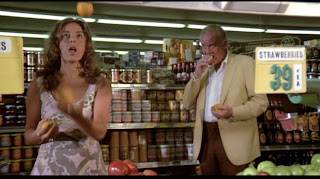
Into this arena steps our hero, Larry Cohen, with his self-financed directorial debut, “Bone”. A vicious and highly original black comedy with a great cast, beautiful photography and a subversive agenda a mile wide, it’s hard to imagine that the many industry bods Cohen screened the film for weren’t on some level impressed with the writer/director/producer’s talent and audacity. Great movie Larry, I can imagine them saying, GREAT movie, but….
Yeah -- BUT. Even circa 1970, it’s difficult to conceive a movie less sellable than “Bone”. Hopper and Nicholson and the Hollywood-hippie crew might have gotten away with freaking out the squares on the big screen, but in the independent sector, things were different.
Clearly not a film that intends to fuck about with disguising its underlying intent, “Bone” opens with a caption card;
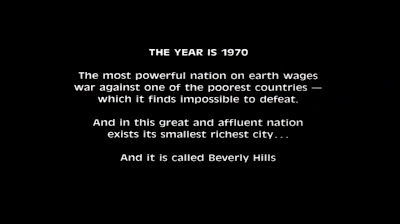
Whoa. That’s half your audience gone right there. When the picture proceeds to open with the Godard-via-The Monkees sight of Bill Lennik delivering his TV ad pitch whilst standing in a junkyard, intercut with bloody stills of road accident victims, I’m guessing you could say goodbye to a few more.

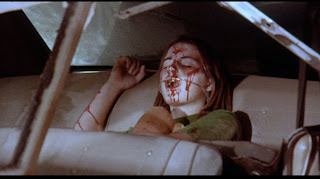
And as for whoever was left when the plot-line kicks in – well, I don’t think there’s any reason why a straight-up home invasion thriller about a Beverly Hills couple being menaced by a criminally-minded black man couldn’t have been fairly successful with an American audience in 1970, even with a good dose of liberal social conscience attached. After all, AIP quickies and ‘progressive’ directors had been knocking about with stuff like that for ages, and it was only a year or two later that audiences were thrilling to the black bad-ass stereotypes of the blaxploitation craze. It coulda worked.
As the commie-art-fag shock opening so clearly implies though, “Bone” is very much
not that film, however much the people writing plot synopses and DVD back copy might want it to be, even today.
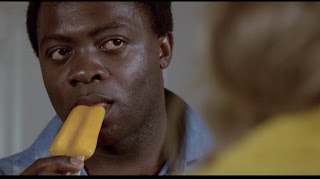
By frustrating genre and plot-based expectations at every turn, by giving us a sociopathic rapist who becomes a sympathetic nice guy and a square, white ‘hero’ who shrugs off his responsibilities halfway through and spends the rest of the movie goofing around, by rejecting three-act scripting conventions and just letting it all hang out, Larry Cohen presented the world with a film guaranteed to wrong-foot pretty much
any expectations that press or posters might have created for it – with sadly predictable results.
After failing to secure a distribution deal from the usual suspects, Cohen turned to veteran independent producer Jack H. Harris, and together they tried pushing “Bone” on Cohen’s own terms, as a hip black comedy, placing it in a few theatres in New York and LA. As Cohen tells it, these preview screenings were pretty successful, but the problems began when the film gained its best box office after Harris booked it in an East LA cinema catering to a black audience, double-billed with Fred Williamson’s “The Legend of Nigger Charley”. Subsequently, Harris decided his best bet was to market the film, against Cohen’s wishes, as an action-packed blaxploitation flick (“White Meat, Black Bone”), a tactic that backfired when confused audiences were presented with an action-free, character-driven comedy, and the film tanked.
In an interview included on the DVD, Harris claims he liked Cohen’s film a great deal. But this admiration apparently didn’t stand in the way of his reediting “Bone” to emphasise ‘the romance angle’ and cutting his losses by shopping it around as a cheap second/third feature under the name “Housewife”, with a sexploitation styled poster to match. Over the next few years, it seems like different versions of “Bone” did the rounds in god knows what kind of condition, trading as a sex film, with or without additional porno inserts, and eventually turning up as a supposed horror film under the ludicrous title “Dial Rat For Terror”.
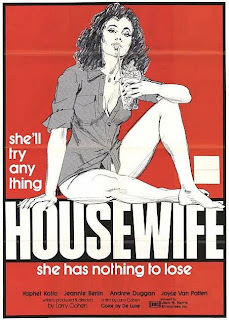
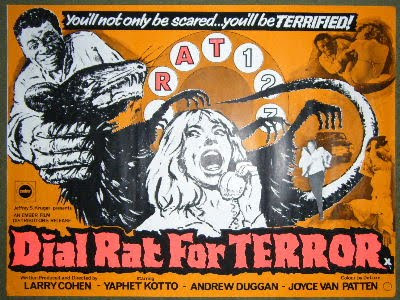
So it goes. We’re lucky enough to live in the DVD era, where we can stick on the reconstructed director’s cut of the film and laugh at such anachronistic craziness. The thing is though, that when I say ‘we’, I essentially mean genre film fans. Horror/sci-fi/exploitation guys. You and I, presumably. I mean, who else is gonna want to spend time tracking down the lost directoral debut of the man who brought us “Q: The Winged Serpent”, “It’s Alive” and “The Stuff”?
The irony is (and obviously I don’t mean this in a snobbish way) - “Bone” is NOT a genre film. As noted, it is a film that laughs in the face of genre convention. Which is extremely curious, given that it is now chiefly notable as the first item on the CV of a director who has spent the rest of his career making unashamed sci-fi and horror movies. But whatever – the fact is, in 1970 Mr. Cohen made a film that finds its true contemporaries not in the drive-in, but among the likes of Hal Ashby’s “Harold & Maude” or Bob Rafelson’s “Five Easy Pieces” – odd, earnest, wilfully unconventional little films about people questioning the paths life has set out for them. Admittedly, “Bone” is a bit more garish than those examples, a bit more brutal with its politics and swinging a bit heavier with the sex and cussing and bad behaviour, but still, at heart it’s a gentle, humane kinda story – more Richard Brautigan than Jim Thompson.
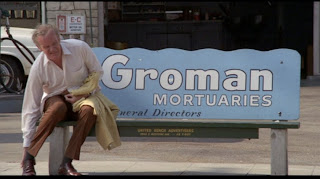
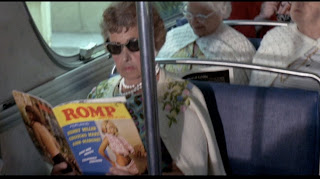
In some ways setting the blueprint for the kind of cerebral alterna-comedies that Spike Jonze and David O. Russell have brought to Hollywood in recent years, Cohen’s script is a riot of non-sequiturs, unexpected left turns and near post-modern diatribes, dealing in race, sex and the general dementia of late capitalist malaise, while “Bone”s improvisational, shot-on-the-run approach to visuals enlivens Andrew Duggan’s odyssey through the streets of Beverley Hills with such intriguing period details as park benches billboards advertising mortuaries, early Scientology pamphlets, gangs of hippies crouching in prayer outside a phonebox and a bus full of old ladies reading porn magazines.
A film created from the screenplay up, Bone is full of the kind of oddball, self-conscious dialogue guaranteed to bum the hell out of any actor not fully committed to the material, and it is amazing to witness how well Cohen’s cast help bring the potentially difficult material to life. It is always difficult to know what to say about acting of this calibre, beyond “it is very good”, so I’ll just observe that all four principals here manage to embody the complicated and unpredictable characters the script has created for them to such an extent that it is impossible to imagine anyone else in their roles, and leave it at that.
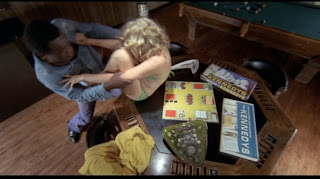
Perhaps the key scene in the film comes when Kotto’s character, having pretty much given up on trying to menace the troublesome and assertive Van Patten, sinks into lethargy and delivers an absolutely astounding monologue, riffing on the uncertain future of his career as a ‘violent black criminal’, an occupation Bone treats as seriously as if he were a bank manager or newsreader.
Easing out of his schizo tough guy mannerisms, Kotto begins to open up, discussing the embarrassing failure of his attempted rampage like an athlete talking to his coach after an underwhelming training session (“this is demoralising – I mean what kind of a rapist am I?”, “Well, I don’t know… I’ve never met a rapist before”). Warming to his theme, Bone next starts reminiscing about the days when all he had to do was look at a white woman to inspire terror;
“..now you go to a movie house, and it’s right up there on the screen – how about that, mixed couples all over the place! They went and took all the mystery out of it… they’re treating us like people
now - you can see what sort of a position that puts a rapist like me in…”
After building up a rhetorical head of steam, cheerfully expounding on the ‘nigger mystique’ that he’d built his career on pre-Civil Rights, Bone abruptly shifts back into a kind of wounded anger, Kotto’s delivery perhaps reflecting the frustrations of a hugely talented black character actor trying to make a name for himself in a culture where African-American performers were given the choice of goofy bit-parts or one-dimensional caricatures;
“..then they changed it, they changed the whole deal and I found myself slipping; there I was, I was holding onto the past, because change is scary, and then they said ‘EDUCATE YOURSELF’, ‘LEARN NEW TRADES’ – what trades? The Pullman porter, the shoeshine boy and ME. What trades? I only know how to do one thing… at least.. I used to know how…”The whole scene is breathtaking. As with Michael Moriarty’s stunning performance in “Q” a few years later, Larry Cohen seems to get a kick out of working closely with under-valued actors to create characters who achieve an almost fourth wall-breaking intensity, consciously pushing a figure whom lesser films (and complacent audiences) might write off as a ‘low-life’ or ‘villain’ into centre stage and letting him work out his frustrations, daring us to engage with the troubling circumstances that have made him what he is, and to acknowledge that this kind of crippling self-consciousness and neurosis isn’t just the province of comfortable middle-class guys on analyst’s coaches.
A brief look at Yaphet Kotto’s subsequent filmography of bit-parts and straight to video roles, as contrasted with the crazy, Brando-scale charisma he’s throwing around in “Bone”, is all the indictment one needs of the genre codes and social conventions that Cohen was seeking to tear apart here, and of how vital Kotto’s presence was in spearheading the attack.
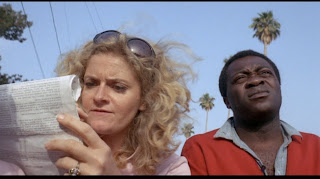
Whilst he provides the emotional centre of the film though, the character of Bone is also kind of unreal, appearing out of nowhere and then vanishing into thin air at the story’s conclusion like some bizarro world Mary Poppins, leaving the lives of those he has touched transformed. Essentially, both Bill and Bernadette end up using Bone as a prism through which they can realise transgressive desires that they didn’t even know they had until he intervened in their lives.
As Larry Cohen convincingly explains on the Blue Underground DVD’s commentary track, “Bone” essentially operates as a dense network of interlocking fantasies that the characters project onto one another. Bernadette gets to replace her deadbeat husband with a virile black man, whilst Bone gets to enjoy the love of a white woman and the comforts of a rich, white man’s home without having to take them by force. Through Bone, Bill is able to liquidate his responsibility for wife, home and business, and gets to wander around town aimlessly, perhaps for the first time, drinking in the daytime, stealing food from the supermarket and making out with a crazy lady he met in the bank queue. Even Jeannie Berlin’s character gets to project onto Bill her obsession with a childhood memory of being molested in the cinema by a middle-aged man, convincing herself that Bill was the original perpetrator and squaring the circle of her own strange obsessions. For a crazy moment or two it actually looks as if everyone is going to emerge a lot HAPPIER from this unexpected series of events, but, well… y’know, that would just be too easy wouldn’t it? Fantasies never really work out.
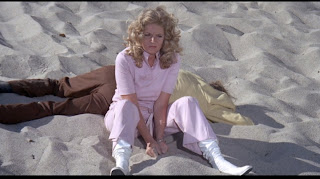
Some of “Bone”s damn-the-man Vietnam-era jibes may seem slightly quaint by modern standards, and the free-wheelin’ humour (particularly as embodied by Jeannie Berlin’s nightmare hippy chick character) may cross the line into bloody-minded quirk from time to time. But thanks to the genuinely unusual character dynamics and flick-knife satire of Cohen’s script, and to its flawless realisation by Kotto, Duggan and Van Patten, “Bone” remains a film with big, fuckin’ teeth, one that dares to present a genuinely different approach to American filmmaking, and that succeeds in challenging our boundaries and expectations of such to this day. All high-falutin’ talk aside, it’s a pretty great movie, it’s really funny, and you should do yourself a favour and watch it.
KOTTO WEEK LINE-UP:
Monday Nov. 15thUnflinching Eye -
AlienRaculfright 13's Blogo Trasho -
Truck TurnerTuesday Nov. 16thLost Video Archive -
Raid on EntebbeManchester Morgue -
Friday FosterWednesday Nov. 17thBooksteve's Library -
Live and Let DieThursday Nov. 18thMondo 70 -
DrumB Movies and Beyond -
The Monkey Hu$tleCinema Gonzo -
Report to the CommissionerFriday Nov. 19thIllogical Contraption -
Eye of the Tiger Ninja Dixon -
Across 110th St.Lines That Make Things -
The A Team (TV episode)Things That Don't Suck -
Blue CollarSaturday Nov. 20thBreakfast In the Ruins - Bone (YER READIN' IT!)
Lost Video Archive - The Park Is Mine