Showing posts with label torture chambers. Show all posts

Sunday, 14 June 2020

Gothic Originals:
The Virgin of Nuremberg
(Antonio Margheriti, 1963)


(AKA ‘Horror Castle’, ‘The Castle of Terror’, ‘Das Schloss des Grauens’, etc.)

When ploughing my way through the canon of ‘60s Italian gothics a few years back, I overlooked this early effort from Antonio Margheriti – his first entrée into the horror genre, I believe - simply because I couldn’t locate a watchable copy. Nowadays of course, the internet provides, but I’m not sure that ‘La Vergine di Norimberga’ was entirely worth the wait.

Filmed in colour on the same sets used for Mario Bava’s The Whip and The Body (does the presence of Christopher Lee indicate that both films were filmed around the same time?), Margheriti conjures some splendid - albeit entirely conventional - passages of gothic atmosphere here, complete with all the looming, cob-webbed staircases, candelabra-bearing, night-gowned peregrinations and baroque, wrought iron latticework one could possibly ask for.

Ernesto Gastaldi’s script (supposedly based on a book by the fictitious sounding ‘Frank Bogart’) meanwhile throws a few novel ideas into the mix to off-set the clichés – not least the decision to make this one of the first ‘60s gothic horror films which ostensibly takes place in the present day. It’s unfortunate therefore that the filmmakers consistently fail to put these innovations to very effective use, but… more on that later. (1)

For now, let’s simply state that the idea of our unsuspecting young bride (Mary, played by Rossana Podestà, in this case) discovering that the airless rooms of her aristocratic German husband’s creepy familial mansion are haunted not only by the memory of his most infamous ancestor, a scarlet-garbed inquisition torturer, but also by the more recent horrors of the Third Reich, is a fantastic and potent one indeed.

Specifically, the heroine’s dashing husband Max (Georges Rivière) is the son of a deceased Nazi general / surgeon, whose legacy is personified by the menacing presence of Lee, who remains largely in ‘looming heavy’ mode here in the role of Erich, the taciturn, scar-faced former adjutant of the house’s dead patriarch, who, obedient to the last, now spends his days maintaining his erstwhile commanding officer’s on-site family museum, dusting off the thumb-screws and iron maidens, and keeping the black-hooded effigy of the ‘The Punisher’ (as the medieval torturer was known) in good nick.

“He laid down the law in this region, and punished adultery with death,” Max cheerily notes of his nefarious ancestor. “It seems he killed many women, torturing them to death. Was he a moralist, or a maniac?” Let’s hope that was intended as a rhetorical question.

Though this ‘return of the torturer’ plot-line is a direct lift from Corman’s ‘The Pit & the Pendulum’, which had been a huge hit in Italy the previous year, the version of it presented here must surely have exerted a strong influence upon Massimo Pupillo’s camp classic Bloody Pit of Horror (1965), after which the idea of defunct torture instruments being put to use by contemporary killers went on to become a common motif in Italian horror, recurring in Fernando Di Leo’s ‘Slaughter Hotel’, Bava’s ‘Baron Blood’ and Emilio P. Miraglia’s ‘The Night Evelyn Came Out of the Grave’, to name but a few.

Likewise, the rich crossover between gothic horror’s familial, sins-of-the-past atavism and unresolved Nazi guilt was irreverently explored in a number of later European horrors - Jean Brismée’s supremely entertaining ‘The Devil’s Nightmare’ (1971) and Sergio Bergonzelli’s delirious giallo ‘In The Folds of the Flesh’ (1970) immediately spring to mind - but ‘The Virgin of Nuremberg’ feels very much like ground zero in this regard.

Indeed, unease over the inclusion of such contentious subject matter at this comparatively early date perhaps accounts for the fact that the treatment of this theme is somewhat bungled here by Gastaldi and Margheriti. The shaky lines connecting dusty medieval sadism, ultra-masculine Teutonic tradition and the apparent impossibility of reconciling war-time atrocities with peace-time forgiveness are all plainly visible to the viewer, but they remain frustratingly undrawn by the writer and director.

In particular, the final act revelation (conveyed to us via a crudely assembled stock footage-based flashback) that Max’s father was actually one of the conspirators who plotted to assassinate Hitler circa 1944, and that he was subsequently disfigured and driven insane by the punishments inflicted upon him as a result, feels like a real face-palm-worthy example of missing the point.

Thereafter, the film’s villain is allowed to become an ultimately sympathetic figure, somewhat akin to the tragic / damaged characters played by Vincent Price in the early Poe films, rather than the black-hearted, unrepentant monster from Europe’s collective id which this story’s younger characters should really be finding a way to stand up to and deal with as they try to build a new life for themselves in the 1960s.

Whilst the skull-faced killer’s depredations may be curtailed in the physical sense at the film’s conclusion, the psychic and historical wounds he represents remain untended and unacknowledged, lending the film a numb, depressing feel which is only enhanced by the longueurs of relative tedium which precede its finale.

Readers familiar with Margheriti’s work will be aware that his chief behind-the-scenes innovation involved dramatically speeding up production schedules on his films by using the kind of multi-camera shooting style which would later become the norm for TV soap operas and sit-coms. Said readers will also sadly be aware though that, however much money this technique may have saved for his producers, it also had a tendency to leave Margheriti’s films feeling distant and emotionally uninvolving, even when (as here) all the necessary ingredients for a greatness were seemingly present and correct.

This was by no means always the case of course (career highlights like ‘Castle of Blood’ (1964) and Cannibal Apocalypse (1980) remain absolute bangers), but ‘The Virgin of Nuremberg’ suffers particularly acutely from Margheriti’s characteristic lack of dynamism, to the extent that it’s run-time feels padded to an absurd degree, even at a double-bill friendly 80 minutes.

The purportedly exciting final act in particular feels like a master class in how to not generate tension, as Rivière’s character finds himself stuck in that ever-green classic, the locked room slowly filling with water, whilst Podestà, unaware of her husband’s predicament, traipses around the house’s interior in the company of a maid, in search of a door that the killer hasn’t yet locked.

Suspenseful stuff, you might think, but as Margheriti proceeds to simply cut between master shot footage of these two scenarios for about ten minutes, with no narrative development and no clearly defined, visible goal for his imperilled characters, even the most indulgent of viewers will be liable to find their eyelids crashing down in anticipation of bed-time.

Performances are likewise pretty flat across the board. Not even Sir Chris (who is dubbed by other actors in all of the film’s extant language tracks, much to his chagrin no doubt) manages to make much of an impression, despite some impressive scar make-up, whilst editing and audio/visual match up feels sloppy throughout (in the version viewed for this review, at least), suggesting that a rushed and/or uncaring attitude prevailed during the film’s post-production.

An incongruously upbeat, jazz-inflected score from the usually reliable Riz Ortolani doesn’t exactly help matters either, incorporating a series of hysterically bombastic cues which sometimes feel entirely inappropriate to the relatively sedate activity on screen.

In accordance with its torture theme, ‘The Virgin of Nuremberg’ does dutifully include a few ghoulishly sadistic horror ‘bits’, which I’m sure must have sent the British censors in particular into a veritable meltdown when it arrived on these shores as ‘Caste of Terror’ in 1964. Most notably, one somewhat revolting scene involves an unfortunate woman getting a basket containing a hungry rat strapped to her face - whilst ‘The Punisher’ meanwhile delivers a chilling monologue concerning the universality of torture techniques across the globe, which serves as probably the film's most legitmately unsettling moment.

The rat device dates from the fifteenth century and was utilised as far afield as China, he calmly informs his victim, as if she might find this interesting. Whilst the modern era has brought us many innovations, he darkly reflects, the old methods are the best.

Though not as explicit or impactful as they might have been in the hands of some of Margheriti’s more visually daring contemporaries, such ‘shock’ moments – including the ‘Black Sunday’-influenced opening in which Podestà finds a mutilated corpse within the iron maiden, and some equally gory B&W surgery flashbacks - have a touch of sordid, low rent nastiness about them which makes them feel like distant precursors to the hey-day of Nazisploitation other more full-on forms of Italian exploitation, which were still some 15 years down the line at this point. (The idea of a hideously mutilated, insane surgeon lurking in a darkened dungeon even reminded me slightly of Fulci’s ‘The House by the Cemetery’ (1981), if we’re keeping score.)

If the sheer number of later films I’ve managed to name-check above might suggest that ‘The Virgin of Nuremberg’ deserves to be reconsidered as a significant landmark in the development of Italian horror though, this would have been cold comfort to anyone who actually paid to see this visually attractive but otherwise rather dreary plod through the halls of gothic cliché in the early 1960s, especially after the local censors’ scissors had inevitably done a number on it.

Unsurprisingly perhaps, the film doesn’t seem to have made much headway in winning over the hearts and minds of horror fans in the decades since then either, despite of its scattered innovations and points of interest, joining such later cobweb-strewn Margheriti snooze-fests as ‘Web of the Spider’ (1971) and ‘Seven Deaths in a Cats Eye’ (1973) on the “walk don’t run” / “not as good as it sounds” list.

----

(1)Curiously, this film also assigns an extremely unlikely co-writing credit to Edmond T. Gréville, the Anglo-French director best remembered for 1960s ‘Beat Girl’. Quite how he got involved, god only knows, but I think it's fair to say that the finished script feels far more like Gastaldi's work than anyone else's, to the extent that I'm comfortable with naming him as the primary author. 

(Pure speculation here on my part here, but, given that Christopher Lee also appeared in ‘Beat Girl’, and also boasted an Anglo-French background, perhaps he and Gréville were friends? Perhaps Lee brought him in to do some rewrites, or perhaps Gréville just threw in some ideas over dinner which were then brought to the production by Lee, or something? Who knows...)

Tuesday, 1 May 2018

Pre-War Thrills:
The Mask of Fu Manchu
(Charles Brabin, 1932)


So, to get this out of the way right from the outset: if you’re going to take an interest in the pulp fiction or popular literature of the early 20th Century, you’re going to encounter a lot of racism.

H.P. Lovecraft may have taken most of the flak for this in recent years (largely due to the fact that he is one of the only pulp magazine writers still liable to be read by the kind of young/educated readers most liable to take offence at his repellent views), but, as fascinating as it may be to ponder the psychological underpinnings of Lovecraft’s errant fears and prejudices, the digger one digs into the work of his contemporaries, the clearer it becomes that these prejudices were far from uncommon.

Put into context alongside the unabashed imperialism and hysterical miscegenation fears of writers like Seabury Quinn and Dennis Wheatley, the deeply offensive caricatures of non-white characters that litter the work of Edgar Wallace or the dozens of other, more obscure, examples that blogger Samuel Wilson has chronicled over the past few years via his True Pulp Fiction project, Lovecraft’s more notorious passages are noteworthy only for the unusually strident manner in which he expressed his views, rather than for the views themselves (and, as fans and detractors alike will appreciate, HPL was writer who liked to express just about everything in pretty strident terms).

More than any other writer of course, it is Fu Manchu’s creator Sax Rohmer who must, through the very nature of his most famous creation, be singled out as the poster boy for all this Pulp Racism. I confess I’ve not read enough Rohmer to really make a call on the extent to which this assumption is justified, but…. well really this is all just a long-winded way of saying that I probably shouldn’t have been too surprised to discover that a Fu Manchu movie from 1932 is pretty damned racist.

Perhaps I’d been lured into a false sense of security here by my familiarity with the 1960s series of Harry Alan Towers/Christopher Lee Fu Manchu movies [see my reviews of ‘Brides of…’ and ‘Blood of…’ here and here]. Though still a far cry from what anyone would be liable to deem ‘politically correct’, these films are essentially pretty good-natured affairs that tend to treat their antagonist’s ethnicity as a mere incidental detail – a bit of exotic colour to liven up his Bond villain-esque schemes for world domination.

Charles Brabin’s film, by contrast, is definitely pulling no punches. “You hideous yellow monster,” heroine Karen Morley spits at Boris Karloff’s Fu Manchu at one point, shortly after he in turn promises to “..destroy your whole accursed white race”. Clearly sensitivity of any kind was not on the cards here.

Adapted by a veritable raft of screenwriters from the simultaneously published Rohmer novel of the same name, ‘The Mask of Fu Manchu’ indeed presents us with a villain whose motivations are somewhat different from those of the unilateral, ego-driven super-villain proposed by most other screen adaptations. Instead, Fu Manchu’s attempts to swipe the face-mask and sword of Genghis Khan from under the noses of the British archaeologists who have just excavated them is motivated by his plan to use the ceremonial power of these artefacts to inspire the people of Asia (yes, all of Asia) to unite and overthrow their Western oppressors.

Leaving aside the fact that, given the geo-political shit that had gone down in the century or so prior to 1932, people in many parts of Asia had pretty legitimate cause to want to overthrow their Western oppressors, the notion that the sight of a Chinese man carrying some paraphernalia belonging to a Mongol folk hero would somehow cause everyone from Istanbul to Yokohama to rise up in revolt is just so utterly bizarre that I don’t even know where to start with it really. It just left me speechless to be honest, but… such is the level of wilful cultural ignorance we’re dealing with here, apparently.

When, late in the film, we see Fu Manchu strutting his stuff on the stage of what looks like a disused theatre, rousing a crowd of guys who largely resemble moth-eaten Afghan warlords of some kind to a mild display of scimitar-rattling enthusiasm (“conquer and breed – kill the white man and take his women”, he memorably exhorts them), we have to wonder how the hell anyone was *ever* supposed to buy this idea, even in the further reaches of fanciful pulp delirium.

Needless to say, the film’s steadfast defenders of the British Empire spend a great deal of time asserting the seriousness of Dr Fu’s rather whimsical scheme, but it doesn’t help that those defenders aren’t really a very persuasive bunch, by and large.

For reasons best known to themselves, the scriptwriters on ‘Mask of Fu Manchu’ seem to have nixed the idea of including Rohmer’s likeable Holmes/Watson surrogates Nayland Smith and Dr Petrie, who usually provide the bulk of the heroic daring-do in these stories, instead entrusting our attentions to bunch of fairly grumpy, interchangeable middle-aged men who never really succeed in making much of an impression.

As our nominal protagonist, Morley does what heroines do in these kind of things – being alternately headstrong and hysterical, wearing a pith helmet and fretting about her missing-presumed kidnapped archaeologist father and/or archaeologist husband - whilst the assorted interchangeable chaps offer little in the way of reassurance once she’s out on-site in the Gobi Desert.

To be fair, Nayland Smith is actually present (in the shape of Lewis Stone, who also appeared in The Lost World), but he spends the first half of the movie directing operations remotely from back in London, and when he does finally get in on the action he proves only marginally more formidable than the other fellows, with his name warranting scarcely so much as a shrug from his supposed arch-nemesis.

Oh well. At least Boris Karloff’s take on Fu Manchu has got to be worth the price of admission, right? Well, perhaps, but, with all due respect to Karloff, I’m not sure he comes over all that well here to be honest.

Whereas Christopher Lee in the ‘60s movies presented an appropriately towering, saturnine presence (much as you’d expect I suppose), Karloff’s Fu Manchu feels like a physically smaller figure, with a loquacious, conniving sort of vibe about him.

Much is made in the script of Fu’s doctorates from Cambridge, Edinburgh, Harvard etc, and in light of this, Karloff speaks in his own delightfully melodious tones, without attempting any hint of an accent. As lovely as it must have been for him to give his voice a good work-out after non-speaking roles in ‘Frankenstein’ and ‘The Old Dark House’ however, the cliché-riddled diatribes the script equips him with are scarcely very edifying, and, well… perhaps it’s just me, but the idea of a Fu Manchu who is ceaselessly nattering away rather distracts from the taciturn, Confusion menace I prefer to associate with the character.

On plus side, Karloff does muster some splendidly diabolical expressions, and makes good use of his long, claw-like fingernails, but his performance can scarcely have been helped by a somewhat excessive make-up job – complete with pointed ears – that makes the “Devil Doctor” look more like a fire-damaged elf than a Chinese man. (Attempting to cash-in on Karloff’s recent breakthrough as a horror star, this explicitly monstrous/non-human Fu Manchu was rather optimistically billed as “The Frankenstein of the Orient” on some of the movie’s posters.)

Likewise, the casting of the great Myrna Loy as Fu Manchu’s lascivious daughter Fah Lo See bodes well, but production anecdotes suggest that Loy (who had often been cast in ‘oriental’ roles during the silent era, in spite of her entirely European heritage) made no secret of her distaste for the material, and her resentment at essentially being forced to appear in the film by MGM is reflected in a performance pointedly lacking in any kind of enthusiasm. (1)

Other gossip meanwhile relates that, when Karloff requested a script prior to shooting, he received nothing but gales of laughter in response, and subsequently had to deal with having his dialogue passed to him from day to day on single-spaced, typo-ridden pages. It also seems worth noting at this juncture that an initial attempt at principal photography on the film collapsed in chaos after three days, with initial director Charles Vidor subsequently finding himself sacked by the studio, and Brabin drafted in at short notice to replace him.

Under such circumstances, it’s hardly surprising that, in purely narrative terms, the completed ‘Mask of Fu Manchu’ is alternately boring and nonsensical, essentially boiling down to lot of stodgy, indifferently shot dialogue scenes interspersed – seemingly at random – with flourishes of morbid, horror movie atmospherics and grand, opulently transgressive set-pieces.

Thankfully though, the latter sequences survive as fairly jaw-dropping examples of deranged, pre-code decadence, and indeed, even as the film embodies the most regrettable aspects of its era’s pulp fiction, it also manages to bring the very best of the pre-war “Shudder Pulp” aesthetic to the screen, going all out to justify Fu Manchu’s reputation as “The Lord of Strange Deaths” with a series of hair-raising, grand guignol spectacles, rendered with such lavish enthusiasm that they feel like ‘Weird Tales’ cover illustrations come to life.

After minor bits of ghoulishness early on (one character gets a knife in the back, a severed hand falls from a tree at another’s feet etc), things really get underway in this regard when we see Fu Manchu subject the first of his English captives to “the torture of the bell” – a somewhat Poe-like conception that sees the poor chap spread-eagled across a slab whilst a gigantic bell bongs away immediately above him.

Not the most gruesome of on-screen torments perhaps, but it’s at least agreeably bizarre, and Fu Manchu’s attempts to entice information from his victim by dangling grapes from his claw-like finger nails and fooling him with salt water carry an icky charge of sadism that serves to set us up nicely for the depredations to follow.

Subsequent highlights include the extraordinary sight of captured leading man Charles Starrett stripped to a loin cloth and strapped to a table with metal brace around his neck as Fah Lo See covetously surveys his naked flesh, a phalanx of Nubian slaves arranged on pedestals behind her like human statues. When Dr Fu himself makes the scene – ominously clad in a surgical gown - the exceptionally icky action that follows involves the fresh blood of lizards and tarantulas being drawn into a syringe and mixed with snake venom pulled directly from the wound of a dying sacrificial victim(!), all to aid the creation of a mind control serum that we then see injected straight into Starrett’s neck.

One of the earliest horror scenes I’m aware of that dares to go straight for a gross-out / gag reaction, this alarming juxtaposition of bodily fluids and creepy-crawlies almost seems to prefigure the post-‘Black Magic’ excesses of ‘70s/’80s Hong Kong horror, and as such proves pretty hard to top in terms of nastiness.

Even more extraordinary in some ways however is a subsequent scene in which poor old Nayland Smith finds himself strapped to a kind of gigantic see-saw, balanced mere feet above a pit fill of – apparently genuine – alligators. Single shots appear to confirm that Lewis Stone himself was hanging mere inches away from the jaws of these surly looking beasts (no stuntmen here!), whilst, elsewhere, another captured good guy (who presumably won the on-set coin toss prior to shooting) merely has to contend with the none-more classic device of having horizontal spiked walls slowly closing in upon him.

Marvellously, all this madness is rendered in lavish, no-expense-spared fashion by MGM, who at the time were riding high as Hollywood’s top-grossing studio, meaning that, like Doctor X before it, ‘The Mask of Fu Manchu’ is able to take full advantage of the brief, magic window that followed in the wake of ‘Dracula’ & ‘Frankenstein’s box office returns, when horror and pulp adventure subjects could temporarily command something approaching A-picture production values.

Both the opening scenes, set in a shadow-haunted British Museum, and the later explorations of Fu Manchu's suitably extravagant subterranean lair employ a series of genuinely vast sets, elaborately dressed with a wildly imaginative mixture of scientific apparatus and faux-Chinese artistry, incorporating throne rooms, amphitheatre-like torture chambers and – my personal favourite – a curtained-off circular alcove carved from a dividing wall within Fah Lo See’s bed-chamber, wherein, we suppose, Fu’s daughter likes to recline with her “victims” (more on which below).

Tony Gaudio’s photography intermittently catches some fine, shadowy vistas on all this high camp weirdness, and, despite the chaos that apparently characterised the production, the film intermittently displays some great bits of visual imagination – most notably the introductory shot of Fu Manchu himself, in which we see Karloff’s fiendish visage reflected in distorting mirror, inexplicably raising a glass of dark, foaming liquid to his lips as electricity crackles dangerously from some off screen device, casting jagged shadow across his face.

It is in moments like this I think that the film’s conception of Fu Manchu really comes alive, portraying him as a man so completely immersed in his hermetic world of rare poisons, venomous concoctions and scientifically-derived terror machines that they have practically (or literally, in this case) become his food and drink, placing him beyond the threshold of mere humanity – a theme that is taken up later in the film, when we see him almost dancing with the sparking, unearthed electricity current that fly from his machinery.

‘The Mask of Fu Manchu’ also echoes ‘Doctor X’ in providing another fine exemplar of early horror’s post-‘Frankenstein’ fascination with the sinister properties of electricity. Indeed, Fu Manchu’s impressive array of spark-spewing equipment – including an actual death ray, no less - were built by Kenneth Strickfaden, the legendary architect of the laboratory sets in Universal’s Frankenstein series, and his creations definitely get a good work out here.

Perhaps we could read a touch of metaphorical significance into all these electricity bolts flying around the place too, given that, as has often been observed, there is something weirdly sexual about Karloff’s portrayal of Fu Manchu, with his sinuous movements and his propensity to unleash sighs of pleasure furthering the impression that the scenes within his lair were purposely designed to convey a particular kind of frisson to the thrill-hungry audience MGM were hoping to attract to the picture. (Heck, even the carved figures on doors of Genghis Khan’s tomb look a bit saucy.)

In this respect, the film is particularly keen to push the envelope in regard to Loy’s character, making the nature of the sexual interplay between Fah Lo See and her father’s captives abundantly clear whenever the opportunity arises. When Fu Manchu initially interviews his captured archaeologist, he basically offers to let the man sleep with his daughter in exchange for information about the location of Genghis Khan’s swag (“even this, my daughter, I offer to you”), but the boot is very much on the other foot later in the picture, when, prior to his ordeal with all the snake venom and tarantula blood, Charles Starrett finds himself chained to a dungeon ceiling, stripped to the waist and whipped (with what look like leather straps) by Fah Lo’s musclebound Nubian slaves… all whilst the lady herself looks up, working herself up into a bit of a sweat as she insists they hit him harder, and faster.

After this, we see Starrett’s exhausted body deposited – where else – in Fah Lo See’s bed chamber, where she lasciviously caresses his bloodied torso until the scene is interrupted by the entrance of her father. Essentially, the filmmakers outline her activities as a sadistic sexual predator about as unambiguously as they possibly could without moving into full on stag movie territory, and, though the power of these scenes is somewhat undermined by Myrna Loy looking as if she was being forced to emote at gun point, modern viewers can still thrill as they contemplate the long decades that would pass before American audiences would next be allowed to enjoy the sight of a woman experiencing orgiastic pleasure as she oversees a man-on-man bondage session.

To be honest, given the puritanical edicts that would begin to be imposed upon Hollywood productions just a few years after this film’s release, it’s surprising that the early proponents of the Hays Code didn’t suffer a collective coronary when they learned of the kind of depravity depicted in ‘The Mask of Fu Manchu’. In fact, having apparently failed to learn the lessons of the disastrous reception that greeted their release of Tod Browning’s notorious ‘Freaks’ a year earlier, it seems in retrospect as if MGM were hell-bent here on crafting a horror movie calculated to offend absolutely everyone on some level.

I mean, even if you were a 1930s citizen with liberal enough sensibilities to roll with all the sadistic torture and sexual perversity, chances are you might have drawn a line at the film’s blunt racial prejudice and dumb-headed colonialism (or failing that, at least been a bit grossed out by all the lingering close-ups of snakes and spiders).

As a result of this triple threat to public morals (and stomachs), it’s scarcely surprising to learn that ‘The Mask of Fu Manchu’ seems to have become one of the most widely censored films in history. It was banned outright in some territories (including many European countries and, unsurprisingly, in Japan), whilst other local jurisdictions proceeded to arbitrarily cut the film as they saw fit. Some excised bits of the more extreme content, whilst others snipped the inflammatory dialogue, and some even imposed cuts on the grounds of blasphemy, before moral guardians presumably did the same in the next state/county/town, until surviving release prints must have been sliced and diced beyond the worst nightmares of a Lucio Fulci/Jess Franco archivist.

Adding to the confusion, it seems that, when MGM staff returned to the film with a view to striking a new print in the 1970s, they were so shocked by the racially insensitive content that they sliced many offending lines of dialogue straight out of the negative, creating a bowdlerised version that became the only way to watch the movie for decades to come, until the nigh on miraculous discovery of a clean, uncut lab print returned it to circulation in all its unsavoury glory in the 21st century.

For all the multitudinous outrage that ‘The Mask of Fu Manchu’ provoked however, the moment modern viewers might be liable to find most unsettling is one that largely escaped to attention of censors at the time – namely, the scene during the film’s conclusion in which Nayland Smith and his comrades take control of Fu Manchu’s death ray and turn it upon the arch-fiend and his followers, who are gathered in the hall below.

What I found noteworthy here is that, rather than alarming the villains and prompting them to scatter (as would normally be the case with this sort of thing), our heroes actually mow down every single one of the quote-unquote “Asian” ne’erdowells, even leaving the weapon running to mop up the survivors as they head off in triumph.

Distantly recalling the same dark questions raised by the old College Debating Society chestnut about whether or not the USA would ever have dared to drop an atomic bomb on a European city, there is something genuinely chilling about the sight of the good guys in an action-adventure story casually massacring several hundred defenceless people in a locked room, without their heroism being at all called into question as a result.

Immediately after this meanwhile, the film reaches the nadir of its unapologetic racism in a deeply regrettable closing scene that finds Nayland Smith and his friends aboard ship on their way home to England. They are in the process of consigning Genghis Khan’s sword and mask to the bottom of the ocean (because, y’know, fuck that shit), when they freeze upon hearing the sinister crash of an oriental gong.

Their surprise turns to laughter however when a short, pot-bellied, gap-toothed Chinese man enters stage right to declare that dinner is served. Do you have a doctorate from Harvard, or from Christ’s College, Nayland Smith jokingly asks the man, who shakes his head in mute incomprehension, giggling along with his relieved interrogators as they shuffle past him and head off to get their grub. Cue triumphant musical flourish and ‘The End’ card.

The comparison between this pitiable ship steward and the defeated Fu Manchu is thus made explicit, and the message that the film leaves us with is clear: as long as we keep these people away from our institutions of learning and make sure they don't get any funny ideas, they’ll remain where they belong - illiterate, buck-toothed and banging the dinner gong – and all will be right with the world.

Taking the film far beyond a mere “this is the way they did things in 1932” level of background racism, it’s hardly surprising that these ugly sentiments proved controversial even at the time (apparently the Chinese Ambassador to the USA lodged a complaint about the film following its release), and perhaps, like ‘Freaks’ before it, ‘The Mask of Fu Manchu’ can best be seen as another example of MGM disastrously misjudging public tastes in their rush to try to cash in on the contemporary vogue for horror.

Certainly, no sequels to were forthcoming, despite the obvious potential for turning Fu Manchu into a series character. Karloff quietly returned to work at Universal after filming was completed, and, as we’ve discussed above, the film was withdrawn from circulation in its uncut form for pretty much the entirety of the 20th century.

But, eighty plus years down the line, we can hopefully at least strive toward some semblance of 20-20 hindsight and acknowledge that, for all of the deplorable attitudes it embodies, ‘The Mask of Fu Manchu’s errant combination of hare-brained colonialism and grotesque, sexualised sadism still proves fascinatingly unsettling and alluring, carrying with it an intoxicating whiff of the forbidden that edges it toward the same “dark camp” category within which ‘Freaks’ eventually found its niche as a celebrated cult film.

With its baroque excesses and general air of taboo-trampling derangement, ‘Mask..’ certainly stands up as just as much of an unforgettable viewing experience as the other (ostensibly far superior) films I’ve covered elsewhere in this review thread, irrespective of the hateful attitudes expressed within it.

--

(1) Confusingly, Fah Lo See inexplicably became Lin Tang (played by Tsai Chin) in the ‘60s movies, and she had already been renamed Ling Moy (played by the beautiful Eurasian star Anna May Wong) in an earlier Fu Manchu adaptation with Warner Oland, 1931’s ‘Daughter of the Dragon’. In Rohmer’s novels, she was Fah lo Suee, so ‘Mask of..’ gets it closest.

Thursday, 5 October 2017

October Horrors #3:
Inquisition
(Jacinto Molina, 1977)


 Believe it or not, I’ve never really been a big fan of the whole witch hunter/tortures of the Inquisition sub-genre, in spite of the fact that I seem to have spent half my life watching examples of it. As such, I have held off investigating Paul Naschy’s inevitable entry in the “religious hypocrisy is explored, meanwhile naked ladies get bits cut off them” sweepstakes for quite some time, feeling that it would most likely prove a somewhat unedifying experience.

Now, don’t get me wrong here - of course I’m a big fan of Naschy and I love many of the wild n’ wooly horror movies he starred in unreservedly. But, I found myself thinking, is there really anything worthwhile he could contribute to the kind of heavy, historical subject matter necessitated by a project like this, beyond just another dose of imitative, ‘Mark of the Devil’-style sadism..?

Well, let’s just say that I hang my head in shame for underestimating El Hombre Lobo, because it turns out Naschy actually had a great deal to bring to the table here, and, assuming one can overlook the fact that it is at least partially cobbled together from reheated bits of ‘Witchfinder General’ and ‘The Devils’, ‘Inquisition’ is a far better, and far more sincere, film than many might have anticipated.

In fact, when Naschy - using his birth name Jacinto Molina - took the plunge and began directing his own films in the late 1970s, he departed significantly from the kind of goofy monster rallies we might reasonably have expected of him. Instead, Naschy/Molina met the collapsing market for independent horror films in the second half of the decade head-on with a series of unexpectedly challenging projects, including the ’10 Rillington Place’-esque serial killer film ‘The Frenchman’s Garden’ (1978) and the bizarre medieval morality tale ‘El Caminante’(1979). First in line in this apparent attempt to reinvent himself as a more serious filmmaker though was perhaps the jewel in the crown of this strange, transitional period in his career – ‘Inquisition’.

Although he was stepping behind the camera for the first time, Molina’s direction here is extremely confident, arguably achieving more professional results than any of the men who had helmed his projects up to this point. Apparently inspired by such works as Polanski’s ‘Macbeth’ and (inevitably) Michael Reeves’ aforementioned ‘Witchfinder General’, Molina establishes a tone that is sombre, stately and doom-laden right from the outset, utilising well-choreographed crowd scenes and carefully composed long shots to establish a genuine feel for the lingering mediaeval barbarism of the rural 17th century setting.

The director is aided in this by some exceptional production design; Molina was apparently a stickler for historical detail, and his collaborators do him proud here with an impressive range of costumes and set dressings that, along with the oppressively dense, earthy tones of Miguel F. Milá’s cinematography, combine to create a brooding atmosphere of febrile menace and mud-splattered feudal poverty.*

Though the film is, shall we say, deliberately-paced, Molina’s tale of a trio of beleaguered witch-hunters trespassing upon the hospitality and inner secrets of an isolated French community threatened by the approach of The Black Death remains sufficiently compelling that boredom never comes knocking (which is certainly more than can be said for some of Naschy’s earlier movies) and, once the story gets underway, it heads off in some unexpectedly interesting directions.

Though character development remains minimal, and much of the acting here is as emblematic and old-fashioned as you’d expect of a pulpy historical yarn, Molina nonetheless does a good job of exploring the social and economic tensions boiling beneath the surface of the story’s myriad witch finder/church/landowner/peasant relationships, all explored in an admirably straight-faced manner that rarely boils over into melodrama.

We probably shouldn’t go too far in trying to play up ‘Inquisition’s “seriousness” however; there are of course still plentiful clichés and random bits of silliness here for euro-horror fans to enjoy. We might for instance ask how the witch hunters, whom we saw arriving in town on horseback with no luggage, nonetheless manage to outfit a local dungeon with a magnificent selection of massive wooden torture instruments within a few days of their arrival -- and indeed, the ensuing scenes of misogynistic torture are as gratuitously exploitative as you might imagine.

Early in the film, Molina proves he is not above letting his camera linger over the naked bodies of some surprisingly buxom plague victims, and, once the witch findin’ gets underway, the torments inflicted upon one young blonde victim in particular top anything in ‘Mark of the Devil’ for sheer, eye-watering excruciatingness. (Those who have seen the film won’t need reminding of the details; I’ll leave the rest of you to find out for yourselves.)

As in Jess Franco’s surprisingly-decent ‘The Bloody Judge’ (1968) though, this sort of thing is more of a gruesome sideshow than anything else – a sop to the more bloodthirsty horror fans in the audience, perhaps – and the imprisonment and torture of innocent victims thankfully never becomes the main focus of the narrative.

Speaking of Franco, ‘Inquisition’ has often been accused – most recently by Jonathan Rigby in his book ‘Euro-Gothic’ – of following the pattern established by 1972’s utterly daft The Demons in terms of taking a mixed up, “have yr cake and eat it” approach to the witch hunter sub-genre, inviting us to condemn (whilst also revelling in) the sadism and hypocrisy of the inquisitors, whilst simultaneously portraying witchcraft and black magick as a genuine supernatural threat.

Though developments in the second half of ‘Inquisition’ – wherein heroine Catherine (Daniela Giordano) falls under the sway of the local witch cult and embarks upon a campaign of vengeance against Naschy’s lead inquisitor – are certainly suggestive of such a conclusion, I nonetheless believe this is a misguided and superficial reading of the film, and one that Molina actually goes to great lengths to avoid, as attentive viewers will hopefully note.

Admittedly, Molina/Naschy is treading a delicate balance here, and some may feel that the character he plays, who is initially painted as a cruel religious fanatic, becomes a tad too sympathetic in the final act (an indulgence perhaps to the actor/director’s usual “tragic monster” persona), but, by and large, ‘Inquisition’ just about manages to hold fast to a consistent worldview throughout.

Crucially, effort is made to establish that the film’s Black Mass sequences – which are totally way-out and awesome, by the way, complete with Naschy pulling double duty as His Satanic Majesty – can be seen as hallucinations on Catherine’s part; more restrained, earth-bound festivities lent an extra kick by the sinister psychoactive brew administered to her by the cult’s intimidating head crone.

Catherine’s other ‘visions’ meanwhile, including the one in which she sees her lost lover murdered by assassins under Naschy’s command, are thus rendered equally suspect; more the result of ideas placed in the head of a desperate and suggestible woman than bona fide supernatural sign-posts. (Giordano, it should be noted, delivers an excellent performance here, powerfully conveying her character’s unravelling mental state without ever overdoing it.)

In order to further untangle the film’s intentions for the audience, ‘Inquisition’ also introduces a character – the wise, liberal minded local doctor, played by Eduardo Calvo - who essentially functions as a mouthpiece for the filmmakers, criticising the proto-fascist behaviour of the witch hunters, whilst also patiently explaining that they are a symptom of the very same atmosphere of religious fanaticism and social inequality that has  pushed women toward the far fringes of this society, leaving them with nowhere to go except into the arms of a newly re-vitalised witch cult.

Whilst the inclusion of such an obvious “mouthpiece” character sounds rather fatuous on paper, in practice the doctor’s presence as a moral barometer within a long, complex film full of compromised, unsympathetic characters is actually very welcome, and Calvo is a strong enough actor to sell the part convincingly.

The ideology he espouses meanwhile will be familiar to most students of the European witchcraft mythos as part of a compelling – if rather fanciful – line of thought that runs through such texts as Margaret Murray’s ‘The Witch Cult in Western Europe’ and Jules Michelet’s ‘La Sorcière’, and films stretching from Eiichi Yamamoto’s extraordinary ‘Belladonna of Sadness’ (1973) to Robert Eggers’ The Witch (2016), all of which seek to some extent to reframe the witchcraft phenomenon as a kind of quasi-feminist rebellion against a repressive Christian patriarchy.

(Quite how well these bold ideas can be squared with the misogynistic violence exploited elsewhere in the film is of course a matter for debate, but veteran Euro-horror viewers should be used to rolling with the punches when it comes to these kind of mixed messages.)

Viewed within this framework, ‘Inquisition’s conclusion, in which Naschy’s character - a befuddled puritan, his acts noble in his own mind but abominable to the world at large – finds himself burned to death next to the former object of his lust/love, now howling with derisive laughter as her kamikaze quest for vengeance reaches its conclusion, actually represents a uniquely twisted spin on the usual, over-familiar witch hunter narratives.

Despite the best efforts of Calvo’s doctor, we are left with the impression of a world gone mad, unsure how we should be feeling, or where our sympathies are supposed to lie – certainly a more unsettling mixture of emotions that those who think of Naschy purely as some cheap-jack werewolf guy would ever have thought him capable of evoking.

Why, it’s almost enough to make us overlook the fact that, when his character is wheeled out to meet his fate with a shaved head, white smock and square-jawed, teary-eyed countenance, Naschy is “doing” Oliver Reed in ‘The Devils’ just as shamelessly as he had previously “done” Chaney, Lugosi, Karloff et al in his earlier films. Well, you can’t keep a good horror-man down I suppose, even when the weight of history, religious philosophy and high art comes knocking.

Whilst it clearly can’t hold a candle to Reeves or Russell, ‘Inquisition’ is still an extremely impressive achievement in its own right, despite its somewhat imitative agenda. In fact I think I would rate it as the single best entry in the “second division” of witch hunter movies I have seen to date. Needless to say, if you are at all interested in any of this stuff, it is well worth your time. (Mondo Macabro's recent blu-ray release is splendid, by the way.)

---

* A mainstay of ‘60s spaghetti westerns who moved on to home-grown horror pictures in the ‘70s, the range of Milá’s credits as a cinematographer is such that he could probably claim a certain amount of credit for establishing the uniquely “earthy”/brown-heavy look that defined much Spanish horror – a look that perhaps reaches its apex in ‘Inquisition’.

Monday, 20 February 2017

A Forgotten Euro-Gothic Double-Bill:
‘Tomb of Torture’ and
‘Cave of the Living Dead’
(1963)

This month, I’ve been busy reading Jonathan Rigby’s new book ‘Euro Gothic’ – a fairly self-explanatory follow up to the author’s previous surveys of British and American horror - and enjoying it greatly. Whilst fans will no doubt have a few bones to pick vis-à-vis the choices of coverage within, Rigby’s concise and sardonic summation of about eight decades of continental fantastic cinema remains a joy.

From my own point of view, one of the most welcome aspects of the book, and one that I think more than makes up for the author’s occasional omissions, is the extent to which exhaustive research into production and release schedules (matched by an equal dedication to actually tracking down and watching the bloody things) has allowed Rigby to shine a light on numerous films that have been almost entirely forgotten by today’s euro-cult fan base.

Some of these seem to have proved quite rewarding discoveries, and are allotted comparable coverage to the expected ‘classics’ of the genre. Others however… not so much so.

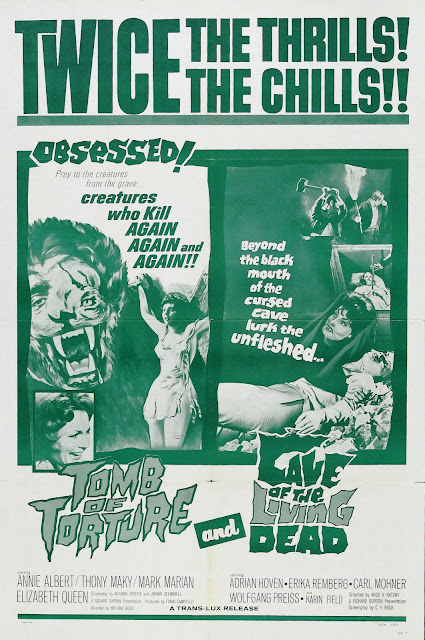
For instance, did you know that, in 1964, noted transatlantic producer and horror enthusiast Richard Gordon acquired the rights to two European productions of the previous year, one Italian (‘Metempsyco’, directed by Antonio Boccaci) and one German (‘Der Fluch der Grünen Augen’ [The Curse of the Green Eyes], directed by Ákos Ráthonyi), and sent them out as a ready-made double-bill in both the US and UK, redubbed for English-speaking audiences and respectively retitled as ‘Tomb of Torture’ and ‘Cave of the Living Dead’?

Until I read about this in Rigby’s book, I had no idea, and knew nothing of either of these films. Frankly, one suspects that Gordon’s offer of two rather threadbare, black & white ‘shockers’ didn’t attract a great deal of interest from cinema owners or sub-distributors during the great push toward colour in the mid-‘60s, and as a result the films have remained little seen and largely unremarked upon in the English-speaking world, even whilst copies of the prints Gordon prepared have circulated in the bootleg/grey market domain for years.

It is by such means that I made the happy discovery that I actually had copies of both films sitting unwatched in my collection. As such, I thought it might be nice to put an evening aside and recreate what audiences venturing into this long-lost double-feature may have experienced back in 1965 (that being the copyright date given on both prints).

Beginning with ‘Tomb of Torture’ then, Rigby actually gives this one an absolute kicking in his book, deeming it “dismal in the extreme”, alongside other bon mots.

As an avowed advocate of ridiculous pulpy nonsense, I believe I enjoyed it at least a *bit* more than Rigby, but nonetheless I’m sad to report that I can offer little evidence to contradict his conclusions.

Following a credits sequence that I’m guessing was thrown together entirely by Gordon – featuring a regrettably anglicised cast list, floating disembodied chess pieces, a nifty ‘spookshow’ font and some close-ups of a rather fetching rotting skull-face with (sadly static) hypno-wheel eyes - Antonio Boccaci’s sole directorial effort actually begins on a pleasantly Jean Rollin-esque note, as two rather heavily made-up “schoolgirls” enter stage left and, with no further ado, decide to go snooping about in the scary castle on the hill (the same one previously used by Renato Polselli in The Vampire and the Ballerina, if I’m not mistaken).

Whereas Rollin’s totemic twins however usually accepted their initiation into the netherworld of vampiric weirdness with a sense of silent, angelic resignation, this pair by contrast make a right fuss about things, adopting a fairly tiresome investigator-vs-scaredy-cat routine that continues even after they’ve bumped into the castle’s apparent owner – a sour-faced, middle-aged lady who understandably instructs them to clear off. For some reason though, she fails to enforce this edict, leaving the girls to continue their wanderings unmolested until they find themselves accosted by some kind of leering, paper-mache-faced hunchback(?) creature.

(In fairness, I’m not sure this creature is actually supposed to be a hunchback, but I’m damned if I can of anything else to call him within the recognised lexicon of horror movie types – I suppose he’s more of a “deformed, dungeon-dwelling psycho” sort of deal really, but that’s a tad long-winded, so henceforth let’s just call him the ‘monster’.)

Anyway, one shriek of terror later, and the brunette half of the schoolgirl duo awakes to find herself – now wearing nowt but a flimsy night-gown – being strapped by the monster onto one of those X-shaped cross-beams last seen in the 1932 ‘Murders in the Rue Morgue’, down in the castle’s obligatory torture dungeon. (1)

Soon the creature tires of this though, and lugs her over to the rack for a brief but surprisingly intense sequence of mildly-eroticised torment that serves to ensure that those who paid to see ‘Tomb of Torture’ can no longer legitimately ask for their money back, regardless of whatever follows.

One abrupt cut later, and a coach conveying some kind of doctor and his daughter to the same castle is waylaid by the discovery of the bodies of the two girls, who have been unceremoniously dumped by the side of the road. Incredibly, the local comic relief idiot policeman insists that the girls have died from natural causes, in spite of the blood on their faces and (we must assume) sundry other evidence of the monster’s depredations.

Seemingly unconcerned about this ghastly turn of events, the doctor restricts his disagreement with the policeman’s diagnosis to a bit of disapproving tut-tutting, and otherwise devotes his attentions to chatting with another man on the scene – a chap named Ramon, whose brown-face make-up and turban are presumably supposed to identify him as some kind of Hindu, although, as with every single other character in this film, any further insight into his background is denied to us. (Ramon, incidentally, is played – rather stiffly, it must be said – by the film’s director, in his only screen appearance.)

Apparently, Ramon and the doctor know each other of old, and both used to live in the castle in some context before moving away. Ramon is subsequently astonished to discover that the professor’s daughter (Anna) is the spitting image of the castle’s deceased Countess Irina, to whom he was engaged when she disappeared under mysterious circumstances some twenty years previously. (2)

It seems that Anna’s father is bringing her to the castle on the pretext that the relaxing atmosphere will help her with some bad dreams she has been having(?!), but it soon becomes clear that he harbours a hidden agenda, believing that his daughter’s dreams are in fact some kind of psychic visions which will allow him to discover what happened to the Countess, and, more pertinently, the location of the legendary stash of treasure that may or may not have disappeared along with her.

If all this sounds rather puzzling, well, it is – and it certainly doesn’t become any less so as things go on. Mere sketchy plotting however has nothing on the level of sheer bewilderment soon to be induced by the lengthy dream sequence that follows these events.

As Boccaci wheels out the old “wobbly screen” effect to signal that we’re now entering Anna’s “dream-time”, she finds herself down in the dungeon, reclining on the same torture instrument we saw the monster making enthusiastic use of a few minutes earlier.

In short order, a static, cowled skeleton pops up like some escapee from a ghost train, and a clawed monster with a wispy bearded, clay face somewhat reminiscent of the creature from Cocteau’s ‘Le Belle et la Bete’ (or perhaps one of the denizens of Kenneth Anger’s Pleasuredome?) has extracted itself from a tomb and commenced lumbering about, menacing our heroine in a vague sort of fashion.

Meanwhile, a man in evening dress whom we’ve not met before descends the stairs and begins calling the name of “Countess Irina”, only to find himself bloodily dispatched by an animated suit of armour wielding a broadsword (the horror of his demise is somewhat undermined by some rather comical “oooooh, aaaaaagh” type noises on the English dub). The spectral knight then slices the string holding back the bolt on a giant medieval siege crossbow, causing the projectile to fly free and bloodily impale Anna straight through her chest!

All of this is just as jaw-dropping as it sounds, and once again, if you’re holding out for a rational explanation of some of the more outré elements of Anna’s dream, you will be left disappointed. Up to this point in fact, ‘Tomb of Torture’ has seemed less like a film in its own right, and more like the kind of footage that might have been created for use in a sequence in another film in which the characters go to a cinema to watch a horror movie – if you get my drift. A mindless, near plotless parade of horror-type imagery, devoid of either artifice or artistry, its sheer, cheap preposterousness actually puts me in mind of nothing so much as Andrea Bianchi’s ‘Burial Ground’ (‘Le Notti del Terrore’, 1981), a similarly unglued artefact from the opposite end of Italian horror’s golden age.

At least Bianchi though had the good grace to ensure his film remained uproariously entertaining throughout its duration, whereas Boccaci, having blown his load in opening half hour described above, unfortunately leaves us to fend for ourselves through a further fifty minutes of run time devoid of almost any interest whatsoever.

It pains me to come down so hard on a film this adorably crazy, but seriously folks - as soon as we’re back in the waking world with Ramon, the doctor, the hunchback-monster and the sulky woman who owns the castle, ‘Tomb of Torture’ really is a dead loss.

Little of the crazy/fun stuff from Anna’s dream ever reappears, as assorted characters wander aimlessly, conversing at length on matters that we likely wouldn’t care about even if they made any sense, whilst supposedly ‘suspenseful’ scenes in which the monster chases people around are repeatedly botched by means of amateurish direction that sees the participants trudging through the static long-shots, evidencing very little sign of alarm. A slide trombone soundtracked ‘comedy’ sequence in which Anna is introduced to her made-to-order intrepid journalist boyfriend whilst skinny-dipping meanwhile is simply unspeakable.

I suppose you could say that the moody photography of the closing ten minutes gives us some nice dungeon atmos and a touch of melodramatic grandeur, but the marginally novel idea of having the castle’s rats gradually gnaw their way through the restraining rope on the aforementioned bolt-thrower during the climax is rather ruined by the decision to use hamsters – quite fluffy, cute-looking ones at that – in lieu of actual rats, and regardless, it’s all too little too late for this turkey. (3)

In spite of a few truly bizarre passages and a uniquely eccentric approach to production design, it is difficult to recommend ‘Metempsyco’ / ‘Tomb of Torture’ as anything more than a minor curio for gothic horror completists, and even in that capacity, my word-to-the-wise would be to gleam whatever kicks you can from the opening few reels, then shut it off and do something more useful with your time. Ah well – one down, one to go.

In stark contrast to the wildly uneven, slapdash qualities of the Italian half of tonight’s double-bill, it is difficult not to fall back on national stereotypes as we turn to our German offering, which, as it turns out, takes a similarly hackneyed set of genre elements and somehow fashions them into a thoroughly satisfactory exemplar of accomplished b-movie craftsmanship.

As ‘Der Fluch der Grünen Augen’ / ‘Cave of the Living Dead’ gets underway, we are swiftly introduced to our male lead, in the form of future Jess Franco collaborator and the producer/director of ‘Castle of the Creeping Flesh’ (1968) and ‘Mark of the Devil’ (1969), Mr Adrian Hoven.

After more than a decade playing romantic leads in German features, the forty year old Hoven seems at this point in time to have been transitioning toward character parts, and here we find him essaying the role of a smirking, eyebrow-arching Interpol agent – exactly the kind of off-the-peg protagonists that became ubiquitous in European movies in the wake of the early James Bond films in other words (although in this case, I’d imagine an equal debt is owed to Joachim Fuchsberger’s roles in the early Rialto krimis).

In a set-up reminiscent of Franco’s The Sadistic Baron Von Klaus from a year or so earlier, Hoven’s vacation (spent eyeing up a leggy blonde in a cocktail lounge, naturally) is interrupted when he is called back to base by his superior officer, who informs him that he is being dispatched on an undercover assignment to a remote village (famed for its “grotto”, apparently), where he is ordered to single-handedly crack the case of a series of mysterious slayings of young women that has thus far left local law enforcement baffled.

Upon his arrival at the village’s ramshackle, rustic inn, Hoven doesn’t have to wait long before getting down to business, as, conveniently, the comely maid occupying the room next to his falls victim to the vampiric killer that very night.

Though an almost shot-for-shot quotation from ‘Nosferatu’, this shadow-based nocturnal assault is nonetheless a striking sequence, with the combination of eerie electronic noise on the soundtrack and the fact that the clawed monster appears to be wearing some kind of gauze-shrouded body-suit momentarily creating the impression that the village’s female populace might actually be falling prey to some sort of space-monster.

A Yugoslavian co-production, I’m guessing ‘Cave..’ may also have been shot there too, but wherever it was lensed, ‘sense of place’ is definitely strong here, with the film’s locations conveying a convincing sense of poverty-stricken, rural isolation.

Though the exact location or nationality of the ‘village’ in which the action takes place is never made clear, it is a realm of rough stone interiors, roaring open fires, flickering shadows, mouldering wood piles, freezing fog, and an almost palpable shadow of benighted primitivism just waiting to descend, whenever the locale’s few, shaky signifiers of modernity withdraw.

Speaking of which, one of the most curious aspects of the ‘Cave..’s storyline arises from the fact that, each time the vampires – who are soon revealed to be of a pretty much common or garden variety, incidentally - make an attack, the village’s electricity supply pre-empts their arrival by shorting out, in a manner sufficiently widespread that it apparently affects the battery in Hoven’s car as well as the mains.

Whilst no explanation is ever offered for these power cuts, they nonetheless provide a beautiful metaphor for the film’s central theme of atavistic superstition reasserting its power over scientific rationalism – a theme that, thinking about it, renders the lack of a sign-posted explanation entirely appropriate.


Already hip to the notion that there is something a little peculiar going on here, Hoven’s character begins his investigation in time-honoured fashion by butting into the lives of the locals, revealing them to be as curious and suspicious a bunch as you could hope for.

After acquainting himself with the somewhat Walter Matthau-esque inn-keeper, the surly and uncooperative doctor and a hulking, mute brute who always seems to be hanging around, looking well up for of a strangling or two, Hoven follows up on the suggestion that he should pay a visit to the local witch / wise-woman - referred to in the English dub simply as “Nanny” - to get the low-down on the vampire threat.

What follows is a surprisingly compelling scene whose pungent atmosphere could almost have been pulled from some ‘Haxan’-esque film of the silent era. “Look how enticingly they dance..”, Nanny opines as a super-imposed coven of naked witches are briefly shown shimmying around the flames beneath her cauldron. (Hoven’s “did I really see that?!” reaction shot is a winner.)

After identifying Hoven as the man whose destiny is to put down the evil afflicting her community, Nanny gifts him with a silver crucifix (an artefact whose significance in this film seems curiously detached from Christianity, which otherwise goes entirely unmentioned) and a magical powder for use in reviving victims of a vampire bite, “..ground from the thorns of mountain roses, which on Walpurgis night are in full-bloom, the night when the witches’ fires burn on the mountains”. The English dubbing team did a great job on this scene, needless to say.

Returning to the more down-to-earth side of his investigations, Hoven also calls in on the castle (of course there’s a castle), where he has been invited to take up residence by the reclusive Professor who has recently taken possession of what we are told was formerly a ruin.

That the Professor is played by Wolfgang Preiss – an actor best known to contemporary German audiences for his appearances as Dr Mabuse in the series of updates of the character instigated by Fritz Lang’s ‘The 1,000 Eyes of..’ in 1960, and probably best known to you and I as the go-to-guy for Nazi officers in countless Hollywood WWII movies – suggests that our hunt for the perpetrator of the killings may well have reached a premature conclusion.

And, even if you didn’t pick up Preiss’s background as a sort of honorary German ‘horror man’, the Professor’s nifty array of bad guy accoutrements (skulls on pedestals, circles of gigantic black candles, apparent powers of clairvoyance) should leave viewers in little doubt that any pretense the film entertained toward being a whodunit is very much dead in the water by this point.

Though his screen time is sadly limited (it seems likely the production only had him on board for a couple of days), Preiss brings a quiet, understated menace to what could easily have been played as a fruity ‘master vampire’ role, but, given that he proves as reclusive to viewers of the film as he does to the villagers, it is the members of his staff who ultimately prove more interesting.

A striking looking actress with a New Wave-ish blonde bob, Erika Remberg plays the Professor’s research assistant / Hoven’s obligatory love interest, and, as with most of the characters in this movie, she’s given enough of a twist to transcend blandness. Sick of running pointless experiments for the Prof (she summarises his research interests as “anything and everything to do with blood”), she seems thoroughly bored of the whole remote village/scary schloss business, icily telling Preiss at one point that her three week contract has come to end, leaving him looking rather glum at the realisation that his aristocratic charm has failed to convince her to stay on and become his vampire mistress (or whatever). (4)


Even more noteworthy is the Professor’s black man-servant, John, who, in contrast to the way one might have expected such a character to portrayed in a contemporary British or American horror picture, actually turns out to be quite an agreeable fellow, disassociating himself from his employer once he realises he’s up to no good, and subsequently becoming Hoven’s chief ally in the fight against the vampires.

More pertinently, this character also allows Ráthonyi’s film to open up a sub-plot exposing the prejudice and petty cruelty of the rural villagers, who make no bones about distrusting John purely on the basis of skin colour, covertly blaming him for the murders, and, in one particularly blunt demonstration of small town racism, physically ejecting him from the inn when he naively drops in in search of a drink and some company. (He even offers to buy everyone a round before the pushing and shoving begins, the poor chap.)

You could say that this theme is explored in pretty heavy-handed fashion, and that John Kitzmiller’s performance as John is rather lacking in subtlety (his occasional lapses into Maitland Moreland-esque comedic facial expressions are somewhat regrettable), but nonetheless - even choosing to address such subject matter makes ‘Cave..’ / ‘Der Fluch..’ pretty much unique in my experience of early ‘60s horror films. (5)

By lining up this extensive cast of characters (certainly a more varied bunch than your average gothic horror) and kicking things off as an off-beat murder mystery, ‘Cave..’ seems, almost inevitably for a German genre film of its era, to be drawing to some extent from the krimi template. Indeed, you can see from the German poster reproduced below that the film was sold as such domestically, with no hint that it is actually a supernatural horror movie.

Happily though, such advertising proves to be entirely misleading, and in fact, what I loved most about ‘Cave of the Living Dead’ is that, whereas you might expect a story in this vein to drop hints of supernatural goings-on before wrapping them up into a quasi-scientific explanation, this film instead does precisely the opposite. Early suggestions of a scientific rationale for the vampire threat (the power cuts, the Professor’s ‘experiments’, Hoven’s attempts to take a blood sample from one of the vampires) are never followed up, whilst “Nanny”s witchy profanations are meanwhile revealed to be as solidly reliable as the wooden stakes and mallets that Hoven and his allies eventually use to ‘crack the case’ the old-fashioned way.
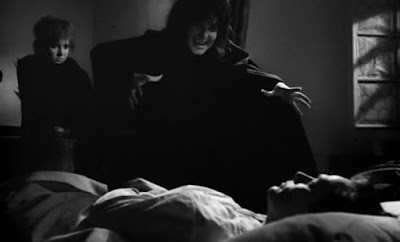
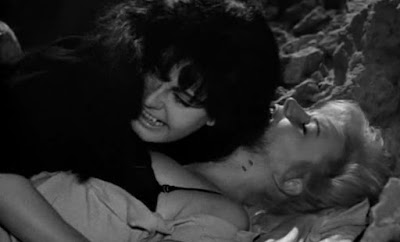
Functioning as a no-nonsense vampire movie by the time it hits its final act, ‘Cave..’ doesn’t really bring anything new to the table in this regard, but nonetheless acquits itself rather well, providing enough empty coffins, seductive, fanged beauties and dramatic stakings to satisfy most aficionados of the form, with some eerie, lantern-lit excursions into the appropriately atmospheric caves promised by Gordon’s retitling proving a particular highlight, with the filmmakers even managing to incorporate an apparently genuine swarm of bats at one point.

Though it eventually turns out to be assembled the same sort of loosely bolted together genre clichés that comprised ‘Tomb of Torture’, I for one found ‘Der Fluch..’/ ‘Cave..’ to be quite a rewarding little film, far exceeding my (relatively low) expectations. More detailed and imaginative scripting than most European gothics were graced with lends the story a rare sense of thematic consistency, whilst Ráthonyi keeps the screen stocked with enough interesting stuff to capture our attention throughout, and the uniquely atmospheric setting and unusually good performances from most of the cast seal the deal.

Whilst ‘Der Fluch der Grünen Augen’s unpretentious, programmer level ambitions mean it perhaps doesn’t quite scale the heights achieved by Europe’s very finest gothic horror productions, it nonetheless compares favourably with any of the second tier efforts emerging from Italy or the UK at around the same time, and as such is well worth tracking down. Even after suffering through eighty minutes of turbaned Antonio Boccaci and his hunchback-monster with only an interval ice cream to look forward to, I still think I would have left that cinema in 1965 feeling pretty satisfied.


-----

(1)Interestingly, the next film I recall seeing these iconic X-shaped frames in is Jess Franco’s Necronomicon (1967) -- which was co-produced by Adrian Hoven, star of ‘Cave of the Living Dead’. Pure speculation here of course, but do you think it possible that Hoven could have checked out the Gordon double-bill at some point to see how ‘Cave..’ played out in English, and, noting these cool-looking frames in the co-feature, might have suggested them to Franco when planning his own horror film a few years later...? If so, that could even be ‘Metempsyco’/’Tomb of Torture’s main claim to historical posterity, given the number of erotic/horror films that subsequently used these frames in the ‘70s.

(2) “Countess Irina” of course offers another Franco connection, should you wish to make it. You probably don’t.

(3)I suppose perhaps you could posit ‘Tomb of Torture’s roving hamsters as a knowing tribute to the inexplicable armadillos in Todd Browning’s ‘Dracula’, but… it would be pushing it, to be honest.

(4)Historians of horror movie sleaze may be interested to learn that Remberg also delivers an *almost* nude scene in this film, when, in a shamelessly gratuitous sequence, we see her stripping off to go to bed, with merely her casually raised wrist hiding her nipples from full view. Pretty envelope-pushing stuff for ’63 (although Franco had already gone further with the French cuts of ‘..Dr Orloff’ and ‘..Baron Von Klaus’), and I’m inclined to believe this shot alone could have been responsible for gaining the film the British ‘X’ certificate proudly displayed on the print I watched. (I’m surprised they let it through at all to be honest, given how timid UK censorship was in those days.)

(5)An American actor primarily based in Europe, Kitzmiller also appeared as that-black-guy-who-gets-killed in ‘Dr No’, before playing the title character in the 1965 adaptation of ‘Uncle Tom’s Cabin’ – a role which was sadly his last, as he died in Rome the same year.