Showing posts with label Donald Pleasence. Show all posts

Friday, 4 October 2024

October Horrors #1:
Circus of Horrors

(Sidney Hayers, 1960)

Released, I believe, one year prior to Franju’s definitive ‘Les Yeux Sans Visage’, this early outlier in the ever-popular field of plastic surgery / facial reconstruction-themed horror differs slightly from the norm, in that Anton Diffring’s Dr Schüler [formerly Rossiter] is actually really good at restoring facially scarred women to their former beauty, requiring neither non-consenting skin-donors nor years of gruesome trial and error grafting experiments to get the job done.


Unfortunately however, despite his exceptional expertise and high success rate, fame and fortune do not await the good doctor and the brother / sister team of assistants who inexplicably follow him around, partly due to that stuffy ol’ medical establishment refusing to countenance his radical innovations… but largely due to the fact that he is also shady as fuck, in addition to being played by everybody’s favourite cold-eyed, expressionless Nazi officer.


As such, Schüler / Rossiter instead finds his true vocation acting as the tyrannical manager of a continental travelling circus, whose artistes are in fact petty criminals and prostitutes whose faces the Doc has surgically altered in order to grant them a new identity (as well as apparently training them all to be world class acrobats in the process), and whom he inevitably ends up murdering via various circus-appropriate staged accidents when they decide to leave his employ and/or threaten to expose his sinister racket. All of which falls pretty far from anything which might normally be deemed to make “a lick of sense”, but hey, who’s counting?

Unleashed upon the British public by Anglo-Amalgamated productions shortly after they’d delivered the sublime-to-the-ridiculous double whammy of Michael Powell’s ‘Peeping Tom’ and Arthur Crabtree/Herman Cohen’s ‘Horrors of the Black Museum’, it’s probably fair to say that ‘Circus of Horrors’ falls somewhere between those two poles, quality-wise, but a lot closer to the latter than the former.

Indeed, most of the plotting and character stuff here consists of tacky, ultra-lurid sado-melodrama, very much in the vein of the three films Cohen made with Michael Gough during this era, the details of which need not concern us here. But, at the same time, the production values are FAR higher than on any of Cohen’s flicks, with the use of a genuine circus (and its performers) lending a sense of scale and visual interest to proceedings which belies the low budget, whilst the cast also do a bang-up job breathing life into their corny, under-motivated roles.

Douglas Slocombe’s photography though is what really seals the deal, balancing rich colours with deep shadows, and adding real depth to Hayers’ oft-imaginative framing, especially during the scenes set in the big top, which (unusually for circus stuff in movies) have some decent atmosphere to them, and are quite fun to watch.

By the standards of a late ‘50s British production, this is strong stuff content-wise too, beating Hammer at their own game by including at least one absolutely startling bit of gore, whilst the circus setting meanwhile allows the glamorous (and numerous) female cast members (notably including both Yvonnes - Monlaur *and* Romain) to display acres of pulchritudinous flesh, whether crammed into kinky outfits, getting frisky with the ever-lecherous Diffring, or indeed with the equally randy cop/hero character who belatedly attempts to, uh, save the day?

Also - there’s a superbly fruity early Donald Pleasence performance to enjoy here too, as he pops up (with hair!) in the 1947-set prologue, playing the shell-shocked, alcoholic owner of a destitute circus, collapsing into despair amid the ruins of post-war France. And boy, does he ever get his teeth into it. It’s a shame he exits the film so early, but seeing him meet his sorry fate, crushed beneath the weight of an entirely inanimate dancing bear, is worth the entry price alone.

Thursday, 13 May 2021

Gothic Originals / Exploito All’Italiana:
Nosferatu in Venice
(Augusto Caminito et al, 1988)

 The tragedy of ‘Nosferatu in Venice’ is that, under more favourable circumstances, it could so easily have been great.

The character of Nosferatu - first seen of course in F.W. Murnau’s 1922 masterpiece and resurrected in the form of Klaus Kinski in Werner Herzog’s 1979 remake - remains a potent, genuinely terrifying and comparatively underused figure in the horror pantheon, whilst the city of Venice meanwhile remains one of the best places on earth in which to set a horror movie, its atmosphere of decaying, historical grandeur seeming to elevate the quality of pretty much any film project lucky enough to shoot there.

Just imagine, the grand spectacle of the Doge’s winter carnival, the bridges and alleyways thronging with depraved revellers vainly clinging on to the remnants of Italy’s moribund aristocracy, whilst below the water level, in the ancient sewers and catacombs, Nosferatu lurks, rat-like, spreading fear and death through the blood-lines of their errant daughters and abused servants... amazing. The damned thing writes itself.

Given that producer, screenwriter (and eventual director) Augusto Caminito wrangled a fairly lavish budget for the production (bankrolled at least in part by future despot Silvio Berlusconi), as well as gaining a remarkable level of access to some of the city’s most evocative shooting locations, ‘Nosferatu in Venice’ should by rights have been a sure thing - a last gasp triumph of Italian horror cinema’s twilight years. Needless to say though, that’s not exactly the way things turned out.

It would be all to easy to blame the project’s collapse into infamy and disaster entirely upon the mayhem perpetrated by Klaus Kinski (of which more shortly), but in truth things seem to have been going awry before he even arrived on set. By that point, Caminito had already hired and fired two directors (Maurizio Lucidi and Pasquale Squitieri), and - if the version of the film which was eventually released is anything to go by - the wafer thin narrative and bamboozling morass of expositional blather which comprise his screenplay are not exactly suggestive of a lost masterpiece.
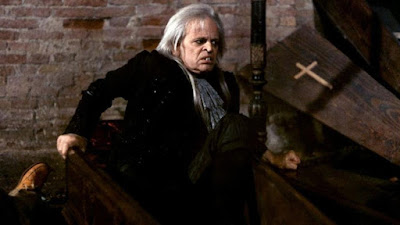
Suffice to say though, if Caminito didn’t exactly have his ducks in line here, it was blood and feathers as far as the eye could see as soon as Kinski made the scene. Tales of the actor’s outrageous conduct during the 1980s are, of course, legion, but, clearly aware that ‘Nosferatu in Venice’ lived or died on the basis of his participation, this particular shoot seems to have found the actor scaling ever greater heights of maniacal narcissism.

This was made immediately evident upon his arrival, when, infamously, he refused point blank refused to wear the Nosferatu make-up which had been prepared for him, declaring instead that he would play the vampire, sans prosthetics, as a more ‘romantic’ figure, complete with his own long, thinning blonde hair.

Not only did this make a mockery of evoking the Nosferatu name in the first place (and indeed of hiring Kinski specifically to reprise his role from Herzog’s film), but even more gallingly for the producers, the crew had already shot and edited twenty minutes of footage - filmed at great expense during Venice’s winter carnival - featuring a double wearing the full Nosferatu make-up.

Consulting the sketchy contract Kinski had signed for his appearance in the film, it was determined that there was nothing in place to actually compel him to wear the make-up… and woe-betide anyone who cared to try. With a substantial chunk of the budget already in the truculent star’s pocket, there was nothing to be done but surrender to his whims, ditch the pre-shot footage, re-jig the script and try to find something else to inexpensively fill all that empty screen time.

The next disaster was quick to arrive when the film’s third director, “safe pair of hands” industry veteran Mario Caiano (best known to horror fans for 1965’s Nightmare Castle) quit after less than a day on set, walking out after a violent altercation with Kinski. Thereafter, Caminito took the reins himself, with significant (uncredited) assistance from second unit director / special effects supervisor Luigi Cozzi [also see: Paganini Horror].

We could continue discussing the difficulty Kinski provoked on set at some length here, but one anecdote related by Cozzi will hopefully prove sufficient. At one point it seems, he and Caminito left the set for ten minutes, to make a phone call and buy some cigarettes. Returning, they found Kinski sitting alone in an empty room, the entire crew having apparently packed up their equipment and left with the intention of boarding the next plane back to Rome, so heinously had the star managed to offend them during the producer/director’s brief absence.

All of this though pales into insignificance compared to the rumours surrounding Kinski’s abuse of his female co-stars, which cast an ugly pall over whatever enjoyment may still be gleaned from ‘Nosferatu in Venice’. Again, we don’t need to labour the point here - the grisly details are easily google-able, and, if true, they’re pretty horrendous.

In summary though, it seems that actress Elvire Audray (who plays the wife of the movie’s supposedly heroic doctor character, woodenly played by Yorgo Voyagis) left the film with immediate effect when - as per Cozzi’s recollections once again - Kinski disregarded an instruction to bite her on the neck during filming, and instead subjected her to what can only be described as a violent and sustained sexual assault.

Even taking into account the progress which has been made on such matters since the dark days of the 1980s, it seems extraordinary to me that Kinski was not behind bars within hours of this incident, having apparently assaulted a woman in front of multiple witnesses and a rolling camera, but… who am I to speculate on the whys and wherefores of the situation?

Be that as it may, Kinski remained on the loose, and tried the same tactics on the film’s ostensible leading lady, Barbara De Rossi, allegedly molesting her off-camera whilst shooting close ups for a scene in which Nosferatu seduces her character in her bedroom. Reportedly, De Rossi only agreed to continue work on the film after receiving a promise that she would never again be placed in close proximity to Kinski… thus necessitating further rewrites. (1)

Meanwhile, the star seems to have found what we must assume was slightly more willing recipient of his attentions in the shape of a young woman named Anne Knecht, who apparently caught his eye when she visited the set as Voyagis’s girlfriend. Despite Knecht having no prior acting experience, Kinski insisted she was cast as a hastily-scripted new character. (No wonder the female characters in the finished film are so ill-defined and interchangeable.)

Presumably to the great relief of the other cast members, Knecht went on to dutifully provide the bulk of the film’s requisite nudity, most prominently during the lengthy ‘love scene’ (I use the term loosely) which comprises the film’s the finale. Therein, we see a shockingly haggard looking Kinski groping and clambering around on Knecht’s impassive naked body for what feels like hours, whilst, in a particularly grim irony, the footage is intercut with shots of her real life boyfriend Voyagis grumpily stomping about in ineffectual ‘vampire hunter’ mode.

And so the chaos went on, until - thankfully for all concerned, I can only imagine - Caminito called principal photography to a close after six weeks, despite having only acquired around two thirds of the footage he needed to complete the scripted film - in addition that is to ten solid hours of material ‘directed’ by Kinski himself, featuring his character stalking alone through Venice’s pre-dawn streets. (Ironically, these shots actually comprise some of the best stuff in the finished film.)
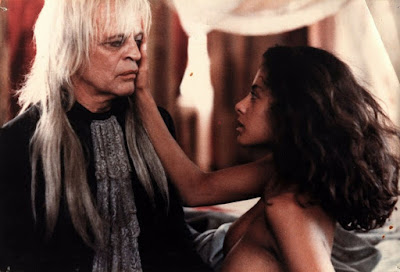
In view all the palaver outlined above, it’s hardly surprising that ‘Nosferatu in Venice’ emerged as an extraordinarily disjointed mess. Unreleased for several years after shooting was completed, the film’s editing (credited to Claudio Cutry) comprises the cutting room equivalent of a dazzling high wire act, splicing together pieces of mismatched, discontinuous footage into some semblance of narrative order, with… mixed results, in spite of what I take to have been herculean efforts on Cutry’s part.

The tragedy of it all is though, there are bits of the film - sequences of shots here and there, or even entire scenes during the first half - which are genuinely excellent. 

The deep shadows and subdued, Gordon Willis-esque lighting favoured by DP Tonino Nardi lend a pungent, foreboding atmosphere to the Venetian location footage, whilst interior scenes featuring the film’s better actors (Christopher Plummer, Donald Pleasence, and Maria Cumani Quasimodo as ‘the princess’), apparently filmed in a genuine, suitably palatial Venetian villa, achieve a sense of brooding menace, reminiscent of such art-house horror staples as Borowczyk’s ‘Docteur Jekyll et les Femmes’ or Tony Scott’s The Hunger. “Terrible things happened in these chambers two hundred years ago,” we are repeatedly told, and for a moment there, we can believe it.

Even the disjointed / discontinuous editing rhythms sometimes work in the film’s favour, bringing a murky, opiated haze to proceedings, suggestive of some incorporeal, space/time warping evil which feels entirely in keeping with the symbolic/metaphysical aspect of the Nosferatu character, whilst the thinly sketched, comic book weirdness of the, uh, ‘plot line’ invests everything with a haphazard surrealism which surpasses even the ‘80s output of directors like Cozzi or Lucio Fulci for sheer bewilderment.

So, speaking of the plot, let’s try to get this straight, shall we?

A perpetually silk-clad young woman, who lives alongside several other young women in a crumbling Venetian villa belonging to an elderly princess afflicted by a cursed bloodline, invites a Van Helsing surrogate vampire expert to come and see her, because she has found an iron-bound coffin in the villa’s basement which she believes, for some reason, must be the resting place of the dread Nosferatu, who (it is apparently well known) was last seen in Venice exactly two hundred years earlier.

But, this cannot be so, the vampire expert (Professor Catalano, played by Plummer) insists, because Nosferatu actually perished in a shipwreck somewhere far away, and now rests at the bottom of the ocean. But, everyone at the villa still feels some kind of psychic ‘connection’ to the bad ol’ vampire (reflecting both the cursed bloodline business, and the fact that he committed assorted atrocities in the villa back in 1786). So, what else do do but call in a medium and hold a séance with the intention of contacting the spirit of Nosferatu, thus prompting him to awaken from his slumber and bust out of his dusty coffin way over yonder in… some other place. (Not the bottom of the ocean, at any rate.)

After taking time out to engage in some lusty dancing with a group of gypsies who - in an interesting, if politically questionable, throwback to Stoker’s ‘Dracula’ - appear to hold him in high reverence, the revived Nosferatu employs a rather vague supernatural methodology to transport himself back to Venice, where, needless to say, he sets about biting necks, leching over ladies and indulging his inexplicable passion for throwing people out of windows.

Brilliant! All makes perfect sense, right? Italian horror movie logic, god how I love it.

Also hitting that late-era Italio-horror sweet-spot, consistently undermining the film’s intermittent attempts to achieve a more ‘classy’ feel, is Luigi Ceccarelli’s score, which - perhaps reflecting the lack of funds/enthusiasm which remained for this project during post-production - sounds as it was recorded on the cheapest synthesizer available, and transferred to the film via a warped cassette tape left for too long in direct sunlight. Whether the fact that I still enjoy the music speaks to Ceccarelli’s talents or just my personal fondness for such lo-fi aesthetics, I’ll leave readers to judge for themselves.

So, for my purposes at least, this is all pretty amazing as far as it goes - but, each time we’re ready to settle back and surrender to the intoxicating, oneiric groove of the whole thing, something completely stupid happens, crashing us straight back to reality. Again and again, the film catapults us from the sublime to the ridiculous in a matter of seconds, which proves a real buzz-kill.

Nosferatu’s aforementioned return to Venice proves a good case in point. A disconnected series of images sees him gliding across unguessed at landscapes before he is seen stalking recognisable Venetian landmarks in the eerie glow of the rising/setting sun, temporarily imbuing him with an ethereal, nameless menace matching the baleful rhetoric which has previously spouted about him in the film’s heavy-handed dialogue.

When he appears, silently, in the bedroom of the elderly princess, grinning like some imp of the perverse - or like Robert Blake’s white-faced man in Lynch’s ‘Lost Highway’ perhaps - the effect is truly horrific. Utterly malevolent, Kinski is all too convincing here as the personification of death, pestilence and misfortune, come to wreak cold, impersonal suffering upon all who cross his path.

We can only savour this exquisite dread for a few seconds though, because… then he jumps up and throws the old lady out of the window! An unconvincing dummy goes SPLAT on the inevitable spiked railings which surround a small patch if garden below, and we cut to an unedifying insert shot of the 78-year-old Maria Cumani Quasimodo - evidently not impaled upon the railings - with some stage blood dribbling down her chin.

Unbelievably, this exact same defenestration gag - a ridiculous way for a supposed master vampire to deal with his prey, aside from anything else - is repeated, equally unconvincingly, several more times during the film, as if someone on the production was convinced that a few good railing impalements was all it would take to win over a post-‘Omen’ horror crowd.

Even in terms of its gory horror business though, ‘Nosferatu in Venice’ is wildly inconsistent - consider for instance a frankly incredible shot elsewhere, when Nosferatu is hit point-blank in the chest by a shotgun blast. In what was apparently a green-screen effect orchestrated by Cozzi, we see Kinski raise his arms in a mocking, Christ-like posture, revealing a perfectly spherical hole in his chest, through which we can see traffic slowly passing on the canal behind him. It’s a pretty great moment.

Essentially anchoring the first half of the film, Christopher Plummer initially seems determined to bring his A game to a frankly dreadful script, lending an admirable amount of gravitas to the rambling passages of cod-vampiric lore he is called upon to recite. As the film goes on though, and the situations get sillier, we can almost see him disengaging, his patented “ah, I see now - this is a load of shit” expression becoming increasingly difficult to hide.

And indeed, his facial muscles have a point. Entirely dismissing the accepted ‘rules’ for vampirism, Caminito’s script instead opts to just, well… make up a bunch of random shit, as Plummer’s dulcet tones are employed to inform us that, amongst other things, the illegitimate children of illegitimate parents (and/or plague victims) will inevitably become vampires, that the only surefire way to destroy a vampire is to use bullets filled with liquid mercury, and that - rather like Waldemar Daninsky - a vampire’s spirit can only achieve true death after receiving the pure love of a virgin. (Boy, I bet Kinski must’ve loved that last one!) 

I wouldn’t mind so much, only… none of these novel innovations actually seem to have much of an impact on the film’s storyline?

Back in the real world meanwhile, I’m guessing that Plummer must have also left the production before shooting concluded - having presumably completed his contractually obligated number of days, or whatever - meaning that his all-too-noticeable absence from the film’s final act is rationalised by means of a hurriedly slapped together montage of unconnected shots, which attempt to visually convey the idea that, having despaired of his ability to defeat Nosferatu following a heated argument with Donald Pleasence’s priest character, Professor Catalano has committed suicide by jumping from a bridge into the canal!

Largely avoiding such indignities meanwhile, Pleasence (who seemed to have been specialising in bringing a touch of class to creaky gothic horror movies starring hell-raising sex-pests at this point in his career) here provides good value for money as usual, playing a weak-willed, gluttonous priest who attends the elderly princess.

As has been mentioned, Maria Cumani Quasimodo (who may be recognisiable to euro-cult fans for small roles in ‘Femina Ridens’ and ‘All The Colors of the Dark’), does fine work here too, as does Clara Colosimo (a wife, mother & maid specialist in Italian movies since the early ‘60s) as the medium. It’s interesting in fact to find two such strong roles for older women in a project which otherwise seems awash with misogyny on both sides of the camera. (One shot of Colosimo cruising through the canals in her private gondola, hair defying gravity, proves particularly memorable.)

So where, ultimately, does ‘Nosferatu in Venice’ sit within the cultural hinterlands of late ‘80s Italian horror? Even assuming we can temporarily put aside the legends arising its nightmarish production, is the weird, beached husk of a movie which remains ultimately worth our time?

Well, as difficult as it may be to defend from any objective standpoint, what can I say? We still watch ‘The Lady From Shanghai’ and ‘The Private Life of Sherlock Holmes’, don’t we? We still listen to Big Star’s ‘Third/Sister Lovers’ and The Beach Boys’ ‘Smiley Smile’. So why not ‘Nosferatu in Venice’?

The difference, I suppose, is that each of those works had the hand of a legitimate creative genius behind them, and seeing that hand slip or fail or tear itself apart carries a fascination which can sometimes even surpass that engendered by the greatest of artistic triumphs.

By contrast, ‘Nosferatu in Venice’ provides us with an equally fascinating example of a creative work which reached completion (in a manner of speaking) with no one at the wheel. Cruising into harbour like the empty, cursed ship which carries Nosferatu to shore in Murnau’s original film, there is a black hole at the centre of this movie - a void where the vision or direction provided by even a mediocre guiding light would normally be found.

Kinski may have established himself as the dominant presence on set through sheer force of will, but at the same time he was clearly happy to see the film crash and burn, interested solely in the opportunities it provided for him to pamper his ego and indulge his demonical lusts. Caminito meanwhile was obviously way out of his depth with regard to all aspects of on-set filmmaking, whilst everyone else simply kept their heads down and prayed for the damn thing to end.

Nardi’s lighting, Cutry’s editing, and the steadfast presence of Plummer, Pleasence and Quasimodo - these things came through to deliver 86 minutes of tangible celluloid which we can watch today without physical pain, but beyond that… the closest thing the movie gets to an auteur is probably Venice itself, the riches of its architecture and atmosphere infusing nearly every shot, pretty much cementing my long-held suspicion that literally anything shot in this extraordinary city will to some extent be worth watching.


--

(1) Widely repeated around the internet, the film’s Wikipedia page sources the accusations concerning Kinski’s abusive behaviour on set back to both Roberto Curti’s book ‘Italian Gothic Horror Films, 1980-1989’ (2019) and Matthew Edwards’ ‘Klaus Kinski: Beast of Cinema’ (2016), whilst the stories are also reiterated to some extent by both Cozzi and soundman Luciano Muratori in the excellent documentary ‘Creation is Violent: Anecdotes from Kinski’s Final Years’, which accompanies Severin’s recent blu-ray edition of ‘Nosferatu in Venice’. We here at BITR can of course make no claims either way regarding the accuracy of these tales, especially if there are any legal professionals in the room. 

Thursday, 15 April 2021

Gothic Originals:
The House of Usher
(Alan Birkinshaw, 1989)

 One oft-overlooked wrinkle in the history of gothic horror cinema is the inexplicable revival of the form which seemed to take place at the close of the 1980s, nearly 20 years after the subgenre had last been considered a viable commercial prospect.

Largely (though not entirely) confined to the low budget/straight to video realm, this phenomenon is difficult to account for, but it is interesting to note in retrospect that it seems to have directly pre-empted the short-lived Hollywood gothic revival of the early/mid ‘90s, as epitomised by Coppola’s ‘Dracula’, Branagh’s ‘Frankenstein’, Neil Jordon’s ‘Interview with the Vampire’ and so on.

Could it simply be that, by the tail end of the ‘80s, slasher sequels, exorcist derivations and movies about stupid, rubber-faced goblin creatures were all thoroughly played out, yet the relentless thirst for new horror product down the local video shop yet remained unquenched, thus allowing a generation of directors and producers who came of age during the glory days of the 1960s (or in some cases directly contributed to them) to step in and pick up the slack..? I don’t know, but that seems as good of an explanation as any, so let’s go with it.

Possibly the best of these films was Stuart Gordon’s ‘The Pit & The Pendulum’ (1991), whilst the most unusual and original must be Roger Corman’s last directorial effort to date, ‘Frankenstein Unbound’ (1990). Elsewhere meanwhile, we find Argento & Romero’s oddball Poe anthology ‘Two Evil Eyes’ (1990), the Robert Englund version of ‘The Phantom of the Opera’ (1989), a new, Corman-produced ‘Masque of the Red Death’ (also ’89), and, further out on the limb within the sub-genre, Ken Russell’s characteristically bizarre ‘Lair of the White Worm’ (1988) and Dan Golden’s Bram Stoker-derived ‘Burial of the Rats’ (1994).

Strangest and seediest of all these productions though are surely the two Edgar Allan Poe derivations shot back-to-back in 1989 under the auspices of our old friend Harry Alan Towers - a man whom I assume will need no introduction to readers who have spent a certain amount time toiling in the depths of horror/exploitation cinema.

Though his most famed / notorious productions may have been far behind him by this point, the indefatigable Mr Towers had remained busy through the 1980s, lending his production talents (credited or otherwise) to a bewildering cross-section of softcore, horror and action projects, each more tasteless and disreputable than the last, some bankrolled (almost inevitably) by Cannon Films, with many co-financed and/or shot in Apartheid-era South Africa (not too cool, man).

As the decade drew to a close though, Towers must have smelled something fetid and sepulchral on the breeze. Clearly no stranger to the prospect of jump-starting moribund / public domain literary properties via the injection of a few cheaply acquired stars and vague contemporary trappings, the idea of launching his own re-do of the Corman/Poe cycle seems to have taken hold.

And, who better to assist Towers in this noble venture than Alan Birkinshaw - the man who, a decade earlier, brought us the unfeasibly entertaining Killer’s Moon?

Add Oliver Reed (then hitting the very nadir of his booze-fogged b-movie purgatory, thanks in no small part to a series of Towers collaborations) and the always-up-for-a-laugh Donald Pleasence to the equation, and you’ll readily appreciate that House of Usher ‘89 is not so much “in my wheelhouse” as actually commandeering the wheel, bottle in hand, and ploughing full steam ahead ahead toward the nearest iceberg. When the opportunity to watch it recently arose, declining was simply not an option. 


So, how does the whole thing actually pan out then? Well, diverging from Poe right from the outset (not that there’s any shame in that of course), we begin with a wealthy and fashionable American couple - Molly and Ryan, played by Romy Windsor and Rufus Swart - taking a jog in Hyde Park as part of their sojourn in England, sweatbands and reeboks in full effect as they duck back into the entrance of the swanky Park Lane Hotel.

(If you find yourself amused rather than insulted when we cut directly to a cramped interior set which if surely not representative of the accommodations offered by the swanky Park Lane Hotel… well, long story short, I think this movie might be for you.)

Somewhat inevitably, it turns out that the couple intend to visit Ryan’s long-lost uncle / only surviving relative at his remote country pile, and, in the first of many arbitrary/unconscious borrowings from earlier horror films mixed into Michael J. Murray’s screenplay, the movie briefly threatens to turn into a re-run of 1978 dud ‘The Legacy’. Subsequent events however make it seem more likely that Murray was more likely to have been cribbing from David McGillivray’s script for the late Norman J. Warren’s ‘Satan’s Slave’ (1976).

Lost on the way out to Uncle Usher’s abode, the couple swerve off the road to avoid a pair of ghostly children (a random horror trope which is never really elaborated upon), precipitating a near-fatal crash which leaves Ryan unconscious. Fleeing to the nearby mansion in search of help, Molly is greeted by sour-faced, formally-attired butler Clive (Norman Coombes), who soon thereafter ventures out to the wrecked car with a crowbar in order to correct that whole “near fatal” thing vis-à-vis her severely injured fiancée.

It’s only after waking from her obligatory dose of heavy sedatives in an extraordinarily garish, neo-classical bed chamber that Molly is introduced to haughty, soft-spoken Roderick Usher (Reed, of course), who seems to have borrowed not only his general demeanour but even his moustache from Michael Gough’s sinister uncle in ‘Satan’s Slave’.

In some ways, making Molly’s ersatz Madeline figure the inquisitive visitor to the Usher household, whilst relegating her male counterpart to the coffin-bound narcoleptic role (as per Madeline in the source text, the exact state of Ryan’s health remains unclear throughout), seems like an interesting reversal of the gender roles baked into Poe’s text. But, of course, things soon take the path of least resistance, falling back into a series of familiar horror movie ruts.

In this Usher variation you see, Roderick is determined to propagate his cursed bloodline by any means necessary - and Molly, needless to say, is his chosen vessel. Roderick also appears to be receiving experimental, life-extending medical treatment from a sleazy family doctor (Philip Godawa), briefly adding an extraneous touch of Frankensteinian mad science to proceedings.

Clive the butler’s equally sour-faced wife (Anne Stradi) meanwhile acts as reluctant housekeeper for the warped household, even though Roderick is evidently no fan of her cooking (“Clive, will you tell your wife I do not expect horse meat to be served at my table?”), whilst the servants’ mute daughter Gwendolyn (Carole Farquhar) seems to represent Molly’s best prospect for a non-crazy/evil ally as she contemplates her escape from a nightmarish future as the heavily sedated recipient of Oliver Reed’s tainted seed.


Which leads us neatly on to the matter of Reed himself. Though viewers of a cynical disposition might be tempted to assume that what we are seeing here is actually take # 26 of any given scene, during which he finally managed to recite the voluminous passages of dialogue written up for him on off-screen cue cards without corpsing or falling over, I feel there are moments here in which he actually delivers a pretty good performance.

His inimitable, hushed voice is still in good shape, which certainly helps, and though fairly static and subdued, he brings a sense of preternaturally decrepit desperation to some of his early scenes, hinting at a vulnerability rarely seen in his on-screen (or indeed off-screen) persona. Later on however, the script’s graceless dialogue and absurd situations defeat his better instincts, with Shatner-esque… pauses… tending to… predominate (thus lending further weight to the cue cards argument).

If Reed’s acting is a tad lacking in energy though, he - regrettably - seems to have retained a great deal of enthusiasm for manhandling his leading lady, in a manner which becomes increasingly questionable over the course of several scenes which call for close physical contact between himself and Romy Windsor.

I have no idea whether Windsor ever spoke about her experience making this film, or what her thoughts were on working with Reed, but she certainly looks pretty damned uncomfortable as he more-or-less dry humps her live on camera on at least one occasion. Recalling numerous tales of Reed’s less than gentlemanly conduct during this era, it seems reasonable to assume that the gusto with which he approached this task was less than entirely fictitious.

Horrifying as this seems however, even worse is to come during a particularly grotesque, hallucinogenic dream sequence (presumably modelled after those in the Corman/Poe pictures) depicting a daemonic marriage ceremony between Reed and Windsor. Here, we see Reed pick up a slice of a gigantic, tottering wedding cake, force it into Windsor’s mouth, and pull it out again with his teeth! Lord in heaven, I’ve never seen anything so repulsive.

Again, we should probably refrain from making any assumptions about a movie’s behind the scenes production circumstances, but whatever the truth of the matter, you’d better believe that this sight will leave a scar on my memory far more severe than any of the film’s ostensible ‘horror’ moments. You have been warned.


Moving swiftly on, another aspect of this ‘House of Usher’ liable to scar one’s senses is Leonardo Coen Cagli’s defiantly excessive production design, which throw the film almost immediately into a realm of phantasmagorical theatrical camp.

Although a few brief exterior shots on the Usher mansion were shot - I believe - at Knebworth House near Stevenage (an impressive Tudor edifice previously seen in ‘Horror Hospital’ (1973) and the aforementioned ‘Lair of the White Worm’), the interior sets are once again comically ill-matched.

To give credit where it’s due, Molly’s aforementioned bedroom is genuinely impressive in a crazy sort of way - a vast, medieval chamber decked out entirely in nightmarish pastel blue, it’s the kind of space which would indeed have fit the bill for a latter-day Ken Russell movie. The main ‘entrance hall’ set, complete with marble staircase, gilt curtains, hooded, faceless statues and Rubik’s Cube-styled windows, is pretty overwhelming too, conveying a similarly OTT, dreamlike feel.


Other areas within the candy-coloured mansion fare less well however, with a distinct whiff of air-brushed polystyrene and Dulux applied straight to plywood often predominating. Worst of all in this regard must be the ‘chapel’ set, which some overzealous scene painter has decorated with little black twirls, flames and spray-painted skulls, putting me in mind of the ‘goth room’ in some provincial indie nightclub. 


Uncle Roderick’s briefly mentioned background as an artist appears to have encouraged the film’s designers to load these sets up with all manner of mismatched tat, from Rodin-esque modernist sculptures to looming gargoyles, all-seeing eye covered Klimt pastiches, Italianate murals, moth-eaten Turkish carpets, faux-marble angel-y crap - you name it, and so long as it looks awful, it’s probably in here somewhere.

(It would probably be snarky to question how exactly all this is supposed to jibe with Roderick’s “acute sensitivity to certain colours”, which early in the film forces Molly to change her evening attire to “something a little more tasteful”, even though her initial choice of dress, though admittedly horrible, was actually a pretty good match for the mansion’s decor.)

Not that any of this is so dreadful in-and-of-itself, I should clarify - if anything, I appreciate the film’s wild disregard for realism and poverty-stricken attempts to overwhelm our senses. The problem lies more I think with DP Yossi Wein’s photography, which for the most part is odiously over-lit, its relentless brightness allowing no real mystery or atmosphere to accrue within these unhinged surroundings, highlighting their artificiality and essential silliness at every turn.


For all this baked-in shoddiness though, ‘House of Usher’ ’89 will still prove impossible for some of us not to enjoy on some perverse, unheimlich level. As uncharitable as some of my comments here may seem, I nonetheless found Birkinshaw’s film to be an absolute hoot, and would wholeheartedly recommend it to any admirer of distressed gothic aesthetics or oddball British horror.

Clearly a product of the same warped well-spring of inspiration which brought us ‘Killer’s Moon’, it is packed with enough uncouth eccentricities, bad ideas and baffling non-sequiturs to leave even the most jaded of psychotronic movie fans reeling - the aforementioned ‘cake incident’ foremost amongst them. (Hint when doing a psychedelic dream sequence, by the way: cutting away to shots of the dreaming character thrashing around in bed tends to spoil the effect somewhat.)

Early on for instance, we get a leering, grand guignol fake-out worthy of Todd Slaughter, as Clive the butler appears (for no apparent reason) to jam his wife’s arm into a hand-operated mincing machine, convincing us for one breathless moment that we’re witnessing a psychotic outburst of sickening gore… only for her to raise her arm from behind the machine, revealing that it’s merely the meat for tonight’s dinner being ground up. What larks.

Actually, now that I stop to think about it, pretty much all of the film’s big ‘horror highlights’ are equally arbitrary, not to mention highly derivative; hungry rat in cage (courtesy of ‘1984’, or possibly The Virgin of Nuremberg), grabby arms emerging from wall (‘Repulsion’ and/or ‘Dawn of the Dead’), head on serving platter (‘Tales That Witness Madness’ poster) - you get the idea.


Elsewhere, there is also much amusement to be gleaned from Molly’s pre-Usher profession as a hair stylist to the rich & famous. Apparently for instance, she’s so dedicated to her work that she managed to squeeze one of those full size Bakelite helmet hairdryer things into her suitcase!

Later, as she weeps inconsolably after learning that her fiancée is dead, the ever thoughtful housekeeper - distant and rude to fault through the rest of the film - picks her moment and asks, “I know you’ve got a lot on your mind, but whilst you’re here, could you do something with my hair?” Ever professional, Molly’s response is to throw her a can of mousse - “men love spikes”, she advises. (Recalling ‘Killer’s Moon’ again, moments like this cause me to wonder whether Birkinshaw had once again called upon his sister Fay Weldon to throw a few curveballs into the script.)

More emotional cross-wires can meanwhile be found in the final act, when Clive the butler learns of the deaths of his wife and child in separate Usher-instigated rampages - incidents which would play as tragic, gratuitous or cruel in most films, but here Birkinshaw pushes us straight into comedy by getting Norman Coombes to deliver two identical “OH MY GOD!” reaction shots in quick succession.

Another inexplicable curiosity meanwhile arises the film’s delightfully low rent synth score, jointly credited to two composers - George S. Clinton and Gary Chang - who both went to to enjoy noteworthy Hollywood careers, unlikely as that may seem. IMDB authoritatively informs me however that the rather fine, Carpenter-esque main theme used throughout ‘House of Usher’ was originally composed by Chang for John Frankenheimer’s 1986 Elmore Leonard adaptation ’52 Pick-up’, of all things. Had Towers just been pilfering tapes whilst visiting Cannon’s offices or something? God Only knows.


But wait a minute - didn’t I state, way back in the opening paragraphs of this review, that Donald Pleasence is in this film? Well, he is indeed! Turning up in the last half hour, he plays… well, to intents and purposes, he’s playing Saul Femm from James Whale’s 1932 ‘The Old Dark House’.

As the heretofore unmentioned lunatic brother locked in the attic, he manages to convince our heroine that he’s a poor, unfortunate fellow prisoner, before revealing, once granted his his freedom, that he’s actually a ruthless homicidal loon hell-bent on destroying everything in sight! (As in Jack Hill’s ‘Spider Baby’, these Ushers are cursed with a degenerative blood condition which pushes them further into psychosis as they get older, meaning that Pleasence’s character is pretty far gone.)

As usual, Pleasence does great work here. Evidently aware of his character’s pre-war inspiration, he has a great time putting his own spin on Brember Wills’ unforgettable performance in Whale’s film, bringing a sense of gravitas to his dialogue which temporarily even convinces us to take the film seriously. (“Thank god, an ACTOR,” I recall thinking at this point.)

Pleasance’s character is confined to a wheelchair (OR IS HE?, etc), and, apparently on account of his penchant for sculpture, he has a domestic hand drill strapped to one of his arms. Though allegedly utilised in a few moments of gory (off-screen) violence, I was chiefly struck my how thoroughly UN-threatening this looks, particularly when - in a moment which in a sense seems to sum up this movie’s crazy charm perfectly - he responds to being shut behind a locked door by a fleeing Molly by angrily drilling a series of very small holes straight into the plywood walls of the set! Whatcha gonna do Donald, hang some pictures?


Needless to say, this whole farrago concludes the only way it possibly could, with a decent into blood-curdling hysteria which Oliver Reed and Donald Pleasence rolling around on the floor in a frenzied, mutually suicidal wrestling match (shades of ‘Women in Love’ perhaps?), as the Corman/Poe-mandated conflagration erupts around them, sending these horrendous sets up in smoke once and for all.

Meanwhile, having rescued her hunky fiancée from behind a polystyrene tombstone, Romy Windsor finally flees back out into the fresh air of Knebworth House, presumably contemplating an immediate change of profession. (Actually, she went on to roles in ‘Surf Ninjas’, ‘Camp Nowhere’ and ‘Howling IV: The Original Nightmare’, but safe to say no more Harry Alan Towers productions were forthcoming.)

Towers and Birkinshaw though ploughed straight on in the same furrow, ensuring that ‘House of Usher’ was released more-or-less back to back with their visionary re-imagining of ‘The Masque of the Red Death’ - a film so assaultively crass it makes this one looks like a model of respectful sobriety by comparison. All being well, we’ll hopefully be digging into the garish mysteries of Red Death ‘89 here soon, so gird your loins folks, and make sure you come prepared. (Blindfolds, tranquilisers and hard liquor are all recommended.)


Friday, 29 May 2020

Exploito All’Italiana:
Paganini Horror
(Luigi Cozzi, 1989)


You don’t need a PhD in Italian cinema to realise that the nation’s commercial film industry was in pretty dire straits by the tail end of the 1980s. Simply watching a few of the increasingly cynical and poverty-stricken horror and action films which continued to trickle out as the decade drew to a close, all seemingly designed solely to try to claw back some easy dough from the overseas video rental market, should get the point across well enough.

In terms in horror, Luigi Cozzi’s ‘Paganini Horror’ and its even more bizarrely conceived companion piece ‘The Black Cat’ (aka ‘De Profundis’, aka ‘Demons 6’, aka ‘Suspiria 2’, 1989) were not technically the end of the line. After all, directors like Fulci, Lenzi and Fragasso all kept pluggin’ away into the early ‘90s, Argento was still making films (albeit with overseas financing at this point), and Michele Soavi even pulled off a late era triumph with 1994’s ‘Dellamorte Dellamore’.

But, on an emotional level, Cozzi’s ’89 films still seem very much like the end of something. On some level, I can’t help but feel that that particular strain of stylised Mediterranean gothic first kicked off in earnest by Mario Bava’s ‘La Maschera del Demonio’ in 1960, reaches it’s eventual, ragged conclusion right here.

All of which may sound a bit maudlin, but, thankfully, there are two things you can always rely on Luigo Cozzi to provide, however daft his films may be – earnest enthusiasm and utter weirdness. True to form, ‘Paganini Horror’ delivers both in spades.

As you might have expected, the genesis of this film seems to have been pretty convoluted, but insofar as I can establish, the series of events which led to its creation went as follows. Earlier in the ‘80s, Cozzi claims that he wrote a script for a film which he envisioned as a serious period drama, exploring the life of the legendary Venetian composer and violinist Niccolò Paganini (1782-1840), and the diabolical rumours which swirled around him.

Unsurprisingly, this project didn’t get anywhere near being made, but a few years later, Cozzi found himself working in some capacity on the nightmarish production of the thrice-doomed Klaus Kinski vanity project ‘Nosferatu in Venice’ (1988). Word on the canals was that Kinski planned to follow up this misbegotten venture with a self-directed film about Paganini – and indeed he did, although the result was reportedly such a car crash that it barely even saw release upon completion.

Prior to that however, there was apparently a sufficient buzz surrounding the project for low budget producer extraordinaire Fabrizio De Angelis (who seems to have almost single-handedly kept Italian b-movie industry afloat through these lean years) to smell the opportunity for a quick cash-in.

(If you’re wondering by the way why Enzo Sciotti’s incredible poster artwork for ‘Paganini Horror’ – reproduced at the top of this post – features a monster design, characters and a building which bear no resemblance to the finished film… well, I believe that’s simply because, in true grindhouse style, De Angelis commissioned him to paint it before the movie had even been scripted.)

Presumably remembering Cozzi’s earlier Paganini script, and aware that he was already working on the Kinski film, De Angelis must have given our man a call, and after getting the kind of hearty “HELL YES” that producers are naturally liable to receive when calling up struggling directors about their unrealised dream projects, he proceeded to lay down some pretty harsh caveats.

Firstly, he wanted the film to be a contemporary, American-style slasher movie with a rock soundtrack. Secondly, he wanted it made super-quick for pretty much no money whatsoever. (In an interview included on the blu-ray release of the film, Cozzi claims that De Angelis’s contribution as producer consisted of handing him a faulty 16mm camera, pointing him in the direction of the ruined villa which serves as the film’s primary location, and telling him to get on with it.)

So, you can probably see where this is all headed. Yes, that’s right - somewhere AWESOME, particularly once the great Daria Nicolodi (permanently estranged from Dario by this point, I believe) somehow also got involved with writing the script.

Perhaps this last point might help explain why ‘Paganini Horror’ kicks off with an initially perplexing, ‘Deep Red’ style childhood trauma prologue in which a small girl carrying a violin case travels home via gondola and electrocutes her mother in the bath. Or perhaps not, who knows. Either way though, once that’s out of the way, the story proper kicks off in a recording studio, where an unnamed, primarily female rock band are demoing their latest song - a shameless rip off of Bon Jovi’s ‘You Give Love a Bad Name’.


The band’s manager Lavinia (Maria Cristina Mastrangeli) is unimpressed. “If you ask me, your creativity has fallen on it’s ass – you keep doing the same stupid things again and again,” she tells singer/band leader Kate (Jasmine Maimone), not unreasonably under the circumstances. “Find something new, something mind-blowing and sensational,” Lavinia commands. “That’s what people expect from you! Another hit, not rehashed bullshit!” Ouch.


In an attempt to overcome this creative impasse, the band’s drummer and sole male member Daniel (Pascal Persiano) decides the time has come for them to considerably raise the stakes on their plagiarism, and as such he arranges a clandestine rendezvous with the sinister Mr. Pickett, a dishevelled, Mephistophelean type figure played by Donald Pleasence (who clearly wasn’t above jumping on a plane every now and then to lend his talents to this sort of thing, nearly a decade after the humiliation of ‘Pumaman’).


In exchange for a big wad of lire, Mr Pickett hands over a dusty suitcase containing – what else - a long lost, unpublished composition by Paganini himself! (In one of the film’s most memorable scenes, we later see Pleasence climbing to the top of the Basilica di San Marco in Venice and throwing piles of bank notes into the wind above St Mark’s Square; “little demons, little demons,” he cackles.) (1)

Back at the shack meanwhile, drummer-boy sits at the piano and plays his new acquisition for his band-mates (naturally it sounds like daytime soap opera music with a few baroque flourishes thrown in), and verily, they are inspired. Not just to rework some the 200-year-old tune into a solid gold hit, but also to use the music’s allegedly foreboding atmosphere as the jumping off point for an epic, horror-themed video project, which will no doubt clean up on MTV!

“No one has done anything remotely like it before… except for Michael Jackson, with ‘Thriller’, and his fantastic video clip,” declares Kate - and no, that’s not just me being facetious, it’s a direct quote from the film’s English dub, which, as you will have noted, is an absolute thing of beauty. “WE COULD DO THE SAME,” Daniel immediately responds, clearly still struggling with the essential concept of creating something ‘new’ and ‘sensational’.

And so, the band and their bitchy manager set out to make their dreams come true, hiring a renowned horror movie director (Pietro Genuardi, apparently playing a close cousin of ‘The Black Cat’s Dario Argento stand-in character) along the way, and decamping to a genuinely ominous looking derelict palazzo on the edge of town (actually a location in Rome), in which Paganini allegedly spent his final years.

These days however, the place is owned by none other than Daria Nicolodi! And so naturally she hangs around during the filming too, because hey, who wouldn’t? It all looks like a lot of fun, as the shadows loom and the elegantly-hued drapes billow through the dusty, candelabra-and-skull filled rooms, whilst the spandex-clad band dodge their way past armies of creepy mannequins, enthusiastically miming their way through their new, Paganini-derived smash hit (which my wife, who has a better ear than I for these things, assures me is a shameless rip off of a song by ELO). Good times indeed.

But, of course, all is not well. Before you know it, there’s a guy in a big, floppy hat and ‘Phantom of the Opera’ rubber mask (looking not unlike the killer from Bava’s ‘Baron Blood’ (1971)), stalking the band and their entourage, disposing of a few of ‘em with a switchblade embedded in the body of a violin, and, well, you know the drill.

More than anything, ‘Paganini Horror’ (especially when viewed in its English dub) strikes me as having tapped into the same rare and special brand of straight-faced absurdity which has helped make Juan Piquer Simón’s ‘Pieces’ (1982) into such a fan favourite. But, as much as I may have enjoyed taking the piss out of it in the paragraphs above, it’s worth stressing that Cozzi and his collaborators still manage to bring a sense of craft and style to proceedings which fans of older Italian horror are liable to find extremely endearing (if not a little heart-breaking, in view of the reduced circumstances they find themselves here).

Although much of the film is shot on roving, handheld 16mm, Cozzi’s footage retains a certain amount of elegance and compositional flair (more than can be found in his earlier, more generously budgeted films, some may argue), reflecting perhaps the years he spent peering over the shoulders of Argento, Bava and other celebrated maestros of the Italian gothic.

Lighting is consistently, uh, interesting (bright, infernal neon reds and blue-filtered day-for-night), whilst the editing (courtesy of industry veteran Sergio Montanari) is particularly strong, lending an Argento/Soavi-esque vitality to the film’s central stalking / murder set pieces which momentarily transcends the inherent silliness of the characters and storyline.(2)

The abandoned building in which much of the action takes place makes for a great, authentically ancient and creepy location, with elaborate (albeit budget conscious) set dressing helping to recapture a bit of that ineffable Italio-gothic feeling, whilst the Venetian location work is likewise as atmospheric as you could wish for, aided by an icy, surprisingly sombre electronic score from Vince Tempera.

This being a Cozzi film though of course, there is still plenty of room for outright, inexplicable goofiness, particularly during the movie’s second half, as the director seems to begin throwing in any wacky idea he can come up with to try to keep audience interest from flagging, even managing to indulge his long-standing preference for fantasy and science fiction to a certain extent.

It turns out, for instance, that there is an invisible ‘energy field’ preventing our characters from leaving the grounds of the palazzo – as we discover when the movie director character drives his car into it and somehow ends up roasting upon his flaming windshield.

Furthermore, the house has a cursed room, with for some reason boasts E=MC2 graffiti, esoteric equations, giant glowing egg-timers and a portrait of Einstein(?!), its flimsy floor concealing a system of time-and-space defying caves, in which Lavinia gets lost… or something..?

Elsewhere meanwhile, we get billowing green smoke, scratched-in blue lightning crackles, deafening synthesizer squalls, Andy Milligan-esque camera swirl, putrid, multi-coloured goo (“it looks like blood… mixed with some other thing”), dialogue about “a special fungus which only existed during the eighteenth century”, lots of senseless screaming and shouting and… laser beams? Could there be laser beams at some point? I don’t entirely recall to be honest, but signs point to ‘yes’.

It’s a good ol’ descent into complete delirium in other words, rendered all the more enjoyable by the sight of Daria and Donald (once he reappears) hamming it up in appropriately eye-rolling fashion, in stark contrast to the younger cast members, who seem largely bamboozled by the experience, staring blankly into the middle distance whilst looking faintly aggrieved, whenever they’re not being asked to run around screaming each other’s names.

So, what exactly does all this have to do with the simple tale of an undead Paganini returning from the grave to ice a bunch of galoots who have had the audacity to steal his music? And, given that we’re clearly very much in supernatural territory here, how the hell is that giallo-esque matricide prologue going to factor into things? And what about all the Mr Pickett, deal-with-the-devil stuff, for that matter?

I wish I could to tell you that all this is tied up satisfactorily at the film’s conclusion, but… well, instead of fretting about it, let’s just put it this way – excluding those directed by Argento or Soavi, when was the last time you watched a late ‘80s Italian genre movie which suffered from having TOO MANY ideas? Count your blessings, readers.

Cheap, tawdry and nonsensical as it may be in fact, I can put hand on heart and say that there is not a single element of ‘Paganini Horror’ which I did not enjoy. By cross-breeding poorly dubbed comic book mayhem and last gasp slasher hangover vibes with adorable Luigi Cozzi brain-wrongs and genuine gothic flair, it actually stands as pretty much perfect comfort viewing for someone of my particular inclinations.

Unlike the majority of his increasingly grizzled contemporaries, Cozzi’s heart was clearly still full of love for what he was doing at this late stage in the game, and even when talent, resources and opportunity all faltered, that love still shines through brightly in ‘Paganini Horror’, as if this were the work of some Italio-horror Daniel Johnson. Which, perhaps in a sense, it is? Don’t worry friends, ‘Paganini Horror’ will find you in the end.


---

(1)Given that Pleasence was also a veteran of ‘Nosferatu in Venice’, and given that most of his footage here was shot on Venetian locations, it’s tempting to speculate that Cozzi might have actually grabbed these shots during downtime on the Kinski film, subsequently crow-barring them into ‘Paganini Horror’? The fact that Pleasence also appears in scenes in which he interacts with the rest of the ‘Paganini Horror’ cast, in addition to the film’s Venice-shot prologue, suggest that this may not actually have been the case, but who knows.

(2) For those who are unaware of his background, Cozzi began his film career as the Italian correspondent for ‘Famous Monsters of Filmland’, filing set reports from assorted horror productions during the ‘60s, before he befriended Dario Argento and began to work as his assistant through the ‘70s, branching out to make his own directorial debut with the giallo ‘The Killer Must Kill Again’ in 1975.

Tuesday, 30 October 2018

October Horrors # 14:
The Monster Club
(Roy Ward Baker, 1981)


Yet another British horror film that I’ve put off watching for a long, long time, ‘The Monster Club’ sounds on paper like a uniquely unappealing prospect.

The very last gasp of Milton Subotsky’s Amicus productions, it saw the company considerably toning down the more violent elements of their long-running horror anthology series, going instead for a family friendly, tongue-in-cheek approach, whilst simultaneously making a desperately misguided attempt to court a youth audience more interested in slasher and zombie flicks by adding a pop music / variety show aspect to proceedings.

Clearly smelling embarrassment a mile off, both Cushing and Lee declined to participate, and I wonder to what extent they regretted their decision in subsequent years, given that, against all the odds, ‘The Monster Club’ somehow turned out to be an absolute delight.

Vincent Price, always game for this sort of caper, conversely described it prior to shooting as “..the best script I’ve been offered in years”, and indeed he anchors the anthology’s extensive framing sequences with gusto, playing an urbane vampire who takes a midnight snifter from the neck of the miraculously-still-alive John Carradine, portraying these stories’ real life author, R. Chetwynd-Hayes.

I confess, I’m not familiar with the work of Mr Chetwynd-Hayes (despite having spent much of my life skulking around second hand bookshops, I don’t recall ever actually seeing one of his books), but, based on the version of stuff that made it to the screen here, I think Price had a point.

Although each of the three stories presented here (four if you count the framing narrative) sounds pretty twee on paper, they all manage to temper their Halloween party silliness with a reassuring edge of pitch-black nastiness that causes them to linger longer in the memory than they really should.

The “monster genealogical chart” – tracing the complicated results of inter-breeding between vampires, werewolves, ghouls and humans – which provides a jumping off point for the three segment is a strange and imaginative conceit that I’ve never really seen explored elsewhere, and most people’s pick for the best of the stories will probably be the tale of James Laurenson’s lovelorn ‘shadmock’ (a creature who makes up for his position as the lowest and most diluted form of monster with his uniquely destructive whistle).

Aside from the fact that everyone treats Laurenson as if he is hideously deformed when clearly he’s just a fairly normal looking fella with heavy make-up and a bad haircut, this tale is really beautifully done, mixing some doomed, fairy tale-style emotional yearning with some proper, EC Comics style poetic justice and a cat-incinerating gimmick reminiscent of Jerzy Skolimowski’s then recent ‘The Shout’ (1978).

Furthering the spirit of the in-jokery introduced by featuring Chetwynd-Hayes as a character, the stakes are upped when the movie’s second story is introduced by a much-loved movie producer named, uh, “Lintom Busotsky”(!), who introduces what is purportedly a preview of a film he has made based upon his own childhood.

You see, Lintom’s dad (Richard Johnson) was a vampire – an exiled Count who now has to “work nights”, commuting from the suburbs to the West End for his nocturnal fix, leaving the youngster in the care of his adoring mother (Britt Ekland!). Admittedly, this business skims pretty close to the realms of tweeness, but the stuff about the exiled aristocratic vamps having to slum it as down-at-heel refugees, bullied and feared by their neighbours, adds a nice bit of verisimilitude, and things get considerably more interesting once Donald Pleasence is introduced as the chief of “The Bleeney”, a sinister, black bowler-hatted police division charged with the investigation of “blood crimes”(!).

Splendidly enjoyable stuff, this segment ends up toying with our sympathies in an uncomfortably ambiguous fashion; where do we stand, between the cheerily blood-thirsty, family-man vampire, and the cold, pinched-lipped cops who want to make poor Britt a widow..?

Somewhat surprisingly, both of these first two stories boast pretty solid production values, with some impressive set design, striking compositions and beautiful photography. (The vampire story even achieves some Bava-esque moments, with saturated gel-lights blurring into deep shadow.) Having presumably put the ignominy of Scars of Dracula far behind him, the sixty-four year old Roy Ward Baker proves here that he was still capable of knocking out of the park when circumstances allowed.

The third story, it must be said, looks considerably more poverty-stricken, but its tale of a ghoul-haunted village lurking just off the M4 nonetheless delivers the film’s most sustained dose of fetid, horror-ish atmosphere. As several commentators have noted, the fog-shrouded village with a graveyard at its centre seems like a deliberate call back to Amicus’s very first horror film, 1960’s ‘City of the Dead’, and the self-aware vibe continues as we’re introduced to a film director - a brash, Porsche-driving American played by the perpetually hungover-looking Stuart Whitman. (Named “Sam”, and notable for his cantankerous attitude and insistence upon realism, I briefly wondered whether this character was intended as a kind of vague skit on Sam Peckinpah.)

After he finds himself imprisoned in the village inn whilst in the process of scouting locations for his latest horror movie, Sam befriends a sympathetic young “humegoo” (human / ghoul hybrid), and also enjoys a few run-ins with the one and only Patrick Magee. It must be said, Magee doesn’t really seem to be putting a lot of effort into his role as the inn-keeper here (perhaps he was miffed at the absurd make-up he had to wear?), but it’s nice to have him around nonetheless.

Sadly this segment is regrettably over-lit (nixing the fancy lighting seems to have been a common Baker move when pressed for time), which serves to draw attention to the iffy sets and abysmal ghoul make-up (green faces all round), but things are once again saved by the strength of the writing, including some grisly details of the ghouls’ corpse-chomping lifestyle, and some interesting reflections on the torn loyalties of the unfortunate Humegoo.

A strong as these stories are however, I think it’s fair to say that ‘The Monster Club’ will always be chiefly remembered for what goes on in-between them, as Price introduces Carradine to the pleasures offered by the titular club, including performances from a selection of the very finest rock n’ roll acts that a bunch of elderly men working for a small film company on the verge of bankruptcy could persuade to record vaguely monster-themed songs for them during the uncertain, transitional year of 1980.

First, we get a sort of tough, new wave-aspirant pub rock band called The Viewers, whose members are probably still lurking in various North London pubs bitterly complaining about the fact that the only thing anyone remembers them for is this stupid bloody film. Though blighted by a truly dreadful set of lyrics, their song ‘Monsters Rule OK’ has a good, Stiff Records style power-pop chug on the verse and an affirmative, sing-along chorus that you’ll find impossible to shake after hearing the track twice during the movie.

Next up, the bitter ending to the Shadmock story is swiftly forgotten as we head straight into a performance by some character named B.A. Robertson. I confess, I’d never heard of this guy before, but according to Wikipedia he recorded for the Asylum label through the late ‘70s and early ‘80s with a certain amount of success, before becoming a bit of a minor celeb on UK TV.

‘Sucker For Your Love’, Robertson's contribution to ‘The Monster Club’, is actually a bit of a banger - in fact it’s easily my favourite song in the film, and I’d definitely commend it to any contemporary garage / punk band in search of a good, off-beat song to cover.

Filmed entirely in sweaty close-up (we never get to see his band members – maybe they didn’t make it to the shoot?), Robertson works through some fairly bizarre shtick here, alternatively rolling his eyes and staring at the ground whilst delivering extraordinary lines about “making love to a colander” and such like. Wild stuff indeed.

Probably the most awkward segment in a film that often seems entirely predicated on awkwardness comes from a band named Night, who deliver the next musical performance. The musicians here resemble a Rorschach test of guys who all got kicked out of different bands for being too sleazy and/or thuggish, whilst out-front a Bonnie Tyler styled female vocalist belts out a tune entitled ‘I’m a Stripper’, which I refuse to describe further, simply on the basis that I don’t even want to think about it anymore.

After this traumatic experience, our septuagenarian protagonists enjoy The Monster Club’s own strip routine. Filmed in silhouette, this is actually a quite inventive bit of animation in which – surprise, surprise - the performer strips right down to her skeleton! (“What a glorious set of bones,” exclaims Price).

In what seems to be a bit of an R. Chetwynd-Hayes trademark, all of this jolly business suddently takes a darker turn than expected, as Price instigates a debate with the “club secretary” (who resembles a member of The Goodies dressed as a werewolf) over whether or not the author’s fictional analogue should be allowed to become the first human to attain membership of The Monster Club.

“Can we truly call this a monster club if we do not boast amongst our membership a single member of the human race?” Price asks, before running through a quick list of humanity’s more monstrous achievements before an audience of startled-looking extras in Halloween masks. The death camps, the trenches of WWI, Hiroshima and Nagasaki, the witch trials and the horrors of the inquisition all get a look-in – oh, such laffs.

A celebratory closing number was clearly needed after that jarring bit of heavy-handed moralising, and who better to provide it than pioneering ‘60s/’70s psyche-rock wildmen The Pretty Things? As a fan of the band, I was very much looking forward to seeing them close the show, but - oh boy.

I know it has often been said that most survivors of the ‘60s found themselves in a pretty dark place at the dawn of the ‘80s, and, on the evidence of this footage, it seems as if the Prettys were feeling the pain more than most. I’ll spare you the sartorial details (although vocalist Phil May’s short-sleeved shirt must be singled out for its sheer awfulness), but, far more onerously, the band seem to have been taking some tips at this point from the cod-reggae sound of UB40 (who also contributed something or other to ‘The Monster Club’s soundtrack, although mercifully they declined to appear on-screen) and the results are… not good, to put it mildly.

The Pretty Things’ Wikipedia page notes that “the new wave sound did not improve their sales figures,” and that they split up shortly after filming their appearance for the film, but their gently skanking, prog-funk direction nonetheless apparently held enough appeal to get Price and Carradine out on the dance floor, where they proceed to boogie away unsteadily for a few minutes, Vincent dancing hand in hand with a young lady in an alien mask and a fat suit. It is not a sight easily forgotten.

Despite the evident silliness of these Monster Club segments, it’s still a shame I think that Cushing and Lee turned this one down. In spite of everything, the evident good feeling and ‘anything goes’ attitude that characterised the making of this film could have make it a delightfully irreverent farewell for the old gang.

I know that the wizards at Cannon deigned to bring us ‘House of Long Shadows’ a few years later, but, aside from the wonderful performances from all the horror stars, I’ve always found that film to be a rather dour, poorly conceived mess, in which director Pete Walker’s darker sensibility mitigated against the gentler, more whimsical take on gothic tropes that his stars (and their fans) might have preferred for their final curtain call.

If they’d all decided to call it a day with ‘The Monster Club’ though, well, just imagine – Vince, and John, and Peter all arthritically jiving to the last, spluttering gasps of The Pretty Things’ career, as Sir Chris sits glowering at a table in the corner, spluttering at the indignity of it all. Never fear though, I’m sure Vincent could have had a quick word in his ear, promising to insert some high-falutin’ reference to The Seal of Solomon into the script or something, at which point he’d have perked up a bit, and perhaps even smiled and snapped his fingers. Ah, it would have been lovely.

But -- he have what we have, and happily ‘The Monster Club’ is still far better than it really has any right to be. More than anything, it feels akin to watching a top quality Amicus anthology movie interspersed with a particularly barrel-scraping instalment of Top Of The Pops 2 - and what better entertainment could we in the British public possibly ask for than that? Why this hasn’t become a much-loved Christmas TV fixture, I can’t possibly imagine. I almost felt like swapping my usual hard liquor for a box of Quality Street and a milky cup of tea whilst watching it. Perfect comfort viewing for all the monster-lovin’ family.