I had a couple of weekends to myself last month: no social events, no responsibilities to take care of, no plans, nothing. Meaning? A few perfect evenings to catch up on the backlog of horror movies I’ve been acquiring recently you’ll be unsurprised to hear, as I’ve yet to start a damn blog about staring at the ceiling in existential anguish, or building cathedrals out of matchsticks or something.
Rock N’ Roll Nightmare (John Fasano, 1987)
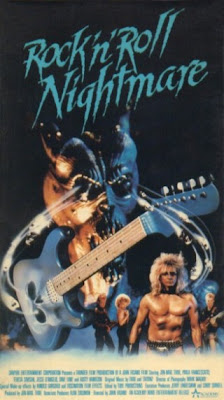
First into the DVD player one Friday night was Rock n’ Roll Nightmare, which I’ve read about here and there over the years and, speaking as someone who takes an interest in just about any rock n’ roll / horror crossover movie, no matter how bad, you can appreciate that I was looking forward to some enjoyably stupid, rampagin’ fare. God, what a disappointment. “Cult classic” my ass, this film fucking stinks. I mean, I’ve seen some uninspired, slapdash, “will this do?” filmmaking in my time, but can you imagine the lack of commitment necessary to take the following concept - ‘80s hair metal band led by charismatic glam-rock barbarian called Thor go to deserted old house with their girlfriends, fight goo-dripping Evil Dead style ‘80s monsters - and produce a movie that is not only a crass, ugly and deeply stupid work (as might well be expected), but is also utterly lacking in any kind of entertainment value…? How can this be? Couldn’t you just, I dunno, put the rockers, the girls and the monsters in a room, tie a camcorder to ceiling and let nature take it’s course, and still emerge with something that’s at least…. kinda fun? To screw up this badly takes a special kind of incompetence.
Don’t get me wrong here. I mean, I’m not being some witless “films should be coherent and well-made” bore, writing an Amazon product review to reveal to the world the shocking truth that “Werewolves On Wheels” isn’t actually very good. I love all kinds of objectively *bad* films: mysterious-bad films, weird-bad films, funny-bad films, sublime-bad films, culturally interesting-bad films… but Rock n’ Roll Nightmare is just a downer on every level that fails to throw the audience anything to reward them for sitting through the damn thing. A bad-bad film.
I can’t even think where to start in shooting this thing down, there are so many easy targets. The supposedly creepy, isolated old house is right next to a main road, is mainly filmed in overcast daylight, and looks like a Barrett Home! Nothing at all happens, for ages! When the inevitable monster/death scenes do turn up, they’re short, crap and filmed in such a joyless manner they might as well have not bothered, and just had the characters declare “ok, I’m dead now”, and wander off, which in some cases they pretty much do! They can barely even be arsed to make clear who’s alive and who’s monster-ised at any given point! The band is so boring and polite they make Stryper look like Mayhem by comparison, and we have to watch them playing all their dull-ass, six minute songs in their entirety! Much of the rest of the running time seems to be taken up with awful, awful dryhumping sex scenes – soundtracked by Thor’s own love ballads, natch – that it’s fair to say NOBODY wanted to see.
Ok, so vaguely on the up-side, Jon-Mikl Thor manages to pass himself off quite well as a likeably earnest and engaging…uh… protagonist (I’m reluctant to say ‘hero’, as he doesn’t actually do much), and it would be fun to see him strut his stuff in a better film. He seems like a nice enough guy. The legendarily ludicrous ‘trick ending’/final battle sequence/flying starfish bit is pretty funny, in a ‘would provoke some chuckling if you stumbled across it on late night TV’ kinda way, but, if you’re sufficiently bored, I’m sure you can probably find it on youtube without slogging through an hour’s worth of aimless, lifeforce-suffocating crap to get there (here ya go).
Somewhat unfeasibly, my DVD of ‘Rock n’ Roll Nightmare’ is a ‘collector’s edition’, packed with ‘special features’, a circumstance that seems akin to putting a new rocket engine in a slug. They’d better be pretty damn special, that’s all I’m saying.
The Witching (Bert I. Gordon, 1972)
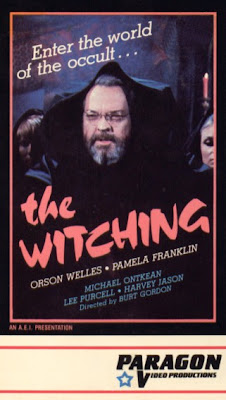
Another one well worth avoiding. Director Bert I. Gordon was responsible for b-movie classics such as ‘The Amazing Colossal Man’ and ‘Village of the Giants’ back in the ‘50s, but squandered the resultant goodwill by spending much of the rest of his career turning out the occasional bit of unremarkable hackwork. If you were feeling particularly cruel, you could say Orson Welles did much the same, only, y’know, with ‘Citizen Kane’ and ‘Touch of Evil’ to look back on instead of ‘War of the Colossal Beast’.
Certainly, ‘The Witching’ would seem to mark a definitively depressing example of the decline of both men, as Gordon sets about directing it with all the flair and atmosphere of a public information film about crop blight. Apparently, this movie was originally released under the title ‘Necromancy’, with all the nudie witchcraft scenes cut out, a strategy which I can only assume was an attempt to create the most boring 70 minute film on record, but hey, what do I know? Maybe there was a big gap in the family movie market in ’72 for really dull, PG rated witchcraft thrillers featuring former cinematic luminairies sitting in a big, uncomfortable chairs muttering to themselves. Anyway, the nekkid witches and occasional bits of bloodshed were reinstated (they were part of the original production, not later inserts) when ‘The Witching’ got a second chance at life on the ‘80s home video market, and that’s the one I’m watching here.
Things start on a high with a pretty enjoyable satanic ritual scene, as Orson’s coven initiate a new witch by slicing a chunk out of her chest and trying to persuade her in turn to stab a voodoo doll which causes the death, hundreds of miles away, of Pamela Franklin’s unborn child. From there the action (and henceforth I use the term loosely) cuts to Pamela and her husband (played by Michael Ontkean – Sheriff Truman in Twin Peaks), who are driving across the desert en route to the isolated small town – called ‘Lilith’, would you believe - where Welles rules supreme in his capacity as a sinister patriarch/warlock type guy. Hubby has been offered a new job there you see, with the town’s sole employer – Orson’s toy factory.
From this not entirely unpromising opening however, the rest of the movie basically just reheats scraps from ‘Rosemary’s Baby’ in flat TV movie fashion, as the townsfolk try to get the new couple interested in joining their hip, swinging witch cult (they “worship pleasure” you see, which in Lilith seems to amount to holding cocktail parties where lots of housewives lounge around in witch gear with their tits hanging out), and Pamela, understandably though boringly, gets all ‘I-don’t-like-it-here’ and ‘am-I-hallucinating-or-are-they messing-with-my-mind’ and ‘why-did-they-bring-us-here’ and ‘can-I-still-trust-my-husband-or-what’ and BLAH BLAH BLAH.
As for Orson Welles’ performance, about the best thing you can say about it is that, well, at least he turned up, and allowed them to point the camera at him for a bit, which is more than can be said for certain other occasions on which his services were engaged during the ‘70s. Obviously overcome with disgust at being reduced to appearing in such a crappy motion picture, Orson spends his scenes motionless, lethargic and grumpy, delivering his lines in a resentful, semi-coherent monotone as if reading them off an autocue. A fun, powerful performance from a decent character actor as the villain could have livened this picture up 100%, but Welles is a complete charisma vacuum throughout. Still, at least Gordon got to stick “starring Orson Welles” on all the marketing without even having to lie about it, thus presumably increasing this otherwise lousy movie’s distribution/profit potential by a factor of ten, which was probably the point of persuading the big O to do it in the first place. Hell, I know curiosity re: ‘Orson Welles + witches = ??’ is what suckered me into watching it.
And that’s yer lot really. I can’t really recommend wasting your time on this one, unless you really, really, really like topless witches and watching Orson Welles looking sleepy, and have already exhausted the possibilities of all the other motion pictures in the world that feature such things.
Day of the Dead (George A. Romero, 1985)
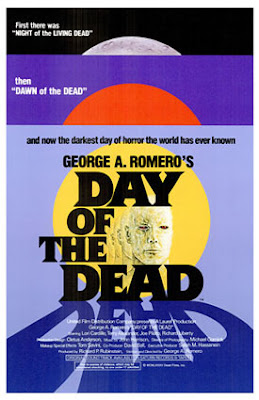
After all that, I felt like I REALLY needed some real solid horror, with guts and substance. So I’ll admit it, I just watched “Day of the Dead” again. Job done. And as with my most recent viewing of “Night of The Living Dead” a few months ago, this time around I found myself mainly contemplating how fiendishly effective George Romero’s manipulative good cop / bad cop characterisations can be, and the way he employs them to undermine expected audience reaction.
For instance, I’m sure I’ve watched ‘Night..’ upward of a dozen times over the years, but it was only on the last viewing that I finally realised that arch-asshole Mr. Cooper actually purveys pretty sound survival advice throughout the film, and that, if they’d listened to him rather than to Ben, they might conceivably have all lived through the night (assuming they could bring themselves to behead the infected kid). But neither characters nor audience take heed of this, even after obsessive repeats viewing in my case, because, y’know, he’s such an unbelievable asshole, what kind of world could this be where he could actually be right about stuff?
Similarly, on maybe the fifth or sixth viewing of “Day..”, I still manage to get me all hot and bothered, thinking, christ, those soldiers are SUCH inhuman jerks, and the helicopter pilot and the radio guy are SUCH solid, likeable, no nonsense awesome dudes; I vow that when the apocalypse arrives, I’m gonna be like them (at least until I die of hyperglycaemia)! There I am, putty in George’s directorial hands, as per usual. Of course, he doesn’t repeat the same subtle morality vs. practicality turnaround used in ‘Night..’, but instead concentrates on ratcheting up the audience’s hatred for the ‘bad guys’ until it comes time for them to suffer stomach-turning, visceral deaths at the hands and teeth of the undead, at which point you’re caught thinking HA HA, THAT’S RIGHT, DIE YOU…. oh my god, there are maybe only a dozen human beings left alive in the world of this film, and I’m here CHEERING as half of them get their entrails ripped apart and their throats torn out by walking corpses….? – at which point things take on a distinctly unsettling resonance for us liberal humanist type viewers.
Analysis of Romero’s zombie films (prior to his heartbreakingly awful recent efforts at least) has often tended to dwell on their oft-praised social/political commentary, but to me those elements sometimes seem shallow and heavy-handed (in ‘Dawn’ and ‘Day’ at least – admittedly you could write whole books on the cultural resonance of ‘Night’), taking a definite backseat to his truly subversive mangling of character dynamics and narrative expectations.
Planet Terror (Robert Rodriquez, 2007)
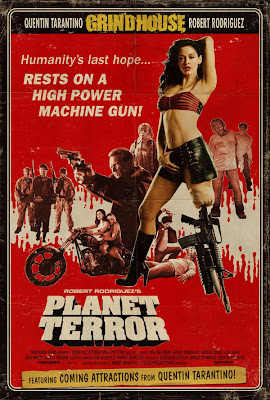
After the failure of that fateful Friday’s attempt to get with some simple-minded, gory fun, the following evening’s viewing began with a flick that’s SURELY got to deliver: Robert Rodriguez’ ‘Planet Terror’. Now, let it be said that I’m not generally a fan of Rodriquez’ somewhat chauvinistic, stylised action movie aesthetic, but I , like all good people, adore ‘From Dusk Till Dawn’, I loved Tarantino’s ‘Kill Bill’(both parts), I think the two directors joint b-movie fascination tends to bring out the best in both of them and, well… essentially this is a movie in which Rose McGowan from out of The Doom Generation fights zombies with a machine gun for a leg. Ok, I realise Rose McGowan may have been thoroughly blanded out by over a decade doing stuff like ‘Charmed’, made-for-TV Stephen King adaptations and an unfortunate stint as Marilyn Manson’s ladyfriend, but to me she’ll always be Rose McGowan out of ‘The Doom Generation’, and, in this movie, a post-ironic b-movie-pastiche blockbuster staring out at me from the shelves of Fopp with a £4 pricetag, she fights zombies with a machine gun for a leg.
If you think I’m not gonna watch it, you give me more credit than I deserve.
So how was it for me? Well, by way of a review, simply close your eyes and imagine the sensation of drinking four beers in quick succession, then open your eyes and heed my words as I say, MAN - THAT WAS FUCKING AWESOME.
And what more is there to say? A whole bunch of stuff happened, I don’t quite remember it all, and in retrospect it probably didn’t make much sense, but it seemed reasonable at the time. There were a whole crew of weird, entertaining comic book type characters, and loads and loads of hideous gross-out violence and a hospital full of mixed up zombies, lovable redneck cops, nasty crooked mutant soldiers, and loads of guns and bombs everywhere! Gunshot wounds that do a big, satisfying SPLAT like in an old Peckinpah movie only more so, and sleazy b-movie injokes, severed limbs and goofy, interesting sub-plots and really, really cute girls riding around on motorbikes, wielding shotguns and doing go-go dances and kung-fu and stabbing guys with syringes (but they have real characters and are tough and idiosyncratic and kick-ass and stuff too, so the modern day “not being a misogynist bastard” rules say it’s allowed). Oh my lord, it was good.
And that’s that! It’s a film that consciously avoids any kind of intellectual engagement, so I’m gonna respect its wishes and not give it any. It’s clearly the best mainstream Hollywood movie in years, just by default! It rules! Even the music was quite good! It wins my Oscars! The End!
I know I should be grumpily discussing how conspicuously Rodriquez fails in his brief as regards making a modern day recreation of a ‘70s exploitation movie. For one thing, ‘Planet Terror’ is half an hour longer than any actual b picture, it’s far too carefully planned out/shot/edited, and any one of the aerial shots, explosions, car crashes or stunts that it lays on by the screaming dozen would be beyond the reaches of the blowing-the-budget finale set-piece of a genuine grindhouse effort. Not to mention the incongruous appearance of faces like Bruce Willis, which make the whole conceit seem a little flimsy (I mean, that would be like what – Cary Grant turning up in a H.G. Lewis flick or something?).
BUT, I don’t think that’s really an issue. As with ‘Kill Bill’, the true intent here is not the authentic recreation of a b-movie, but an attempt to bring to life the kind of film that the more crazed and imaginative b-movie directors COULD have made, had they had access to the budget, time, technical ability and talent necessary to fully realise the majestically fucked up panaramas of awesomeness that we fans would like to think were buzzing around their heads as they set out with joy in their hearts to film some fuzzy footage of lingerie models doing amateur kickboxing moves in the desert, or whatever.
‘Planet Terror’ often succeeds very well in capturing this spirit, but…. I can’t help but feel maybe it succeeds TOO well, in some ways. In the midst of its modern day Hollywood excess, it perhaps ends up crushing to death the very b-movie essence it seeks to reserve. After all, one of the basic prerequisites of b-movie fandom is to realise that you WILL be disappointed, that the movies will very rarely live up to the decadent depravity of their advertising. But, if you’re lucky, you may find instead that they make amends by offering something a little more strange, touching, funny or disturbing than the unaffordable/unfilmable adolescent wish fulfilment of their posters ever could. That's what we love 'em for really.
By laying on it’s expectation-surpassing gore/action/sex with all the restraint of a 12 year old psychopath and then throwing the results into a contemporary multiplex context, a film like ‘Planet Terror’ can easily lose this mixed up charm where ‘Kill Bill’ was (arguably) stylish and idiosyncratic enough to retain it, cracking the legitimizing veneer of post-modern trash homage, and leaving, well…. what exactly? A soulless parade of girl-porn, gun-porn, explosion-porn, car-porn, gross-medical-disaster-porn, flying limb-porn and more girl-porn (although strangely little porn-porn) that plays to a patronising, reductionist idea of what a male audience wants to see just as thoroughly as a lowest common denominator ‘chick flick’ plays to the assumed idea of what a female audience wants to see? Although the inherently patriarchal nature of the film industry and movie fandom allows ‘Planet Terror’ a far greater level of critical acceptance than ‘Confessions of a Shopaholic’ is liable to receive, are they not, in some sense, flipsides of the same grim, exclusionary coin?
And I swallowed the whole damn thing, hook, line and sinker.
GOD, that’s depressing.
Me and my stupid brain! Why did I have to pay attention to it? I was having so much fun! Stupid, crappy ‘thinking’! Whose idea was that anyway? Fuck!