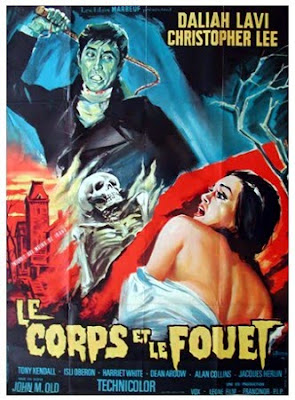
Over the past year or so I have been making a concerned effort to watch as many Mario Bava movies as is humanly possible… not that you’d know it from the content of this weblog thus far.
It’s the old problem I guess – I can harp on for pages about some film that’s weird or confounding or terrible, but many of my favourite films – particularly my favourite horror films – cast a spell on the viewer that requires no further explanation: they are what they are. And Bava’s work, even his non-horror films, are a case in point. Great though they are, it is often hard to find anything of substance to say about a given Bava film, beyond “this is great, you should watch it!”
Bava experts (and I’d really like to think that there are recognised Bava experts out there somewhere, who all get together on academic panels to say “this is great, you should watch it” to audiences of eager students) may beg to differ, but I find Bava cheerfully defies the doctrines of the original auteur theorists at every tun, by virtue of making films which are instantly recognisable as his work whilst simultaneously being invested with very little material that relates to the intellectual or emotional concerns of their maker.
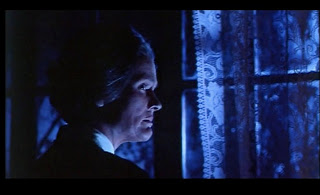
I’m sure some writers could be inclined to drag some weighty psychological exegesis out of his work (the sadism, the sensuality etc), but personally I don’t think that’s gonna float. Thematically, there is little in his films which stands out as particularly unusual in the world of ‘60s/’70s European b-movies, even if he was able to express things more powerfully and memorably than most of his contemporaries. And yet…. you can spot a Bava film a mile off – his framing, production design, camera movement – all are utterly unique.
Bava really stands as the preeminent example of the ‘craftsman-director’, casually rolling with whatever genres and story set-ups the weird whims of the producers and studios deemed relevant or saleable at a given moment, humbly positioning himself as just another jobbing director amongst many helping to keep Europe’s screens supplied with regular doses of girls, blood and monsters through the all-important mid-century cinema boom. What really sets him apart though is a) a sense of aesthetic vision and technical talent that puts just about all of his more lauded American counterparts in the shade, and b) a dedication to making sure that whatever today’s movie happened to be, he would do his utmost to make it *really fucking good*, never patronising his audience or succumbing to laziness or cynicism, and always delivering a beautiful, professional, kick-ass movie that really gives us our money’s worth, whether on a grindhouse triple bill in 1965 or on a DVD reissue in 2010.
I guess it must have been recognised even at the time that Bava’s way of doing things gave him a particular affinity with the gothic horror genre, and as such he managed to make a whole bunch (a BUNCH, no less) of films within that milieu, all of them freakin’ amazing to a greater or lesser extent, in the period between his unforgettable directorial debut ‘Black Sunday’ aka ‘Mask of the Devil’ in 1960 and ‘Baron Blood’ at the tail-end of the gothic horror’s viability as a commercial proposition in 1973. But beyond that, whatever brand of ‘60s/’70s popular cinema you’re into, chances are Mario took a bash at it at some point and delivered the goods.
Fancy a wacky space adventure? His astounding 1965 sci-fi/horror hybrid ‘Planet of The Vampires’ goes one better, pretty much providing the blueprint for a whole swathe of American SF cinema, from ‘Alien’ through to ‘Event Horizon’. Does a kick-ass Viking-based sword n’ sandal movie float your boat? They don’t come much better than ‘Knives of The Avenger’ (1963). Or hey, how about the single greatest pop art adventure film / comic book adaptation ever made? I know I won’t have to justify that hyperbole to anyone who’s seen 1967’s endlessly incredible ‘Danger: Diabolik’. Hell, even Bava’s sex comedy, 1972’s ‘Four Times That Night’, is pretty good, making me wish more than ever that I was Italian, born into a country capable of producing something so stylish, witty and genuinely sexy whilst the rest of Europe was busy churning out eight million variations on ‘The Naughty Cheerleader’ and ‘Confessions of a Window Cleaner’.
Back to the gothic horror though, and today we’re looking at yet another bone fide Bava masterpiece, but one that for a variety of reasons is more rarely screened or referenced than his early classics of the genre or even his early ‘70s weirdo/kitsch blow-outs – 1963’s provocatively titled ‘Whip And The Body’.
It was I suppose sadly inevitable that Bava’s ‘60s classics were often treated pretty shoddily when they found themselves distributed overseas (particularly by AIP in America), falling into a chasm between two eras of horror film-making and not fully emerging until their resurrection as acknowledged classics in the DVD era. Today, Bava’s gothics play out like beautiful reminders of a more elegant era of horror, in which oneiric atmospherics and creeping, devilish unease took precedence over graphic violence and fast-paced thrills. But in the more censorious climate of the early ‘60s, these films’ occasional flashes of lingering sadism and sexuality were deemed beyond the pale by many critics and guardians of decency, a situation probably not helped by AIP’s typically lurid marketing campaigns and English retitling.
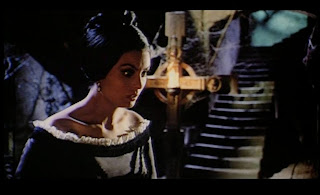
All this of course would change only a few years later, when the floodgates of cinematic perversity burst forth into the sleazoid madness of the early ‘70s, but for many of Bava’s best works the tide turned too late, leaving them chopped up, denigrated, critically reviled and all but forgotten in the English-speaking world. As Michael Weldon notes in the entry for ‘Whip And The Body’ in his Psychotronic Encyclopedia, Bava’s films were “treated like cancer” when they appeared in American inner-city theatres, whilst less than ten years later similar but inferior films were regularly being presented as major Hollywood releases.
(Not that the man himself could give a damn by that stage, happy as he was to roll with the new freedoms, upping the ante once more with blood-curdlingly gruesome shockers like ‘Twitch of the Death Nerve’ and ‘Hatchet For The Honeymoon’, still somehow managing to exude pure class even as he pushed the envelope for gratuitous boobs and gore, prefiguring the ‘80s slasher craze by a further decade.)
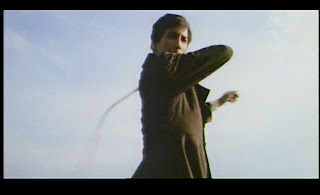
Anyway, whether by accident or design, ‘Whip And The Body’ seems to have suffered especially badly from the ill-judged hypocrisy of ‘60s distribution. The film’s suggestions of S&M would have seemed tame stuff even by 1972 standards, but in 1963 the very idea that the beautiful Daliah Lavi is maybe reacting with pleasure as her husband’s caddish brother sets about her with a horsewhip was enough to reduce the film to the most lowly obscurity, to the extent that VCI’s Region 0 DVD (yay for Region 0 DVDs, by the way) represents perhaps the first opportunity most Bava fans have had to see the film in its entirety with an acceptable print.
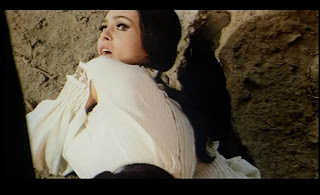
Of course, ‘Whip And The Body’s commercial prospects probably weren’t helped by the fact that it’s also one of Bava’s most austere and old fashioned horror films, featuring very little in the way of violent action or recognizable ‘horror’ thrills, and blessed with an early example of one of those gloriously bong-addled Italian scripts that kinda-sorta-mostly makes sense, but basically drifts around in a stupor for eighty minutes wondering how the hell it ended up being a movie script, as opposed to a dream a minor aristocrat had in 1875 after indulging in too much port and cheese.
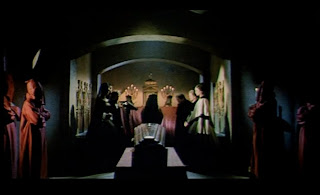
The narrative, concerning the return of Kurt Menliff (Christopher Lee) to the family home which he left under a cloud of scandal several years previously, his rekindling of his adulterous relationship with his brother’s wife Nevenka (Lavi) and his subsequent murder, is unapologetically slight – a Poe gothic by numbers, mixing in only a thin veneer of the supernatural and wrapping everything up neatly in the final reel with the same plot twist that would later resurface in seemingly about 80% of ‘70s Giallos. But all this matters not. Frankly ‘Whip And The Body’ could be the heart-warming tale of a rural baker searching for the perfect recipe for scones and it would still be a breathtaking work of haunting cinematic artistry. We’re talking Mario Bava here – that’s just what he does.
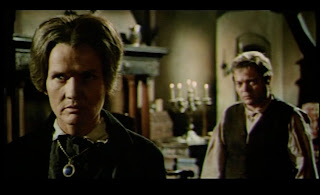
It is often said that Bava – whose pre-film background was in painting/sculpture - approached his films with a painter’s eye for texture and composition, and nowhere is this more evident than in ‘Whip and the Body’. Often, Bava took on a triple threat role in his films, working as director, production designer and cinematographer, and looking back over the credits for ‘Whip..’, I was surprised to see that this wasn’t actually the case here: Ottavio Scotti is the designer, and Ubaldo Terzano takes credit as DP. Regardless, the film still manages to attain an aesthetic purity and unity of vision that is rarely achieved in the world of low budget commercial cinema, utilising a highly specific visual palette which, together with the flimsy narrative, help to turn it into what is in effect a vast, moving painting.
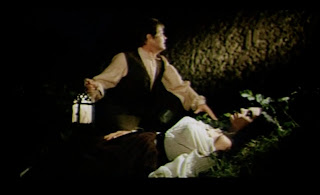
If ‘Diabolik’ could be said to be Bava’s great pop-art masterpiece, and ‘Black Sunday’ – at a stretch – his tribute to expressionism, then ‘Whip..’ is more than anything his Pre-Raphaelite showstopper. Full of rich, old world detail and drenched in dense, autumnal colour, it is a film that, appropriate to the gothic tradition, seems to shrug off any suggestion of modernity, drifting instead through a slowly unraveling tableaux of carefully wrought, beautiful things, displayed for us because they are beautiful, and because we, the movie-going connoisseurs of such things, deserve the opportunity to drink them in at our leisure. Acting almost more as a nostalgic memory of unquestioned, aristocratic grace than as a horror movie, ‘Whip And The Body’ often seems like the kind of confection the Prince from Guiseppe Di Lampedusa’s ‘The Leopard’ might have enjoyed, were he to unexpectedly sidle into a 42nd street fleapit one balmy mid-sixties afternoon.
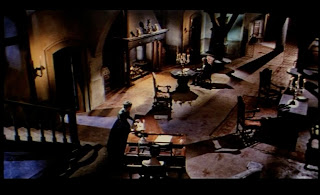
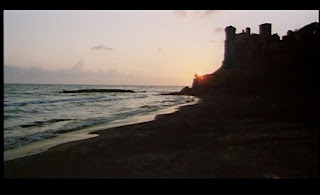
The soft light of the sunset across the bay overlooked by the film’s castle (is it a real location or a miniature? – I’ve honestly got no idea, which tells you something about the quality of the film’s artistry), the loving pans across the details of daggers, candlesticks and chandeliers, the horses galloping across the sand, the gaunt shadows across the faces of the male protagonists, the whole thing flaring up into a Rossetti fever dream whenever Nevenka enters the frame…. what more can I tell you?
It’s just bloody marvelous.
In terms of cinematography, Bava is of course best known for his almost psychedelic use of bright and unnatural colour, but here things are tad more subtle than usual, sticking primarily to a palette of blacks, browns and golds, with jarring bolts of lightning flashing the sets bright blue, and violent splashes of red and green only intruding into the frame occasionally, serving as signifiers of more extreme emotional states (green is to LOVE, red is to KILL, if I’m not mistaken, with the two colours groovily entwined on the roses which surround the dagger used to perpetrate the maidservant’s suicide and Kurt’s murder – a motif Bava would return to in ‘Hatchet For The Honeymoon’).
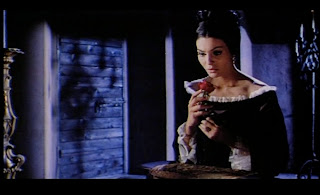
Bava may have later taken pleasure in smashing down the walls of gothic horror convention in the delirious ‘Kill Baby Kill!’ (my all-time favourite Bava) and the bizarro ‘Lisa & The Devil’, but in ‘Whip & The Body’ he seems perfectly happy to embrace the most creaky clichés of the genre, perhaps unconsciously fitting them into his overall aesthetic picture of (literally) fading light and crumbling aristocratic ideals. The film’s fluid and unsettling camera movement and slow, eerie build-ups may speak of Hitchcockian tension, but to anyone who’s watched and enjoyed even a handful of these kinda movies (and let it be said that I could watch ‘em till the cows come home, and frequently do), easy comfort and recognition is assured throughout.
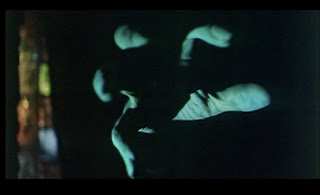
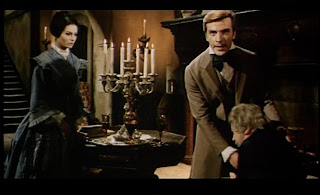
Acting is mannered and theatrical at all times. There’s an aged father, a nervous young bride and a limping, craggy-faced servant. There’s a secret passage behind the fireplace in the master bedroom, leading to unknown subterranean chambers. Waves crash hypnotically against the shore, candles flicker, lightning strikes, and if anybody wants a drink, they’ll have it from a fucking chalice. And hark, is that a ghostly piano, playing itself? Naturally we don’t have to wait around long before someone ends an awkward conversation by saying “come, you must be tired after your long journey”.
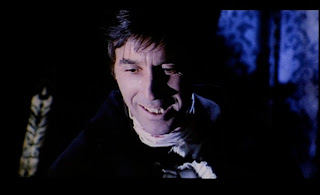
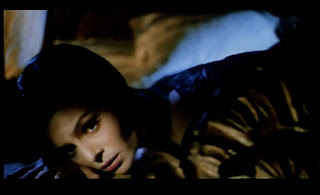
It’s all good, in other words. Lavi gives an amazing performance as the film’s central female dynamo, her character acting very much like a lascivious sixties starlet, trying her hardest to assume the corset of a demure gothic heroine as funny, repressed feelings tear her up inside, but her male counterparts (including drippy good guy Tony Kendall and an elderly father who looks about the same age as his children only scruffier) are uniformly stiff as boards, talking around the dinner table as if they’re delivering a report to their sergeant major. Which again is fine by me – stern, emotionless acting suits the genre trappings perfectly, the contrast helping to heighten the implicit fear of ‘feminine’ expressivity and emotion that lurks behind many a gothic yarn.
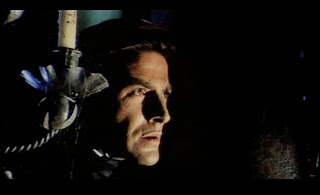
Even ol’ Christopher Lee tones down his ham-munching considerably here, delivering one of the most low-key performances of his career. Often it seems like he wants nothing more than to fade into the background, in stark contrast to his usual grandstanding, despite portraying a character who could easily have been turned into a bellowing, power-mad villain. Whether Lee was cowed by the films overbearing production design, whether he was uncertain (or pissed off) about appearing in an Italian production, or whether Bava simply kept him in check, who knows, but whatever the case, this is about the only Christopher Lee movie you’ll ever see where you don’t even feel compelled to exclaim “hey, it’s Christopher Lee” when he makes his grand entrance.
And I couldn’t finish this review without mentioning the role played by Carlo Rustichelli's excellent and unusual score in enhancing ‘Whip..’s uniquely languid atmosphere. Drifting, sustain-heavy string textures perfectly match the lethargic pace of the on-screen action whilst the central piano motif that cycles through the film manages to pull off the same rare trick as Angelo Badlamenti’s theme for Twin Peaks – somehow soothing and unnerving at the same time, its constant repetition taking on an almost ritualistic quality as the drama it accompanies becomes gradually darker. By the time Nevenka slowly picks it out on the heavily echoed piano in the castle’s great hall as the camera menacing shifts around her and into the air (very Lynchian blurring of the boundaries between music within and without of the film world, wot?), the initially slightly syrupy theme has assumed a breathtaking power. Much like the Twin Peaks theme, I didn’t much care for it at first, but by the time the end credits rolled I was dying to track down a copy of the soundtrack.
And… that’s about all I have to say on the matter, really. Those yearning for violent, event-filled horror certainly won’t get much out of ‘Whip And The Body’ except perhaps a pleasant nap, and the same goes for anyone who likes their cinema to come with a strong central narrative and challenging, thought-provoking themes. But to any lover of dreamy, romantic horror movies and anyone able to appreciate the aesthetic conventions of gothic horror in and of themselves, the film is an absolute banquet, brought to you by one of cinema’s all-time greatest visual artists, cookin’ it up like a bastard. Just dim the lights, crack open a nice bottle of red (or three) and let Mario take the reins; no further explanation required. ‘Whip And The Body’ is good, and you should watch it.
