First off, I will need to begin this review with an apology / disclaimer, stating that my knowledge of Indian cinema is minimal, bordering on non-existent. So if you’re looking for an informative and insightful review that seeks to place this motion picture within the wider world of Hindi film-making… I’m afraid you won’t find it here. In all my years on this earth, I have watched maybe five or six Indian films… and one of those was
Shaitani Dracula, which I think it’s safe to say only qualifies as a ‘film’ in the very loosest possible definition of the term.
Of course, like all right-thinking people, I greatly admire Bollywood for its position as the most exciting and prolific popular film industry in the world. But, sad to say, I have thus far conducted my admiration from afar. My reasons for doing so are, I would imagine, similar to those stated by movie fans in a similar position throughout the world: I mean, personally, I don’t mind the comedy interludes, and I love the music & dancing, but… I hope you’ll get where I’m coming from when I say that, when the working week ends and Movie Night arrives, 3+ hour romantic melodramas that serve to celebrate traditional family values are generally not what I’m looking for.
I would love to have the time and means to challenge this no doubt terribly misguided generalisation for myself, and were there 100+ hours in the day, I would be happy to fill at least a few of ‘em with some classic Bollywood business and see what wonders emerge. But for the moment… well, it seems like a pretty tough gig, to be honest, when there are still plenty of nice 80 minute numbers about sexy vampires, motorcycle-riding werewolves and moustached mobsters shooting each other in the face that I haven’t got around to watching yet.
So, I know what you’re thinking:
what if sexy vampires, hairy beasts and severe facial trauma were to make it *into* Bollywood films? Wouldn’t that be great? Well, yes, it would be actually – thanks for asking. And thus, it was sadly inevitable that my entry point into Indian cinema should come via horror movies. And if we’re talking Indian horror movies, we’ve basically talking The Ramsay Brothers – those seven Mumbai-based sons of F.U. Ramsay who pretty much single-handedly (in so far as the term “single-handed” can be applied to seven guys) pioneered and popularised the idea of Hindi language horror films through the ‘70s, ‘80s and early ‘90s.
Thus far, I’ve been lucky enough to see three Ramsay Bros productions, and, for anyone who lacks the patience to read the rest of this review, let me summarise by simply saying that this shit is BRILLIANT. In fact, let’s make this paragraph a full-blown public service announcement: if there are any jaded horror fans out there who feel like they’ve seen just about everything American/European productions have to offer, well, fear not my friends: India is your new destination. Pack an extra bag, because you might be out there a while.
1989’s ‘Purani Haveli’ (English = ‘Mansion of Evil’) generally doesn’t seem to be considered one of the best Ramsay Bros films out there, but, but it’s the one I watched most recently, so it’s the one I’ve picked to review, and what can I say? I still thought it was pretty good. In fact I absolutely loved it.
Right from the opening credits, we get a pretty good insight into what makes these movies such a ton of fun. Sick of American movies listing pages-worth of co-producers, executive producers and casting associates in their opening crawl? Well, the Ramsays don’t need any of that crap (although their chartered accountant does get pretty high billing). After we’ve finished delighting in the fact that just about everyone with a major technical role is named ‘Ramsay’, the boys get down to business. Kiran Kumar handles DANCES. Gulab Rao does FIGHTS. Jawahar Saw Mills provided TIMBER. Now that’s the way to make a movie!
Post-credits, we meet a honeymooning couple with car trouble, who, in classic horror movie tradition, opt to spend the night in a dank crypt located in the grounds of an eerily luminescent, fog-shrouded mansion. Awakened by strange growlings, couple’s male half unwisely decides to investigate, opening a sealed iron door and unleashing a hairy, demonic, glowing-eyed caveman beast, who promptly does away with the pair in predictably blood-curdling fashion. The beast barely has time to gloat however before he in turn is set upon by a wild-eyed, poncho-clad Christian priest, who compels the fiend back to its subterranean lair using a magically charged crucifix, subsequently chaining down the gate with said crucifix, imprisoning the beast FORVERMORE.. or at least until some happy-go-lucky young people happen to stumble past and…. you know what, let’s just start the clock now shall we? Anyone want to place a bet?
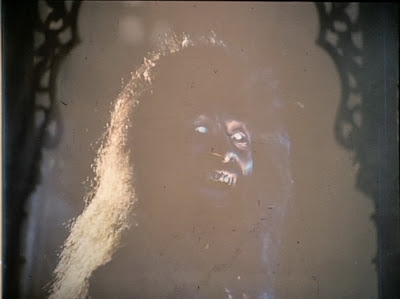
Assuming we get a second to stop and think about what just happened, rather than just clapping our hands with glee like happy, horror-loving seals, the extensive use of Christian imagery in ‘Purani Haveli’ seems kinda interesting - even the opening credits play out against images of Jesus. Again, my inability to really put these movies into wider cultural context defeats me, but… that’s gotta be quite unusual for Hindi horror, right? Were the Ramsays maybe gunning for international distribution by this point in their career..? As I say, I am sadly in no position to speculate as to the why or wherefores here, but… it’s an issue worth noting, I think.
Anyway, next we’re whisked to a somewhat safer domestic setting, where an avalanche of exposition awaits us. This being Bollywood though, exposition tends to come in the shape of outlandishly exaggerated melodrama, fights, lavish musical sequences and slapstick comedy, so… that’s just fine.
In brief, then: a vain rich man (and he has a golden cannon in his living room, so he must be pretty rich and vain) declares that he intends to buy a mansion for the beloved daughter of his late brother. Conveniently, an old geezer baring pictures of the joint in which we saw the preceding carnage unfold seems willing to sell.
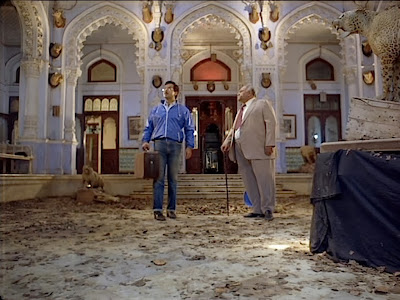
When the old geezer’s servant arrives at the mansion to ‘prepare’ it for its new owners, he is almost immediately terrified out of his wits by the general, insane horrifyingness of the place (guttural roaring noises, vast swathes of fog, eerie fluorescent lighting, rattling walls, staring animal heads, you name it..), and swiftly meets his doom via a feature that proves a bit of a surprise even for this singularly far-out piece of real estate: a gigantic, horned, skull-faced iron statue with penchant for coming to life at inconvenient moments and stomping around strangling anyone in its path! Happily, we will be seeing a lot of this statue through the rest of the film, so better get used to it.
By this point, more attentive viewers will no doubt have clocked the fact that the location in which much of ‘Purani Haveli’ takes place is
simply bloody magnificent. Initially, I thought the Haveli’s interiors had such a perfectly phantasmagorical, horror movie look to them that they had to be sets, but by the time the aforementioned caretaker is wondering around the gargantuan entrance hall, it becomes clear that this structure is too solid and elaborate to be anything other than the
actual interior of the mansion used for the equally breath-taking exteriors.
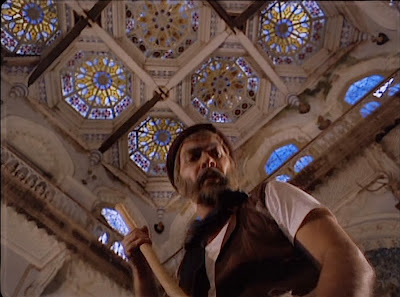
So yes, if we’re to maintain our sanity, I’m afraid we’ll have to accept the fact that the Ramsays actually DID find a sprawling, semi-derelict Masala-gothic baroque folly sitting atop a remote clifftop, and proceeded to simply film the hell out of it. And the more we see of this place, the more astonishing it becomes – perhaps the best readymade horror movie location I’ve seen in all my life, in fact. The vast, gothic-arched entrance hall looks like something out of Dario Argento’s dreams, decked out with dozens of moth-eaten, mounted animal heads and topped with a multitude of kaleidoscopic stained glass windows, whilst the exterior looks like one of those beautiful matte paintings from a Mario Bava gothic come to life in three dimensions, with subsequent establishing shots revealing that (though it’s not really utilised in the film), this joint even has a sea view over a kind of wide, picturesque bay. Stunning. Hell, I’m starting to feel a certain sympathy with Mr. Golden Cannon - I’d buy this place in a second, homicidal statue or otherwise.
(1)
And, speaking of the mansion’s boastful new owner, he and the old geezer who just sold it to him turn out to be next on the menu of victims. Arriving to look the place over and finalise their deal, it takes about two minutes of screentime before the latter has suffered death by statue and the former is cowering in terror in the centre of a spontaneous circle of fire and random explosive charges in the adjacent graveyard, awaiting the approach of the hairy caveman beast. Forget your Shirley Jackson shit, this is a haunted house that doesn’t mess around.
Of course, plenty more meat is needed to fill out the remaining 120 minutes, and so before we know it, Anita, the aforementioned niece, is on her way to the house, accompanied by a literal bus load of salty characters, including, amongst others: Seema, her scheming step-sister! Vikram, the lazy, drunken brute that Seema is trying to push her into marrying! (He comes accompanied by goons.) Jagdeep, the chortlesome fat guy sidekick of Anita’s real true love Sunil, sneaking onboard in hilarious disguise as a burqa wearing woman! Sher Khan, the inexplicable elderly gay bus driver, who keeps saying things like “ I am a happy friend to all!”, and trying to molest Jagdeep! And of course, noble, upstanding Sunil himself is not far behind – a go-getting photographer (I loved how the set for his photography studio was full of giant-sized Kodak film boxes), keen to win back Anita’s love, mistakenly believing himself to have been spurned after evil Seema and Vikram forced her to reject his advances at gun-point!
And so, as you might imagine, we can more or less wrap up the plot synopsis right there by simply stating that all hell breaks loose pretty sharpish when this crew pitch up at the Mansion of Evil, and that it continues to do so for more or less the next two hours, give or take a few extended flashbacks, utterly unconnected comedy sequences, sleazy bathing scenes and romantic interludes, until Sunil finally gets his shit together to team up with the crazy, demon-fighting priest and put a Christ-endorsed stop to all this hullabaloo. So, not exactly the most innovative and involving of horror movie narratives, I’ll grant you - but, by thunder, it will do.
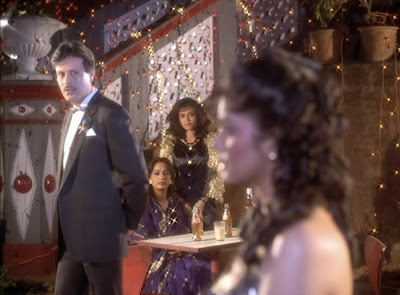
Ordinarily, one might be wary when a approaching a horror movie with a two and a half hour run time, but the great thing about these Ramsay movies is that (in common with more mainstream Hindi productions, I’m assuming), their pace is absolutely relentless. For these guys, 150 minutes of screen-time isn’t an excuse to ‘stretch things out a little’ and try out some of those auteur-ish indulgences our more artistically minded Western directors love so much - it’s simply an opportunity to cram the screen with 150 solid minutes of super-charged spook show mayhem, giving the audience more, and more, and more of what they want (alongside various diversions they didn’t even know they wanted), until less hardy viewers will find themselves falling from their sofas begging for mercy as yet more thunder-crashing gothic beastliness and mugging, shrieking technicolor overload unfolds, all at the kind of breakneck tempo that we in the West would more readily associate with a Daffy Duck cartoon than a feature length film.
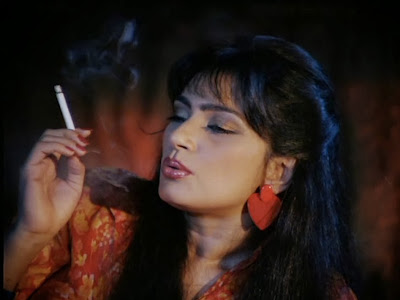
Ok, so I suppose less patient viewers than I might find the fairly lengthy diversions from the central horror business to be something of a chore, but what can I say – I dug it all. At least once every 15-20 minutes, you can guarantee that something totally mad will happen that you’d be telling people about for weeks if it popped up in the middle of a common or garden Western genre flick, and such highlights aren’t simply confined to the horror segments either.
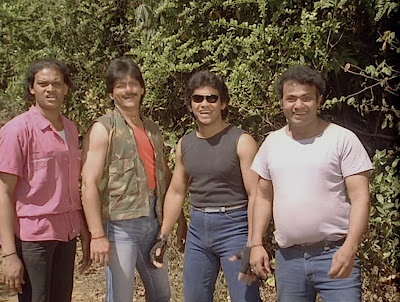
For instance, there’s a wonderful, extended fight/action scene that takes place during the introductory “setting up the characters” section, in which Sunil and Anita are ambushed by a gang of thugs hired by Vikram on a remote country road. (Apparently the couple’s journey from the photo studio to “the club” takes them through a picturesque jungle wilderness, which seems strange to me, but then hey – I don't know India). A feast of intense lunkhead kung fu ensues, culminating in a life or death shovel vs pitchfork battle atop a rickety wooden bridge. Well played, Gulab Rao! As far as making exciting cinema out of absolutely nothing except six actors and some garden tools go, this sequence was some A1 shit. And all that happens before anyone’s even SUGGESTED going to the haunted mansion! I mean, what kind of an awesome movie is this, where even the preliminary exposition stuff contains more crackpot fury and inept kick-boxing than most so-called films get through in their whole run time..? Donations for the Ramsay Bros shrine I’m in the process of constructing in my living room to the usual address please.
Despite what I presume to be the generally conservative approach taken to sexuality in mainstream Indian cinema (hey, correct me if I’m wrong), the Ramsays also seem comfortable with the idea that a bit of sexual frisson is an integral part of the horror experience, and to that end, they throw in a number of sequences that feature the film’s suitably curvaceous female stars cavorting in extremely tight-fitting swim-wear, including a scene in which Anita is subjected to an attempted rape from nasty old Vikram, until heroic Sunil provides a rousing, two-fisted rescue.
Again, I’m poorly placed as to speculate as to whether the Ramsays were intending to offer their audience a “hey, you don’t get this in ya regular movies” type thrill here (from what I gather, horror films have always been considered pretty disreputable in India, so if they were already incurring the wrath of the moral majority just for making movies like this, they might as well go all out and throw in a bit of sleaze too, I guess?), or whether they again had their eye on the global market, just trying to keep pace with the kind of stuff you might see in an American horror movie circa the mid/late ‘80s…? No idea, but anyway, something else to take note of and maybe return to when I’m a bit more confident on how to read Indian films.
Not that such a wild, subtlety-free approach seems to impact much on the film’s production values or technical ambition however; on the contrary, ‘Purani Haveli’, as presented in pristine form via Mondo Macabro’s Bollywood Horror collection
(2), is often an extremely beautiful gothic horror film, boasting uniquely eerie location work, a feast of rainbow-hued Bava-esque lighting effects, and production design that looks like something Hammer’s Bernard Robinson might have conjured up in a fever dream after eating too much cheese. And if the camera-work is sometimes a bit crazed and ragged, the story-telling pulpy, repetitive and melodramatic, well, so be it - for me that doesn’t stop what’s going on in front of the lens being one of the most joyfully enthusiastic celebrations of horror movie imagery you could ever hope to see.
Of course, the soundtrack (by Ajit Singh) is pretty astounding too – a must-hear for anyone who enjoyed
Finder Keepers’ superb
Bollywood Bloodbath compilation last year, with a suitably unhinged mixture of light-weight pop, mutant retro disco, sci-fi synth abuse, squelching electronic drum beats, phaser blasting surf guitar, unearthly female wailing, blaring overdriven string crescendos and jarring bursts of what sounds like a about six sound effects records being played simultaneously – it’s a feast of low budget musical insanity that matches the everything-but-the-kitchen-sink tone of the film perfectly, hitting just about all bases re: ‘sounds you might want to hear in an Indian horror flick’, often all at the same time.
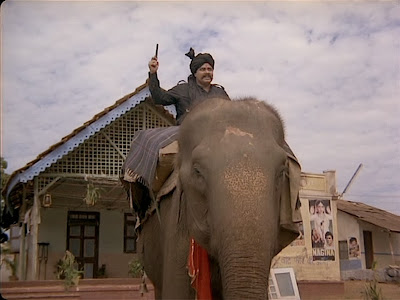
And, as mentioned, personally I really enjoyed the jarring and lengthy diversions into slapstick comedy and musical territory too. The variety of garish late ‘80s leisure-wear on show during the scenes that illustrate Anita and Sunil’s burgeoning relationship is in itself enough to keep me entertained, whilst the extended (by Western standards) run-time allows the totally irrelevant sub-plot in which strangely likeable comic relief fat guy Jagdeep discovers that he is an exact doppelganger of a feared bandit chief to become so elaborate that it could easily have been spun off into a movie in its own right – and a fairly entertaining one at that, with plenty of lovingly wrought Laurel & Hardy-esque hi-jinks to enjoy.
How many Western horror films have you seen which find time for the sight of a portly bandit chief stripping off to his voluminous y-fronts for a dip in a tropical lake whilst humming Donna Summer’s ‘Love To Love You Baby’? Very few, I should imagine. And do you feel, on the whole, that horror films could be improved by the inclusion of such antics, when judiciously applied? Let’s take a straw poll. I vote ‘YES’.
(3)
And if you vote yes too, that I’d commend you to put a Saturday afternoon or two aside and investigate the world of the Ramsay Brothers forthwith. By taking the macabre, monster bash imagery, psychotic violence and leering yet puritanical sexuality beloved of the Western horror film, and combining it with the joyous excess and maximalist entertainment value of Bollywood film culture, the Ramsays created a wonderful and unique cinematic brew that simultaneously hits up just about all the pleasure-points that popular cinema has to offer, and furthermore does so relentlessly for two and a half solid hours, without even stopping to take a breath.
It tells you something I think about the richness of Indian horror that ‘Purani Haveli’ seems to be considered one of the later and lesser efforts in the Ramsey Bros catalogue, when frankly, if any director West of Istanbul had made this film, it would surely be considered a classic of mindbending OTT genre insanity, ready to be referenced by fans in the same breath as ‘Alucarda’, ‘Housu’, ‘Santa Sangre’ or ‘Suspiria’. Admittedly, it is far cruder, both thematically and technically, than any of those examples, but in purely visceral terms it provides just as much of a full-on, transformative experience for the unwary viewer. And with the paucity of critical attention these films have received thus far, I suspect we are almost all unwary viewers. Time for total immersion style education, I feel.
(1) A handy location credit on the film’s opening titles reveals that the bulk of it was actually shot at the Palace of the Nawab of Janjira, near the village of Murud on India’s East Coast – a colonial mansion set atop a hill overlooking an island that appears to have been completely transformed into a Moorish coastal fortress (the Murud-Janjira). “Distinct features of Moghul architecture with a touch of the Gothic”, according to the link above, and who am I to argue? Type it into google image search and proceed to GAWP. Currently riding high on the list of “incredible places I’d like to visit”. I couldn’t find many pictures of the palace’s interiors online (maybe it’s not publicly accessible, or whatever?), but the few blurry camera-phone pics that did come up on a search definitely match the interiors seen in ‘Purani Haveli’.
(2)All three volumes of MM’s Bollywood Horror Collection were recently declared officially out of print, so with Ebay/Amazon prices currently in the process of rocketing in tediously predictable fashion, I’d recommend grabbing copies whilst you still can – they’re really a the only way to experience these much neglected flicks in high quality / English friendly forms.
(3)According to the notes by Pete Tombs accompanying the Mondo Macabro DVD, this bandit chief is a parody of a similar character in the 1975 bollywood classic ‘Sholay’.