Showing posts with label haunted houses. Show all posts

Sunday, 27 October 2024

October Horrors #10:
Oddity

(Damian McCarthy, 2024)

I will frame this review by saying that, over the past year or so, I have watched a number of highly acclaimed / hyped new horror movies, and, sadly, have found that they all either failed to live up to their full potential, or else just left me feeling a bit underwhelmed. On its own modest terms however, this latest word-of-mouth hit really worked for me.

This will likely be a short review, partly I don’t really have any deep thoughts I need to unpack with regard to Irish writer-director Damian McCarthy’s second feature film to date, and partly because it is very much the kind of movie whose structure makes it difficult to get too deep into discussion of plot detail without straying into spoiler territory.

But, I do at least want to record the fact that I watched it, and really liked it, in the hope this recommendation might inspire a loyal reader or two to check it out - possibly even in time for Halloween next week, as this one definitely makes a good fit for the season.

So - our setting is contemporary Ireland, where Ted (Gwilym Lee) and his wife Dani (Carolyn Bracken) are in the process of renovating a remote stone farmhouse. Ted is a doctor who works the night shift at a nearby psychiatric hospital, leaving Dani alone overnight.

Subsequent to a suitably baleful and unnerving opening sequence establishing this situation, it becomes clear that Dani has in fact been murdered, seemingly by patient recently released from Ted’s hospital, who intruded into the house during the night, and who in turn has subsequently been found dead in grotesque and inexplicable circumstances.

Jumping forward exactly one year in the timeline, Dani’s twin sister Darcy (also played by Bracken) re-enters the life of Ted, who is living in the now completed farmhouse with his new girlfriend Yana (Caroline Menton), seemingly determined to obtain some kind of closure and/or clarity vis-a-vis her sister’s death.

It is with the introduction of the Darcy character that the tone of the film shifts from a sharp, cynical brand of 21st century realism incorporating all the usual accoutrements of contemporary horror (smartphones, jump scares, dissociative editing, drone shots, rumbling sound design, softly spoken yet totally self-centred characters), and, admirably, instead begins to embrace what I can only describe as a mammoth dose of dusty, old-fashioned creepitude.

Darcy, you see, is a blind woman with keenly attuned psychic abilities, who runs a fantastical antique shop specialising in the sale of ‘cursed objects’ - each of them precisely calibrated via Darcy’s paranormal abilities to ensure that, whilst legitimate purchasers may sleep easy, shoplifters taking advantage of the sightless proprietor will have a very bad time indeed.

Which, needless to say, does not bode well for the substantial locked trunk which Darcy arranges to be delivered to Ted and Yana’s farmhouse, in advance of her own surprise arrival…

…and, if you think that this sounds like a conceit which an early 20th century ghost story anthologist might have rejected for being a bit too whimsical and on-the-nose, well… suffice to say that it ultimately feels as if the contents of several entire Pan Books of Horror Stories have been put through a blender to create the script for ‘Oddity’. In the best possible way, I hasten to add.

Or, perhaps it is instead more helpful to instead suggest that things play out rather like one of those projects in which all of the episodes in an Amicus-style portmanteau movie have been sewn together into a single story - but done with such care that, in this case, you can barely even see the joins.

Picking the film apart post-viewing, I can identify at least six or seven different horror tropes / story set ups woven together here - I won’t list them all, because, again, spoilers - but somehow, they are all successfully combined into a simple, minimal narrative featuring just six inter-connected characters and two locations.

The result, essentially, in an agreeably pulpy kind of supernatural riff on a ‘Les Diaboliques’-model thriller, which, in defiance of all storytelling logic, all hangs together just beautifully.

The unusual mixture of real world verisimilitude and atmospheric, occult-tinged fantasy is finely balanced here too, with the more outré elements of the story taking on an eerie, surrealistic power which they would likely not have achieved had the whole thing been framed as a Burton-esque retro gothic horror type palaver (which, thank the dark gods, it is not).

The scary bits are properly scary, the whimsical/creepy bits are whimsical and creepy… and I’d even go so far as to say that the funny bits are funny, although they’re a long time coming, admittedly.

And… that’s about all I have to say on the matter really.

A great little movie, well worth making time for, and a great choice for Halloween-adjacent viewing, I reckon.

So, if you find yourself ploughing trough the fallow fields of whatever streaming services you’re signed up to later this week after the trick or treaters have gone to bed - take a chance on ‘Oddity’, and I’ll wager a very small amount of money you won’t regret it.

Friday, 21 October 2022

Hammer House of Horror:
The House That Bled To Death

(Tom Clegg, 1980)

Episode # 5. Pretty cool title, eh? Could have made a good sequel to ‘The House That Dripped Blood’ in an alternate world. But anyway, yes - this is ‘the haunted house one’, much as you’d expect.

Director Tom Clegg’s sparse feature credits however include such hard-boiled items as ‘Sweeney 2’ (1978) and ‘McVicar’ (1980), so it’s perhaps not surprising that, in keeping with all preceding episode of ‘Hammer House of Horror’, he and writer David Lloyd entirely forgo gothic/period atmos here, instead telling the quotidian tale of a young family who have the misfortune to move into a pebble-dashed suburban semi previously occupied by an old codger who cut up his missus with a pair of Gurkha knives, which, after being eerily rediscovered by the new occupants, remain ominously nailed up on the kitchen wall.

When it came to this episode, I confess I mainly found myself enthralled by the ambient details and textures of lower middle class British life circa 1980 which fill almost every second of screen time. This is more-or-less where I came from, but my memories are sketchy, so I couldn’t help just drinking it all in, thinking about the life lived by my parents, and their neighbours and friends, around the time of my birth.

Of course, unlike husband/father Nicholas Ball here, my old man didn’t look and act like an attempt to genetically cross-breed Mel Gibson and David Hemmings; there’s something fishy about that guy right from the start I thought, although the double denim outfit he wears to the first day of his gig as a hospital porter is admittedly pretty spectacular.

(And just imagine, incidentally, a world in which it was a reasonable expectation for a bloke who works as a porter to have not only managed to buy his own family home, but to support his wife, who can comfortably stay home caring for the kid and doing the shopping. Outdated patriarchal assumptions aside, and bearing in mind that we probably shouldn’t regard an episode of ‘Hammer House of Horror’ as a barometer of social realism, it gives you an insight into how sorely the lot of the common (wo)man has declined over the years, doesn't it?)

BUT ANYWAY. Horror-wise, most of this episode is pretty excruciating and/or boring to be honest, as the family’s daughter is traumatised by the highly suspicious death of her beloved cat (who seems to have eviscerated himself on a broken window), and as her parents meanwhile develop a creepily intimate passive/aggressive relationship with their across-the-road neighbours (TV stalwarts Pat Maynard and Brian Croucher - the latter so shifty and pervy he makes Ball seem like a paragon of trust in comparison).

But, it’s difficult to resist the show-stopping chaos of the central children's party drenched in blood set-piece, and the story’s final act brings forth a splendidly cynical, self-reflexive twist which I really enjoyed (but won’t spoil), closing on a note of vengeful nastiness worthy of a Pete Walker movie.

Tuesday, 14 December 2021

Horror Express:
A Name For Evil
(Bernard Girard, 1973)

 Goddamn hippies. They turn up when you least expect it, don’t they?

I thought I had pretty much mapped out the entirety of the ‘hippie horror’ sub-genre a few years back (around the time I started making this thing), but these unexpected stragglers just keep dragging me back in.

On the surface of things, ‘A Name For Evil’ appears to be a sort-of-haunted house movie, theatrically released in ’73 with name stars Robert Culp and Samantha Eggar. Writer/director Bernard Girard was a TV veteran who occasionally made the jump into features, but even his one paragraph IMDB bio notes that “the majority of his film output has been routine”.

Cueing this up of a weekday evening, I was expecting, I suppose, some fuzzy, bucolic mid ‘70s TV movie vibes. Perhaps a bit of a pre-Stephen King, ‘Flowers in the Attic’/‘Burnt Offerings’ airport paperback kind of feel?

Well, I certainly got all of that. Indeed, we’ve got sun-dappled ‘70s cathode ray ambient gorgeousness as far as the eye can see. But, I also got so much more… and simultaneously, also kind of… much less, if you know what I mean (man).

Right from the outset, things are a bit… off. The distinctly Corman/Poe-esque opening titles consists of super-imposed/interweaving close-ups on a series of Bosch-via-Bacon expressionist paintings. Even more unnervingly however, the titles appear to have been set in some ‘70s equivalent of comic sans, and inform us that this is a “a Penthouse Production presentation”. Hmm.

The weirdness continues as footage of sunshine shimmering on water is cross-faded with images of construction cranes, cement mixers and skeletal tower blocks. “I don’t wanna build filing cabinets twenty stories high,” construction company exec John Blake (Culp) protests in voiceover. “I wanna build something beautiful! Every time I come into the office it makes me sick - I’m getting outta here!”

I don't know whether he’s turned on and tuned in yet, but John Blake is certainly ready to drop out. He wears a mustard yellow shirt, a funky neckerchief and brown leather jacket, and tells his middle-aged secretary that she’ll soon be “wrapped in cellophane, on sale for 49 cents a pound” if she doesn’t quit her job.

Via fragmentary, vérité type footage reminiscent of a ‘Medium Cool’/‘Putney Swope’-esque counter-culture satire, we see Blake triumphantly quit the rat-race for good, leaving his enraged brother/partner to pick up the pieces. (“You’re as loony as your great-grandfather The Major, and you’ll end up the same way - nuts!”)

Returning to his penthouse apartment (or, “this infernal plastic anthill”, as he likes to call it), Blake continues to talk anti-materialist turkey with his presumably long-suffering wife Joanna (Eggar). Obviously their relationship is on the rocks (because, y’know - the ‘70s), but John hopes that his plan to relocate to (and subsequently renovate) a beautiful yet dilapidated lakeside timber frame mansion he has recently inherited will bring them back together.

He also takes the opportunity to throw his television set off the balcony, allowing us to watch it descend to the ground and shatter in slo-mo, ‘Zabrinskie Point’-style (a particularly sweet moment for director Girard, one imagines), just in case he hadn’t quite made his point clearly enough yet.

Later that evening, John is rapping in the general direction of his sleeping wife, telling her how they’re going to “..find out the truth, together” (try looking for it when she’s awake next time dude, I think you’ll find that yields better results), when suddenly, without warning, sitars and tamburas are blaring on the soundtrack, and we cut to gel-lit, heavily super-imposed footage of naked, bead-covered dancing girls gyrating to the sound of a drowsy, finger-picked guitar which has joined the ersatz Indian drone. Sound the klaxon! Red alert! We’ve got some full strength hippie shit going on here.

Never fear though, it all vanishes as quickly as it arrived, and after a brief fantasy sequence in which Culp and Eggars try to embrace through a pane of glass (SYMBOLISM), we’re back in the ‘real’ world. It goes without saying of course that the aforementioned mansion has reached John’s ownership through the family line from the aforementioned ‘Major’, and, once the couple reach it, they learn - much to John’s joy and Joanna’s chagrin - that it is also both, a) completely uninhabitable, and b) located way out in the back of beyond, with nothing but suspicious, gimlet-eyed creepy locals as far as the eye can see.

Particularly notable in this regard is Jimmy (inexplicably played by Kansas City jazz legend Clarence ‘Big’ Miller), the mansion’s simple-minded live-in caretaker, whose role seems to consist of lumbering around refusing to do any work, creeping up on people when they least expect it, and occasionally muttering things like, “once the Major’s, always the Major’s”. (A pretty demeaning, racially stereotyped role for a renowned musician like Miller to take on, I would have thought, but… who knows.)

Anyway, things progress more or less as one would imagine, and, in terms of both plot and atmosphere, ‘A Name For Evil’ seems to fit squarely into the “city folk with back-to-nature aspirations hit the country and get more than they bargained for” mould of ‘Let’s Scare Jessica To Death’ (1971) or Dark August (1976).

But then, during the second half of the film, things get increasingly tripped out and unglued - so much so that it started to put me more in mind of, I dunno, Brianne Murphy’s ‘Blood Sabbath’ (1972 - real dark heart of brain-fried regional hippie horror, that one) or Tonino Cervi’s witchy political allegory ‘Queens of Evil’ (1970), with a touch of Altman's nightmarish ‘Images’ (’72) lurking about in the background somewhere too.

Before we get to all that though, I must confess that I kept nodding off whilst trying to watch ‘A Name For Evil’ - a factor which would normally prohibit me from attempting to review a film, but in this case, I’ll make an exception. Because, the fact is, ‘A Name For Evil’ is a great film to fall sleep to - so much so that it often feels like it could have been made explicitly for that purpose.

Once the basic set-up has been established, very little happens. The horror element is extremely mild and unthreatening (basically just the ghost of The Major turning up occasionally to whisper in people’s ears or interfere with some building work), whilst the whole thing is so dream-like and sedate already, what with all those fuzzy, bucolic forests and shimmering lakes... after a while, you just end up closing your eyes and going to nice places. It’s inevitable. Just go with it.

At some point about two thirds of the way through the film, I awoke from a little snooze to find Robert Culp was riding a spectral white stallion through the forest to some kind of local bar / barn dance place, where there are campfire sing-alongs and wrestling contests going on, huge platters of spaghetti are being thrown around, and folk-pop singer Billy Joe Royal is on stage, performing his song ‘Mountain Woman’. (1)

Blake begins dancing with a blonde woman (Culp’s real life fourth wife Sheila Sullivan). She tears his shirt off, and suddenly the camera goes fish-eye crazy and everyone is naked! There are human pyramids of head-banging naked people. Billy Joe Royal is surrounded by naked girls as he strums his guitar. It’s a kaleidoscope of nudity!

Then, we’re outside, and there are are weird, naked pagan hippie ceremonies going on out in the woods. Culp and Sullivan make wild, passionate love on the forest floor, as the distant strains of ‘Mountain Woman’ reverberate ceaselessly in the background.

I'm pretty sure I didn't dream any of that. I think it all happened... within the movie, I mean. Whether or not it happened to Culp’s character, who can say.

Crawling back to the shack the next morning like a soggy tom-cat, John slips indoors and immediately gets into a situation with Joanna, who gives him hell for ruining her sleep, insisting that he actually spent the night next to her, “masturbating like a fourteen year old child”(!) This line is subsequently repeated several times in voiceover (as if it wasn’t bad enough the first time around), as Culp wanders around amid his beloved nature, looking aggrieved, and presumably reflecting on his inability to separate fantasy from reality, or somesuch.

But then, he drives back to the bar / barn dance place (so I guess it must be real?), and meets up again with the blonde woman (so I guess she was real too?), and they start having heavy conversations about, y’know…. life, and stuff.

Man, what a weird movie. It only marginally counts as horror, but the half-hearted supernatural elements, creepy atmospherics and monied, middle-aged protagonists jibe so strangely with the discombobulated psychedelic / counter-culture stuff which takes up so much of the run-time… just where in the hell was this thing coming from? And more to the point, where was it going? (Cos either way, I have a feeling it didn’t quite get there.)

Once again, we must turn to the oracle of the IMDB trivia page for answers:

“Filmed in 1970 as a psychological thriller that parodied then-modern society, production swelled over budget and MGM ultimately shelved the movie. Three years later, Penthouse magazine's movie division acquired the rights to re-cut the film and market it as a horror movie.”

Well, I suppose that helps clear a few things up (not least the film’s persistent reliance on off-screen voiceovers), but… I mean… I’m still not sure this version of events quite makes sense. 

I mean, one assumes Penthouse’s number one priority would have been adding more sex to the film, but, all the gratuitous nudity and weird orgy stuff occurs within the hippie/counter-culture sequences which I’m pretty sure must have formed part of the original 1970 footage. OR, did Penthouse actually acquire this film BECAUSE it had loads of naked people in it, and then realised that the rest of it was a load of (by ’73) heinously outmoded hippie blather, so tried to turn it into a horror film instead..? But, that scenario doesn’t work either, because visual elements of the ‘horror’ plotline (ie, the ghost of and the spooky occurrences he instigates) are embedded within footage featuring the principal cast and original locations from 1970, so…. agh, I don’t know.

Goddamned hippies. They never make it easy for us, do they? Whatever untold stories lurk behind the battered extant prints of ‘A Name For Evil’ though, they don’t really matter. It is what it is, and I make no apology for loving this kind of ambient, plotless weirdness and the unique and beautiful moment in culture which allowed it to exist, so… yeah. Dig it, and so forth.

At the time of writing, a tape-sourced print of ‘A Name For Evil’ can be acquired free of charge from Rare Filmm.

 ---


 --- 

(1) Quoth Wikipedia: “Billy Joe Royal (1942 - 2015) was an American country soul singer. His most successful record was ‘Down in the Boondocks’ in 1965.” Insofar as I can tell, ‘Mountain Woman’ does not appear in his discography of recorded work, but it was written by acclaimed session player and producer Emory Gordy Jr, with lyrics by Ed Cobb - the man who gave the world The Standells’ ‘Dirty Water’, Gloria Jones’ ‘Tainted Love’ and the career of The Chocolate Watch Band, amongst other things. Far out.

Thursday, 21 October 2021

Nippon Horrors:
Girl Divers of Spook Mansion
[Ama no Bakemono Yashiki]
(Morihei Magatani, 1959)


After hitting on the idea that making films about the female Ama divers of Japan’s remote coastal communities could prove a great way to get red-blooded males into cinemas, Shintoho studios must have found themselves wondering just what the hell kind of stories they could actually tell about these plucky maidens of the deep. So, in a sense, the idea of the splicing this nascent sub-genre with the series of interesting, low budget horror films the studio was also making at around the same time [also see: Ghost Cat Mansion, The Lady Vampire] must have been a bit of a no-brainer.

Which brings us to ‘Girl Divers of Spook Mansion’, the first in a brief flurry of ‘spooky Ama’ movies which also produced such unforgettable transliterated titles as ‘Ghost of the Girl Diver’ and my personal favourite, ‘Girl Diver Trembles in Fear’ (both 1960).

In real life of course, Ama divers were famed for setting out to sea in nothing more than loincloths, but in deference to standards of cinematic decency circa 1959, our divers here naturally all wear neat little halter-tops, big white bloomers and head-scarves. Pervs in the audience may be reassured though that, once they get down to sub-aquatic business, there's a whole lot of transparency goin’ on (all very tastefully done, mind).

(Those still protesting a lack of realism meanwhile may wish to reflect on the fact that, given the extreme physical duress of open sea diving and the level of expertise needed to carry it out effectively, the majority of real life Ama were liable to have been muscular, weather-beaten, mature women, in stark contrast to the happy-go-lucky gaggle of aspiring models and actresses seen strutting their stuff here; accuracy on this point however has never, so far as I’m aware, been demanded by these movies’ audiences.)

Whilst on the subject of the more exploitational aspects of these movies’ conception, Japanese genre film historians (hi, guys) may likewise wish to consider the scene early in ‘Girl Divers of Spook Mansion’ depicting a beach-side cat-fight between the leaders of two rival Ama factions, which plays out pretty much exactly like the equivalent stock scene from any given Toei ‘Pinky Violence’ movie a decade later. Indeed, lead diver Reiko Seto has a hard-boiled attitude and venomous stare that could have could have seen her managing quite nicely on the mean streets of early ‘70s Shinjuku.

Meanwhile, on the horror side of things, viewers expecting a lightweight, ‘Beach Party’ style affair are liable to be taken aback by the film’s unsettling credits sequence, which depicts members of the female cast frozen in various kinds of sinister/monstrous activity, mirroring the kind of tableaux traditionally seen in Japanese ‘ghost houses’ during the late summer Oban season.

Further to this, there is indeed some fairly strong kaidan-via-gothic type stuff to enjoy during the first half of the film, as the more central storyline sees a woman named Kyoko (future Toei star Yôko Mihara) arriving in the Ama village from Tokyo, after receiving a letter from her friend Waka (Kuniko Yamamura).

Waka appears to be living alone in a gigantic, Western-style mansion filled with an entire museum's-worth of dusty old statuary and antique knick-knacks from around the globe - seriously, the set-dressers just went crazy decking out this place - assisted, as as standard in such situations, by staff including a cackling hunchback and a sinister, stink-eye dispensing housekeeper who is often seen carrying a cat (rarely a good omen in these kind of things).

Waka claims she is being haunted by (I think) the ghost of her missing sister, who was last seen running toward the ocean after her husband was lost at sea, and indeed, some wonderfully spooky imagery and a few beautifully executed jump scares ensue. (Seriously, if jump scares were competitively-rated ala ice-skating, I’d hold up a “9” for these - just perfectly done.)

Disappointingly of course, it eventually becomes clear that the supernatural elements of this haunting are all phony, as Waka is actually being gas lighted by a gaggle of pleasingly maniacal villains who are looking to steal the family treasure, which it transpires is hidden in an underwater cave (and they would have gotten away with it too, if it weren't for those meddling pearl divers!)

Once the penny drops, there's still plenty to enjoy in the film’s more light-hearted, action/adventure-orientated second half however, including heavy Nikkatsu vibes as local youngsters groove to what sounds very much like Hawaiian music in the tiki-style beachside bar, and the wonderfully overplayed antics of the aforementioned villains (who include a corrupt, kimono-clad local politician and a lecherous, cigar-chomping fake marine scientist).

As is almost always the case with Japanese films of this era, the scope photography is splendid throughout, with the stuff in the shadowy, snake-haunted cave during the final act standing out as particularly atmospheric, even as it leads up to a great, LOL-worthy demise for the main villain. Perhaps best of all though, we get to enjoy the presence of a young Bunta Sugawara, making only his fifth credited screen appearance here as Mihara’s cop boyfriend. Spending much of his screen-time strutting around, Tarzan-style, in a pair of swimming trunks he appears to have stolen from a small child(!), Bunta makes for an engaging and off-beat presence here, as well as offering ‘a little something for the ladies’ in the midst of all the diving girls.

In closing, I should probably point out that I watched ‘Girl Divers of Spook Mansion’ without the benefit of subtitles, hoping that a rudimentary knowledge of basic Japanese vocab and a general familiarity with b-movie plotlines would see me through. As a result, I fear there were probably a number of story elements and sub-plots going on here which completely passed me by, and even the basics I've outlined above should be taken as a ‘best guess’. But nonetheless, I enjoyed the film a great deal.

Irrespective of the language barrier, the mixture of elegant, spook-house atmos, wistful seaside nostalgia, pulpy serial plotting and strangely wholesome titillation on offer here has much to recommend it, and viewers with a yen for the, uh, gentler side of Asian horror shouldn’t hesitate to dive in (sorry, couldn’t help myself) without delay.

--- 

Poster image borrowed from the ever-wonderful Pulp International.


Saturday, 5 December 2015

Nippon Horrors:
Ghost Cat Mansion
(Nobuo Nakagawa, 1958)


Before he embarked upon his attempt to make the ‘ultimate horror movie’ in the form of 1960’s startling ‘Jigoku’ (‘Hell’) – a film so ambitious that many claim it played a significant role in bankrupting the financially fragile Shintoho studios – director Nobuo Nakagawa had already made a name for himself as an important contributor to the rather marginal field of Japanese horror cinema, shooting a series of low budget programmers during the years 1957-59 that arguably represent the first conscious attempts to incorporate more modern (eg, Western) horror tropes into the highly formalised tradition of classical Japanese ghost stories.

Nakagawa’s films ran the gamut of popular horror themes, both Japanese (‘Yotsuya Kaidan’, 1959) and foreign (‘Lady Vampire’, also 1959), but today we’re going to be looking at his take on the ubiquitous bakeneko / ghost cat mythos, ‘Bôrei Kaibyô Yashiki’, variously tanslated as ‘Mansion of the Ghost Cat’, ‘Black Cat Mansion’, or my preferred combination of the two options, ‘Ghost Cat Mansion’.

As has previously been discussed on this blog in reference to Yoshihiro Ishikawa’s Ghost Cat of Otama Pond (1960), variations on such stories seem to have exercised a persistent hold over Japanese filmmakers and audiences, with a history of bakeneko titles stretching back to the silent era, and, more pertinently to the film at hand, those who have read that review will also recall that, prior to making his solo debut with ‘..Otama Pond’, Ishikawa had previously worked as Nakagawa’s assistant on most of his pre-‘Jigoku’ horror films.

Whilst the ‘master & protégée’ relationship between the two men must be thus acknowledged, the sad truth is that my prior viewing of ‘..Otama Pond’ lowered my subsequent enjoyment of ‘Ghost Cat Mansion’, simply due to the fact that, for a sensation hungry modern viewer at least, Ishikawa’s film is basically much better – a wilder, stranger, more ambitious and visually splendid take on the ghost-cat formula than that achieved by his sensei a few years earlier, even as it covers about 75% of the same ground, stylistically speaking.

This is not to imply that ‘Ghost Cat Mansion’ is anything less than a perfect satisfactory (and indeed somewhat innovative) example of bakeneko cinema of course. In fact, its deficiencies in comparison to the later film likely stem mainly from its more obvious origins as a rushed, cash-strapped b-movie, rather than from any lack of ambition on the part of its makers, and as such, it’s probably best if I nix the unfair comparison between the two films for now and allow ‘Ghost Cat Mansion’ stand on its own not-inconsiderable merits.

It certainly gets off to wonderfully atmospheric start, that’s for sure. Subjective POV torch beams prowl the darkened corridors of a deserted Tokyo hospital, taking us eventually to the skeleton and specimen jar filled lab of a doctor who is apparently pulling an all-nighter. Who could that be on the stairs, he wonders, as the heavy footfalls of whoever we were following with the torch creak the floorboards outside. This, the doctor muses to himself, reminds him of certain events that transpired six years ago, and, like some doomed noir protagonist awaiting a terrible fate, he calmly sits down and lights a cigarette, awaiting the arrival of his sinister visitor.

Cue flashback to six years earlier. The doc’s wife is suffering from TB, and, to aid her recovery, the couple have left Tokyo and moved back to her familial home on the Southern island of Kyushu. For reasons that never really become clear, the doctor’s brother-in-law has secured them lodgings in, uh - a shunned, clifftop haunted house in which no one has lived for over a century. (That his brother-in-law might be somewhat of a jerk is a possibility the doctor may wish to consider, but it is not something the filmmakers choose to dwell upon here.)

As you might well have expected, upon moving into their new home, the couple and their household almost immediately experience all manner of spooky goings-on, and in particular, they become subject to frequent visitations from a particularly persistent and terrible variation on the inevitable kaidan white-haired-old-lady ghost. Not even so much a ghost in this case in fact, but a full-blown monster of apparently palpable form, this bastard hag proceeds in short order to kill the family dog and terrify the nurse who is helping the doctor establish a new clinic, before repeatedly utilising prank phone calls and disguised voices to gain entry to the house, on each occasion making a bee-line straight for the long-suffering wife, whom she proceeds to strangle to the point of near-death, only to disappear when interrupted at the last moment.

Understandably unnerved by all this grim incident, the doctor temporarily puts his rationalist principles on hold and pays a visit to a venerable local Buddhist priest, who promptly makes with the old “ah yes, I remember the dark legends connected to that dreadful old house..” routine, prompting (as per the formula of every other bakeneko movie I’ve seen to date) another flashback within the flashback, this time taking us back to (I assume) the Edo Period – a change accompanied by a corresponding shift to colour photography.

Up to this point, it must be said that ‘Ghost Cat Mansion’ has been directed with great skill. The opening creep though the hospital and the couple’s initial investigation of the haunted house both utilise the inherently terrifying combination of smooth, slow camera movements and wide, empty spaces that would later be perfected by Masaki Kobayashi in his epic ‘Kwaidan’ (1964), and even minor incidents such as a moment when the couple’s car is run off the road by a stray cat are conveyed using jarring, Hitchcock-esque mini-montages that further add to the somewhat ‘Carnival of Souls’-esque sense of icy, detached unease.If, as I’ve always thought, the key to creating a genuinely scary story is to present a world that seems sinister and somehow off-balance even before anything spooky happens, then it’s safe to say that Nakagawa succeeds here with aplomb.

It is a shame then that once the action shifts to the past and the photography switches to a rather drab variety of colour, this carefully wrought atmosphere largely vanishes. Suddenly, Nakagawa’s direction becomes blandly formal, whilst the obviously set-bound backdrops take on an unnatural, theatrical feel and the acting becomes stiff and melodramatic. As with many older Japanese period dramas, it sometimes feels more as if we're watching a local theatre reenactment of a well-known legend than an engaging piece of cinema.

Anyway, the flashback story here chiefly concerns the abuses of power perpetrated by one Lord Shogen, a wealthy local daimyo (and patriarch of the future haunted mansion of course), who is, to put it mildly, a bit of an arsehole.

When we first meet Shogen, he is on the verge of slaughtering his most trusted servant for some minor infringement of protocol (the servant’s life is only spared after Shogen’s upstanding son intervenes), and the Lord’s inordinately aggressive and cowardly behaviour only gets worse from thereon in.

In brief then, dark powers of a vengeful and supernatural nature are eventually evoked to deal with this disagreeable fellow following an incident in which he summons a young samurai and renowned Go master to his chambers to tutor him in the finer points of the game. Unfortunately however, the young man makes the fatal error of playing Shogen in a fair contest, refusing to let the diamyo cheat and replay his moves, with the inevitable result that lord grumpy-pants becomes so irate that he eventually snaps and, grabbing his katana, redecorates his dayroom with the samurai’s blood.

When Shogen subsequently has the audacity to avoid responsibility for the killing by claiming that the young man instantly left for Kyoto to further study Go technique after becoming embarrassed when the Lord defeated him in the game, the samurai’s blind mother – for whom he cared and provided sole financial support – cannily disbelieves him, and, visiting the daimyo to try to discover what actually happened to her son, her suspicions turn to futile rage after the hateful old bastard adds insult to injury by taking the opportunity to rape her.

As she contemplates her sorry state, the blind woman is visited by a ghostly vision of her son, who confirms the truth of her suspicions about what happened to him, and, seeing no way forward, she clutches her beloved pet cat to her bosom and uses a dagger to take her own life, calling on the spirit of her cat to execute her vengeance from beyond the grave. Before her blood has even dried of course, it’s ghost-cat-a-go-go for the folks in the mansion on the hill.

One thing I like about the avenging spirits in these bakeneko stories (and indeed in Asian ghost stories more generally) is how absolutely ruthless they are, in comparison to their more genteel, ‘poetic justice’-inclined Western counterparts. In this case for instance, all of the evil in the story has emanated directly from Lord Shogen himself. His mother, son and servants are all portrayed as sympathetic characters, as much the victims of his cruelty as anyone else - but just try telling the ghost-cat that! The dying woman specifically issued her curse against the bad man plus his entire family, his household and his descendants, and ghost-cat’s not taking any prisoners.

Indeed, the first thing the avenging ghost does is possess the body of the daimyo’s elderly mother, transforming her not only into the image of the wild, white-haired hag seen in the film’s present day section, but into an actual anthropomorphic cat-monster! Regrettably for anyone still taking ‘Ghost Cat Mansion’ seriously by this point, the result of this transformation is frankly hilarious, prompting a ten minute segment in which the film goes absolutely berserk.

“My mother took a carp from the pond and went under the house?!” exclaims the daimyo at one point when a servant relates details of his mother’s disturbing cat-like behaviour, and by the time the cat-mother – her costume complete with pointy, fluffy ears that spring upward when she raises her head – begins busting out the familiar J-horror lady-ghost device of using an invisible fishing rod to draw her victims toward her like a sci-fi tractor beam, even the most determinedly straight-faced viewers will be hard-pressed to suppress a few WTF-ish guffaws.

As the ghost-cat’s rampage reaches its bloody conclusion, Nakagawa utilises prototypes of many of the quasi-psychedelic visual effects later employed by Ishikawa In ‘..Otama Pond’, with everything from double-exposures and giant, looming cat shadows to random, Bava-esque coloured gel lighting wantonly thrown around, to pleasantly psychedelic effect. Though such effects are neither as extensively nor effectively used as in the later film (here for instance, the coloured lighting simply consists of spinning, multi-hued spot-lights that come out of nowhere to assault the tormented Lord Shogen), this is all still jolly good fun, needless to say.

Thankfully, this excessive and unhinged atmosphere is to a certain extent maintained when we return to the black & white ‘present day’, wherein a charm proffered by the priest and the disinterment of the mouldering skeleton of the Go master (who had been bricked up Poe-style within the walls of the house) helps the doctor and his wife return their angry revenant to its resting place, in a wind-swept, lightning-riddled finale that remains very enjoyable – at least until a thoroughly disappointing bummer of a contrived happy ending follows

Flawed though it may be, I don’t believe that ‘Ghost Cat Mansion’s deficiencies are *quite* serious enough to ruin the good feeling generated by its highlights. Although budgetary contraints and tonal inconsistencies mean that no one’s ever likely to single it out as a masterpiece, it is nonetheless a wild and wooly bit of quintessential Japanese b-horror, rich in authentically creepy moments and full-on weirdness that fans of the particular ‘feel’ generated by this kind of thing are liable to cherish.

Thursday, 20 August 2015

Japan Photo Spectacular:
Inside the Japanese Ghost House.


I wish I was able to tell you precisely when and how the tradition of the Obake Yashiki, or Ghost House, entered Japanese culture, but sadly such historical detail is not really forthcoming to us lazy English language googlers, and no one I’ve discussed the matter with is really familiar with the origins of the tradition. 19th century travelling carnivals would be my best guess, but I wouldn’t rule out the possibility of them being either a more recent, or indeed much older, form of public entertainment.

Initially seen as summer-time attractions, to be enjoyed during the Obon period in August during which Japanese Buddhism teaches that the spirits of the departed roam free on earth, purpose-built Ghost Houses are now operated all year round, and can be found throughout Japan – appended to funfairs, theme parks, local attractions, and even in shopping malls and some Tokyo department stores.

The concept of the Ghost House is pretty self-explanatory; basically, after buying their ticket, punters navigate a small labyrinth of cramped, darkened (or intermittently lit) corridors decked out in traditional ryokan style, wherein the House’s designers utilise everything in their power to scare them senseless.

More adult-oriented (well, teen-orientated, at least) than their Western counterparts, comfy nostalgia and campy cartoon monsterism are emphatically NOT on the menu for most Obake Yashiki, and indeed, the best Ghost Houses are genuinely unnerving and immersive experiences, whilst I think I’m probably safe in claiming that even the most mediocre examples of the form make yr average gaijin Ghost Train look pretty shabby in comparison.

As you might expect, some of the more modern, hi-tech Ghost Houses have gone all-out to establish themselves as record-breaking, stand-alone attractions with an accompanying modern horror aesthetic (think a cross between Laserquest and a ‘Silent Hill’ video game maybe?), but you’ll be unsurprised to learn that I have little interest in these, and instead find myself drawn to older, stranger, more low-key examples of the tradition.

The first Ghost House I experienced first hand – whilst visiting Japan in January 2014 – was located in the loveably decrepit Hanayashiki amusement park in Asakusa, Tokyo. Though probably not an outstanding Ghost House by any means, as a novice I thoroughly enjoyed it, as did Satori, who alarmed those queuing up by exiting mid-way through a blood-curdling scream, I seem to recall.

According to the evidence of my camera (randomly snapping, largely sans flash, as we stumbled through), it looked a bit like this;


Three months later, another visit, and the peculiar museum of vintage pop culture lurking quietly on the roadside near the coast on the Izu peninsula in Kanto is well worth a post in its own right. (Since I’m already going through the photos, hopefully said post will be forthcoming soon.)

I was already pretty bowled over that we’d somehow managed to book accommodation within walking distance of such an extraordinary establishment, which catered to my interests so well that I was already overwhelmed by the time we reached the building’s back door, only to discover that, lurking out back by the bins and cleaning cupboard, they also had their very own Ghost House.


Shall we take a look? OF COURSE WE SHALL.


Well, that will take some beating. Needless to say, these photos can’t get anywhere near to capturing the full effect of the staccato flashing gel lighting, motion triggered sound effects, home-made blasts of hot and cold air (several strategically placed hairdryers were involved) or any of the other myriad effects that make up the Ghost House experience, so you’ll just have to take my word for it that this one was extraordinary.

We’ll be back in Japan again next month, visiting places new and old, so let’s hope some contenders to the strange Izu museum emerge; sooner or later, I’ll let you know.

Update: If you've enjoyed this post, why not try Ceiling Gallery's visit to the 'Witche's Cave' in the abandoned 'Nara Dreamland' theme-park?

Sunday, 22 December 2013

Purani Haveli (‘Mansion of Evil’)
(Shyam & Tulsi Ramsay, 1989)


First off, I will need to begin this review with an apology / disclaimer, stating that my knowledge of Indian cinema is minimal, bordering on non-existent. So if you’re looking for an informative and insightful review that seeks to place this motion picture within the wider world of Hindi film-making… I’m afraid you won’t find it here. In all my years on this earth, I have watched maybe five or six Indian films… and one of those was Shaitani Dracula, which I think it’s safe to say only qualifies as a ‘film’ in the very loosest possible definition of the term.

Of course, like all right-thinking people, I greatly admire Bollywood for its position as the most exciting and prolific popular film industry in the world. But, sad to say, I have thus far conducted my admiration from afar. My reasons for doing so are, I would imagine, similar to those stated by movie fans in a similar position throughout the world: I mean, personally, I don’t mind the comedy interludes, and I love the music & dancing, but… I hope you’ll get where I’m coming from when I say that, when the working week ends and Movie Night arrives, 3+ hour romantic melodramas that serve to celebrate traditional family values are generally not what I’m looking for.

I would love to have the time and means to challenge this no doubt terribly misguided generalisation for myself, and were there 100+ hours in the day, I would be happy to fill at least a few of ‘em with some classic Bollywood business and see what wonders emerge. But for the moment… well, it seems like a pretty tough gig, to be honest, when there are still plenty of nice 80 minute numbers about sexy vampires, motorcycle-riding werewolves and moustached mobsters shooting each other in the face that I haven’t got around to watching yet.


So, I know what you’re thinking: what if sexy vampires, hairy beasts and severe facial trauma were to make it *into* Bollywood films? Wouldn’t that be great? Well, yes, it would be actually – thanks for asking. And thus, it was sadly inevitable that my entry point into Indian cinema should come via horror movies. And if we’re talking Indian horror movies, we’ve basically talking The Ramsay Brothers – those seven Mumbai-based sons of F.U. Ramsay who pretty much single-handedly (in so far as the term “single-handed” can be applied to seven guys) pioneered and popularised the idea of Hindi language horror films through the ‘70s, ‘80s and early ‘90s.

Thus far, I’ve been lucky enough to see three Ramsay Bros productions, and, for anyone who lacks the patience to read the rest of this review, let me summarise by simply saying that this shit is BRILLIANT. In fact, let’s make this paragraph a full-blown public service announcement: if there are any jaded horror fans out there who feel like they’ve seen just about everything American/European productions have to offer, well, fear not my friends: India is your new destination. Pack an extra bag, because you might be out there a while.


1989’s ‘Purani Haveli’ (English = ‘Mansion of Evil’) generally doesn’t seem to be considered one of the best Ramsay Bros films out there, but, but it’s the one I watched most recently, so it’s the one I’ve picked to review, and what can I say? I still thought it was pretty good. In fact I absolutely loved it.

Right from the opening credits, we get a pretty good insight into what makes these movies such a ton of fun. Sick of American movies listing pages-worth of co-producers, executive producers and casting associates in their opening crawl? Well, the Ramsays don’t need any of that crap (although their chartered accountant does get pretty high billing). After we’ve finished delighting in the fact that just about everyone with a major technical role is named ‘Ramsay’, the boys get down to business. Kiran Kumar handles DANCES. Gulab Rao does FIGHTS. Jawahar Saw Mills provided TIMBER. Now that’s the way to make a movie!

Post-credits, we meet a honeymooning couple with car trouble, who, in classic horror movie tradition, opt to spend the night in a dank crypt located in the grounds of an eerily luminescent, fog-shrouded mansion. Awakened by strange growlings, couple’s male half unwisely decides to investigate, opening a sealed iron door and unleashing a hairy, demonic, glowing-eyed caveman beast, who promptly does away with the pair in predictably blood-curdling fashion. The beast barely has time to gloat however before he in turn is set upon by a wild-eyed, poncho-clad Christian priest, who compels the fiend back to its subterranean lair using a magically charged crucifix, subsequently chaining down the gate with said crucifix, imprisoning the beast FORVERMORE.. or at least until some happy-go-lucky young people happen to stumble past and…. you know what, let’s just start the clock now shall we? Anyone want to place a bet?
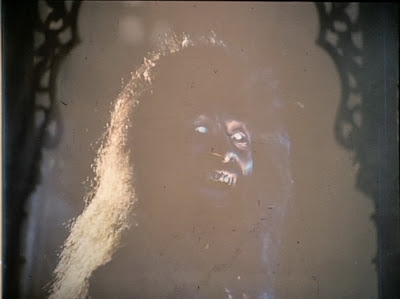


Assuming we get a second to stop and think about what just happened, rather than just clapping our hands with glee like happy, horror-loving seals, the extensive use of Christian imagery in ‘Purani Haveli’ seems kinda interesting - even the opening credits play out against images of Jesus. Again, my inability to really put these movies into wider cultural context defeats me, but… that’s gotta be quite unusual for Hindi horror, right? Were the Ramsays maybe gunning for international distribution by this point in their career..? As I say, I am sadly in no position to speculate as to the why or wherefores here, but… it’s an issue worth noting, I think.


Anyway, next we’re whisked to a somewhat safer domestic setting, where an avalanche of exposition awaits us. This being Bollywood though, exposition tends to come in the shape of outlandishly exaggerated melodrama, fights, lavish musical sequences and slapstick comedy, so… that’s just fine.

In brief, then: a vain rich man (and he has a golden cannon in his living room, so he must be pretty rich and vain) declares that he intends to buy a mansion for the beloved daughter of his late brother. Conveniently, an old geezer baring pictures of the joint in which we saw the preceding carnage unfold seems willing to sell.

When the old geezer’s servant arrives at the mansion to ‘prepare’ it for its new owners, he is almost immediately terrified out of his wits by the general, insane horrifyingness of the place (guttural roaring noises, vast swathes of fog, eerie fluorescent lighting, rattling walls, staring animal heads, you name it..), and swiftly meets his doom via a feature that proves a bit of a surprise even for this singularly far-out piece of real estate: a gigantic, horned, skull-faced iron statue with penchant for coming to life at inconvenient moments and stomping around strangling anyone in its path! Happily, we will be seeing a lot of this statue through the rest of the film, so better get used to it.


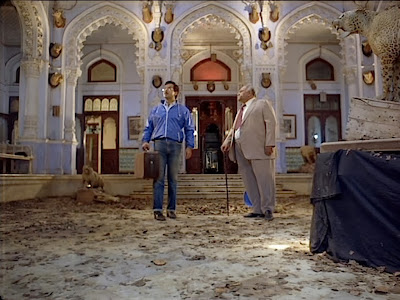
By this point, more attentive viewers will no doubt have clocked the fact that the location in which much of ‘Purani Haveli’ takes place is simply bloody magnificent. Initially, I thought the Haveli’s interiors had such a perfectly phantasmagorical, horror movie look to them that they had to be sets, but by the time the aforementioned caretaker is wondering around the gargantuan entrance hall, it becomes clear that this structure is too solid and elaborate to be anything other than the actual interior of the mansion used for the equally breath-taking exteriors.
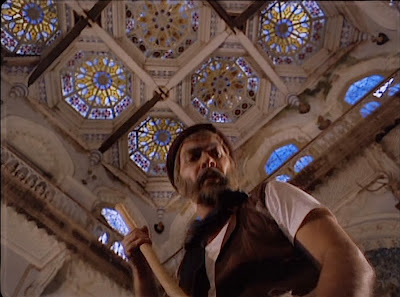

So yes, if we’re to maintain our sanity, I’m afraid we’ll have to accept the fact that the Ramsays actually DID find a sprawling, semi-derelict Masala-gothic baroque folly sitting atop a remote clifftop, and proceeded to simply film the hell out of it. And the more we see of this place, the more astonishing it becomes – perhaps the best readymade horror movie location I’ve seen in all my life, in fact. The vast, gothic-arched entrance hall looks like something out of Dario Argento’s dreams, decked out with dozens of moth-eaten, mounted animal heads and topped with a multitude of kaleidoscopic stained glass windows, whilst the exterior looks like one of those beautiful matte paintings from a Mario Bava gothic come to life in three dimensions, with subsequent establishing shots revealing that (though it’s not really utilised in the film), this joint even has a sea view over a kind of wide, picturesque bay. Stunning. Hell, I’m starting to feel a certain sympathy with Mr. Golden Cannon - I’d buy this place in a second, homicidal statue or otherwise.(1)


And, speaking of the mansion’s boastful new owner, he and the old geezer who just sold it to him turn out to be next on the menu of victims. Arriving to look the place over and finalise their deal, it takes about two minutes of screentime before the latter has suffered death by statue and the former is cowering in terror in the centre of a spontaneous circle of fire and random explosive charges in the adjacent graveyard, awaiting the approach of the hairy caveman beast. Forget your Shirley Jackson shit, this is a haunted house that doesn’t mess around.


Of course, plenty more meat is needed to fill out the remaining 120 minutes, and so before we know it, Anita, the aforementioned niece, is on her way to the house, accompanied by a literal bus load of salty characters, including, amongst others: Seema, her scheming step-sister! Vikram, the lazy, drunken brute that Seema is trying to push her into marrying! (He comes accompanied by goons.) Jagdeep, the chortlesome fat guy sidekick of Anita’s real true love Sunil, sneaking onboard in hilarious disguise as a burqa wearing woman! Sher Khan, the inexplicable elderly gay bus driver, who keeps saying things like “ I am a happy friend to all!”, and trying to molest Jagdeep! And of course, noble, upstanding Sunil himself is not far behind – a go-getting photographer (I loved how the set for his photography studio was full of giant-sized Kodak film boxes), keen to win back Anita’s love, mistakenly believing himself to have been spurned after evil Seema and Vikram forced her to reject his advances at gun-point!

And so, as you might imagine, we can more or less wrap up the plot synopsis right there by simply stating that all hell breaks loose pretty sharpish when this crew pitch up at the Mansion of Evil, and that it continues to do so for more or less the next two hours, give or take a few extended flashbacks, utterly unconnected comedy sequences, sleazy bathing scenes and romantic interludes, until Sunil finally gets his shit together to team up with the crazy, demon-fighting priest and put a Christ-endorsed stop to all this hullabaloo. So, not exactly the most innovative and involving of horror movie narratives, I’ll grant you - but, by thunder, it will do.
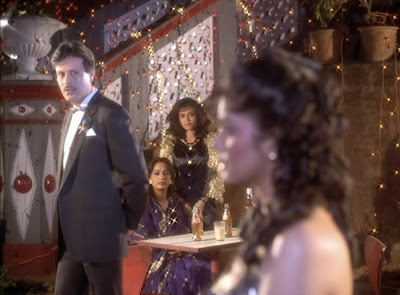


Ordinarily, one might be wary when a approaching a horror movie with a two and a half hour run time, but the great thing about these Ramsay movies is that (in common with more mainstream Hindi productions, I’m assuming), their pace is absolutely relentless. For these guys, 150 minutes of screen-time isn’t an excuse to ‘stretch things out a little’ and try out some of those auteur-ish indulgences our more artistically minded Western directors love so much - it’s simply an opportunity to cram the screen with 150 solid minutes of super-charged spook show mayhem, giving the audience more, and more, and more of what they want (alongside various diversions they didn’t even know they wanted), until less hardy viewers will find themselves falling from their sofas begging for mercy as yet more thunder-crashing gothic beastliness and mugging, shrieking technicolor overload unfolds, all at the kind of breakneck tempo that we in the West would more readily associate with a Daffy Duck cartoon than a feature length film.


Ok, so I suppose less patient viewers than I might find the fairly lengthy diversions from the central horror business to be something of a chore, but what can I say – I dug it all. At least once every 15-20 minutes, you can guarantee that something totally mad will happen that you’d be telling people about for weeks if it popped up in the middle of a common or garden Western genre flick, and such highlights aren’t simply confined to the horror segments either.

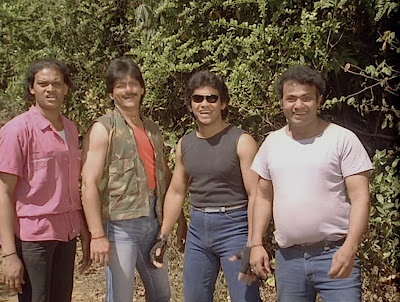
For instance, there’s a wonderful, extended fight/action scene that takes place during the introductory “setting up the characters” section, in which Sunil and Anita are ambushed by a gang of thugs hired by Vikram on a remote country road. (Apparently the couple’s journey from the photo studio to “the club” takes them through a picturesque jungle wilderness, which seems strange to me, but then hey – I don't know India). A feast of intense lunkhead kung fu ensues, culminating in a life or death shovel vs pitchfork battle atop a rickety wooden bridge. Well played, Gulab Rao! As far as making exciting cinema out of absolutely nothing except six actors and some garden tools go, this sequence was some A1 shit. And all that happens before anyone’s even SUGGESTED going to the haunted mansion! I mean, what kind of an awesome movie is this, where even the preliminary exposition stuff contains more crackpot fury and inept kick-boxing than most so-called films get through in their whole run time..? Donations for the Ramsay Bros shrine I’m in the process of constructing in my living room to the usual address please.

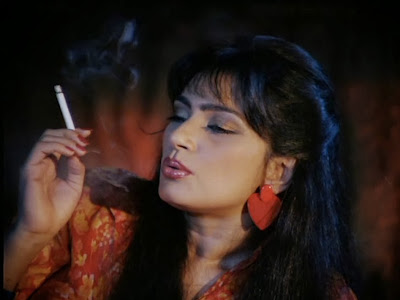
Despite what I presume to be the generally conservative approach taken to sexuality in mainstream Indian cinema (hey, correct me if I’m wrong), the Ramsays also seem comfortable with the idea that a bit of sexual frisson is an integral part of the horror experience, and to that end, they throw in a number of sequences that feature the film’s suitably curvaceous female stars cavorting in extremely tight-fitting swim-wear, including a scene in which Anita is subjected to an attempted rape from nasty old Vikram, until heroic Sunil provides a rousing, two-fisted rescue.

Again, I’m poorly placed as to speculate as to whether the Ramsays were intending to offer their audience a “hey, you don’t get this in ya regular movies” type thrill here (from what I gather, horror films have always been considered pretty disreputable in India, so if they were already incurring the wrath of the moral majority just for making movies like this, they might as well go all out and throw in a bit of sleaze too, I guess?), or whether they again had their eye on the global market, just trying to keep pace with the kind of stuff you might see in an American horror movie circa the mid/late ‘80s…? No idea, but anyway, something else to take note of and maybe return to when I’m a bit more confident on how to read Indian films.


Not that such a wild, subtlety-free approach seems to impact much on the film’s production values or technical ambition however; on the contrary, ‘Purani Haveli’, as presented in pristine form via Mondo Macabro’s Bollywood Horror collection(2), is often an extremely beautiful gothic horror film, boasting uniquely eerie location work, a feast of rainbow-hued Bava-esque lighting effects, and production design that looks like something Hammer’s Bernard Robinson might have conjured up in a fever dream after eating too much cheese. And if the camera-work is sometimes a bit crazed and ragged, the story-telling pulpy, repetitive and melodramatic, well, so be it - for me that doesn’t stop what’s going on in front of the lens being one of the most joyfully enthusiastic celebrations of horror movie imagery you could ever hope to see.

Of course, the soundtrack (by Ajit Singh) is pretty astounding too – a must-hear for anyone who enjoyed Finder Keepers’ superb Bollywood Bloodbath compilation last year, with a suitably unhinged mixture of light-weight pop, mutant retro disco, sci-fi synth abuse, squelching electronic drum beats, phaser blasting surf guitar, unearthly female wailing, blaring overdriven string crescendos and jarring bursts of what sounds like a about six sound effects records being played simultaneously – it’s a feast of low budget musical insanity that matches the everything-but-the-kitchen-sink tone of the film perfectly, hitting just about all bases re: ‘sounds you might want to hear in an Indian horror flick’, often all at the same time.
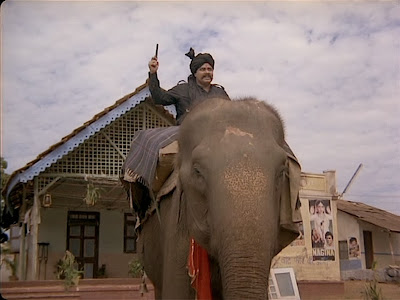


And, as mentioned, personally I really enjoyed the jarring and lengthy diversions into slapstick comedy and musical territory too. The variety of garish late ‘80s leisure-wear on show during the scenes that illustrate Anita and Sunil’s burgeoning relationship is in itself enough to keep me entertained, whilst the extended (by Western standards) run-time allows the totally irrelevant sub-plot in which strangely likeable comic relief fat guy Jagdeep discovers that he is an exact doppelganger of a feared bandit chief to become so elaborate that it could easily have been spun off into a movie in its own right – and a fairly entertaining one at that, with plenty of lovingly wrought Laurel & Hardy-esque hi-jinks to enjoy.

How many Western horror films have you seen which find time for the sight of a portly bandit chief stripping off to his voluminous y-fronts for a dip in a tropical lake whilst humming Donna Summer’s ‘Love To Love You Baby’? Very few, I should imagine. And do you feel, on the whole, that horror films could be improved by the inclusion of such antics, when judiciously applied? Let’s take a straw poll. I vote ‘YES’.(3)


And if you vote yes too, that I’d commend you to put a Saturday afternoon or two aside and investigate the world of the Ramsay Brothers forthwith. By taking the macabre, monster bash imagery, psychotic violence and leering yet puritanical sexuality beloved of the Western horror film, and combining it with the joyous excess and maximalist entertainment value of Bollywood film culture, the Ramsays created a wonderful and unique cinematic brew that simultaneously hits up just about all the pleasure-points that popular cinema has to offer, and furthermore does so relentlessly for two and a half solid hours, without even stopping to take a breath.

It tells you something I think about the richness of Indian horror that ‘Purani Haveli’ seems to be considered one of the later and lesser efforts in the Ramsey Bros catalogue, when frankly, if any director West of Istanbul had made this film, it would surely be considered a classic of mindbending OTT genre insanity, ready to be referenced by fans in the same breath as ‘Alucarda’, ‘Housu’, ‘Santa Sangre’ or ‘Suspiria’. Admittedly, it is far cruder, both thematically and technically, than any of those examples, but in purely visceral terms it provides just as much of a full-on, transformative experience for the unwary viewer. And with the paucity of critical attention these films have received thus far, I suspect we are almost all unwary viewers. Time for total immersion style education, I feel.


(1) A handy location credit on the film’s opening titles reveals that the bulk of it was actually shot at the Palace of the Nawab of Janjira, near the village of Murud on India’s East Coast – a colonial mansion set atop a hill overlooking an island that appears to have been completely transformed into a Moorish coastal fortress (the Murud-Janjira). “Distinct features of Moghul architecture with a touch of the Gothic”, according to the link above, and who am I to argue? Type it into google image search and proceed to GAWP. Currently riding high on the list of “incredible places I’d like to visit”. I couldn’t find many pictures of the palace’s interiors online (maybe it’s not publicly accessible, or whatever?), but the few blurry camera-phone pics that did come up on a search definitely match the interiors seen in ‘Purani Haveli’.

(2)All three volumes of MM’s Bollywood Horror Collection were recently declared officially out of print, so with Ebay/Amazon prices currently in the process of rocketing in tediously predictable fashion, I’d recommend grabbing copies whilst you still can – they’re really a the only way to experience these much neglected flicks in high quality / English friendly forms.

(3)According to the notes by Pete Tombs accompanying the Mondo Macabro DVD, this bandit chief is a parody of a similar character in the 1975 bollywood classic ‘Sholay’.