(This is a new thing where I’m going to look collectively at the films included on some box sets I’ve recently been working my way through.)
I can’t be the only one out there who sometimes wonders what goes on behind the scenes when independent Blu-ray/DVD labels in the English-speaking world make deals with the big studios and distributors in Asia. Dark rumours (please don’t ask me for sources) suggest that the Japanese studios in particular like to play hard-ball with foreigners when drawing up licensing agreements, and incidents such as Arrow’s disastrous release of the ‘Female Prisoner: Scorpion’ films a few years back (the only explanation for which seems to have been that Toei deliberately provided the company with inferior transfers, for some reason) would certainly seem to suggest that there’s something fishy going on.
Likewise, Arrow’s choice of releases from Nikkatsu’s rich back catalogue has often seemed baffling. Whilst key films with immediate commercial potential, both from the late Seijun Suzuki (
Gate of Flesh, ‘Tattooed Life’, ‘Tokyo Drifter’, to name but a few) and from the studio’s other directors (‘Black Tight Killers’, ‘Cruel Gun Story’, ‘Velvet Hustler’, just to skim the top of my favourites list), remain AWOL on blu-ray, Arrow have instead concentrated their resources on putting out collections of the studio’s critically undistinguished “program pictures” of the late ‘50s and early ‘60s.
By and large, these are films that have always been characterised by English language critics as homogenous, light-weight affairs that adventurous viewers should not trouble themselves with, and writers have usually tended to frame Nikkatsu’s more artistically ambitious directors (Suzuki, Kurahara, Imamura) in direct opposition to them.
Given that such selections lack either the art-house credibility or cultish sex/violence/weirdness that might make them viable prospects for the Western market, one frankly suspects that some kind of “you’ll release what we give you” arrangement must be in operation here, with our disc-pressing heroes holding out in the hope of snagging some more plum titles further down the line.
But – I come not to bury Arrow’s admirably diverse Japanese cinema line, but to praise it. For, personally speaking, I’ve actually quite enjoyed most of the Nikkatsu “program pictures” I’ve happened to see over the years. They have a certain ‘feel’, a certain nostalgic pop art beauty, to them that I like a lot, and I’m always happy to have a few more to get stuck into on a quiet Sunday evening when something comfortable and undemanding is in order.
In particular, new releases of the previously little seen “programmers” directed by Seijun Suzuki before he began to flex his creative muscles in the early/mid 1960s are always welcome. Regarding the vast quantity of product the now revered director turned out for Nikkatsu in the decade prior to his infamous dismissal in 1967, a certain orthodoxy seems to have developed amongst Western critics, separating his exceptional/personally engaged films (largely comprising the stylised yakuza films and edgy, eroticised dramas he made post-1962) from his “routine” genre assignments, the bulk of which are generally dismissed out of hand.
On occasions when items from the latter category have sneaked out in English friendly editions however (cf: ‘Take Aim At The Police Van’ (1960) on Criterion’s ‘Nikkatsu Noir’ set, or ‘Voice Without a Shadow’ (1958) on Arrow’s ‘Nikkatsu Diamond Guys Vol # 1’), I’ve actually found them to be very good, with scattered examples of the director’s visual ingenuity and anarchic energy often in evidence.
As such, purchasing the first of what promises to be several multi-disc box sets stuffed with such obscure, early works was a no-brainer, even as ‘Volume # 1’ (designated as “The Youth Movies”) promises to demonstrate how this much-loved filmmaker began to develop his chops in an environment entirely devoid of stylised gun battles, blinding primary colours, blood-drenched prostitutes, sneering, hamster-cheeked gangsters or psychedelic butterfly close-ups (
definitely no butterfly close-ups).
Proceedings begin with
The Boy Who Came Back [
Fumihazushita Haru, 1958], Suzuki’s eighth film as director, according to IMDB. As scripted, this is a fairly mundane juvenile delinquent melodrama, centred on an earnest high school girl (Keioko, played by Sachiko Hidari) who works for a voluntary organisation whose members seem to act as mentors / ersatz probation officers for young people who have just been released from juvenile detention centres.
Apparently no one in this film’s world seems to see a problem with placing inexperienced schoolgirls in unsupervised contact with troubled young men with criminal records, and as such Keiko soon finds herself drawn into the chaotic world of Nobuo (Akira Kobayashi), an unrepentant bad boy who is soon dragging her to wild jazz parties, brawling with his old adversaries on the streets, arguing with his family, and generally tearin’ it up in classic JD style, irrespective of her attempts to try to keep him on the straight and narrow.
One thing that immediately makes this film somewhat noteworthy for fans of Japanese cinema is its cast. Kobayashi was already well on his way to earning his stripes as Nikkatsu’s second biggest male star (behind Yûjirô Ishihara) by this point, with over a dozen films under his belt, but more interesting is the early appearance of Hidari, an actress who later went on to genuinely great things, delivering exceptional and challenging lead performances in both Shôhei Imamura’s ‘The Insect Woman’ (1963) and Kinji Fukasaku’s harrowing ‘Under The Flag of the Rising Sun’ (1972), amongst others. (According to Jasper Sharp’s notes accompanying this set, Hidari also holds the distinction of becoming the first Japanese woman to both direct and produce her own feature film, when ‘The Far Road’, a project apparently funded by a rail workers trade union, saw release in 1978.)
Sadly, it must be said that little of this promise is evident from Hidari’s appearance in ‘The Boy Who Came Back’. Though clearly both possessed of a certain amount of charisma, the film’s young leads (who were respectively aged around nineteen and seventeen at the time) flounder dreadfully, desperately in need of guidance that they clearly weren’t receiving from Suzuki, or apparently anyone else on the production.
Hidari in particular overacts horrendously in places, making a mockery of story’s more dramatic moments as she simpers and stomps and, at one point, beats her fists on the floor in a largely unmotivated tantrum. Kobayashi meanwhile seems nervous and gangly, grinning and shrugging as if he just failed a boy band audition, and evidencing little of the easy charm and/or dramatic intensity he brought to productions such as Buichi Saitô’s
The Rambling Guitarist (1959) or Toshio Masuda’s low-key yakuza drama ‘Rusty Knife’, released in the same year as this film.
Elsewhere, future Nikkatsu leading lady Ruriko Asaoka is third billed as Kobayashi’s on-off girlfriend, whilst perennial yakuza boss Tôru Abe also puts in an appearance, and there’s a lot of great, energetic stuff with Jô Shishido as the porkpie hat-rockin’ ringleader of a small gang of toughs who live in a tiny room above a night club, harassing Kobayashi and, in a development that would be legitimately shocking in a film from any other country in the world, dragging the gentle Asaoka to their hideout to have their wicked way with her. Shishido’s always welcome presence (his only appearance on this set, sadly) tops off what stands, in retrospective at least, as a remarkably impressive cast for a routine Nikkatsu b-movie.
None of this seems to have impressed Suzuki however, and mirroring his apparent disinterest in his leading players, the director seems to have been equally disengaged from the film’s admittedly run-of-the-mill script, instead leaving the central drama to play out in whatever hap-hazard form it may, whilst he focuses his attention instead on the kind of incidental pleasures more easily accessible to jobbing studio directors.
As with all the films in this set – and most vintage Nikkatsu productions in general, to be honest – the photography here is exceptional, capturing some beautiful vistas of the out-of-the-way corners of Suzuki’s native Tokyo in which the film is set. Incorporating brief snatches of what basically amounts to documentary footage, the film gives us a fascinating and, in this context, rather romantic glimpse of a scrappy, suburban landscape, balanced mid-way between dusty, pre-war malaise and the transformative modernisation Japan’s post-war ‘economic miracle’ (more on which below).
Meanwhile, the jazz club scenes – another common Nikkatsu trope – are absolutely tremendous fun, displaying some of the wild cutting and infectious energy that would come to define Suzuki’s work over the coming decade as Kobayashi guzzles some big, foamy mugs of beer (courteously, he orders some for Hidari too, though she seems less keen) and finally lets rip, frugging wildly to an infectious mixture of big band swing and early doors Asian rock n’ roll. (Look out for the beret and shades-sporting ‘hipsters’ in the background in these scenes – they’re pretty great.)
Elsewhere, an early example of the kind of anarchic spirit that later came to rile Suzuki’s paymasters can be seen in a number of location-shot scenes in which, whilst the leads thrash through their dialogue, the director frames shots in such a way as to draw our attention instead to the crowds of genuine passers-by who have gathered on nearby pavements and bridges, quietly watching the film being shot.
Though the evident weaknesses of its scripting and central performances don’t really allow ‘The Boy Who Came Back’ to pass muster as a ‘good’ film, it is certainly an interesting and entertaining one that – largely due to delightful touches such as those discussed above - is liable to live long in my memory.
“Delightful” also seems a perfect descriptor for the next film in this chronologically-sequenced set, the awkwardly translated
The Wind of Youth Group Crosses The Mountain Pass [
Tôge o Wataru Wakai Kaze, 1961].
Both a straight-forwardly good-natured coming-of-age comedy and a heart-felt celebration of the traditional festivities and atmosphere that characterise summertime in rural Japan, the tone of this one will be immediately familiar to anyone who has seen Suzuki’s first colour film, the rather more boisterous comedy ‘Fighting Delinquents’ (aka ‘Go To Hell Hoodlums’, 1960), which shared this film’s star, the affable Kôji Wada.
Here, Wada plays a penniless, happy-go-lucky student who has taken some time off to go a-ramblin’ across his homeland with no particular aim in mind. We meet him as he hitches a ride with a bedraggled family magic troupe, joining them as they wind their way up into the mountains in a decidedly uncomfortable looking open-topped truck, midway through a tour of rural summer festivals.
Subsequently, we find Wada pitching up in one of the sprawling fairs/markets that to this day surround Japan’s temples and shrines during festival time. Inexplicably, our feckless hero is trying to raise some cash by flogging a shipment of ladies’ underwear that he somehow ‘acquired’ back in Tokyo, which leads to him learning a few quick lessons on hard sell techniques from his fellow market traders, and also getting friendly with the amiable quasi-yakuza types who are controlling pitches at the fair. (Pretty much everyone in this movie is amiable, it should be noted, even the bad guys.)
(Most notably among the latter, by the way, is Nobuo Kaneko, probably best-known as the cowardly Boss Yamamori in Kinji Fukasaku’s ‘Battles Without Honour & Humanity’ saga, who turns up here in an early prototype of the “comedic creep” character he’d go on to portray in dozens of ‘70s Toei productions.)
Meanwhile, Wada’s pals in the magic troupe (who of course include the obligatory contrasting duo of eligible young ladies, as well as a loveable-yet-simple-minded strongman and various other oddballs) are in a quandary. Having lost their star attraction – a stripper! – they are having to face the fact that, without her charms, nobody is very interesting in paying to see their patriarch’s dusty old magic tricks.
As one might well expect, Wada becomes increasingly embroiled in the life of the magic troupe, attempting to help them through their problems by means of various schemes and shenanigans, the exact nature of which need not concern us here. Needless to say though, things work out more or less ok for the vast majority of the film’s extensive cast of characters, and our young protagonist eventually continues on his way through life with happy, sun-dappled memories of life lessons learned and a summer well-spent.
Only a small percentage of Nikkatsu productions enjoyed the luxury of being filmed in colour during this period, and, as with his earlier collaboration with Wada, Suzuki makes the most of the opportunity to do so here. Filmed in beautifully rich, over-saturated faux technicolor, the film’s evocative mountain and forest locations become a vivid riot of reds, greens and wide blue skies, with some footage presumably shot at genuine summer festivals.
Although nothing terribly riotous occurs in the actual storyline to match all this visual excitement, Suzuki nonetheless seems to have been far more engaged with this material than he was with that of the previous film in this set, skilfully weaving together a sometimes dizzying assortment of characters and sub-plots and maintaining a lively, energetic pace that somehow never undercuts the slightly wistful, nostalgic tone of the story, and delivering an entertaining and accomplished movie that it’s hard to believe his paymasters at the studio weren’t pleased with.
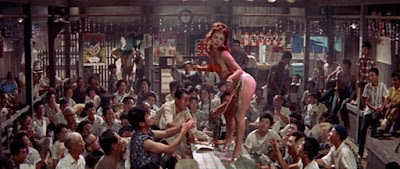
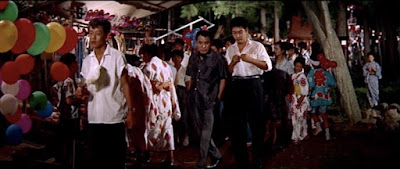
One of the things I found most interesting about ‘Wind of Youth Group..’ is that it stands as perhaps the only Nikkatsu film I’ve seen that entirely avoids the studio’s trademark references to Western culture and youthful aspirations toward internationalism. There are no jazz records or Hollywood movie icons here, no US airbases, sharp suits, gleaming new skyscrapers or young hoodlums hanging around the docks, staring wistfully out to sea.
Instead, Suzuki – perhaps surprisingly for viewers who know the director solely for the likes of ‘Branded To Kill’ and ‘Tokyo Drifter’ - seems very much at home with this comforting, inward-looking celebration of the traditions of working class rural life that in part reminds me of the more bucolic entries in the
Zatoichi series, produced by the far more conservative Daiei studios.
About the closest the film gets to Nikkatsu’s usual “borderless” agenda is amoment when one of the young girls in the magic troupe admits that she longs to raise enough money to travel to distant Tokyo (one shudders to imagine what
other kind of Japanese cinematic narrative she might find herself part of when she finally gets there). I suppose there
is a slight suggestion here that the world presented by the film is fading away, moving towards irrelevance as the country moves toward (an implicitly Westernised) modernity. The magic troupe is a relic of the past, the traders in the market all seem pretty destitute, and so on – but the script addresses this sort of thing only in passing.
For the most part, the feeling viewers will end up taking away from ‘Wind of Youth Group..’ is a happy one. Everyone in the film is basically nice and helpful and likeable, and they all have splendid time together in their self-sufficient, nomadic demi-monde. Even when bad things happen – and, without resorting to spoilers, some
fairly bad things happen – this film makes summertime in rural Japan feel like a lovely place to be.
For those who experienced this atmosphere first-hand when growing up, there must be a real comfort factor here that could conceivably have made this movie a fixture on the nation’s holiday TV schedules had it had more exposure, and even your humble
gaijin correspondent found himself feeling very positive about the prospect of soon paying another visit to Japan and soaking up a few remaining ghosts of this old-timey atmos here and there.
Any perceived dearth of modernity in ‘Wind of Youth Group..’ is more than more up for by the next film in Arrow’s box set, a 1962 item named
Teenage Yakuza [
Hai Tiin Yakuza]. Very obviously a b-movie, presumably destined for the bottom of some triple bill, this one runs a mere 72 minutes, features none of the studio’s ‘name’ stars and appears to have been thrown together in great haste – all of which, I would suggest, are circumstances that sat pretty well with Suzuki’s directorial muse.
The ostensible narrative here is slight, presenting Tamio Kawaji – a prolific actor who turned up in many key Nikkatsu titles, but more usually only in supporting roles - as a young man in a small mountain town, whose ‘stand up guy’ tendencies and ability with his fists lead him first to fight off the local protection racket praying upon local businesses, and then, inadvertently, to usurp it, naively accepting gifts and freebies from the business owners, and subsequently attracting the attention both of the law, and of some out-of-town toughs with proper sharp suits and shades (and we all know what that means – see title).
The actual story Suzuki seems to be telling here however is an entirely different one, and it is conveyed in part simply by the location – an apparently genuine one, insofar as I can tell – in which the film’s exteriors were shot. A tiny, self-contained community in the process of being hit full force by the effects of Japan’s post-war “economic miracle”, the cramped storefronts and shabby back-rooms occupied by the movie’s primary characters find themselves dwarfed by the shiny new apartment blocks and industrial buildings that seem to be springing up almost organically from the hills around them.
Construction materials lie around everywhere, whilst mechanical diggers churn the earth in the vertiginous quarry/construction site around which both the film’s opening titles and climactic ruckus take place. In the town’s main thoroughfare meanwhile, roaring trucks and phalanxes of bicycles vie for space with strutting gangs of idle teenagers.
Kawaji’s industrious mother (Suzuki regular Kotoe Hatsui) plans to make it big by opening an American style coffee bar, complete with chromium counter, linoleum flooring and high bar stools, which she seems to have bought wholesale from a franchise catalogue, presumably in anticipation of the crowds of hip, Western-orientated professionals who will soon be occupying all those tower blocks. (Modern viewers who have enjoyed the questionable privilege of living in a “revitalised” urban area in recent years may feel a twinge of déjà vu at this point.)
Normally, one would expect a film loaded with such signifiers of aggressive modernisation and economic transformation to cast a cynical or nostalgic eye upon the human cost and cultural homogenisation engendered by such developments, but, despite the yakuza-related plotline’s implicit criticism of the moral corruption underlying such “progress”, Suzuki - in stark contrast to the feeling conveyed by ‘Wind of Youth Group..’ - seems to be all for it. And in a sense, who can blame him?
From start to finish, this film flows by on a tide of pure, giddy energy, just as much so as the post-modern gangster romps the director began making shortly afterwards. Almost every second of ‘Teenage Yakuza’ is filled with noise and action and general hullaballoo, with people shouting, laughing, arguing, running around and dancing. Vehicles roar around the place honking their horns, deals are made, business open and close, money changes hands and – seemingly a Suzuki speciality at this point - there is a great deal of kinetic though good-spirited fisticuffs, with characters retreating on several occasions to the adjacent wasteland in order to beat each other senseless (though they usually seem to get up smiling at the end of it).
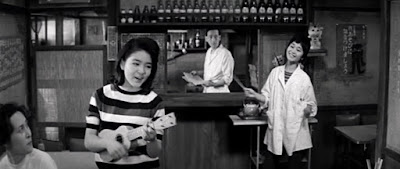
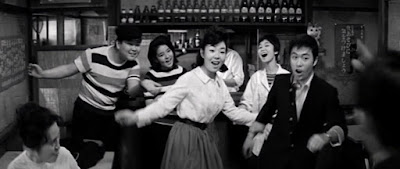
Everywhere, music blares (a new stereo system is Kawaji’s pride and joy) and teens congregate in a kind of prototype pachinko parlour or – joy of joys – in another jazz club, where blown up pics of American musicians are plastered on the walls, and kids frug amid decorative signposts emblazoned with such exotic, English language legends as “Don Elliot Play Mellophne”, “Cha-Cha To Haiti” and “To Loui Armstrong in Cicago”. Even the more old fashioned environs of the local noodle shop get forcibly livened up at one point, when a gang of casually-attired young folk burst in to dance and sing along with a jaunty number being played on ukulele and hand drums by the owner’s daughters (Midori Tashiro, looking very cute as Kawaji’s love interest in one of only a handful of screen roles for Nikkatsu, is prominently featured here).
It seems these youngsters can’t stop movin’ for a minute, and all this joy and vitality serves to remind us that, for a nation still emerging from the shadow of authoritarianism, war, austerity and reconstruction, the freedoms and easy rewards offered by all this rampant, untamed capitalism were PRETTY DAMN COOL – a conclusion the director seems, on the surface at least, to share.
Indeed, Suzuki’s framing and cutting is extremely skilful, mirroring the energy of his characters, and compositions are often quite striking in the more dramatic scenes, enhancing the film’s feeling of perpetual movement and constant excitement, at times making things rather like a more punk-ass take on one of those “people on the move!”-type war-time propaganda reels.
Interestingly however, Kawaji’s final confrontation with the out-of-town Yakuza guy sees the antagonists rolling across the top of the hill that overlooks the town, revealing an area of fertile, well-tilled agricultural land facing in the other direction, providing a stark contrast to the dust and concrete in which we’ve spent the preceding seventy minutes, and, momentarily at least, setting up a more conflicted urban-vs-rural / old-vs-new type dichotomy that leaves a question mark hanging over the movie’s ostensibly happy, forward-moving conclusion. Whether or not this was Suzuki’s intention is, strangely, fairly irrelevant – the simple fact that that farm land was THERE, and ended up on-screen, makes the point as clearly as any deliberate act on the part of a writer or director could have done.
Though an admittedly minor effort, details such as this again help turn ‘Teenage Yakuza’ into a unique snapshot of the time and place in which it was made, and of the currents and contradictions that were flowing through certain areas of Japan. Its directorial confidence, unruly energy and refreshing brevity all proved very welcome, and, if pushed, I’d probably nominate it as the film in this set that I enjoyed the most.
Next up, Arrow’s set shifts gears on us quite dramatically, showcasing a pair of films both adapted from similar, semi-autobiographical stories penned by one Kon Tôkô, an author who seems to have enjoyed a considerable literary reputation in mid-century Japan, but has subsequently been largely forgotten. (Critic Jasper Sharp should be commended for his efforts fill in the blanks re: Tôkô’s life and work in his supplements to this box set.)
Suzuki actually completed a loose trilogy of films adapted from Tôkô’s writing during his time at Nikkatsu – indeed, the third, 1966’s ‘Carmen From Kawachi’ (not included here), appears to be very well thought of domestically, where it remains one of the director’s more well-known films. As such, it is probably safe to assume that Seijun was a fan – but, in the top-down, contracted environment of Japan’s studio system, it’s difficult to be too sure. I suppose it’s equally likely that, after Suzuki’s first Tôkô adaptation proved something of a hit, the powers that be at Nikkatsu simply decided that this writer and director made a good pairing, and began planning some follow-ups… but, for the sake of argument, let’s assume the former possibility.
Anyway, regardless of how they came about, the two films included here are 1963’s
Akutarô, translated by Arrow as
The Incorrigible, but known elsewhere as ‘Bad Boy’ or ‘The Bastard’, and 1965’s loose follow up/kind-of-remake
Akutarô-den: Warui Hoshi no Shita Demo, which has been dubbed
Born Under Crossed Stars by Arrow, although I personally favour the more direct alternative translation, ‘Stories of Bastards: Born Under a Bad Star’.
As well as causing us to ponder the circumstances that led to Suzuki directing so many movies with insults or derogative terms in their titles (to those already referenced in this article, we can add 1963’s magnificently translated ‘Detective Bureau 2-3: Go To Hell Bastards!’), these two films serve to introduce us to yet another underappreciated facet of the director’s personality – that of the voracious reader, sympathetic adapter of literary source material and gentle connoisseur of period historical atmosphere.
(Actually, this side of Suzuki can also be glimpsed in several of the more tonally “serious” films he made during his Nikkatsu heyday – ‘The Flower and The Angry Waves’ [
Hana to Dotô, 1964] and ‘Fighting Elegy’ [
Kenka Erejî, 1966], for example - but it would arguably not fully emerge until much later, when he embarked upon his celebrated ‘Taishō trilogy’ in the 1980s.)
To begin by outlining the similarities between the two films under consideration here - both star the relatively little known Ken Yamauchi as an ambitious young man forced to cool his heels in a picturesque small town in the Kawachi district of Western Japan. Although set in different historical periods (Taishō [1912-1926] and early Shōwa [1926-1989] respectively), both feature Yamauchi’s character getting caught up in a love triangle, see him expounding upon his precocious appreciation of Western literature, and find him rubbing up against the forces of resurgent authoritarian nationalism.
Said forces are represented in both films by uniformed school ‘committees’ (a fairly common feature of Japanese school life throughout the 20th century, at least if manga and exploitation movies are to be believed) whose thuggish members inflict savage beatings upon their fellow students for such heinous crimes as walking with girls, reading novels or failing to address their seniors using the correct honorifics.
Both films, needless to say, also conclude with Yamauchi’s character manfully striding across the bridge that leads out of town, ready to make his way in the big, bad world, older, wiser, lessons learned and all the rest of it.
So similar in fact are the two films that watching them in quick succession can prove a rather confusing and repetitive experience, but nonetheless, they still very much retain their own identities. In
Akutarô, Yamauchi’s character (named, uh, Tôgo Konno) is the wilful and self-possessed son of an apparently wealthy and cosmopolitan family. In an attempt to curb his growing arrogance, his mother tricks him into accompanying her on a trip to an
onsen resort, but actually dumps him in a small, provincial town along the way, entrusting his well-being to the headmaster of the strict local school.
Initially declining to adopt the school’s drab uniform, Konno instead attracts attention (both positive and negative) by striding around town in an aristocratic kimono, whilst pointedly failing to take any of the advice or instruction proffered to him by anyone.
Given how indolent, conceited and generally obnoxious he is, it is a credit both to Yamauchi and to the film’s production team that they nonetheless manage to make Konno very likeable, winning our sympathies almost straight away, and indeed it is his earnest-yet-naïve persona and mannered, almost theatrical, delivery of dialogue that helps Suzuki pull off the many charming and memorable scenes dotted through the film.
One of the best of these occurs when the members of the aforementioned discipline committee visit Konno in his digs to punish him for ownership of a novel. After stridently arguing his case, Konno invites the proto-fascists to sit down, offers them some chocolate, no less, and delivers a rousing lecture to them on the value of literature, the importance of familiarising oneself with foreign cultures, and the particular qualities of the volume that has aroused their ire (a translation of Strindberg’s early novel ‘The Red Room’). Thoroughly taken aback, and perhaps with a new respect for their non-conformist classmate, the committee members momentarily cease their braying antagonism and quietly leave him be.
Of course, the movie’s narrative demands they’ll be back to their old bullying ways before long, but it is nonetheless a lovely scene, allowing us to feel, for a few moments at least, that our hero has perhaps planted a seed of doubt in the minds of the thugs, potentially inspiring them to rethink their blinkered and puritanical approach to life as they get older; a refreshing change from the variations on the theme of outrageous violence through which heroes usually make their point in Japanese genre cinema.
Equally delightful is the flashback to Konno’s sexual awakening at the hands of a happy-go-lucky geisha named Ponta, who takes a shine to him at another one of those bucolic summer festivals. Though ostensibly as chaste as early ‘60s mainstream entertainment demanded, this erotic encounter is nonetheless presented in admirably matter-of-fact fashion, with a great performance from the little known Chiharu Kuri as the lady in question.
Reminding me somewhat of the realistic, easy-going approach to sexuality later embodied by such films as Tatsumi Kumashiro’s excellent art-house/Roman Porno crossover ‘Street of Joy’ (1974), this again makes for a welcome contrast to the unsettling themes of patriarchy, abuse, fetish and obsession that we cult movie buffs are probably more used to seeing dominate the depiction of such subject matter in Japanese films.
Although it takes an unwelcome – perhaps studio mandated? - diversion into hand-wringing melodrama in its final act,
Akutarô is nonetheless an unusual and entertaining addition to the Suzuki canon, making this box set four for four up to this point in the enjoyment stakes.
I wish I could say the same for
Akutarô-den / ‘Born Under Crossed Stars’ / ‘Stories of Bastards’ (henceforth,
Akutarô-den), but sadly this one didn’t really do a lot for me. Despite sitting right in the middle of Suzuki’s key creative period in the mid-‘60s, it is easy to see why it has failed to attract the kind of attention retrospectively lavished on most of the other films he directed between ’64 and ’67.
In stark contrast to the aristocratic scion he portrayed in
Akutarô, Ken Yamauchi’s character here – named Jûkichi – comes from complete the other end of Japan’s social strata. His family reside in a tumble-down rural shack and his father is a shiftless, destitute gambler, whilst his mother a nagging, put-upon housewife whose sole pleasure in life seems to come from upsetting her husband’s doltish activities. Depending on how charitable you feel toward their rather broad antics, hilarity may potentially ensue.
Jûkichi himself meanwhile has a bit more get-up-and-go about him, and supports the family through his part time job, which involves travelling around the local area on his bicycle, selling milk (a distinctly non-Japanese commodity, you’ll note) on behalf of a dairy owner who wears a cowboy hat and never tires of telling people that he used to live in Texas. Inevitably, it is this job – together with his school activities, which more closely resemble those of the earlier film – that serve to draw young Jûkichi into the various encounters and convolutions that comprise the movie’s frustratingly rambling and digressive plotline, and… well, yeah, there ya go really.
Watching
Akutarô-den, I momentarily felt a certain sympathy for Nikkatsu studio president Kyusaku Hori vis-à-vis his oft-quoted remark about Suzuki turning in movies that “make no sense, and make no money”. As various comedic grotesques caper about the place and the far-too-large cast tramp about to little discernable purpose, I’ll freely admit that it proved quite difficult for me to even grasp what was going on here during the opening half hour, and even after that, much of what transpired proved difficult to fully engage with.
This wouldn’t be so much of a problem of course if the kind of filmmaking bravado and visual ingenuity that Suzuki’s had mastered by this stage in his career was in evidence – I mean, does anyone know or care what
Youth of the Beast was ostensibly ABOUT?- but sadly, give or take a few nice scenes and interesting framing decisions here and there,
Akutarô-den is pretty routine stuff. Suzuki’s mise en scene favours cramped long-shots, often letting comedic routines and bits of dramatic business play out at length, and Kazue Nagatsuka’s monochrome photography, though perfectly competent and attractive, is fairly undistinguished, at least by Nikkatsu’s high standard for such things.
Probably the strongest element in
Akutarô-den comes from the ‘love triangle’ storyline, with our hero’s romantic entanglements a bit more – if you’ll excuse the pun – convincingly fleshed out than they were in
Akutarô. As Jûkichi attempts to bond with demure good girl Masako Izumi – his infatuation inspired he the fact he’s spotted her reading a translation of that cornerstone of love triangle texts, ‘Anna Karenina’ – Suzuki employs some oddball,
nouvelle vague style framing to imply their nervousness, showing the two speaking whilst standing with their backs to a wall, staring directly to camera, and suchlike.
Meanwhile, Jûkichi’s parallel relationship with Yumiko Nogawa – an actress who made a striking debut in Suzuki’s ‘Gate Of Flesh’, and subsequently seems to have found herself typed in ‘erotic’ roles – is related in more earthy, naturalistic terms.
Nogawa plays a sexually outgoing local girl who catches a glimpse of Jûkichi when he turns up to berate her previous boyfriend about something or other, and likes what she sees. The vibe here is reminiscent of the scenes with the geisha in the earlier film, and sees
Akutarô-den moving into proto-sex comedy territory for a enjoyable scene in which Nogawa lures the uptight and high-minded Jûkichi into a private bathhouse to have her wicked way with him.
Though essentially not much different from the kind of scenario we’d see a hundred times over once this-sort-of-thing became a staple exploitation genre across the world in subsequent decades, it’s very nicely played here, with some near nudity that I would term ‘daring’ were it not for the far more outrageous content Suzuki had already brought to the screen in ‘Gate of Flesh’ a year earlier, to general acceptance and acclaim.
(The best translated English title on Nogawa’s IMDB filmography, by the way, is a tie between ‘Cat Girls Gamblers: Naked Flesh Paid Into the Pot’ and ‘Cat Girls Gamblers: Abandoned Fangs of Triumph’ – both 1965/6 Nikkatsu releases that suggest the company may have already been routinely dipping their toes into steamier waters by this point. Heaven knows what these are all about, but I’d sure buy a blu-ray of ‘em sight unseen, in case anyone from Arrow happens to be reading.)
Basically though, this is all I can really find to recommend in
Akutarô-den, a film in which Suzuki’s increasingly lackadaisical approach to narrative seems for once to have tripped him up, resulting in a rather ramshackle and muddled picture that – for me at least – closes an otherwise extremely rewarding set of films offered up by Arrow on a disappointing note.
Never mind though – it’s taken me so damn long to get around to watching and writing about these that I now have the very promising sounding ‘Early Years Vol # 2: The Crime and Action Films’ sitting on the shelf awaiting my attention, ready to further expand my knowledge of the lesser known works of this mercurial and much-missed filmmaker. Will I return one day to torment you with another 5,000+ word review of that one? Only time will tell.
Needless to say, this review is dedicated to the two million plus citizens of Western Japan who have recently had their bucolic summer festival season interrupted by an unprecedented series of highly destructive, weather-related natural disasters. If you’re still reading this far down the page, hopefully you’ve enjoyed my efforts, and will consider making a donation to support the victims by way of thanks.