Showing posts with label Piers Haggard. Show all posts

Saturday, 21 January 2023

Deathblog:
Piers Haggard
(1939-2023)

I was very sad to hear this week that Piers Haggard - director of probably my favourite horror film of all time, ‘Blood on Satan’s Claw’ (1971) - has passed away at the age of 83.

Speaking about ‘..Satan’s Claw’ in interviews over the years, Haggard always seemed very serious about his intentions for the project, and the lengths to which he and writer Robert Wynne-Simons went in realising them - an attitude which, though largely responsible for helping the film turn out as brilliantly as it did, perhaps ironically also damaged his prospects for a follow-up career as a director of features. (By which I mean, it probably wasn’t quite the vibe that the likes of Tony Tenser, Deke Heywood or other players in the cash-strapped world of early ‘70s British genre movies were looking for, or so I can only imagine.)

Instead, Haggard carved out a career for himself as a reliable director of respectable British TV (winning a BAFTA for his work on Dennis Potter’s ‘Pennies from Heaven’ in 1978) - in which context we should also single out his role as director on the 1979 ITV ‘Quatermass’ serial (or ‘Quatermass Conclusion’, as I think it should probably have been called - the one with John Mills, anyway). Odd, disturbing and perpetually underrated, it’s a series which arguably feels more resonant and relevant today than it did when first broadcast, and which could perhaps be seen to share a seriousness of purpose, a warped sense of realism and a willingness to disregard genre convention which all loop back to Haggard’s earlier horror masterpiece.

Thereafter, we’ve also got to admire his chutzpah in stepping in to take over 1981’s infamous ‘Venom’ after Tobe Hooper bailed, and actually delivering a half-decent movie in the process. (I know he’s been credited with saying, “the friendliest person on set was the snake,” or words to that effect, but I can’t actually find a source for that quote; his slightly more nuanced thoughts on wrangling one of most difficult casts in film history can be found here however.)

Scarcely much less problematic, Haggard also has the misfortune of being credited as the director of Peter Sellers’ ill-fated ‘The Fiendish Plot of Dr Fu Manchu’ in 1980, although the internet informs me that he was actually dismissed after a few days shooting by Sellers, who completed the bulk of the film himself, so hopefully that whole farrago won’t cast too much of a shadow on his legacy.

Also worthy of note: Piers was the grandson of H. Rider Haggard (author of ‘She’ and ‘King Solomon’s Mines’), and the father of ubiquitous British TV actress Daisy Haggard.

RIP, and my thoughts and best wishes go out to his family & friends. 


Monday, 23 January 2012

Venom
(Piers Haggard, 1981)


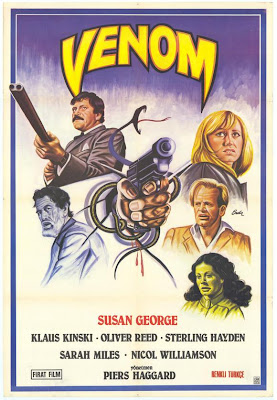
It’s difficult to know where to start with a movie like ‘Venom’. Let’s just say that if you’ve had a quick look at the poster reproduced above and you’re still reading this, rather than running straight to your preferred movie provider to locate a copy, you might be reading the wrong weblog.

I’m unfamiliar with the novel, by Alan Scholefield, from which this film was adapted, but I can only imagine it to be the absolute epitome of hilariously contrived, late ‘70s, post-Jaws airport potboilers. Did it have a black cover with the title outlined in giant, shiny silver letters and an airbrushed illustration of a rampant snake-head? Was it about 400 pages longer than it really needed to be? I have no idea, but by god, I would like to think so.

I don’t want to get bogged down in plot summarising, so let’s keep it simple and just state that this is indeed a film in which a trio of crooks played by Klaus Kinski, Oliver Reed and Susan George find themselves under siege by the police in a luxurious West London townhouse, with aged big game hunter Sterling Hayden and his chronically asthmatic, heir-to-a-colossal-fortune grandson as their hostages. By complete coincidence, the grandson has just come into possession of a new pet which, due to an innocent pet shop mix-up, turns out to be not the docile house snake he was promised, but – oh no! – a full size Black Mamba, most deadly poisonous snake in the entire world!

So yes, it’s Kinski and Reed vs the snake, vs the cops, and vs each other, with kid and grandpa (plus a late entrant in the form of Sarah Miles’ mild-mannered snake expert) stuck in the middle. Anything could happen, but it’s a fair bet it’s not gonna be pretty.
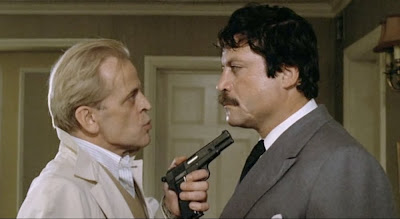

Initially entering production with Tobe Hooper as director, ‘Venom’ suffered a set-back when Hooper was either a)thrown off the project for being unmanageable and incompetent, or b)walked voluntarily after having his creativity intolerably compromised by the big-head producers and disobedient stars, depending on who you choose to believe. Either way, ‘Blood on Satan’s Claw’ director Piers Haggard took the reins mid-stream and, whilst he clearly doesn’t display much of the personal vision he brought to that film, he nonetheless delivers exactly what was required of him under the circumstances, streamlining the frankly ludicrous source material into an efficient, fast-moving thriller, whilst also coping with the unenviable task of having to put Kinski and Reed in a small room together and then tell them what to do all day long.

The essential who/what/wheres thus established (never mind the ‘why’s or we’ll be here all night), I think perhaps the best way to convey the many unique qualities of ‘Venom’ is via a quick list of bullet pointed items.

There will be spoilers, in case you’re bothered about that sort of thing.
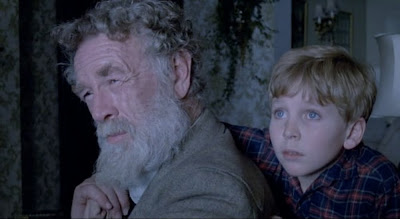

* Sterling Hayden IS Action-Grandpa! Hopping around in a moth-eaten cardigan and the most unflattering beard foisted upon a fading Hollywood star by the cruel British since Robert Mitchum in ‘The Secret Ceremony’, he’s far too “golly gee” to really convince as a retired colonial adventurer, coming across more like some twinkly-eyed old codger who’s accidentally wandered in from a live action Disney movie. But the set-piece scene where he’s forced to hunt the snake across a darkened living room armed only with table-lamp and a cushion is a lot of fun, the tension only slightly diminished by fact that continuity has clearly established that the snake has buggered off into the heating ducts by this point.
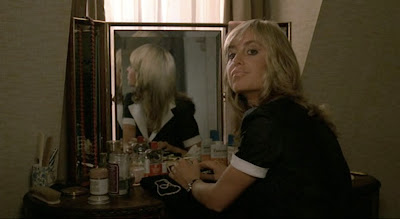

* Susan George is brilliantly duplicitous as the cockney maid who initiates the kidnapping plan, clearly planning to set her two lovers/accomplices at each other’s throats as soon as the opportunity presents itself. Unfortunately, one of the film’s major drawbacks comes from having her die far too soon, causing the vicious little Jim Thompson-esque love triangle that's been brewing to fizzle out before it’s ever really got going. I guess somebody needed to get whacked to demonstrate the gruesome effect of the snake’s venom, and she was just deemed the least essential character vis-a-vis the story’s plot dynamics. I wish they woulda killed that annoying kid instead, but then the crooks would have lost their hostage angle… or they coulda killed Grandpa, but then there’d be no sensible ‘good guy’ presence to lead the snake hunt. Stupid plot dynamics! Stupid good taste! What they should have done of course is written in some additional pointless flunky characters and killed them off. But they didn’t, so… no more Susan George. Curses!
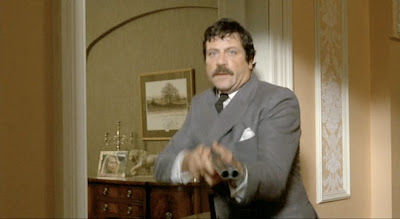

* It’s great watching Oliver Reed’s character making a b-line for the liqueur cabinet whenever things get tough – “I… I think I need a drink… yes, a DRINK.. a drink would help us all relax!” Whether this was part of the original story or just written in for Olly, who knows. This isn’t really the place for a cheap dig at Reed's alcoholism though, partly because that would be unnecessary and cruel, but also because he’s actually on pretty top form in 'Venom', delivering a characteristically barn-storming turn as a petty thug way out of his depth, desperately trying to keep his shit together. A stock character, but in Reed’s meaty hands his gradual collapse into panic and random violence is a pleasure to behold.
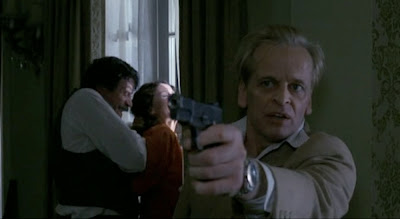

* Conversely, it’s safe to say Kinski probably didn’t invest a great deal of commitment in his work here, but at least he stays awake and delivers the lines, which is more than can be said for a lot of the exploitation pictures he made through the ‘70s. Basically he contents himself with just ‘doing the villain’, but as ever, he’s pretty great at it - seeing him curl his lip in disgust as he delivers his monotone ransom demands to the “poliiizeman” brings joy to my soul.
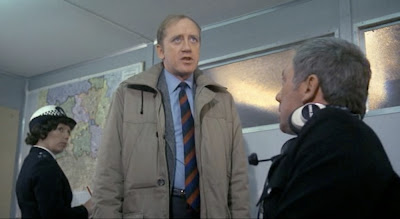

* The poliiizeman in question by the way is Nicol Williamson, toiling away just below the bigger names on the cast list as a character who seems like a genetically engineered prototype of every dour, no nonsense working class ‘70s British police detective ever. By turns he reminds me a bit of Robert Hardy in ‘Psychomania’, Alfred Marks in ‘Scream and Scream Again’, and the entire brood of stoney-faced functionaries who propped up Carter & Regan on ‘The Sweeney’. A perfect specimen, he’s armed with a full set of Scottish tough guy mannerisms, a dirty raincoat, a really ugly school tie, and he even enjoys the attentions of a weaselly aristocratic superior who pops up at inopportune moments to make disparaging remarks and ‘keep an eye’ on him.
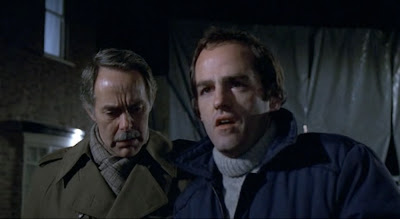

* There’s a great bit where Kinski throws a cigarbox from the window of the house, announcing it to be “..a geeft from doctor Shtowe”. Nicolson opens the box, hands it over to the others with a look of disgust. The other cops open it – close up of a severed finger wrapped in tissue paper, followed by reaction shots of their horror and surprise – you know the drill. Long, shocked silence as they try to form a response. Young policeman ventures; “they’ve cut her bloody finger off!” Laugh? Why, I nearly…
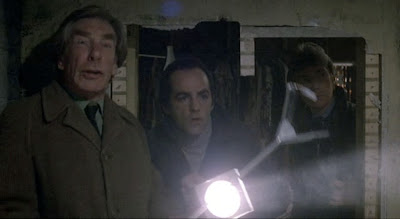

* A cameo from Michael Gough, playing real life London Zoo snake-handler David Ball, anyone..? Well, why not.
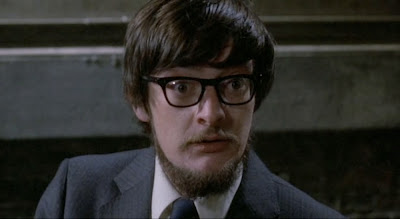

* This one guy!
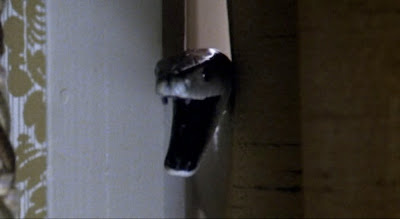


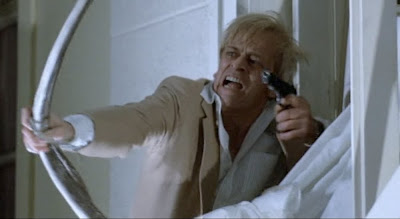
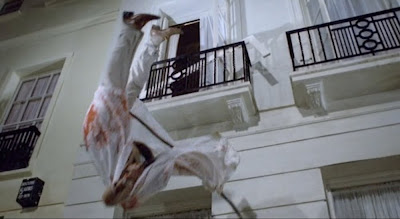
* Above all else though, ‘Venom’s sudden/violent finale is perhaps one of the most astounding sixty seconds of cinema I’ve seen in my entire life. I mean, for the love of god, we’re talking about Klaus Kinski, locked in deadly combat with a Black Mamba, plummeting to his death through a shattering balcony window, being riddled with police sniper bullets, as he succeeds in shooting the snake’s fucking head off a mere split-second before he hits the ground, narrowingly missing a set of cast iron railings.

Damn, if only they could have gone all the way and ended with the impalement, it would have perfect. Even so, watching this alone in my living room on a Sunday afternoon, I stood up and applauded. And to think, they gave Oscars to other films in 1981.

Smothered in Michael Kamen’s absurdly bombastic score, which makes the whole movie sound like Indiana Jones exploring a lost Babylonian tomb, ‘Venom’ is as spectacular a load of beserk, high-powered nonsense as could possibly be wished for. If you’ve read all the above and you’re still not rushing out to get a copy, well.. I fear there is no hope for you.

Tuesday, 18 January 2011

#2
Blood On Satan’s Claw
(Piers Haggard, 1971)


“Hail Behemoth, spirit of the dark, take thou my blood, my flesh, my skin and walk; Holy Behemoth, father of my life, speak now, come now, rise now from the forest, from the furrows, from the fields and live…”

Another one of those films whose reputation has slowly grown over the years, recent writings that mention “Blood on Satan’s Claw” (not to mention that recent BBC doc, which gave the film an applaudable amount of screentime) have tended to see the movie as the third side of a triangle of early ‘70s British ‘folk horror’ classics, alongside “The Wicker Man” and Michael Reeves’ “Witchfinder General”.

Whilst it is nice to see “..Satan’s Claw” getting some recognition, I would actually go further and declare it a greater achievement than either of those excellent films. Indeed, my enthusiasm for the movie grows with each viewing, to the extent that it currently gets my vote not only as the best British horror movie ever made, but as the kind of film against which every other horror movie should be judged. Bold claims there I realise, and in truth, each time I return to “..Satan’s Claw” I expect to be disappointed, thinking it can’t possibly live up to the expectations I’ve built around it, but each time my admiration just grows.

As with many of the more eccentric choices on this list, my love of the film probably stems more from the extent to which it appeals to *me*, than from any kind of objective ‘better-ness’, but still, when I watch “..Satan’s Claw”, I can’t help but think that whatever qualities one might be looking for from a horror film, this one ticks the boxes. It is intelligent, well directed, well written and beautifully shot. It is also violent, shocking, erotic and disturbing. It has a haunting atmosphere of heavy cultural/historical resonance, an amazing, unconventional score and a great, memorable cast. It is full of awesome occult imagery and ritualistic/psychedelic freakout potential, but also features engaging and unusual character relationships and plumbs uncomfortable psychological depths. For the less high-minded amongst us, it also features gratuitous naked witches and Patrick Wymark battling the devil with a gigantic claymore. I don’t know about you, but that just about makes a 100% hit rate for me.

Beyond the rather tenuous ‘folk horror’ tag, what Piers Haggard’s film really shares with “Wicker Man” and “Witchfinder..” is a certain seriousness of intent that immediately sets the three films apart from their contemporaries. As much as I love British horror from the ‘50s and ‘60s, it is probably accurate to say that the majority of writers and directors working in the field saw themselves at best as craftsmen delivering solid genre pictures, or at worst considered themselves to be ‘slumming’ in the widely derided horror/exploitation field. Reeves, Hardy and Haggard though were all younger men who, perhaps influenced by the increasing public interest in weird/occult shenanigans sparked off by the ‘60s counter-culture, did the unthinkable and took the subject matter of their horror films seriously, setting out to consciously avoid the gothic cliché and nod/wink good humour of Hammer et al, and investing their respective films with all the thought and earnestness and attention to detail more usually expected of an auteur-led arthouse film.

For all that though, two of those three directors still essentially emerged with a different kind of film, using the foundations of the British horror film industry to turn in a nihilistic historical drama and a strange metaphysical mystery film respectively, leaving Haggard the only contender to really turn his talents to the creation of some straight up supernatural horror.

And indeed, boiled down to a quick plot synopsis, “Blood on Satan’s Claw” is as conservative as “The Devil Rides Out” and as lurid as “Lust for a Vampire”, presenting sex and youthful rebellion as direct manifestations of Satanic evil, threatening a benevolent social status quo that can only be maintained through the intervention of a violently puritanical adult authority figure. There are several elements though that help make “..Satan’s Claw” a far more interesting and subversive work than such a summary would suggest.

Firstly, we have the gleeful pleasure Haggard takes in relentlessly pushing the envelope as regards the connections between sex and violence, and the conflicting reactions that can be generated in the target audience when said connection are taken beyond the realms of the comfortable. The film’s rape scene is of course pretty infamous, and the ghastly fate allotted poor old Wendy Padbury (familiar to 1971 UK viewers from TV soap ‘Crossroads’ and her role in the Patrick Troughton era Dr. Who) is strong medicine indeed for the relatively polite world of British film. The casting of such a recognisable actress, notable for her homely, helpless innocence, is a viciously unsettling decision by the filmmakers, and hard not to read on some level as a kind of cultural attack.

And this attack continues throughout, as the film delights in mixing eroticism with psychosis, never missing an opportunity to fuck with the hetero-male expectations of a ‘sexy horror film’. Perhaps the most astounding moment of such for me is the scene in which the rather furtive village doctor takes it upon himself to ‘cleanse’ Margaret, the captured member of Angel Blake’s cult, by surgically removing the ‘taint of Satan’ from her. Nobody much seems to talk about this scene, but I remember watching in absolute disbelief the sight of two stony-faced middle-aged men holding down a hysterical teenage girl, as the doctor tries to save her immortal soul by taking a straight razor and cutting away a suggestively shaped patch of thick, tumour-like hair and skin from her thigh. Such sickeningly imaginative imagery, carrying such a gruesome and obvious subtext, it seems to cut straight to the heart of the way a repressive religious upbringing can spark truly twisted horrors, making it’s point with a visceral power that would never have been seen in a ‘real world’ story dealing with such issues.

Secondly, and on a slightly more esoteric note, one of the keys to the film’s success I think is its portrayal of the ‘evil’ that overtakes the village’s children not as some simple demonic invasion of a god-fearing community, but rather as a completely natural, atavistic process. In “Blood on Satan’s Claw”, the land itself is evil – whether the mysterious bones lying in wait in a freshly ploughed field, or the verdant promiscuousness of the flowers in the meadows. Christianity is imposed upon this pagan landscape, not vice versa, and it can only be maintained through violence, self-denial and continual vigilance.

The demon, or devil, or whatever it is, literally rises out of the earth beneath the feet of the young people, using their natural energy and rebellious nature (not to mention their skin and hair) to pull itself back into the world and take on new form. On one level, this is a brilliant reflection of the way the fevered imaginings of the actual 17th century witchhunters served to create an incorporeal ‘evil’ in the public mind that proved just as destructive as any cloven hoofed ne’erdowell… but on another level, it can simply be read as the most bloodcurdling metaphor for the perils of puberty ever devised.

Beyond all this though, what you’ll remember about “Blood on Satan’s Claw” are the individual moments and oddly persuasive details that live on in the memory after viewing…

• The indescribable look on Tamara Ustinov’s character’s face when they drag her down from the attic – actually sends a shiver down my spine.

• The attention given to the landscape throughout, and the amazing cinematography of (no sniggering at the back please) Dick Bush - the way the dead, disembodied eye rising from the soil looks no less natural than the foreboding shots of ravens and branches that begin the film.

• The handful strange, older people who appear out of nowhere join the demonic children in their rituals, with no explanation asked or received… they seem to emerge from the woods as some kind of ‘outcasts’ from the regular, Christian community, happy to see the ‘old ways’ revived… a strange and chilling touch.

• Patrick Wymark as the Judge! I love the horror movie stand-by of the learned gentleman who initially scoffs at any suggestion of the supernatural… then sees something that changes his mind and immediately becomes deathly serious and starts busting out the grimoires and holy artefacts. (Also see Peter Cushing in “Dracula”, Andre Morell in “Plague of the Zombies”, etc.) You know that that guy means business, and indeed, Wymark’s Judge can be seen as the horror genre’s pre-eminent exponent of NOT FUCKING AROUND.

• Every single damn thing about Linda Hayden’s portrayal of Angel Blake, even the eye make-up – no explanation needed.

And, well, I could go on…

Appropriate to its theatrical title, “Blood on Satan’s Claw” is a rare kind of horror movie in the fact that all its horrors seem to rise unheeded from nature itself: red in tooth and claw.