Showing posts with label monsters. Show all posts

Sunday, 13 October 2024

October Horrors # 6:
Jaani Dushman
(Rajkumar Kohli, 1979)

Whilst watching this intermittently delightful Bollywood werewolf movie, I was under the impression that what I was witnessing here was a precursor to the definitive mode of masala horror film which the Ramsay Brothers would go on to perfect in their work through the ‘80s and early ‘90s.

I’ve only subsequently realised however that, in making that assumption, my chronology was actually a bit off. In fact, the Ramsays’ first successful horror film, ‘Darwaza’, came out in 1978, meaning that, in all likelihood, ‘Jaani Dushman’ [which translates as something like ‘Beloved Enemy’, if anyone’s bothered] took its inspiration from the surprise popularity of that film - which actually makes a lot of sense, in view of the way that this one awkwardly crow-bars horror/monster elements into the storyline of what would presumably otherwise have been a standard rural / romantic melodrama.*

Certainly, the horror material here has a very Ramsays-esque feel to it, as the werewolf (think Universal-style facial make up, ingeniously combined with a Fozzy Bear-style ‘furry jump suit’ body) terrorises a remote mountain village, snatching red-robed brides from within the curtained palanquins in which they are carried during their traditional bridal procession. Spiriting them away to a dry ice-strewn subterranean temple, he then gets busy menacing them with his claws, and generally charges around freaking out and so forth, surrounded by ornate stone columns and randomly scattered bones.

During the film’s opening sequence, a honeymooning couple travelling through the dark, dark woods in a broken down taxi end up sheltering in a derelict mansion. Therein, the ghost of a deceased nobleman appears, and helpfully fills them in on how he was possessed by the demon spirit which transformed him into the Wolfman, forcing him to murder his unfaithful wife in the aforementioned subterranean temple on their wedding day, or some such. None of which will obtain any relevance to the rest of the film’s narrative for a very, very long time, but nonetheless - it all feels like quintessential Ramsay Bros type business, that’s for damn sure.

Not that Rajkumar Kohli and his colleagues really manage to summon much of the overloaded atmosphere or bombast of the fully-fledged Ramsays productions, sad to say, but they more than make up for it with sheer gusto during ‘Jaani Dushman’s horror scenes, employing a range of lo-fi, in-camera special effects - most notably, primitive matte shots to create the illusion of the Wolfman’s head rotating 360 degrees, ‘Exorcist’-style, along with some absolutely adorable model work, used to depict people and horses jumping across chasms or plummeting off cliffs.

The movie’s finale, wherein our dashing hero (Sunil Dutt), the film’s now-reformed human bad guy (Shatrughan Sinha) and, uh, some other dude, team up to take on the werewolf in an extended tag-team throw down, is also exceptionally good fun - especially once our heroes get some swinging chains on the go, whilst the Wolfman begins trying to crush them by throwing gigantic stone pillars, accompanied by frequent cutaways to Sinha’s kidnapped bride shrieking in highly theatrical terror. Terrific stuff.

Unfortunately however, whereas the Ramsays were proud and unashamed monster-mongers, devoting probably around 60%-70% of the screen-time in their movies to horror, the producers of ‘Jaani Dushman’ seem to have been far more reticent about adopting the tropes of what, up to this point, had been a universally scorned and despised genre within the Indian film industry.

As such, everything I’ve described above comprises at most 40 minutes of the film’s 155 minute run time - the opening plus the conclusion, essentially. Between which, two further hours stretch out, utterly devoid of any reminder that we’re watching a horror movie.

Thankfully from my own POV, there are few things I enjoy more in life than kicking back with a ‘70s Bollywood movie on a rainy afternoon, so, even though this probably rates as second tier masala stuff at best, I still had a pretty good time with it, even though I swiftly found myself losing track of who was supposed to be marrying who, and who was whose brother, or sister, and so on.

So, within these sprawling, werewolf-free hours, we find many under-cranked scenes of people charging around beautiful mountain landscapes on white stallions, many massed brawls and several exciting tests of masculine strength for our hero and his cad-ish, spoiled-son-of-the-local-aristocrat love rival.

There is also an enjoyable sub-plot at one point about a female character whose painted-on moustache apparently convinces everyone she’s a young man, until she gets trapped in a pit with a deadly cobra, and must reveal her true feminine identity. 

And meanwhile, all of the more lady-like ladies look absolutely stunning in their brightly-hued formal / bridal finery and ceremonial jewellery, imbuing the film with an almost psychedelic overload of visual stimuli in places.

(A special shout-out is due here to Sarika Thakur, playing the lower caste orphan girl rescued from rape by Sinha’s aforementioned spoiled brat character, who has a great take-no-shit attitude, and really shines during the dance sequences.)

Speaking of which, Laxmikant-Pyarelal’s musical score for ‘Jaani Dushman’ is… fairly traditional, I would say, largely eschewing the raging synthesizers, disco beats, electric guitars and crazy echo effects which began to make Bollywood music so awesome around this period - as befits the film’s vaguely delineated historical setting, I suppose. The songs are all quite nice though, the staging of the dance routines is as splendid as you’d hope for, and with Lata [Mangeshkar], Asha [Bhosle] and Mohammad Rafi all present and correct on playback duty, who’s complaining?

Well - horror fans with less tolerance than myself for random Bollywood shtick, that’s who. In fact, they will be complaining like fuck by the time we reach the ninety-minute mark with no further werewolf action on the horizon, and they will find little to salve their woes for a good long while thereafter.

So, whilst I would never condone such a wholesale dismissal of one of the world’s most vital and unique pop cinema cultures, I will at least quietly advise more single-minded monster kids in the audience that, if your sole interest here lays in seeing a Bollywood werewolf in action, well - watch the first half hour of ‘Jaani Dushman’, then skip to the final half hour. Nothing that happens in-between was meant for you.

Consumer guide note: I watched ‘Jaani Dushman’ via a DVD put out by the Italian Filmotronik label, purchased in the UK from Strange Vice. It’s a very soft-looking SD transfer with occasional print damage, but thoroughly watchable, with nice colours, and a definite step up from bootleg quality. The film appears to be properly licenced, and the English subtitles are excellent (including translations of the song lyrics, which I always enjoy), so buy with confidence.

And meanwhile, check out this amazing range of artwork I managed to google up for the film:

---

* Whilst saying this, I am of course aware that Rajkumar Kohli had already directed an earlier horror film, ‘Nagin’ (1976), which I’ve not yet had a chance to see. Reading around it however suggests that it is likely a rather different kettle of fish to the bloody, monster-centric movies ushered in by ‘Darwaza’ and ‘Jaani Dushman’, so for now I’ll stick by my contention that the former likely influenced the latter.

Saturday, 5 October 2024

October Horrors #2:
X… The Unknown

(Leslie Norman, 1956)

One strand I want to try to work into my horror marathon this October involves filling in a few gaps re: films I really should have seen by now, but for some reason have not.

Given that I’m a big fan of both Hammer Films and eccentric, black & white British sci-fi movies more generally, the awkwardly titled ‘X… The Unknown’, Hammer’s immediate follow up to the success of ‘The Quatermass Xperiment’ a year previously, and the very first scripting credit from Jimmy Sangster, certainly fits the bill.

Essentially dealing with the travails of a giant, sentient oil slick from the centre of the earth as it rampages around some less picturesque areas of Scottish highlands eating radioactivity (and people), Sangster’s story is an admirably straight-down-the-line, bullshit-free exemplar of a ‘50s radioactive monster movie, but one which still, somehow, remains curiously compelling, touching at least in passing on the kind of Big Ideas and weird thematic resonances which Nigel Kneale reliably brought to his Quatermass stories.

By and large though, the feel of the movie is… dour in the extreme, reminding me somewhat of other military-focussed British films like Cliff Owen’s ‘A Prize of Arms’ (1962), whilst also pre-figuring the ‘Doomwatch’ franchise of the early ‘70s via its emphasis on lengthy scenes featuring blokes in great-coats stomping about in the frozen mud, poking patches of oil, taking Geiger counter reading and talking about science, whilst bored squaddies hang around in the cold awaiting orders. Grim weather, military manners, very few smiles, and no female characters whatsoever.*

A bit less of this kind of thing and a bit more excitement might have livened things up during the first half of the picture, but nonetheless, it’s all very well made (much as you’d expect of a Hammer production of this vintage) and moves at a fair old clip, with a varied and interesting cast (including such notables as Leo McKern, Anthony Newley and - of course - Michael Ripper) all doing good work re: keeping the audience engaged. It’s also worth mentioning meanwhile that, as the token American ‘star’, the bumbling, softly spoken Dean Jagger proves a vastly more likeable and convincing presence than Brian Donlevy did in the Quatermass movies.

The shock / horror scenes, when they eventually arrive meanwhile, are pretty great too. There are some really cool effects, and the black, amorphous crawling creature is genuinely quite unnerving - a totally alien presence, not so far removed from the kind of thing which might have slurped its way up from the depths of some ancient, pre-human vault at the end of a Lovecraft tale.

In fact, it is the few brief moments in ‘X… The Unknown’ which veer into gothic horror territory, splitting the difference between a scientific and occult threat, which prove to be by far the most memorable. 

For all the nuts n’ bolts SF logic of Sangster’s writing, it’s difficult not to feel that some weird, atavistic race memory has been unleashed, as we see the residents of a remote Scottish village cowering for protection in a cold, stone church as an evil, nameless menace which has literally crawled up from the depths of Hades slimes its way through the misty graveyard outside, demolishing the pretty dry stone walls, and narrowly missing an errant toddler who is pulled to safety at the last moment by the heroic vicar.

Great stuff, needless to say, and hey, check out this amazing Japanese poster I found (featuring a far cuter monster, apparently sourced from a different movie altogether, but never mind).


--


* Ok, precisely speaking, I realise there’s a nurse who turns up at one point and has about five lines, and there’s the mother of a boy who’s killed by the monster, and some old dears being hustled into the church by the vicar… but we’re pretty much looking at an all-male affair here, perhaps reflective of the same awkwardness / inability to find things for women to do which later became a hallmark of Sangster’s gothic horror scripts?

Tuesday, 10 October 2023

Horror Express:
The Angry Black Girl and Her Monster
(Bonami J. Story, 2023)

So, yes, a word on the title. It’s a bit ‘on the nose’, isn’t it? Could probably stand to lose the ‘angry’ at least... not that I wish to question the character’s anger, you understand, but it just seems unnecessary to cram such descriptors into the title, and it would scan better without it. Also, then maybe they could’ve made it a reference to Bernard Shaw’s ‘The Black Girl in Search of God’ or something instead, who knows? (One for the kids there!)

Anyway - at first, I wasn’t really down with the movie the title is attached to either. In fact, through the opening half hour I was getting ready to give it to stern a lecture about how I’m all for genre movies exploring socio-political issues, but how it tends to work better when they naturally arise from the genre elements. Whereas, this seems to have approached things the other way around, presenting a well-intentioned but dispiritingly one-dimensional take on systemic racism, drugs, police brutality and social inequality (all of which are bad, dontcha know), with a featherweight take on the Frankenstein mythos overlaid on top.

Meanwhile, any narrative tension seemed liable to be nullified by the presence of a central character - Vicaria, played by Laya DeLeon Hayes - who appeared to be destined to spend the film being smarter than everyone else, right about everything all the time, and generally morally unimpeachable / intellectually undefeatable.

In particular, I just didn’t buy Vicaria’s whole “death is a curable disease” shtick as a message which is in any way positive or helpful for those dealing with grief - which is a problem, given that it’s the single rhetorical device upon which most of Bomani J. Story’s script rests. And, similarly, I found the decision to open the film with a succession of close up, slo mo familial deaths to be not so much harrowing (as was presumably intended), but simply emotionally manipulative, establishing a tone of grim self-seriousness which proves hard to shake through the opening act.

Thankfully though, I also felt that the film becomes a lot more interesting as it goes along, really kicking into gear during the second half, and winning me over in the process.

Though Story clearly has no interest whatsoever in delivering the all-black-cast version of ‘Reanimator’ or ‘Monster on Campus’ I suppose I was vaguely hoping for, he does give us a surprisingly faithful reinterpretation of ‘Frankenstein’, as taken straight from the novel, concentrating in particular upon the rarely filmed trope of the creator abandoning and losing track of his/her monster immediately after creating it, only to become engaged with its plight once it returns to threaten his/her loved ones.

Towering in the darkness, its face hidden by dangling, blood-caked dreads and a voluminous hoodie, Vicaria’s ‘monster’ (a reconstituted version of her brother Chris, who was slain in a gang shooting during the opening) proves a pretty menacing and memorable creation, capable of dishing out some reassuringly gruesome ultra-violence at various points in the film. (Although, the attempt to humanise him through the use of a generic, distorted ‘monster voice’ falls rather flat, it must be said.)

Once the monster is on the scene though, the film as a whole becomes more intense, more chaotic and more convincing across the board, questioning our heroine’s motives and means in appropriately Frankensteinian fashion, and incorporating enough moral ambiguity and emotional turbulence to more than justify its existence.

An improv-heavy set of performances from the supporting cast very much helps in this regard, as characters who initially seemed pretty one-note are allowed to come into their own and acquire some depth, lending a sense of authenticity to the avowedly realist setting, and achieving some genuinely powerful moments here and there.

A particular shout out in this regard must go out to Chad L. Coleman, playing Vicaria’s father, who, to not put too fine a point on it, is fucking brilliant. As a broken man struggling to keep it together in the face of grief and substance abuse, he has pathos to burn, and in the (sadly too few) scenes when he’s on screen, the movie really takes flight in dramatic terms.

In fact, it is Coleman who carries the weight of the movie’s most cathartic moment, when he stands his ground and refuses to unlock his surrogate family’s front door for the police who are outside carrying out a door-to-door search.

Amidst all the wide-ranging political point-making and generalised rage at the state of contemporary America crammed into Story’s script, it is this tangential detail, conveyed through Coleman’s all-too-convincing fear and determination, which perhaps made the deepest impression on me, prompting me to reflect on the sobering reality of the fact that, although the family in this case have nothing to hide from the law, black people in the USA (and by extension, members of similarly marginalised communities across the globe) have nothing to gain from allowing armed cops access to their living space, but a hell of a lot to lose.

Elsewhere, Denzel Whitaker is also very good as the housing project’s resident drug dealer, blurring our sympathies as he’s revealed to be just another frightened, overgrown kid once the threat from the monster takes hold, and delivering some of the film’s very few genuine laughs in the process. Child actor Amani Summer meanwhile does great work too, in one of the more interesting portrayals of the obligatory “little girl who befriends the monster” character I can recall seeing in Frankensteinian cinema.

Whilst avoiding spoilers, I’ll conclude simply by noting that the ending of ‘The Angry Black Girl and Her Monster’ is… significantly different from that of a standard Frankenstein narrative, let’s put it that way. By the time we get there though, it feels as if the film (and the characters) have earned it.

Saturday, 22 July 2023

Horror Express:
Verotika
(Glenn Danzig, 2019)

Say what you like about Glenn Danzig’s widely derided feature debut as writer/director/composer/co-cinematographer, which I finally persuaded myself to get around to watching last week - it’s a remarkable achievement in at least one respect.

Specifically, I’m referring to fact that, despite having been a successful musician and public figure for at least forty years at the time of this film’s production, Danzig still managed to create a movie exactly like the one a horny sixteen-year-old goth kid would probably have made, given access to the same resources.

Whatever your thoughts on the result of his efforts, his refusal to countenance any form of maturity whatsoever here is genuinely quite extraordinary, arguably making ‘Verotika’ the most purely (accidentally?) punk rock thing he has been associated with since Robo quit as The Misfits drummer in 1983.

Unfortunately however, simply being a contender for the most adolescent film ever directed by a sixty-four year old man does not necessarily mean ‘Verotika’ is worth watching. Indeed, for anyone lacking either a pre-existing interest in its creator’s oft-questionable oeuvre or a very indulgent attitude toward low budget 21st century horror, I’d recommend a hard pass.

As much as I’d love to defy critical consensus and declare this an unappreciated masterpiece, the sad truth is that, by any reasonable yardstick, ‘Verotika’ is an extremely bad film in pretty much every respect; indifferently directed, cheaply staged, sketchily scripted (to put it kindly), thoughtlessly misogynistic, entirely devoid of originality and filled with dead-eyed non-performances from a cast seemingly comprised of aspirant fetish models and porn stars. (1)

To paraphrase Chris Morris, we’re looking here at a crass, ugly and deeply stupid work, and yet.... what kind of horror/exploitation fan would I be if I couldn’t find something perversely captivating in the midst of this lumbering, irredeemable mess of nonsense?

Though it is not remotely as significant or enjoyable, ‘Verotika’ still, to some extent, captures the same mixture of gleeful nastiness and utter weirdness which helps make the early Misfits material so extraordinary. For all its faults, it bears the same gory signature of an artist whose brain-damaged concerns have (perhaps worryingly) remained remarkably consistent across five decades of creative output.

To run down a few elements of the ‘weirdness’ part of that equation, I’ve firstly got to commend Danzig’s refusal to adhere to the narrative conventions which usually govern the EC-via-Amicus anthology framework he has chosen to work within here.

The idea that segments within a horror anthology should consist of concisely rendered cautionary tales with a circular/twist ending goes completely out the window form the outset, but… in a way, I appreciated the open-endedness of this. 

 I mean, let’s just take the first story here - ‘The Albino Spider of Dajette’ - and admit that I have no idea why the aspirant fetish model with eyeballs where her nipples should be (played by Ashley Wisdom) gets victimised by an anthropomorphic spider monster which manifests itself whilst she is asleep, and proceeds to rape and murder women.

And if there is ultimately no connection at all between the eyeballs-for-nipples thing and the spider-monster thing, well… why not? That’s life, right? Here’s this poor girl, just tryin’ to get through life with her freakish eye-boobs, and today, she’s having an especially hard time of it, vis-a-vis the whole aforementioned spider-monster situation. There’s no moral pay-off, no clever resolution, no lessons learned - fuck you, O.Henry! It’s actually quite refreshing.

(Of course, I didn’t realise at this point in my viewing that I was actually watching by far the most well-developed of the film’s three segments, but… we’ll get back to that soon enough.)

More mystifying - as one or two commentators have noted - is Danzig’s inexplicable decision to have the cast of this first story deliver their lines in ersatz French accents.

If the intention here was to lend the film a sense of continental exoticism, I’m afraid it's rather undercut by the fact that ‘Verotika’ otherwise remains as all-American as a burger van parked outside a Sunset Boulevard strip joint. And, given that few of the performers appear to have much prior acting experience, and seem to have been informed about the whole accent thing about sixty seconds before shooting began.... well, you can imagine the range of out-rrrageous ac-CENTS we’re treated to here.

(My favourite must be the waiter who advises our heroine to hurry home before she falls victim to “zee neck brea-CURR”.)

Were it not for Danzig’s total devotion to the gospel of low-brow / trash culture, I’d be tempted to speculate that he intended this French accent thing as a kind of Brechtian disassociation technique - like Werner Herzog using hypnotised actors in ‘Heart of Glass’, but far more entertaining. But no. There is no way a man as steadfast in his aesthetic beliefs as Glenn Danzig would countenance such pretentious/abstract bullshit.

Indeed, the most incredible thing about all this is that he is entirely sincere, but… we’ll return to that train of thought later, because unfortunately we still need to address the film’s two remaining stories. 


So, sadly, the weird charm of the eyes-for-nipples/spider-monster business is entirely jettisoned in the second ‘tale’ presented here. A paper-thin item about a stripper with a mildly burned face (Rachel Alig) murdering and stealing the faces of other strippers, this one largely just serves as an excuse for what feels like hours of dispiriting bump n’ grind strip club footage, accompanied by a succession of mediocre stoner rock tracks.

Disappointingly, it also drops the French accents, but is notable for those of us charting ‘Verotika’s divergence from horror anthology tradition in that it doesn’t even attempt to have an ending. It basically just sets up its premise, and… stops? C’mon Glenn, give us something!

The third story, ‘Drujika: Countess of Blood’, certainly gives us… something… in that it’s a period-set Countess Bathory type affair. The attempt at a medieval setting is fairly ambitious under the circumstances, including use of actual horses, some limited location shooting and - get this! - a real wolf (albeit a not terribly threatening one).

But, on the other hand, you know we’re in trouble as soon as you note that the green-screened panoramic photo backdrop depicting the Contessa’s castle includes clouds of unmoving, still photographed smoke. Mario Bava, this ain’t.

With her spiked crown, latex fetish gloves and habit of staring contemplatively at bunches of grapes, the Contessa (played by Alice Tate) takes us straight into full-on Nigel Wingrove territory, somewhat reminiscent of those dreadful Redemption video promos we all had to sit through back in the bad old days every time we wanted to watch a Jean Rollin film.

Probably the film’s most overtly erotic segment, this one also finds Danzig indulging in some pretty shameless ‘chained virgin’ type fantasies. Perhaps he was going for a vague Borowcyzk / ‘Immoral Tales’ kind of vibe, though the faint Eastern European accents adopted by the cast aren’t as funny as the French ones, and again, the intended effect is rather spoiled by the arid, atmos-free L.A. porno feel, which hangs around the footage like disinfectant in a hospital ward.

Unfortunately, this also proves to be the film’s most boring segment - because, above all I think, what kills ‘Verotika’s chances in the midnight movie / so-bad-its-good stakes is actually its pacing.

Like so many amateur / first time filmmakers, Danzig just cannot cut his stuff for shit, stretching out most shots at least a few beats too long, and the concluding story finds him expanding this lethargic approach to a frankly quite trying degree, as he subjects us to several extended, silent medium-close ups of the Contessa bathing in blood or gazing at herself in the mirror which just seem to go on forever, seriously challenging the wakefulness of any late-night viewers who have proved hardy enough to stick with the movie thus far.

As expected by this point, there’s also pretty much no narrative here at all - just the blood-bathing Contessa going about her virgin-slaying day-to-day in more or less the manner you’d expect.

There is a certain audacity to the bit where she manages to begin fondling and eating a girl’s extracted heart whilst it remains beating and attached to the victim’s blood vessels, but the impact is deflated by the absurdly realised special effects, including the use of a heart prop whose size seems closer to that of an organ belonging to a large mammal than that of a human being. 

But, it matters not. Only an utter goon would demand realism in a context like this, and besides, to return to the point I touched on above, ‘Verotika’s sole saving grace - the unique component that allows this otherwise terrible film to cycle back round and grasp at something approaching warped greatness - is that Danzig is utterly sincere in his intent to make a sexy, gory erotic horror movie.

Unbelievable as it may sound in view of what I’ve outlined above, there is not an ounce of self-mockery or camp intent discernible here. Given how rare this total absence of self-awareness is in any creative industry these days, maybe we should take a moment or two just to think about that - to let it sink in.

Like the aforementioned goth kid sitting in the corner of the classroom, scribbling drawings of women who look like Death from ‘Sandman’ fucking bat-winged demons, Danzig believes his half-baked cartoon atrocities are transgressive and shocking, and that if you don't like it, you just can't handle his dark vision.

Given how few of us can make it to adulthood whilst retaining such knuckleheaded naivety - let alone preserve it through the rigors of adult life - isn’t that, in itself, a beautiful thing?

Or, to put it another way, I’d rather sit through ‘Verotika’ a million times than read a page of Morrissey’s stupid novel.

Saner voices may contend that neither option is compulsory, but saner voices have no place in this discourse. For as the man of the hour himself once sang, “possession of a mind is a terrible thing..”.

 --

(1)As it seems ungallant to let a statement like that stand without unpacking it a bit, here are the results of my IMDB-based research into ‘Verotika’s cast. So, we do indeed have several porn stars (primarily Ashley Wisom), along with a large number of people who have very few IMDB credits aside from this one (so who knows what they normally do all day), and a few legit actors.

Surprisingly, probably the most noteworthy person in the cast is actually the one with the silliest name, Kansas Bowling, who it turns out has won considerable acclaim as a director of music videos (working with Iggy Pop amongst others) and played a small role as one of the Mansonites in Tarantino’s Once Upon a Time in Hollywood. As one of the Contessa’s victims in ‘Verotika’, she is assigned the thankless task of remaining dead and topless through several very long scenes.

Saturday, 6 November 2021

Pre-War Thrills:
Dark Eyes of London
(Walter Summers, 1939)

Until recently, I’d tended to accept the received wisdom that the few, scattered, horror films made in the UK during the 1930s were pretty creaky and timid affairs, their ambition stymied both by the era’s censorious climate and by the British film industry’s steadfast refusal to treat the nascent genre with anything approaching acknowledgement or respect.

Like viral infection or rock n’ roll though, horror will always find a way, and as such, I was pleasantly surprised to discover that, rather than the mere historical curiosity I was expecting, ‘Dark Eyes of London’, shot in the less than palatial surroundings of Welwyn Garden City over eleven days in April 1939, is actually pretty damned great.

Headlined by imported star Bela Lugosi - who seemingly undertook a journey across the Atlantic by ship solely to appear in the film - this adaptation of Edgar Wallace’s 1924 novel is in fact fairly strong stuff for its era, conveying a morbid, decidedly unsavoury atmosphere and including some moments of sadism grim enough to provoke comment even in the more open-minded United States (where the film played in 1940 as ‘The Human Monster’, having been picked up for distribution by Lugosi’s regular employers at Monogram).

Whilst the film’s violence never reaches a level which viewers alive today would deem ‘graphic’, there is a certain, base level nastiness to the depredations of Lugosi’s villainous Dr Orloff which remain disturbing. From the steel water tank in which it is implied the good doctor drowns his victims before dumping them, pre-deceased, into the Thames, to the scene in which he uses an electrical current to deafen a bed-ridden, blind-mute beggar, there is some nasty business going on here and no mistake.

In view of all this, it difficult to believe the film was produced at all, given that the UK’s censors had effectively banned all horror films just four years earlier, having thrown their toys out of the proverbial pram when confronted with the comic book excesses of Universal’s ‘The Raven’ (Lew Landers, 1935). I’d certainly be interested to learn how ‘Dark Eyes..’s domestic release played out under such circumstances, although it was, I note, the first film to be awarded the short-lived “H” (for “horror”) classification by the BBFC, meaning that persons under sixteen would theoretically be refused admittance.

It is telling that, between 1939 and 1950, when the ‘H’ certificate was more or less phased out in favour of the more iconic ‘X’, only one other domestic production achieved the dubious distinction of being “rated H” (Ivan Barnett’s little seen 1950 take on ‘The Fall of the House of Usher’). Instead, the dreaded ‘H’ was reserved exclusively for imported American horror pictures, leading me to surmise that its introduction in 1939 must have reflected the censor caving in to pressure from representatives of the American studios, particularly Universal, who had of course returned to making horror films in earnest at around the same time, and presumably needed a way to get their product onto UK screens. Beyond noting the unique position in which this leaves ‘Dark Eyes of London’ though, perhaps that’s a subject best left for another day.

It is possible, I suppose, that ‘Dark Eyes..’ journey to the screen may have been further aided by the fact that it sprung from the pen of a phenomenally popular, household name author, celebrated (if not exactly respected) for his mystery and crime - as opposed to horror - fiction.

Indeed, for all its unpleasantness, the movie is framed as a police procedural rather than a gothic horror, with the approach taken by director/co-screenwriter Walter Summers reminding me, not so much of the Universal-derived horror you might have expected from a production which went to trouble of luring Bela Lugosi across an ocean, but of Alfred Hitchcock’s then-recent series of ground-breaking contemporary thrillers.

In particular, 1934’s ‘The Man Who Knew Too Much’ shares this film’s down-at-heel East London setting, its diabolical Hungarian-accented villain, and even the idea of a charitable/religious institute being used as a front for criminal activity. More importantly though, ‘Dark Eyes..’, like Hitchcock’s British films, has the decency to remain fast-paced, modernistic and ingeniously plotted, imbuing its convoluted storyline with a strong, character-driven through-line to keep us hooked.

Along the way, Summers (along with co-writers Patrick Kirwen and producer John Argyle) give us plenty of interesting diversions, good-natured banter and running gags to break the tension / ghoulishness, and, whilst it’s probably fair to say that Summers lacks the touch of mastery we’d routinely assign to Hitch, the film is nonetheless very nicely done, with solid performances across the board and some impressively detailed production design, making for a rather charming, neatly turned out entertainment whose incongruously breezy tone must have further eased the censor’s worries.

For those who are neither keen readers of Edgar Wallace nor familiar with Alfred Vohrer’s excellent early ‘60s German quasi-remake of this film (of which more below), the plot of ‘Dark Eyes..’ concerns a number of suspicious corpses fished out of the Thames, all of whom turn out to have been customers of the Greenwich Insurance Company - a small-time outfit operated by one Dr Orloff, a seemingly kindly and well-meaning fellow with - AHEM - a murky past as a disgraced medical researcher, who also maintains close connections to The Dearborn Institute, a Limehouse-based home for the blind operated by his - AHEM - close personal friend, the sightless Rev John Dearborn.

As well he might, dashing young Inspector Holt of the Yard (a brisk and likeable Hugh Williams) smells a rat, and, given that Dr Orloff is clearly guilty as sin from the outset, the film’s subsequent ‘mystery’ largely consists of mapping out the precise size and shape of that rat. Less of a ‘whodunnit’ then, and more of a ‘what in god’s name is he doing!?’, if you will.

Of course, further complications arise across the film’s 76 minutes of densely-packed plottin’ and chattin’, not least the introduction of Norwegian actress Greta Gynt, providing a surprisingly strong and self-sufficient heroine as the daughter of one of Orloff’s earlier victims.

In this telling of the tale, Inspector Holt is also accompanied - presumably for reasons of transatlantic sales potential - by a hard-boiled, gun-toting Chicago cop - played for laughs by Edmun Brian - who is sticking around after delivering an extradited convict in order to learn something of Scotland Yard’s rather more genteel methods. It’s a testament to the film’s overall quality however that, rather than functioning as an insufferable comic relief goon, Brian is actually quite an appealing presence. Providing an effective foil for Holt, he even manages to achieve a few unforced laughs here and there, allowing the film to pioneer the ‘chills n’ chuckles’ formula which would later be repeatedly taken to the bank by Rialto Film’s post-war Wallace adaptations in West Germany. [Please consult the Krimi Casebook for further details.]

Jess Franco fans in the audience will no doubt be gesturing frantically and jumping up and down by this point, so yes, let’s briefly pause to acknowledge the fact that, given that the name ‘Orloff’ does not appear in Wallace’s source novel, Uncle Jess clearly must have been very fond of this movie, given the many and varied Dr Orloffs who abound throughout his mammoth filmography, beginning, of course, with Howard Vernon’s memorable portrayal in 1962’s The Awful Dr Orlof [sic].

Technically I suppose, this makes ‘Dark Eyes of London’ the inaugural entry in the Orloff saga, a loose accumulation of cinematic oddities which went on to include not only Franco’s numerous reiterations of the character, but also such mind-boggling spin-offs as Pierre Chevalier’s ‘Orloff Against The Invisible Man’ (1970) and Santos Alcocer’s ‘El Enigma del Ataúd’ aka ‘Les Orgies du Docteur Orloff’ (1967). (1)

As such, Euro-horror fans may wish to pause to consider the fact that the screen’s very first Dr Orloff was in fact embodied by no less a personage than Bela Lugosi - and a pretty bang up job he does of it too, I must say. Gifted with a more ambiguous and multi-faceted role than he was generally called upon to play in Hollywood, and with his confidence presumably buoyed by both his top-billed status and (we must assume) a level of respect and financial recompense commensurate with his talents, Lugosi actually delivers what I’m inclined to consider one of the very best performances of his career here.

Though Lugosi clearly makes little effort to try to convince the audience of the innocence his scripted character pleads during the film’s early scenes, he instead builds Orloff into an exquisitely loathsome, duplicitous, scene-stealing villain, the like of which old Bela was born to play, but so rarely actually did. The way he can switch from acting the soft-spoken philanthropist one moment to turning on his EVIL STARE and revealing himself as a diabolical mesmerist the next is truly remarkable.

Rivalling Lugosi’s hold over the imagination of the movie’s original viewers meanwhile is the more literally monstrous figure of ‘Jake’ (played here by Wilfrid Walter), the hulking, blind stooge whom Orloff uses to carry out his dirty work (somewhat pre-empting the character of Morpho in Franco’s Dr Orloff films).

Monogram’s publicity materials and re-titling certainly made Jake the star of the show upon the film’s American release, and, although the character was portrayed in more naturalistic, and more terrifying, fashion as ‘Blind Jack’ (Addy Berber) in Alfred Vohrer’s Die Toten Augen von London (‘The Dead Eyes of London’, 1961), Walter makes an impression here nonetheless; if not for his acting, then at least for the absolutely extraordinary make up job achieved by the film’s technicians.

Framing this unfortunate brute as a full-on monster, complete with pointed ears, protruding jaw and bulbous, orc-like fangs, Jake’s utterly fantastical visage provides another wonderfully diversion from the stultifying rules of ‘good taste’ which confined the ambition of so much British cinema in this era.

Speaking of Vohrer’s film meanwhile, that’s certainly another matter we’ve got to discuss here. Going into ‘Dark Eyes..’, I was worried that that it might pale in comparison to the more stylish, more sensational quasi-remake which hit screens over two decades later. And indeed, there is a lot of crossover between the two films, with at least some scenes and visual motifs in ‘Dead Eyes..’ appearing to directly recreate material first seen here. But, there are also enough differences between the two in terms of character and storytelling for them to avoid treading on each other’s toes too much, allowing them to co-exist as equally enjoyable alternate versions of the same tale.

As is extensively discussed by Kim Newman and Stephen Jones on the special features accompanying Network’s new blu-ray edition of the movie, ‘Dark Eyes of London’ feels in many ways like a bit of a cursed film; if not exactly an unheralded classic, then certainly a solid and historically significant effort which has never really gotten its due.

Being released in the UK six weeks after Britain’s declaration of war with Germany probably didn’t exactly help ‘Dark Eyes..’ prospects at the domestic box office - and, sadly, this same historical circumstance made the prospect of Lugosi returning to the country to promote the film, or to work again with the its producers, an impossibility. (2)

Slipped out with little fanfare by Monogram in the U.S. a year later amid a glut of creatively and financially impoverished Lugosi vehicles, it was all too easy for ‘The Human Monster’ to fall through the cracks, filed away between the likes of ‘The Devil Bat’ and ‘Spooks Run Wild’ in the memory of young audiences ill-equipped to appreciate the movie’s rather different cultural context.

With the majority of extant prints comprising blurry, severely degraded copies of this U.S. release version, the film has subsequently languished in Public Domain hell (see this version for a representative example). As a result, it has failed to gain much traction even amongst die-hard classic horror buffs, whilst Vohrer’s 1961 version has meanwhile been (justifiably) enshrined as something of a cult classic.

It is only really with this year’s pristine restoration (see link above) in fact that ‘Dark Eyes of London’ has finally, over eighty years later, been given another chance to find its audience. If you’re still reading this far down the screen, I’d bet that you’re a potential member of that audience, and as such, I’d urge you to take the plunge.

Ok, so the sight of Bela Lugosi lurching around claustrophobic faux-London sets menacing blind people whilst some bantering cops close in on his tail probably won't exactly change your life, but for fans of pulp mystery fiction or classic horror cinema alike, it will at least prove an absolute hoot, if not something of a minor revelation. It seems strange to retrospectively crown such a marginal and unbeloved production as probably THE best British horror film of the pre-war era, but, such is the dearth of competition that I’m damned if I can think of a better one.

----


 ----

(1)In the commentary track included on Network’s blu-ray, Kim Newman puts forward the theory that ‘The Dark Eyes of London’ influence on Jess Franco’s work goes far beyond merely repurposing the villain’s name for his own purposes. Newman suggests in fact that Franco scattered references and homages to the film throughout his filmography - an idea that, as a Franco fan, I find fascinating, but can’t immediately dredge up much evidence for. Certainly, there are similarities here to Franco’s script for ‘The Awful Dr Orloff’ (1962) - particularly re: cross-cutting between the villain’s crimes and the police investigation thereof - and Franco did indeed obsessively return to the same narrative framework across his subsequent career. But beyond that..? I’m not so sure. In an ideal world, I’d love to discuss this idea at length with the esteemed Mr Newman, perhaps over a few drinks and a slap-up supper, but I’d imagine he probably has more pressing matters to attend to (not least his new novel, which sounds great).

(2) As also observed by Newman & Jones, it is notable that ‘Dark Eyes..’ producer/co-writer John Argyle’s next project was another Wallace adaptation, ‘The Door With Seven Locks’ (aka ‘Chamber of Horrors’), which debuted in October 1940 with Leslie Banks, who had of course beautifully cribbed Lugosi’s style in ‘The Most Dangerous Game’ (1932), in the leading role. We may surmise therefore that that pesky war may perhaps have deprived us of the pleasures of an entire series of Lugosi-starring, UK-produced Wallace pictures.


Tuesday, 19 October 2021

Monster Books # 3:
1st Armada Monster Book
edited by R. Chetwynd-Hayes
(Armada, 1975)

A lighter, more family-friendly take on the ‘monster book’ concept here, from children’s imprint Armada, cover artwork by hands unknown.

As you will note, this one has the distinction of being edited by R. Chetwynd-Hayes, the West London-based author of light-hearted horror tales whose work formed the basis for the Amicus anthology films ‘From Beyond The Grave’ (1974) and The Monster Club (1980) (and who of course enjoyed the privilege of being played by John Carradine in the latter).

Not much to add here, beyond noting that, even accounting for the fact he was writing for children, Mr Chetwynd-Hayes’ introduction establishes him as quite possibly the most jovial fellow ever to have turned his attention to vampires and ghouls.


Also on an Armada ‘monster book’ tip meanwhile, check out this one, which I posted here - cough - nearly a decade ago.

Wednesday, 13 October 2021

Horror Express:
Beast From Haunted Cave
(Monte Hellman, 1959)

Woe betide anyone who comes to this Gene Corman-produced quickie looking for the roots of the late Monte Hellman’s later, auteurist films. I suspect Hellman was just getting to grips with the basics of how to point a camera at stuff at this stage. Framing is certainly pretty haphazard throughout, and most of the cast deliver their lines as if they were shouting down a megaphone - which admittedly may have been a necessity in view of the muffled, live-on-location sound recording.

Charles B. Griffiths’ script however is characteristically sharp, off-beat and pulpy as hell, meaning that the movie begins as a kind of scrappy rural noir about a bunch of Jim Thompson-esque misfits planning a gold heist at a South Dakota ski lodge... and more-or-less continues as one too, notwithstanding occasional, lethargic attacks from a shapeless, cobweb-covered Lovecraftian snow-beast.

Making one of his only significant screen appearances before relocating to Italy, the great Frank Wolff is one cool mo-fo as the leader of the crooks. Looking almost like Warren Oates in ‘..Alfredo Garcia’ as he knocks back drinks in the bar early in the film, he provides a startling contrast to the kind interchangeable squares who usually tended to populate these movies (whenever Griffiths and Gene’s brother weren’t involved, at least).

Possibly revealing traces of ‘Key Largo’ in the script’s DNA, Frank’s venomous love/hate relationship with heavy-drinking moll/“secretary” Sheila Noonan crackles nicely as they exchange barbed put-downs, archly addressing each other as “Charles” (a detail made even weirder by the fact that that was also the name of the screenwriter). The other two members of their gang (Wally Campo and Richard - yes, cousin of Frank - Sinatra) are ill-defined, quasi-comedic goons, but they’re dumb and unpredictable enough to heft the necessary amount of menace, so all is well.

Though it’s rather poorly explained on-screen, the gang’s plan seems to involve blowing up a local mine as a distraction whilst they pilfer a very small number of gold bars from a nearby bank vault (Frank insists that they only can only carry two each in their backpacks). Then, they’re to proceed with undertaking a pre-arranged trek through the mountains, guided by an unsuspecting, granite-jawed ski instructor / wilderness survival guy whom the gang sneeringly call “nature boy” (played by the appropriately named Michael Forest, although he could easily be mistaken for a Scots Pine).

Give or take a dead barmaid (the monster killed her, but of course the others assume goon # 1 did away with her like the psychotic freak he evidently is), this scheme goes surprisingly smoothly, and… to be honest, I’m not really sure what they planned to do once they’re out in the wilderness, besides hide out indefinitely in the remote cabin Nature Boy leads them to, but… would you really expect a gang this dysfunctional to have thought things through properly? Besides, by the time they hit the shack, the monster is getting seriously on their case, so they’ve soon got bigger antediluvian, spider-like horrors to fry.

Filmed back-to-back with Roger C’s ‘Ski Troop Attack’ (1960) (apparently the Cormans had cut a deal with the ski lodge in which both films were shot), in technical terms ‘Beast From Haunted Cave’ is a pretty terrible film in just about every respect, feeling much more amateurish and chaotic than most of the films Roger turned in on similarly tight schedules in the late ‘50s. At the same time though, its warped (and occasionally inaudible) human drama has a loose, punk-ass charm that’s difficult to deny. So… perhaps not actually that far removed from Hellman’s later achievements, now that I think about it?

Instantly redeeming the movie’s rep with the monster kids meanwhile, when we finally reach the final five minutes of climactic monster action, they’re actually pretty damned good. Created (and indeed played) by actor and future director Chris Robinson, the beast seems fairly laughable during its early appearances, but when framed in the gloomy, atmospheric confines of the titular cave, it becomes a far more interesting and frightening prospect than most of its competitors in the Corman/AIP-adjacent monster movie canon.

Shot against this shadowy backdrop, the candy floss-like white tendrils which cover its spider-like appendages look sinewy and icky, whilst the beast’s lack of a face or fixed shape also proves extremely effective. Perhaps its just the snowbound setting, but it feels in some ways like a distant ancestor of Carpenter’s ‘The Thing’, and… would it be too much of a stretch to suggest that the way the beast sticks its still living victims to the walls in webbed cocoons seems to pre-figure ‘Aliens’ a quarter century later…? Probably, but it still looks really scary and cool nonetheless.

In conclusion then, approximately ten times more enjoyable than Creature From The Haunted Sea, which I watched as part of my pre-Halloween marathon a few years back because I got the titles confused and thought it was this.

---

Check out the amazing artwork on this 8mm digest version… 


Monday, 4 October 2021

Monster Books # 1:
Monsters Galore
‘resurrected’ by Bernhardt J. Hurwood
(Fawcett/Gold Medal, 1965)

One curious phenomenon birthed by the commercial imperatives of mid 20th century paperback publishing is that of what I like to call MONSTER BOOKS; hastily thrown together compendiums of public domain short stories and folkloric / paranormal blather, no doubt intended to capture the attention of ghoulish, impressionable young boys and girls left alone in supermarkets and corner shops whilst their parents took care of hum-drum grown-up business.

Ranging across decades and continents, these rarely acknowledged books remain pretty ubiquitous on the second hand market, and, naturally enough, I generally can’t resist ’em. Despite the haste and cheapness of their production, they’re often actually pretty great reads too, assembled with admirable care and attention by their editors/compilers.

I mean, just imagine you’re a struggling writer with a taste for the stranger side of life, and some editor from Gold Medal calls you up out of the blue and says, “hey Bernie, can you get us about two hundred pages of copyright-free stuff about MONSTERS by a week on Thursday?” Boy, can you EVER. Dream gig, right?

That, presumably, is the call that the venerable Bernhardt J. Hurwood received sometime in 1965, and, as you can see from the scans below, he really went to town on it. Not only do we get M.R. James, Lafcadio Hearn, Sir Walter Scott and Ambrose Bierce, but also original retellings by the editor (sorry, ‘resurrector’) of tales sourced from China, Japan, Arabia, Greece and Siberia… amazing stuff. Whilst I haven’t managed to scan them, the text is also interspersed with blurry reproductions of images from Goya, Kuniyoshi, Hokusai, Brueghel, medieval wood carving, and an etching of “two Mongolian demons”.

Just imagine the impact this “United Nations of virulence,” as Hurwood dubs it in his introduction, could have had on some culturally deprived child out in the boondocks somewhere. Mr Hurwood, we salute you!

As you will note, things take a darker turn toward the end of the book, as Hurwood goes off on a bit of a “of course man is the only true monter” tip, throwing in some historical accounts of serial killers, cannibals and the like alongside such borderline supernatural cases as that of Elisabeth Báthory, not to mention the unfortunately named Johannes Cuntius, a medieval ‘vampyre’ whose unsavoury antics are reported here, sans context, in what appears to be an English translation of a contemporary(?) eye witness account.

Needless to say, it is this stuff, more-so than the were-bears and vampire cats, which would probably have given me nightmares had I stumbled across this book in my youth.

Finally, a quick word on the cover design. Incorporating a rough sketch from legendary illustrator Harry Bennett, nothing here is terribly remarkable from a technical POV, but it just looks really great, with that big, blobby lettering and the bright colours and everything. I often leave this one out on display in the living room, and I never get tired of looking at it.


Sunday, 11 October 2020

Horror Express 2020 #5:
The She-Creature
(Edward L. Cahn, 1956)

Though it was likely little more than another day, another dollar for ‘50s b-movie workhorse Edward L. Cahn (whom we last encountered on the way back from Mars with It! The Terror From Beyond Space earlier this year), this curious yarn is notable for running with a set of mismatched plot ideas so sketchy and ill-thought-out that they actually go full circle, resulting in a tale whose steadfast refusal to make any damn sense whatsoever leaves it feeling dream-like, inscrutable and obscurely haunting, emerging as one of the more bizarre monster movies mid-century America had to offer.

Seemingly in some kind of southern Californian beach community (although this is never explicitly made clear), ‘The She-Creature’ is able to exploit a range of settings which will to doubt remind modern viewers of such later, brine-soaked classics as Herk Harvey’s ‘Carnival of Souls’ (1962), Willard Huyck & Gloria Katz’ ‘Messiah of Evil’ (1973) and most of all, Curtis Harrington’s ‘Night Tide’ (1960).

First of all, there are the lonely, rocky beaches, where we initially find the mysterious Dr Carlo Lombardi (didn’t he build E.T.?) stalking through the sea-mist, making esoteric pronouncements to himself (“now, on this very night, I have called her from the unknown depths of time itself, she is here”) as he observes a set of sinister, triangular footprints leading up from the surf.

(Chester Morris, who plays Lombardi, had been Hollywood royalty in the era of the early talkies, but was clearly pretty down on his luck by this point - ‘The She Creature’ marks his last feature film appearance until 1970, the year of his death.)

Then, there are the isolated, wood-panelled beach houses in which most of the characters live, which seem to extend in a horizontal line along the beach-front, although we never see more than one of them at a time.

And, of course, there’s the carnival, wherein Lombardi conducts his strange shows, attempting to win converts to his quack transcendental doctrines whilst thrilling punters with live-on-stage past life regression sessions, featuring his psychically indentured hypnotic subject Andrea (Cahn regular Marla English), who seems to spend her non-performing hours reclining in a diaphanous gown upon the stage-set’s altar-like backdrop.

Whereas the films I referenced above though were all shot on real locations, carrying an authentic sense of place as a result, the imagined geography of ‘The She-Creature’s world by contrast feels entirely disconnected from any kind of reality. We see no cars or roads, no streets or infrastructure. The people live in the beach houses. The shore is a realm of mist and monsters. The crashing of the waves never ceases. If the people want to go anywhere, they go to the carnival.

When necessary, cops and detectives appear from somewhere to frown and crack wise, haul off the bodies and (eventually) take ineffectual pot-shots at the monster. But though the wider world is frequently referred to in dialogue, we never see it. To all intents and purposes, the film’s budgetary constraints trap us within a closed, goldfish bowl-like realm - a Malibu gothic ‘Truman Show’, or a Pacific analogue to ‘The Prisoner’s village.

Our hero within this disembodied realm - Ted, played by Lance Fuller - is that rarest of things, a serious, scientifically-minded parapsychologist who frowns upon quacks like Lombardi for bringing his profession into disrepute. I won’t trouble you with the ins and outs of Ted’s relationship with the beach-house dwelling Chappell family, but essentially he’s courting eligible daughter Dorothy (Cathy Downs).

Dorothy’s proto-new age, society wife mother Mrs Chappell (Frieda Inescort) has meanwhile become a devotee of Lombardi’s hypnotic revelations, whilst comically single-minded, amoral capitalist Mr Chappell (Tom Conway, brother of George Sanders, who was playing horror movie cads as far back as ‘Cat People’ and ‘I Walked with a Zombie’) reckons he can make big bucks exploiting Lombardi’s uncanny gift for predicting local murders. So, like it or not, the pencil-moustached man of mystery is a pretty inescapable topic of conversation at the family’s nightly soirees.

Like Roger Corman’s even weirder The Undead from the following year, ‘The She-Creature’ seems to tap into the mania for past life regression therapy which seemed to be sweeping the U.S.A. in the late 1950s (if the plots of b-movies are to be believed, at any rate). In attempting to graft this concept onto the bones of a common-or-garden monster movie, scriptwriter Lou Rusoff apparently gave little thought to even the most elementary notions of scientific understanding, resulting in leaps of theoretical logic which are truly dizzying.

Even leaving aside the notion of a hypnotic subject’s past selves being able to manifest as invisible spirts who can roam around the waking world causing mischief at the hypnotist’s command, by seeking a way to crow-bar a monster into proceedings, Rusoff’s script implicitly invites us to contemplate an entirely new theory of evolution (“..based on the authentic FACTS you've been reading about,” claimed the poster).

Rather than accepting the conventional assumption that primitive, amphibious life-forms moved from the sea to the land at a fairly early stage in their development, gradually developing over the millennia into reptiles, birds and mammals as we know them today, ‘The She-Creature’ instead casually confronts us with the possibility that humanity’s distant ancestors stayed in the water far longer, apparently evolving directly from some monstrous and heretofore unknown species of carnivorous, anthropoid lobster.

The ontological implications of this Nigel Kneale-like revelation are staggering, but naturally no one in ‘The She Creature’ seems to bat an eyelid as Lombardi babbles on to all and sundry about how he’s been able to summon a living, breathing example of this primordial monstrosity from deep within Andrea’s ancient, pre-human subconscious.

Perhaps understandably, most of our characters are more concerned with the more immediate matter of the people Lombardi’s creature keeps bumping off each time it hauls its atavistic, weed-encrusted carcass from the depths of the Pacific. After all, this is a goddamn Edward L. Cahn movie, not some navel-gazing, pinko beatnik speculative science seminar! This thing is eight feet tall, immune to conventional weaponry and can crush a man’s head like a walnut, forgoddsake! What are gonna do again it?!

Built (and indeed occupied) by Paul Blaisdell, the creature suit here may not quite be up to the standard of the one he built for ‘It!’, but ridiculous though it is, it sure makes an impression - those big, choppy claws are convincingly huge, and the insect-like compound eyes and segmented antenna are a nicely horrible touch, ready to give kiddie matinee audiences are serious case of the heebie-jeebies, even as the gnomic vagaries of the film’s script potentially played havoc with hard work their teachers had gone to providing them with a solid grounding in the whys-and-wherefores of life on earth.

Released by AIP, double-billed with Corman’s ‘It Conquered the World’ (also scripted by Rusoff), ‘The She-Creature’ subsequently drifted off into the late-night UHF ether from which one supposes it periodically emerged to pollute the impressionable minds of subsequent generations American youth, accidentally propagating the veneration of weird, primordial lobster gods which we see practiced so frequently on our cities’ streets today.

So, heed the word of Lombardi, and check out ‘The She-Creature’ today - it’s a mist-shrouded subliminal mind-bender for the ages, its wave-crashing, theremin-blasting echoes ringing out through time and space long after its director picked up his lunchbox and headed off to make ‘Runaway Daughters’ and ‘Shake, Rattle and Rock’ back-to-back.


Friday, 11 September 2020

Lovecraft on Film:
The Unnamable
(Jean-Paul Ouellette, 1988)

“The witchcraft terror is a horrible ray of light on what was stewing in men’s crushed brains, but even that is a trifle. There was no beauty: no freedom – we can see that from the architectural and household remains, and the poisonous sermons of the cramped divines. And inside that rusted iron straightjacket lurked gibbering hideousness, perversion, and diabolism. Here, truly, was the apotheosis of the unnamable.”  - H.P. Lovecraft, ‘The Unnamable’

First published in the July 1925 issue of ‘Weird Tales’, H.P. Lovecraft’s brief tale ‘The Unnamable’ is an odd business, even by its author’s usual standards. Though ostensibly a conventional horror story, with an old dark house, a graveyard, scary folk tales and a grisly climax involving an indescribable monster to be found within its few short pages, Lovecraft’s intentions in drafting this one actually seem to have lain somewhere else entirely.

Seemingly functioning more as an extended in-joke aimed at the author’s fans and correspondents, ‘The Unnamable’ is in fact an archly self-aware piece of niche literary jocularity. Chiefly centred around a faux-Platonic dialogue conducted between two gentlemen lounging around in an Arkham cemetery, it also meanwhile provides a vehicle for Lovecraft’s sincerely held views on the value of mystery and ambiguity within literature and culture (as opposed to the smug, Christian Science-derived rationality proffered by his hypothetical critics).

Though identified in the story’s final sentence as “Carter”, the narrator of ‘The Unnamable’ is clearly a stand-in for Lovecraft himself – an amateur scribbler of spooky tales, criticised by his more down-to-earth friends for his “..constant talk about ‘unnamable’ and ‘unmentionable’ things”; “..a very puerile device, quite in keeping with my low standing as an author,” the narrator informs us, tongue firmly in cheek.

Beginning with the unforgettable opening gambit, “We were sitting on a dilapidated seventeenth-century tomb in the late afternoon of an autumn day at the old burying-ground in Arkham and speculating about the unnamable,” the story in fact allows us a rare glimpse of Lovecraft’s capacity not only to recognise, but to happily lampoon, the excesses of his own style, as he proceeds to pepper his text with adjective-clogged sentences so patently absurd that they surely must have been intended as a kind of winking self-parody.(1)

Much of this literary jiggery-pokery is inevitably lost in Jean-Paul Ouellette’s 1988 movie adaptation of ‘The Unnamable’, but nonetheless, the first-time writer/director does a surprisingly good job of retaining the self-reflexive tone of the piece, remaining faithful both to the flimsy outline of the story, and to the reassuringly eerie atmosphere of Lovecraft’s fantastical New England.(2)

Immediately expanding upon Lovecraft’s story, the film opens with a historical prologue which seems designed to reassure nervous Weird Tales fans that they can nix that outraged letter to the editor of ‘Crypt of Cthulhu’ – this movie’s got them covered.

In the drawing-room of a shadow-haunted, colonial mansion, an aged alchemist or warlock of some kind is chilling out with his extensive collection of grimoires. But, his contemplation of the Pnakotic Manuscripts is persistently interrupted by the unholy sounds emanating from the house’s gabled attic room, causing him to recall that this is where he has locked up the unseen, and indeed unnameable, creature which used to by his wife.

One cautious (and, it must be said, extremely slow) ascent of the perilous staircase later, following some shaky fingering of the wrought iron key which may perchance unlock the big, rusted padlock which keeps the door chained, and – surprise! – we’re treated to some of the best value late ‘80s gore that money can buy, and “the unnameable” is on the loose.

Though admirable in its intent to establish an authentically “Lovecraftian” feel, the meagre resources with which this film was produced are all too clearly on view during this prologue. Though the sets and lighting are pretty decent, and the grimoires and candles and stuff look lovely, some of the other period details have a bit of an Andy Milligan feel to them, which does not necessarily bode well for what follows.

(I just couldn’t get past the absolutely ridiculous nightcap/hanky thing the old man is wearing on his head, whilst the puritan minister who turns up to declare that the house should be sealed up and shunned for all eternity looks about twenty years old, and appears to be wearing a sheet of A1 printing paper with a hole cut in the middle around his neck.)

We’re on safer ground however – in terms of costumery, at least - as we zip forward to present day, where we find ourselves in a bucolic cemetery just down the road from Arkham’s Miskatonic University campus. Here, as per Lovecraft’s tale, a group of friends are indeed ‘speculating about the unnameable’. Admittedly, the mature adults of HPL’s story (in which the narrator’s rationalist antagonist is identified as “principal of the East High School”) have been recast here as fresh-faced students, and there are three of them, rather than two, but y’know – this is an ‘80s horror movie. Young victims are needed. 
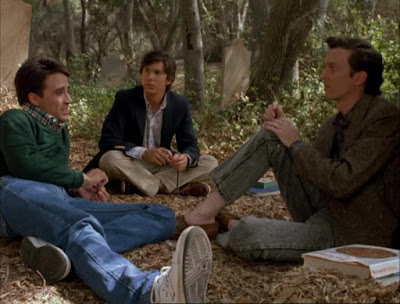
Making an inter-textual jump never explicitly stated in the source text, Ouellette’s screenplay assumes that that our narrator, “Carter”, is in fact none other than Randolph Carter, protagonist of both HPL’s titular ‘Statement of…’ (1919), and his subsequent series of Dunsany-inspired “dreamland” fantasies.

As played here by the immediately likeable Mark Kinsey Stephenson, it is also clear that this Randolph Carter is going to be anything but a sickly, introverted Lovecraft stand-in. In fact, he comes across as a lively and rather charismatic figure right from the outset, becoming more-so as the movie progresses.

An oddball aspiring folklorist possessed of nervous energy and a presumably vast knowledge of esoteric lore, Stephenson’s Carter makes for a pretty great horror movie hero all round. It’s easy to imagine him having headed up his own TV show or on-going franchise in which he traipsed around New England, collecting old stories and investigating sinister goings-on, like some more collegiate equivalent of Manly Wade Wellman’s ‘Silver John’ character.

(Though this possibility sadly never came to pass, the appeal of Stephenson’s characterisation was clearly not lost on Ouellette and his collaborators; ‘The Unnamable’s 1992 sequel is sub-titled “The Statement of Randolph Carter”, with Stephenson top-billed.)

Unfortunately, none of the other characters here are quite so memorable, but again – we’re in ‘80s horror movie territory here, so they’re all just meat for the grinder, more or less. For the most part the cast acquit themselves fairly well, with Charles Klausmeyer standing out for his young Roman Polanski / John Moulder-Brown type look in the role of Carter’s younger buddy/protégé Howard Damon. (He also seems to wear a tweed suit and tie to campus every day, which lends a touch of class.) 

In this telling of the story, Carter’s rationalist antagonist in the graveyard discussion – business major Joel Manton, played by Mark Parra – becomes so worked up about his friend’s willingness to embrace the supernatural that he stomps off in the direction of the haunted house just across the way, declaring that he will spend the night there in order to prove that nothing untoward is going on within. (Good luck with that, fella.)

Shrugging this off, Carter and Damon meanwhile return to campus, where we re-join them the following morning in the Miskatonic University library, where they discuss Manton’s apparent failure to return from his impromptu camp-out.

Meanwhile, we suddenly find ourselves in the middle of a routine campus slasher, as two studious sorority girls (one of whom the shy Damon happens to have the hots for) are chatted up by a pair of generic frat-boys, one of whom proudly displays that universal signifier of jockitude, a woollen sweater hanging loose over his shoulders (where indeed it remains, worn like a cloak, for the entire remainder of the movie).

Claiming rather feebly that they need to undertake some nocturnal location-scouting for forthcoming initiation-related hi-jinks, the jocks manage to convince the reluctant girls to meet them at the spooky old house by the graveyard that evening for a thinly veiled double-date, and… well you don’t need to be much of an aspiring folklorist to figure out where all this is headed. (Toward a partial recreation of 1981’s ‘Hell Night’, if nothing else.)


This mixture of quirky, Lovecraftian atmospherics and rote slasher movie cliché may seem a little jarring at first, but ‘The Unnamable’s tone actually remains pretty consistent throughout, using hefty doses of humour and raised eyebrow self-awareness to distract attention from the minimal and formulaic plotting -- much as Lovecraft did in his original tale, in fact.

Despite the low budget, the film’s photography (courtesy of DP Tom Fraser) is pretty good, particularly once the action moves entirely into the cluttered, candle-lit interior of the derelict old house during the movie’s second half, making extensive, rather fantastical use of blue gel lighting, alongside some imaginatively patterned shadows.

So smitten do the filmmakers seem in fact by their creepy gothic lighting, the film actually begins to suffer from something of a middle act slump, as characters spend a very, very long time exploring the eerily lit interior sets. Feeling suspiciously like attempts to pad out a near non-existent narrative to feature length, these extended peregrinations could well induce severe wakefulness / attention-span issues amongst late night/inebriated viewers, but as a dedicated fan of ‘60s Italian gothics, I was personally happy enough to roll with ‘em.

Likewise, David Bergeaud’s ridiculously over-bearing, faux-classical keyboard score may prove an intolerable for some, but I actually found it weirdly endearing, functioning in a sense as a persistent reminder of the film’s independent/low budget origins and determined eccentricity, lest we begin expecting it to get too slick n’ professional.


As befits a movie dealing with the, ahem, “unnameable”, much of the drag in the middle half hour results from the filmmakers’ reluctance to reveal their monster. The mystery of what the creature actually looks like is maintained for what, by 80s/90s b-horror standards, feels like an exceptionally long time. And, when we do finally start to get some glimpses of our resident beastie, well…. the hairy goat legs were a bit of a surprise, I’ll tell you that much. [Cue momentary flashback to Dragnet (1987).] 

Unfortunately, most of the posters and box art for this movie rather give the game away, spoiling the eventual appearance of the monster by utilising stills which make it look a scrawny cousin of that demon thing from Ridley Scott’s ‘Legend’, but if we can put that out of our minds before viewing, the creature’s eventual Big Reveal within the movie itself is…. actually quite impressive.

Portrayed by actress Katrin Alexandre, who employs a series of extravagantly theatrical, choreographed movements, this creature’s amalgam of disparate monster tropes manages to justify the “unnameable” epithet about as well as anything which could be conjured up on this movie’s budget possibly could. 

Fans may be liable to declare that it looks absolutely nothing like the kind of entity we usually think of as fitting in to Lovecraft’s universe, but they’d be well advised to refer back to the source text, wherein HPL, who seems to been on a bit of a Cotton Mather-inspired backwoods folklore kick at this point, does actually state that his indescribable creature’s attributes include horns and cloven hooves, as well as the more familiar tentacles and shapeless, shifting clods of organic matter.

Obvious though it may be, the climactic scene here in which the monster skulks in the shadows whilst a doomed jock/sorority girl couple are making out in a deserted room (thus delivering the film’s requisite minimum quantity of gratuitous nudity), rolling a severed head into the view of the female partner, is very well done – a killer scare with some sharp editing. (Meanwhile, I’ve also got to admire the fact that the couple weren’t deterred by discovering a bloody femur bone beneath their makeshift bed.)


Another highlight in the lead-up to the film’s conclusion are the scenes which find a flustered Randolph Carter indulging in a few arch, rather Jeffrey Combs-esque line readings as he ploughs his way through the deceased warlock’s grimoire collection, which has apparently been left untouched for three centuries. Kicking up as much dust as you’d expect in the process, he eventually zeroes in on (what else?) the ‘Necronomicon’ itself, and, in a development almost certainly inspired by ‘The Evil Dead’, he’s soon located the requisite “anaal nathrakh”s necessary to send the unnamable creature which was once the ancient wizard’s wife back from whence it came. (3)

(Actually, it’s implied that Carter saves the day by invoking some kind of dryad-ish woodland spirits embodied in the trees outside the house, or something – an interesting, if under-explored, twist.) 

Though not a lost classic by any stretch of the imagination, ‘The Unnamable’ is nonetheless a noble effort. Ouellette was clearly a sincere fan of Lovecraft’s work, and his attempt to make a film which might actually appeal to his fellow cultists whilst also fulfilling the commercial requirements of a late ‘80s American horror movie demonstrates a certain amount of both daring and ingenuity.

Considering that he and his collaborators were working on a miniscule budget, utilising a largely inexperienced cast and crew, and working to a script which ultimately doesn’t add up to much more than a handful of well-worn genre clichés, I think ‘The Unnamable’ actually emerges as a surprisingly accomplished piece of work, within its own modest parameters. It conveys a ‘little-train-that-could’ style sense of fun and achievement, which seasoned connoisseurs of independent American horror should be able to appreciate, even if it couldn’t hope to hit the heights so recently scaled by Stuart Gordon and co in the field of Lovecraftian cinema. 

---- 

(1)Just as an example, try this one on for size: “Moreover, so far as aesthetic theory was involved, if the psychic emanations of human creatures be grotesque distortions, what coherent representation could express or portray so gibbous and infamous a nebulosity as the spectre of a malign, chaotic perversion, itself a morbid blasphemy against Nature?”

(2) After working in camera tech / continuity roles on a variety of marginal New York-based productions in late ‘70s, Ouellette seems to have gotten quite a big break when he was appointed as ‘second unit director (action)’ on ‘The Terminator’ in 1984, but sadly his career in the film industry never really seems to have gained much traction after this. Aside from the two ‘Unnameable’ films, his only other feature as director is a 1990 STV actioner named ‘Chinatown Connection’, and the remainder of his sparse CV comprises short films, a TV movie script and production credits on a few little-known projects in the early ‘00s. 

(3) Yeah, I know “anaal nathrakh” is actually from ‘Excalibur’, but gimme a break here – I just like it more than the ‘Evil Dead’ incantations.