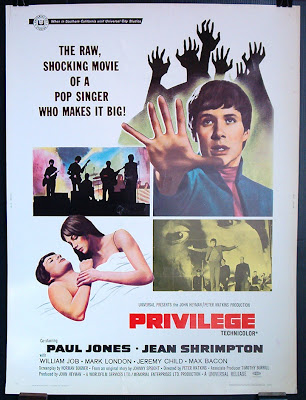
It must be said that when the BFI launched their ‘Flipside’ cult/underground DVD imprint last year, their initial batch of releases left me less enthused than one might imagine. An applaudable venture, for sure, but selections such as Richard Lester’s grimly unfunny black comedy ‘The Bed Sitting Room’ and mondo stripper flicks like ‘London In The Raw’ seemed like strange initial choices for high profile restoration and reconsideration.
Not that I’d wish to see these films UNavailable to the curious viewer you understand, but giving priority to such historical curios when there are so many straight-up masterpieces of British weirdness languishing in the vaults seemed a pretty frustrating use of resources. Obviously my own tastes veer toward the kind of horror and sci-fi that Flipside’s overlords seem to be deliberately avoiding thus far, but nonetheless, wouldn’t the label provide a great opportunity to finally give A-grade cult oddities like John Gilling’s “The Night Caller”, Michael Reeves’ “The Sorcerers” or Don Sharp’s incredible “Psychomania” the proper DVD releases they deserve? Or how about such potent, currently-unavailable pop cultural smash-ups as Robert Freeman and Donald Cammell’s “The Touchables”, or what about “Smashing Time” for that matter?
Well needless to say, the above have all yet to (re)appear on our shelves, but Flipside’s subsequent releases have still succeeded in bringing me back to the fold. In fact in view of some of the singular items they now have in their catalogue, it is easier to see those odd initial releases as part of a deliberate and brave policy of avoiding more obvious film-nerd favourites and instead seeking out a variety of largely unclassifiable ‘misfit’ films of the kind that not only found themselves ignored, misunderstood or reviled on initial release, but which have subsequently proved too idiosyncratic, flawed or difficult to have enjoyed much of a revival on the nostalgia-driven cult film circuit.
Rather than giving us ‘the hits’ off our must-see lists so to speak, Flipside seem to be more concerned with seeking to rehabilitate the reputations of some of the legions of glorious, audacious, semi-lunatic failures hidden out there in the Out Of Circulation zone, and, for better or worse, it’s certainly proving fascinating to see what they come up with every few months.
And few films could be said to hit that ‘idiosyncratic/audacious/misunderstood’ sweet spot better than Peter Watkins ‘Privilege’, a movie I’ve been desperate to see for so long I’ve almost forgotten why it caught my attention in the first place, goaded into considering it a forever unobtainable treasure as copies traded hands for triple figures on ebay, and now BANG, suddenly, thanks to Flipside, it’s in my hands in a beautiful no-expense-spared package with flawless picture quality and crammed with extras, essays and associated blather. Thanks guys!
Peter Watkins has always stood out as the very archetype of the difficult, uncompromising filmmaker, but having found himself more or less completely ostracised by the film industry for decades for precisely those reasons, the DVD era has seen a slow but steady revival in his fortunes, with ‘Privilege’ representing - I think - the last of his major works from the ‘60s and early ‘70s to gain a high profile re-release. Not that it would appear the man himself could care less, as he continues to communicate with the world via his
personal website in the form of lengthy broadsides directed against what he deems the malevolent ‘MONOFORM’ of contemporary audio-visual entertainment.

So, yeah, let us make no mistake – Watkins is and has always been what those back in the day may have termed a ‘heavy cat’. Although possessed of a frankly astonishing level of formal innovation, fierce intelligence and visceral power, his films are equally subject to a sense of unfocused rage and paranoid political extremism that has served to alienate him as much from would-be allies as it has from his hated establishment. ‘Privilege’, his only excursion into the realm of commercial studio filmmaking, is no exception.
Ostensibly telling the story of Steven Shorter, a phenomenally successful pop star played by former Manfred Mann singer Paul Jones, ‘Privilege’ seems to have been marketed at the time as a conventional rags-to-riches rock star flick, although the film itself swiftly ditches all semblance of that traditional narrative. Instead, ‘Privilege’ takes the form of a blunt Orwellian social satire, portraying Shorter as the tool of an increasingly totalitarian British state, who, in direct collusion with Shorter’s corporate backers, use his bland good looks and undirected charisma as a white wall onto which the desires and behaviour of the country’s youth can be projected, and subsequently controlled.

Norman Bogner’s screenplay sets out to business as a Terry Southern style absurdist comedy, but Watkins, one suspects, had little time for chuckles, and the comedy elements that remain in the film – in the form of the various grotesques who make up Steven’s immediate circle, the filming of an absurdly pretentious ‘existentialist’ apple commercial etc. – fall rather flat, or else are steamrolled into Watkins’ political agenda.
In fact, it’s hardly surprising the film bombed on initial release, as, on a pure popular cinema level, it’s not very entertaining at all. Capers, antics and action are all in pitifully short supply, as are sympathetic characters or central narrative drive. Even the kind of requisite Swinging London awesomeness you might reasonably expect of a 1966 pop culture movie is largely AWOL, with crowd/party scenes generally looking pretty set-bound, with costume design and incidental detail mostly dedicated to the realisation of Watkins’ nightmare vision of a pop-fascist dystopia, rather than to sharing any groovy mod-era thrills.
That said, it is undoubtedly the concert sequences and other mass gatherings in which Watkins really excels as a filmmaker. Like other Watkins films, ‘Privilege’ is constructed as a faux-documentary, and, as usual, the director’s greatest strength lays in his ability to actually CREATE the battles, conflicts and spectacles the film calls for, and to get down on the ground with his handheld camera and just plain film shit as it ‘happens’, lending his work a startling and often terrifying sense of immediacy and realism.
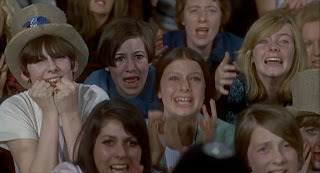
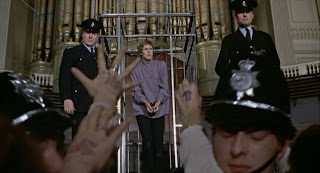
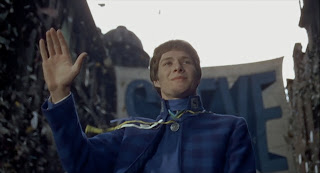
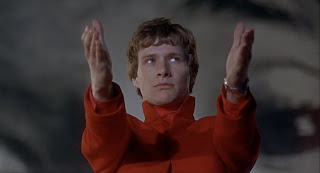
The opening of ‘Privilege’ sees Stephen Shorter making his first appearance in the UK after returning from a grueling American tour. Only, a Stephen Shorter appearance is apparently no ordinary ‘concert’ - it is a choreographed ritual by which teenagers are allowed to express their anger and frustration in an officially-sanctioned, controlled environment. To the accompaniment of Beatlemania screams, Shorter is dragged on-stage by uniformed officers, handcuffed and thrown into a cage, from behind the bars of which he begins to sing a bombastic rock ode, demanding his freedom (it’s pretty awesome actually – sounds like something The Who might have done on ‘Tommy’), looking every bit the swoonsome, tormented innocent as he implores the crowd to release him. In performance style and appearance, Shorter/Jones is a dead ringer for stormy solo era Scott Walker, and it’s all pretty intense stuff to be honest, as he tears his shirt, strains against the cuffs until his wrists bleed etc.

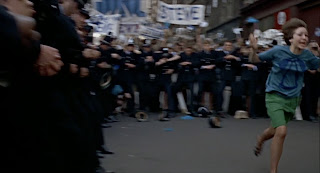
The audience becomes more frenzied as the guards taunt and beat the singer and as he subsequently fights back and tires to escape, and by the time Shorter is finally dragged off the stage in silence at the (extremely long) song’s conclusion, the crowd is ready to erupt on cue into a bloody riot which presumably provides the rest of the evening’s entertainment, as a battalion of baton-wielding police try valiantly to control a frenzied mass of howling teenage girls.
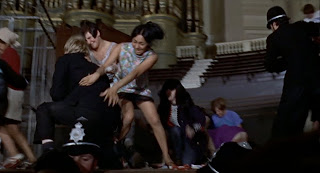
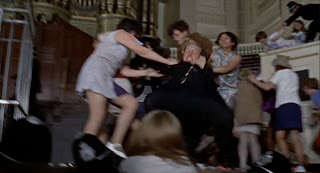
Captured with Watkins’ verite-styled photography and jolting, fingers-on-the-blackboard editing, and throwing in a mixed up palette of freedom/confinement imagery that requires no explanation, the entire sequence is jawdropping. The unusual nature of Shorter’s performance sorta comes out of the blue with no prior warning, and initially the whole thing seems crazily unlikely. I mean, why would so many teenagers fall for such a bizarre and violent bit of performance art shtick? Doesn’t seem much like my idea of fun. That changes though when you think on and recall David Bowie acting out similar theatre-of-cruelty psychodramas to a similar screaming teen crowd in his Ziggy Stardust period a few years later, at which point ‘Privilege’ temporarily achieves its objective of becoming eerily prescient.
Altogether less convincing, although just as impressive visually, is the film’s centerpiece, a vast Nuremberg style rally in a football stadium, organised by Shorter’s organization in collaboration with the Church of England and Britain’s one-party government (about the funniest moment in the film for modern viewers is when the narrator casually announces that the Labour and Conservative parties recently decided to merge, having discovered an essential lack of difference between their policies and seen no reason why they should subject the public to ‘disruptive expressions of political difference’).

The gimmick this time is that, having earlier lent his endorsement to all manner of commercial products, Shorter’s services have been bought wholesale by the C of E, for whom he will become a mouthpiece, appearing for the first time without handcuffs and announcing that he was been freed by the power of faith. As I say, the whole event is staged like the British equivalent of a Nazi rally, with legions of boy scouts and Salvation Army bands trooping around, blaring music, gigantic banners and a huge, neon crucifix being carried to the stage. Appropriate to the occasion, Watkins’ camera here departs from his usual close-to-the-ground approach, instead documenting things from an expressionistic ‘eyes of god’ point of view that seems to take direct inspiration from Leni Riefenstahl’s ‘Triumph of the Will’ (know your enemy and all that).
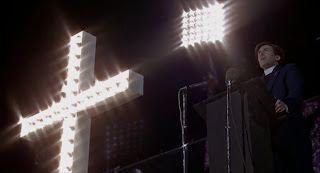
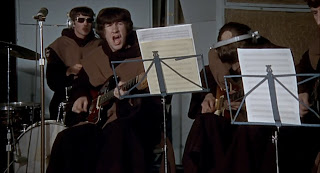
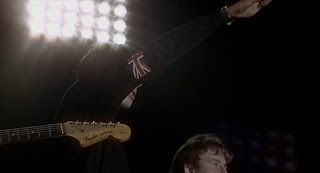
It may have worked ok for Riefenstahl I guess, but shackled here to an alternate history which is, let’s face it, pretty wacky, I found all the interminable saluting and stomping about quickly became a bore, conveying all too well the kind of stuffy school assembly atmosphere that inevitably accompanies this kind of militaristic hoo-hah. I found myself instinctively waiting for Mick Travis and his gang to set off their smoke bombs, but it never happened, with the leaden bombast only easing briefly into unsettling comedy as a rock band in blackshirt outfits with Union Jack armbands play a jangling Byrds-esque rendition of ‘Jerusalem’ (we saw them earlier in an entertaining studio sequence, playing a freakbeat infused ‘Onward Christian Soldiers’ and wearing monastic robes). The fact that the music’s pretty good and I’m tapping my toes probably says more for the chilling validity of the film’s central premise than any amount of sound and fury, to be honest.
When Watkins was making his film, I suppose the post-Beatles mass popularity of pop music was a relatively recent phenomenon, leading, I'm sure, to much chin-stroking from conservatives and radicals alike re: where things could be heading. To certain extent, 'Privilege' was probably just throwing its own pessimistic view of things into the ring. For those of us raised on rock n' roll as an established way of life though, it's hard to think of anything more disturbing and jarring than the sight of a Fender Jaguar and a fascist salute in the same shot. Point made, job done.
With a slightly more restrained approach, Watkins could have hit home with a far more convincing political message, but here things are undercut from the start by the fact the scene he’s painting for us is so patently absurd. Essentially it’s the same problem that sinks his later almost-masterpiece ‘Punishment Park’ (1971). On the level of pure cinema, ‘Punishment Park’ is an astonishingly powerful work of anti-establishment propaganda, enough to make you feel like loading up your AK-47 and going underground after viewing. Only you don’t, because the film’s central conceit – that hippies en masse constitute enough of a threat to the status quo for the American government to set up vast desert concentration camps to kill them in weird war games – is so utterly fucking ridiculous (and precisely the kind of paranoid, self-involved narrative that helped distract and dissolve the post-hippie counterculture in the ‘70s when it could instead have been doing something genuinely useful, come to that) that the film’s grimly determined ‘realism’ immediately dies a death.

And similarly in ‘Privilege’, I’m sure that British readers will know what I mean when I say that the sight of a sinister Church of England bishop standing atop the podium at a fascist rally/pop concert and leading the nation’s youth in a chant of “WE WILL CONFORM” is just about the stupidest and most ham-fisted attempt at political commentary I’ve ever seen. It could be a Monty Python sketch, only Watkins treats the scenario with such dire and unrelenting seriousness.
Of course, there are innumerable ways in which a democratic state can slowly slip into totalitarianism and we always need to be on our guard etc etc; but the idea of the most polite and parochial religious organisation in the world suddenly leading the British public straight into an exact recreation of a Nuremburg rally only twenty years after the Third Reich got it’s comeuppance and Hitler and fascism forever established as the go-to embodiments of evil the world over..? I don’t want to seem like I’m giving too much credit for political suss to a nation that continues to read The Daily Mail, but c'mon - not bloody likely.
So, top marks perhaps for a subtle and increasingly prophetic presentation of corporate/government/media collusion, but as a conformity vs. individualism parable or a treatise on the roots of totalitarianism, I’m afraid we’re looking at a bit of a wash-out with ‘Privilege’. Leaving Watkins and his polemics aside for the moment though, there is undoubtedly more depth to the film that just this hammer-blow stuff. For one thing, the faux-documentary conceit is carried off beautifully much of the time, with the painstaking level of incidental detail that’s crammed into each frame and some excellent performances from the supporting cast often serving to capture the same kind of backstage banter and shady power-brokering that D.A. Pennebaker immortalised in ‘Don’t Look Back’ (a pretty huge influence on this film, I suspect). But beyond all that, in the sequences when the narrative drifts away from the shaky-cam toward straight fiction, I actually found myself becoming quietly absorbed by a whole other voice that is making itself heard within this film, perhaps even outside the director’s earshot.
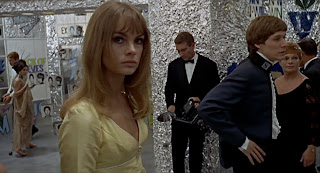
Although the performances of both Paul Jones and Jean Shrimpton as the film’s female lead have attracted a certain amount of criticism over the years, the decision to cast them was inspired. At the time, Jones had recently quit Manfred Mann at the height of the band’s popularity, declaring himself exhausted by the pressures of the pop star lifestyle. Shrimpton meanwhile had found herself becoming almost unbelievably famous in the mid-‘60s, as the discovery/muse/fiancée of photographer David Bailey. By the time she turned twenty, her picture had appeared on the front of more magazines than most people read in a lifetime, and her and Bailey’s troubled relationship was daily fodder for the tabloids. By the end of the decade though, the young woman had apparently decided she couldn’t be arsed with the whole thing and retreated from public life entirely to run a hotel in Penzance, where she’s remained ever since.
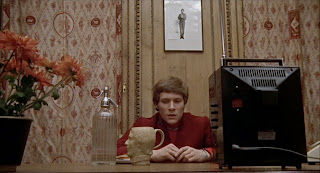
Both leads bring somewhat limited acting abilities to their roles in ‘Privilege’ (in the booklet accompanying the DVD, Robert Murphy sums up Shrimpton as “stunningly beautiful, but almost inaudible”), and the development of their on-screen relationship could easily be seen as confusing, contrived and uneventful (Shrimpton plays Vanessa Ritchie, a painter who is hired to create portraits of Shorter and who subsequently encourages him to express his individuality and rebel against his handlers). But both are possessed of what I suppose you might call a ‘raw physical charisma’, and whatever finesse their line readings may lack, their presence adds a whole new level of meaning to the film. After all, no amount of ‘method’ can compare with the opportunity to act what you already know, because it’s happening in your life right now.

For the first half of the film, Stephen Shorter is very deliberately set up as a cipher. People talk to him, or through him, or about him, but aside from a few mumbled complaints, the man himself is silent – an empty vessel for the ideas of others. When he is introduced to the similarly reserved and awkward Vanessa though, their scenes together become a islands of tranquility amid the garish decadence and cruelty of the rest of the film, and their partnership becomes sad and moving in a weird, wordless way that extends beyond the hackneyed “man meets woman, discovers humanity” device that the script may have intended.
Beautiful and blank, Jones and Shrimpton essentially find themselves standing in for the ACTUAL privileged first world youth of the late 20th century. Confused, inarticulate souls fleetingly trying to anchor some understanding of themselves, and to communicate with each other in the midst of a ceaseless, shrieking tornado of malevolent excess, bad ideas and constant overstimulation, Jones and Shrimpton become the heart and soul of the film, lost forever within Peter Watkins’ brave but self-sabotaging circus of horrors.
