Showing posts with label Jack Hill. Show all posts

Wednesday, 25 September 2019

Deathblog:
Sid Haig
(1939 - 2019)


As 2019’s great celestial purge of good and kind souls continues apace, it goes without saying that I was very sad to hear this week that the great Sid Haig has checked out, aged 80.

A wildly charismatic performer in his ‘60s and ‘70s hey-day, the nuance and variety Haig brought to his roles, and his capacity for creating fully-formed (albeit larger-than-life) characters in a matter of seconds, remain underappreciated.

The performances he gave us whilst working as a kind of totem for director Jack Hill are all, without exception, brilliant, whether playing primitive, cannibalistic creeper Ralph Merrie in ‘Spider Baby’ (1964), a feckless beatnik in the U.S. reshoots which helped create ‘Bloodbath’ (‘66), a sociopathic racing driver in ‘Pit Stop’ (‘67), a sadistic warden in ‘The Big Doll House’ (‘71), an equally sadistic thug in ‘Coffy’ (‘73), or an easy-going, sleazeball pilot in ‘Foxy Brown’ (‘74).

Sure, he goes over the top, but when you’re playing a rampaging weirdo in a Jack Hill movie, no one’s gonna give you a medal for under-playing it, y’know? Suffice to say that few could have brought this rogue’s gallery to life with the wit, charm and physical dynamism that Sid brought to the party. (It’s a shame that Haig and Hill seem to have parted company in the mid-70s – I would have loved to have seen him strutting his stuff in ‘The Swinging Cheerleaders’, ‘Switchblade Sisters’ and ‘Sorceress’ too.)

My all-time favourite Sid Haig character though must be one he played outside of Hill’s catalogue, during a sojourn in The Philippines which saw him appearing in a string of action-exploitation U.S. co-productions, including Eddie Romero’s immensely entertaining ‘Black Mamma, White Mamma’ (1973). The wild n’ woolly circumstances of Filipino film production seem to have suited Haig’s on-screen persona perfectly, and he’s an absolute riot in this one, playing a psychedelically-clad cowboy gangster / pimp cruising around the nation’s back-roads in a jeepy full of heavily-armed goons. (Highly recommended, if you’ve not seen it – it’s a hoot.)

Although Quentin Tarantino to some extent deserves credit for enabling Haig’s 21st century resurgence (convincing him to come out of self-imposed retirement to appear in ‘Jackie Brown’ in ’97), it is of course his work for Rob Zombie which has kept him in the public eye and given him an (I hope rewarding) second wind as a “horror man” – a designation which is odd, given that he pretty much never appeared in a straight horror film back in the old days (‘Spider Baby’ notwithstanding).

But, he certainly seems to have made it work for him, lending to his distinctive services to dozens of movies in the genre across the past few decades. Though Zombie’s recently released ‘3 From Hell’ seems likely to be his official swan-song, his great turn in the prologue to S. Craig Zahler’s Bone Tomahawk also seems to make a perfect cap-stone to his career.

Outside of his film appearances, Haig also worked as a gigging drummer through the late ‘50s and early ‘60s (he played on The T-Birds 1959 hit ‘Full House’), served a two year apprenticeship at the Pasadena Playhouse, played mute ‘heavy’ roles in just about every ‘60s/’70s U.S. TV show under the sun, founded and managed a community theatre project in Simi Valley, and, according to IMDB, was a qualified hypnotherapist too. By all accounts, he was also a really nice guy - something which comes across loud and clear in every interview or Q&A I’ve seen with him, and indeed crossed over into his screen persona too; even when he’s playing a raving psychopath, you can feel the really-nice-guyness creeping through. He will, of course, be hugely missed.

The way all films should end.

Sunday, 9 January 2011

#06
Spider Baby
(Jack Hill, 1964)


Jack Hill’s “Spider Baby” was one of the first films I ever wrote about for this weblog, back in the halcyon days of May 2009. You can read what I had to say here if you like, although my formative stab at long-form film-writing probably leaves something to be desired.

In particular, I’d like to take back the bit about the straight/normal characters lessening the film’s impact when they turn up halfway through. On the contrary, looking back now, I think they’re all pretty brilliant – some great comic acting and memorable turns from all concerned. Obviously they’re somewhat overshadowed by Lon and Jill and Sid, but who wouldn’t be?

What an amazing movie, though. It’s like the weirdo-horror “It’s A Wonderful Life”. Makes me cry every time, seriously.

Tuesday, 8 June 2010

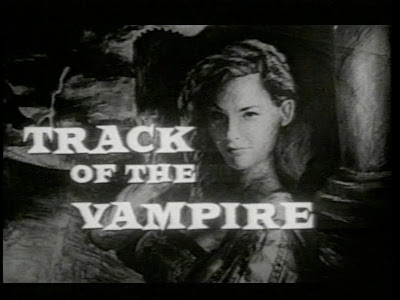
Track Of The Vampire
(Jack Hill & Stephanie Rothman, 1966)


First off, I would personally like to thank the world’s movie reviewers, horror bloggers, authors of the various nerd-tastic reference works I like to consult etc., for keeping me in the dark for so long re: the unique qualities of this obscure AIP schedule-filler, thus allowing it to hit me as a real unexpected surprise. Thanks guys - I appreciate it! In some small way, it feels like Christmas when a film I’d never even heard of (well, maybe I read the title once or twice, or saw a poster somewhere..) turns out to be more weird and wonderful than I could ever have hoped.

I didn’t deliberately set out to watch “Track of the Vampire” - it’s the other movie on a double feature DVD I bought primarily to see Barbara Steele in “Nightmare Castle”. Reading the back of the box whilst sitting through the latter in a narcoleptic haze (it’s the only way to watch “Nightmare Castle”), I was intrigued to note that “Track..” is co-directed by two of American International’s most talented b-team directors, Jack Hill (Mr. Spider Baby himself) and Stephanie Rothman (who went on to introduce a welcome dose of feminism into American exploitation in the ‘70s via flicks like “The Student Nurses”). My interest thus piqued, the least I could do was shift this thing up my viewing schedule and check it the hell out. And I’m very glad I did.

To my surprise, “Track of the Vampire” begins not with one of AIP’s trademark animated credits sequences, but with a brilliantly atmospheric ‘town square at midnight’ scene-setter, reminiscent of the way Mario Bava utilised the creepy geometry of old Mediterranean architecture in flicks like “Kill Baby Kill” and “Lisa & The Devil”.

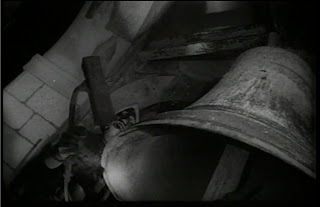

Those can’t be sets, surely…?

Less surprisingly, a monstrous, black-hatted fellow of some description has emerged from the shadows to prey upon a lone female! Fangs! Groping! Cripes, what horrors!
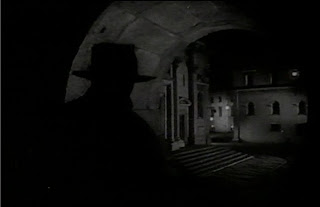
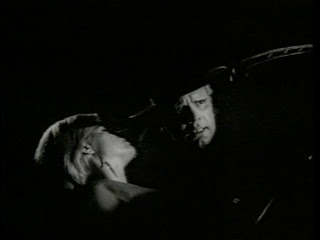

A pretty cool opening, no doubt, but the moment I knew I was REALLY going to love “Track of the Vampire” was when we cut straight to a bunch of beatniks, who are avidly watching what appears to be a severed eyeball attached to a metronome…
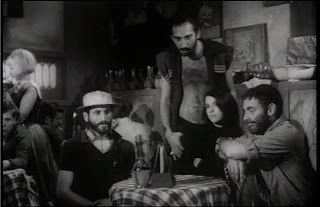
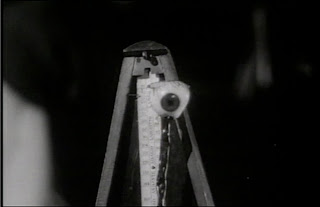

In what I assume is a cheeky homage to Corman’s classic “A Bucket of Blood”, our hep-cats begin earnestly discussing the nature of artistic expression, as Karl Schanzer (Schlocker out of “Spider Baby”) explains his new concept of ‘quantum painting’. I think it looks like a lotta fun, and the beatniks seem to agree!
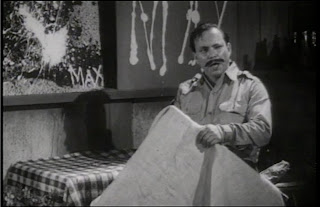
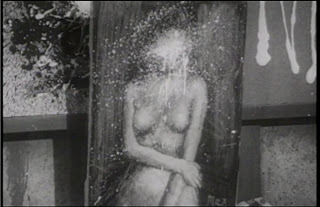
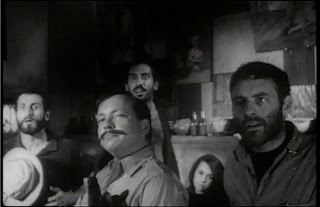

Where the hell is this movie supposed to be set, you may be asking by this point. Europe? America? No my friends, nothing so crude. With a vagueness that borders on genius, “Track of the Vampire” seems to take place instead in ‘60s-HORROR-TOWN, a free-floating principality that those of us who watch too many of these movies may occasionally find ourselves visiting in dreams.

A place where imposing gothic edifices cast leery shadows across cobbled streets and waves crash hypnotically and unceasingly upon the eerily deserted beach, where beatniks beat their chops in cantinas, eccentric artists skulk in their converted crypt studios, and a seemingly endless supply of beautiful, dark-haired girls practice their roles in daring avant garde ballet productions.

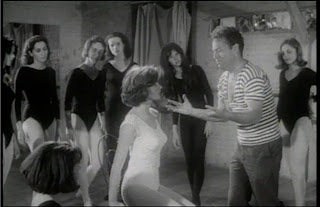

Throughout this whole movie, I don’t think we meet so much as one ‘normal’ person – no squares, no policemen, no shopkeepers, no reporters – just the way out kids, occasional surly innkeepers and seekers after truth… and the guy with the fangs.


Damn, I love it here, I wish I could stay forever. It reminds me of happy times in my youth, staggering around seaside towns by night, pissed out of my brain, with the sobering sea air on my face and all of life stretching out ahead of me… (again, guy with fangs notwithstanding).

Anyway, another thrilling stalk n’ strangle sequence is up next, serving to perfectly illustrate the strange and pleasurable art/trash disjuncture that seems to be going on throughout “Track of the Vampire”…
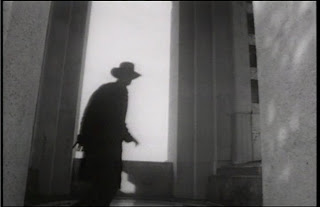


Seriously - one moment we could be looking at brooding, expressionistic framing straight out of a Murnau or Fritz Lang movie, the next it’s like we’re suddenly transported to that stupid bit in “Astro Zombies” where those guys chase each other around a swimming pool for about a hour and Tura Satana shoots somebody…

And as I probably don’t need to remind you, this weird negative zone connecting the two is pretty much EXACTLY where I like to find myself on movie night.


This scene, in which a girl dances across the beach to pad out the running time a little, just goes on, and on, and on, far longer than such a scene ever really should. Being generally in favour of such dreamy nonsense, I was having a lovely time with all the woozy marimba music and compound-eye lenses and stuff, but when it hit the five minute mark even I was thinking “right, that’s enough of that, can we have some kind of event or something now?”
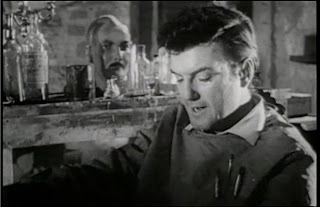

William Campbell plays troubled artist Antonio Sordi, who does a brisk trade knocking out bloodthirsty paintings like this one;
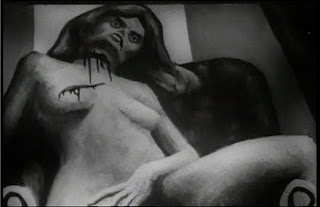

ANY GUESSES WHERE HE GETS HIS INSPIRATION FROM, HUH READERS?


That’s right! Another one bites the dust.

Campbell is superbly creepy, lumbering about and drawling his lines like Robert Mitchum’s punch-drunk older brother.

The scene in which an unsuspecting girl poses for him whilst he stares at a canvas he’s just painted pitch black, ranting about the fate of his ancestor, a controversial artist who was killed by the inquisition in the 11th century, seeing the laughing face of the woman whose evidence condemned him reflected in the black mess, is one of the most grandly ghoulish and unsettling scenes I’ve seen in a gothic horror flick for a long time.


That alone would have done a really nice job of transforming the standard “cornball explanation of why he’s a psycho” sequence into something altogether more enjoyable, but when the scene shifts into a full tilt, Bergman-esque desert dream sequence in which Sordi acts out the drama of his heretical forebear…. man, it’s a knock-out!
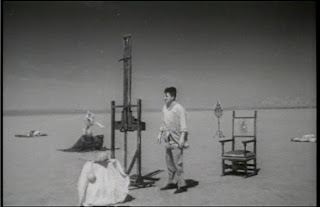


If my generalised talk of ‘girls’ in this review seems a tad crass, I apologise, but the fact is “Track of the Vampire”s general sense of oneiric incoherence makes it very difficult to keep tabs on it’s myriad female characters, most of whom look very similar and sometimes even seem to change places, or come back from the dead, or reappear as their own sisters and so on. The whole thing almost has a kind of constantly shifting, Jean Rollin-like drift to it, and if there are some fine and characterful performances from the female cast hidden in their somewhere, I’m damned if I can figure out who was who by looking at the cast-list in order to acknowledge them.


The fact that most of the actresses look distantly familiar from other AIP movies, but that I can never QUITE put names to the faces, only increases this delicious feeling of dislocation, as I stumble through “Track of the Vampire” wondering whether I last saw that girl who was dancing on the beach hanging out in a technicolour castle with Vincent Price, or riding with a wild black & white hotrod gang… or did I just see her out of the corner of my eye in some movie-inspired dream…? Ah, the truth – forever beyond my grasp! Here I sit, like poor old Vincent in one of those Poe movies where his new wife turns into his dead wife or his daughter turns into his mother or whatever, contemplating the possibility that I’m just DREAMING this whole ridiculous movie…
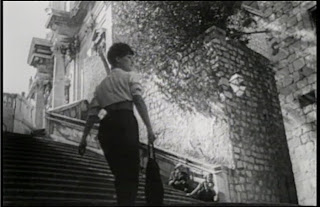

Later on, we get some shots like this one, that lead me to think, holy shit, that’s no back projection – did Roger Corman actually pack everybody off to Europe to make this damned thing…?


Given Corman’s legendary reputation for penny-pinching, I’ve always been kind of curious about how and why he let Francis Coppola go all the way to Ireland to shoot “Dementia 13” in ‘63, so on that basis I guess an overseas jolly for Hill and Rothman wouldn’t have been *completely* beyond the realms of possibility… although the suits at AIP can’t have been too thrilled when they returned with a film this art-damaged and incoherent.


One thing I absolutely love about the best of the black & white ‘60s AIP film is that even as they were poking fun at beatniks and art world pretension, they really do carry a genuine ‘beat’ sensibility that somehow manages to sit neatly alongside their exploitation / pure entertainment agenda. Certainly you’d be hard pressed to find anything in the early ‘60s avant garde as shocking and fragmented as “Dementia 13”, as insightful as “Bucket of Blood” or as uncompromising in it’s rejection of social norms as “Spider Baby”, even as all three still function perfectly well on the level of goofy horror movie fun.

I guess it goes without saying that Corman and Hill and Rothman and Coppola and Daniel Haller were all smart, talented, literate people, and an uncanny sense of vitality and intelligence can’t help but shine through in their work, even as the moneymen crack the whip. And if that latent sense of experimentation can be seen creeping around the edges of those other movies, it’s a pure delight to find it exploding all over “Track Of The Vampire”, a film that, whilst highly accomplished in technical terms, couldn’t have been much more of a free-wheeling daydream if Corman had hired a bunch of Venice Beach hippies to shoot it.


There is a refreshing ‘first thought/best thought’ feeling about the film’s incongruous mix of beautiful, well-executed sequences and total junk, a spirit of knowing good humour and energy that makes the resulting film a hoot, even as the events on-screen make about as much sense as a 3am conversation in the bar at an Italian scriptwriter’s convention.

“HEY,” seems to be the unspoken message from Hill and Rothman, “WE WENT TO FILM SCHOOL AND LEARNED A BUNCHA NEAT STUFF; NOW ROGER CORMAN’S HIRED US, AND HE LET US MAKE THIS THING! PRETTY CRAZY, HUH?”

A starry-eyed rampage through the back roads of the mid-‘60s subconscious disguised as a commercial b-movie, “Track of the Vampire” blows my mind.


Of course, every dream is followed by the crude awakening when you realise you’ve got to put your trousers on and get the hell to work in the next twenty minutes, and a modicum of internet research reveals that my vision of Jack and Stephanie hanging out on the beach together, sharing a few sticks of tea and crafting this mad movie was sadly pretty wide of the mark.

The real circumstances behind “Track of the Vampire”s creation are as follows:

One day, Roger Corman acquired the rights to an obscure Yugoslavian movie, the intriguingly titled “Operation Titian”, for the price of a milkshake, but subsequently deemed it too dull to bother releasing. (I’m guessing this is where all the atmospheric location shooting and chase sequences came from?)

Meanwhile, Jack Hill was busy shooting a whole bunch of footage for another film that never got finished for some reason (all the beatnik/mad artist stuff, presumably?), and Corman, utilising his uncanny ability to pull a feature film out of just about anything, decided he might as well crowbar the two together into, well… SOMETHING, roping in Stephanie Rothman to write and shoot enough additional scenes to establish some sense of coherence.

And if “some sense of coherence” would be a pretty generous description of the film that eventually emerged, I think we’ve still got to give it up for all concerned – “Track of the Vampire”, ladies and gents, a wholly ACCIDENTAL masterpiece of ‘60s weirdo horror.

As a final note, IMDB tells me that Sid Haig turns up in this movie, portraying “Abdul the Arab”.

I’ve watched it twice now, and don’t recall seeing any “Abdul the Arab”.

He’s probably in there somewhere though. Maybe he’s hiding. It’s just that kinda movie.

Sweet dreams.

Monday, 18 May 2009

Spider Baby, or The Maddest Story Ever Told
(Jack Hill, 1964)


I realise I’m not exactly reinventing the wheel by writing a review of ‘Spider Baby’. Most self-respecting horror/weirdness fans will have seen it, and those who haven’t will surely be familiar with it via it’s killer rep as a – sigh – “cult classic”.

But, for all that, it is still a film which has never been commercially released in the UK and Europe, a film which is still more frequently referred to in passing than it is actually screened or directly discussed. Thus: I feel the need to write about it.

Perhaps one of the reasons for it's ‘limited’ public exposure, even whilst the movie is established canonical viewing for horror fans, is that ‘Spider Baby’ is lumbered with a plot line that is difficult to summarise without making it sound like a thoroughly ghastly enterprise.

Opening with a shot of the ‘Encyclopaedia of Rare Genetic Diseases’ sitting atop the coffee table, the camera pans up to a rather smug, well-adjusted looking fellow, who proceeds to deliver a monologue regarding the curse of the Merrye family, whose bloodline is subject to a unique hereditary disorder that causes it’s victims’ minds and bodies to effectively deteriorate from puberty onwards, subjecting them dementia and psychopathic behaviour from a young age and eventually reducing them to “a pre-human state of savagery and cannibalism” as they advance into adulthood.

As you might well expect, such an affliction has not exactly made for a happy or healthy family tree, but the remnants of an aristocratic fortune have enabled the family to cling onto SOME sort of existence over the years, and ‘Spider Baby’ proceeds to introduce us to the last survivors of the Merrye lineage, teenage sisters Virginia and Elizabeth and their older brother Ralph, who live alone in ascetic poverty, confined to a crumbling, isolated Californian mansion and cared for by the family’s dedicated chauffer Bruno (Lon Chaney), a man whose vow to protect and raise his late master’s offspring has rendered him scarcely any less maladjusted than his charges.


Realised with rare skill and imagination by writer/director Jack Hill, the whole set up becomes an instant masterpiece of American Gothic, as the bored, disobedient children struggle to scratch a life for themselves out of the detritus left by their doomed ancestors. Raven haired psychopath-in-training Virginia obsessively identifies herself with spiders and bugs, separating edible and poisonous toadstools in the garden and playing her favourite game ‘spider’, filling a room with rotting drapes and crouching near an open window, kitchen knives at the ready. Marginally saner sister Elizabeth meanwhile acts out a slightly satanic parody of a bored schoolgirl, fruitlessly trying to provoke her siblings into hating each other, whilst Ralph is a more overtly monstrous presence; a simple-minded, weirdly lovable beast-man, clambering across the rooftops and hunting cats, Ralph is realised in perfect drooling, gurning form by professional really-weird-lookin’-dude Sid Haig. And, in good, gruesome Lovecraft-via-EC-comics backwoods gothic tradition, the family is completed by the unseen “Uncle Ned” and “Aunt Clara”, who dwell in darkness in the basement, their presence noted largely through ominous growls and scrapes.


A potentially grim scenario for a movie, I’m sure you’ll agree, but the choice of actors charged with bringing this deviant family unit to life easily manages to transcend the potentially tasteless subject matter, each of them offering a performance that is little short of extraordinary. Lon Chaney, who at the time had long been cruelly relegated to the sidelines of even b-movie production thanks to the changing times and his legendarily debilitating alcoholism, manages to put in a real career-best performance here, acting with a dignified solemnity that it’s tragic to think he had hidden within him through the proceeding decades of pisstakes and bit-parts. Apparently Chaney was drawn to the script of ‘Spider Baby’ for personal reasons, seeing the role as reflecting his own experiences caring for troubled teenagers. And indeed, it is from this sort of genuine feeling, rather than from horror movie grotesquery, than Chaney builds Bruno’s character, drawing on a reserve of pathos that, combined with the sort of slow, mannered theatrical performance style that was dying out in cinema by the ‘60s, is almost heartbreaking as he patiently tries to discipline the children, explaining to them yet again that “it’s not good to hate” as they listen doe-eyed, knowing that he hasn’t got the strength to protect them from the outside world for much longer, as they grow older and crazier and the family’s position grows ever more untenable.

Actually, I’ve always had a soft spot for Lon. Somehow, he always managed to come across as a hell of a nice guy and a really gifted actor, even when he was portraying villainous cartoon freaks, and, even moreso than his contemporaries Lugosi and Karloff, I feel his eternal typecasting as “the monster guy” was deeply unfair. It was a brilliant stroke of luck therefore that he found a film as good as ‘Spider Baby’ in which to prove his talents to the world at the tail-end of his career, and boy, does he ever make the best of the opportunity. It’s a shame barely anybody got to see the damn thing within his lifetime.


And if ‘Spider Baby’ brought out the best in Chaney, the casting of 17 year old unknown Jill Banner as Virginia was a stroke of genius. She is, to resort to some much-overused filmic clichés, unforgettable, burning up the screen with an extraordinary combination of genuine dementia, childlike malevolence and warped charisma – one of those performances that seems less like a good acting gig, more like a record of a truly incredible and fascinating person, captured on film and doing her fucking nut, so to speak.

In a certain sense, ‘Spider Baby’ can be seen as a final knife in the belly of the classic Hollywood Noir tradition, and as such, Jill/Virginia manages to perfectly embody the vengeful, shrieking lunatic girl who was always lurking behind the soft focus eyes of our favourite femme fatales, fully unleashed at last thanks to the more brutish aesthetics of ‘60s exploitation flick, with her filthy antique dress, wild eyes, pet tarantula and butcher’s knife in each hand, as the vague spider/liar metaphors of ‘Double Indemnity’ and ‘Angel Face’ are blown up into an actual, literal fucking homemade web, with a spider at the centre expressing a perverse teenage fury that wouldn’t be seen again in popular culture until Lydia Lunch was fronting Teenage Jesus in the late ‘70s. It’s scarcely surprising that the early advertising for ‘Spider Baby’ (what little of it there was under that name) concentrated largely on Banner, billing her as “The Spider Baby” and promising “seductive innocence of Lolita, the savage hunger of a black widow!”

She’d steal the show no question, were Chaney, Haig and Beverly Washburn as Elizabeth not all equalling compelling. If such performances were the only thing ‘Spider Baby’ had going for it, it would still be a pretty unique motion picture, but thankfully the same qualities are reflected in every other aspect of the film’s production too.


There is a telling moment in one of the short documentaries accompanying the DVD in which Jack Hill confesses that, at the time of ‘Spider Baby’ at least, he tended to feel jealous of his friends in the movie business who got to work on more ‘serious’ studio films. Such concerns apparently didn’t stop Hill from subsequently embarking on a long career working with Roger Corman, bringing all manner of sleazy, action-packed craziness to the screen over the following decades. But, bearing the above quote in mind whilst viewing ‘Spider Baby’, it is interesting to note the extent to which Hill relies not on the style and conventions of contemporary horror movies (although ‘Psycho’ certainly exerts an influence), but upon the classic Hollywood stand-bys of solid storytelling, broadly painted emotion and carefully composed, articulate mise en scene. Despite it’s grotesque subject matter and sometimes graphic violence, this helps to give ‘Spider Baby’ a wonderfully old fashioned atmosphere that’s perfectly in keeping with it’s gothic lineage, a proud throwback to an eerier era, much as H.P. Lovecraft’s batty faux-Victorian prose must have been in the 1930s.

Some of the credit for this must be given to Alfred Taylor’s beautiful black & white photography, which, at a time when many horror flicks were moving into the realms of garish technicolor gore, pays tribute to the dense interplay of sunlight and shadow of the best of ‘40s Hollywood, lighting the exterior shots of the Merrye house in such a way that you almost expect Philip Marlowe to stride up the front steps.

(The fact that the guy who DOES stride up the steps, and with whom the audience is encouraged to identify for the film’s opening sequence, is actually disgraced black comic actor Manton Moreland, says a lot for ‘Spider Baby’s status as an impossibly strange one-off – a film that was never going to find a comfortable home in the time/place of it's creation.)

Hill’s direction too is often suitably stately, managing to imbue the Merrye family with an internal logic and a deep sense of recognition and sympathy worthy of a Frank Capra film, albeit one turned on it’s head, as the mantle of lofty, everyman humanity assumed by Jimmy Stewart in Capra’s most memorable films is taken on here by a gang of murderous, damaged outsiders, whose happy isolation is threatened by the venal, cowardly “normals” who intrude upon them. All this nearly thirty years before Tim Burton (you knew he was gonna get a mention somewhere) explored the same themes in a slightly less extreme form in ‘Edward Scissorhands’.


Not everything in ‘Spider Baby’ is flat-out wonderful of course: there are a few moments when the low budget and quick shooting time clearly show through, and other scenes that are just plain goofy, attempting to rope in some bankable exploito fare and just sorta… failing weirdly, as the film’s more genuine feeling of humour and humanism win through. There’s also the fact that when the aforementioned “normals” arrive, although each of the actors does a prerfectly sterling job, they nonetheless somewhat undermine the film’s odd sense of realism by basically acting like they’re hamming it up in a William Castle monster movie… although in a sense, this very lack of depth helps to set them apart from the warmth and empathy generated by the “weirdos”, in way that serves the film’s themes very well.

Overall though, ‘Spider Baby’ is an unlikely masterpiece, a creative triumph for all concerned. Given the love, thought and commitment that was clearly put into the film by cast and crew alike, it remains nigh-on unbelievable that it was written and shot as a drive-in circuit filler under the working title “Cannibal Orgy”. A perfect example of how great, moving, life-changing art can happen when the right elements just happen to come together and throw up sparks, someplace where no one would ever think to look.

There are so many more things to say about ‘Spider Baby’ – I haven’t even yet mentioned Ronald Stein’s amazing, unconventional score, the cartoon credit sequence or Lon Chaney’s utterly bizarro speak-singing ‘theme song’ ; I haven’t got around to discussing how gleefully effective the twist-in-the-tail ending is, despite being so predictable it’s nigh on inevitable. I haven’t discussed how the various sub-plots involving the ‘normal’ visitors are kinda fun in their own right, or found time to riff about the extent to which the life histories of some of this movies cast and crew read like choice examples of California Gothic in their own right (check out Jill Banner’s biog some time), or related the history of how the lay completely unseen for decades, building a legendary word-of-mouth reputation as a lost classic until Hill was eventually forced to effectively steal the negatives of his own film so that he could get a remastered print made to counteract the emergence of terminally degraded VHS bootlegs.

But, I’ve said enough. The fact is, whether you reckon the film is an over-exposed, obvious cult reference point or you’ve never heard of it before in your life, we should give thanks for the fact that anyone with a multi-region DVD player or a boradband connection can now watch ‘Spider Baby’ in full, so I’ll just conclude by recommending you go and do just that - you know where to find it, I'm sure.