Showing posts with label film. Show all posts

Saturday, 13 September 2025

NEW ZINES LAUNCH.

 Dear friends, followers and anyone else who is still reading this blog after many months of inactivity -

I am writing today to let you know that, after an eternity of faffing about, I have finally printed up the first issues of two new paper fanzines - the current plan being that they will replace / supersede this blog going forward.

There are several reasons for making the move back to paper at this point.

Firstly, I need to face the fact that I’ve reached a point in life where I no longer have sufficient free time to produce regular, quality writing, as demanded by the weblog format.

As such, the zines I have put together contain about a 50/50 mixture of new writing, and stuff which I have previously published here (all substantially revised, or entirely re-written in some cases).

This is a balance I intend to maintain going forward, allowing me to draw upon the huge volume of stuff I’ve published here over the years, revisiting some highlights and hopefully presenting them to a new audience along the way. Combined with the possibility of publishing work from other contributors (submissions/ideas are very welcome), I hope that this will help me to put new issues together at a slightly quicker speed than would otherwise be the case - assuming that there are future issues that is (let’s see how these first ones go).

Secondly - let’s face it, the internet in the 2020s sucks. As anyone who has ploughed through the various warning screens and cookie pop-ups necessary to access these words will be aware, the blogger platform in particular has become increasingly obstructive and dysfunctional, and after trawling through the various aggressively monetized / homogenous sites which may have offered an alternative home for BITR… well, long story short, making stuff online is just no fun anymore, at least for a social media-eschewing refusenik like myself.

And, thirdly, from the POV of where I live at least, the world of DIY paper publications is actually thriving, counter-intuitive as that may seem. Zine fairs and such-like are regular occurrences, and whilst the personal & art-based zines which dominate them are generally not my thing, there have still been a number of great music / film / culture-based efforts popping up here in the UK in recent years, providing me with a blueprint for how this kind of thing can still be made to work, on a creative level at least.

So, to finally get the point -

The Beast with Two Paperbacks is a new zine about reading second-hand books.

 The first issue features writing on Simon Raven, Martin Cruz Smith’s ‘Inquisitor’ books (both re-dos of BITR blog-posts), along with a Pulp Non-Fiction piece on the Pelican punk rock classic ‘Knuckle Sandwich: Growing Up in a Working-Class City’ (new) and a compare/contrast between two novels by Ramsey Campbell and Doris Lessing (also new).

It also contains some badly structured sentences and a couple of glaring typos. I really should have done a final proof-read of the text before sending to print. But if you’ve persisted with this blog over the years, you’ll be familiar with all that I suspect.

Skull Time Movie Journal is a new zine covering fringe movies, genre movies, WEIRD movies - you know the score.


The first issue contains a re-do of my post on the Indonesian erotic horror ‘Cinta Terlarang’ (1995), a brand new review of the Johnny Cash scum-noir disasterpiece ‘Five Minutes To Live’ aka ‘Door-To-Door Maniac’ (1961/66), a round-up of ’50s/‘60s Japanese horror films with contemporary settings (largely re-written, although I’ve reviewed all of the films here in the past), and a lengthy chat with my partner about the career of Cynthia Rothrock (also brand new).

This one also has - I believe - fewer typos and better sentence construction, because I sent it to print after the other one, and hey, you live and learn.

Paper copies of both of these zines can be purchased here.

Or alternatively, PDF copies can be read or downloaded for free via Archive.org. (Which is totally cool with me btw - please don’t feel obliged to buy the paper versions just to show support or whatever.)

Also, I’ve put together a new Linktree to unite my various online projects / pages, so please do give that a look too.

If you hit the ‘FOLLOW’ button on the Ko-fi site linked above, I will send you occasional updates on activities related to these zines, but I will also hopefully continue to plug any new issues etc here too.

And finally, I’m also planning to start doing another mailing list, mainly just to keep in touch with friends and chat about music and stuff - very much TBC at this stage, but you’d be welcome to sign up if you’re interested, link on the Linktree page above.

And… that’s about it for now I think! Hope you’re all doing well, and as ever, thoughts and feedback are welcome.

Thursday, 3 April 2025

ACTION WORLD - 29/04/25.

So, I’m unsure whether or not I have any remaining readers who are London-based, but just on the off-chance…

I am contributing the above event, taking place on Tues 29th April, at my local community café, as part of the New Cross & Deptford Free Film Festival.

The concept is, we will be travelling the globe, exploring world cultures through the warped prism of action movies.

As such, the current expectation is that I will be screening and introducing brief clips and trailers from Indonesia, Taiwan, Turkey, Australia, The Philippines and… possibly even some more places, whilst my accomplices cover assorted other locales.

Also, there will be beer - which is frankly a relief.

I can't make any great claims about the event being worth travelling / going out of your way for or anything, but like I say - just on the off-chance.

Sunday, 23 March 2025

Deathblog:
Wings Hauser
(1947 - 2025)

So first off - a quick note to any remaining loyal readers, to clarify that I didn’t really intend for this to just become an obits blog going forward, but a total absence of time to write, combined with blogger’s increasingly disruptive barrage of log-in requests, content blocks and cookie pop-ups, make it difficult to envisage a return to regular posting in this space. I have however been diverting my faltering energies into some other projects - which I will hope to update you on soon.

But now, on to more important matters.

I hate to be the one to tell you if you’ve not heard the news elsewhere, but Wings has left the building.

There is, of course, a corny line to be inserted her about bells ringing and angels - but this is a sad time, so I’m not going to be the one to do it.

Wings! What an incredible human being. What untold joy he has brought to those of us who persist in believing that watching low budget genre films made in Los Angeles in the 1980s / 1990s is a respectable use of our time on earth. Truth be told, he personally provided a fairly hefty percentage of the force behind that belief, and he asked so little in return.

Long-term readers will be aware of the respect I hold for actors with the courage to GO BIG in small films, and rarely has a jobbing thespian routinely gone bigger than Wings, a man who seems to have approached the task of playing the baddie in a DTV action flick with the same dedication a professional athlete brings to running a triathlon - commanding the screen, flattening the opposition, capturing the audience in his mad glare like an unshackled psycho about to stick a shiv in the camera operator’s gut.

FUN was always the name of the game with Wings; even on the rare occasions when he was allowed to sink his teeth into a more quote-unquote ‘serious’ role, he gives every impression of having a blast with it, and his energy is infectious - a talent honed no doubt during his apprenticeship as a rock singer (and what I wouldn’t have given to have been able to attend one of his gigs in the ‘70s - at least if ‘The Neon Slime’ [see below] is any indication of his preferred musical oeuvre).

Despite all this though, I am astonished to note that the Deadline obit piece I have linked to above does not mention Hauser’s appearances in motion pictures at all, instead framing his legacy in terms of his prolific TV work and parenthood of his apparently-more-famous children.

I mean, we really do live in a parallel universe here, don't we people?

How has the Cult of Wings been allowed to remain such a fringe concern?

Beats me, but in fairness, in the early days of this blog, I was equally clueless - reviewing Nico Mastorakis’s ‘The Wind’ aka ‘The Edge of Terror’ in 2010 [I won’t link, because those early posts an an embarrassment], I made fun of his name, and remained non-committal on the quality of his (no doubt wonderful) psychopath acting.

Since then though, having obtained a more informed overview of the cinematic hinterland, I’ve naturally seen the light, allowing Wings to ascend to “I will pay to watch anything this man is in” status in my personal pantheon (a pledge which, believe me, has proved painful at times), and experiencing an acute sense of joy each time I see his name fade up, third or fourth billed, in a set of opening credits, probably accompanied by ominous, synthesizer sludge and ‘Terminator’-esque snare drums.

In spite of everything though, there are still some crucial entries in the Wings filmography which I’ve not gotten around to at the time of writing; his surely magnificent top-billed role as ‘The Carpenter’ (1986)? [I’m waiting to pick up that new blu-ray on import.] His collaboration with the equally legendary Brian Trenchard Smith on ‘The Siege of Firebase Gloria’ (1988)? [I have it lined up, but my partner doesn’t care for war movies.] Or what of ‘Skins’ aka ‘Gang Boyz’ (1994), his self-directed skinheadsploitation epic with Linda Blair?!

All of these and more will no doubt find a place in my future viewing schedule, helping to ease the pain of a world without Wings.

Meanwhile though, and bearing in mind the above caveats re: films I’ve not yet seen, here are a few picks of my favourite Hauser performances, to hopefully help the uninitiated get a handle on the achievements of this unique and already missed performer. 


Vice Squad (1982)

Hauser’s breakout role (to the extent that he ever really ‘broke out’), and probably most fans’ pick for his definitive performance. It helps of course that ‘Vice Squad’ is one of those films which is about x100 times better than it has any right to be, as director Gary Sherman takes what could have merely been a sleazy ‘hookers on the Strip’ exploitation piece and transforms it into one of the best and most exhilarating American crime movies of the 1980s… but if there is one thing everyone remembers from the film, it is the central presence of Ramrod.

On paper, the figure of the Elvis-obsessed, faux-cowboy psycho pimp, keeping his girls violently in line through the liberal application of his ‘pimp stick’ (don’t even ask) could have made for a fairly routine / comedic villain… but, as so often, Wings really takes it to another level. Channelling his frustration at spending three years stuck on the soap opera treadmill of ‘The Young & The Restless’ into a hyper-energised performance (even by his standards), he turns Ramrod into an obscene, unstoppable force of physically intimidating chaos, lashing out in all directions with a mixture of unhinged menace and pitiful grotesquery, cutting a bloody swathe through the Hollywood underworld with an intensity which is frankly jaw-dropping.

Feeling very much like a ‘80s analogue to Richard Widmark’s turn in Kiss of Death (1947), it’s hardly surprising the ‘Vice Squad’ opened up a new career for Wings as a go-to guy for scene-stealing villainy. And when, after Ramrod has met his inevitable demise at the hands of the far-less-memorable cops, as the camera gratuitously crane-shots above the urban wasteland and the man himself launches into the aforementioned ‘Neon Slime’, you’ll be hard-pressed not to physically cheer / applaud /salute the magnificent, nihilistic insanity of the whole enterprise. What a movie.


Tough Guys Don’t Dance (1987)

In a film loaded with unhinged, oversized macho performances, corralled by an even more unhinged, oversized egomaniacal writer-director, Wings still manages to come out as top dog, grinding the competition into the dust as his foul-mouthed, priapic closet-case monster-cop Luther Regency rides roughshod over the privileged populace of Provincetown, Massachusetts, getting so up-in-the-face of bewildered hero Ryan O’Neill that at one point he manages to make a windswept cliff-top feel claustrophobic and sweaty.

I attempted to write about my love for this astonishing, uncategorisable film as part of one of my ‘Best First Watches of 2022’ posts here, but needless to say - despite reportedly being given a hard time by Big Norm on set, Wings fits into Mailer’s toxic, coked out world like a filth-stained leather glove. 


Nightmare at Noon (1988)

Quite possibly the aforementioned Nico Mastorakis’s masterpiece, you can read my thoughts on this classic piece of b-movie junk here, but specifically in terms of Hauser’s performance, I find it interesting the way he upturns expectations by playing his everyday-guy-in-an-RV protagonist / hero character as an absolute, raging asshole - whining, wheedling, selfish, he has that nails-down-the-blackboard annoyance down pat, until a “shit just got real” revelation eventually causes him to simmer down and become a helpful part of the bro-hero zombie-fighting team alongside Bo Hopkins and George Kennedy - a beautifully played transition.


Pale Blood (1990)

In this entertaining low budget vampire epic from Chinese-American director V.V. Dachin Hsu, Wings essays the role of a Van Helsing-descended vampire hunter with an ancient magic sword, posing as a sleazy, Richard Kern-esque video artist in contemporary L.A. Need I say more?!

I mean, if you’re on the scene in 1990, looking for an actor who’s going to turn up on time everyday for whatever pitiful rate your non-union picture is paying and breath life into a character like that… there’s only one guy you’re gonna call, right?

I can’t quite claim the resulting film is a stone-cold classic, but if you’ve sat through as much horror / sci-fi drek from this era as I have… keep your expectations in check, and you may be pleasantly surprised, let’s put it that way. 


Champagne & Bullets [aka ‘Geteven’ aka ‘Road to Revenge’] (1993)

In interviews, Hauser often spoke about his wild, hard-partying lifestyle during the 1980s, and nowhere can you see the weird aftermath of all this hedonism quite so clearly as in this astounding, once seen / never forgotten vanity project from Los Angeles lawyer John De Hart.

One of several b-movie stalwarts drafted in to lend a fig leaf of legitimacy to the production, Wings plays De Hart’s character’s best friend / partner ‘Huck Finney’, and… well, I should emphasise at this point that everything else I’ve ever read about Hauser gives the impression that he was a dedicated, hard-working professional, but let’s just say that he spends the majority of his screen time here instead giving a pretty good impression of being completely out of his mind.

He’s under control and hits the required beats in some scenes, so I’ll assume he was at least aware that he was in this movie, and wasn’t just hanging out at De Hart’s house being covertly filmed or something, but the rest of the time…? We’re deep into “point the camera at him and see what he does” territory here.

In one scene, he seems to be having a conversation with a wooden Cigar Store Indian; in another, he’s lolloping about senselessly in De Hart’s swimming pool, outlining his plan for starting a new religion based around ‘The Adventures of Huckleberry Finn’. I may be misremembering, but I think he spends some time theatrically downing and crushing cans of beer, in response to his character’s marital difficulties, or something?

I have no idea what is going on with all this. Did De Hart pay him in bourbon (or worse)? Or did Wings simply respond to the amateurishness of the production by throwing caution to the wind and going full-on Dr Gonzo? Who can say.

Whatever the case, Hauser’s performance ranks as about the 86th most uncomfortable thing in the gruelling duration of ‘Champagne & Bullets’. 


Mutant (1984)

And finally, I don’t think anyone on earth would pick this poverty-stricken alien/zombie flick from director John ‘Bud’ Carlos as an all-time favourite, but if you’re a tolerant viewer who likes this sort of thing, it’s certainly worth a watch.

With the exception of top-billed Bo Hopkins, Wings is clearly the best actor on the movie by a factor of ten, and I recall being touched by the way that, rather than simply steamrolling his younger, inexperienced co-stars and leaving the production a smouldering ruin (as he could so easily have done), he reins his performance in beautifully, considerately leaving space for the other actors to fill, and using his own presence to prop them up.

In particular, my memory is that his scenes with female lead Jody Medford feel more like acting workshops than anything else, as he patiently tries to help her through her faltering performance, revealing what I would like to think is a generosity of spirit rarely glimpsed in his more over-sized roles.

--

And, that’s about it for now I think, but in closing - I recommend opening your windows, cranking your speakers, and paying tribute to the late, great Wings Hauser by exposing your neighbours to an undiluted dose of The Neon Slime…. you know you want to.

Sunday, 19 January 2025

Deathblog:
David Lynch
(1946-2025)

Of all the obituary posts I’ve felt obliged to hastily bang out for this blog over the years, this loss is perhaps the one which has proved most difficult to process, or to find words for.

When looking at a figure like Lynch - who has been a giant presence within any kind of art or culture I’d deign to care about, throughout my life - it would be all too easy to begin throwing ill-judged superlatives around.

For instance, in terms of what we might colloquially refer to as “being weird” - or, more precisely, using art and narrative to open the gates to previously unknown realms within/without/above/beneath the fabric of quotidian reality - I’d tend to remove him from any discussion around late 20th/early 21st century filmmakers, and instead place him in the same category as figures as diverse as Lovecraft, Burroughs (W.S., not E.R., although he’s cool too), Blake or Dali.

Like all of the above, his explorations of unmapped terrain are so totally suffused with his own personality, his own background and aesthetic concerns, they’ve become melded into a totally singular body of work, which for the most part defies comparison with that of any contemporaries in their chosen field. Instantly recognisable yet totally inimitable, impenetrable as an eerily misshapen hunk of granite in the middle of the cultural highway.

Unlike the others on the above list however, Lynch consistently managed to filter this vision through an industry requiring millions of dollars, labyrinthine layers of corporate approval and hundreds of collaborators, and still somehow managed to deliver it to receptive audiences in a form which felt like more-or-less 100% proof.

And, in stark contrast to the aforementioned exemplars, he achieved all this whilst still giving every impression of being a real swell guy, whom I’m sure most of us would have loved the opportunity to share a cup of (damn fine) coffee with - his sense of humour and unflappable, humane optimism as unique and cherished as his approaches to art, craft, metaphysics and whatever else.

But, yeah - overblown superlatives and vast generalisations. Probably not helpful.

Strategy # 2 when composing an obit post meanwhile, is to take the personal angle, so let’s do that.

Have I ever told this blog the story of how I first discovered the work of David Lynch? I don’t believe I have, so, ok, here we go…

I must have been about 14 or 15 years old, and (being a slow starter in this regard, with censorious parents and little access to non-mainstream culture to draw upon), my entire knowledge/experience of cinema comprised science fiction (which I loved across all media), dumb blockbusters and even dumber comedies. Maybe the occasional black & white classic mixed in there, but that was about it.

David Lynch, at the time, was going through an extended period of critical disapproval / disappearance from The Official Culture (post-‘Fire Walk With Me’, pre-‘Mulholland Drive’), and as such his name meant nothing to me.

‘Twin Peaks’, at this point, seemed to be treated as a quirky cultural phenomenon which had come and gone some years beforehand, mentioned in print only in relation to the various cast members whose careers it had helped launch, whilst a year or two later, I recall ‘Lost Highway’ achieving only a very marginal release in the UK (did it even go straight to video?), and receiving Ebert-esque reviews of the, “oh, is this guy still making his pretentious, sleazy films which make no sense” variety.

This was the late ‘90s, pre-internet void in other words, and if you were looking for “weird movie directors” and had no access to somewhat more enlightened alternative/underground print media, you were pointed straight in the direction of Tim Burton or Terry Gilliam - do not pass Go, and do not collect $200.

BUT ANYWAY. One day during the school holidays, my parents had assigned me the task of going through a box of unlabelled, recorded-off-TV VHS tapes, to find out what was on them, and to determine whether or not it was worth keeping. (Nearly three decades later incidentally, it occurs to me that this chore sounds like pretty much the most fun day that I could possibly imagine having - but, I digress.)

So, you probably saw this coming, but, second or third tape out of the box - it was ‘Blue Velvet’.

(How it got there, I have no idea, but I can only assume it was a result of my parents’ habit of occasionally setting the video to record a movie which had been given a five-star rating in the Radio Times, then either forgetting about it or deciding they didn’t like it, or something along those lines.)

Not only was it ‘Blue Velvet’ furthermore, but (presumably due to the fact that either the video player’s timer or the TV schedules were constantly fucking up), the tape had missed the entire opening of the movie (including the all-important credits), beginning - so memory serves - shortly before the moment in which the camera descends into the severed ear.

You can picture the instant “what the fuck is THIS” reaction from teenage me, and likewise imagine the effect which the rest of film had on me; an overwhelming mixture of danger, terror and total bafflement / disorientation which I daresay I’ve been searching for in cinema ever since.

This must have been a BBC broadcast, because there were no ad breaks, and no on-screen idents to let me know what I was watching, or to reassure me that it was actually a commercially released motion picture and not some insane, Videodrome-esque televisual hallucination. (In analogue, pan-and-scan form, with all detail and texture rubbed off the images and sound, such distinctions could easily get a bit blurry.)

The only thing which served to ground me through this fateful viewing was (ironically enough, given how terrifying he is in the film) the fact that I recognised Dennis Hopper. So I knew this thing was… at least kind of legitimate?

With the unlabelled tape subsequently ferretted away somewhere as a powerful piece of contraband, the next thing I recall - imagine this, youngsters - actually going to the local library, finding some massive movie reference book, and looking up the entry on Hopper to try to figure out the identity of this insane spectacle which had wreaked such untold havoc upon my impressionable young mind.

Naturally enough, it was easy to pinpoint the culprit as ‘Blue Velvet’, to follow this to the corresponding entry for David Lynch… and what follows from there is fairly self-explanatory.

My brother and I were just reaching the age where our parents were easing up and allowing us to buy / rent tapes without close supervision, and so a weird twofer of ‘Blue Velvet’ and ‘Wild At Heart’, the first season of ‘Twin Peaks’, ‘The Elephant Man’, ‘Dune’, the initial VHS release of ‘Lost Highway’ and (wow) a DVD of ‘Fire Walk With Me’ were gradually acquired over the next few years, as we spent our days muttering darkly about fire, cherry pie and the nature of “the other place”.

I’m not going to say that this process was directly responsible for my signing up to take an A-Level in Film Studies aged sixteen (by then toting Lynch, Cronenberg and Romero as my heroes, despite having only seen a merest handful of each of their movies), or for anything that’s happened since as I’ve moved deeper into an obsession with / appreciation of film during my adult life; but it definitely played a part.

I’m sure that others, across multiple generations, have similar tales to tell, which is all basically a long-winded way of getting around to the point that, whilst the appeal of Lynch’s work will probably never be universal (and I can easily sympathise with the frustration those immune to its charms must feel as the likes of me bang on, and on, about it), he nonetheless managed to reach an almost unfeasibly large number of people across the globe, and to touch and change each one of us more deeply than we perhaps know how to understand.

He has left us with feelings, ideas, images and sounds which will remain with us throughout our lives, but which will never become settled, nostalgic, over-familiar; they will always be alive, always changing, always lurking just around the corner, behind the trash cans outside Winkies - always wild.

And, churlish as it may seem to make such a comment about an artist whose achievements were so unprecedented, and who left us with eighteen solid hours of new directorial material (which I must get around to re-watching, incidentally) just a few short years ago - it still pains me deeply to realise there will now be no more of them.

Sunday, 27 October 2024

October Horrors #10:
Oddity

(Damian McCarthy, 2024)

I will frame this review by saying that, over the past year or so, I have watched a number of highly acclaimed / hyped new horror movies, and, sadly, have found that they all either failed to live up to their full potential, or else just left me feeling a bit underwhelmed. On its own modest terms however, this latest word-of-mouth hit really worked for me.

This will likely be a short review, partly I don’t really have any deep thoughts I need to unpack with regard to Irish writer-director Damian McCarthy’s second feature film to date, and partly because it is very much the kind of movie whose structure makes it difficult to get too deep into discussion of plot detail without straying into spoiler territory.

But, I do at least want to record the fact that I watched it, and really liked it, in the hope this recommendation might inspire a loyal reader or two to check it out - possibly even in time for Halloween next week, as this one definitely makes a good fit for the season.

So - our setting is contemporary Ireland, where Ted (Gwilym Lee) and his wife Dani (Carolyn Bracken) are in the process of renovating a remote stone farmhouse. Ted is a doctor who works the night shift at a nearby psychiatric hospital, leaving Dani alone overnight.

Subsequent to a suitably baleful and unnerving opening sequence establishing this situation, it becomes clear that Dani has in fact been murdered, seemingly by patient recently released from Ted’s hospital, who intruded into the house during the night, and who in turn has subsequently been found dead in grotesque and inexplicable circumstances.

Jumping forward exactly one year in the timeline, Dani’s twin sister Darcy (also played by Bracken) re-enters the life of Ted, who is living in the now completed farmhouse with his new girlfriend Yana (Caroline Menton), seemingly determined to obtain some kind of closure and/or clarity vis-a-vis her sister’s death.

It is with the introduction of the Darcy character that the tone of the film shifts from a sharp, cynical brand of 21st century realism incorporating all the usual accoutrements of contemporary horror (smartphones, jump scares, dissociative editing, drone shots, rumbling sound design, softly spoken yet totally self-centred characters), and, admirably, instead begins to embrace what I can only describe as a mammoth dose of dusty, old-fashioned creepitude.

Darcy, you see, is a blind woman with keenly attuned psychic abilities, who runs a fantastical antique shop specialising in the sale of ‘cursed objects’ - each of them precisely calibrated via Darcy’s paranormal abilities to ensure that, whilst legitimate purchasers may sleep easy, shoplifters taking advantage of the sightless proprietor will have a very bad time indeed.

Which, needless to say, does not bode well for the substantial locked trunk which Darcy arranges to be delivered to Ted and Yana’s farmhouse, in advance of her own surprise arrival…

…and, if you think that this sounds like a conceit which an early 20th century ghost story anthologist might have rejected for being a bit too whimsical and on-the-nose, well… suffice to say that it ultimately feels as if the contents of several entire Pan Books of Horror Stories have been put through a blender to create the script for ‘Oddity’. In the best possible way, I hasten to add.

Or, perhaps it is instead more helpful to instead suggest that things play out rather like one of those projects in which all of the episodes in an Amicus-style portmanteau movie have been sewn together into a single story - but done with such care that, in this case, you can barely even see the joins.

Picking the film apart post-viewing, I can identify at least six or seven different horror tropes / story set ups woven together here - I won’t list them all, because, again, spoilers - but somehow, they are all successfully combined into a simple, minimal narrative featuring just six inter-connected characters and two locations.

The result, essentially, in an agreeably pulpy kind of supernatural riff on a ‘Les Diaboliques’-model thriller, which, in defiance of all storytelling logic, all hangs together just beautifully.

The unusual mixture of real world verisimilitude and atmospheric, occult-tinged fantasy is finely balanced here too, with the more outré elements of the story taking on an eerie, surrealistic power which they would likely not have achieved had the whole thing been framed as a Burton-esque retro gothic horror type palaver (which, thank the dark gods, it is not).

The scary bits are properly scary, the whimsical/creepy bits are whimsical and creepy… and I’d even go so far as to say that the funny bits are funny, although they’re a long time coming, admittedly.

And… that’s about all I have to say on the matter really.

A great little movie, well worth making time for, and a great choice for Halloween-adjacent viewing, I reckon.

So, if you find yourself ploughing trough the fallow fields of whatever streaming services you’re signed up to later this week after the trick or treaters have gone to bed - take a chance on ‘Oddity’, and I’ll wager a very small amount of money you won’t regret it.

Monday, 21 October 2024

October Horrors # 8:
Us
(Jordan Peele, 2019)

Well, speaking of doppelgangers, look what else I watched this month…

There’s an awful lot to unpack in this ambitious attempt to take the Freudian conception of the unheimlich / uncanny to its ultimate extreme, but, given that I’ve got around to it five years late, and given that it was the high profile follow up to an Oscar-winning hit, I’m sure all of its semiotic / socio-political sub-texts and cultural antecedents so on have already been discussed and picked over ad nauseam. 

So, hopefully instead I can just use this space to throw up a few random observations about how well it stands up as horror film - which will be for more enjoyable for all of us, let’s face it. 

 #1:

There is a section of about ten or fifteen minutes in the middle of ‘Us’ (delineating the script’s first and second acts, pretty much), during which the underground / ‘shadow’ version of the film’s central family make their presence known to their real world/above ground counterparts, which is absolutely, honest-to-god terrifying.

In particular, the impact of this sequence is heightened because everything which has happened up to this point has been pretty light-hearted in tone. A bit of eerie atmos, some quirky character dynamics, lots of ‘80s/’90s cultural signifiers, a few laughs… but then, without warning, the tone crashes down into fucking hades. Suddenly, things have the potential to become incredibly grim and upsetting, extremely quickly, as we enter a seemingly inescapable home invasion / captivity scenario, with (checks watch)… nearly ninety minutes still left on the clock?

Thankfully though, this is not the film Jordan Peele chose not to make - for which I am grateful, because it is not one I wanted to watch either.

So, instead, our family members make their assorted, unlikely escapes from what seemed to be their inevitable gory fates, and for the remainder of the picture we are kept entertained by stylised action sequences, an ersatz Romero zombie survival narrative, the pleasure of watching a bunch of unsympathetic secondary characters get whacked, and - under the circumstances - an unfeasibly swift return to an atmosphere defined by wisecracks, laughs and familial banter.

For a few minutes back there though…. well, let’s just say that the (admittedly rather niche) concept of being tortured and killed by a soulless, inarticulate doppelganger of yourself has rarely been conveyed on screen as powerfully as it is here.

#2:

[Not quite a ‘spoiler warning’ as such, but the relevance of this next observation is probably limited to those who have already seen the film, so you might want to skip over it if you’ve not.]

Ok, so, to get straight to the point re: the biggest problem I had with ‘Us’, in spite of its many strengths - am I alone in feeling that everything in this film would have worked so much better if we never received an explanation of what the ‘shadow people’ are, or where they came from?

I mean, we’re given a few fragmentary hints in earlier dialogue about these creatures living underground, subsisting upon raw rabbit flesh etc - which I feel essentially gives us everything we need to pencil in some suitably horrific back story for ourselves, should we care to.

And, I’m about 99% sure that whatever twisted sketches we conjure up as viewers at that point, would prove vastly more effective than the staggeringly absurd, plothole-ridden, poorly thought out ‘rational explanation’ which Peele eventually concocts to help justify the various, totally irrational, scenes and images which clearly inspired him to make this film in the first place.

Given that the ‘big reveal’ segment of the final act is by far the weakest part of the movie, jettisoning it would also have helped slash about twenty minutes from ‘Us’s somewhat bloated run time - but, more importantly, I mean… why can’t contemporary filmmakers just have the balls to keep things mysterious, y’know?

This entire film is basically patterned upon a surrealistic / sub-conscious nightmare scenario, so… can’t we just keep it on that level sometimes, please?

But no. Instead, 21st century cinema’s curse of over-explanation - along with the simultaneous insistence that a story’s protagonists must play a personal/exceptional role in whatever global/societal events are depicted - rear their ugly head yet again.

As a result, we’re left watching the equivalent of a 2.5 hour cut of ‘Night of the Living Dead’ in which the characters travel to the source of the zombie plague and discover that Ben’s dad was actually behind it all, using recovered DNA from Atlantis to re-animate the corpses of astronauts whose deaths were covered up by the CIA, because he just can’t bring himself to reconnect with his estranged son, or some such horseshit.

As I think both Romero’s masterpiece and (more to the point, perhaps) the Two Faces of Evil episode of ‘Hammer House of Horror’ clearly demonstrate, this sort of thing is just not needed - and in fact proves catastrophically detrimental to an attempt to tell this kind of story.

#3:

Random talking point:

I realise this will seem like a bit of an off-beat comparison, but having now watched all three of the horror films Jordan Peele has been to date as writer/producer/director, I keep thinking that, in some way, his directorial style and generally approach to things reminds me of no one so much as Dario Argento.

Clearly the biggest difference between the two of course is in terms of subject matter and characterisation, given that Peele seems like a good-natured fellow who invests a lot of thought and affection into his characters, and doesn’t enjoy seeing them hurt, which is certainly the polar opposite of Argento’s approach to such matters (or, the general perception of it, at least).

Aside from THAT, though…

Peele, like Argento, focusses heavily on technically audacious, attention-grabbing Big Shots and painstakingly pre-planned set-pieces of outlandish mayhem, which nonetheless tend to end up feeling a bit confused, emphasising visceral impact over coherence.

And, both directors have a tendency to announce these set-piece scenes through the use of big, booming over-amped pieces of Signifying Music.

Additionally, although ‘Get Out’ was admittedly a pretty lean and efficient piece of work, in his other two films to date, Peele also seems to share Argento’s chronic difficulties with story-telling. As writers, both mean insist on cramming their scripts with far too many ideas, themes, images, cultural references and so, without ever pausing to think them through properly, or to consider how they might cohesively combine into a single narrative.

Related to which, both directors are also entirely shameless in their willingness to confront their viewers with events or ideas so ridiculous that they basically short circuit any attempt at rational thought, presenting projects which dispense with real world logic and diverge from their core ideas/themes to a quite extraordinary degree. Which is definitely a compliment in Argento’s case, once you get used to his uniquely peculiar MO. In Peele’s case, I’m note quite so sure...

Certainly, ‘Us’ sees him turning in a movie which gets about half way toward being absolutely extraordinary, then over-reaches itself to the point of absurdity.

Which, in a similar spirit, concludes my random, insufficiently processed, thoughts on ‘Us’ for the time being.

Sunday, 13 October 2024

October Horrors # 6:
Jaani Dushman
(Rajkumar Kohli, 1979)

Whilst watching this intermittently delightful Bollywood werewolf movie, I was under the impression that what I was witnessing here was a precursor to the definitive mode of masala horror film which the Ramsay Brothers would go on to perfect in their work through the ‘80s and early ‘90s.

I’ve only subsequently realised however that, in making that assumption, my chronology was actually a bit off. In fact, the Ramsays’ first successful horror film, ‘Darwaza’, came out in 1978, meaning that, in all likelihood, ‘Jaani Dushman’ [which translates as something like ‘Beloved Enemy’, if anyone’s bothered] took its inspiration from the surprise popularity of that film - which actually makes a lot of sense, in view of the way that this one awkwardly crow-bars horror/monster elements into the storyline of what would presumably otherwise have been a standard rural / romantic melodrama.*

Certainly, the horror material here has a very Ramsays-esque feel to it, as the werewolf (think Universal-style facial make up, ingeniously combined with a Fozzy Bear-style ‘furry jump suit’ body) terrorises a remote mountain village, snatching red-robed brides from within the curtained palanquins in which they are carried during their traditional bridal procession. Spiriting them away to a dry ice-strewn subterranean temple, he then gets busy menacing them with his claws, and generally charges around freaking out and so forth, surrounded by ornate stone columns and randomly scattered bones.

During the film’s opening sequence, a honeymooning couple travelling through the dark, dark woods in a broken down taxi end up sheltering in a derelict mansion. Therein, the ghost of a deceased nobleman appears, and helpfully fills them in on how he was possessed by the demon spirit which transformed him into the Wolfman, forcing him to murder his unfaithful wife in the aforementioned subterranean temple on their wedding day, or some such. None of which will obtain any relevance to the rest of the film’s narrative for a very, very long time, but nonetheless - it all feels like quintessential Ramsay Bros type business, that’s for damn sure.

Not that Rajkumar Kohli and his colleagues really manage to summon much of the overloaded atmosphere or bombast of the fully-fledged Ramsays productions, sad to say, but they more than make up for it with sheer gusto during ‘Jaani Dushman’s horror scenes, employing a range of lo-fi, in-camera special effects - most notably, primitive matte shots to create the illusion of the Wolfman’s head rotating 360 degrees, ‘Exorcist’-style, along with some absolutely adorable model work, used to depict people and horses jumping across chasms or plummeting off cliffs.

The movie’s finale, wherein our dashing hero (Sunil Dutt), the film’s now-reformed human bad guy (Shatrughan Sinha) and, uh, some other dude, team up to take on the werewolf in an extended tag-team throw down, is also exceptionally good fun - especially once our heroes get some swinging chains on the go, whilst the Wolfman begins trying to crush them by throwing gigantic stone pillars, accompanied by frequent cutaways to Sinha’s kidnapped bride shrieking in highly theatrical terror. Terrific stuff.

Unfortunately however, whereas the Ramsays were proud and unashamed monster-mongers, devoting probably around 60%-70% of the screen-time in their movies to horror, the producers of ‘Jaani Dushman’ seem to have been far more reticent about adopting the tropes of what, up to this point, had been a universally scorned and despised genre within the Indian film industry.

As such, everything I’ve described above comprises at most 40 minutes of the film’s 155 minute run time - the opening plus the conclusion, essentially. Between which, two further hours stretch out, utterly devoid of any reminder that we’re watching a horror movie.

Thankfully from my own POV, there are few things I enjoy more in life than kicking back with a ‘70s Bollywood movie on a rainy afternoon, so, even though this probably rates as second tier masala stuff at best, I still had a pretty good time with it, even though I swiftly found myself losing track of who was supposed to be marrying who, and who was whose brother, or sister, and so on.

So, within these sprawling, werewolf-free hours, we find many under-cranked scenes of people charging around beautiful mountain landscapes on white stallions, many massed brawls and several exciting tests of masculine strength for our hero and his cad-ish, spoiled-son-of-the-local-aristocrat love rival.

There is also an enjoyable sub-plot at one point about a female character whose painted-on moustache apparently convinces everyone she’s a young man, until she gets trapped in a pit with a deadly cobra, and must reveal her true feminine identity. 

And meanwhile, all of the more lady-like ladies look absolutely stunning in their brightly-hued formal / bridal finery and ceremonial jewellery, imbuing the film with an almost psychedelic overload of visual stimuli in places.

(A special shout-out is due here to Sarika Thakur, playing the lower caste orphan girl rescued from rape by Sinha’s aforementioned spoiled brat character, who has a great take-no-shit attitude, and really shines during the dance sequences.)

Speaking of which, Laxmikant-Pyarelal’s musical score for ‘Jaani Dushman’ is… fairly traditional, I would say, largely eschewing the raging synthesizers, disco beats, electric guitars and crazy echo effects which began to make Bollywood music so awesome around this period - as befits the film’s vaguely delineated historical setting, I suppose. The songs are all quite nice though, the staging of the dance routines is as splendid as you’d hope for, and with Lata [Mangeshkar], Asha [Bhosle] and Mohammad Rafi all present and correct on playback duty, who’s complaining?

Well - horror fans with less tolerance than myself for random Bollywood shtick, that’s who. In fact, they will be complaining like fuck by the time we reach the ninety-minute mark with no further werewolf action on the horizon, and they will find little to salve their woes for a good long while thereafter.

So, whilst I would never condone such a wholesale dismissal of one of the world’s most vital and unique pop cinema cultures, I will at least quietly advise more single-minded monster kids in the audience that, if your sole interest here lays in seeing a Bollywood werewolf in action, well - watch the first half hour of ‘Jaani Dushman’, then skip to the final half hour. Nothing that happens in-between was meant for you.

Consumer guide note: I watched ‘Jaani Dushman’ via a DVD put out by the Italian Filmotronik label, purchased in the UK from Strange Vice. It’s a very soft-looking SD transfer with occasional print damage, but thoroughly watchable, with nice colours, and a definite step up from bootleg quality. The film appears to be properly licenced, and the English subtitles are excellent (including translations of the song lyrics, which I always enjoy), so buy with confidence.

And meanwhile, check out this amazing range of artwork I managed to google up for the film:

---

* Whilst saying this, I am of course aware that Rajkumar Kohli had already directed an earlier horror film, ‘Nagin’ (1976), which I’ve not yet had a chance to see. Reading around it however suggests that it is likely a rather different kettle of fish to the bloody, monster-centric movies ushered in by ‘Darwaza’ and ‘Jaani Dushman’, so for now I’ll stick by my contention that the former likely influenced the latter.

Thursday, 10 October 2024

October Horrors # 5:
The Sex Serum of Dr Blake
[aka Voodoo Heartbeat]


(Charles Nizet, 1973)

Las Vegas-based filmmaker Charles Nizet’s berserk drive-in oddity ‘Help Me.. I’m Possessed!’ was one of the unexpected highlights of my 2022 October horror marathon, so naturally I was curious to check out Nizet’s other foray into horror territory, previously considered a lost film, but now happily rescued from oblivion (albeit in an alternate softcore sexploitation cut, with burned in Dutch and French subtitles) by Vinegar Syndrome, as part of their Lost Picture Show box set.

The first thing to note here is that, compared to decidedly lo-fi production values showcased in ‘..Possessed’, this one actually seems a bit more ambitious in scope (relatively speaking). By which I mean, Nizet employs a fairly wide range of locations, with shots stolen around airports, military bases and highways, along with some actual, choreographed action scenes, camera set ups that occasionally extend beyond basic ‘point and shoot’ methodology, and so on.

Reassuringly though, the whole affair is also still lurid as a strip club basement and mad as a bag of snakes, with a wild, “absolutely anything could happen next” vibe which makes it feel like an entertainment for a strange and debased form of humanity, beamed in from another dimension.

All of this weirdness however is parsed out on this occasion with lengthy passages of almost transcendental boredom, as if the filmmakers were determined to make every goddamned frame they sent to the lab count.

So, a scene in which a man breaks into a locked briefcase and carefully examines its contents plays put pretty much in real time. A close up of a needle being injected into an arm holds for so long that I actually undertook a brief exchange of messages on my phone, looked back to the screen, and realised it still hadn’t cut. There are many, many phone calls and office meetings in which secondary characters calmly explain the plot to each other. A sixty second shot of a policeman descending a ladder, anyone? You get the idea.

In the context of a film like this though you understand, I am not necessarily criticising the inclusion of all this extraneous footage. On the contrary, it actually has a kind of hypnotic effect after a while, and, whether in a 1973 drive-in or a 2024 living room, it allows ample opportunity for toilet breaks, food and drink preparation and so on - which is helpful, especially within this kind of movie’s natural environment, sandwiched mid-way through a continuously rolling, multi-film marathon of some kind. Grotesque, inexplicable madness, presented in an admirably relaxed, ambient package.

Don’t dawdle too long though, or you’ll miss some of the many “highlights” (for which please interpret those quotation marks to denote a wry and sardonic tone of voice, leavened by a certain underlying leeriness).

These begin with a lengthy, exotica-tastic “African” tribal ritual, in which a gaggle of dancing girls strip out of their zebra-print bikinis, screw a guy and then cut his heart out (shades of Love Goddesses of Blood Island?), observed by a pith-helmeted explorer who sneaks in after the show to steal a vial of what (for some reason) he takes to be the fabled elixir of youth.

Then, at different points, we’re treated to a car chase AND a boat chase, both fairly elaborately staged.

Sleaze junkies meanwhile will want to note the presence of both a harrowing, roughie-esque vampire sex murder, and a later threesome with a few borderline hardcore shots, staged in a desert canyon, which culminates in the participants being shot to death from above and vampirised.

Perhaps best of all from my point of view though was the most awkward father/daughter dinner date in cinema history, which… well, you’ll just have to witness it first-hand, that’s all I’m saying.

Speaking of cinema history though, I would also like to take this opportunity nominate the titular Dr Blake (played by Ray Molina) as a contender for the single sleaziest and most misguided motherfucker ever to grace the screen.

As exhibit A, I present his hairstyle, combining sideburns which extend all the way to the corners of his mouth with a disgusting, tangled, oily kiss-curl which hangs down across his forehead, almost reaching his eyebrows. If I walked into a doctor’s office and he looked like this, I would leave immediately, no questions asked.

It is no surprise therefore to discover that Dr Blake has recently been in hot water for performing unlicensed abortions, and is now being prosecuted for manslaughter by the parents of one of his patients, who died following the procedure. (The doc insists it was nothing to do with him, but I don’t believe him for a second.)

During his drive home after another hard day of.. this sort of thing, Dr Blake happens upon a flaming, overturned wreck on the side of the highway. Rather than notifying the authorities or trying to help any survivors however, his first reaction is instead to steal a briefcase with a severed arm handcuffed to it(!) from inside the wreckage, after which he jumps back in his car and heads straight back to his ugly suburban tract home, where he casually sticks the arm in the icebox(!?), and gets to work on opening the case (see above).

Extracting a vial of unidentified, colourless fluid from the case, he immediately digs out a syringe and ties off, injecting the fluid straight into his veins… only to then remember that - oh no - he’s forgotten to pick his daughter up from the airport!

Gentlemen, I put it to you - in all facets of life, Do Not Do What Dr Blake Does, and your life will proceed in a more harmonious and worthwhile direction.

Charles Nizet, one of cinema’s great moralists - truly he hardly knew ye. 


---

Bonus screengrab - the doctor takes a call in his office...


Tuesday, 8 October 2024

October Horrors # 4:
Sexo Sangriento

(Manuel Esteba, 1981)

As the foundations of Franco’s fascist regime in Spain gradually disintegrated through the late 1970s following the dictator’s death, the restrictions governing on-screen content in the previously censorious nation correspondingly collapsed, flooding Spanish screens with an unprecedented backlog of smut, eventually culminating the early ‘80s hey-day of the hastily codified Classificada ‘S’ certification for “adult” (but not quite porn) features.

Soon to be celebrated in a new documentary from Severin Films, the possibilities for low budget filmmaking opened up by this era not only saw ex-pat directors like Jess Franco and José Larraz returning home to produce some of their most distinctive work, but also encouraged a brief outburst of one-off sex-horror films, including the likes of Mas Alla Del Terror, the more widely seen Satan’s Blood, and - delving further into the depths of obscurity - films like ‘Sexo Sangriento’ (I don’t need to translate that for you, do I?), which at the time of writing remains available only as VHS-sourced bootleg.

Interestingly, ‘Sexo Sangriento’ explicitly acknowledges this political context, at least to some extent. Set in 1975, it begins with its characters listening to (and pointedly ignoring) a radio announcement reporting the Generalissimo’s death, as they motor on toward the snow-capped mountains of (we assume) a sparsely populated rural area somewhere on the country’s Northern border.

Despite this curious touch of historical verisimilitude though, real world concerns are soon forgotten (at least for a while), and this is in fact one of the few early ‘80s Spanish horrors which immediately harkens back to the genre’s more escapist golden age a decade beforehand, presenting us with a trope unseen since the glory days of Paul Naschy - namely, that of a group of beautiful young ladies who share a passionate interest in parapsychology and medieval witchcraft, getting way out there on a field trip to a remote, mountainous locale!

Helpfully for the film’s exploitation quotient, two of the girls also share a passion for intense lesbian lovemaking, whilst the third prefers to spend her nights hanging out in abandoned castles with a tape recorder, capturing what she calls ‘psychophonies’.

By which point, long-term readers will appreciate, I was pretty much already sold on whatever happens next.

Before long of course, the girls’ car breaks down (“the distributor is useless,” exclaims the driver, in what I’m going to assume is a movie industry in-joke), and right on cue, a sinister older lady (Mirta Miller, essaying the ‘sadistic/domineering mature woman’ role less than a decade after she was doing her ‘glamorous female lead’ bit in Naschy vehicles like ‘Count Dracula’s Great Love’ and ‘Vengeance of the Zombies’) emerges from the woods and invites them to stay the night at her place.

After a hot night in the sheets, some nude posing for Mirta’s suitably creepy, blood-drenched paintings (she is a reclusive macabre artist, it transpires) and a few strolls around the local ruins, strangely nobody seems terribly concerned about getting the car fixed anymore.

A more threatening note is struck by the presence of Mirta’s lumbering, mute housekeeper, whom she cheerfully declares is “gradually turning into a beast”, but you know, I suppose you’ve got to take the rough with the smooth in this kind of scenario, right?

Truth be told, there’s not much of a story to this one, and things are pretty slow-moving, but with frequent elegiac softcore interludes, plus an equal amount of time spent exploring some of those truly incredible, evocative, derelict locations so unique to Spanish horror, who’s complaining?

During the final act however, things take a considerably darker turn, as the expected supernatural shenanigans are entirely bypassed in favour of gory crotch violence, revelations of historical child murder and some pointed commentary on the trauma suffered by Northern rural communities during the years of fascist oppression. Hmm, didn’t see that coming.

In its currently extant version, this film’s photography has an unappealing Shot On Video kind of look to it, but it’s easy to imagine that a more filmic texture (plus widescreen framing?) might be salvageable, if someone were able to get hold of the original elements. (I’m looking at you Severin - fingers crossed.)

A more intractable problem however is presented by the soundtrack which primarily consists of poorly chosen and poorly synchronised needle-drops on cheesy rip-offs of well known pieces (Goblin’s ‘Zombie’ theme, ‘Star Wars’, ‘Air on a G String’ etc); it’s all very distracting, and far too high in the mix.

Despite these drawbacks though, ‘Sexo Sangriento’ is as sexy and bloody as its title promises, and delivers a respectable dose of palpable gothic atmosphere into the bargain; dedicated Euro-horror devotees should find it well worth tracking down. 


Friday, 4 October 2024

October Horrors #1:
Circus of Horrors

(Sidney Hayers, 1960)

Released, I believe, one year prior to Franju’s definitive ‘Les Yeux Sans Visage’, this early outlier in the ever-popular field of plastic surgery / facial reconstruction-themed horror differs slightly from the norm, in that Anton Diffring’s Dr Schüler [formerly Rossiter] is actually really good at restoring facially scarred women to their former beauty, requiring neither non-consenting skin-donors nor years of gruesome trial and error grafting experiments to get the job done.


Unfortunately however, despite his exceptional expertise and high success rate, fame and fortune do not await the good doctor and the brother / sister team of assistants who inexplicably follow him around, partly due to that stuffy ol’ medical establishment refusing to countenance his radical innovations… but largely due to the fact that he is also shady as fuck, in addition to being played by everybody’s favourite cold-eyed, expressionless Nazi officer.


As such, Schüler / Rossiter instead finds his true vocation acting as the tyrannical manager of a continental travelling circus, whose artistes are in fact petty criminals and prostitutes whose faces the Doc has surgically altered in order to grant them a new identity (as well as apparently training them all to be world class acrobats in the process), and whom he inevitably ends up murdering via various circus-appropriate staged accidents when they decide to leave his employ and/or threaten to expose his sinister racket. All of which falls pretty far from anything which might normally be deemed to make “a lick of sense”, but hey, who’s counting?

Unleashed upon the British public by Anglo-Amalgamated productions shortly after they’d delivered the sublime-to-the-ridiculous double whammy of Michael Powell’s ‘Peeping Tom’ and Arthur Crabtree/Herman Cohen’s ‘Horrors of the Black Museum’, it’s probably fair to say that ‘Circus of Horrors’ falls somewhere between those two poles, quality-wise, but a lot closer to the latter than the former.

Indeed, most of the plotting and character stuff here consists of tacky, ultra-lurid sado-melodrama, very much in the vein of the three films Cohen made with Michael Gough during this era, the details of which need not concern us here. But, at the same time, the production values are FAR higher than on any of Cohen’s flicks, with the use of a genuine circus (and its performers) lending a sense of scale and visual interest to proceedings which belies the low budget, whilst the cast also do a bang-up job breathing life into their corny, under-motivated roles.

Douglas Slocombe’s photography though is what really seals the deal, balancing rich colours with deep shadows, and adding real depth to Hayers’ oft-imaginative framing, especially during the scenes set in the big top, which (unusually for circus stuff in movies) have some decent atmosphere to them, and are quite fun to watch.

By the standards of a late ‘50s British production, this is strong stuff content-wise too, beating Hammer at their own game by including at least one absolutely startling bit of gore, whilst the circus setting meanwhile allows the glamorous (and numerous) female cast members (notably including both Yvonnes - Monlaur *and* Romain) to display acres of pulchritudinous flesh, whether crammed into kinky outfits, getting frisky with the ever-lecherous Diffring, or indeed with the equally randy cop/hero character who belatedly attempts to, uh, save the day?

Also - there’s a superbly fruity early Donald Pleasence performance to enjoy here too, as he pops up (with hair!) in the 1947-set prologue, playing the shell-shocked, alcoholic owner of a destitute circus, collapsing into despair amid the ruins of post-war France. And boy, does he ever get his teeth into it. It’s a shame he exits the film so early, but seeing him meet his sorry fate, crushed beneath the weight of an entirely inanimate dancing bear, is worth the entry price alone.

Tuesday, 2 July 2024

Cormania:
Gas-s-s-s! Or, It Became Necessary to Destroy the World in Order to Save It
(Roger Corman, 1970)


If we were to chart Roger Corman’s engagement with socio-political issues in his work upon some kind of hypothetical scale, then at the opposite end of it from the uncomfortably effective The Intruder, we would find ‘Gas-s-s-s!, or, It Became Necessary to Destroy the World in Order to Save It’ [henceforth ‘Gas’, just for the sake of our sanity], an inexplicable, rather hare-brained movie which, over fifty years later, is difficult not to see as one of its directors greatest failures. (I mean, say what you will about Creature From The Haunted Sea, but at least it had reasons for being crap.) (1)

This is extremely regrettable, given that the project represents an important milestone in Corman’s career on a number of levels. Not only does it mark the conclusion of his cycle of ‘counter-culture’ films (following on from ‘The Wild Angels’ in ’66 and ‘The Trip’ in ’67), but also his final collaboration with American international Pictures (following fifteen years of fruitful co-dependence), and in fact his final work as a director of independent commercial cinema in the United States. (2)

So, what’s ‘Gas’ all about then? Well… it’s difficult to say really, and that very uncertainty soon becomes a pretty big part of the problem.

A pastel crayon animated prologue introduces us to some high ranking military officials (including such personages as ‘General Strike’, and ‘Dr Murder’ - and if you find that magazine cartoon level of humour uproariously funny, there’s hope you might enjoy this movie yet), who, in the process of attending a ceremonial function at a chemical research base in Alaska, accidentally uncork a beaker containing a cloud of custom-made poison gas which now promises to spread across the earth, killing everyone aged over twenty-five.

Moving into live action post-credits, we meet a long-haired, wise-crackin’ campus troublemaker (Bob Corff) and his adorable, only marginally less wide-crackin’ girlfriend (Elaine Giftos), who depart Dallas in a salmon pink Cadillac and promptly get involved in a series of tiresome comical capers, eventually joining forces with a group of other sketchily-defined, more-or-less hippie-aligned young people (including amongst their number both a young Bud Cort, and one Tally Coppola, later to become Talia Shire). Together, this merry band traverse a marginally post-apocalyptic version of the American South-West, enduring a multitude of symbolic / quixotic encounters and threats as they vaguely pursue an Oz-like quest to consult an ‘oracle’, whose billboards (including a count-down in miles) they spot along the highway.

And… that’s about it, really. I mean, I wish I could tell you what the wearying procession of factions, marauders, aggressors, cultists, herd-like victims and all-purpsoe extraverted weirdos our protagonists run into along the way were actually meant to represent, but, as the film’s attempts at satirical humour alternate wildly between blunt, eye-rolling obviousness and head-scratching, lost-in-translation obscurity, it is honestly difficult to locate anything here which we squares might term a ‘point’.

Which might have been all well and good, if only Corman and his collaborators been able to wrangle some other value from these narratively unglued proceedings, but, sadly, the kind of pupil-dilating visual excess and subversive, taboo-breaking chaos which defined the era’s more successful underground/counter-cultural filmmaking is in very short supply in ‘Gas’.

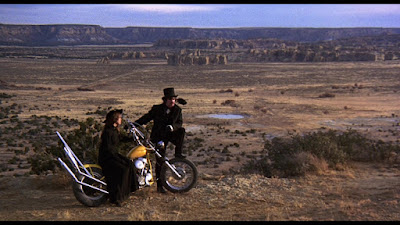
Shot in a range of uninhabited / wreckage-strewn desert locations across Texas and New Mexico, the film’s footage soon becomes fairly monotonous, in spite of the natural beauty of the surroundings and some intermittently impressive photography from DP Ron Dexter. The tone of the action meanwhile remains cloyingly light-hearted, employing a gratingly twee take on hippie-era surrealism, whilst the characters remain vacant, distant and uninteresting.

Even the garish, mid-century Americana of the costumes and production design simply remain… standard issue, for the most part. Please bear in mind that I say all this as a viewer who usually maintains an extremely high tolerance for what Kim Newman has termed ‘Weird Hippie Shit’, but in a word, ‘Gas’ simply feels tired.

Just a few short years earlier, Corman could reasonably have claimed to have had his finger on the pulse of the intersection between popular culture and the underground (after all, ‘The Wild Angels’ not only launched a whole new era-defining genre, but provided direct aesthetic inspiration for generations of proto-punk rebels in the process).

The shadow-haunted autumn/winter of ’69 though found Corman and screenwriter George Armitage (future director of ‘Grosse Pointe Blank’ and the fantastic Miami Blues) beginning work on ‘Gas’ at precisely the moment in which the optimism of the 1960s evaporated, leaving something darker and more fragmented behind it, ready to curdle as the decade turned… and ensuring that the film’s happy-go-lucky, flower-child hipster-isms must have felt painfully irrelevant by the time their film finally opened in September 1970. (3)

In this context, scenes which may have passed as wild, Godardian po-mo provocations back in the mid-‘60s (such as the film’s lampoon of a western shoot-out, in which characters point their fingers at each other whilst shouting the names of famous cowboy actors) simply play out as eye-rolling tedium - self-satisfied acting class wheezes dragged out for far longer than is really necessary.

Indeed, for a Corman production, ‘Gas’ feels uncharacteristically bloated and excessive. Shot across multiple locations in several states (and dogged by inevitable weather-related delays along the way), he seems to have become fixated here on mounting vast public spectacles of one kind of another.

The finished film is stuffed full of marching bands and parades, crowds of extras fleeing through the streets of Western town sets pursued by gangs of stuntmen on brightly painted bikes and sidecars, convoys of golf carts, JCBs and tooled up dune buggies (triggering entirely accidental flashes of Mansonoid paranoia), cheerleaders, football teams and hundreds of people crammed onto a remote mountaintop for the film’s conclusion… all, ultimately, to very little effect.

Amidst all this sound and fury, it becomes difficult to avoid the conclusion that the man who once shot a film as beautifully crafted as ‘Little Shoppe of Horrors’ on a single set in two and a half days has lost his way very badly somewhere along the line.

Perhaps the sole quantifiable pleasure I took from ‘Gas’ in fact came from the music - and this is entirely due to the fact that I’m a big fan of the perennially underrated Country Joe & The Fish, and in particular of their gifted lead guitarist Barry ‘The Fish’ Melton, who was charged with composing ‘Gas’s songs and incidental cues (as heard in the rare moments when the brass marching bands, cheerleading chants and honking car horns shut up for a few minutes). (4)

It’s nice to hear the various bits and pieces Melton came up with (recordings never otherwise released, insofar as I’m aware), and we also get to enjoy some choice footage of the band in full flow at some kind of outdoor festival held at a drive-in theatre, backed up by a bitchin’ psychedelic light show, inter-cut with footage of two of the young hippie characters making out during an acid trip, and accompanied by subliminal flashes of underground movie-style abstract imagery.

Arguably the film’s strongest sequence, the overall effect here is only partially spoiled by the presence of Country Joe McDonald (who I’m fairly sure would not have made the twenty-five year old cut-off point required for this movie’s plot, incidentally) doing some kind of terminally unamusing skit about how he’s an omnipotent, god-like figure named ‘A.M. Radio’, or somesuch. (My god, this obnoxiously performative, satire-lite fucking hippie ‘humour’, I swear… it’s enough to make me want to shave my head and enlist in the nearest para-military organisation post-haste.)

Aside perhaps from hardcore C.J. Fish fans though, it’s difficult to imagine that anyone at the time of ‘Gas’s original release was actually digging what Corman was laying down here. Whilst ‘straight’ audiences must have simply been confused and alienated by all this mystifying hullaballoo, the campus radicals and garage band suburban punks the movie was presumably supposed to appeal to would surely by this point have felt patronised and turned off by its parade of quirky, central casting hippies mouthing half-baked flower power witticisms, long past their sell-by date in the hyper-accelerated climate of mid-century pop culture.

Even within the sphere of disastrous, released-too-late hippie movies, ‘Gas’ ranks low, lacking the lo-fi earnestness of the Firesign Theatre’s “electric western” ‘Zachariah’, the wild artistic vision of Dennis Hopper’s ‘The Last Movie’ or the magisterial visual gimmickry of Antonioni’s ‘Zabriskie Point’.

But the saddest thing of all is that, despite all this, ‘Gas’ seems to have been a project which mattered to Corman a great deal.

He spends over five pages of his 1990 memoir ‘How I Made a Hundred Movies in Hollywood and Never Lost a Dime’ discussing the film, acknowledging the gruelling nature of the production, and regretting his decision to begin filming without a finished script. But, he also speaks enthusiastically of his success in creating “an apocalyptic, Strangelovian satire,” - one which, sadly, sounds a lot more exciting in Corman’s recollection than any of the footage which actually ended up on the screen;

“My films and my politics were getting more radical, more “liberated,” as the 1960s were coming to a close. I was truly beginning to believe I could do anything, which is why the picture ran a little out of control. Any idea that came to us, we would put in.” 
[…] 
“We ended up with some pretty wild and surreal images. We had a group of Hell’s Angels riding in their colors in golf carts instead of their choppers. The Texas A&M football team became a band of marauders on dune buggies, terrorizing the Southwest. We had Edgar Allan Poe speeding through the frame on a Hell’s Angels chopper with a raven on his shoulder, making comments from time to time. […] We re-created the Kennedy assassination while it was sleeting. Then we finally got to the Acoma mesa, which is virtually cut off from civilization, accessible only by a steep and winding dirt road.”

Although everything Corman describes can kind of be seen in the movie if you squint hard enough, I think the failure of any of it to actually make much of an impression on the viewer simply goes to prove that, much as I love him, Roger Corman was no Alejandro Jodorowsky. Logic, working within fixed limits and careful advance planning were the engines which powered his best cinema, and the mellow ideals of middle class So Cal suburbia remained his aesthetic base-camp, even as the wily tendrils of psychedelia and European decadence repeatedly threatened to drag him further afield. At the end of the day, maximalist cosmic wig-flipping was simply not his bag, man.

Nonetheless, Corman remained extremely unhappy about a number of cuts he claimed were made to ‘Gas’ in post-production, and which he blamed primarily on AIP’s James H. Nicholson, whom he felt had become increasingly conservative and intolerant of risk-taking in the films his company released, citing these arbitrary cuts as reasons for the film’s incoherence and commercial failure.

Strong words perhaps from a man who in later years would become famous for insisting his protégés’ films came in at under 88 minutes in order to save on film canisters, but above all, AIPs decision to cut the film’s intended final shot remained a source of great bitterness to Corman, ending one of the longest and most productive relationships in the history of independent cinema on an extremely sour note;

“The unkindest cut of all was the last scene. I ended the film with a spectacular shot from on top of the mesa, with a view sixty, seventy miles to the horizon. We had the entire tribe there and everyone else who had been in the film. It was a celebration. The leading man kisses the woman and I zoom back. It was a cliché I had never used to end a film. I did it precisely because it was a cliché. I had the entire marching band of the local high school. I had a whole group of Hell’s Angels. I had a bunch of guys on dune buggies. I had a football team. I had our whole cast in this wild celebration as the camera zoomed back and over the shot. God, who was a running character throughout the film, made his final comments on what went on. 

There must have been three hundred people on top of that mesa. It was one of the greatest shots I ever achieved *in my life*. And AIP cut the entire shot. They ended the picture on the couple’s clichéd kiss - because they didn’t like what God was saying. The Picture ended and made no sense.”

For a more revealing take on Corman’s state of mind during the production of ‘Gas’ though, I think the last word must go to production manager Paul Rapp, quoted in the same book;

“The ‘Gas-s-s-s!’ shoot was the toughest one I ever saw Roger go through. I had never seen Roger in a nasty, bad mood like that. He seemed very down, snarling and weary. The Dallas sequences were around Thanksgiving and they had all-time record cold and blizzard conditions. It was miserable. Roger was shivering the whole time, wearing the same parka he had for ‘Ski Troop Attack’. 
[…] 
The day we set up the last sequence at the mesa Roger seemed really adrift. The Indians were terrible to work with. He seemed isolated, almost directing like a robot. The last scene was a big action shot with the entire cast, dune buggies, motorcycles, and the whole Indian tribe coming together. The first take was a complete mess. Roger just sat there. I got everybody back in their positions for a second take and looked over at Roger. He just nodded. I called action for him, and surprisingly, this time it went perfectly. Roger got up from his chair slowly, thanked everybody, and said very quietly, “Let’s go home.” (5)
---

(1)According to IMDB trivia, ‘Gas’s lengthy sub-title was inspired by an unnamed Major in the U.S. Army, who is alleged to have justified the total destruction of a Vietnamese town and its inhabitants on the basis that, “it became necessary to destroy the town in order to save it” - a reference which would have stood as the darkest and most effective piece of satire in the entire picture, if only an effort had been made to draw the audience’s attention to it.

(2) The WWI aerial combat epic ‘Von Richtofen and Brown’, which Corman shot in Ireland for United Artists, saw release in 1971, and subsequent to that he did not return to the director’s chair until 1990’s ‘Frankenstein Unbound’ - a film which I would argue stands more as a one-off vanity project produced by his own studio (albeit, a very worthwhile and interesting one) than as a strictly commercial proposition.

(3) Ironically in view of how badly the film falls victim to it, it’s interesting to note that Armitage’s script for ‘Gas’ is both aware of the hyper-accelerated fashion cycle of the ‘60s, and indeed pokes fun at it via the character played by Cindy Williams, a devotee of ‘old timey’ pop music who hangs around the jukebox listening to “golden oldies” by the likes of Jefferson Airplane and The Grateful Dead; a familiar motif found in near-future fiction written at the time by slightly bamboozled older geezers, and in Thomas Pynchon novels all the way up to 2009.

(4) It seems that Corman had originally planned to make ‘Gas’ with The Grateful Dead appearing on-screen and providing the soundtrack, only to end up - in characteristic Corman fashion - telling them to get lost when they turned up demanding more money than had been agreed upon, and immediately getting Country Joe on the line instead.

(5) All quotes in this review are taken from ‘How I Made a Hundred Movies in Hollywood and Never Lost a Dime’, by Roger Corman with Jim Jerome (De Capo press edition, 1998), pp. 162-167.