Showing posts with label cosmic horror. Show all posts

Friday, 17 November 2023

Lovecraft on Film:
Suitable Flesh
(Joe Lynch, 2023)

“..the place of utter blasphemy, the unholy pit where the black realm begins and the watcher guards the gate… I saw a shaggoth - it changed shape… I can’t stand it… I won’t stand it… I’ll kill her if she ever sends me there again…” 

- H.P. Lovecraft, ‘The Thing On The Doorstep’

Though it was apparently drafted as early as 1933, ‘The Thing On The Doorstep’ was actually the last of H.P. Lovecraft’s story to see publication during the author’s lifetime, appearing two months before his death, in the January 1937 issue of ‘Weird Tales’.

Employing a relatively direct and unadorned prose style, ‘..Doorstep’ opens not with, say, a dense and baroque description of the stunted trees growing around some rarely used pike off the road in the depths of the Miskatonic valley, but instead with a concise sentence more deliberately designed to draw in the casual pulp magazine reader. (“It is true that I have sent six bullets through the head of my best friend, and yet I hope to show by this statement that I am not his murderer.”)

This has led some to speculate that this tale, chronicling decadent writer Edward Pickman Derby’s enslavement and bodily possession by his sinister wife Asenath, may have been concocted with a greater degree of commercial consideration than was usually the case with HPL’s work - possibly reflecting the occasional necessity of actually earning a buck or two from the coffers of his long-suffering editors. Perhaps as a result, it is rarely cited as a favourite by Lovecraft’s more ardent devotees, and remains a bit of an outlier within his canon of core ‘Cthulhu Mythos’ tales.

Nonetheless, I’ve always found it surprising that ‘Thing on the Doorstep’ hasn’t more frequently drawn the attention of those seeking to adapt the Lovecraft’s work for the screen, given that it features the only significant female character in the entirety of his fiction (well, sort of), and that the essence its core body transference plot-line remains pretty cinema-friendly, requiring no on-screen realisation of unearthly locales or sanity-shaking monstrosities.

And verily, the drought of ‘..Doorstep’ adaptations has finally come to an end in grand style this year, as some familiar faces have teamed up with some less familiar ones to bring us ‘Suitable Flesh’ - an acknowledged tribute to / continuation of the legacy of Lovecraftian cinema created by the late Stuart Gordon, and a far from unworthy one, if I’m any judge.

Birthed from a project which was apparently in the early stages of development when Gordon passed away in 2020, ‘..Flesh’ has subsequently been brought to fruition by producer/star Barbara Crampton and director Joe Lynch, and the resulting film benefits greatly from a classically well turned out script by Dennis Paoli (who, for the uninitiated amongst us, wrote all of Gordon’s Lovecraft adaptations).

Dragging the core conceit of Lovecraft’s tale into the 21st century by means of gender-switching both the narrator and the best friend character who forms the subject of the narration, Paoli has succeeded in whittling the story down into a highly effective, tightly-plotted modern horror movie (just as he did with Reanimator and From Beyond all those years ago), adding additional interest to the narrative by considerably complicating the nature of Dr Elizabeth Derby’s relationship to the unlikely sexual partner who drags her into a hellish predicament of body-switching black magickal terror.

Played by Heather Graham, Dr Derby was formerly an Arkham-based psychoanalyst, but when we meet her here, she is a resident in the dingy padded cell which Miskatonic Medical School have conveniently kept upstairs since the days of Dean Halsey’s incarceration.

Elizabeth’s friend and professional mentor, Dr Daniella Upton (Crampton), boldly steps through the bolted door, intent on subjecting her latest patient to a good ol’ “let’s go through it one more time” talking cure. And so, after Derby has obsessively reiterated her insistence that the corpse of one Asa Waite - a badly mutilated teenage boy currently residing downstairs in the morgue - be cremated immediately, we shift straight into Film Noir-approved flashback mode, taking us back to the day when awkward and inarticulate goth kid Asa (played by Judah Lewis) first burst unannounced through the door of Elizabeth’s private practice office, pleading for help, claiming he was being pursued and persecuted by his father, before suddenly undergoing a sudden, alarming shift in personality.

Patterned more after a thriller or noir than a gothic horror, Paoli’s script renders the assorted twists which follow with a precision that any ‘40s RKO or Columbia screenwriter would have been proud of, threading a wealth of verbal tics and visual motifs (a concentration on hands, the details of the various characters’ smoking habits, etc) through the narrative to help us glide through this potentially confusing yarn in smooth, exposition-free fashion, whilst allowing all the knotty inter-personal relationships to pay off just the way they should come the inevitable, bloody conclusion.

For Lovecraft fans approaching a ‘..Doorstep’ adaptation, the natural fear is that the generous dose of yogsothothery HPL gifted us with on paper could easily be jettisoned, allowing the central body-swap gimmick to be presented as a more easily digestible (and cheaper) science fiction conceit.

As such, I’m glad to report that ‘Suitable Flesh’ keeps at least a bit of Mythos mayhem in the mix, allowing Asa’s father (or at least, the malevolent entity inhabiting him) to remain a black magician and disciple of the Great Old Ones. In fact, his portrayal (by Bruce Davison, when in his ‘original’ body) as a foul-mouthed, narcissistic, lecherous old bastard  proves one of the movie’s highlights - both surprising and genuinely menacing.

(Could Davison’s character perhaps be read as a reflection of the evil wrought upon contemporary American culture by certain other predatory, self-obsessed baby boomers… or is that maybe a stretch too far, do you think?)

That aside though, we’ve still inevitably lost a lot in the transition to the screen. With the constraints of low budget filmmaking being what they are, you’ll be unsurprised to hear that there are no unspeakable rites in unhallowed caverns beneath the Maine woods to be enjoyed here, no - ahem - “shaggoths”, no hints of nameless cults sniffing around the Derby/Waites’ doors, and - sadly - no remnant of the original story’s Innsmouth angle (which effectively makes it a sequel of sorts to ‘The Shadow Over Innsmouth’).

There are some remaining hints that ‘..Flesh’s script may at one point have retained this connection (eg, some references to Elizabeth’s husband (Jonathan Schaech) catching and cooking fish, and the couple’s use of ocean footage when they're making love), but, unlike the rest of Paoli’s script, these little winks to the Lovecraft-literate viewer never really pay off.

As a result, we lose probably the single nastiest idea from Lovecraft’s story (that of the elderly sorcerer Ephraim Waite fathering his “weak-willed, half-human girl child” purely in order to take possession of her body, leaving her spirit screaming mad in the attic in his mouldering carcass), along with that persistant sense of a wider occult conspiracy which permeates Lovecraft’s mythos tales.

Making up for these absences however, ‘Suitable Flesh’ does give us, well… a hell of a lot of sex, to not put too fine a point on it.

Crowbarring sex and perverse eroticism into Lovecraft’s universe was already of course a key element of all of Paoli and Gordon’s collaborations, but even in the BDSM-drenched ‘From Beyond’, the beast-with-two-backs was never previously foregrounded to quite the extent it is here, as the development of ‘Suitable Flesh’s plot is increasingly driven forward through the multifarious couplings of of the bodies of the four primary characters, together which whichever combinations of the four (or five?) primary intelligences are ‘inhabiting’ them at any given point, as the body-swappin’ ritual initiated by the entity possessing Ephraim Waite becomes wilder and more instantaneous as things progress.

As some commentators have already noted, many of the sex scenes here have a bit of a ‘skinemax’ / cable TV vibe to them, and not necessarily in a good way, as tastefully shot, nudity-free kinky/vanilla encounters remain the order of the day, in spite of the outlandish circumstances surrounding them, making ‘Suitable Flesh’ perhaps the world’s first example of a fully-fledged Lovecraftian erotic thriller. (Fifty Shades of Great Old One, anyone? I’ll get my coat…) (1)

Moving away from such pastel-hued sweatiness however, the climactic body transfer / seduction scene between Heather Graham and Judah Lewis in the study of Waite house proves rather more disquieting - probably the closest ‘Suitable Flesh’ gets to the trademark moments of transgression which Gordon brought to nearly all his films, as the teenaged Asa - inhabited by the spirit formerly residing in his father - uses telepathic ooga-booga to force himself upon Elizabeth Derby, as the corpse of the old man - soon to be decapitated and flambéed - lays dead on the carpet behind them.

It’s a great, show-stopping scene all round, but, the curious disjuncture between ‘erotic thriller’ and ‘cosmic horror’ can still be felt here to some extent, in the sense that, whilst all this was going on, I kept finding myself wishing they’d give it a rest and check out those oh-so-tempting sorcerer’s bookshelves behind them instead. I mean, softcore sex films are ten a penny, but how often do you get a chance to have a good poke around in ‘Unaussprechlichen Kulten’, y’knowwhatImean?

(Admittedly, we do get a pretty good look at Waite’s ‘Necronomicon’ here, but sadly I fear the prop the design team came up with looks a bit naff. Bit of a niche gripe to put it mildly, but I do sometimes wish people could move past the look of the book as defined by ‘The Evil Dead’ and try a different approach…)

Anyway, ‘Suitable Flesh’s closing act, full of gory chaos in Miskatonic Medical School, functions as pure fan service for the ‘Reanimator’ / ‘From Beyond’ crowd... but I’m entirely fine with that, I must say. I especially enjoyed the little in-joke about the security guard sitting outside the morgue being the son of the guy who fulfilled the same function on ‘Reanimator’ , and as mentioned, I’m glad the hospital kept the padded cell upstairs, just for old time’s sake.

As always, Crampton is cool as ice here, and the male members of the cast (Lewis, Davison, Schaech) are all excellent, but really - in acting terms, this movie belongs to Heather Graham. I mean, I must confess, I’ve not exactly been following her career much over the past few decades, but I don’t recall seeing her in a role this full-on, since... I dunno, ‘Boogie Nights’, perhaps? She delivers a totally fearless, multi-faceted and appropriately unhinged performance here anyway, chewing up and spitting out some challenging material with ease, so - respect is due.

Could this be the start of a new career trajectory for her I wonder, joining Nick Cage as a former A-lister battling it out every couple of months in the realm of crazy, mid-budget horror movies? Here’s hoping.

Moving on to Joe Lynch’s direction meanwhile, it would be all too easy to say, “Stuart Gordon could have done this better”, but that would be an unfair comparison. Gordon, after all, was a much-loved horror director with a consistently strong body of work behind him, whereas, at the point I sat down to watch ‘Suitable Flesh’, Lynch was just... some guy, as far as I was concerned.

If I were feeling critical, I could take issue with a few bits of sub-par production design, a few goofy transitions (one ‘ceiling fan wipe’ in particular raised a few unintentional laughs in the cinema), the aforementioned blandness afflicting some of the sex scenes, and a reliance on the kind of modern effects (pointless gliding camera moves, rumbling “woosh/BANG!” sound design timed to the cutting, etc) which one would imagine Gordon, as a filmmaker of an older generation, would possibly not have embraced.

But, these are minor criticisms, and thankfully the film built up such a weight of good feeling elsewhere that I certainly wasn’t feeling critical when I left the screening. Lynch stepped into some big shoes by taking this project on and making it happen, and by-and-large he’s done pretty damn well with it. Good for him.

If not exactly a mind-blowing, game-changing triumph by any stretch of the imagination, ‘Suitable Flesh’ is solid, whether viewed as a more-than-decent 21st century horror film, a really weird-ass erotic thriller, or a noteworthy new addition to the tangled canon of Lovecraftian cinema. Perhaps most importantly though, it’s also a worthy continuation of the cinematic world Stuart Gordon created across his lifetime, and proof positive that that spirit can be still be taken forward, even though he’s no longer with us. Well done everybody. Any chance of another one, do you think..?

--

(1) In view of this, it was no surprise to hear director Joe Lynch popping up on the always entertaining The Movies That Made Me podcast last month, discussing his long-standing and unrepentant love for the erotic thriller genre.

Friday, 14 October 2022

Horror Express:
Glorious
(Rebekah McKendry, 2022)

This was my first time venturing into the blighted realm of ‘a Shudder original’, but Rebekah McKendry’s third feature as director got a rave from Denis at The Horror!? weblog, which was all it took to persuade me to dive in.

So essentially, ‘Glorious’ starts off as a rather pleasing high concept oddity; fleeing from a catastrophic break-up, a sad-sack, emotionally strung-out man named Wes (Ryan Kwanten) finds himself forcibly confined to the bathroom of a remote highway rest stop, with only a Lovecraftian Elder God in the adjoining cubicle for company.

The God is named something along the lines of GHATANOUTHUA (its explanation of how to correctly enunciate this provides one of the film’s comic highlights), and it speaks to Wes in deep, sonorous, ingratiating tones (courtesy of veteran character actor J.K. Simmons).

Ghat (as it will subsequently be known) won’t let Wes leave, because it needs something from him in order to complete a ritual which will prevent it being trapped in sanity-shatteringly horrible corporeal form, and thus avoid the ensuing annihilation of all life in the universe (that being the purpose for which Ghat was originally brought into being by the indifferent creator of our material realm).

Could the ‘something’ Ghat requires from his mortal prisoner possibly involve the glory hole in the side of the God’s cubicle...?

By and large, the cosmic horror stuff ‘Glorious’ is very well done, and the decision to illustrate mind-bogglingly vast, abstract concepts via ‘Watership Down’-esque animated animated devotional drawings and toilet stall graffiti proves effective, both greatly enhancing the movie’s visual / psychedelic appeal and helping communicate some pretty out-there metaphysical concepts to the audience with a minimum of fuss.

The film’s script (for which Todd Rigney, Joshua Hull and David Ian McKendry all share writing credit) seems to draw pretty heavily on August Derleth’s more orderly / gnostic reinterpretation of the Cthulhu Mythos, which I’m not generally a big fan of, but as this one is strictly ‘non-canon’ and exists within the context of its own cosmology, I’ll give it a pass.*

Indeed, it is the conflict between Lovecraft’s trademark cosmic nihilism and the idea of there being a kind of moral balance to the universe which eventually fuels much of the film’s drama - which may sound like heavy-going on paper, but again, is actually all unpacked quite casually, with a minimum of self-serious pretention, which I appreciated.

That said, this one does rather sag in the middle, despite an admirably concise 79 minute run-time, with the travails of one unhappy man speaking to a disembodied voice in a grubby location inevitably threatening to degenerate into some kind of self-exploratory / avant garde solo theatre piece from time to time.

Meanwhile, whilst avoiding spoilers, I also need to note that the film’s final act centres around a plot twist which I just plain could not buy, and which indeed seemed to me to undermine the essential points about human nature which the movie seems to be trying to articulate elsewhere. (Pure speculation on my part, but perhaps director McKendry felt similarly, as the revelation of said twist is handled in a fairly ambiguous / off-hand manner, as if the filmmakers' hearts weren't really in it..?)

But, regardless - ‘Glorious’ nonetheless remains a really interesting and thought-provoking low budget effort which never forgets to time time-out for a few good laughs and some crowd-pleasing gore amidst its high-falutin’ philosophical musings; well worth a watch, especially for my fellow Lovecraft nuts out there in blog-land.

--

* For some quick background on the controversy surrounding Derleth’s take on the Mythos, try here?

Tuesday, 7 December 2021

Horror Express:
The Devil Commands
(Edward Dmytryk, 1941)

 Darker, creepier and more intense than the other ‘mad doctor’ movies Boris Karloff made for Columbia between 1939 and 1941, this fourth and final instalment in the loosely connected series finds incoming director Edward Dmytryk really upping the ante, delivering a film which remains startling and somewhat unnerving to this day, in spite of its brutally foreshortened 64 minute run time and all too evident budgetary constraints.

A brief but highly effective prologue gets the antennae of us Lovecraft-fanciers tingling right from the off, as the daughter of Karloff’s Dr Julian Blair delivers an ominously deadpan voiceover narration, intoned over a series of very well done model-shots which take us on a slow pan toward the doors of a derelict, storm-lashed cliff-top mansion;

“In Barsham Harbour, on nights like this, when lightning rips the night apart, why do people close the shutters which face toward my father’s house, and lock their doors, and whisper? Why are they afraid? No one goes near my father’s house. I don’t know where my father is. I only know that for one brief, terrible moment, he tore open the door to whatever lives beyond the grave.”

I don't know about you, but I’m sold.

Thereafter, we rewind seven years, and the film’s first act settles down into a pattern very much in keeping with the Karloff’s other Columbia pictures, as the gentle and soft-spoken Dr Blair, a research fellow at a fictional New England college, astounds his fellow boffins by demonstrating that the human brain generates an electro-magnetic impulse which can be recorded, and potentially ‘read’, via electrodes attached to the subject’s temples, hooked up to a primitive, EEG-like encephalogram. (1)

Claiming that “the wave impulse of woman, the so-called weaker sex, is much stronger than man’s”, Dr Blair uses his beloved wife Helen (Shirley Warde) as his primary experimental subject. His beliefs become both more questionable and more obsessive though when, stricken with grief after Helen dies in a car accident, he observes that his machinery is still recording the unique ‘signature’ of her brainwaves, convincing him that his wife’s spirit remains present in the ether, attempting to communicate with him.

As you might well imagine, ‘The Devil Commands’ becomes a gloomy and rather sad affair at this point, and Karloff conveys Dr Blair’s misery and exhaustion with almost painful conviction. Viewers who had previously turned out to see Karloff in Nick Grinde’s ‘The Man They Could Not Hang’ (1939), ‘The Man with Nine Lives’ or ‘Before I Hang’ (both 1940) will have been more than familiar with the path the good doctor subsequently takes, as his mental health gradually crumbles, and as he repeatedly ignores the advice proffered by the film’s procession of straight-laced supporting players, who urge him to give up his weird work and take a well-earned break.

The film’s tone shifts considerably however when, on the advice of his simple-minded assistant Karl (Cy Schindell) - only potentially mad scientists are assigned one of those, you see - Dr Blair attends a séance conducted by a renowned medium, the stentorian Mrs Blanche Walters (Anne Revere).

Though Mrs Walters is initially pretty pissed off when the doc busts up her phony séance, easily exposing the assorted gimmicks she has been using to hoodwink her clients, she nonetheless reveals herself to be as cold, avaricious and amoral an operator as any film noir spider-woman - so naturally, when Blair suggests that she could make herself a great deal of dough assisting him with his experiments, she’s all ears.

Before long, the doctor’s increasingly unhinged attempts to channel vast amounts of electricity through Mrs Walters’ brain in an attempt to make contact with Helen’s roving spirit lead to poor old Karl getting accidentally lobotomised. Blanche, who seems suspiciously well versed on how to handle such situations, suggests they duck out and make a quick getaway before anyone finds out about the accident, prompting the unlikely trio to flee the campus and hit the road, setting themselves up in the remote cliff-top manse we saw during the film’s prologue.

Once this memorably eerie set-up, reminiscent both of Lovecraft’s ‘From Beyond’ and the unhinged finale of Michael Curtiz’s Doctor X a decade earlier, has been established, palpable fear and loathing on claustrophobic interior sets is soon the order of the day. In a neat turn-around, we’re reintroduced to our characters a year or two down the line, through the eyes of the county sheriff, who comes a-knocking, investigating, oh, y’know, just some bodies which have gone missing from the local cemetery (uh-oh).

After the door is opened by a cowering, lantern-bearing maid (a great performance from character actress Dorothy Adams), the sheriff soon encounters the lumbering, Igor-like Karl, before Blanche descends the rickety, shadowed staircase, glaring daggers in full-on, imperious Lady Macbeth mode. And as to the good doctor, who shambles into view behind her, meanwhile… well, he’s certainly given up brushing the dust out of his hair, let's put it that way.

Under Blanche’s encouragement no doubt, Blair has of course gone full loony by this stage, and the crooked couple have indeed been re-appropriating the carcasses of the local citizenry for use in their experiments. In a breathtaking tableau of psychotronic weirdness, they have in fact wired up the mouldering corpses in what look for all the world like antiquated, metallic diving suits with flashing Tesla coils appended to their helmets. They are seated around a table with their arms out-stretched, in some perverse, quasi-scientific imitation of a séance, whilst the doctor’s banks of McFadden-esque electrical equipment whir and drone behind them. Good lord!

With shit like this going down, it’s naturally only a matter of time before a torch-wielding mob is called for - but, given that we know the house is still standing seven years hence, they’re required on this occasion to nix the flames and do their worst with clubs and wooden poles instead. Yikes.

Edward Dmytryk would soon of course go on to play a significant role in defining the aesthetic of film noir with the classic ‘Murder, My Sweet’ (1944), and he takes the opportunity here to prove himself a post-expressionist stylist per excellence here, ladling on angular shadows, spot-lighting, venetian blinds and dutch angles as if they were going out of fashion, and employing harsh, jagged editing patterns to produce a rather fevered, dissonant tempo.

The film’s production crew meanwhile douse practically every scene in thunder, lightning and squalling gales, undercutting the science-based plotting with the kind of quasi-gothic atmos you could cut up and sell by the pound, whilst mournful cellos saw away on the stock music score, emphasising the essentially tragic nature of the storyline.

Towering over the bumbling, submissive Karloff during the second half of the film, Anne Revere likewise acts up a storm, giving us the kind of vile, emotionless femme fatale / heartless bitch character who could eat Phyllis Dietrichson or Mrs Danvers for breakfast.

The uncertain nature of her relationship with Karloff’s character is in fact one of the movie’s most intriguingly perverse elements. Could they really have a romantic connection? Seems unlikely, given that Dr Blair is still utterly fixated on trying to establish contact with his late wife. We’ve already established that Mrs Blanche Walters is driven by a desire for money, but surely hanging around in a dilapidated mansion living off the diminishing resources of a crazy old geezer wasn’t exactly what she had in mind. Does she just get a kick out of lording it over the doctor and his mindless servant, or - is she hooked on the thrill she derives from having thousands of volts of electricity (and potentially the disembodied brainwaves of the dead) blasted through her nervous system on a regular basis..?

The latter possibility could have conceivably made her an early precursor to Barbara Crampton’s character in Stuart Gordon’s adaptation of From Beyond, but, forced to rattle through its potent story at breakneck speed to hit the era’s one hour b-movie finishing line, ‘The Devil Commands’ is allowed little time to explore such niceties as character motivation, leaving a wealth of rampaging ambiguity in the gaps between scenes which makes the film all the more fascinating.

Of course, the title and poster blurb assigned to this movie by Columbia upon its release are a complete misnomer. The film contains no reference to the devil, and he certainly issues no commands. Indeed, it is interesting to note that there is no allusion to religion or Christian belief to be found anywhere in the film; even the obligatory blather about defying God’s law or somesuch which was routinely shoehorned into this era’s post-Frankenstein mad doctor movies in notable by its absence.

Perhaps one explanation for this is that the script for ‘The Devil Commands’ (credited to Robert Hardy Andrews & Milton Gunzburg) was loosely derived from William Sloane’s science-based supernatural novel ‘The Edge of Running Water’ (first published in 1939) - an acclaimed work, often hailed as a landmark in the field of ‘cosmic horror’, which I’ve been meaning to obtain a copy of for many years at this point. (2)

Whilst I’d imagine that the film probably ditches or reworks many of the details of Sloane’s story, disquieting remnants of what I understand to be his core premise remain. Namely, we’re talking here about the idea that, whilst Dr Blair believes that his experiments allow him to make contact with departed human souls, he is actually tapping into something else entirely.

This truly frightening concept, beautifully implied by the novel’s title, is realised rather more bluntly during the frenzied climax of Dmytryk’s film, wherein we see Dr Blair’s table of wired up corpses become possessed by some unholy St Vitus’ dance as the riled up mob of townsfolk approaches, summoning up what, in their audio commentary for the film’s blu-ray release, the ever-reliable Kim Newman and Stephen Jones identify as perhaps cinema’s first example of a full-blown trans-dimensional vortex.

If on one level ‘The Devil Commands’ remains a morbid and joyless rumination on the self-destructive futility of seeking solace from beyond the grave, it is simultaneously animated by a crazed spark of total morbid madness which proves extremely compelling. Crashing heedlessly into the realm of what-man-was-not-meant-to-know with a fervour far more alarming than than anything generally encountered in the rather sedate world of early ‘40s scientific horror films, it stands as a raw, wild and genuinely unnerving classic of the weird/cosmic end of the genre.

---  


---  

(1) I’m no scientist, but it’s interesting to note that, whilst Karloff’s learned colleagues in ‘The Devil Commands’ treat his theories as if they pretty far-out speculation, Dr Blair’s initial ideas about brainwave activity are essentially correct, and paper-and-ink EEGs very much like the once he demonstrates in the film had actually been in use since at least the early 1920s.

(1) This 1967 Bantam edition of Sloane’s novel, with its IMPOSSIBLY CREEPY cover illustration, is a particular paperback holy grail of mine.

Thursday, 23 July 2020

Lovecraft on Film Appendum:
Cthulhu Sex Magazine.


In the past, I’ve tried to follow up each of my Lovecraft on Film post with a brief supplementary post, either highlighting some ephemera related to the recently reviewed film or showing off some scans of relevant artefact from my collection. When it came to finding something to compliment the lascivious themes discussed in last week’s discussion of From Beyond however, I’m afraid I drew a blank. Instead therefore, I thought I’d share a few tantalising images and scraps of info concerning a publication whose issues are sadly entirely absent from my modest archives.

Published in New York City from some point in the 1990s up to 2007, the blunty titled ‘Cthulhu Sex’ is notable for the sheer lack of information about its contents and creators which has made its way online.

The image above is taken from an ebay auction archived on the valuation site WorthPoint, whilst all other images and information in this post have been sourced from a series of entries on the zine on the SF/fantasy fanzine database site Galactic Central. Between them, these two links seem to provide pretty much the sum total of extant evidence concerning this publication’s existence.

The earliest issue which I can find a cover image for is Vol. 1, No. 13, published in 1998. This and a few subsequent issues seem to exhibit a raw, photocopied aesthetic, with splattery / grindcore style artwork that certainly doesn't hold back.

(Vol. 1, No. 13 - cover artist unknown.)

(Vol. 1, No. 14 - artwork by Paul Komoda.)

Soon thereafter however, the zine seems to have embraced a now very dated looking digital/DTP approach to design, moving toward a gothy/cyberpunky feel which is… less to my taste, shall we say. At least some of the extant cover illustrations from the MS Publisher era are still pretty cool though, nonetheless.

(Still working primarily in the realm of the monstrous to this day, cover artist Paul Komoda apparently went on to lend his talents to the 2012 remake of ‘The Thing’.)

(Vol. 1, No. 16 - artwork by Paul Komoda.)

(Vol. 1, No. 18 - artwork by Paul Komoda.)

(Vol. 1, No. 18 - artwork by Paul Komoda.)

During its second ‘volume’ in the early ‘00s, ‘Cthulhu Sex’ gradually became a somewhat more lavish, semi-pro type affair, even moving into colour, and featuring far less explicit / attention-grabbing imagery on its covers. A few examples follow;

(Vol. 2, No. 13 - artwork by ‘Popeye Wong’.)

(Vol. 2, No. 23 - artwork by Chad Savage.)

As to the actual contents of ‘Cthulhu Sex’, all we have to go on is a partial set of contents lists available on the Galactic Central database. Scanning through these, we learn that the pseudonymous figures of ‘St Michael’ (presumably credited editor Michael A. Morel) and ‘Father Baer’ seem to have loomed large over proceedings, with other contributors to the earlier issues including ‘Racheline Maltese’, ‘Abigail Parsley’ and ‘Oneroid Psychosis’. All of which gives me the pleasant (if likely entirely misleading) impression of some seedy clique of sun-shunning reprobates creeping around the back-streets Manhattan in the late 1990s, knocking on unmarked basement doors and whispering hoarsely to each other of ever more twisted new ideas for their next issue.

Later on, the sense of mystery dissipates somewhat, with a greater number of contributors using what may actually be their birth names (alongside some choice chatroom-era teen-goth alter egos). There are also what appear to be some interviews with bands (none of whom I’ve heard of, but imagine the sheer sense of accomplishment they must have felt when ‘Cthulhu Sex’ called them up to request an interview), along with the inevitable reviews section. More spine-chilling terror than any of the tentacle-sex based material is surely promised meanwhile by a regular column entitled ‘Gothic Nightclub Romance Monthly’.

The official website of ‘Cthulhu Sex’ appears to have been stone cold dead since the final issue hit highly selective shelves in 2007, but Horror Between The Sheets, a collection of writing taken from the zine, was published in 2005, and as of September 2019, a volume entitled ‘Letters to the Editor of Cthulhu Sex Magazine’ can sit proudly upon your shelves for only $16.99 payable to amazon.com, courtesy of e-book/print-on-demand publishers Crossroad Press.

Authorship is credited to Oliver Baer - Father Baer himself no less - whose other credits apparently include “..a history of the Wu Tang Physical Culture Association”. His Amazon biography furthermore informs us that, “he has performed as an unspeakable horror from the depths and his likeness has appeared on film in the documentary ‘Tai Chi Club’ as well as in videos of different sorts.” What a guy.

And, that’s about all the info I can dredge up on this subject for the time being, though of course I’d be interested to learn more about this unique zine and its contents, particularly those elusive older issues whose covers seem never to have seen the light of a scanner. In all seriousness, I hope that ‘Cthulhu Sex’ provided a lively and valued community organ (so to speak) for the select group of readers and writers bold enough to place it on the counter of their local underground bookshop and/or post their subscription cheque to the mag’s Grand Central Station PO Box, and it saddens me that I missed out on the opportunity to at least sample an issue or two.

Wednesday, 15 July 2020

Lovecraft on Film:
From Beyond

(Stuart Gordon, 1986)


I.

“That Crawford Tillinghast should ever have studied science and philosophy was a mistake. These things should be left to the frigid and impersonal investigator, for they offer two equally tragic alternatives to the man of feeling and action; despair if he fail in his quest, and terrors unutterable and unimaginable if he succeed.”
- H. P. Lovecraft, ‘From Beyond’ (1920)

“It ate him. It bit - off - his - head... like a gingerbread man!”
- Crawford Tillinghast (Jeffrey Combs), ‘From Beyond’ (1986)

After the surprise success of 1985’s ‘Reanimator’, a follow up was inevitable. Rather than embarking upon a direct sequel however (producer Brian Yuzna would later fill that gap in the market), director Stuart Gordon seems to have envisioned a thematically linked series of H.P. Lovecraft adaptations – presumably mirroring the pattern set by the Corman/AIP Poe cycle of the 1960s, which exerted a strong influence on Gordon’s work in the horror genre throughout his career.

Gordon’s initial proposal apparently involved adapting ‘The Shadow Over Innsmouth’ (written 1931, published 1936), one of the most conventionally structured and comparatively action-packed of Lovecraft’s Cthulhu mythos tales, but Empire Pictures boss and executive producer Charles Band put the nix on that idea.

Band was reportedly of the opinion that rampaging fish people wouldn’t make for good box office (whatever could have given him that idea?), but to give him his due, perhaps he was also concerned about the budgetary implications and/or the story’s rather icky racial/miscegenation sub-text. Either way, Gordon had to wait nearly fifteen years to realise his ‘..Innsmouth’ project, completing his quartet of Lovecraft films with ‘Dagon’ in 2001.

Back in the mid ‘80s though, Gordon, Yuzna and screenwriter Dennis Paoli instead went back to the drawing board and worked up a script based upon ‘From Beyond’, a short but perfectly formed Lovecraft tale which comprised part of the author’s first burst of literary creativity at the dawn of the 1920s, although again, it was inexplicably overlooked for publication until 1934, when he deigned to dig it out of his archives for the June issue of a small press publication named ‘The Fantasy Fan’. (1)

Weighing in at barely 3,000 words, ‘From Beyond’ is an important but oft-overlooked entry in Lovecraft’s oeuvre, arguably marking the earliest point at which the morass of imagery and ideas which we’re now inclined the throw together under the umbrella adjective “Lovecraftian” first began to coalesce – and, if you’ll forgive me a brief digression, it is an important story for me personally too.

When I first became aware of Lovecraft’s work as a teenager, some circumstance now lost to history prevented me from getting hold of the essential third volume of the then-standard Grafton / Harper Collins paperback anthology series, which contained the bulk of the core Cthulhu mythos stories. Instead, I had to make do for a while with volume # 2 (‘Dagon and Other Macabre Tales’), largely comprised of the earlier Dunsay/Poe-inspired tales and assorted other odds and ends.

Coming to these tales as a fan of reality-bending science fiction seeking gruesome new thrills, ethereal, pulp-poetic fragments like ‘The Tomb’ and ‘The White Ship’ initially left me rather non-plussed, but ‘From Beyond’ really grabbed me. I recall re-reading it multiple times, thinking, “ok, I get it now – this guy was really on to something”.

The June 1934 edition of ‘The Fantasy Fan’ – see footnote for further info.

Essentially, the story explores the notion that electrical waves keyed to certain frequencies can serve to activate “..unrecognised sense-organs that exist in us as atrophied or rudimentary vestiges”, expanding the range of human perception to allow us a glimpse of parallel layers of being which overlap with our day-to-day reality, causing us to realise that shapeless monsters float through the air around us in an incessant, seething throng. A simple idea, yet such a horribly compelling one.

Prefiguring the ‘multiverse’ theories first proposed by Schrödinger in the 1950s, whilst also touching upon weird, quasi-medieval notions of monads, ‘humours’ and other such unseen guff lurking within the firmament, ‘From Beyond’ finds Lovecraft tapping into the uniquely uncanny eldritch sweet spot midway between science and demonology which would go on to inform all of his best subsequent work.

In fact, ‘From Beyond’s mad scientist character, the splendidly named Crawford Tillinghast, squares that particular magick circle almost immediately, pushing his scientific fervour to the point where it impinges upon the realm of spirituality, as his ranting (which comprises a fairly hefty proportion of the text) begins to echo the kind of rhetoric espoused by advocates of the LSD experience and other such new age psychonauts over forty years later;

“‘Our means of receiving impressions are absurdly few, and our notions of surrounding objects infinitely narrow. We see things only as we are constructed to see them, and can gain no idea of their absolute nature. With five feeble senses we pretend to comprehend the boundlessly complex cosmos, yet other beings with a wider, stronger, or different range of senses might not only see very differently the things we see, but might see and study whole worlds of matter, energy, and life which lie close at hand yet can never be detected with the senses we have.’”

The manner in which Lovecraft manages to pull these high-falutin’ notions back into the horror genre is pretty inspired (“We shall see that at which dogs howl in the dark, and that at which cats prick up their ears after midnight”), and the inevitable revelation that “we are able to be *seen* as well as to see” provides the perfect hook upon which to hang the grisly denouement of this extraordinarily effective little story. (“Remember we’re dealing with a hideous world in which we are practically helpless,” Tillinghast reminds our unnamed narrator. “Keep still!”)


Initially likened to polyps or jellyfish, the “semi-fluid” things glimpsed by our narrator whilst under the influence of Tillinghast’s whirring electrical machine are soon revealed to be merely an appetiser on the story’s full menu of cosmic terrors, as the increasingly hysterical scientist begins to insist that he has “drawn down daemons from the stars”, leaving him hunted by “things that devour and dissolve”;

“‘My pets are not pretty, for they come out of places where aesthetic standards are— very different. Disintegration is quite painless, I assure you—but I want you to see them. I almost saw them, but I knew how to stop. You are not curious? I always knew you were no scientist!’”

Factor into this the story’s rich, Edwardian atmosphere of clanking, electrical machinery powered by “huge chemical batteries”, and the more conventional candle-lit, barely glimpsed horrors of the “..the ancient, lonely house set back from Benevolent Street” in which Tillinghast has been reduced to “..a shivering gargoyle” over the course of ten weeks of solitude, and you’ve got one hell of a potent little pulp yarn here. A pure, concentrated dose of head-fuckery for eager young minds, ‘From Beyond’ stands as one of most efficient summations of his strange art that HPL ever produced.

All of which presumably helps explain why the ‘Reanimator’ gang picked this story out as a good prospect for their next film, but, as you might well have imagined, bringing something like this to the screen was not without its challenges, to put it mildly.


II.

“Suddenly I myself became possessed of a kind of augmented sight. Over and above the luminous and shadowy chaos arose a picture which, though vague, held the elements of consistency and permanence. It was indeed somewhat familiar, for the unusual part was superimposed upon the usual terrestrial scene much as a cinema view may be thrown upon the painted curtain of a theatre.”
- H. P. Lovecraft, ‘From Beyond’ (1920)

Surprisingly, the chief issue faced by Gordon, Paoli and Yuzna in working up their script for ‘From Beyond’ was not the obvious difficulty of translating Lovecraft’s wild, inter-dimensional visions into a form which can be assembled by special effects technicians and stuck in front of a camera - but rather the more prosaic issue of the fact the source material is so narratively slight.

Boil it down to crude, storytelling terms in fact, and for all of ‘From Beyond’s mind-bending ideas and heady, delirious prose, in terms of earthbound cause and effect there’s not much going on here besides “man visits friend in creepy house, sees unspeakable stuff, goes mad”. An interesting, masculine take on the minimalist “girl gets scared in old house” formula which animated so many ‘60s gothic horror films, perhaps - but a difficult one to try to stretch out to ninety minutes.

In trying to work around this, the writers hit upon the same solution utilised so effectively by Richard Matheson in his scripts for the ‘60s Poe movies (specifically, ‘The Pit & The Pendulum’ (1961) and ‘The Raven’ (1963)) – namely, using up the entire source story during the pre-credits prologue, then just spending the rest of the run time riffing wildly off the loose thematic threads of the original tale, figuring out an entirely new story along the way. (2)

To reverse their achievement and cut a long story short though, let’s just say that the Gordon/Paoli/Yuzna adaptation of (or perhaps more correctly, ‘extrapolation from…’) ‘From Beyond’ is really quite the thing - an overpowering, hugely enjoyable and exuberantly tasteless horror film whose tone of barely controlled hysteria makes it difficult to fully digest on first viewing – or indeed to reduce to an easy capsule summation even on the fourth or fifth go-round.

In spite of its singularity and strength of vision however, I’ve always come away from the film feeling that something was slightly amiss – perhaps simply as a result of the fact that it sidesteps the essential idea which I found so compelling in Lovecraft’s story.


Here, the “thousand sleeping senses” of which HPL waxes lyrical are boiled down to mere stimulation of the pineal gland, which can't help but strike me as at least a bit reductionist, whilst the film’s idea of allowing said gland to physically change and expand, eventually bursting through the forehead of Crawford Tillinghast (Jeffrey Combs), causing him to spend the final act of the movie as an albino zombie - sucking out victims brains through their eye-sockets no less - feels like an all too obvious attempt to inject some crowd-pleasing, ‘Reanimator’-style medical gore into proceedings. (Having said that however, the horror fan in me of course can’t claim that Combs’ blood-drenched rampage through the wards of Arkham General Hospital is anything less than a joy to behold.)

Though somewhat updated to include flashing banks of both computer and valve-driven equipment, ‘From Beyond’s impressive attic laboratory set, built around the fluorescent, glowing tuning forks and central Van de Graaff generator-like sphere of the all important “resonator”, retains the spirit of that described by Lovecraft. At the same time though, I’ve always found the film as a whole to be curiously over-lit, notably lacking in the kind of shadow and decay stipulated by the story’s quasi-gothic atmospherics.

Even as sickly, over-saturated shades of red, green and purple play havoc over the screen once the effect of the resonator takes hold, we’re in a considerably more earthy – more fleshy - realm here than that described by HPL’s narrator, who likens Tillighast’s unnaturally hued attic to “..some vast and incredible temple of long-dead gods; some vague edifice of innumerable black stone columns reaching up from a floor of damp slabs to a cloudy height beyond the range of my vision.” (3)

In truth though, this change in visual emphasis is entirely appropriate to the new direction in which the film’s script takes the material. For all its gothic bells and whistles, Lovecraft’s story is essentially a coldly scientific nightmare. The denizens of his hidden layer of reality remain those we might encounter under a microscope – polyps, protozoa, and stranger, more unknowable alien life-forms.

After treating us to the sight of a few toothy, conga eel/hookworm-like beasties and spectral jellyfish though, the film largely jettisons the ‘parallel dimensions’ concept (or at least, fails to communicate it very clearly). Instead, it chooses to populate its unseen realm with something a great deal more recognisable to the experience of most human beings, even if, according to most accounts, it would have had Lovecraft himself reaching for the smelling salts.

To not put too fine a point on it, the new order of reality which is revealed when that naughty, bulbous pineal gland is vibrated just so in Gordon’s movie is full of nothing but SEX.


III.

DR KATHERINE MCMICHAELS: Don't you understand? This is the greatest discovery since van Leeuwenhoek first looked through a microscope and saw an amoeba.
BUBBA BROWNLEE: Yeah, but he wasn't down there *with* the amoebas!
- ‘From Beyond’ (1986)

Of course, bringing an element of, ahem, feminine allure into screen versions of Lovecraft’s pointedly sexless tales wasn’t exactly a new innovation at this point. Until John Carpenter made the case for men-only horror with his tangentially Lovecraftian ‘The Thing’ in 1982, keeping a pretty girl or two on hand to be frightened and imperilled (if not actually slaughtered) was considered the key commercial imperative of all horror cinema, for better or for worse, and filmmakers tackling material derived from Lovecraft were happy to follow convention.

Given that mid 20th century horror cinema could be seen to represent the most misogynistic corner of the most chauvinistic of creative industries, it is perhaps no surprise that when it ran headfirst into the fear-driven psycho-sexual dynamics bubbling away beneath the surface of Lovecraft’s fiction, the results were… less than progressive, shall we say, with the female characters conveniently parachuted into HPL-derived plotlines being largely defined in terms of violence, helplessness and victimhood, even more-so than we would normally have expected within genre product of this era.

Although such a scenario never actually occurred in Lovecraft’s writing, the recurrent idea of a damsel in distress being tied down on a stone slab and sacrificed to the Great Old Ones goes all the way back to The Haunted Palace in 1963, and by the end of the decade, things were taken considerably further, with Dean Stockwell’s icky, somewhat Mansonite ritual rape of the drugged Sandra Dee in The Dunwich Horror (1970) - a scene which finds its natural successor in the even more delirious sexual assault perpetrated upon Barbara Crampton in what soon became by far the most notorious scene in Re-animator.

None of these films though had the wherewithal to fuse sex and horror in anything like the manner attempted by ‘From Beyond’.

In the most significant change the Paoli/Gordon/Yuzna team made to ‘From Beyond’s source story, Crawford Tillinghast is essentially downgraded here from his central ‘mad genius’ role, instead assuming the function of a mere traumatised assistant and witness to events, pitched somewhere between the unnamed narrator of Lovecraft’s tale and the obligatory cringing hunchback of the Universal-derived Frankenstein movie tradition.

The latter in particular seems an apt comparison, given that primary responsibility for the film’s mad science maleficence falls instead upon the shoulders of a newly created character, Dr Edward Pretorius (Ted Sorel) - the name presumably borrowed from another camp-skirting, taboo-shattering horror sequel, James Whale’s ‘Bride of Frankenstein’ (1935).

Much like the character so memorably portrayed by Ernest Thesiger in Whale’s film (though of a more aggressively heterosexual inclination, to put it mildly), our Dr Pretorius here is an imperious sadist who seems to relish the opportunity of using science to tear down conventional limits of taste and decency, colouring the nature of his scientific breakthroughs with his own egomaniacal obsessions.


More than merely making folks horny, the pineal stimulation process perfected by Pretorius seems to accelerate the human libido like some crazed horror movie variant on Wilhelm Reich’s Orgone therapy, causing all living matter within range of the ‘resonator’ to eventually fuse into a kind of polymorphous perversion of undifferentiated flesh, held under the thrall of a dominant, alpha male will (that of Pretorius himself in this case, needless to say).

By raising the idea of jaded thrill seekers being being driven insane and/or propelled beyond bodily restrictions by sheer sensation, ‘From Beyond’ jettisons the austere cosmicism of Lovecraft, touching instead upon a mixed up set of ideas stretching all way back to the aesthetic extremism of J.K. Huysmans’ ‘Against Nature’ (1884), or perhaps even to antiquarian mutterings of Roman decadence which inspired it, whilst the story’s sub/dom, battle of wills element brings us back, somewhat inevitably, to that inadvertent progenitor of so many of sex-horror’s most compelling cinematic manifestations, De Sade himself.

Closer to home meanwhile, the predatory/devouring aspect of ‘From Beyond’s take on supernatural sexual hysteria directly pre-empts Clive Barker’s ‘Hellraiser’ (which hit big the following year), whilst its startlingly lurid body horror, together with Dr Pretorius’s post-human advocacy for the idea of the spirit unleashed from the limitations of the body, also puts the film on a similar trajectory to the shape-shifting, pan-sexual hallucinations of William S. Burroughs, or the treacherous world of David Cronenberg’s ‘Videodrome’ (1983).

Heady stuff indeed for a low budget horror flick, even if the film, perhaps wisely, works these ideas through not so much with actual human bodies, but via one of the most grotesquely chaotic parades of over-sized latex abominations that had ever been seen on screen up to this point, with the hardship that Sorel in particular must have experienced in the make-up chair frankly defying belief. (Always a keen proponent of the ‘crazed latex overload’ approach to horror, producer Yuzna would take these ideas to even further extremes in his own directorial debut ‘Society’ in 1989.)

With hyper-sensual sadist Dr Pretorius thus established as the film’s Big Bad, ‘From Beyond’s most inspired departure from horror movie convention has Barbara Crampton’s Dr Katherine McMichaels, rather than the top-billed Combs, emerge as the story’s prime motivator and central ‘doomed protagonist’ figure, creating in the process the most complex and interesting female character Lovecraftian cinema has seen before or since.


IV.

“‘You see them? You see them? You see the things that float and flop about you and through you every moment of your life? You see the creatures that form what men call the pure air and the blue sky? Have I not succeeded in breaking down the barrier; have I not shown you worlds that no other living men have seen?’”
- H. P. Lovecraft, ‘From Beyond’ (1920)

As ridiculous as it might sound, even today it’s extremely unusual to find a horror film in the gothic lineage in which the character inhabiting what we might call the ‘Vincent Price role’ – the domineering, morally ambiguous central figure who changes over the course of the story, becoming fascinated and/or possessed by the forces of evil – is a woman, but that’s essentially what Gordon & co give us here.
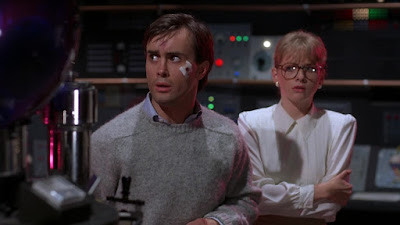
Although Jeffrey Combs provides a pretty much definitive reading of the nervous, weak-willed Lovecraftian protagonist here (it is difficult to read HPL’s description of Tillinghast’s “..high and unnatural, though always pedantic, voice” without recalling Combs’ unique line readings), he nonetheless seems aware that he is essentially a supporting character – a victim rather than instigator of events – this time around, despite his top billing on the poster, and he steps back accordingly. No match for the force of Pretorius’s malevolent sexual energy, Tillinghast essentially exits prior to the film’s final act, transformed into a mindless, albino monster before he meets his sorry fate.
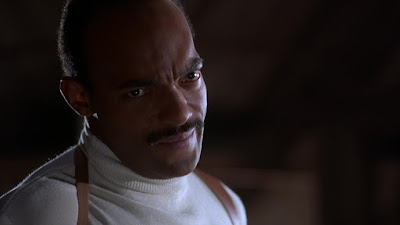
As for Ken Foree’s turn as good-natured cop ‘Bubba’ Brownlee meanwhile, he seems to have wandered in from another film entirely (perhaps taking a wrong turn on his way to audition for a pre-‘Lethal Weapon’ buddy-cop movie?), with his light-hearted banter and comedic appetite feel absurdly out of place in the Lovecraftian universe. It’s always nice to see Foree (whom you’ll recall from Romero’s ‘Dawn of the Dead’ (1977)) getting a good role, and it’s impossible not to be charmed by his shtick - but nonetheless, Bubba’s materialist attitude and steadfast refusal to countenance the ‘other’ clearly indicate that he is no fit protagonist for this story. Indeed, his former football pro libido counts for little in the relentlessly hetero eyes of Pretorius, whose shapeless minions proceed to eat him at the first convenient opportunity.


It is Barbara Crampton’s Dr Katherine McMichaels therefore who lives on to battle ‘From Beyond’s inter-dimensional overlord, experiencing by far the most well developed arc doled out to any of this film’s characters in the process, with her earth-bound transformations between different female pulp archetypes in a way mirroring the trans-dimensional shape-shifting of Pretorius himself.

Crampton’s solid performance in ‘Re-animator’ gave us some hints that she was more than just yr average ‘80s ‘scream queen’ (or rather, more than just a somewhat competent actress who was willing to go all the way re: the singular demands of that film’s finale), but with ‘From Beyond’, the filmmakers really gave her a chance to step up and turn the tables on genre expectation, essentially taking centre stage amid the libidinous, latex excesses of the movie’s hyper-sexualised take on cosmic horror, and the results are pretty wonderful.

A radical psychiatrist who, we are told, disapproves of locking up schizophrenics, Dr McMichaels is initially introduced to us her through her antagonistic relationship with the more authoritarian Dr Bloch (Carolyn Purdy-Gordon), who accuses her younger colleague of exploiting rather than rehabilitating her patients, using them as guinea pigs for her research as they are presumably allowed to run free to indulge their most destructive whims.

Be that as it may (and to be honest, the script is clearly just using these argument to set the stage for the mayhem which will occur once Dr McMichaels is assigned custody of the incarcerated Tillinghast, rather than attempting make any grander point about contemporary psychiatry), Crampton presents an almost comically buttoned up and repressed figure during these early scenes, complete with tightly bunned hair, woollen overcoat and oversized glasses. Even here though, she already manages to inject a hint of submerged kinkiness into her performance, failing to hide her obvious excitement when Tillinghast, confined to his asylum cell, begins to tell her of the work he and Pretorius carried out.

Once our gang are back at the Pretorius house, ostensibly in an attempt to help Tillinghast by repeating the experiments which led to his collapse, Crampton gradually dials up the more sensual aspect of her character, as her prim mannerisms and fusty exterior begin to feel more and more like some kind of perverse dress-up, as the true scale and freakery of Pretorius’s activities (both earthbound and supernatural) become increasingly clear to the good doctor.

It’s almost a relief therefore when, in classic camp / fairy tale fashion, Crampton lets her blonde locks down and dons the obligatory frilly nightie in preparation for bed time, allowing things to get really charged as she knowingly takes on the role of the timorous gothic heroine, practically role-playing it for Pretorious’s unseen spirit as she takes that same nocturnal walk toward the cursed attic that thousands have trod before her. Approaching, and indeed fondling, the rather phallic edifice of the resonator, she uses it to summon her learned lover from beyond as if it were some tribal fetish object, prompting a traumatic, slimy encounter with Sorel’s by now thoroughly inhuman patriarch, apparently magnifying both her attraction and repulsion to the heavily sexualised Other.
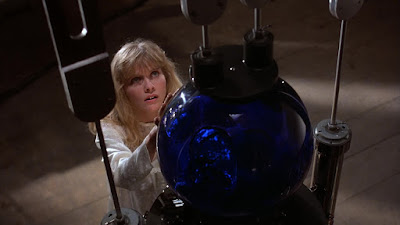
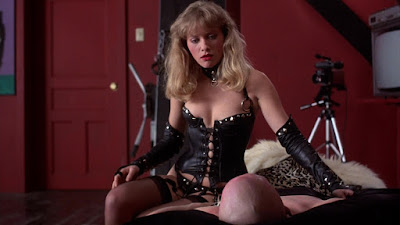
By the time Katherine has transformed herself, via the contents Pretorius’s on-site sex dungeon, into a kind of mind-blown, insatiable dominatrix, we’re heading into pretty uncomfortable territory here, as the warped hues of the film’s lighting and garish sleaziness of its interior décor becoming increasingly nauseous.

Following a delirious special effects showcase which sees Foree (in startling tight red y-fronts) and Combs (in a Miskatonic Uni t-shirt) battling a decidedly vaginal (yet also kinda phallic) giant worm in the infernal, flooded basement, Gordon leads us on helplessly toward the trademark, “this is going considerably further than I expected” / envelope-pushing type scene which he likes to include in each of his horror movies – which in this case involves Crampton, in full black leather fetish get-up, mounting the bruised and unresponsive body of Combs, who has been reduced to a hairless, shuddering albino after being swallowed and spat out by the suggestive, spectral worm. (And honestly, they wonder why the MPAA had some issues!)

If we can reclaim our jaws from the floor whilst all this is going on, we may again wish to award the filmmakers a gold star for defying expectation by casting Crampton as the aggressor here, and concede that ‘From Beyond’s weird detournement of the kind of titillation which hetero-male horror fans tend to consider their birth-right is in many ways quite admirable (for it is here that the dark mystery of the sex-horror ideal truly resides, cf: Cronenberg’s ‘Shivers’ or Franco’s Lorna the Exorcist). By this point in proceedings in fact, things have become infused with such a miasma of sickness – of, for want of a better word, grossness - that we can’t help but be to some extent relieved when Foree intrudes upon the scene, pulling us back to reality with a dose of good ol’ fashioned restraint and self-respect and/or slut-shaming reinforcement of patriarchal values [delete according to taste].

In terms of the moral schema through which the film’s script deals with all of these inter-dimensional sexual shenanigans, submission to one’s desires is framed as triumph of pure ego over collective human responsibility. Satisfaction, under the terms imposed here by the predatory Pretorius, can only be achieved through the destruction of another soul. When Foree’s character tries to snap Katherine out of her new persona as a kind of sleazoid, brain-washed nymphomaniac, there is more than just mere puritanism at work. Bubba, as an archetypical down-to-earth realist, realises that the kind of idealistic quest for mindless sensation embodied by Pretorius can lead only to destruction – first of the bodies and souls of others, and ultimately or oneself.

Trying to extrapolate some kind of real world analogue from all this, it occurs to me that proponents of sado-masochism and/or so-called polyamorous relationships might well be inclined to take offence at ‘From Beyond’s approach to sexual ethics, but, I’ll leave that battle for them to fight, should they wish to. Instead, I’ll merely state that, in terms of a horror movie, the conflict which rages within our characters between all-consuming ego rampage and the inter-personal respect for the bodily and cerebral identities of others, works very well.

Whether or not ‘From Beyond’ ultimately works as a film however, will largely be a matter of personal taste. Even if the production veers dangerously close to outright cheesiness in places, I’ve certainly grown to love it over the years, largely thanks to the excellent set of performances delivered by the cast (another Gordon trademark) and the astounding special effects work (that basement worm battle is really a thing to behold).

Many viewers though will doubtless find the excesses of the movie’s visuals and ideas difficult to process, and, whatever fans may have had in mind for a follow up to ‘Re-animator’ back in 1986, some lunatic fusion of ‘The Rocky Horror Picture Show’ and ‘The Thing’ on an Empire Pictures budget was probably not it. Though the film has amassed a considerable cult following over the years, the initial reaction of audiences and critics was far from kind, with the response of many leaving theatres probably best summed up by one of the more memorable lines uttered by Combs’ Tillighast; “That… will be quite enough of that.”

Though Brian Yuzna proceeded to follow this particular strain of latex insanity even further in the aforementioned ‘Society’, he soon retreated to the comparatively safer ground of ‘Bride of Re-animator’, and ‘From Beyond’ meanwhile seems to have led to a decade long hiatus in Gordon and Paoli’s Lovecraftian adventures, as the director transitioned straight into a series of considerably more audience-friendly (or perhaps more to the point, producer-friendly) ventures, beginning with the thoroughly wholesome ‘Dolls’ (1987). Thus, ‘From Beyond’ is left to stand on its own merits as a kind of fascinating historical aberration. All of the film’s principal creatives and cast members would go on to make good horror films after this, and all of them would return to Lovecraft in some form or another, but none of them ever again attempted anything quite this unconventional and tonally extreme.

----


(1) Published between 1933 and 1935, ‘The Fantasy Fan’ was founded by an Elizabeth, NJ based teenager named Charles D. Hornig. Although its circulation remained minimal (subscribers numbered around 60, and the print run never exceeded 300 copies), ‘The Fantasy Fan’ is remembered an an important title within the earl ‘weird fiction’ community, publishing work by Lovecraft, Howard, Derleth and Bloch, as well as correspondence from HPL, Clark Ashton Smith and Forrest J. Ackerman. Surprisingly given their rarity and fragility, extant copies begin at a not unreasonable $150 at Abebooks. Further info via Wikipedia.

(2) In fact, there are numerous parallels between ‘From Beyond’ and Corman’s ‘The Pit & The Pendulum’ in particular. Both are the second movies in a series, coming hot on the heels of an initial big success, and both make a point of pushing the envelope far further than their respective predecessor, incorporating uncomfortable sexual content with a concentration on torture and/or S&M. Both have a rather unhinged, hysterical tone and encourage a dreamlike sense of shifting, uncertain realities, and on some level they also tell similar tales of a younger character losing his/her identity to the fleshy, sensual obsessions of an absent patriarchal figure. Both films even make extensive use of red in their colour schemes, for goodness sake. Coincidence? Quite possibly, but just putting the idea out there.

(3)Interestingly, both the extreme colour scheme used in ‘From Beyond’ and the discussion of ultra-violet light in Lovecraft’s original story seem to mirror the approach to visualising ‘impossible’ colours utilised by Richard Stanley in his recent adaptation of ‘The Color Out of Space’. As both films make clear, MAGENTA is clearly the colour of cosmic horror.