Showing posts with label Kaidan. Show all posts

Thursday, 21 October 2021

Nippon Horrors:
Girl Divers of Spook Mansion
[Ama no Bakemono Yashiki]
(Morihei Magatani, 1959)


After hitting on the idea that making films about the female Ama divers of Japan’s remote coastal communities could prove a great way to get red-blooded males into cinemas, Shintoho studios must have found themselves wondering just what the hell kind of stories they could actually tell about these plucky maidens of the deep. So, in a sense, the idea of the splicing this nascent sub-genre with the series of interesting, low budget horror films the studio was also making at around the same time [also see: Ghost Cat Mansion, The Lady Vampire] must have been a bit of a no-brainer.

Which brings us to ‘Girl Divers of Spook Mansion’, the first in a brief flurry of ‘spooky Ama’ movies which also produced such unforgettable transliterated titles as ‘Ghost of the Girl Diver’ and my personal favourite, ‘Girl Diver Trembles in Fear’ (both 1960).

In real life of course, Ama divers were famed for setting out to sea in nothing more than loincloths, but in deference to standards of cinematic decency circa 1959, our divers here naturally all wear neat little halter-tops, big white bloomers and head-scarves. Pervs in the audience may be reassured though that, once they get down to sub-aquatic business, there's a whole lot of transparency goin’ on (all very tastefully done, mind).

(Those still protesting a lack of realism meanwhile may wish to reflect on the fact that, given the extreme physical duress of open sea diving and the level of expertise needed to carry it out effectively, the majority of real life Ama were liable to have been muscular, weather-beaten, mature women, in stark contrast to the happy-go-lucky gaggle of aspiring models and actresses seen strutting their stuff here; accuracy on this point however has never, so far as I’m aware, been demanded by these movies’ audiences.)

Whilst on the subject of the more exploitational aspects of these movies’ conception, Japanese genre film historians (hi, guys) may likewise wish to consider the scene early in ‘Girl Divers of Spook Mansion’ depicting a beach-side cat-fight between the leaders of two rival Ama factions, which plays out pretty much exactly like the equivalent stock scene from any given Toei ‘Pinky Violence’ movie a decade later. Indeed, lead diver Reiko Seto has a hard-boiled attitude and venomous stare that could have could have seen her managing quite nicely on the mean streets of early ‘70s Shinjuku.

Meanwhile, on the horror side of things, viewers expecting a lightweight, ‘Beach Party’ style affair are liable to be taken aback by the film’s unsettling credits sequence, which depicts members of the female cast frozen in various kinds of sinister/monstrous activity, mirroring the kind of tableaux traditionally seen in Japanese ‘ghost houses’ during the late summer Oban season.

Further to this, there is indeed some fairly strong kaidan-via-gothic type stuff to enjoy during the first half of the film, as the more central storyline sees a woman named Kyoko (future Toei star Yôko Mihara) arriving in the Ama village from Tokyo, after receiving a letter from her friend Waka (Kuniko Yamamura).

Waka appears to be living alone in a gigantic, Western-style mansion filled with an entire museum's-worth of dusty old statuary and antique knick-knacks from around the globe - seriously, the set-dressers just went crazy decking out this place - assisted, as as standard in such situations, by staff including a cackling hunchback and a sinister, stink-eye dispensing housekeeper who is often seen carrying a cat (rarely a good omen in these kind of things).

Waka claims she is being haunted by (I think) the ghost of her missing sister, who was last seen running toward the ocean after her husband was lost at sea, and indeed, some wonderfully spooky imagery and a few beautifully executed jump scares ensue. (Seriously, if jump scares were competitively-rated ala ice-skating, I’d hold up a “9” for these - just perfectly done.)

Disappointingly of course, it eventually becomes clear that the supernatural elements of this haunting are all phony, as Waka is actually being gas lighted by a gaggle of pleasingly maniacal villains who are looking to steal the family treasure, which it transpires is hidden in an underwater cave (and they would have gotten away with it too, if it weren't for those meddling pearl divers!)

Once the penny drops, there's still plenty to enjoy in the film’s more light-hearted, action/adventure-orientated second half however, including heavy Nikkatsu vibes as local youngsters groove to what sounds very much like Hawaiian music in the tiki-style beachside bar, and the wonderfully overplayed antics of the aforementioned villains (who include a corrupt, kimono-clad local politician and a lecherous, cigar-chomping fake marine scientist).

As is almost always the case with Japanese films of this era, the scope photography is splendid throughout, with the stuff in the shadowy, snake-haunted cave during the final act standing out as particularly atmospheric, even as it leads up to a great, LOL-worthy demise for the main villain. Perhaps best of all though, we get to enjoy the presence of a young Bunta Sugawara, making only his fifth credited screen appearance here as Mihara’s cop boyfriend. Spending much of his screen-time strutting around, Tarzan-style, in a pair of swimming trunks he appears to have stolen from a small child(!), Bunta makes for an engaging and off-beat presence here, as well as offering ‘a little something for the ladies’ in the midst of all the diving girls.

In closing, I should probably point out that I watched ‘Girl Divers of Spook Mansion’ without the benefit of subtitles, hoping that a rudimentary knowledge of basic Japanese vocab and a general familiarity with b-movie plotlines would see me through. As a result, I fear there were probably a number of story elements and sub-plots going on here which completely passed me by, and even the basics I've outlined above should be taken as a ‘best guess’. But nonetheless, I enjoyed the film a great deal.

Irrespective of the language barrier, the mixture of elegant, spook-house atmos, wistful seaside nostalgia, pulpy serial plotting and strangely wholesome titillation on offer here has much to recommend it, and viewers with a yen for the, uh, gentler side of Asian horror shouldn’t hesitate to dive in (sorry, couldn’t help myself) without delay.

--- 

Poster image borrowed from the ever-wonderful Pulp International.


Saturday, 24 October 2020

Nippon Horrors / Horror Express 2020 #10:
Kaidan Hebi-Onna /
‘Snake Woman's Curse’

(Nobuo Nakagawa, 1968)

 A decade or so after he turned out a series of fairly wacky horror pictures like Ghost Cat Mansion and The Lady Vampire for Shintoho, Nobuo Nakagawa - who had largely retired from directing after directly contributing to the bankruptcy of the aforementioned studio with his 1960 epic ‘Jigoku’ [‘Hell’] - returned to the fray for this considerably more conventional kaidan effort, produced under the unlikely auspices of Toei.

I say ‘unlikely’, because, although they soon would soon go on to cut a bloody swathe across the early ‘70s with some of the most grotesquely violent and OTT genre movies ever made, supernatural horror was never really Toei’s ‘thing’, leaving Kaidan Hebi-Onna [‘Snake Woman’s Curse’] feeling like a bit of a curious one-off.

According to what little background info I can find on the film, the production seems to have originated with writer Fumio Kônami, who apparently told the producers that he would only allow the studio to film his script if Nakagawa (who had not worked in the industry for about five years at this point) was hired to direct. (1)Apparently keen to try to establish a viable kaidan/horror line at the time, Toei acquiesced to the writer’s request, and…. bob’s yr uncle, as we say over on this side of the globe. (2)

Plot-wise, ‘Kaidan Hebi-Onna’ is in most respects a pretty standard, run-of-the-mill kaidan picture - essentially a variation on the old bakeneko (ghost-cat) story, in which a wronged woman returns from the grave with the help of an animal spirit to take her vengeance on the hateful aristocrats who have destroyed her family, only with snakes used as the totem animal this time around instead of cats.

Set (and presumably filmed) somewhere in Japan’s remote far western region, the story opens with an elderly peasant farmer (the ubiquitous Ko Nishimura), practically throwing himself under the wheels of the local landlord’s coach, as he begs for leniency vis-à-vis the repayment of his debts. Needless to say, such mercy is not forthcoming from the venal plutocrat (Seizaburô Kawazu), but, on his death-bed, the farmer is still pleading deliriously for the chance to save his family’s small-holding, uttering the key phrase which will go on to become something of a catch-phrase for the film’s spectral avengers: “even if I have to eat dirt, I will pay you back”.

After the man’s death, the landlord decrees that his homestead will be demolished in order to clear space for the planting of mulberry trees (used in the production of silk), whilst his wife (Chiaki Tsukioka) and adult daughter (Asa, played by Yukiko Kuwahara) are cheerfully informed that they will be taken into service in the landlord’s household, there to ‘work off’ their late patriarch’s debts.

As you might imagine, this is far from an idyllic prospect for the two women. Set to work weaving silk in what basically amounts to a small scale Victorian sweatshop, Asa must work sixteen hour days under the supervision of the landlord’s thuggish, lecherous son (Toei yakuza/action regular and future Roman Porno director Shingo Yamashiro), whilst her mother meanwhile becomes a general domestic dogsbody, bullied and belittled at every turn by the landlord’s sadistic wife (Kurosawa regular and future ‘Female Prisoner: Scorpion’ / ‘Sex & Fury’ legend Akemi Negishi).

Although their fellow servants treat them with kindness, and although Asa still has steadfast fiancée Satematsu (Kunio Murai) waiting for her on the outside, the inhumane treatment doled out to the two women leads them, inevitably, to their sad and undignified deaths. Asa’s mother, significantly, has always made a habit of habit of helping unloved animals (she was nursing a pigeon back to health when the family lost their home), and she is struck down whilst attempting the prevent the killing of a snake which has intruded into the landlord’s house.

As anyone who knows the ‘rules’ of this genre will be well aware by this point, the Big Man and his horrid family had better watch the hell out, as Nakagawa and his crew prepare to get busy with the thunder crashes, gel lighting, stage blood, green-faced living corpses and double-exposed snake effects, for the riotous closing act of vengeance-from-beyond-the-grave.

To Western audiences, these films often play more like ritual re-enactments of familiar folk tales than exercises in contemporary story-telling, which perhaps to some extent accounts for their failure to gain much of an overseas following, as the lack of novelty within their narratives can soon become pretty dispiriting. Once you’ve seen a handful of ‘em, you’ll know exactly how things are going to play out, right from the outset. The only interest comes from seeing how efficiently the filmmakers will accomplish their task, in technical and dramatic terms.

For domestic audiences however, we must assume this would not have been so much of a problem. More accepting of the traditions behind the bakeneko form, and more able to appreciate the more subtle cultural resonances within it, one hopes they would have been able to view each addition to the cycle with fresh eyes. 

(By way of comparison, we can perhaps imagine how a viewer largely unfamiliar with American culture would feel after being sat down and told to watch 25 early ‘80s slasher films. We might love them all for their minor eccentricities and variation on the theme, but to the uninitiated, aren’t they all kind of the same, more or less?)

In some ways, ‘Snake Woman’s Curse’ feels like a case in point in this regard. As eye-rollingly over-familiar as the basic storyline may be, look deeper and some very specific points of departure from the norm begin to emerge. For a start, the film is set during the Meiji era (1868-1912), a time of dramatic change and modernisation for Japan, immediately differentiating it from the more historically static Edo or Tokugawa eras in which kaidan stories more traditionally take place.

Again, domestic audiences would likely have been keyed into this right from the start, as the landlord is seen roaring through his domain in a Western-style coach, whilst his son sports a bowler hat and other foreign accoutrements. The mechanised ‘sweat-shop’ in which Asa is put to work likewise represents a form of industry unknown in pre-Meiji Japan, but whilst the the adoption of these innovations by the film’s villainous aristocrats would seem to indicate an implicit support for the older, folk-based way of life favoured by the hard-done-by peasants, the approach taken by Kônami’s script is, as usual, a little more nuanced than that.

The ambiguous attitude to modernisation and/or Westernisation so frequently encountered in early ‘70s Japanese genre cinema is perfectly encapsulated here via a memorable one scene cameo from Tetsurô Tanba, playing a regional police chief dispatched to investigate the murderous goings on within the landlord’s domain.

Effectively acting as the very personification of modern, democratic state governance, Tanba reduces the landlord to a fit of spluttering disbelief as he calmly undercuts the local lord’s Shogunate-derived feudal authority, daring to suggest that the police may wish to investigate the death of one of his peasants, and that he might even dare to implicate members of the aristocrat’s own family in the process - an absolutely unthinkable prospect for a man born into the strict caste system of the Tokugawa era, and an amusing demonstration of that the way that, however keen the ruling classes may have been to enrich themselves using technological innovations offered by contact with Western capitalism, their understanding of the social and political implications of such development tended to lack somewhat behind.

As you will no doubt have gathered from the preceding paragraphs, ‘Kaidan Hebi-Onna’ is about as politically conscious a kaidan pictures as you could possibly hope to find, taking the age old fantasy of the rural peasantry exacting revenge against their cruel feudal overlords baked into all bakeneko stories, and hammering it home for strongly than ever, applying it to a more nuanced, more realistic and more historically recent setting in the process.

Some might be apt to suggest that the film’s success as a horror movie suffers as a result of this heavy emphasis on socio-economic angst, and indeed Nakagawa’s pacing here is glacially slow, whilst the atmosphere he builds is painstakingly sombre. The inevitable horror ‘effects’ which dominate the final act meanwhile, whilst inventive and fun, are strictly conventional within the genre.

So, we’re definitely not looking at a Friday night horror banger here I’m afraid, but, if you can approach the film in an appropriately sober, arthouse-y frame of mind, Nakagawa’s execution at least is absolutely top notch. Performances are excellent across the board (in addition to the aforementioned esteemed actors, there are also turns from such Toei notables as Yukie Kagawa and Hideo Murota), whilst Yoshikazu Yamazawa’s photography, highlighting the fertile-yet-foreboding topography of Japan’s mountainous Western coast, is beautiful, radiating an overpowering brown n’ green aura which seems to link the earth where the snakes crawl directly to the hallowed afterlife from whence the spectres emerge.

Shunsuke Kikuchi’s score meanwhile is richly evocative, and the carefully wrought production design includes a wealth of great “folky stuff” (songs, costumes, local festival customs) for Japanophiles to enjoy. Most importantly perhaps, Nakagawa manages to imbue the script’s off-the-peg structure with a handful of genuinely haunting, transcendental images which will live long in the viewer’s memory after viewing.

Born in 1905, the director was sixty-three years old as the time of this film’s production, and it would be all too easy to interpret the slower, more meditative direction Nakagawa takes here as the work of a filmmaker trying to establish himself as a more ‘serious’ voice in cinema during the twilight years of his career, after half a lifetime spent churning out rushed 60 minute programmers and battling the studios for budgets.

Unfortunately for us reviewers’ desperate need to try to impose a narrative onto everything however, Nakagawa rather kicked this idea in the nuts by immediately going on to make a brief but prolific comeback as a commercial director in 1969, directing five action/yakuza pictures for Toei in quick succession before, curiously, adopting the pseudonym “Ise Tsugio” in order to make what I presume to be a series of obscure, independently distributed pinku (erotic) titles (ubiquitous S&M / rope torture guru Oniroku Dan is credited as writer on at least one of them). All of these hit cinemas before the year was out, with the director’s anonymity surely somewhat undermined by the fact that they were all proudly produced by his own ‘Nakagawa Pro’.

So, once again, we return to the idea of ‘Kaidan Hebi-Onna’ seeming like a real one-off - an odd, inexplicable diversion in the paths followed by its director, writer and studio. It is what it is, I suppose - but thankfully for those with an interest in this particular overlooked corner of Japanese culture, what it is is very worthwhile indeed.

---- 

(1) An absolutely pivotal figure in the golden age of Toei exploitation, Kônami (1933-2012) went on to contribute to a huge number of the studio’s best and/or most outrageous films from the early ‘70s, including the entire ‘Female Prisoner: Scorpion’ series, Sonny Chiba’s Yakuza Deka movies, the extraordinary Wolf Guy: Enraged Lycanthrope, the horrifying Zero Woman: Red Handcuffs and Kinji Fukasaku’s ‘Sympathy for the Underdog’ and ‘Graveyard of Honour’, to name but a few. 

(2) CREDIT WHERE IT’S DUE DEPT: All background info on the production of this film is taken directly from Jonathan M. Hall’s well-researched commentary track on the 2007 Synapse DVD release.

Sunday, 13 October 2019

Nippon Horrors / October Horrors 2019 # 7:
Unbalanced Horror Theatre:
A Mummy’s Love

(Seijun Suzuki, 1973)

Sometimes, it’s difficult to know where to even start with these things.

So, let’s try this.

The narrative that has developed around the late Seijun Suzuki has tended to suggest that he more or less disappeared into the wilderness following his dramatic dismissal from Nikkatsu studios in 1967, only re-emerging when he helmed his critically acclaimed ‘Taisho trilogy’ in the early 1980s. In reality however, reports of Seijun’s invisibility during the 1970s have been greatly exaggerated. As his fans in Japan will be well aware, the idiosyncratic director actually kept busy and remained to some extent in the public eye throughout these ‘lost years’.

Indeed, viewed in the light of Nikkatsu’s decision to dedicate their resources entirely to the production of low budget ‘roman porno’ features from late 1970 onwards, and the subsequent collapse of the contract-based Japanese studio system as a whole in the mid-to-late ‘70s, it could easily be argued that Suzuki’s early dismissal basically just gave him a head-start in adjusting to the situation that most directors of his generation found themselves facing a few years later – interspersing more low-key, independently-financed films (if they were lucky) with voluminous quantities of TV work and commercials.

Which brings us neatly to ‘Kyôfu Gekijô Umbalance’ [‘Unbalanced Horror Theatre’], a weekly anthology series produced by the legendary Tsuburaya-Pro (home of ‘Ultraman’, etc), thirteen episodes of which were broadcast on Monday nights on the Fuji TV network, beginning in January 1973.

In terms of its creative ambition and production values, this series seems to have represented something akin to a Japanese take on the BBC’s celebrated ‘Ghost Stories for Christmas’, and it also seems to have acted as a bit of a ‘life line’ to other struggling Nikkatsu directors, with Suzuki’s erstwhile colleagues Yasuharu Hasebe and Toshiya Fujita also contributing episodes.

Suzuki’s entry in the series however was the first to be broadcast, and is thus far the only one I’ve been able to track down with English subtitles. And, purely on this basis, I’m inclined to think that ‘Unbalanced Horror Theatre’ was pretty aptly named. To not put too fine a point on it, ‘Miira No Koi’ [roughly, ‘A Mummy’s Love’], first broadcast to the nation on 8th January 1973, is absolutely mental.

Frankly, even the series’ opening credits, in which twisting patterns of psychedelic flames are back-projected onto the looming silhouette of a roaming cat, to the accompaniment of shrieking, discordant strings and electronics, were enough to get me jumping out my seat, but once the story proper gets underway, all bets are off.

Suzuki’s reputation as a devil-may-care surrealist is immediately in evidence here, as he begins by cutting in a disorientating fashion between seemingly unrelated shots - close-ups of red warning lights at a railway crossing, and visions of a scraggly-haired skeleton in meditational pose floating toward the viewer – whilst voiceover narration, in a gentle female voice, also competes for our attention.

The woman who is speaking to us, it turns out, is a widowed employee of a publishing house who is travelling to visit an elderly and infirm professor, who has been working on a new translation of a work known as Harusame Monogatari (‘Tales of the Spring Rain’) – a genuine collection of folkloric tales, compiled by the famous writer and scholar Ueda Akinari in the years immediately preceding his death in 1809. The narrator describes this book as a “maddening and terrifying work”, and, on the basis of the story from it we’re treated to here, I’m inclined to take her word for it.

Pausing at the railway crossing, the woman encounters a small family car, driven by a chauffeur in full top-hatted finery, who gets out and doffs his hat to her. Inside the car are a Buddhist monk and a woman in formal, Edo period garb (complete with bakeneko type eye makeup). Our narrator is alarmed by the appearance of the monk, whom she declares conveys an “uncanny impression”, “like a doll”.

Before we realise what’s happening, we cut to a series of expressionistic studio tableau shots, reminiscent of some of the primary coloured effects Suzuki used a decade earlier in his masterpiece Gate of Flesh. We see the woman who has sitting in the car performing some kind of ritual before a bare tree branch, as the narrator’s voice fills us in on the nature of the ‘Nyujo’ Buddhist sect, whose adherents apparently attempted to attain enlightenment by confining themselves in wooden boxes and being buried alive.


Another sudden jump cut takes us back into the top-knotted, Shogunate past, where a studious young man named Shoji lives in a remote village with his mother. Shoji finds himself bothered by the sounds of a bell ringing somewhere in the vicinity of their house during the night, and, determining that these sounds emanate from the bottom of a disused well, he announces that they must belong to a “bodhisattva petitioning to return from the Pure Land”.

So, the young student starts digging, attracting a crowd of local on-lookers in the process. Eventually, the villagers succeed in unearthing a desiccated, mummified ancient sage, who was apparently buried in the lotus position.

Suzuki marks this discovery by suddenly cutting to a shot of an explosion taking place in some kind of thatched building, and a freeze-frame of the young student leaping in the air in front of it, after which the villagers begin hysterically laughing and bickering, kicking the polystyrene mummy prop around as if it were a football and cursing the unearthed monk for his apparent uselessness. Vaseline or something similar appears to have been smeared all over the lens for these shots, giving everything a woozy, unclear feeling, as if viewed through cataracts. (I’d also bet money that none of this was in the script.)

As the student and his mother set about resuscitating and caring for the revived ancient, whom the villagers have nicknamed ‘Nyoju no Josuke’ [very roughly, “guy in a trance”], it turns out that the predictions of his uselessness were entirely justified.

One of the monk’s first actions upon regaining consciousness is to attempt to molest a local woman (he is discovered in the rafters of a barn, making bird noises after she flees in terror), and, much to the villagers’ chagrin, he subsequently turns out to be a mute, drooling simpleton who displays no evidence of his apparent enlightenment.

Indeed, in stark contrast to the asceticism one would expect of such a high level sage, his sole interests in life seem to be stuffing his face, leering at women and giggling like a creep. This sends the young student who unearthed him into an existential rage, as he angrily questions the very basis of his nation’s Buddhist beliefs.

Before long, Josuke - who, hilariously, is played by none other than cult writer/director Atsushi Yamatoya, who worked with Suzuki on the script for ‘Branded To Kill’ and helmed a series of notable avant garde pink films, including 1967’s ‘Inflatable Sex Doll of the Wastelands’ - has become a kind of despised village idiot figure, bumbling around in a dirty nappy and performing simple chores for the villagers.

Josuke’s antics, it should be noted, are accompanied by an incredibly strange music cue, which appears to blend digeridoo-like devotional chanting of Buddhist sutras with a light jazz/funk drum beat, effectively complementing the story’s crudely heretical themes, and cementing the surreal / comic mood. [IMDB credits this episode’s music to famed analogue synth maestro Isao Tomita, but I’m guessing he probably just provided the series theme tune, leaving the authorship of this weird music a mystery.]

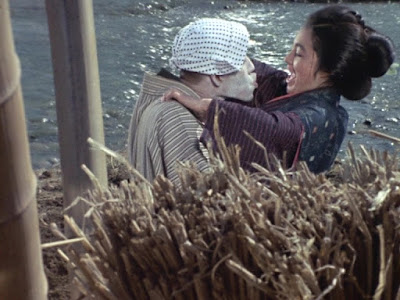
When Josuke is discovered hiding in a haystack by a fornicating couple upon whom he is spying, they proceed to taunt him, with the woman suggesting he’d have more luck with the ladies if he were reborn as a kabuki actor – prompting our drooling bodhisattva to take on an even more grotesque appearance, plastering his face with theatrical make up, and wearing a handkerchief on his bonce in imitation of a kabuki head-dress.

Thus far, the portrayal of Josuke seems to have been inspired to some extent by the classic Karloff ‘Frankenstein’s Monster’ archetype. Abandoned by his creator (or, uh, resurrector I suppose in this case) and shunned for his ugliness and inability to communicate, he gazes at his reflection in the river and so forth, inviting our sympathy. But, Karloff’s creature was never characterised as a goon-ish, slovenly sex fiend, and Frankensteinian mythos certainly offers us no analogue for what happens next, as Josuke’s new look unexpectedly succeeds in attracting the attentions of an impoverished young widow, to whom he is promptly married, or so the narrator (who has now become an elderly, croaking male voice, incidentally) informs us.
The narrator further relates that “Josuke had held within him an appetite for women for hundreds of years”, as a result of which, the couple make love continuously for seven days and seven nights. On the eighth day, they take a quick breather, and the woman collapses in pain, screaming that she is about to give birth. The frantic ringing of Josuke’s bell attracts the attention of the villagers, who, upon arrival, find clouds of bright pink smoke billowing from the widow’s house.

When the men, led by Shoji, break into the house, they find the woman dead, and, well, I don’t know how to tell you this, but… she appears to have given birth to dozens of tiny, gold-skinned Buddha people, who are crawling around all over her corpse like little human worms, ringing their miniature bells.

Understandably maddened by this terrible sight, the young student pretty much loses his mind, and begins crushing and stomping the little people, who collapse into dust at his touch. “What is a Buddha? What is resurrection? What have we been praying to all this time? Kill them all!” he cries as he tramples the tiny golden monks, encouraging the other villagers to join him in the destruction, kicking up clouds of Buddha-dust which soon cover them all.

Josuke meanwhile flees the scene with an angry mob in hot pursuit, commandeering a hay cart whose under-cranked progress drives him straight over the edge of a nearby cliff-face to his doom.

At some point subsequent to these awful events, Shoji takes a bride, but as soon as the young student and his partner attempts to consummate their marriage, they are interrupted by the tolling bell of the feral Nyoju no Josuke, who lurks cackling outside in the shadows.

Wondering the land in a daze, looking increasingly filthy and unhinged, the young man begins obsessively digging up the ground in the various locations where this story has taken place, in search of the ringing bell which plagues him. “From that point on, Shoji never touched a woman again,” the narrator tells us. THE END.


Still reeling, we cut back to the 20th century, where the woman whom we were following at the start of all this has arrived at the home of the professor who was working on the Harusame Monogatari, and has been transcribing his recitation of the tale outlined above.

The professor seems to pretty much at death’s door, far gone with some kind of consumptive illness, and his rooms are cramped, messy and seedy. Despite his illness however, the prof’s manner is intense and unnerving. He rambles on weirdly about the story of the resurrected monk as if it were verified truth, insisting that such things have actually occurred, and he further upsets his visitor – a former student of his - by unexpectedly producing a photograph of her late husband, who died as a young officer in the Pacific War.

Amid his ravings, the professor tells the widow he believes her husband is still alive, “like Nyoju no Josuke,” and that he has seen him walking around the era. He then becomes lecherous and grabby, attempting to assault the widow, who promptly leaves the house, suitably unnerved by her experience.

These scenes are sweaty and claustrophobic, with Suzuki slowly tracing his camera back and forth across the characters’ prone bodies, cutting between extreme close-ups of their eyes, as if it were some twisted Jess Franco sex scene, emphasizing the feeble desperation of the professor and the crushing loneliness of the widow, culminating in an intensely uncomfortable moment in which the professor’s sinister nurse attends to his needs with an incontinence bottle, whilst the sound of an air raid siren is heard on the soundtrack.

On her journey home through the stormy night, a shortcut takes the widow to the ruins of the air-raid shelter where her husband died. Some of the photography here is hauntingly beautiful, employing rich primary colours, deep blacks and chaotic compositions which again momentarily remind me of ‘Gate of Flesh’ – notably I think, another work which sought to exorcise the trauma of war through a kind of melancholic, sexualised desperation.


In order to leave the reader with at least some surprises should they seek out this TV show, I will break off my synopsis at this point and leave the story’s conclusion a mystery, but needless to say – it’s unpleasant, horribly ambiguous yet perversely beautiful -- and a final smug, Rod Serling-like farewell from series host (and future mayor of Tokyo) Yukio Aoshima does little to ease our frazzled senses or let us tie the threads of our conflicted emotions after all this startling business concludes.

Though I’ve drawn some comparison to Suzuki’s earlier work above, viewers familiar with Japanese genre cinema will inevitably emerge from ‘Miira No Koi’ with the name of ero-guro specialist Teruo Ishii on their lips. Indeed, this episode’s unsettling mixture of goon-ish comedy, twisted sexuality and malign visionary surrealism feels very much of a piece with the extraordinary series of “torture” films Ishii produced for Toei in the late 1960s, whilst the tiny, gold-skinned Buddhas seem to have been drawn straight from the same well of imagery as Ishii’s controversial Horrors of Malformed Men. Even Yamatoya’s performance as Nyoju no Josuke seems, when he initially appears, to echo the style of Iishi’s most distinctive collaborator, the pioneering Butoh choreographer Tatsumi Hijikata.

Going further, you could even make the case that there are moments here which recall the mad, performative psycho-analytical freak-out feel of Alexandro Jodorowsky, but really, such comparisons count for little. Ultimately, the clammy, unsettling feeling ‘Miira No Koi’ leaves us with is unique, even within Suzuki’s work.

In its own crazy way, this story seems determined to push the envelope in directions viewers tuning in for a more traditional ghost story would never have anticipated, interrogating themes that Japanese audiences in particular are liable to find deeply disturbing to this day. Not only do Suzuki (and writers Fumiko Enji and Yôzô Tanaka) treat the Buddhist traditions of resurrection and reincarnation which underpin much of their nation’s shared culture with nigh-on blasphemous scorn, they go one step further in suggesting that these received metaphysical notions have been chronically warped and devalued by the abusive lusts of a patriarchal social order, whilst simultaneously evoking harrowing memories of the personal loss and grief embodied in the mass death of the Second World War (still, lest we forget, well within the living memory of many viewers in 1973).

Digging into some deep, sticky psychic wounds, the goat-ish humour of this initially frivolous and absurd tale gradually gives way to some far more disturbing; safe to say, it must have left an impression difficult to shake off in minds of its initial viewers.

Wednesday, 17 October 2018

Nippon Horrors / October Horrors #9:
Ghost Stories of the
Seven Wonders of Honjo

(Gorô Kadono, 1957)


Original title: 怪談本所七不思議 / 'Kaidan Honjo Nanafushigi'

The introduction to this Shintoho b-feature could prove a bit perplexing for us many of us gaijin, as voiceover narration tells us about a Tanuki (Japanese ‘racoon-dog’) who lives in a certain area (is it Honjo?), and seems to have especially noteworthy magical powers, but the narrator never really gives us the full low-down on this, because it seems to be assumed that everybody already knows all about it..?

Well, no problem – such are the pleasures of watching films whose makers would never have dreamed that people on the other side of the world would be assessing their efforts sixty years later.

Anyway, both the film’s title and this intro (in which forthcoming events are briefly ‘previewed’ via super-imposed shots of assorted characters we have yet to meet) would tend to suggest that we’re in for an anthology film -- an extremely cut price ‘Kwaidan’, perhaps? What fun! Actually though, once things get going, it soon becomes clear that the film (which clocks in at a sprightly 54 minutes) intends to concentrate on just a single ghost story, and an achingly over-familiar one at that. But, like most of these Shintoho ghost pictures, it’s an enjoyable business nonetheless, and not without its own quirks and surprises along the way.

Initially for instance, we meet a pair of fishermen, who, eager to get to their favourite drinking place before they run afoul of that aforementioned Tanuki, run instead into a brace of Yokai, including such ten carat spooks as a faceless woman (Yokai ID currently undetermined), a big guy with the eye in his forehead (an Ao Bōzu variant, perhaps?), the ever popular hopping umbrella thing (Karakasa-kozō), the big head dude (Abura-sumashi), and even a brief appearance by everybody’s favourite, the long-necked Rokurokubi.

The effects here are actually pretty great – easily the match of those seen in Daei’s Yokai films from the ‘60s – and, though brief, it’s all lots of eerie fun. (I particularly liked the bit in which, in an odd reverse Charles Fort kinda thing, the fishermen’s catch begins to levitate, and floats off into the sky.)

The next thing we know, the aggrieved fishermen and a bunch of their friends seem to have caught the mischievous Tanuki, whom they hold responsible for sicing the spooks upon them. Before they can turn it into soup however (for such is their stated intention), the animal is rescued by an elderly samurai patriarch (Hiroshi Hayashi) who happens to be passing. Fresh from visiting the grave of his first wife, he takes pity on the poor creature, and feels an urge to save it from the brutish treatment the fishermen no doubt have in mind.

Back home however, the old man has plenty of troubles, not least the fact that his rogueish nephew (the splendidly seedy Shigeru Amachi, whom you’ll recall from The Lady Vampire and several Zatoichi instalments) is trying to scam money off him whilst simultaneously making time with his much younger second wife (Akiko Yamashita), with whom the debauched young samurai had a fling at some point in the past. (1)

Fear not though, as the grateful Tanuki spirit appears to the old man in the form of a charming young girl (Michiko Tachibana) and her accompanying folk dancing troupe. The Tanuki pledges to protect the elder’s interests in return for his saving her life, so… what could possibly go wrong, right?

It’s rare to see a Japanese period film in which the aristocratic patrician guy turns out to be the aggrieved victim of the inevitable crimes and betrayals rather than perpetrator, but Amachi and Yamashita are such a convincingly vile pair of ne’erdowells that, as soon as they’ve teamed up in an adulterous union and started plotting to dispose of the old geezer, our sympathies are firmly nailed down, and we basically know where this is all heading.

Happily though, the film soon breaks away from the formal, ‘staged folk tale’ feel common to many earlier Japanese ghost films, allowing this standard issue tale of supernatural vengeance to become a simple, yet gripping and sensationalistic, b-movie melodrama, dynamically directed by the little-known Gorô Kadono, and played out with theatrical vigour by the cast.

Considering the year of production, a surprising amount of sexual impropriety follows the inevitable violent demise of the patriarch, as the leery Amachi has his wicked way with the bride of his morally upstanding cousin and Yamashita engages in some heavy-duty flirting with craven servant Gosuke (Saburô Sawai). Meanwhile, the lightning flashes and the winds howls outside the noble family’s now thoroughly profaned residence, and we all know that a bad end for the murderous adulterers will soon be on the way.

Justice soon marches in the corporeal form of the deceased patriarch’s aforementioned chivalrous son, who has returned from an extended stay in Edo upon hearing of his father’s death (I like the fact that this good samurai helpfully wears a white kimono, whilst Amachi of course favours black), whilst our mischievous Tanuki meanwhile is of course cooking up a right old storm in the spirit realm.

It may seem a bit disingenuous to claim that a film derived (at some level of remove, admittedly) from Japanese folklore was influenced by ‘Macbeth’, but, given that Kurosawa’s ‘Throne of Blood’ had premiered seven months before this film saw release in July 1957 (just in time for the Obon season, perhaps?), the possibility of a bit of hand-me-down influence doesn’t seem entirely out of the question.

Certainly, the echoes here of Shakespeare’s immortal yarn will be plainly obvious to Western viewers, and the film definitely succeeds in evoking what I can only describe as a ‘Macbeth-type atmosphere’, as what initially seemed like a light-hearted, fairy tale type film is gradually transformed into a doom-laden supernatural revenge tragedy, culminating, inevitably, in a rain-soaked, chanbara blood-bath in which the villainous Amachi gets what’s coming to him via his cousin’s shining blade.

It’s nothing we’ve not seen many times before, but I for one am happy to see it again, and, with all this blood-curdling incident compressed into less than an hour, the story certainly doesn’t outstay its welcome. Despite the miniscule budget, the kaidan atmosphere here is thick as a bowl of fermented miso, and all the stuff with the Yokai and sundry other ghostly manifestations is a lot of fun.

There’s also a great bit with a gravel-voiced Buddhist exorcist doing his thing, until his ritual is curtailed by a rain of poisonous snakes (!), and, whilst I won't spoil the details of the fate the Tanuki and her multitudinous ‘friends’ contrive for the bad guys, but it’s rather delirious and wonderful, in the best tradition of these kind of b-kaidan pictures.

Strangely enough, the most disappointing aspect of ‘..Seven Wonders of Honjo’ is probably the music, which consists of lazy/random needle drops that often undermine the painstakingly rendered atmos to a certain extent, particularly during the finale, in which the highly charged sword battle is sound-tracked by what sounds like a jaunty, brass band marching theme that sounds like it was pulled off some dusty old disc left behind by the U.S. occupying forces.

I can’t for the life of me imagine why the film’s producers chose to lay this down over the action in preference to some more appropriate and evocative Japanese music (which must surely have been available to them), but, given the extreme haste with which films like this one were presumably knocked out, I doubt anyone had time to quibble over such details in post-production. Visually, this scene is excellent, so it's a real shame that the music makes such a mess of it, but what can you do?

That aside though, whilst this marginal and rather eccentric item may not exactly be the best place to start with vintage Japanese ghost films, it’s a delightful surprise for those us of who already have a taste for them.

I’m still none the wiser regarding “the Seven Wonders of Honjo”, but I’m sure they can wait for another day.

(My profound thanks to the heroic souls who recently fan-subbed this film and stuck it up on the interweb, incidentally.)

---

(1) An actress who seems to have worked almost exclusively in the milieu of Shintoho ghost movies, Yamashita can also boast appearances in in ‘Girl Divers at Spook Mansion’ (1959), Ghost Cat of Otama Pond (1960), and an apparently Western-inclined vampire movie whose existence I was previously unaware of, 1960’s ‘Vampire Bride’ [‘Hanayome Kyûketsuma’].

Saturday, 5 December 2015

Nippon Horrors:
Ghost Cat Mansion
(Nobuo Nakagawa, 1958)


Before he embarked upon his attempt to make the ‘ultimate horror movie’ in the form of 1960’s startling ‘Jigoku’ (‘Hell’) – a film so ambitious that many claim it played a significant role in bankrupting the financially fragile Shintoho studios – director Nobuo Nakagawa had already made a name for himself as an important contributor to the rather marginal field of Japanese horror cinema, shooting a series of low budget programmers during the years 1957-59 that arguably represent the first conscious attempts to incorporate more modern (eg, Western) horror tropes into the highly formalised tradition of classical Japanese ghost stories.

Nakagawa’s films ran the gamut of popular horror themes, both Japanese (‘Yotsuya Kaidan’, 1959) and foreign (‘Lady Vampire’, also 1959), but today we’re going to be looking at his take on the ubiquitous bakeneko / ghost cat mythos, ‘Bôrei Kaibyô Yashiki’, variously tanslated as ‘Mansion of the Ghost Cat’, ‘Black Cat Mansion’, or my preferred combination of the two options, ‘Ghost Cat Mansion’.

As has previously been discussed on this blog in reference to Yoshihiro Ishikawa’s Ghost Cat of Otama Pond (1960), variations on such stories seem to have exercised a persistent hold over Japanese filmmakers and audiences, with a history of bakeneko titles stretching back to the silent era, and, more pertinently to the film at hand, those who have read that review will also recall that, prior to making his solo debut with ‘..Otama Pond’, Ishikawa had previously worked as Nakagawa’s assistant on most of his pre-‘Jigoku’ horror films.

Whilst the ‘master & protégée’ relationship between the two men must be thus acknowledged, the sad truth is that my prior viewing of ‘..Otama Pond’ lowered my subsequent enjoyment of ‘Ghost Cat Mansion’, simply due to the fact that, for a sensation hungry modern viewer at least, Ishikawa’s film is basically much better – a wilder, stranger, more ambitious and visually splendid take on the ghost-cat formula than that achieved by his sensei a few years earlier, even as it covers about 75% of the same ground, stylistically speaking.

This is not to imply that ‘Ghost Cat Mansion’ is anything less than a perfect satisfactory (and indeed somewhat innovative) example of bakeneko cinema of course. In fact, its deficiencies in comparison to the later film likely stem mainly from its more obvious origins as a rushed, cash-strapped b-movie, rather than from any lack of ambition on the part of its makers, and as such, it’s probably best if I nix the unfair comparison between the two films for now and allow ‘Ghost Cat Mansion’ stand on its own not-inconsiderable merits.

It certainly gets off to wonderfully atmospheric start, that’s for sure. Subjective POV torch beams prowl the darkened corridors of a deserted Tokyo hospital, taking us eventually to the skeleton and specimen jar filled lab of a doctor who is apparently pulling an all-nighter. Who could that be on the stairs, he wonders, as the heavy footfalls of whoever we were following with the torch creak the floorboards outside. This, the doctor muses to himself, reminds him of certain events that transpired six years ago, and, like some doomed noir protagonist awaiting a terrible fate, he calmly sits down and lights a cigarette, awaiting the arrival of his sinister visitor.

Cue flashback to six years earlier. The doc’s wife is suffering from TB, and, to aid her recovery, the couple have left Tokyo and moved back to her familial home on the Southern island of Kyushu. For reasons that never really become clear, the doctor’s brother-in-law has secured them lodgings in, uh - a shunned, clifftop haunted house in which no one has lived for over a century. (That his brother-in-law might be somewhat of a jerk is a possibility the doctor may wish to consider, but it is not something the filmmakers choose to dwell upon here.)

As you might well have expected, upon moving into their new home, the couple and their household almost immediately experience all manner of spooky goings-on, and in particular, they become subject to frequent visitations from a particularly persistent and terrible variation on the inevitable kaidan white-haired-old-lady ghost. Not even so much a ghost in this case in fact, but a full-blown monster of apparently palpable form, this bastard hag proceeds in short order to kill the family dog and terrify the nurse who is helping the doctor establish a new clinic, before repeatedly utilising prank phone calls and disguised voices to gain entry to the house, on each occasion making a bee-line straight for the long-suffering wife, whom she proceeds to strangle to the point of near-death, only to disappear when interrupted at the last moment.

Understandably unnerved by all this grim incident, the doctor temporarily puts his rationalist principles on hold and pays a visit to a venerable local Buddhist priest, who promptly makes with the old “ah yes, I remember the dark legends connected to that dreadful old house..” routine, prompting (as per the formula of every other bakeneko movie I’ve seen to date) another flashback within the flashback, this time taking us back to (I assume) the Edo Period – a change accompanied by a corresponding shift to colour photography.

Up to this point, it must be said that ‘Ghost Cat Mansion’ has been directed with great skill. The opening creep though the hospital and the couple’s initial investigation of the haunted house both utilise the inherently terrifying combination of smooth, slow camera movements and wide, empty spaces that would later be perfected by Masaki Kobayashi in his epic ‘Kwaidan’ (1964), and even minor incidents such as a moment when the couple’s car is run off the road by a stray cat are conveyed using jarring, Hitchcock-esque mini-montages that further add to the somewhat ‘Carnival of Souls’-esque sense of icy, detached unease.If, as I’ve always thought, the key to creating a genuinely scary story is to present a world that seems sinister and somehow off-balance even before anything spooky happens, then it’s safe to say that Nakagawa succeeds here with aplomb.

It is a shame then that once the action shifts to the past and the photography switches to a rather drab variety of colour, this carefully wrought atmosphere largely vanishes. Suddenly, Nakagawa’s direction becomes blandly formal, whilst the obviously set-bound backdrops take on an unnatural, theatrical feel and the acting becomes stiff and melodramatic. As with many older Japanese period dramas, it sometimes feels more as if we're watching a local theatre reenactment of a well-known legend than an engaging piece of cinema.

Anyway, the flashback story here chiefly concerns the abuses of power perpetrated by one Lord Shogen, a wealthy local daimyo (and patriarch of the future haunted mansion of course), who is, to put it mildly, a bit of an arsehole.

When we first meet Shogen, he is on the verge of slaughtering his most trusted servant for some minor infringement of protocol (the servant’s life is only spared after Shogen’s upstanding son intervenes), and the Lord’s inordinately aggressive and cowardly behaviour only gets worse from thereon in.

In brief then, dark powers of a vengeful and supernatural nature are eventually evoked to deal with this disagreeable fellow following an incident in which he summons a young samurai and renowned Go master to his chambers to tutor him in the finer points of the game. Unfortunately however, the young man makes the fatal error of playing Shogen in a fair contest, refusing to let the diamyo cheat and replay his moves, with the inevitable result that lord grumpy-pants becomes so irate that he eventually snaps and, grabbing his katana, redecorates his dayroom with the samurai’s blood.

When Shogen subsequently has the audacity to avoid responsibility for the killing by claiming that the young man instantly left for Kyoto to further study Go technique after becoming embarrassed when the Lord defeated him in the game, the samurai’s blind mother – for whom he cared and provided sole financial support – cannily disbelieves him, and, visiting the daimyo to try to discover what actually happened to her son, her suspicions turn to futile rage after the hateful old bastard adds insult to injury by taking the opportunity to rape her.

As she contemplates her sorry state, the blind woman is visited by a ghostly vision of her son, who confirms the truth of her suspicions about what happened to him, and, seeing no way forward, she clutches her beloved pet cat to her bosom and uses a dagger to take her own life, calling on the spirit of her cat to execute her vengeance from beyond the grave. Before her blood has even dried of course, it’s ghost-cat-a-go-go for the folks in the mansion on the hill.

One thing I like about the avenging spirits in these bakeneko stories (and indeed in Asian ghost stories more generally) is how absolutely ruthless they are, in comparison to their more genteel, ‘poetic justice’-inclined Western counterparts. In this case for instance, all of the evil in the story has emanated directly from Lord Shogen himself. His mother, son and servants are all portrayed as sympathetic characters, as much the victims of his cruelty as anyone else - but just try telling the ghost-cat that! The dying woman specifically issued her curse against the bad man plus his entire family, his household and his descendants, and ghost-cat’s not taking any prisoners.

Indeed, the first thing the avenging ghost does is possess the body of the daimyo’s elderly mother, transforming her not only into the image of the wild, white-haired hag seen in the film’s present day section, but into an actual anthropomorphic cat-monster! Regrettably for anyone still taking ‘Ghost Cat Mansion’ seriously by this point, the result of this transformation is frankly hilarious, prompting a ten minute segment in which the film goes absolutely berserk.

“My mother took a carp from the pond and went under the house?!” exclaims the daimyo at one point when a servant relates details of his mother’s disturbing cat-like behaviour, and by the time the cat-mother – her costume complete with pointy, fluffy ears that spring upward when she raises her head – begins busting out the familiar J-horror lady-ghost device of using an invisible fishing rod to draw her victims toward her like a sci-fi tractor beam, even the most determinedly straight-faced viewers will be hard-pressed to suppress a few WTF-ish guffaws.

As the ghost-cat’s rampage reaches its bloody conclusion, Nakagawa utilises prototypes of many of the quasi-psychedelic visual effects later employed by Ishikawa In ‘..Otama Pond’, with everything from double-exposures and giant, looming cat shadows to random, Bava-esque coloured gel lighting wantonly thrown around, to pleasantly psychedelic effect. Though such effects are neither as extensively nor effectively used as in the later film (here for instance, the coloured lighting simply consists of spinning, multi-hued spot-lights that come out of nowhere to assault the tormented Lord Shogen), this is all still jolly good fun, needless to say.

Thankfully, this excessive and unhinged atmosphere is to a certain extent maintained when we return to the black & white ‘present day’, wherein a charm proffered by the priest and the disinterment of the mouldering skeleton of the Go master (who had been bricked up Poe-style within the walls of the house) helps the doctor and his wife return their angry revenant to its resting place, in a wind-swept, lightning-riddled finale that remains very enjoyable – at least until a thoroughly disappointing bummer of a contrived happy ending follows

Flawed though it may be, I don’t believe that ‘Ghost Cat Mansion’s deficiencies are *quite* serious enough to ruin the good feeling generated by its highlights. Although budgetary contraints and tonal inconsistencies mean that no one’s ever likely to single it out as a masterpiece, it is nonetheless a wild and wooly bit of quintessential Japanese b-horror, rich in authentically creepy moments and full-on weirdness that fans of the particular ‘feel’ generated by this kind of thing are liable to cherish.

Thursday, 17 July 2014

Nippon Horrors:
Ghost Cat of Otama Pond
(Yoshihiro Ishikawa, 1960)


Thus far in this ‘Nippon Horrors’ strand, we’ve been looking at movies that are either modern style, Western-influenced horror films, or else just lunatic one-offs of one kind or another, but it is of course impossible to gain an understanding of Japanese horror without examining the more traditional k(w)aidan tales that comprised by far the most prolific category within the genre prior to 1970. And if we’re talking kaidan, then before long, we’ll be talking kaibyo, aka bakeneko, aka GHOST-CATS - a subject that the movie-going public in Japan apparently couldn’t get enough of, with a catalogue of titles stretching right back to the dawn of cinema.

If I started trying to run down the folkloric roots of these ‘ghost-cat’ stories, we’d be here all day, but needless to say, specific ghost-cat legends pertaining to such locales as Okazaki, Arima and (most pertinently in this case, perhaps) Kasane Swamp go back at least a few hundred years, and formed a cornerstone of the canon of supernatural kabuki plays, woodcuts and novels that fed straight into the earliest Japanese fantastic films.

Although most of Japan’s silent-era films are now lost, surviving records indicate that the Okazaki ghost-cat legend alone was filmed three times prior to 1917, once by the esteemed “father of Japanese cinema” Shozo Makino no less, whilst the first example of the ‘cursed wall’ variant, which appears to incorporate elements taken from Edgar Allen Poe’s ‘The Black Cat’ into the mix, appeared as early as 1918.

I have heard Kiyohiko Ushihara’s 1938 production ‘Ghost Cat: Haunted Shamisen’ referred to as the earliest surviving Japanese film to include fantastical elements, and, after the war, the 1950s seem to have heralded an unprecedented boom in ghost-cat pictures, with a few representative examples including ‘Ghost Cat: Cursed Wall’ (Kenji Misumi, 1958), ‘Cat Monster of Ouma Cross’ (Bin Kato, 1954) and ‘Ghost Cat of Yonaki Swamp’ (Katsukiko Tazaka, 1957), as picked from a list comprising many, many more titles.

Given all this, it is slightly ironic that by far the best-known ghost-cat movie in the West is Kaneto Shindô’s arthouse-horror classic ‘Kuroneko’ (‘Black Cat’, 1968), a film that domestic audiences must have seen as a nostalgic summation of a set of clichés endlessly reiterated over the course of the preceding fifty years, rather than the wild novelty it may have appeared to foreign viewers.

So, the Japanese like their ghost-cats – this much we know. Insofar as I can tell from online reading, the plots of these movies seem standardised to the point of complete uniformity, but I probably shouldn’t draw too many generalisations until I’ve at least seen a few more of them. So as such, let’s jump in entirely at random with ‘Ghost Cat of Otama Pond’, selected for no other reason than that I happen to have a copy, and watched it last week.

A relatively late entry in the ghost-cat cycle, this 1960 Shintoho production was the directorial debut of one Yoshihiro Ishikawa, striking out on his own for the first time after a lengthy spell working as assistant and co-writer to horror specialist Nobuo Nakagawa, on such films as ‘Black Cat Mansion’ (1958), ‘The Woman Vampire’ (1959) and ‘The Ghost of Yotsuya’ (1959) (hopefully we’ll get around to those here at some point). Like Nakagawa’s films, ‘..Otama Pond’ seems notable for combining a traditional kaidan storyline with techniques borrowed from contemporary Western horror films, and, unusually for a 1960 genre picture from the cash-strapped Shintoho, it makes great use of colour photography too.*

Things begin in the present day, where we join a neatly-attired couple in western dress who are in the process of getting lost amid a network of narrow, woodland paths in an area we later learn is “known for its thick fog”. They are en route to the man’s parental home, to seek his father’s blessing prior to their marriage, but unknown forces seem to be endlessly drawing them back to the same swampy-looking pond. “If we arrive after dark, my father won’t let us marry”, the man says. A curious notion, but, well.. let’s move on.

Right from the outset here, the atmosphere is incredibly spooky, with massively ominous, droning music (composed by Chumei Watanabe) and authentically muddy-looking, claustrophobic sets used to represent the woodland locale. It is difficult to pin-point quite how the film succeeds so well in creating a genuinely unnerving effect from such stock elements, but nonetheless, it does. Even the thunder-claps seem scary, and when was the last time you felt that whilst watching a horror film?

Of course, frequent cutaway shots to a mewling black cat lurking in the trees help, and when the couple eventually take shelter in a derelict house, despairing of finding their way out of this nightmare before morning, the woman drifts off into a tormented fever after encountering a terrifying vision of a white-haired witch archetype who will need no introduction to those familiar with Kurosawa’s heavily kaidan-inspired ‘Throne of Blood’. (The shot in which the witch appears to ‘reel in’ her fainting victim in slow motion is wonderfully sinister.)

Extensive use is made here of anti-naturalistic, Bava-esque gel lighting, with inexplicable green and red glows lurking around every corner, and indeed, just like the protagonists of a Western gothic horror film, this couple – their clothes and behavior coding them as ‘modern’ and ‘rational’ – seem to have found themselves trapped in a world that is entirely ruled by the more macabre elements of antiquity. (Even the doctor they track down the next morning immediately starts rabbiting on about ancient curses, and chooses to treat the lady’s fever by means of an elaborate Buddhist exorcism.)

Also recalling a Western gothic, it is our characters’ previously obscure family history that eventually proves responsible for subjecting them to such a weird fate… as gradually becomes clear when the doctor begins narrating the story which, via flashback, will comprise the majority of the movie’s remaining run-time.

Back to the days of the Shogunate then, where we find a pretty standard star-crossed lovers vengeance story unfolding, played out in a rigidly formal yet beguilingly beautiful manner. The lovers’ final meeting is a particular highlight in this regard, taking place against a nigh-on apocalyptic sunset in a desolate wasteland, creating a suitably expressionistic backdrop to their doomed farewell.

Interestingly, the in-fighting between the lovers’ rival clans here adds a slight twist of populist politics to the mix – something that seems to be a reoccurring theme within ‘ghost-cat’ stories. Viewers of ‘Kuroneko’ will recall that that film incorporates a pretty strident critique of those who propagate conflict to line their own pockets, and here, the catalyst for the destruction of the benevolent family comes when their patriarch publically speaks out against unfair taxes leveled by the corrupt local magistrate - thus prompting said magistrate and his evil brood of cronies to do away with him and his family in as disproportionately violent and generally dastardly a fashion as can be imagined.

As soon as the good family’s martially gifted son (the male portion of the star-crossed lovers) departs to pursue a career in Edo, the vultures descend, and, as is standard procedure in these supernatural vengeance stories, the family home is set ablaze and the patriarch and elderly grandmother cruelly murdered, whilst the noble daughter/sister chooses to kill herself with a hairpin (that ever-useful accessory of the virtuous Japanese maiden) when kidnapped and threatened with rape by the intruders.**

All of this is already somewhat grimmer business than you’d be liable to see in a Western film from 1960 not entitled ‘Black Sunday’, and, when the noble son returns home to learn of the destruction of his family, he meets his downfall by way of an unusually intense and sinister sword-fighting set-piece, full of bloody wounds, bulging eyes and jagged, kabuki-like choreography.

With ominous, post-massacre shots of blood red skies (echoing both the house-fire and the blood spreading across the waters of the pond where the bodies are dumped), and unspeakably eerie, metal-scraping fiddle music, the combined consequences of all of this villainy amount to strong stuff indeed, designed to have us almost crying out for the ghostly retribution we know is on its way.

And thankfully, it’s not wasting any time getting here, either. Following their crimes, the clan of baddies is almost immediately subjected to such a tirade of hair-raising supernatural phenomena, it’s a wonder they don't immediately go insane and flee straight for the nearest fortified town. Nocturnal visits from reanimated corpses, bleeding walls, ghostly tolling bells, sake turning to blood, giant cat silhouettes and unearthly red glows projected against screen-doors, sleep-walking possessed daughters, gory-lock shaking Macbeth-like phantoms, and even a floating yokai fireball pitching in for the conclusion.

Of course, we all know from the outset that it’s curtains for the villains, but the filmmakers have a heck of a lot of fun getting us to that point, realizing all of the above with a great deal of ghoulish skill and visual imagination, and even managing to generate some surface level tension, despite the fateful inevitability of the scenario now in play.

As seen in ‘Kuroneko’, but perhaps not in earlier versions of this story (or so I would imagine), the vengeful ghost-cat actually takes on solid, humanoid form here too, appearing as a werewolf-clawed half-woman, half-cat monster who turns up in one memorable scene to chomp the head off a passing snake and generally put the wind up the surviving characters even further. Curiously though, this furry cat-monster appears only briefly, and fails to return for the film’s finale, so I can only assume that the filmmakers must have decided that the costume just looked too silly, and minimized its use. It IS pretty silly, to be fair, but speaking as a lifelong fan of outlandish horror movie nonsense, I was still disappointed that we were denied any scenes of full-on, Paul Naschy-esque werecat mayhem. Oh well, you can’t have everything I suppose.

Lacking though at may be in furry-clawed grappling however, the conclusion here is certainly anything but underwhelming – in fact it is an desperate maelstrom of blood-letting, cat-hissing, limb-hacking carnage, incorporating strobe speed cutting, all kinds of goofy spook manifestations and howling super-imposed cat-faces. Whilst it may be far more orderly than the equivalent scenes of madness in Nobuhiko Ôbayashi’s legendary ‘Hausu’ (1977), we’re definitely somewhere in the same ballpark here, tonally speaking.

I many ways, ‘Ghost Cat of Otama Pond’ seems poised at a transitional moment in the development of Japanese horror. From 1960 onwards, the popularity of kaidan films seemed seems to have plummeted (at least if we can judge from the quantity of films produced in the genre), with only Shindô’s more prestige productions really flying the flag for the form by the second half of the decade, leaving Japanese horror flailing around in a bit of a no man’s land, mainly resulting in the kind of occasional one-offs and stylistic cross-overs that we’ve looked at previously in this review strand.

As such, a film like ‘..Otama Pond’ can perhaps best be viewed as an attempt to keep the kaidan train rolling by adopting something of an east-meets-west approach, grafting Western techniques and aesthetics (lightning flashes, gel lighting, hairy monsters) onto a highly traditional, folkloric narrative. The extravagant use of colour is interesting in this regard, with the concentration on deep reds and luminous greens causing ‘..Otama Pond’ to completely lose the trademark ‘bone-chilling cold’ evoked by many older kaidan films, instead moving toward a kind of sweaty, hot-house fecundity that prefigures the kind of colour horror films that would begin to emerge from Italy just a few years later.

Given its era, I was also surprised how thickly the film lays on the horror business. At a time when many Asian (and indeed European) ghost stories were more inclined to go for the ‘softly, softly’ approach, padding out a few minutes-worth of spooky goings on with acres of convoluted plotting and dialogue, Ishikawa really goes all out for scares, throwing everything at his disposal into trying to freak his audience out, and dedicating probably about two thirds of the eventual run time to supernatural creepery of one kind of another. (Needless to say, I approve.)

The stiff presentation of the story here may feel more like a formalised re-enactment of an ancient legend than an engaging piece of human drama, but nonetheless, the extraordinary variety of macabre visuals and the general sense of marauding, out of control terror help make ‘Ghost Cat of Otama Pond’ a hugely rewarding experience for fans of early ‘60s horror, presenting a cocktail of thrills, weird imagery and atmosphere that matches up to the very best of the Italian gothics. By which I mean, I really liked it. A definite two paws up in the cat-related horror movie sweepstakes.

---

* Less than a year after this film was released, Shintoho – a studio initially founded by renegade Toho staff following an industrial dispute, and renowned for the creative freedom it allowed its filmmakers – declared bankruptcy and promptly ceased to exist, the earliest casualty of the slow decline of the Japanese studio system through the ‘60s and ‘70s. Notably, the commercial failure of Nakagawa’s ambitious horror epic ‘Jigoku: The Sinners of Hell’ (1960) is often seen as a key factor in the studio’s demise.

** Whilst it is of no importance to the film’s narrative, those of you who, like me, enjoy shouting “NINJA!” at your TV sets at every opportunity may wish to note that the baddies initially creep up on the good family dressed in traditional ninja outfits. So there ya go. NINJA!