Showing posts with label frugging teens. Show all posts

Friday, 11 October 2019

October Horrors 2019 # 6:
The Black Cat
(Harold Hoffman, 1966)

 It says something about the wild liberties cinema has taken with Edgar Allan Poe’s work over the years that Harold Hoffman’s 1966 independent production of ‘The Black Cat’ is actually one of the more faithful adaptations of Poe I can remember seeing, despite featuring a brawl at a rock n’ roll bar, an application of insulin shock treatment, a guest appearance by the Scotty McKay Quintet, a car chase and a man trying to feed champagne to his pet toucan.

Though the film-making here is pacey and technically proficient, one-shot director Hoffman made this one in Dallas, Texas in 1965, with funding partially provided by New York-based Hemisphere Pictures (yes, the Blood Island / Filipino co-production guys), and a sense of ineffable regional oddness shines through loud and clear in the finished product.

Aside from the 1960s setting, Hoffman’s main deviation from the text of Poe’s most disturbing and personal story is the fact that our protagonist Lou (Robert Frost – not the poet, obviously) is no longer a struggling writer, but in fact a very wealthy one. Lou (no surname provided) resides comfortably in a grand mansion he has inherited from his late parents, and the rationale for his descent into alcoholic delirium is given a more contemporary, Freudian update, as he is haunted by his hatred for his over-bearing father, whilst simultaneously revering the memory of his sainted mother.

When we meet Lou, he has been married for one year to the pretty but rather vacant Diana (Robyn Baker), apparently winning her heart with his romantic sensibility, child-like kindness and grasp of poetic-type lingo, so that’s nice for them both. Slightly less encouraging however is the fact that Lou increasingly likes to stay up all night, getting blind drunk and hanging out with his menagerie of caged animals, whom he speaks to in a crazy, cackling voice whilst attempting to force feed them alcohol.

One gets the feeling that Robert Frost may have made more than a few return visits to his local picture palace to catch Anthony Perkins in ‘Psycho’ a few years earlier, and he does great work here, delivering an endearingly twitchy, hellzapoppin’ uncomfortable-in-his-own-skin type performance. Sadly, Baker is, shall we say, an actress of more limited range, and the film ultimately suffers from her failure to garner much sympathy from viewers once her husband goes off the deep end.

As per Poe, Lou’s delicate mental balance seems to be upset by the introduction of the titular black cat, Pluto, into his household, as the cat soon comes to replace Diana in his affections. Also as per Poe, Lou begins heading further afield to get hammered – in this case, to a swinging joint where the aforementioned Scotty McKay and his boys (best known for their memorably raucous recording of Train Kept A-Rollin’, issued in 1968 with ‘Theme from The Black Cat’ on the flip) are busy laying down polite, white bread versions of ‘Bo Diddley’ and ‘Brown Eyed Handsome Man’.

These scenes are a lot of fun, complete with go-go dancers, a small crowd of modishly attired extras ravin’ it up, and the inebriated Frost looking cool as a cucumber as he cuts some rug, lit cigarette hanging precariously between his lips. (‘60s garage aficionados will also no doubt appreciate the chance to get a good look at the band doing their thing too.)

It’s kind of wonderful to suddenly realise we’re watching an Edgar Allan Poe movie with a rock n’ roll soundtrack (there are some groovy instro cuts too, and McKay and the band return later to sing ‘Sinner Man’, complete with piratical eye patches for some reason), and things get even more enjoyable when Lou’s raging drunkenness gets out of hand and the whole scene degenerates into a full on bar-room brawl, flying stools, smashing mirrors and everything. Good times!

In fact, whilst the success of the Corman/AIP Poe films earlier ‘60s must surely have inspired this project, at least in terms of convincing people it was a financially viable prospect (you can almost hear the filmmakers exclaiming “hey, they haven’t done ‘The Black Cat’ yet – let’s go!”, having apparently missed the middle segment of 1962’s ‘Tales of Terror’), it’s interesting to note the extent to which Hoffman refuses to draw upon their example here, eschewing gothic cliché and instead keeping things resolutely contemporary in terms of both setting and style.

As a result, ‘The Black Cat’ ends up feeling more akin to one of Corman’s snappier, black & white ‘50s productions, or one of those oddball hipster flicks that Something Weird Video used to specialise in digging up (indeed, I first watched ‘The Black Cat’ many years ago on a SWV double feature with the demented beatnik serial killer movie ‘The Fat Black Pussycat’ (1963), which I must get around to reviewing at some point).

After all this rockin’ fun, things adhere fairly closely to the Poe blueprint, and, though the film thankfully steers clear of full-on animal cruelty, prospective viewers should be aware that animals were at least made to feel a bit uncomfortable during its production, with a cup of liquid thrown over a caged monkey and a cat on a make-shift leash getting dragged up a flight of stairs, as well as providing a convincingly gruesome (staged) depiction of the pussycat gore the subject matter demands. The close up of a severed eyeball amid a mass of matted blood and fur in Lou’s clawed hand in particular is a great horror moment, though animal lovers of a sensitive disposition may beg to differ.

Once Lou has managed to burn his goddamn house down whilst in the process of electrocuting poor old Pluto, our lad is understandably confined to a sanatorium, where a scene depicting the application of the aforementioned insulin therapy (a grim and discredited procedure, needless to say) is truly rather horrifying, with his screams going way behind the comfort zone.

After a routine “yes doc, modern psychiatry has left me completely cured, yep, I ‘m a changed man alright, no doubt about that whatsoever” type sequence, Lou is back on the street – or, more specifically, in the more modest suburban home he now shares with Diana – and naturally he’s soon back to his old tricks. Another fun scene finds him freaking out in a low-life drinking den, where he unleashes a stream of crazy-man invective in the direction of a prospective hooker who has latched onto him. Amazingly, she continues to court him as a potential customer, even after he has slurringly accused her of being “a witch”, “the devil’s wife”, “an agent sent by my father” and “a cat in human form”. She must have really needed the business.

If the film drags a bit after this point, that’s largely just due to the fact that it plainly follows the story – and of course, we all know the story. Could the resulting feeling of ho-hum over-familiarity perhaps offer us an insight into why most other Poe adaptations tended to go so wildly off-piste with their story-telling (particularly in the USA, where, I gather, students are even required study this stuff in High School)?

The one remaining highlight – and it’s a doozy – comes when Lou (as per the story, once again) suddenly brains his long-suffering wife with a wood axe – whammo! This is a startlingly full-on, ahead of its time gore effect which punk rock fans of a certain age will immediately recognise as the source of the still used on the cover of The Angry Samoans’ Inside My Brain album.

To put my ‘serious critic’ hat on for a moment, ‘The Black Cat’s main weakness as a Poe adaptation is its superficiality. Whilst Hoffman dramatises the story in an admirably straightforward fashion, in the process of updating the explanation for the protagonist’s condition to reflect a paradigm of mid-20th century pop-psychiatry, he entirely jettisons Poe’s doom-laden musings on the underlying evil of the human condition, and loses most of the bleakly disturbing atmosphere which accompanied it in the process.

Meanwhile, we’re never really given a chance to engage with or share in Lou’s internal torments, despite Frost’s highly enjoyable performance, meaning that the movie’s eventual message never really delves much deeper than: hey girls, keep away from rich guys with parent issues who go a bit wacky when they drink – they ain’t no good, so do the right thing and you’ll keep your cranium intact.

Whilst these deficiencies prevent it from really being hailed as a lost classic of the horror genre however, Hoffman’s film is still a fun, divertingly weird watch, complete with a handful of startlingly memorable moments, a few laughs and some cool tunes, and its near total obscurity strikes me as slightly unfair. I certainly found it to be well worth the investment of 70-something minutes, and those with an interest in Poe adaptations and / or off-beat American regional horror in general are strongly encouraged to track it down.

Monday, 16 July 2018

Boxing Clever:
Seijun Rising: The Youth Movies
(Seijun Suzuki: The Early Years,
Vol # 1)


(This is a new thing where I’m going to look collectively at the films included on some box sets I’ve recently been working my way through.)

I can’t be the only one out there who sometimes wonders what goes on behind the scenes when independent Blu-ray/DVD labels in the English-speaking world make deals with the big studios and distributors in Asia. Dark rumours (please don’t ask me for sources) suggest that the Japanese studios in particular like to play hard-ball with foreigners when drawing up licensing agreements, and incidents such as Arrow’s disastrous release of the ‘Female Prisoner: Scorpion’ films a few years back (the only explanation for which seems to have been that Toei deliberately provided the company with inferior transfers, for some reason) would certainly seem to suggest that there’s something fishy going on.

Likewise, Arrow’s choice of releases from Nikkatsu’s rich back catalogue has often seemed baffling. Whilst key films with immediate commercial potential, both from the late Seijun Suzuki (Gate of Flesh, ‘Tattooed Life’, ‘Tokyo Drifter’, to name but a few) and from the studio’s other directors (‘Black Tight Killers’, ‘Cruel Gun Story’, ‘Velvet Hustler’, just to skim the top of my favourites list), remain AWOL on blu-ray, Arrow have instead concentrated their resources on putting out collections of the studio’s critically undistinguished “program pictures” of the late ‘50s and early ‘60s.

By and large, these are films that have always been characterised by English language critics as homogenous, light-weight affairs that adventurous viewers should not trouble themselves with, and writers have usually tended to frame Nikkatsu’s more artistically ambitious directors (Suzuki, Kurahara, Imamura) in direct opposition to them.

Given that such selections lack either the art-house credibility or cultish sex/violence/weirdness that might make them viable prospects for the Western market, one frankly suspects that some kind of “you’ll release what we give you” arrangement must be in operation here, with our disc-pressing heroes holding out in the hope of snagging some more plum titles further down the line.

But – I come not to bury Arrow’s admirably diverse Japanese cinema line, but to praise it. For, personally speaking, I’ve actually quite enjoyed most of the Nikkatsu “program pictures” I’ve happened to see over the years. They have a certain ‘feel’, a certain nostalgic pop art beauty, to them that I like a lot, and I’m always happy to have a few more to get stuck into on a quiet Sunday evening when something comfortable and undemanding is in order.

In particular, new releases of the previously little seen “programmers” directed by Seijun Suzuki before he began to flex his creative muscles in the early/mid 1960s are always welcome. Regarding the vast quantity of product the now revered director turned out for Nikkatsu in the decade prior to his infamous dismissal in 1967, a certain orthodoxy seems to have developed amongst Western critics, separating his exceptional/personally engaged films (largely comprising the stylised yakuza films and edgy, eroticised dramas he made post-1962) from his “routine” genre assignments, the bulk of which are generally dismissed out of hand.

On occasions when items from the latter category have sneaked out in English friendly editions however (cf: ‘Take Aim At The Police Van’ (1960) on Criterion’s ‘Nikkatsu Noir’ set, or ‘Voice Without a Shadow’ (1958) on Arrow’s ‘Nikkatsu Diamond Guys Vol # 1’), I’ve actually found them to be very good, with scattered examples of the director’s visual ingenuity and anarchic energy often in evidence.

As such, purchasing the first of what promises to be several multi-disc box sets stuffed with such obscure, early works was a no-brainer, even as ‘Volume # 1’ (designated as “The Youth Movies”) promises to demonstrate how this much-loved filmmaker began to develop his chops in an environment entirely devoid of stylised gun battles, blinding primary colours, blood-drenched prostitutes, sneering, hamster-cheeked gangsters or psychedelic butterfly close-ups (definitely no butterfly close-ups).


Proceedings begin with The Boy Who Came Back [Fumihazushita Haru, 1958], Suzuki’s eighth film as director, according to IMDB. As scripted, this is a fairly mundane juvenile delinquent melodrama, centred on an earnest high school girl (Keioko, played by Sachiko Hidari) who works for a voluntary organisation whose members seem to act as mentors / ersatz probation officers for young people who have just been released from juvenile detention centres.

Apparently no one in this film’s world seems to see a problem with placing inexperienced schoolgirls in unsupervised contact with troubled young men with criminal records, and as such Keiko soon finds herself drawn into the chaotic world of Nobuo (Akira Kobayashi), an unrepentant bad boy who is soon dragging her to wild jazz parties, brawling with his old adversaries on the streets, arguing with his family, and generally tearin’ it up in classic JD style, irrespective of her attempts to try to keep him on the straight and narrow.

One thing that immediately makes this film somewhat noteworthy for fans of Japanese cinema is its cast. Kobayashi was already well on his way to earning his stripes as Nikkatsu’s second biggest male star (behind Yûjirô Ishihara) by this point, with over a dozen films under his belt, but more interesting is the early appearance of Hidari, an actress who later went on to genuinely great things, delivering exceptional and challenging lead performances in both Shôhei Imamura’s ‘The Insect Woman’ (1963) and Kinji Fukasaku’s harrowing ‘Under The Flag of the Rising Sun’ (1972), amongst others. (According to Jasper Sharp’s notes accompanying this set, Hidari also holds the distinction of becoming the first Japanese woman to both direct and produce her own feature film, when ‘The Far Road’, a project apparently funded by a rail workers trade union, saw release in 1978.)

Sadly, it must be said that little of this promise is evident from Hidari’s appearance in ‘The Boy Who Came Back’. Though clearly both possessed of a certain amount of charisma, the film’s young leads (who were respectively aged around nineteen and seventeen at the time) flounder dreadfully, desperately in need of guidance that they clearly weren’t receiving from Suzuki, or apparently anyone else on the production.

Hidari in particular overacts horrendously in places, making a mockery of story’s more dramatic moments as she simpers and stomps and, at one point, beats her fists on the floor in a largely unmotivated tantrum. Kobayashi meanwhile seems nervous and gangly, grinning and shrugging as if he just failed a boy band audition, and evidencing little of the easy charm and/or dramatic intensity he brought to productions such as Buichi Saitô’s The Rambling Guitarist (1959) or Toshio Masuda’s low-key yakuza drama ‘Rusty Knife’, released in the same year as this film.

Elsewhere, future Nikkatsu leading lady Ruriko Asaoka is third billed as Kobayashi’s on-off girlfriend, whilst perennial yakuza boss Tôru Abe also puts in an appearance, and there’s a lot of great, energetic stuff with Jô Shishido as the porkpie hat-rockin’ ringleader of a small gang of toughs who live in a tiny room above a night club, harassing Kobayashi and, in a development that would be legitimately shocking in a film from any other country in the world, dragging the gentle Asaoka to their hideout to have their wicked way with her. Shishido’s always welcome presence (his only appearance on this set, sadly) tops off what stands, in retrospective at least, as a remarkably impressive cast for a routine Nikkatsu b-movie.

None of this seems to have impressed Suzuki however, and mirroring his apparent disinterest in his leading players, the director seems to have been equally disengaged from the film’s admittedly run-of-the-mill script, instead leaving the central drama to play out in whatever hap-hazard form it may, whilst he focuses his attention instead on the kind of incidental pleasures more easily accessible to jobbing studio directors.

As with all the films in this set – and most vintage Nikkatsu productions in general, to be honest – the photography here is exceptional, capturing some beautiful vistas of the out-of-the-way corners of Suzuki’s native Tokyo in which the film is set. Incorporating brief snatches of what basically amounts to documentary footage, the film gives us a fascinating and, in this context, rather romantic glimpse of a scrappy, suburban landscape, balanced mid-way between dusty, pre-war malaise and the transformative modernisation Japan’s post-war ‘economic miracle’ (more on which below).

Meanwhile, the jazz club scenes – another common Nikkatsu trope – are absolutely tremendous fun, displaying some of the wild cutting and infectious energy that would come to define Suzuki’s work over the coming decade as Kobayashi guzzles some big, foamy mugs of beer (courteously, he orders some for Hidari too, though she seems less keen) and finally lets rip, frugging wildly to an infectious mixture of big band swing and early doors Asian rock n’ roll. (Look out for the beret and shades-sporting ‘hipsters’ in the background in these scenes – they’re pretty great.)

Elsewhere, an early example of the kind of anarchic spirit that later came to rile Suzuki’s paymasters can be seen in a number of location-shot scenes in which, whilst the leads thrash through their dialogue, the director frames shots in such a way as to draw our attention instead to the crowds of genuine passers-by who have gathered on nearby pavements and bridges, quietly watching the film being shot.

Though the evident weaknesses of its scripting and central performances don’t really allow ‘The Boy Who Came Back’ to pass muster as a ‘good’ film, it is certainly an interesting and entertaining one that – largely due to delightful touches such as those discussed above - is liable to live long in my memory.

“Delightful” also seems a perfect descriptor for the next film in this chronologically-sequenced set, the awkwardly translated The Wind of Youth Group Crosses The Mountain Pass [Tôge o Wataru Wakai Kaze, 1961].

Both a straight-forwardly good-natured coming-of-age comedy and a heart-felt celebration of the traditional festivities and atmosphere that characterise summertime in rural Japan, the tone of this one will be immediately familiar to anyone who has seen Suzuki’s first colour film, the rather more boisterous comedy ‘Fighting Delinquents’ (aka ‘Go To Hell Hoodlums’, 1960), which shared this film’s star, the affable Kôji Wada.

Here, Wada plays a penniless, happy-go-lucky student who has taken some time off to go a-ramblin’ across his homeland with no particular aim in mind. We meet him as he hitches a ride with a bedraggled family magic troupe, joining them as they wind their way up into the mountains in a decidedly uncomfortable looking open-topped truck, midway through a tour of rural summer festivals.

Subsequently, we find Wada pitching up in one of the sprawling fairs/markets that to this day surround Japan’s temples and shrines during festival time. Inexplicably, our feckless hero is trying to raise some cash by flogging a shipment of ladies’ underwear that he somehow ‘acquired’ back in Tokyo, which leads to him learning a few quick lessons on hard sell techniques from his fellow market traders, and also getting friendly with the amiable quasi-yakuza types who are controlling pitches at the fair. (Pretty much everyone in this movie is amiable, it should be noted, even the bad guys.)

(Most notably among the latter, by the way, is Nobuo Kaneko, probably best-known as the cowardly Boss Yamamori in Kinji Fukasaku’s ‘Battles Without Honour & Humanity’ saga, who turns up here in an early prototype of the “comedic creep” character he’d go on to portray in dozens of ‘70s Toei productions.)

Meanwhile, Wada’s pals in the magic troupe (who of course include the obligatory contrasting duo of eligible young ladies, as well as a loveable-yet-simple-minded strongman and various other oddballs) are in a quandary. Having lost their star attraction – a stripper! – they are having to face the fact that, without her charms, nobody is very interesting in paying to see their patriarch’s dusty old magic tricks.

As one might well expect, Wada becomes increasingly embroiled in the life of the magic troupe, attempting to help them through their problems by means of various schemes and shenanigans, the exact nature of which need not concern us here. Needless to say though, things work out more or less ok for the vast majority of the film’s extensive cast of characters, and our young protagonist eventually continues on his way through life with happy, sun-dappled memories of life lessons learned and a summer well-spent.

Only a small percentage of Nikkatsu productions enjoyed the luxury of being filmed in colour during this period, and, as with his earlier collaboration with Wada, Suzuki makes the most of the opportunity to do so here. Filmed in beautifully rich, over-saturated faux technicolor, the film’s evocative mountain and forest locations become a vivid riot of reds, greens and wide blue skies, with some footage presumably shot at genuine summer festivals.

Although nothing terribly riotous occurs in the actual storyline to match all this visual excitement, Suzuki nonetheless seems to have been far more engaged with this material than he was with that of the previous film in this set, skilfully weaving together a sometimes dizzying assortment of characters and sub-plots and maintaining a lively, energetic pace that somehow never undercuts the slightly wistful, nostalgic tone of the story, and delivering an entertaining and accomplished movie that it’s hard to believe his paymasters at the studio weren’t pleased with.
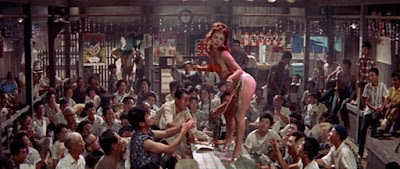
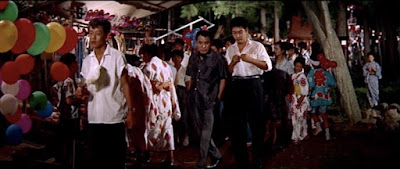
One of the things I found most interesting about ‘Wind of Youth Group..’ is that it stands as perhaps the only Nikkatsu film I’ve seen that entirely avoids the studio’s trademark references to Western culture and youthful aspirations toward internationalism. There are no jazz records or Hollywood movie icons here, no US airbases, sharp suits, gleaming new skyscrapers or young hoodlums hanging around the docks, staring wistfully out to sea.

Instead, Suzuki – perhaps surprisingly for viewers who know the director solely for the likes of ‘Branded To Kill’ and ‘Tokyo Drifter’ - seems very much at home with this comforting, inward-looking celebration of the traditions of working class rural life that in part reminds me of the more bucolic entries in the Zatoichi series, produced by the far more conservative Daiei studios.

About the closest the film gets to Nikkatsu’s usual “borderless” agenda is amoment when one of the young girls in the magic troupe admits that she longs to raise enough money to travel to distant Tokyo (one shudders to imagine what other kind of Japanese cinematic narrative she might find herself part of when she finally gets there). I suppose there is a slight suggestion here that the world presented by the film is fading away, moving towards irrelevance as the country moves toward (an implicitly Westernised) modernity. The magic troupe is a relic of the past, the traders in the market all seem pretty destitute, and so on – but the script addresses this sort of thing only in passing.

For the most part, the feeling viewers will end up taking away from ‘Wind of Youth Group..’ is a happy one. Everyone in the film is basically nice and helpful and likeable, and they all have splendid time together in their self-sufficient, nomadic demi-monde. Even when bad things happen – and, without resorting to spoilers, some fairly bad things happen – this film makes summertime in rural Japan feel like a lovely place to be.

For those who experienced this atmosphere first-hand when growing up, there must be a real comfort factor here that could conceivably have made this movie a fixture on the nation’s holiday TV schedules had it had more exposure, and even your humble gaijin correspondent found himself feeling very positive about the prospect of soon paying another visit to Japan and soaking up a few remaining ghosts of this old-timey atmos here and there.

Any perceived dearth of modernity in ‘Wind of Youth Group..’ is more than more up for by the next film in Arrow’s box set, a 1962 item named Teenage Yakuza [Hai Tiin Yakuza]. Very obviously a b-movie, presumably destined for the bottom of some triple bill, this one runs a mere 72 minutes, features none of the studio’s ‘name’ stars and appears to have been thrown together in great haste – all of which, I would suggest, are circumstances that sat pretty well with Suzuki’s directorial muse.

The ostensible narrative here is slight, presenting Tamio Kawaji – a prolific actor who turned up in many key Nikkatsu titles, but more usually only in supporting roles - as a young man in a small mountain town, whose ‘stand up guy’ tendencies and ability with his fists lead him first to fight off the local protection racket praying upon local businesses, and then, inadvertently, to usurp it, naively accepting gifts and freebies from the business owners, and subsequently attracting the attention both of the law, and of some out-of-town toughs with proper sharp suits and shades (and we all know what that means – see title).

The actual story Suzuki seems to be telling here however is an entirely different one, and it is conveyed in part simply by the location – an apparently genuine one, insofar as I can tell – in which the film’s exteriors were shot. A tiny, self-contained community in the process of being hit full force by the effects of Japan’s post-war “economic miracle”, the cramped storefronts and shabby back-rooms occupied by the movie’s primary characters find themselves dwarfed by the shiny new apartment blocks and industrial buildings that seem to be springing up almost organically from the hills around them.

Construction materials lie around everywhere, whilst mechanical diggers churn the earth in the vertiginous quarry/construction site around which both the film’s opening titles and climactic ruckus take place. In the town’s main thoroughfare meanwhile, roaring trucks and phalanxes of bicycles vie for space with strutting gangs of idle teenagers.

Kawaji’s industrious mother (Suzuki regular Kotoe Hatsui) plans to make it big by opening an American style coffee bar, complete with chromium counter, linoleum flooring and high bar stools, which she seems to have bought wholesale from a franchise catalogue, presumably in anticipation of the crowds of hip, Western-orientated professionals who will soon be occupying all those tower blocks. (Modern viewers who have enjoyed the questionable privilege of living in a “revitalised” urban area in recent years may feel a twinge of déjà vu at this point.)
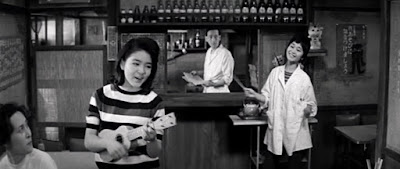
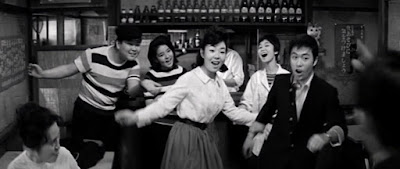
Normally, one would expect a film loaded with such signifiers of aggressive modernisation and economic transformation to cast a cynical or nostalgic eye upon the human cost and cultural homogenisation engendered by such developments, but, despite the yakuza-related plotline’s implicit criticism of the moral corruption underlying such “progress”, Suzuki - in stark contrast to the feeling conveyed by ‘Wind of Youth Group..’ - seems to be all for it. And in a sense, who can blame him?

From start to finish, this film flows by on a tide of pure, giddy energy, just as much so as the post-modern gangster romps the director began making shortly afterwards. Almost every second of ‘Teenage Yakuza’ is filled with noise and action and general hullaballoo, with people shouting, laughing, arguing, running around and dancing. Vehicles roar around the place honking their horns, deals are made, business open and close, money changes hands and – seemingly a Suzuki speciality at this point - there is a great deal of kinetic though good-spirited fisticuffs, with characters retreating on several occasions to the adjacent wasteland in order to beat each other senseless (though they usually seem to get up smiling at the end of it).

Everywhere, music blares (a new stereo system is Kawaji’s pride and joy) and teens congregate in a kind of prototype pachinko parlour or – joy of joys – in another jazz club, where blown up pics of American musicians are plastered on the walls, and kids frug amid decorative signposts emblazoned with such exotic, English language legends as “Don Elliot Play Mellophne”, “Cha-Cha To Haiti” and “To Loui Armstrong in Cicago”. Even the more old fashioned environs of the local noodle shop get forcibly livened up at one point, when a gang of casually-attired young folk burst in to dance and sing along with a jaunty number being played on ukulele and hand drums by the owner’s daughters (Midori Tashiro, looking very cute as Kawaji’s love interest in one of only a handful of screen roles for Nikkatsu, is prominently featured here).

It seems these youngsters can’t stop movin’ for a minute, and all this joy and vitality serves to remind us that, for a nation still emerging from the shadow of authoritarianism, war, austerity and reconstruction, the freedoms and easy rewards offered by all this rampant, untamed capitalism were PRETTY DAMN COOL – a conclusion the director seems, on the surface at least, to share.

Indeed, Suzuki’s framing and cutting is extremely skilful, mirroring the energy of his characters, and compositions are often quite striking in the more dramatic scenes, enhancing the film’s feeling of perpetual movement and constant excitement, at times making things rather like a more punk-ass take on one of those “people on the move!”-type war-time propaganda reels.

Interestingly however, Kawaji’s final confrontation with the out-of-town Yakuza guy sees the antagonists rolling across the top of the hill that overlooks the town, revealing an area of fertile, well-tilled agricultural land facing in the other direction, providing a stark contrast to the dust and concrete in which we’ve spent the preceding seventy minutes, and, momentarily at least, setting up a more conflicted urban-vs-rural / old-vs-new type dichotomy that leaves a question mark hanging over the movie’s ostensibly happy, forward-moving conclusion. Whether or not this was Suzuki’s intention is, strangely, fairly irrelevant – the simple fact that that farm land was THERE, and ended up on-screen, makes the point as clearly as any deliberate act on the part of a writer or director could have done.

Though an admittedly minor effort, details such as this again help turn ‘Teenage Yakuza’ into a unique snapshot of the time and place in which it was made, and of the currents and contradictions that were flowing through certain areas of Japan. Its directorial confidence, unruly energy and refreshing brevity all proved very welcome, and, if pushed, I’d probably nominate it as the film in this set that I enjoyed the most.

Next up, Arrow’s set shifts gears on us quite dramatically, showcasing a pair of films both adapted from similar, semi-autobiographical stories penned by one Kon Tôkô, an author who seems to have enjoyed a considerable literary reputation in mid-century Japan, but has subsequently been largely forgotten. (Critic Jasper Sharp should be commended for his efforts fill in the blanks re: Tôkô’s life and work in his supplements to this box set.)

Suzuki actually completed a loose trilogy of films adapted from Tôkô’s writing during his time at Nikkatsu – indeed, the third, 1966’s ‘Carmen From Kawachi’ (not included here), appears to be very well thought of domestically, where it remains one of the director’s more well-known films. As such, it is probably safe to assume that Seijun was a fan – but, in the top-down, contracted environment of Japan’s studio system, it’s difficult to be too sure. I suppose it’s equally likely that, after Suzuki’s first Tôkô adaptation proved something of a hit, the powers that be at Nikkatsu simply decided that this writer and director made a good pairing, and began planning some follow-ups… but, for the sake of argument, let’s assume the former possibility.

Anyway, regardless of how they came about, the two films included here are 1963’s Akutarô, translated by Arrow as The Incorrigible, but known elsewhere as ‘Bad Boy’ or ‘The Bastard’, and 1965’s loose follow up/kind-of-remake Akutarô-den: Warui Hoshi no Shita Demo, which has been dubbed Born Under Crossed Stars by Arrow, although I personally favour the more direct alternative translation, ‘Stories of Bastards: Born Under a Bad Star’.

As well as causing us to ponder the circumstances that led to Suzuki directing so many movies with insults or derogative terms in their titles (to those already referenced in this article, we can add 1963’s magnificently translated ‘Detective Bureau 2-3: Go To Hell Bastards!’), these two films serve to introduce us to yet another underappreciated facet of the director’s personality – that of the voracious reader, sympathetic adapter of literary source material and gentle connoisseur of period historical atmosphere.

(Actually, this side of Suzuki can also be glimpsed in several of the more tonally “serious” films he made during his Nikkatsu heyday – ‘The Flower and The Angry Waves’ [Hana to Dotô, 1964] and ‘Fighting Elegy’ [Kenka Erejî, 1966], for example - but it would arguably not fully emerge until much later, when he embarked upon his celebrated ‘Taishō trilogy’ in the 1980s.)

To begin by outlining the similarities between the two films under consideration here - both star the relatively little known Ken Yamauchi as an ambitious young man forced to cool his heels in a picturesque small town in the Kawachi district of Western Japan. Although set in different historical periods (Taishō [1912-1926] and early Shōwa [1926-1989] respectively), both feature Yamauchi’s character getting caught up in a love triangle, see him expounding upon his precocious appreciation of Western literature, and find him rubbing up against the forces of resurgent authoritarian nationalism.

Said forces are represented in both films by uniformed school ‘committees’ (a fairly common feature of Japanese school life throughout the 20th century, at least if manga and exploitation movies are to be believed) whose thuggish members inflict savage beatings upon their fellow students for such heinous crimes as walking with girls, reading novels or failing to address their seniors using the correct honorifics.

Both films, needless to say, also conclude with Yamauchi’s character manfully striding across the bridge that leads out of town, ready to make his way in the big, bad world, older, wiser, lessons learned and all the rest of it.


So similar in fact are the two films that watching them in quick succession can prove a rather confusing and repetitive experience, but nonetheless, they still very much retain their own identities. In Akutarô, Yamauchi’s character (named, uh, Tôgo Konno) is the wilful and self-possessed son of an apparently wealthy and cosmopolitan family. In an attempt to curb his growing arrogance, his mother tricks him into accompanying her on a trip to an onsen resort, but actually dumps him in a small, provincial town along the way, entrusting his well-being to the headmaster of the strict local school.

Initially declining to adopt the school’s drab uniform, Konno instead attracts attention (both positive and negative) by striding around town in an aristocratic kimono, whilst pointedly failing to take any of the advice or instruction proffered to him by anyone.

Given how indolent, conceited and generally obnoxious he is, it is a credit both to Yamauchi and to the film’s production team that they nonetheless manage to make Konno very likeable, winning our sympathies almost straight away, and indeed it is his earnest-yet-naïve persona and mannered, almost theatrical, delivery of dialogue that helps Suzuki pull off the many charming and memorable scenes dotted through the film.

One of the best of these occurs when the members of the aforementioned discipline committee visit Konno in his digs to punish him for ownership of a novel. After stridently arguing his case, Konno invites the proto-fascists to sit down, offers them some chocolate, no less, and delivers a rousing lecture to them on the value of literature, the importance of familiarising oneself with foreign cultures, and the particular qualities of the volume that has aroused their ire (a translation of Strindberg’s early novel ‘The Red Room’). Thoroughly taken aback, and perhaps with a new respect for their non-conformist classmate, the committee members momentarily cease their braying antagonism and quietly leave him be.

Of course, the movie’s narrative demands they’ll be back to their old bullying ways before long, but it is nonetheless a lovely scene, allowing us to feel, for a few moments at least, that our hero has perhaps planted a seed of doubt in the minds of the thugs, potentially inspiring them to rethink their blinkered and puritanical approach to life as they get older; a refreshing change from the variations on the theme of outrageous violence through which heroes usually make their point in Japanese genre cinema.

Equally delightful is the flashback to Konno’s sexual awakening at the hands of a happy-go-lucky geisha named Ponta, who takes a shine to him at another one of those bucolic summer festivals. Though ostensibly as chaste as early ‘60s mainstream entertainment demanded, this erotic encounter is nonetheless presented in admirably matter-of-fact fashion, with a great performance from the little known Chiharu Kuri as the lady in question.

Reminding me somewhat of the realistic, easy-going approach to sexuality later embodied by such films as Tatsumi Kumashiro’s excellent art-house/Roman Porno crossover ‘Street of Joy’ (1974), this again makes for a welcome contrast to the unsettling themes of patriarchy, abuse, fetish and obsession that we cult movie buffs are probably more used to seeing dominate the depiction of such subject matter in Japanese films.

Although it takes an unwelcome – perhaps studio mandated? - diversion into hand-wringing melodrama in its final act, Akutarô is nonetheless an unusual and entertaining addition to the Suzuki canon, making this box set four for four up to this point in the enjoyment stakes.

I wish I could say the same for Akutarô-den / ‘Born Under Crossed Stars’ / ‘Stories of Bastards’ (henceforth, Akutarô-den), but sadly this one didn’t really do a lot for me. Despite sitting right in the middle of Suzuki’s key creative period in the mid-‘60s, it is easy to see why it has failed to attract the kind of attention retrospectively lavished on most of the other films he directed between ’64 and ’67.

In stark contrast to the aristocratic scion he portrayed in Akutarô, Ken Yamauchi’s character here – named Jûkichi – comes from complete the other end of Japan’s social strata. His family reside in a tumble-down rural shack and his father is a shiftless, destitute gambler, whilst his mother a nagging, put-upon housewife whose sole pleasure in life seems to come from upsetting her husband’s doltish activities. Depending on how charitable you feel toward their rather broad antics, hilarity may potentially ensue.

Jûkichi himself meanwhile has a bit more get-up-and-go about him, and supports the family through his part time job, which involves travelling around the local area on his bicycle, selling milk (a distinctly non-Japanese commodity, you’ll note) on behalf of a dairy owner who wears a cowboy hat and never tires of telling people that he used to live in Texas. Inevitably, it is this job – together with his school activities, which more closely resemble those of the earlier film – that serve to draw young Jûkichi into the various encounters and convolutions that comprise the movie’s frustratingly rambling and digressive plotline, and… well, yeah, there ya go really.

Watching Akutarô-den, I momentarily felt a certain sympathy for Nikkatsu studio president Kyusaku Hori vis-à-vis his oft-quoted remark about Suzuki turning in movies that “make no sense, and make no money”. As various comedic grotesques caper about the place and the far-too-large cast tramp about to little discernable purpose, I’ll freely admit that it proved quite difficult for me to even grasp what was going on here during the opening half hour, and even after that, much of what transpired proved difficult to fully engage with.

This wouldn’t be so much of a problem of course if the kind of filmmaking bravado and visual ingenuity that Suzuki’s had mastered by this stage in his career was in evidence – I mean, does anyone know or care what Youth of the Beast was ostensibly ABOUT?- but sadly, give or take a few nice scenes and interesting framing decisions here and there, Akutarô-den is pretty routine stuff. Suzuki’s mise en scene favours cramped long-shots, often letting comedic routines and bits of dramatic business play out at length, and Kazue Nagatsuka’s monochrome photography, though perfectly competent and attractive, is fairly undistinguished, at least by Nikkatsu’s high standard for such things.

Probably the strongest element in Akutarô-den comes from the ‘love triangle’ storyline, with our hero’s romantic entanglements a bit more – if you’ll excuse the pun – convincingly fleshed out than they were in Akutarô. As Jûkichi attempts to bond with demure good girl Masako Izumi – his infatuation inspired he the fact he’s spotted her reading a translation of that cornerstone of love triangle texts, ‘Anna Karenina’ – Suzuki employs some oddball, nouvelle vague style framing to imply their nervousness, showing the two speaking whilst standing with their backs to a wall, staring directly to camera, and suchlike.

Meanwhile, Jûkichi’s parallel relationship with Yumiko Nogawa – an actress who made a striking debut in Suzuki’s ‘Gate Of Flesh’, and subsequently seems to have found herself typed in ‘erotic’ roles – is related in more earthy, naturalistic terms.

Nogawa plays a sexually outgoing local girl who catches a glimpse of Jûkichi when he turns up to berate her previous boyfriend about something or other, and likes what she sees. The vibe here is reminiscent of the scenes with the geisha in the earlier film, and sees Akutarô-den moving into proto-sex comedy territory for a enjoyable scene in which Nogawa lures the uptight and high-minded Jûkichi into a private bathhouse to have her wicked way with him.

Though essentially not much different from the kind of scenario we’d see a hundred times over once this-sort-of-thing became a staple exploitation genre across the world in subsequent decades, it’s very nicely played here, with some near nudity that I would term ‘daring’ were it not for the far more outrageous content Suzuki had already brought to the screen in ‘Gate of Flesh’ a year earlier, to general acceptance and acclaim.

(The best translated English title on Nogawa’s IMDB filmography, by the way, is a tie between ‘Cat Girls Gamblers: Naked Flesh Paid Into the Pot’ and ‘Cat Girls Gamblers: Abandoned Fangs of Triumph’ – both 1965/6 Nikkatsu releases that suggest the company may have already been routinely dipping their toes into steamier waters by this point. Heaven knows what these are all about, but I’d sure buy a blu-ray of ‘em sight unseen, in case anyone from Arrow happens to be reading.)

Basically though, this is all I can really find to recommend in Akutarô-den, a film in which Suzuki’s increasingly lackadaisical approach to narrative seems for once to have tripped him up, resulting in a rather ramshackle and muddled picture that – for me at least – closes an otherwise extremely rewarding set of films offered up by Arrow on a disappointing note.

Never mind though – it’s taken me so damn long to get around to watching and writing about these that I now have the very promising sounding ‘Early Years Vol # 2: The Crime and Action Films’ sitting on the shelf awaiting my attention, ready to further expand my knowledge of the lesser known works of this mercurial and much-missed filmmaker. Will I return one day to torment you with another 5,000+ word review of that one? Only time will tell.


Needless to say, this review is dedicated to the two million plus citizens of Western Japan who have recently had their bucolic summer festival season interrupted by an unprecedented series of highly destructive, weather-related natural disasters. If you’re still reading this far down the page, hopefully you’ve enjoyed my efforts, and will consider making a donation to support the victims by way of thanks.

Tuesday, 7 October 2014

Franco Files:
Bloody Moon
(1981)


In 1981, a group of callous German producers sparked a major incident in the esoteric world of horror movie sub-categorisation, when they thoughtlessly invited the ‘80s American Slasher Film to make incursions into the ancient kingdom of Jess Franco. Or perhaps it was the other way around. Nobody quite remembers. Either way, a confrontation was inevitable, and the results could have been catastrophic. Forces were mustered, and, in a darkened alley near a picturesque Alicante holiday village, the two sides met for a showdown.(1)

Strutting, Slasherdom paraded its arsenal:
* A large cast of young actresses, each of them more conventionally attractive and quote-unquote ‘wholesome’-looking (not to mention more frequently clothed) than those you would expect to see in a 1981 Jess Franco film.
* The shadiest and most incompetently managed Spanish language summer school in the known world. (“International Youth-Club Boarding School of Languages” reads a sign spelled out in those slanted, adhesive letters that are usually used for putting house/room numbers on front doors.)

* Teen pool party opening sequence incorporating hand-held ‘killer POV’ shots and mildly ‘transgressive’ usage of a Mickey Mouse mask.

* A bold wardrobe of ‘80s casual attire that actually seems pretty spot-on in its circa-’81 anticipation of the more garish trends of the coming decade.

* A generous scattering of conveniently placed gardening tools and industrial wood-cutting equipment.

* Lumbering, mute gardener guy as obvious red herring.

* A succession of neatly cling-filmed corpses deposited in and mysteriously removed from closets for maximum jack-in-the-box scare / ‘huh-it’s-gone-am-I-going-crazy’ effect.

* Sinister introverted brother who has been released from mental institution, but clearly shouldn’t have been because he’s crazy and murderous. I mean, just look at him - he has a scar on his face and silently stares at stuff. Nuts, I tell you.

* An excruciating American-English dub track that seems designed specifically to make every female character sound like a congenital moron, and every male sound like a sleaze-dripping closet psychopath. (And to make us laugh like a drain whenever an underpaid voice artiste sighs and gives her best shot to a line like “I bet he’s never even made it with a girl, the phony Spanish lover!”)
His pride wounded by all this unfamiliar transatlantic hoo-hah, Franco responded in kind:
* Wobbly tracking shots across picturesque Spanish harbours, culminating in a focus pull on that big goddamn rock he seems to like so much.
* Exactly the same Costa Blanca shooting locations seen fifteen years earlier in Attack of the Robots.
* An actress who looks a lot like the regrettably absent Lina Romay moping seductively in the upstairs window of a Spanish hacienda in a transparent night-dress, contemplating mischief. (The very same window used to frame Françoise Brion in ‘..Robots’, if anyone’s taking notes.)
* Wobbly, focus-blurring zoom shots of the moon, because, y’know – moon.
* A soundtrack that sounds as if the employees of a German library music label began pulling all-nighters and experimenting with Gysin/Burroughs cut-up technique.
* Language school proprietor who struts into the student “Disco Club” in a white suit & black shirt combo, momentarily looking like some decadent, DeSadean strip-club overlord.(2)
* Gore effects so audaciously shoddy they practically break the fourth wall and engage you in discussion re: the persistence of notions of theatricality and disbelief suspension in genre cinema
* Uncomfortable (and illogical) incest-based sub-plot.
* Persistent, low level evocation of that particular atmosphere of intangible, woozy dementia found in only the finest deep cuts of European trash-horror.
And so, battle commenced, in a conflict that will be known forever as ‘Bloody Moon’. Unless you live in Germany - then it's ‘Die Säge des Todes’ (“The Saw of Death”). Or Spain, in which case it’s ‘Colegialas Violadas’ (“Violated School Girls”). In Denmark, it was ‘Sexmord på Pigeskolen’ (“Sex-Death at the Girls’ School”?). Argentina went with ‘Terror y Muerte en la Universidad’. But no matter - to the likes of us, ‘Bloody Moon’ it is.

Legend has it that ‘Bloody Moon’s producers, keen for some reason to recruit the commercially washed up director of ‘Hellhole Women’ and ‘El Sexo esta Loco’ to their slasher dream project, lured Jess Franco on board by promising him the chance to work with up-and-coming German sexploitation star Olivia Pascal, the services of “one of the best effects guys in Hollywood”, and an original score by Pink Floyd.

Pascal materialised. The ‘Floyd did not. Effects ended up being masterminded by some guy Franco knew who handled props and owned a polystyrene head. A bit of a bummer for our long-suffering auteur, we might suppose, but seasoned Francohiles will well know that when the chips are down on a production, that’s often when the magic happens. Often, but not always. Sometimes ‘Oasis of the Zombies’ happens, but we’ve just got to cross our fingers and pray.

In the highly enjoyable interview included on Synapse’s recent blu-ray edition of ‘Bloody Moon’ (from which the screen-grabs above are definitely NOT taken), Franco speaks at length about his dislike for the film’s German composer, whom he angrily accuses of providing “fucking Dutch music”, whatever that’s supposed to mean. Hopefully we can assume that, rather than dismissing the entire cultural output of The Netherlands here, Jess is here referring to some particular form of film music popular at the time, or something like that? I’ve got no idea what he means to be honest, but regardless - if this German cat was bringing it, and Franco wasn’t digging it, my instinct is to go with Jess on this one. (Because if there’s one thing I’ve learned from the frankly unhealthy amount of time I’ve spent watching his work, it’s that JF knows a good tune when he hears one.)

Ever willing to take a deep breath and give it his best shot, Franco took up the bat and got swinging, digging into his own archive of surplus musical bits and bobs and applying a bit of the ol’ cut n’ paste to Gerhard Heinz’ credited score, with reliably off-kilter results. (The extraordinarily odd, squelchy cue that serves to weirdify the otherwise wholly routine “killer POV ascending the stairs” shot early in the film is my personal favourite moment in this regard.) 

It is easy to assume that Franco applied a similar ‘make do & mend’ spirit to all aspects of this ill-starred shoot too, his veteran’s determination to make the best of a bad job for once triumphing over the opposite tendency toward cack-handed laziness that more frequently shone through in his early ‘80s work-for-hire gigs. Despite all the initial signs of hostility between ‘Bloody Moon’s oil & water components, such inspiring leadership seems to have led to both parties in the dispute realising that they had more in common than they initially thought (after all, what was Franco’s earlier ‘Exorcism’ (1974) if not a peculiarly twisted entry in the pre-‘Halloween’ proto-slasher canon?), allowing the project’s conflicting aesthetics to blend and interact in strange and wonderful ways.

For me you see, the thing about slasher films is that their inherently minimal and repetitive format demands that, to become enjoyable for those of us who have no particular love for the genre, they must be… what’s the right word? Eccentric – that’ll do. To generate interest, a slasher must either a) be a technically excellent and emotionally involving motion picture ('Black Christmas' or Tony Williams' 'Next of Kin' spring to mind), or b), plug the gaps between dead teens with the most off-beat, aimless and just plain weird diversions that come to hand. And, given that so many products of the sub-genre’s early ‘80s golden age were cheap, amateurish films made by otherly inspired individuals for purely opportunistic reasons, many of them thankfully embark upon route b) with a great deal of gusto.

‘Bloody Moon’s Spanish-pretending-to-be-American compatriot ‘Pieces’ is perhaps the preeminent example of how things right, by which I mean wrong, by which I mean just sort of strange and confused, in this regard. The Australian-pretending-to-be-American ‘Strange Behaviour’ aka ‘Dead Kids’ is another good one, as is the genuinely-American-though-presumably-beamed-in-from-another-dimension ‘Hack O Lantern’. You can pencil in your own additions to the list, I’m sure. If not, the archives of Bleeding Skull should provide a lifetime's worth of pointers.To recap then: routine, competently made slasher = BORING. Eccentric, amateurish slasher = GOOD TIMES.

During Bloody Moon’s opening half hour, there were some shaky moments where I was worried things were heading in the former direction. The vacant, empty-eyed teens and tedious two-shot conversation scenes. The duh-brained “homages” to ‘Halloween’ and ‘Psycho’. The over-before-its-even-begun un-plotline. The surprisingly good but never quite exceptional cinematography. The presence of this so-called Nadja Gerganoff (in her only screen role) occupying the ‘slutty older sister’ role that should so rightfully belong to Lina. 

But I should have had faith. By the time a detailed discussion takes place regarding the most appropriate sweater to wear on a midnight fishing expedition with some lusty sailors, I was getting into the swing of things. After a perfectly cube-shaped polystyrene boulder narrowly misses our heroine's head, I had that nice “literally anything could happen next” buzz going on. As things stumble toward a climax, the pace quickens, slightly. Events get wilder, editing choppier, framing wonkier and music more unhinged. By the time Lina’s stand-in artlessly slices a guy in half with a chainsaw, I was ready to stand up, weeping with joy, and thank God for bringing all these people together for a few weeks on the sultry Spanish coast.

As far as the – ahem – serious consideration of Jess Franco’s cinematic legacy goes, few would seek to place ‘Bloody Moon’ on the same level as his more accomplished and personal work from the ‘60s and ‘70s. But as a Halloween-adjacent Friday night beer & pizza movie, it delivers beautifully, in ways that a non-Franco directed cynical cash-in slasher would likely never have achieved.

So, to return to where we began. It is 1981. The ‘80s American Slasher Film and the world of Jess Franco face each other across that dark alley near Alicante. Silence reigns. After a few minutes of whsipered discussion, they decide to cancel hostilities and made sweet love instead. The result? WE ALL WIN.

------------

Kink: 3/5
Creepitude: 3/5
Pulp Thrills: 4/5
Altered States: 2/5
Sight Seeing: 3/5

------------


(1) ‘Bloody Moon’s main production heavy-weight Wolf C. Hartwig was the man behind the interminable “Schoolgirl Report” series that pretty much defined the aesthetic of cheapo German sexploitation in the ‘70s (and of which Franco directed one of the stranger installments). Hartwig’s hefty catalogue of cinematic tat actually stretches as far back as 1959’s ‘Horrors of Spider Island’, and in 1977 he seemingly tried to re-balance the scales by taking the sole producer credit on Sam Peckinpah’s ‘Cross of Iron’, the same year he also handled ‘When Girls Make Love’ and ‘Confessions of a Naked Virgin’. I’ve not read up on the working relationship between Hartwig and Peckinpah, but one suspects they might not have seen eye to eye.

(2) The “Disco Club” also serves litre bottles of beer to students as a takeaway, plays lumpen, Shawaddywaddy style retro-kitsch rock n’ roll and allows entry to passing sailors (rollerskates optional). My kinda language school, as if we hadn’t established that much already.

Saturday, 7 June 2014

The Songs of Herman Cohen:
Konga
(John Lemont, 1961)


Having started work on a series of posts earlier this year examining the British-made films of American ex-pat producer Herman Cohen, I confess I’ve found myself repeatedly staggering to a halt when it comes to writing about the very film that inspired me to undertake such a questionable venture in the first place. I’m sure those who have seen the film will know where I’m coming from when I say: what can you possibly write about ‘Konga’? If any motion picture justifies the text equivalent of a stunned, awkward silence, it is this one.

In common with many people who actually *like* genre films, I’m often reluctant to engage with the ubiquitous “so bad it’s good” mentality, not only because I have an increasingly low tolerance for the accompanying snark and the unpleasant attitudes of cultural superiority that underlie it, but also because, as has frequently been pointed out elsewhere, that formula as commonly used is a something of an oxymoron. More often than not, it is applied to films that are imaginative and entertaining on their own terms, and thus successful and to some degree ‘good’, with no qualifiers needed, whilst the vast majority of genuinely ‘bad’ films remain on the shelf unwatched, for the simple reason that they’re too dull to attract anyone’s interest. (To avoid a similar fate, I will save the rest of my diatribe on this subject for another day.)

Sometimes though, you get a film like ‘Konga’ that practically stands up and demands to be counted in the “so bad it’s good” category, meaning that writing about it without falling into the attendant critical pitfalls becomes a tough gig indeed. In fact, one of my first thoughts after viewing the film was something along the lines of “could this be the closest British cinema ever got to a ‘Plan 9 From Outer Space’?” On further reflection though, I suspect that the circumstances that led to ‘Konga’s creation are very much the opposite of those that produced Ed Wood Jr’s magnum opus, even if the results are similar vis-a-vis their unprovoked assaults on normal cinematic protocol.

You see, whereas Wood’s best-known films become fascinating and engaging as a result of the poignant discrepancy between their creator’s earnest ambitions and the resources and skill needed to realise them, ‘Konga’ by contrast is a professionally funded (if admittedly low budget) movie put together by experienced film industry professionals. It is far too competent to qualify as a work of Uncinema, in spite of its frequent craziness, but it is rendered unintentionally extraordinary by vestige of the filmmakers’ sheer cynicism, laziness and disdain for their audience.


Case in point: all you need to know about ‘Konga’, really, is that it is a film in which a chimpanzee who is fed growth hormones grows up to be a gorilla, whilst a world-renowned biologist looks on without batting an eyelid.

That an incident of such obvious stupidity can have made it to the production stage without anyone pointing it out seems inconceivable, and thus we must look at the producers’ rationale for including it. The fact is, obtaining the use of both a trained chimp and a moth-eaten gorilla suit was probably easy enough for a low budget movie production. Trying to factor in either a real gorilla, or else some sort of giant-sized chimp costume, would have proven a lot more costly and difficult. So, they just went with the path of least resistance.

I don’t know anything about Herman Cohen’s manner or personality – for all I know, he might have been an erudite man of letters and a great humanitarian. But, solely from watching his movies, it’s hard not to imagine him, chomping on a cigar at this particular production meeting, saying; “For chrissakes, just shoot it already! Chimp, gorilla… the kids who go to these movies, they won’t give a FUCK.”

Well, I give a fuck, Mr. Cohen – in fact I’ve just spent the best part of half an hour pondering and writing about the whole chimp/gorilla issue, and I’m a busy man (ahem). But nonetheless, I’m not here to criticise. In fact, I’m really glad that things worked out the way they did. After all, if Cohen and his collaborators had just made a logical and carefully considered reworking of the old King Kong formula, I’m pretty sure I wouldn’t be talking about it here today. It is the sheer, couldn’t-give-a-fuck sloppiness that lies behind just about every creative decision in ‘Konga’ that helps make it such a deliriously joyful experience.


Things are frankly absurd right from the outset, as a fateful plane crash in the jungles of Uganda is represented by some plane flight footage that looks like it was probably filmed on a bit of scrubland near an amateur airstrip in the South-East of England, with canned “jungle noises” dubbed in over the top. Cue a post-production ‘explosion’ effect just as unconvincing as the kind of CGI nonsense you might see in a 21st century straight-to-cable movie (so I suppose ‘ Konga’ was ahead of it’s time in that respect at least?), and we cut straight to a radio studio, where an announcer informs us that a private plane bearing Professor Charles Decker, the famous English botanist, has been lost during “an exploratory trip to Africa”, leaving the Professor missing presumed dead. Cut again to a newspaper stand, as the seller barks, “read all about it, Professor Decker, crash survivor, returns after year in jungle”, and, having got that bit of initial set up out of the way in admirably concise fashion, we now meet the man himself, addressing the nation’s journalists (all three of them) upon his return to London airport.

The presence of Michael Gough in full ‘sombre & imperious’ horror movie mode bearing an inquisitive chimpanzee in his arms is a strange sight to take in, and if the ladies & gentlemen of the press are understandably a bit taken aback by the Professor’s new-found best buddy (“Konga has a name and a place in my heart.. we’ve grown rather attached to each other”), wait until they hear what else he has to say for himself.

“You mean what YOU CHOOSE TO CALL civilisation?” he immediately throw in when questioned about his delayed return to the developed world, and if that alone wasn’t enough to get your Mad Scientist Alert buzzing, his vague exclamations about “a new species of insectivorous plants”, “a revolutionary link between plant and animal life” and the necessity of “tearing up a lot of text books” should make things fairly clear.

“That little chimp is the first in a long line of kings, kings of the earth!”, Decker shortly thereafter announces to his all-purpose assistant, secretary, cook, housekeeper and lover Margaret (Margo Johns), and we can pretty much seal the deal.


Soon after that, Decker is busy tearing up the flowers Margaret has lovingly tended for him in the greenhouse, declaring that they have ‘outlived their usefulness’ (a phrase that Gough manages to turn into something of a catchphrase through the rest of the film) and will go on to serve as mulch for the crazy new carnivorous plants he’s brought back from Africa. By the time we find him inspecting the conspicuously gigantic cage he has ordered to be installed laboratory (not to mention shooting his pet cat in an outburst of fevered, egotistical rage), you might think that the rest of the movie pretty much writes itself, but, lazy and cynical though it may be, ‘Konga’ is nothing if not imaginative.

Where it could easily have just gone for another tedious “man finds a big ape, brings to city” story, the decision to mix things up with a Frankenstein mad scientist yarn, complete with a dose of horror/slasher business in the middle section and a decidedly queasy side order of poorly written domestic abuse drama, proves a heady brew indeed, and the screenplay that’s supposed to pull it all together (credited to Cohen and his regular co-writer Aben Kandel) offers up such a relentless tirade of barely thought out rubbish and questionably-inspired, cheap-jack buffoonery that even the most notorious b-movie trainwrecks that the USA produced in the previous decade start to look like sombre works of scientific speculation by comparison.


For a start, Decker’s man-eating plants are wonderful. Absolutely foul creations, they consist of veiny black phallic shafts with lolling red tongues that sway back and forth, chomping at anything that comes near them. Really the stuff of nightmares, and one pities the poor sods on the special effects crew who had to crouch underneath operating them through lengthy scenes of heated melodrama that take place in the greenhouse. (There are also carnivorous venus fly-traps, and what looks like a brood of killer avocados.)

Meanwhile, the aforementioned chimp / gorilla transformations are accomplished via the age-old horror movie means of “wobbly screen” effect plus some dodgy green-screen ‘enlargement’, but when Konga assumes his final (or at least, normal gorilla sized) form, I’m confident that all true connoisseurs of the man-in-a-suit gorilla will agree, the suit used in ‘Konga’ is truly a thing of beauty.

Fitted out with shag-carpet fur, permanently smirking facial features, wild, independently mobile eyes and ill-fitting hind-quarters that cause him to lumber about rather in the manner of a toddler who’s filled his nappy, Konga is an icon of everything that’s great about low budget monster movies, sharing the slightly unhinged charisma of classic-era Godzilla as he effortlessly steals every scene he’s in, providing a happy, grinning contrast to what seems like hours of Michael Gough doing his “biggest-bastard-in-the-world” thing.

Before moving on, I think it is worth quoting verbatim the following anonymous contribution to ‘Konga’s trivia page on IMDB:

“Producer Herman Cohen first considered using "ape" actor Steve Calvert, who had worked with Cohen on Bride of the Gorilla (1951) and Bela Lugosi Meets a Brooklyn Gorilla (1952), but Calvert had retired from performing in his gorilla suit. Cohen turned to another renowned "ape" actor George Barrows, but only hired Barrows' gorilla costume, not Barrows himself. The actor Paul Stockman was instead chosen, based primarily on being a good fit for Barrows' costume. Barrows was annoyed when his gorilla costume was returned from England in bad shape.”

So now you know. As an aside, I’m absolutely thrilled by the suggestion in this factoid that not only was being a ‘gorilla suit performer’ a valid career choice in this era, but that said performers actually owned and maintained their own personal suits. There’s a lot of fun to be had for someone researching that whole milieu, I’m sure.


Having acquired his own hypnotically suggestible, English speaking gorilla in record time, and with a good forty minutes or so still to go before the film’s finale gets underway, Decker does what any self-respecting paranoid psychopath would do, ‘testing’ his creature’s ‘obedience’ by means of murdering those whom he perceives as standing in his way. This he accomplishes largely by means of driving his creepy and highly recognisable black van to the home of his victims, before letting Konga out of the back and ordering him to go in and KILL, KILL, KILL, whilst the doctor lurks about somewhere nearby.

A fool-proof method, I’m sure you’ll agree, and clearly far less likely to arouse suspicion than just doing away with his ‘enemies’ in some more conventional, non-ape related manner. But again: who’d bother watching that movie? The best of these murder sequences features George Pastell, Hammer’s go-to guy for non-specific ‘ethnic’ roles (you can see him portraying swarthy foreigners of one kind of another in ‘The Mummy’, ‘Stranglers of Bombay’ and ‘The Reptile’), as a turbaned rival botanist who ‘threatens’ Decker’s work. The moment when Konga reaches through a set of shelves to strangle him, perfectly on cue, before indulging in some spirited laboratory trashing, is a lot of fun.


Alongside all the monkey business and suggestive rubbery flora though, there is a slightly nastier, more modern edge at work in ‘Konga’ too. All of the Cohen/Gough movies feature this slightly disturbing undercurrent of dysfunctional relationships and emotional abuse (much of it generated by the sheer toxicity of Gough’s beastly characterisations), and ‘Konga’ is no exception.

Margaret is a pitiful creature, and Decker’s treatment of her is comically foul from the outset. “Now Margaret, you know there’s little room for sentiment in the life of a scientist,” he smugly explains to upon his glorious return from the jungle, and things go downhill from there as his barely disguised contempt for her crashes unhappily against her equally mysterious devotion to him.

Johns does her best to portray Margaret as a headstrong & intelligent woman, but the sexist dynamics of the script render it a wasted effort. Given Decker’s singular lack of charm, the curious question of why she puts up with his odious and patronising behaviour in the first place remains unaddressed, and even later in the film, when it becomes obvious that he has been busy sending a giant ape out to cold-bloodedly murder people, she initially keeps quiet and sticks with him. Why? Because the hateful, loveless psychopath has promised to MARRY her if things go well for him, and that would obviously be a happy ending, right?

Though poorly written and camply performed, these power games carry a real fingers-down-the-blackboard discomfort that belies ‘Konga’s status as a quirky throwback to ‘50s monster movies, instead prefiguring the more squalid and upsetting strain of domestic dysfunction that would begin to predominate in British horror during the ‘70s.

Like Hammer’s Baron Frankenstein (to whom he bears more than a passing resemblance), Dr. Decker’s affected scientific coldness certainly doesn’t preclude the potential for sexual lust, and, with Margaret having ‘outlived her usefulness’ in that regard, the second half of the film has him setting his sights on Sandra (Claire Gordon), the top student in his ‘college’ class, as the story’s unsavoury melodrama moves into full swing.

At this point, we might pause to question why a scientist of such high standing that his exploits are recounted on the front page of newspapers still has to hold down a job teaching beginners level biology to a class of disinterested yahoos what looks to be a local Further Education college. Perhaps there is some transatlantic confusion going on here regarding the use of the word ‘college’ as opposed to ‘university’, but that still doesn’t really account for the discrepancy between the Dean sitting in a wood-panelled study earnestly contemplating his institution’s historic reputation, whilst the student body appears to consist mainly of sub-normal 30 year olds who sit sniggering at school desks and leap up for break-time when the bell goes. (“Now as you can see, in addition to leaves and stems, these ferns have roots, which collect water”, Decker tells his class of full-time botany students at one point.)

In my review of Horrors of the Black Museum, we touched upon Cohen’s tendency to put ‘teen’ characters in his movies, “so that the teenagers can relate to someone in the film”, but if these jiving goofballs are his idea of audience-surrogates, the level of contempt he must have had for the people who paid to see his movies is simply staggering.


Anyway, as you might well imagine, Decker’s attempts to seduce Sandra are creepy beyond words. “This may not have anything to do with class work, but I can’t get over how you’ve grown” he says in his mock-gentle voice as he imparts tutory ‘wisdom’ to her after class, and it gets more cringeworthy from thereon in. Urgh.

Despite Sandra’s declaration that she intends to forsake boys to concentrate on her dedication to “chemistry and physics” (so… not biology or botany then?), Claire Gordon’s blank eyes and practiced smile radiate nothing but cue-card reading emptiness – really an astonishingly bad performance, and a reminder that some of acting here hasn’t much improved since ‘..Black Museum’, despite the presence of some stronger players in the supporting cast.

Of course, Decker is determined to have his way with the young hussy whether she likes it or not, even sending Konga out to take care of her equally witless boyfriend, and when he finally gets her alone in the greenhouse, the sight of Gough aggressively pawing this ‘teenager’ is as horribly distasteful as you’d imagine, even as the bizarre, phallic plants waving softly in the background push the whole scene into the realm of utter surrealism. (He also offers her “greater glory than any woman has ever known”, which seems a bit rich coming from a guy whose plan doesn’t seem to extend much beyond living in the jungle with an army of hypnotised gorillas.)


It is this grim scene that of course leads directly to ‘Konga’s inevitable and much celebrated transformation into a proper Big Monster Rampage, as the neglected Margaret finally snaps and shoots Konga up with a huge overdose of the growth formula, setting free and ordering him to KILL, KILL, KILL his sort-of creator.

Bad news for all concerned within the movie, but good news for us the viewing public, as we finally get to see our simian hero strut his stuff, free of Michael Gough’s overbearing influence.


Ar, yeah, that’s the stuff.

“Fantastic,” says the gent pictured below in a manner that delighted Island of Terror and delights me no less, “there’s a huge monster gorilla that’s constantly growing to outlandish proportions loose on the streets!”


As befits a man with such a clear grasp of the situation, he’s onto the ‘war office’ by ‘radio-telephone’ within seconds, and the official response to Konga’s brief reign of terror takes shape.


Before we finish, it’s only fair that we should throw in a quick word on director John Lemont. He had a pretty short career in film, but in addition to orchestrating the myriad absurdities of ‘Konga’, he also directed, produced and co-wrote two other films – ‘The Shakedown’ (1960) and ‘The Frightened City’ (1961) – neither of which I’ve seen, but they both look like really solid British crime films with great casts. I think we can safely say that these Cohen productions were never really “director’s films”, and, like poor old Arthur Crabtree on ‘..Black Museum’, one suspects that if questioned about ‘Konga’, Lemont’s reaction might well have been along the lines of “It was a cheque, for god’s sake! Why can’t you leave me alone?!”. ‘Konga’ was the last feature film he directed.

In Lemont’s favour, we can at least give credit where its due and say that ‘Konga’ does actually look a lot nicer than ‘..Black Museum’, with better compositions, a more workable aspect ratio, improved use of colour and, for the most part, more lively performances and better pacing. None of which is likely to do much to salve the director’s bruised dignity in the face of a movie in which a red-headed rag-doll is used as a stand-in for the lead actress as her character is waved around by a man in an ill-fitting gorilla suit, but I’m prepared to believe he did his best.


And as to Michael Gough, well let’s just say that if Peter Cushing and Christopher Lee were both sometimes upset at the ribbing they got from the snooty British theatrical establishment for their participation in horror films, Gough must have had balls of steel to hold his head high in the West End whilst ‘Konga’ was in the cinemas.

Between his roles for Cohen and his occasional turns for Hammer, Gough was busy with enough TV work to keep ten lesser men in employment, and managed to keep his parallel career in theatre ticking over too, so I’ll assume he approached things in the right spirit and didn’t let the type-casting that resulted from roles like this one get to him too much. After all, if somebody trashes your work in films as worthwhile as ‘The Revenge of Frankenstein’ and ‘The Gorgon’, you’ve got a right to be annoyed. If they’re gonna give you hard time for hamming it up in ‘Konga’, there’s not much to do except smile and nod and point to the new car that’s driving you to rehearsals for that Ayckbourn play you’re doing next month.

Quite a leap from that to the unedifying fate our favourite love-to-hate thespian meets back in ‘Konga’, as an extremely unconvincing dummy with super-imposed Gough-head is thrown from a hairy paw onto the unforgiving cobbles of Westminster. With Margo Johns unceremoniously chucked into a fire, Claire Gordon apparently eaten by a venus flytrap and only a corpse-stiff Michael Gough pleading for his life with the big ape, there’s no ‘beauty killed the beast’ sting in the tail here – just a few more braces of machine-gun fire, and one of the most poignant closing images even seen in the canon of monkey-related cinema.

What lessons can be draw from this excursion to Herman Cohen’s hideously amoral universe, you may well ask. Well, if you’re going to kill someone in a fit of jealousy or paranoia, probably best just get on with it without getting any giant animals involved - that would seem to be the main one; a doctrine which was followed in word if not in spirit when the Cohen/Gough team reunited once more, to complete their inglorious trilogy with 1963’s singularly odd ‘Black Zoo’. We’ll be getting round to that one soon, so, once again: you have been warned.